Introduction
Concern about the democratic consequences of social media is abundant (Tucker et al. Reference Tucker, Theocharis, Roberts and Barberá2017). Worry over the echo chamber created by user-driven algorithms designed to deliver users a curated experience reflective of their likes, clicks, and browsing habits has superseded initial excitement over social media’s democratising potential (Sunstein Reference Sunstein2018; Tucker et al. Reference Tucker, Guess, Barberá, Vaccari, Siegel, Sanovich, Stukal and Nyhan2018). Usage of these sites silos users within their existing social networks, exacerbates political polarisation (Bail et al. Reference Bail, Argyle, Brown, Bumpus, Chen, Hunzaker, Lee, Mann, Merhout and Volfovsky2018; Shin and Thorson Reference Shin and Thorson2017), and is linked to spreading misinformation (Abrajano and Lajevardi Reference Abrajano and Lajevardi2021; Anspach and Carlson Reference Anspach and Carlson2020), primarily through filter bubbles (Pariser Reference Pariser2011) and echo chambers (Eytan et al. Reference Eytan, Messing and Adamic2015; Munger Reference Munger2019; Pariser Reference Pariser2011; Sunstein Reference Sunstein2018). This concern drives existing research around social media, its role in promoting partisan polarisation, the spread of misinformation, and subsequent consequences for American democracy.
Despite this burgeoning literature, scholars have overlooked the relationship between social media use and policy attitudes that affect minoritised groups. More research on this front is needed for several reasons. Ethno-racial conflict is itself a significant undercurrent in growing polarisation (e.g. Parker and Barreto Reference Parker and Barreto2014; Sides et al. Reference Sides, Tesler and Vavreck2019), and social media creates the kind of environment where pernicious out-group attitudes can metastasize (Allcott and Gentzkow Reference Allcott and Gentzkow2017; Lazer et al. Reference Lazer, Baum, Benkler, Berinsky, Greenhill, Menczer, Metzger, Nyhan, Pennycook, Rothschild, Schudson, Sloman, Sunstein, Thorson, Wattsand and Zittrain2018). Moreover, a sizable body of work points to the importance of the media more broadly in shaping attitudes towards stigmatised minorities, even as the role of social media has gone underexplored (e.g. Abrajano et al. Reference Abrajano, Hajnal and Hassell2017; Boomgaarden and Vliegenthart Reference Boomgaarden and Vliegenthart2007; Schmuck et al. Reference Schmuck, Heiss and Matthes2020). Given these trends, this article takes on the initial task of examining the relationship between social media use as a source of news and support for policies targeting stigmatised groups. We take Muslims in the United States (US) as a case study, a low-status group that has garnered much political attention since the tragic events of 9/11, but still remains scientifically understudied relative to other stigmatised social groups in the national spotlight.
Unlike traditional news media outlets, who are tethered to actual news and subject to fact-checking, the social media environment facilitates the development and spread of sensational, misleading, and sometimes outright false information (Carlson Reference Carlson2018; Grinberg et al. Reference Grinberg, Joseph, Friedland, Swire-Thompson and Lazer2019). Building on research that finds social media to be fertile ground for the further propagation of negative stereotypes about Muslims (Awan Reference Awan2014, Reference Awan2016; Marzouki et al. Reference Marzouki, Barach, Srinivasan, Shaikh and Feldman2020), we argue that reliance on social media can heighten support for policies negatively targeting them. We propose that social media may be presenting Islam and its adherents in a particular way that is different from other mainstream news sources and that unregulated information about Muslims on social media platforms may drive support for anti-Muslim policies. Given the nature of the social media environment, even ideological liberals and those without explicitly anti-Muslim attitudes may likely be exposed to negative messaging on social media platforms (Sunstein Reference Sunstein2018). Moreover, research suggests that the messages to which one is exposed via social media – even if only in passing and regardless of one’s partisan stripes – can become internalised as an implicit bias, providing the dominant frame that is primed when queried about relevant policy attitudes (Pérez and Riddle Reference Pérez and Riddle2020). For all these reasons, we hypothesise that reliance on social media for political news will be associated with support for a range of anti-Muslim policies.
To evaluate how different news sources relate to individuals’ support for policies targeting Muslim Americans, we draw on three original surveys fielded between December 2016 and July 2019 on Lucid and Survey Sampling International (SSI). Across each dataset and numerous model specifications, relatively high levels of reliance on social media for news are uniformly and consistently linked to support for a variety of anti-Muslim policies. This relationship exists regardless of whether individuals consume news through other mediums in addition to social media. These findings persist across partisan lines and net of anti-Muslim affect. Additional specifications – such as using alternative measures of media source reliance and replication with the 2019 Nationscape dataset – further support our findings.
Overall, the results highlight the strong external validity of the relationships under study. Our empirical tests across a variety of samples, measures, and time points, and each point to the conclusion that more reliance on social media is associated with greater support for anti-Muslim policies. While our datasets do not enable us to present causal analyses, nor to test the mechanism underlying the observed association (e.g. we are unable to measure the volume of anti-Muslim stereotypic content individuals each was exposed to on social media), the findings presented here invite further investigation into the consequences of misinformation on social media as it pertains to low-status populations.
These findings potentially have grave implications for low-status groups in American democracy. Recent research has shown that consumption of some social media is positively related to misinformation about a variety of stigmatised groups (Abrajano and Lajevardi Reference Abrajano and Lajevardi2021, Figure 2.6). Even as these platforms take steps to ameliorate the spread of misinformation, the most viral stories of 2018 garnered more engagement than those spread during the contentious 2016 election cycle, and various actors have actively leveraged such platforms to spread racially inflammatory messaging (Howard et al. Reference Howard, Ganesh, Liotsiou, Kelly and François2019; McGowan et al. Reference McGowan, Knaus and Evershed2019). Therefore, understanding the role that social media platforms play in society, especially how social media shapes policy attitudes targeting racialised minority groups, is of increasing importance (Allcott and Gentzkow Reference Allcott and Gentzkow2017; Clayton et al. Reference Clayton, Blair, Busam, Forstner, Glance, Green, Kawata, Kovvuri, Martin, Morgan, Morgan, Sang, Scholz-Bright, Welch, Wolff, Zhou and Nyhan2019).
Theoretical framework
Stereotyping Muslims in the media
Muslim Americans are an increasingly stigmatised group (Lajevardi and Oskooii Reference Lajevardi and Oskooii2018; Mogahed and Chouhoud Reference Mogahed and Chouhoud2017; Oskooii Reference Oskooii2016). Anti-Muslim stereotypes propagated via the media tap into an enduring, racialised schema that westerners hold about Islam. Islamic cultural and religious values are stigmatised (Sediqe Reference Sediqe2020) and have been characterised as anti-democratic and at odds with the American way of life (Brooke et al. Reference Brooke, Chouhoud and Hoffman2022; Jamal Reference Jamal and Sinno2009; Kalkan et al. Reference Kalkan, Layman and Uslaner2009; Oskooii et al. Reference Oskooii, Dana and Barreto2019). Because of media portrayals of the role of Islam in promoting terrorism, Muslim men have been typecast as inherently violent (Saleem and Anderson Reference Saleem and Anderson2013). Meanwhile, the hijab, worn by some Muslim women, is associated with the perception of Islam as oppressive and backward (Dana et al. Reference Dana, Lajevardi, Oskooii and Walker2018; Tobin et al. Reference Tobin, Westfall, Russell, Welborne and Tobin2018). These tropes date far back, embodied in Orientalist discourse of the nineteenth century, but developed new life with the perpetuation of the War on Terror, and again with former President Trump’s incendiary rhetoric and ensuing Muslim Travel Ban (Beydoun Reference Beydoun2018; Collingwood et al. Reference Collingwood, Lajevardi and Oskooii2018; Oskooii et al. Reference Oskooii, Dana and Barreto2019).
The long-established racialisation of Muslims provides rich soil for further propagation of anti-Muslim stereotypes. Research abounds demonstrating that negative frames employed in news coverage can impact one’s perceptions of stigmatised social groups (e.g. Abrajano and Singh Reference Abrajano and Singh2009; Kellstedt Reference Kellstedt2003; Merolla, Ramakrishnan and Haynes Reference Merolla, Ramakrishnan and Haynes2013). To wit, scholars write “Several studies have shown that stereotyping is a core element of news regarding minorities, and that these negative depictions are likely to elicit negative and stereotypic attitudes in the audience” (Fuochi et al. Reference Fuochi, Voci, Veneziani, Boin, Fell and Hewstone2020, pg. 196). Negative stereotypes conveyed by the media very often draw on threat frames, which in turn yield corresponding negative attitudes among the public: Black Americans may be portrayed through frames that invoke criminal threat, while immigrants may be associated with economic threat. Symbolic or cultural threats do permeate portrayals of all groups, but are especially pronounced for Muslims, who are regularly painted as endorsing norms distinct from Judeo-Christian traditions and are often juxtaposed as inferior to inhabitants of the western world (Atwell Seate and Mastro Reference Atwell Seate and Mastro2016; Pérez Reference Pérez2010, Reference Pérez2015; Silber Mohamed Reference Silber Mohamed2013).
Recent scholarship has causally linked the invocation of such threat frames associated with out-groups to a corresponding negative, emotive response, which in turn manifests as negative attitudes and actions towards the group in question (Atwell Seate and Mastro Reference Atwell Seate and Mastro2016). Individuals may be socialised towards in-group favouritism as children, and exacerbating cues from parents, peers, the media, and other sources can heighten corresponding negative out-group attitudes, particularly when individuals do not receive countervailing information either through education or inter-group contact (Brown et al. Reference Brown, Ali, Stone and Jewell2017; Miklikowska Reference Miklikowska2017; Pérez Reference Pérez2010). Indeed, scholars identify inter-group contact as the primary contextual factor that can correct stereotypical misconceptions of out-groups (e.g. Allport Reference Allport1954; Fuochi et al. Reference Fuochi, Voci, Veneziani, Boin, Fell and Hewstone2020; Pettigrew Reference Pettigrew1998; Pettigrew and Tropp Reference Pettigrew and Tropp2006; Saleem et al. Reference Saleem, Yang and Ramasubramanian2016). With respect to Muslims specifically, scholars find that group threat yields support for policies like headscarf bans, restrictive anti-Muslim travel policies, and heightened policing of Muslim communities (Aizpurua et al. Reference Aizpurua, Singer, Butler, Collier and Gertz2017; Al-Faham Reference Al-Faham2021; Strabac and Listhaug Reference Strabac and Listhaug2008; Van der Noll Reference Van der Noll2010). In short, when the media serves as a primary source of information about an out-group, individuals are likely to hold both implicit and explicit prejudicial views towards this group. Such biases may be further made salient and relevant by coverage of external events in the news (Behr and Iyengar Reference Behr and Iyengar1985; Kam and Kinder Reference Kam and Kinder2007). These dynamics play themselves out in the context of Muslim Americans, where researchers find that consumers of Fox News have a higher likelihood of holding negative attitudes towards Muslims in the US than do those who get their information elsewhere (Abrajano and Lajevardi Reference Abrajano and Lajevardi2021).
Social media’s impact on policy attitudes
The Internet, and especially social media, facilitates a low cost of entry into the business of disseminating information; by the same token, sites that garner attention can generate revenue through advertising (Allcott and Gentzkow Reference Allcott and Gentzkow2017; Hughes and Waismel-Manor Reference Hughes and Waismel-Manor2021). Headlines that generate clicks, driving readers to the host site, translate into greater proceeds. A robust body of research finds that individuals are more attentive to negative news stories than positive ones (Soroka, Fournier and Nir Reference Soroka, Fournier and Nir2019; Soroka and McAdams Reference Soroka and McAdams2015). Attraction to negative sites is reflexive, where even those who say they prefer positive headlines nevertheless display negative selection bias (Trussler and Soroka Reference Trussler and Soroka2014). The consequences of this dynamic are pernicious, where consumers’ attitudes are more susceptible to negative than they are to positive information (Doyle and Lee Reference Doyle and Lee2016). Within the social media environment, articles that are sensationalised and negatively framed elicit more comments and shares than do positively framed ones, prolonging the life of the headline and heightening traffic to the origin site (Allcott and Gentzkow Reference Allcott and Gentzkow2017; Lazer et al. Reference Lazer, Baum, Benkler, Berinsky, Greenhill, Menczer, Metzger, Nyhan, Pennycook, Rothschild, Schudson, Sloman, Sunstein, Thorson, Wattsand and Zittrain2018; Lee and Chun Reference Lee and Chun2016).
Emerging research finds that information cycling through the social media environment about Muslims is predominantly negative. For example, Awan (Reference Awan2014) examines a subset of Tweets that refer to “Muslims” and “Islam” between 2013 and 2014, and finds that over 75% of examined posts had a strong Islamophobic tone. In another article, Awan (Reference Awan2016) qualitatively examines 100 Facebook pages that mentioned Muslims and finds that in a one-year period, Muslims were discussed 494 times and in an overtly prejudicial way. In 2013, the Online Hate Prevention Institute conducted a study of anti-Muslim hate on public Facebook pages dedicated to this purpose and found that the presence of these pages not only violates Facebook’s own terms of service but also presents a serious hate speech problem on the site (Oboler Reference Oboler2013). Finally, Soral et al. (Reference Soral, Liu and Bilewicz2020) find that migration from traditional forms of journalism to digital sources of news, such as social media, is associated with acceptance of anti-immigrant and anti-Muslim content because digital media creates a sense that such hateful messaging is socially acceptable.
The incentives created by the social media environment ensure that not only is the content about Muslims predominantly hateful, but it is also ubiquitous. Social media provides political actors, activists, and profiteers the opportunity to weaponise age-old stereotypes about Muslims towards ideological and monetary ends. In the wake of the 2018 election, Donald Trump Jr., tweeted, “The caravan thing is an obvious political stunt, but what better way to get terrorists into the country than embed them in the flood? Leftist policies just endanger our kids,” and included a blog post that claimed 100 ISIS terrorists had been apprehended in Guatemala. Footnote 1 In another example, the following report was presented to the US Senate Senate Select Committee on Intelligence: According to a study based on data provided by social media firms, Russia’s Internet Research Agency (IRA) leveraged social media sites to wage a propaganda campaign designed to polarize the American public (Howard et al. Reference Howard, Ganesh, Liotsiou, Kelly and François2019). Through these platforms, the IRA reached millions of users sharing, liking, and otherwise interacting with its content, with anti-Muslim propaganda notably being among the top five most viral posts.
Profit incentives compound political motivations for the propagation of anti-Muslim content. Individuals focused on turning clicks into cash leach off news outlets by “imitat[ing] the format of journalism,” (Clayton et al. Reference Clayton, Blair, Busam, Forstner, Glance, Green, Kawata, Kovvuri, Martin, Morgan, Morgan, Sang, Scholz-Bright, Welch, Wolff, Zhou and Nyhan2019, pg. 1) and simultaneously “benefiting from and undermining their credibility,” (Lazer et al. Reference Lazer, Baum, Benkler, Berinsky, Greenhill, Menczer, Metzger, Nyhan, Pennycook, Rothschild, Schudson, Sloman, Sunstein, Thorson, Wattsand and Zittrain2018, pg. 1094). Exploiting both traditional journalism’s credibility and the consumer’s tendency towards spectacular negativity, false news headlines intentionally invoke fear, disgust, and surprise (Vosoughi et al. Reference Vosoughi, Roy and Aral2018). Disinformation concerning Islam garnered substantial attention during the 2016 election, featuring headlines like, “WikiLeaks confirms Hillary sold weapons to ISIS Then drops another bombshell,” “ISIS leader calls for American Muslim voters to support Hillary Clinton,” and “Democrats want to impose Islamic law in Florida” (Holan Reference Holan2016; Ritchie Reference Ritchie2016). Mercenary bottom-feeders turn Islamophobia for profit, where investigators documented one such scheme to coopt far-right websites, “using them to churn out thousands of coordinated posts to more than 1 million followers across four continents and funnelling audiences to a cluster of 10 advertisement-heavy websites,” (McGowan et al. Reference McGowan, Knaus and Evershed2019). Islamophobic messaging abounds on social media, and reliance on these platforms is likely to indelibly shape attitudes towards Muslims in the US and elsewhere.
The social media environment to which one is exposed, shaped as it is by clicks, likes, and related interactions stemming from one’s political discussion networks (Carlson, Abrajano and Bedolla Reference Carlson, Abrajano and Bedolla2020a, Reference Carlson, Abrajano and Bedolla2020b) ensures that once one is exposed to the stereotypes and narratives employed by an article, one is likely to encounter that information again and again (Pariser Reference Pariser2011; Sunstein Reference Sunstein2018). Research on media priming and public opinion demonstrates that repeated exposure to a narrative or piece of information can alter individuals’ expressed attitudes about the subject, even when they have very little information overall about that subject and may not have thought or cared much about it previously (Behr and Iyengar Reference Behr and Iyengar1985; Krosnick and Kinder Reference Krosnick and Kinder1990). How and what the media covers thus makes a given issue publicly salient, inscribes relevant constructs in one’s thinking, and makes them readily available to future cues (Cacciatore et al. Reference Cacciatore, Scheufele and Iyengar2016). In the case of Muslims, while individuals may not be high in anti-Muslim sentiment, when queried about policies targeted towards this group, anti-Muslim stereotypes may nevertheless become relevant when proffering an opinion (Cacciatore et al. Reference Cacciatore, Scheufele and Iyengar2016; Kam and Kinder Reference Kam and Kinder2007; Nelson and Kinder Reference Nelson and Kinder1996).
Images conveyed via the media – social or otherwise – can activate underlying biases and stereotypes which can in turn become the dominant reference when formulating opinions about policies targeted to the group in question (Nelson and Kinder Reference Nelson and Kinder1996). Public opinion scholars have long recognised that part of the reason the media has such a strong influence on citizens’ attitudes is that for the most part, they do not hold definitive ideas about a wide crosssection of political issues. Instead, when asked to approve or disapprove a policy of interest to a given surveyor, individuals access whatever relevant information they have already integrated into their automatic cognitive processes and form an opinion using that information in an ad hoc manner (Pérez and Riddle Reference Pérez and Riddle2020; Zaller et al. Reference Zaller1992). To wit, Pérez and Riddle (Reference Pérez and Riddle2020) write, “asking a survey question primes specific considerations in a person’s memory, thereby activating them and heightening their mental accessibility, such that they become the basis of one’s reported opinion” (2020, pg. 13). Anti-Muslim renderings that one views on social media, even casually, may become internalised as an underlying implicit bias, or an “automatic attitude,” (Pérez Reference Pérez2010, pg. 519). Researchers demonstrate that these automatic attitudes directly influence opinions about policies directly targeted to the relevant group, and this is true even for individuals who do not express explicit racial antipathy (Pérez and Riddle Reference Pérez and Riddle2020; Pérez Reference Pérez2010).
Social media is a fruitful environment for the dissemination of anti-Muslim imagery and stereotypes. Profit motives, in particular, incentivise the spread of images that tap into Islamophobic sentiment, and anecdotal evidence suggests that anti-Muslim content is plentiful. Researchers further demonstrate that stereotypical media portrayals of out-groups have important ramifications for how individuals view those out-groups (Lajevardi Reference Lajevardi2021). Implicit and automatic cognitive processes ensure that once internalised, those stereotypes are readily available to inform attitudes when individuals are queried about their support for out-group relevant policy proposals. This is true even for those who do not hold explicitly Islamophobic or ethnocentric attitudes. Our primary hypothesis, then, is as follows:
H1: All else equal, individuals who rely on social media for political news will express higher levels of support for policies that adversely impact Muslims in the US, relative to those who do not rely on social media outlets for political information.
The role of partisanship
The question of partisanship is of particular relevance to our study. Our outcome of interest is support for anti-Muslim policies, many of which were touted by Republican candidates during the 2016 primary season and beyond. Research has consistently shown that partisan differences matter for shaping outcomes that affect Muslims. For example, conservative print and cable news media outlets disproportionately portray Muslims negatively in their news coverage compared to other broadcasters (Bleich and van der Veen Reference Bleich and van der Veen2021 a, b; Lajevardi Reference Lajevardi2021). As noted above, consuming Fox News is associated with holding more negative attitudes towards Muslims (Abrajano and Lajevardi Reference Abrajano and Lajevardi2021). Democratic politicians offer more substantive representation to Muslim Americans than do their Republican counterparts (Lajevardi Reference Lajevardi2018; Lajevardi and Spangler Reference Lajevardi and Spangler2022). Research further shows that negative attitudes among voters differ along partisan lines: Republicans hold considerably more negative anti-Muslim attitudes than do their Democratic and Independent counterparts (Lajevardi Reference Lajevardi2020, Figure 3.1).
Nonetheless, we argue that explicitly Islamophobic attitudes are not a prerequisite for supporting anti-Muslim policies, and we anticipate that the impact of relying on social media for political news on anti-Muslim policy attitudes will cut across party lines. This is because the social media environment confounds what we might otherwise expect to function like an ideological echo chamber. Social media facilitates the spread of fake news, in part, because the underlying host sites are not otherwise known to consumers (Allcott and Gentzkow Reference Allcott and Gentzkow2017; Clayton et al. Reference Clayton, Blair, Busam, Forstner, Glance, Green, Kawata, Kovvuri, Martin, Morgan, Morgan, Sang, Scholz-Bright, Welch, Wolff, Zhou and Nyhan2019; Gabielkov et al. Reference Gabielkov, Ramachandran, Chaintreau and Legout2016). In an era of partisan disaffection, where known media outlets may themselves carry partisan connotations, scholars find that the endorsement of an article by a trusted source, such as a loved one, celebrity, or other social media personality, is a more powerful credibility cue than the source of an article (Carlson Reference Carlson2019; Messing and Westwood Reference Messing and Westwood2014). Social media sites disseminate information through the algorithms developed from users’ expressed preferences; thus, on these websites disinformation gains more traction than do articles from traditional news sites (Allcott and Gentzkow Reference Allcott and Gentzkow2017; Mitchell et al. Reference Mitchell, Gottfried, Shearer and Lu2017; Tufekci Reference Tufekci2017).
Research shows Republicans and Democrats use social media for news in comparable ways and that across multiple platforms, users’ networks are diverse, promoting a robust spectrum of ideas (Duggan and Smith Reference Duggan and Smith2016). With respect to the kind of sensationalised content that proliferates so widely in the social media environment, headlines that went viral during the 2016 election cycle appealed to both the left and the right, including “FBI agent suspected in Hillary email leaks found dead in apartment murder-suicide” as well as “Ireland is now officially accepting Trump refugees from America” (Ritchie Reference Ritchie2016). While Trump-related content garnered significantly more traction than did that related to Clinton, researchers demonstrate that partisans on both sides of the isle were susceptible to spreading and ascribing to such sensational headlines (Allcott and Gentzkow Reference Allcott and Gentzkow2017; Clayton et al. Reference Clayton, Blair, Busam, Forstner, Glance, Green, Kawata, Kovvuri, Martin, Morgan, Morgan, Sang, Scholz-Bright, Welch, Wolff, Zhou and Nyhan2019).
In sum, the social media environment muddles the partisan biases that might otherwise predict support for anti-Muslim policies. Exposure to sensational and negative content about Muslims is more likely for those who rely on social media for political news relative to those who do not, and research demonstrates that both Democrats and Republicans are likely to engage with these kinds of stories. Moreover, repeated exposure to anti-Muslim renderings may impact one’s underlying cognitive biases even when they do not espouse specifically Islamophobic or ethnocentric attitudes. Researchers demonstrate that these kinds of automatic attitudes directly impact policy attitudes, even after accounting for relevant demographic and political factors Pérez (Reference Pérez2010). Instead, when individuals receive and cognitively integrate anti-Muslim stereotypes they become available and tractable when individuals are asked about their policy positions. This leads to our second expectation:
H2: Any positive association observed between reliance on social media for political news and support for anti-Muslim policies will hold among self-identified Democrats and Republicans.
To be clear, we are not arguing that partisan cues do not matter, nor that consuming news from conservative media outlets will be less likely than consuming news via social media to lead to support for anti-Muslim policies. Instead, we are arguing that the impact of relying on social media on these same policy attitudes should hold net of other relevant factors, inclusive of partisanship and other kinds of news consumption.
Data and measures
To examine the relationship between reliance on social media for news and support for policies that adversely impact Muslims in the US, we draw on four crosssectional surveys organised into three studies. Studies 1 and 2 rely on three original surveys that were hosted on Qualtrics and conducted online in English through opt-in panels of adult US respondents. The first survey (N = 1,074) was completed between 6 and 10 December 2016 through Survey Sampling International (now Dynata). The second and third surveys were fielded between 4 and 7 March 2019 (N = 1,212) and 17 June and 7 July 2019 (N = 3,733) by Lucid. Footnote 2 By conducting our own surveys, we were able to include a variety of indicators of media consumption habits and Muslim-specific policy measures across different time frames that are not available in secondary datasets. Nevertheless, Study 3 replicates our main analyses using the publicly available Nationscape dataset, which entails a few of the key measures necessary for hypothesis testing. Nationscape consists of weekly crosssectional surveys of US adults conducted online in English in partnership with the Democracy Fund and Lucid (Tausanovitch et al. Reference Tausanovitch, Vavreck, Reny, Hayes and Rudkin2019). For our purposes, we downloaded all of the 24 waves released between 18 July 2019 and 26 December 2019. Footnote 3
Outcome variables
Studies 1 and 2 include two identical outcome measures related to two salient policy proposals introduced during the 2016 presidential primary season by Republican candidates (Donald Trump and Ted Cruz). As Hobbs and Lajevardi (Reference Hobbs and Lajevardi2019) have shown, both proposals were also the subject of much debate during the general election season. The first outcome measure concerns what is popularly known as the “Muslim Travel Ban” (see Oskooii et al. Reference Oskooii, Lajevardi and Collingwood2019), which was enacted through an Executive Order in January of 2017. The second measure concerns Senator Ted Cruz’s call to heighten the monitoring of Muslim neighbourhoods. Across all three surveys, individuals were asked how much they agree or disagree with the following statements: “We must limit Muslim Americans from reentering the US if they have left for any reason (i.e. vacation, work, longer visits) until the nation’s representatives can figure out what is going on” (Muslim Ban), and “We need to empower law enforcement to patrol and secure Muslim neighbourhoods before they become radicalised” (Police Patrols). We scaled these items to range from 0 to 1, where higher values indicate more support for restrictive policies.
Study 2 expands on our existing policy items and includes two additional questions in the 2019 June Lucid survey. Throughout the 2016 presidential election campaign and in the years thereafter, new discussions emerged on whether Muslim citizens, especially those on watch lists, should be subject to more checks and scrutiny or even prevented from buying weapons. Calls for imposing such specific restrictions on American Muslims became particularly salient when Omar Mateen lawfully purchased guns that he later used in the Orlando nightclub terrorist attack in June of 2016. To gauge the level of support for such a proposition, respondents were asked how much they support or oppose the following proposal: “Muslims in America should not be allowed to buy weapons even if they are US citizens” (Weapon Ban). Another proposal that also gained traction over the past several years is related to the desire to restrict or limit the construction of mosques and Islamic centres around the country (Oskooii et al. Reference Oskooii, Dana and Barreto2019), which have been important community building and political mobilisation sites for Muslims across the world (Oskooii Reference Oskooii2020; Oskooii and Dana Reference Oskooii and Dana2018). Zoning laws, for instance, have been used as one legally justifiable method to obstruct the construction of new mosques and Islamic centres in various communities. Footnote 4 As such, we also asked respondents to report their level of support or opposition for the following proposal: “We should pass laws to restrict the number of mosques or Islamic centres being built in the US” (Restrict Mosques). Responses to these new questions were also recoded to range from 0 to 1. Since Study 3 relies on a secondary dataset with relatively limited measures of interest, only one policy item directly relates to Muslims. In this study, a set of randomly selected respondents across all of the waves (∼42,000 individuals) were asked whether they “agree” or “disagree” with or are “not sure” about a policy that would “Ban people from predominantly Muslim countries from entering the US.” To address the “not sure” response category, we constructed two “Ban Support” measures. The first excludes respondents who were unwilling to express an opinion in favour or against the ban (“not sure” category), while the second includes the no-opinion responses as a middle category (.5) between the “disagree” (0) and “agree” (1) response options.
Explanatory and control variables
Fairly nuanced measures are needed to reliably gauge respondents’ news consumption habits in a diverse media landscape. On this front, our original surveys in Studies 1 and 2 provide ample measures as respondents were asked how much (“not at all” to “a great deal”) they rely on a variety of information sources to become informed about politics. In fact, each subsequent survey entails more detailed questions about news source reliance than the previous ones, providing us with a level of specificity that even the Nationscape dataset in Study 3 does not match. For example, SSI survey respondents were asked how much they rely on “social media” platforms to get informed about politics, while the two subsequent Lucid surveys specifically asked about reliance on two of the most popular social media platforms: Twitter and Facebook. Along the same vein, the SSI survey inquired broadly about respondents’ reliance on cable TV news, while the Lucid surveys asked about specific networks (CNN, FOX, and MSNBC), each of which has their own distinct ideological bent. Furthermore, rather than broadly asking about reliance on online/print newspapers, the Lucid surveys also differentiated between local newspapers and national ones, and the June Lucid survey asked more specific questions about radio consumption choices, notably the extent to which respondents listened to Sean Hannity’s radio programme or NPR.
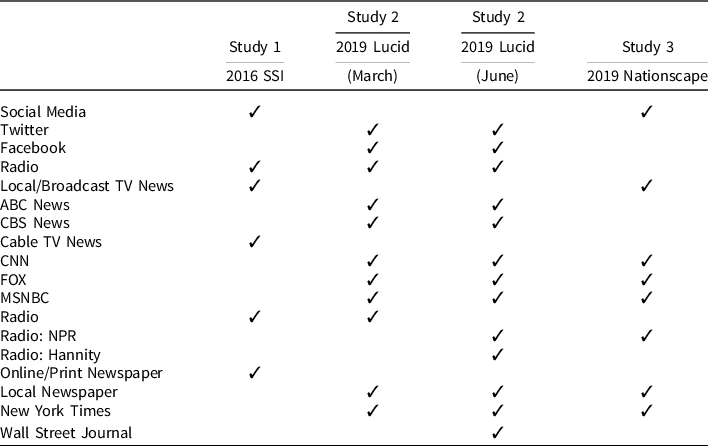
In contrast to the Lucid surveys, the Nationscape dataset provides somewhat a more limited, but certainly sufficient set of news consumption questions. Respondents were asked to indicate whether they have (“Yes” or “No”) “seen or heard news about politics on any of the following outlets in the past week.” The available choices included social media, the three major cable TV news outlets (FOX, CNN, and MSNBC), local TV, NPR, local newspaper, and the New York Times. Due to its bounded time frame of one week and its binary response option, the Nationscape questions are relatively limited in comparison to our surveys as they do not probe about the intensity of news source reliance habits over an extended period of time. Nevertheless, the Nationscape data includes many of the key questions required to replicate our main models in Studies 1 and 2. Given the range of different questions that were available across each study, Table 1 presents an overview of the specific measures available in each of the four surveys used in the three studies.
List of media consumption variables across each survey/study

Note: SSI response options: not at all (1), a little (2), and a lot (3).
Lucid response options: not at all (1), very little (2), somewhat (3), and a great deal (4).
Nationscape response options: no (1) and yes (1).
Since our focus is on citizens’ reliance on social media platforms more generally, rather than differences between specific platforms, we constructed a single social media variable in the two Lucid studies by adding respondents’ answers to “Twitter” and “Facebook” use and dividing it by 2. Footnote 5 However, as a robustness check, we also include each item separately in all of our models. We also grouped ABC News and CBS News consumption into a single “Local TV News” measure in the Lucid samples (Cronbach’sα = 0.863; 0.804). This analytical choice is supported by the fact that viewership of local news does not differ significantly by audience’s partisanship or other characteristics. Footnote 6
Research demonstrates that those who rely on social media for news are slightly more female, younger, and less white than the general population (Duggan and Smith Reference Duggan and Smith2016). Before turning to the main analyses, we first examine predictors of relying on social media for news in our own data (see Table B1). While we find that gender is statistically associated with social media reliance across two of the three surveys, the direction of the relationship is not consistent. But, in keeping with past research, we find that individuals who rely on social media for news are younger and slightly more non-white than are those who do not rely on social media. We therefore account for age, sex, and race in all of the main analyses. We also find that more educated individuals and those who are more ideologically liberal are more likely to indicate relying on social media for news than their counterparts. Footnote 7 These findings indicate that, to the extent that restrictive policies towards Muslims are often supported by conservative elites, the nature of who relies on social media for news should bias the data against finding a connection between social media reliance and restrictive attitudes towards Muslims.
In keeping with previous research which demonstrates that partisanship and racial antipathy contribute to support for anti-Muslim candidates and policies (Aizpurua et al. Reference Aizpurua, Singer, Butler, Collier and Gertz2017; Jardina and Stephens-Dougan Reference Jardina and Stephens-Dougan2021; Lajevardi Reference Lajevardi2020; Lajevardi and Abrajano Reference Lajevardi and Abrajano2019; Tesler Reference Tesler2018), we also account for income, partisanship, and in the Lucid samples, respondents’ favourability ratings of Muslim Americans. To measure partisanship, we employ dummy variables, with Democrats as the comparison category. Favourability towards Muslim Americans is measured through a standard 0–100 feeling thermometer, which we divide by 10 for ease of interpretation. Descriptive statistics for all three studies are located in Tables A1–A4.
Findings
Study 1
Study 1 draws from the 2016 SSI dataset to investigate the potential link between social media news consumption and policy attitudes. Our analyses estimate two separate ordinary least squares (OLS) models per outcome measure. Footnote 8 As reported in Table B2, the first set of models examines the relationship between social media use and policy attitudes with controls for partisanship and a set of standard demographic indicators, while the second set of models includes additional measures for other information sources, such as cable television and newspaper consumption habits. Across both model specifications, greater reliance on social media is associated with more support for limiting Muslim Americans from reentering the US if they have left the country for any reason (at p < 0.01). We find nearly identical results with respect to support for deploying extra police patrols in Muslim neighbourhoods.
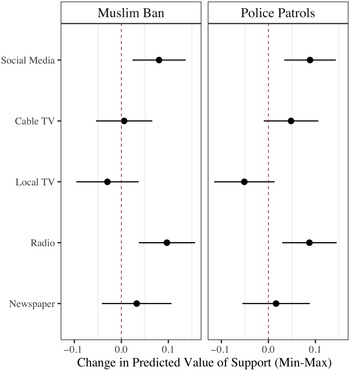
For ease of interpretation, we graph changes in predicted values (min-max effects) with 95% confidence bands in Figure 1. As the left-hand panel of the figure shows, relying on social media increases support for the Muslim ban by 9 percentage points, from a predicted value of .38 among those who do not rely on social media for news to .47 among those who rely on social media a great deal. The effect size of social media reliance on support for police patrols is equivalent, increasing support for the policy proposal from .36 to .45—a 9 percentage point change in the outcome measure. Apart from reliance on social media, only radio use is positively associated with both outcomes, and in ways that are similar to social media use. The relationship between reading newspapers and each outcome variable is positive, but not statistically significant. A similar pattern is also observable with the cable TV consumption measure. Overall, analysis of the SSI data supports H1 and suggests that greater reliance on social media for information about politics is linked to support for anti-Muslim policies.
The relationship between Information Source Reliance and support for anti-Muslim policies, 2016 SSI Data.
Note: Change in predicted values with 95% CIs is derived from OLS regression results (N = 1,072) as reported in Table B2, Models 2 & 4. Models control for standard demographic variables and party identification.

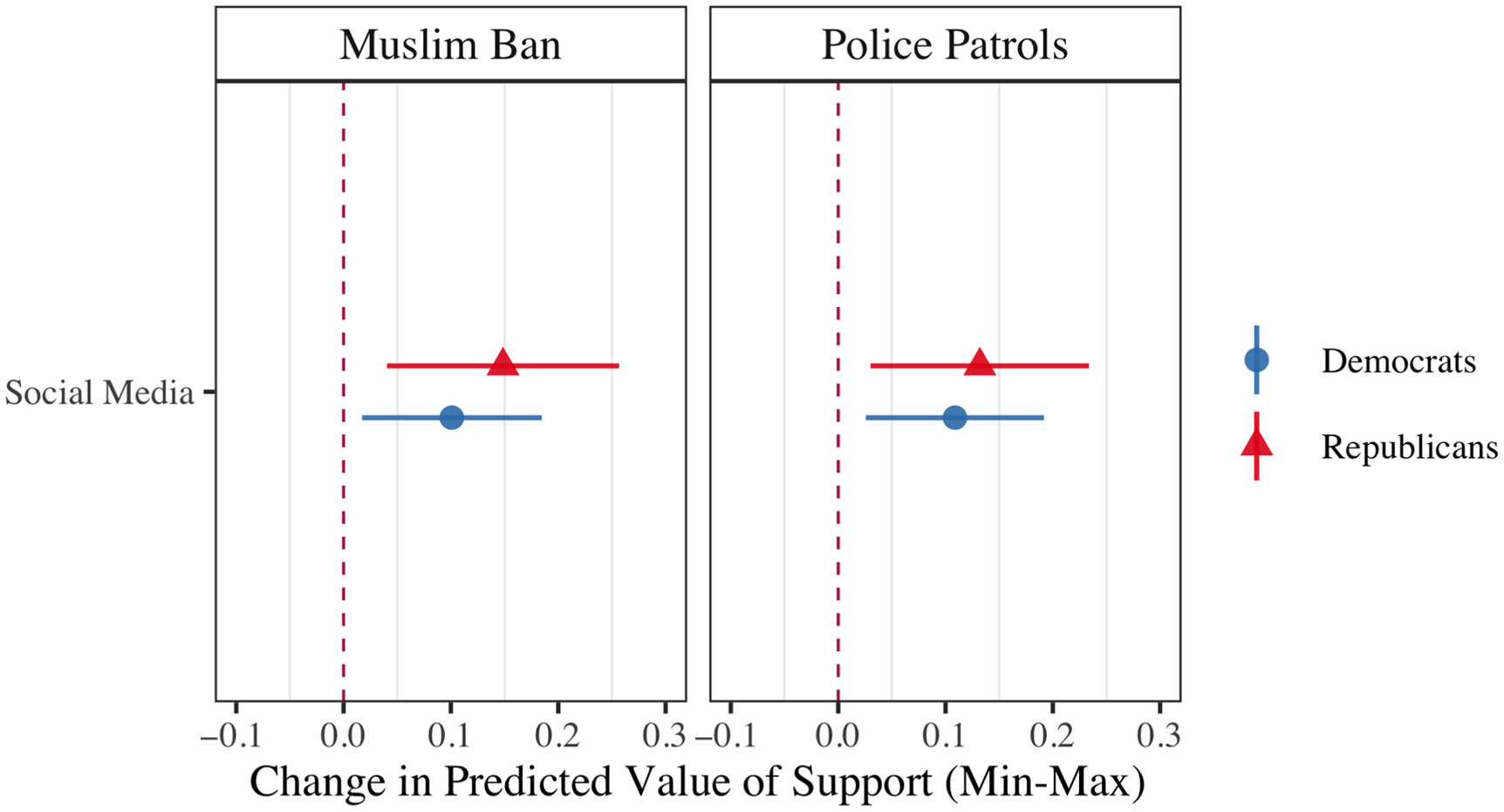
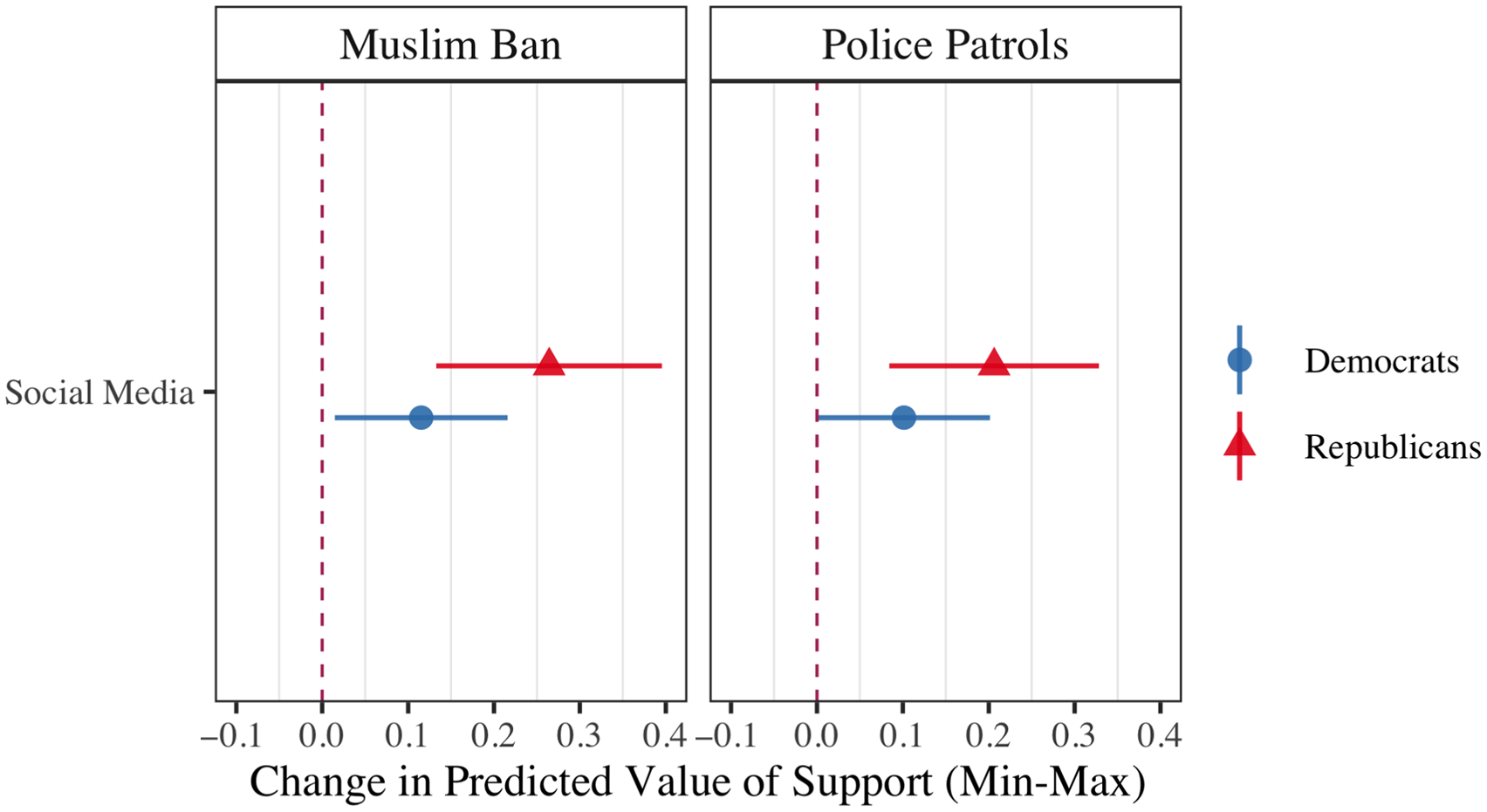
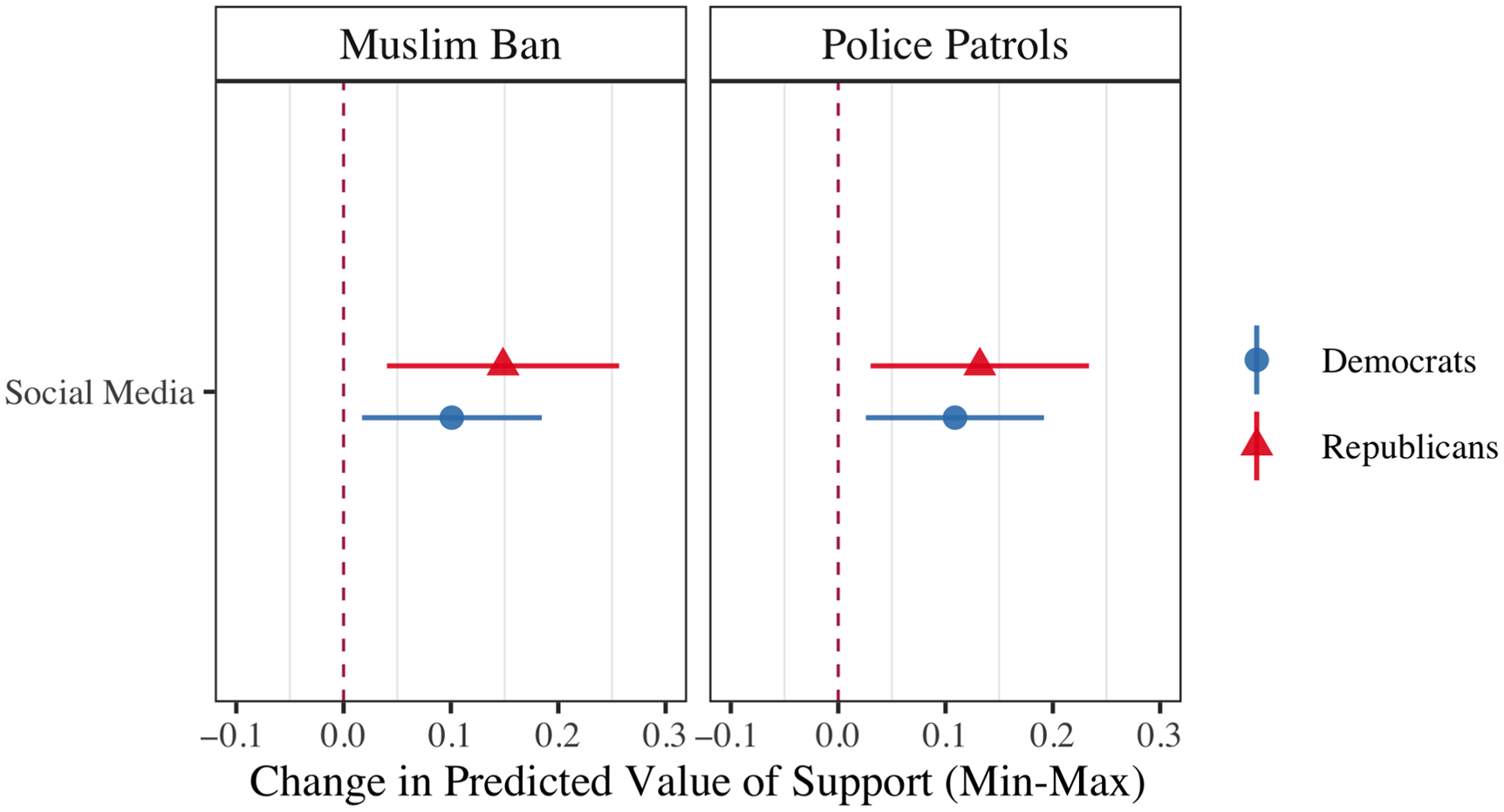
Next, we test whether social media has heterogeneous effects on partisan subgroups by reestimating these models among subsamples of self-identified Democrats and Republicans (see Table B6). Recall that we argued that partisans of both persuasions are vulnerable to falling for disinformation and sensationalised stories about Muslims on social media platforms, and, therefore, we predicted that social media use would have a similar impact on both Democrats and Republicans. As Figure 2 illustrates, this is indeed what we find. Among Democrats, social media use corresponds to about a 10 percentage point change in support for the Muslim ban and police patrols, respectively. Among Republicans, those who rely a great deal on social media platforms to get informed about politics are between 13 to 15 percentage points more likely than those who do not use social media to support both policies. This finding is striking given that Democrats, on average, are less likely than Republicans to express support for anti-Muslim policies. It suggests that even those who may not be predisposed to support Islamophobic policies because of partisanship may be nudged to do so under certain conditions.
The relationship Social Media Reliance and Support for anti-Muslim policies by partisanship, 2016 SSI Data.
Note: Change in predicted values with 95% CIs is derived from OLS regression results (Dem. N = 467; Rep. N = 309) as reported in Table B6. Models control for standard demographic variables and other news sources.
Study 2
Findings from Study 1 suggest that greater reliance on social media for information about politics is linked to heightened support for anti-Muslim policy preferences and that this relationship is persistent among both Democrats and Republicans. Study 2 further examines this relationship with two additional datasets, which include more detailed questions about respondents’ news consumption habits. This study offers two analytical advantages. First, it enables us to rule out the possibility that the main findings are an artefact of just one survey and just one time period. By examining data collected in 2019 among two different groups of respondents, we also move beyond the unique 2016 presidential election context. Second, the surveys in Study 2 offer a range of more detailed measures about other information sources, which in turn enables us to assess whether our main findings are robust to the inclusion of more fine-grained and ideologically tilted information sources. For instance, previous research has shown that individuals who rely on FOX News will likely be exposed to more conservative coverage of policies related to Muslims than those who primarily watch outlets such as MSNBC (Lajevardi Reference Lajevardi2020). Indeed, Oskooii et al. (Reference Oskooii, Lajevardi and Collingwood2019) find that FOX News coverage of Trump’s Muslim travel ban focused heavily on how the executive order was justified rather than at odds with notions of religious liberty. In contrast, more left-leaning outlets, including newspaper coverage from The New York Times and The Washington Post, framed the ban negatively, by labelling it as a “Muslim ban” in violation of cherished American values of religious liberty. Therefore, accounting for more specific news sources can be more informative than relying on more general measures used in Study 1.
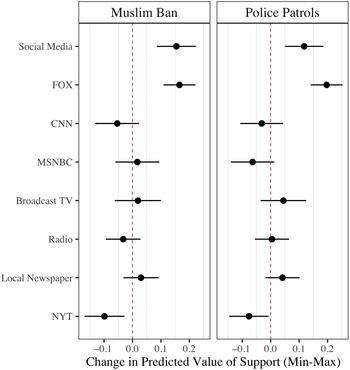
We begin by testing H1 with the March iteration of the 2019 Lucid dataset. Table B3 reports OLS regression results for the Muslim ban and patrol support outcome measures. For ease of interpretation, Figure 3 presents the relationship between different news sources and each policy item in the form of changes in predicted values with 95% confidence bands. As illustrated, social media use is a positive and statistically significant predictor of policy attitudes (at p < 0.01). Frequent reliance on social media for political information increases one’s support for the Muslim ban by about 15 percentage points, from .43 to .58 on an outcome measure that ranges from 0 to 1. The size of the impact is only slightly smaller with respect to support for police patrols, increasing support from .46 among those who do not use social media for news to .58 among frequent users – a change of 12 percentage points. This finding supports H1 and is very similar to the Study 1 results.
The relationship between Information Source Reliance and Support for anti-Muslim policies, March 2019 Lucid Data.
Note: Change in predicted values with 95% CIs is derived from OLS regression results (N = 1,212) as reported in Table B3, Models 2 and 4. Models control for standard demographic variables, party identification, political ideology, and Muslim favourability.

Turning attention to other kinds of new outlets, we find that the partisan bent of different information sources are generally related to policy positions in the expected directions. Of all the cable TV channels, FOX consumption is most strongly associated with the endorsement of anti-Muslim policy preferences. The relationship between CNN and each outcome variable is negative, but does not reach traditional bounds of statistical significance. For MSNBC viewers, the coefficient size is fairly small and statistically insignificant. However, reliance on the liberal-leaning New York Times is associated with lower levels of support for both the Muslim ban and patrol outcomes. All other sources of information (broadcast TV, radio, and local newspapers) do not appear to be linked to respondents’ policy attitudes and do not mediate the relationship between social media use and anti-Muslim policy preferences. We note here that other variables traditionally associated with anti-Muslim policy stances, such as partisanship, ideology, Muslim favourability, age, and education, are all statistically significant and the coefficients are in the expected directions. Muslim favourability, in particular, has a substantively large relationship to each outcome measure – a 27 percentage point change in predicted value.
Examination of the same models by partisan subgroups (see Table B7) further offers support for H2. Figure 4 shows that social media use is positively associated with each outcome measure among both Democrats and Republicans. Reliance on social media increases support for the Muslim ban and police patrols by about 10 percentage points for Democrats. Republicans who report relying on social media for political information a great deal are more than 20 percentage points more likely than their counterparts to express support for each policy outcome.
The relationship Social Media Reliance and Support for anti-Muslim policies by partisanship, March 2019 Lucid Data.
Note: Change in predicted values with 95% CIs is derived from OLS regression results (Dem. N = 516; Rep. N = 390) as reported in Table B7. Models control for standard demographic variables, political ideology, Muslim favourability, and other news sources.

Moving on to the 2019 June Lucid dataset, we find nearly identical results pertaining to the relationship between social media use and anti-Muslim policies. Appendix Table B4 reports OLS regression coefficients for ban and patrol support, as well as the two additional outcome variables: restricting the number of mosques and preventing US Muslim citizens from purchasing weapons. Across all the models, we find that social media users are consistently more likely than their counterparts to endorse anti-Muslim policies (p < 0.01). We summarise the results in the form of changes in predicted values of policy support in Figure 5. Relying on social media for political information increases support for the Muslim ban by about 10 percentage points, from .39 among those who do not rely on social media at all to .49 to those who rely on it a great deal. The size of the effect appears relatively larger with respect to police patrols, mosque restrictions, and preventing Muslim citizens from purchasing weapons, for which social media reliance increases support by about 15 percentage points. Consistent with previous results, we also find that those who are ideologically conservative, Republican, and in most instances, older and less educated are more likely than their respective counterparts to express support for anti-Muslim policies. Additionally, the inclusion of a Muslim favourability measure in any of the models does not suppress the positive and statistically significant association between social media use and anti-Muslim policy stances, despite having a large impact on each outcome measure (changes in predicated values ranging from 35 to 44 percentage points).
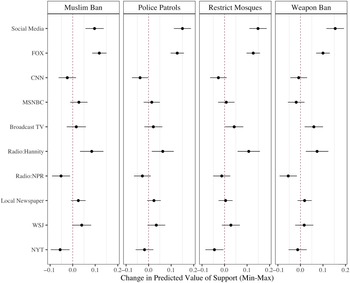
The relationship between Information Source Reliance and Support for anti-Muslim policies, June 2019 Lucid Data.
Note: Change in predicted values with 95% CIs is derived from OLS regression results (N = 3,733) as reported in Table B4, Models 2 and 4. Models control for standard demographic variables, party identification, political ideology, and Muslim favourability.

Furthermore, the partisan bent of other information sources are related to policy evaluations, but primarily in engendering restrictive stances. Of the three different cable TV news outlets, regularly consuming FOX news is a strong predictor of anti-Muslim policy attitudes. However, we do not find evidence of strong relationships between CNN or MSNBC reliance and policy support, with coefficients hovering around zero. We find a similar trend with respect to radio programming. Respondents who listen to Sean Hannity’s radio show are more likely than their counterparts to endorse each of the four policies. While the coefficients for regularly listening to NPR are negative, they are not always statistically significant. Turning to national newspapers, we find somewhat mixed results. Reliance on The New York Times is negatively and modestly associated with the Muslim ban and mosque restriction measures, but not the other outcomes. The right-leaning Wall Street Journal is somewhat positively linked to ban and patrol support, but not the mosque restriction and weapon ban variables. Overall, while liberal-leaning outlets may depict Muslim Americans in a relatively more positive light (Lajevardi Reference Lajevardi2021), reliance on these sources is not consistently linked to opposition to restrictive policy measures. This may be due to the fact that individuals tend to privilege negative over positive information (Albertson and Gadarian Reference Albertson and Gadarian2015; Baumeister et al. Reference Baumeister, Bratslavsky, Finkenauer and Vohs2001), especially if such information is tied to and terrorism and an otherwise threatening context (Merolla and Zechmeister Reference Merolla and Zechmeister2018). Indeed, experimental research on countering misconceptions of Muslim Americans shows that positive treatments fail to generate meaningful opposition towards policies that aim to increase surveillance of Muslim Americans, ban refugees from Muslim countries, and require Muslim Americans to register with the government (Williamson Reference Williamson2019).
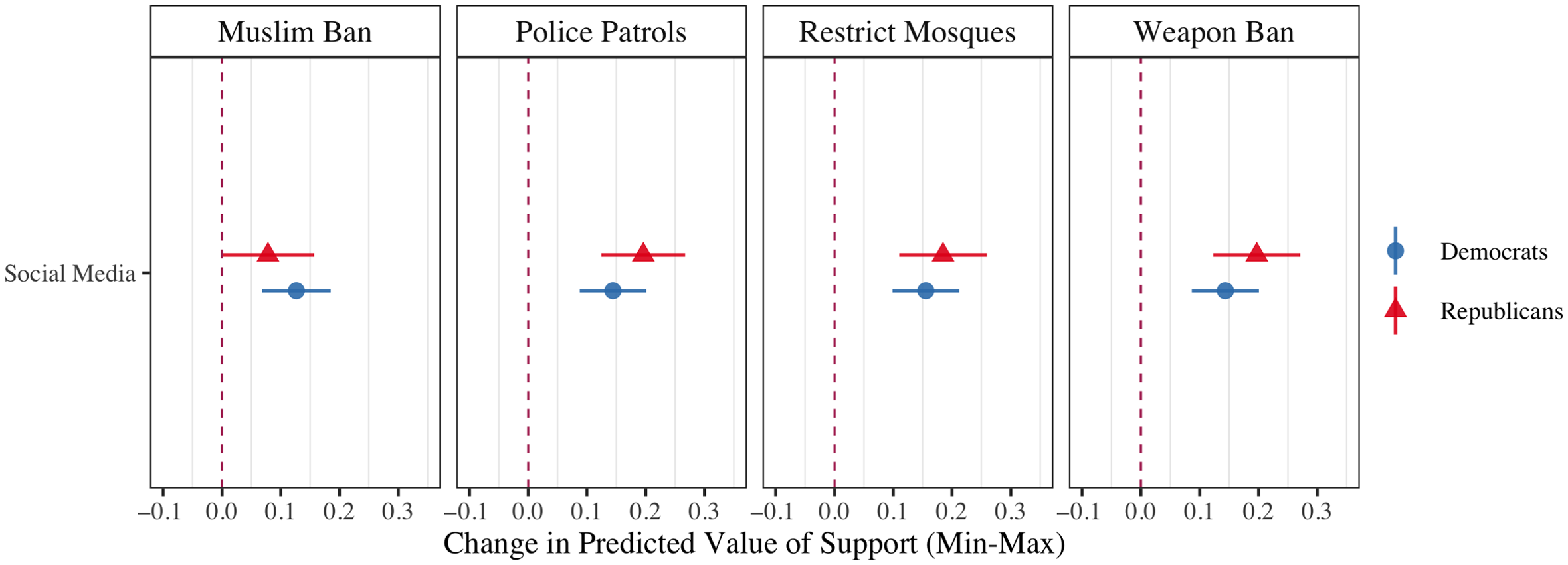
The final analysis of this study, which evaluates H2, is reported in Appendix Table B8 and is summarised in Figure 6. Once again, we find that the positive relationship between social media use and restrictive policy positions persists across both partisan groups. Democrats and Republicans who rely on social media platforms to obtain information about politics are consistently more likely than nonsocial media users to endorse Islamophobic policies, such as not allowing US Muslim citizens to purchase weapons. This relationship holds even after accounting for other media sources, political ideology, and Muslim favourability, providing additional support for H2.
The relationship Social Media Reliance and Support for anti-Muslim policies by Partisanship, June 2019 Lucid Data.
Note: Change in predicted values with 95% CIs is derived from OLS regression results (Dem. N = 1,592; Rep. N = 1,163) as reported in Table B4. Models control for standard demographic variables, political ideology, Muslim favourability, and other news sources.

Study 3
Analyses of three distinct datasets all point to the same basic pattern: social media use is positively associated with anti-Muslim policy attitudes across different outcome measures and model specifications. In Study 3, we further validate our main findings with the publicly available Nationscape dataset, which is one of the largest public opinion survey projects ever conducted (Tausanovitch et al. Reference Tausanovitch, Vavreck, Reny, Hayes and Rudkin2019). While the Nationscape survey does not include all of the variables used in the first two studies, it does include one Muslim-specific policy question (Muslim ban support) and some of the most important source reliance measures central to our inquiry.
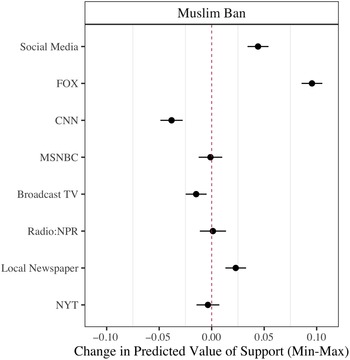
To test H1, we ran several OLS regression models whereby the Muslim ban outcome measure is regressed on social media use and various other measures using Nationscape’s original weight variable. Footnote 9 As Table B5 details, we find that those who rely on social media for news are more likely than their counterparts (p < 0.01) to support the Muslim ban regardless of whether we account for or exclude other media sources. These findings are robust to the inclusion of no-opinion respondents, although the effect size is somewhat bigger with the exclusion of those unwilling to pick a side on the issue. Figure 7 displays changes in predicted values with 95% and shows that social media users are about 5 percentage points more likely than their counterparts to support the Muslim ban, again providing support for H1.
The relationship between Information Source Reliance and Support for the Muslim Travel Ban, 2019 Nationscape Data.
Note: Change in predicted values with 95% CIs is derived from Model 2 OLS regression results (N = 33,863) as reported in Table B5. Model controls for standard demographic variables, party identification, and political ideology.

To test the effect of social media use across the party divide (H2), we report regression results by partisanship in Table B9. Consistent with Studies 1 and 2, we find that both Democrats and Republicans who use social media are more likely than those who do not use social media for news to support the Muslim ban. While there is a positive and statistically significant association across all of the models, the size of the effect appears to be larger for Republicans than for Democrats. Overall, the Nationscape findings lend additional support for our theory.
Additional analyses
Across three different studies, we have found robust associations between citizens’ reliance on social media to seek political information and their support for various anti-Muslim policies. In this section, we report and perform additional analyses to address various questions, concerns, or potential critiques of our study. One such concern is accounting for citizens’ reliance on other media sources. It may be that individuals who rely on social media for news simultaneously use other sources for information and/or other types of news that may depict Muslim Americans in an unfavourable light. If so, controlling for other news measures may not completely address this concern. To further isolate the association between social media and policy attitudes relative to other news sources, we constructed a ratio measure of news consumption. We first calculated one’s mean reliance on all news sources other than social media and then subtracted this mean score from one’s stated reliance on social media. Positive values indicate privileging social media over all other types of media while negative values indicate the opposite. Footnote 10 Consistent with the findings presented above, the results reported in Tables C1 – C2 show that individuals who prioritise social media over all other news sources are significantly more likely to support anti-Muslim policies. This finding holds across all four outcome measures, which serves as an important validation of the main results. Footnote 11
Our findings are further threatened by selection bias. It could be argued that those who are already predisposed to hold negative feelings towards Muslims will be more likely than others to seek out or pay particular attention to anti-Muslim information on social media platforms. Stated differently, such individuals may seek out prejudiced information that reinforces their negative attitudes towards Muslims. If this is the case, one may not expect to find a positive relationship between social media use and anti-Muslims policy attitudes among those who have relatively positive feelings towards Muslims. Presumably, they would not intentionally seek out information that paints Muslims in a negative light, and, if by chance or as a function of their social networks, they become exposed to sensationalised or false stories, they would be expected to dismiss or downplay such information. While we cannot completely rule out selection bias with existing data, we can attempt to address this concern by examining the relationship between social media use and policy attitudes among those who hold a favourable predisposition towards Muslims. If we find that reliance on social media for news even among those who profess positive feelings towards Muslims is associated with anti-Muslim policy preferences then we can be more confident that the main results are not just driven by those who dislike Muslims. This analysis should help alleviate concerns that the causal arrow is as theorised, rather than individuals who dislike Muslims selecting into social media exposure.
We examined this possibility by subsetting our largest and most detailed original dataset, the June 2019 Lucid, to those individuals who scored one standard deviation above the mean on the Muslim favourability score. This left us with a total of 757 respondents. We then replicated the main models among these respondents. Footnote 12 The results are reported in Table C4. The relationship between social media use and anti-Muslim policy attitudes is statistically significant across all of the outcome measures and model specifications. This suggests that the main findings are not simply driven by anti-Muslim affect.
Drawing on our Lucid datasets, we next examined the effects of Twitter and Facebook use independently. Tables C5 and C6 report these results. In the March survey, we find that reliance on Facebook is positively associated (p < 0.01) with both Ban and Patrol support. However, we do not find any statistically significant relationships between Twitter use and each outcome, although the coefficients are in the positive direction. In the June dataset, reliance on both Facebook and Twitter predicts support for all of the four anti-Muslim policy measures. For the Ban Support and Weapon Restrict models, the Twitter coefficient is nearly double the size of that of Facebook. Overall, we do not find convincing evidence that the main findings are primarily driven by a single social media platform.
We argue that social media users will be more likely than their counterparts to support anti-Muslim policies primarily because of the prevalence of sensationalised and stereotypical stories about Muslims on social media. While the findings support this argument, it is possible that social media users simply represent a subsample of individuals who hold more extreme views towards a range of policies regardless of the immediate salience of that content, and regardless of whether it was Muslim-specific. To rule out this possibility, we use two policy items present in the March Lucid survey that were not particularly salient at the time and about which respondents likely had not learned about much on social media platforms. Respondents were asked whether they supported the following: (1) “The Environmental Protection Agency should receive the power to regulate carbon dioxide emissions” and (2) “When a person has a disease that cannot be cured, doctors should be allowed by law to end the patient’s life by some painless means if the patient and his or her family request it.” Table C7 presents the results of this analysis. Across all of the models, the coefficient for social media reliance is small and insignificant, indicating that social media use does not simply predict attitudes towards a variety of policies for which little to no sensationalised information is likely circulated. Using separate social media variables (Twitter and Facebook) does not change the results (see Table C8).
Finally, and related to the above point, we investigated the relationship between social media use and support for another group-oriented policy only available in the Nationscape dataset that emerged on the political horizon around the same time as the Muslim-specific policies: the proposal to build a wall at the US-Mexico border. This final analysis provides a preliminary test of whether the findings observed in our study are only unique to Muslims or whether they translate to other stigmatised groups, in this case Latinos, for which sensationalised stories likely exist across social media platforms. Weighted OLS regression Table C9 shows that the patterns we observed in our main analyses are not unique to Muslim Americans. Individuals who rely on social media for political information are also significantly (p < 0.01) more likely than their counterparts to “agree” with the policy of building a wall on the southern US border. This finding is robust to the inclusion of other media sources.
Discussion and conclusion
The dissemination of political information on social media platforms has been undoubtedly consequential for members of stigmatised groups, and Muslim Americans are no exception (Dana et al. Reference Dana, Lajevardi, Oskooii and Walker2018; Karam Reference Karam2020; Lajevardi et al. Reference Lajevardi, Oskooii, Walker and Westfall2020; Ocampo et al. Reference Ocampo, Dana and Barreto2018; Sediqe Reference Sediqe2020). A rising tide of information about race in American politics can be found on social media platforms, particularly since the 2016 presidential campaign. And, research indicates that attention to prejudicial political elites has emboldened members of the public to express deeply held prejudicial views (e.g. Newman et al. Reference Newman, Merolla, Shah, Lemi, Collingwood and Ramakrishnan2019). Political consumers are not only more brazen in their use of racist language but they also increasingly rely on information sources not beholden to traditional journalistic standards as they increasingly turn to social media for information (Newman et al. Reference Newman, Merolla, Shah, Lemi, Collingwood and Ramakrishnan2019, p. 7). Whether social media can shape policy preferences by shifting Americans’ attitudes towards these groups – regardless of factors like partisanship, education, income, positive group attitudes, and other resources that can combat such disinformation – remains an open question.
Our study fills this scholarly gap. In this article, we take the case of US Muslims, an increasingly stigmatised, salient, and overrepresented group in the national discourse, about whom disinformation has been rampant in recent years. Theoretically, we propose that social media reliance, unconstrained by journalistic norms, plays a deleterious role in shaping policy attitudes towards Muslims and moves all Americans, regardless of partisanship or positive affect towards this group, to hold more hostile policy attitudes.
To test our theory, we turn to three unique datasets fielded from 2016 to 2019. Across each dataset, we assess how social media reliance, compared to reliance on other news sources, impacts support for anti-Muslim policy proposals. While our observational data preclude causal analyses, across three time points and three different samples, we find consistent evidence of a positive link between social media consumption and support for policies that adversely impact Muslims in the US. The findings are robust to the inclusion of many different news sources and alternative modelling strategies. Perhaps more importantly, both Democrats and Republicans who rely on social media are more likely than their counterparts to endorse anti-Muslim policy proposals, contrary to the presumption that Democrats may not be susceptible to negative attitudes about stigmatised populations.
Together, our study moves the conversation about social media effects beyond political polarisation and provides evidence to support the idea that reliance on such outlets can have pervasive consequences for attitudes towards marginalised groups. If left unchecked, anti-Muslim online networks may continue to quickly and regularly disseminate Islamophobic articles on social media platforms (Bail Reference Bail2014, p.128). The format of social media, where few words can be posted to explain the substance of articles and consumers rely on headlines that sensationalise news stories in order to attract clicks, exacerbates the problem.
While the findings presented here are compelling, they also raise additional questions for future research. First, while we find a positive relationship between social media reliance and support for anti-Muslim policies, we have not demonstrated why this is the case. We argue that social media is a fecund landscape for the quick and seamless spread of disinformation, likely because of its peer-to-peer structure, but we have not tested whether actual exposure to disinformation or stereotypic information about Muslims is what drives the observed relationship. Our study also questions about the role of misinformation in stirring and promoting negative attitudes towards other groups, such as anti-Asian sentiment in the present context of the pandemic (e.g. Druckman et al. Reference Druckman, Ognyanova, Baum, Lazer, Perlis, Della Volpe, Santillana, Hanyu, Quintana and Simonson2020). We suspect that reliance on social media for political information would have similar effects on attitudes towards other stigmatised populations, as we have demonstrated with the US-Mexico border wall analysis. An additional avenue for future research is to test whether portrayals of stigmatised groups on social media do in fact differ significantly from other sources of media where journalistic norms are more intact, such as the news media. Another question raised by our analysis pertains to individuals who rely on social media for entertainment or connection purposes rather than becoming informed about politics. Will such users pay attention to any political content? Would incidental exposure to misinformation or sensationalised stories impact their policy preferences if they discount or skip past such information quickly? A clearer understanding of the exact underlying mechanisms between social media consumption and attitudes towards stigmatised populations and how to combat them are, therefore, ripe for future work and deserve more scientific attention.
Data availability statement
Replication materials are available in the Journal of Public Policy Dataverse at https://doi.org/10.7910/DVN/KLMMZS
Supplementary material
To view supplementary material for this article, please visit https://doi.org/10.1017/S0143814X22000083
Acknowledgements
We would like to thank Eric Juenke, Candis Watts Smith, Efren Perez and the participants in the 2021 Spring Racial and Ethnic Politics and Policy Paper workshop for their valuable feedback on the manuscript.