Introduction
The impact of ageing demographics on both economic development and older people'sFootnote 1 social welfare is gaining increased urgency as the rate of new labour market entrants begins to be exceeded by the number of those people retiring (Organisation for Economic Co-operation and Development 2006). Identified as a priority issue for the United Nations (2002), calls have been made on governments and social partners to take measures including identifying and removing barriers to work for seniors, promoting life-long learning, healthy living and access to technology, addressing issues around the informal labour market and fostering flexible retirement opportunities. The World Health Organization (2002) has identified work opportunities in later life as a key component of active ageing; and the International Labour Organization (ILO), together with the International Organization of Employers, has developed strategies for addressing the impact of ageing on sustainable economic growth (ILO 2009).
Although the world's population as a whole is ageing (Lutz, Sanderson and Scherbov Reference Lutz, Sanderson and Scherbov2008), it is within Asia that the greatest challenges will have to be overcome, both in terms of the rate of change and the total numbers of people involved. Today Asia accounts for one-half of the world's older population and by 2050 this is set to increase to two-thirds (Vernon Reference Vernon2010). However, it is developed Asia (Japan, Singapore, Hong Kong, South Korea) that will most immediately experience workforce shortages through population ageing (Heller Reference Heller2006). While Japan has the world's oldest population, Hong Kong and Singapore are not far behind with the median age of their populations all expected to climb to 50 or so sometime between now and 2040 (United Nations 2010).
The impact of shrinking fertility rates and increased life expectancy on Hong Kong and Singapore is expected to be profound; resulting in major implications for government, non-governmental organisations, business and families, as well as for older people themselves (Ministry of Community Development, Youth and Sports 2009a; Steering Committee on Population Policy 2013). This is because as more people retire and fewer younger ones take their place, the labour force will shrink and formal dependency ratios will rise. By 2050, the total child and old-age dependency forecast for Hong Kong and Singapore is expected to rise to 81 dependents per 100 working population (United Nations 2010). However, whereas Singapore has tended to produce more child dependency in the recent past, older-age dependency has tended to be marginally higher in Hong Kong (United Nations 2010).
The financial burden placed on welfare systems due to population ageing is a complex and controversial subject determined in part by how extensive the service coverage is (e.g. universality, allowances, duration) and means of financing (e.g. redistributive content, national insurance, personal contribution) (Gal Reference Gal2002; Yu Reference Yu2007). As increasing proportions of older people – traditionally reliant upon publicly funded pensions and health care – face a privatised retirement future (Moulaert and Biggs Reference Moulaert and Biggs2013), employers will be forced to employ seniors as the available labour supply (Vickerstaff, Loretto and White Reference Vickerstaff, Loretto, White, Vickerstaff, Loretto and White2007). As Magdoff and Magdoff (Reference Magdoff and Magdoff2004) explain, there would be no surplus of labour if everyone had enough to eat, a decent place to live and adequate health-care provision. Faced with an increasingly individualised welfare burden (Moulaert and Biggs Reference Moulaert and Biggs2013; Walker Reference Walker2009), the prospect of longer working lives provokes a new form of ‘ageism’ (Andrews Reference Andrews1999; Biggs Reference Biggs2001), which deprives the old of their retirement and forces seniors into the reserve army of labour to maintain their incomes (Vickerstaff, Loretto and White Reference Vickerstaff, Loretto, White, Vickerstaff, Loretto and White2007).
This paper examines whether longer working lives will lead to greater opportunities for ‘active ageing’ in employment or, conversely, force older workers into low-status, badly paid jobs that are potentially damaging to their health and wellbeing. It draws evidence from Hong Kong and Singapore, two economies that share similar structural conditions conducive to population ageing: increasing life expectancy and low fertility rates. Given the common historic, economic and political backgrounds of Hong Kong and Singapore (Castells et al. Reference Castells, Goh, Kwok and Kee1988; Phang Reference Phang2000), one might expect to find similar age-management practices being adopted in the two economies. However, this paper reveals a number of important differences between the two locations. These differences relate not only to the distinct policy approaches that the two economies have taken towards senior employment but also to trends in labour force participation and to the substantive conditions of older workers. The paper considers the predicaments raised by the comparative evidence and offers some detailed insights into why differences between the two economies are emerging and what their broader implications are.
Comparing policies in Hong Kong and Singapore
In many parts of the developed world employers are widely recognised as key stakeholders in adapting labour markets to help rise to the age challenge (Heller Reference Heller2006; United Nations 2002). It is widely agreed, for example, that giving people the opportunity and flexibility to work longer is one of the most effective methods to restrain some of the financial burdens associated with exit from the labour market because it simultaneously increases tax revenues and reduces spending on pensions (Beck Reference Beck2009; Yu Reference Yu2007). It has also been argued that when people can stay in their jobs an additional source of income is provided which offers a way of preserving the status of seniors in their families and in society, and is a means to avoid social exclusion (Doeringer Reference Doeringer1990). Employers can also seek to retain valued employees and look to ease the ‘brain-drain’ and succession planning challenges (Arnone Reference Arnone2006) presented by the large-scale exit of 1950s baby-boomers from the labour market.
However, beneath the veneer of productive ageing, quality of life, and physical and mental wellbeing, the prospect of extended employment also thrusts seniors into the reserve army of labour recalled to reduce upward pressures on wages in a period of mounting labour shortages (Taylor and Walker Reference Taylor and Walker1998). Contemporaneously, denial of work could remove one of the critical means by which seniors escape poverty in their old age, especially when their history of employment has been founded on inadequate pension preparation (Holstein and Minkler Reference Holstein and Minkler2003). Throughout most of Asia, weak social safety nets have resulted in chronic problems of elderly poverty as well as an over-dependence on family structures for elder-care provision (Masud and Haron Reference Masud and Haron2008). In Hong Kong, the ‘cultural trap’ of filial piety has been particularly identified as keeping older people in a state of dependency, influencing their willingness to participate in the labour force so as not to bring shame on family members, otherwise expected to look after them (Chan and Wang Reference Chan and Wang2009).
On balance, whereas government policy mechanisms in Singapore favour modest social-support schemes that boost household savings and encourage employment (C. H. Wong Reference Wong2013), the Hong Kong approach provides more generous public assistance (Aspalter Reference Aspalter2006). Trends of government expenditure on social security and welfare as a proportion of gross domestic product between 1980 and 2000 suggest that while there was a marked increase in Hong Kong from the early 1990s, Singapore did not show any substantial changes (Asian Development Bank 2001). Meanwhile, a review of social security in Singapore (Ramesh Reference Ramesh2000) suggests that although the Singaporean state is heavily involved in income maintenance and health policies for government employees, only a miserly programme is available to the hard-core poor. This means that for the bulk of the Singaporean population individuals and families are encouraged to meet contingencies on their own (Ramesh Reference Ramesh2000). Contemporaneously, in contrast to other developed Asian economies, the number of recipients of public assistance benefits in Singapore is severely limited (Aspalter Reference Aspalter2006).
Compared to their Hong Kong counterparts, then, Singapore residents less keenly recognise government assistance as an important income source to seniors (Census and Statistics Department 2008; Ministry of Community Development, Youth and Sports 2005). Comparative government studies show, for example, that whereas 55 per cent of Hong Kong seniors aged 65 and above perceive the older-age allowance, a means-tested asset and income benefit, to be a major source of income (Census and Statistics Department 2008), less than 4 per cent of Singaporeans aged 55 and above similarly regard the Central Provident Fund (CPFFootnote 2), the mainstay of Singapore's social security savings plan for old ageFootnote 3 (Ministry of Community Development, Youth and Sports 2005). Even Hong Kong's conditional comprehensive social security assistance (CSSA) scheme is more highly regarded, with 9.4 per cent of elders recognising it as an important income source (Census and Statistics Department 2008).
Hence, in Singapore's more highly commodified social welfare environment, continuing to work in old age provides an important income stream for seniors (Ng Reference Ng2013) and active ageing in employment has been keenly promoted by the government to enhance financial security. In 2005, a Tripartite Committee on the Employability of Older Workers was established to promote age-friendly workplaces and to disseminate good practices towards the older workforce, such as through the establishment of various guidelines on fair employment practices, non-discriminatory job advertisements, and a national award to recognise companies with the most progressive and fair employment practices (Thang Reference Thang2011). Formed of government, employers and trade unions, the committee favours a whole-person approach to tackling the challenges of population ageing, setting out the following four strategic thrusts to cover different aspects of ‘active ageing’, including employment:
1. Enhance employability and financial security. Enabling seniors to remain employed and be financially independent.
2. Enable ageing-in-place. Provide a barrier-free built environment and public transport system with essential services for the elderly to age-in-place in the community.
3. Provide holistic and affordable health care and elder care. Ensure that seniors in need of care have access to a seamless continuum of health-care and elder-care services catering to their different needs and means.
4. Promote active ageing. Encourage seniors to age successfully by maintaining physical and mental wellbeing and continuing to contribute to society (Ministry of Manpower 2007).
One of the most striking features of Singapore's senior employment policy concerns ‘re-employment legislation’, which requires employers to offer re-employment contracts after age 62 of at least one year, renewable up to age 65 (and later 67 from July 2017). Otherwise, according to the 2012 Retirement and Re-employment Act, eligible employees must be offered a one-off Employment Assistant Payment if they are unable to find suitable jobs within the organisation following a thorough review (). Accompanied by a series of financial and training initiatives, the Singaporean authorities document a balanced approach whereby just as
employers should see older employees as a source of quality manpower and recognise the value of making the workplace age-friendly … employees have to see the benefit of staying employable, and should be flexible and adaptable so as to continue contributing to the organisation. (Ministry of Manpower 2011a: 1)Footnote 4
First, for employers, there are schemes to help companies hire older workers. For instance, an ‘advantage’ scheme offers a grant of up to S $400,000 to fund a company's efforts to recruit, retain or re-employ mature workers. Similarly, a special employment credit is available to provide employers who voluntarily re-employ workers aged 65 and above with an offset of up to 3 per cent of an employee's monthly wages. There have also been efforts for a string of work programmes to facilitate the redesign of jobs to make available employment opportunities more suitable for older individuals in the marketplace (Lim Reference Lim, Maclean, Jagannathan and Sarvi2013). One such scheme, entitled WorkPro, is designed to help employers adopt progressive workplace age-management practices, to facilitate job redesign and improve workplace practices, as well as to encourage employers to recruit and retain back-to-work locals and mature workers to meet their manpower needs (Singapore Workforce Development Agency website http://www.wsg.gov.sg/). Second, for employees, the Workfare Income Supplement was introduced in 2007 to help low-wage workers find work, continue working and to build up their CPF savings. An Employment Assistance Payment is offered to eligible employees as a last resort when employers are unable to re-employ them. Equivalent to three months’ salary, the one-off payment is subject to a minimum of S $4,500 and maximum of S $10,000.
In contrast, the lack of a mandatory retirement age in Hong Kong allows employers and employees to negotiate freely the timing of their retirement. However, in face of mounting labour shortages (Siu Reference Siu2013), and concerns about increased health and welfare costs (Chief Secretary for Administration's Office 2015), the relevant authorities have adopted a much stronger functionalist position, reaching the conclusion that age can no longer be relied upon as an indicator of capability, performance or productivity (Chow Reference Chow2016: A17). In October 2013, a Steering Committee on Population Policy started a four-month public engagement exercise to collate views on Hong Kong's demographic situation (Steering Committee on Population Policy 2013). As part of Hong Kong's commitment to ‘unleashing the potential of the existing population’ it was decided that the retirement age of civil servants should be raised from 60 to 65, while those in disciplined services should retire at age 60 instead of 55 (Civil Service Bureau 2014). Previously, following the Asian financial crisis, seniors were in a much more vulnerable position, since early retirement was seen to be a less painful way to downsize the workforce than large-scale lay-offs.
For the rest of the economy, the Hong Kong government has been far less prescriptive, proposing only to provide training for older persons, among other target groups, to help seniors re-join the labour market (Tsang Reference Tsang2015). As Chow (Reference Chow2016) explains, there are few structured re-employment programmes in Hong Kong. One minor exception concerns the Re-employment Training Programme for middle-aged unemployed workers (aged 40 and above), which aims to encourage employers to engage unemployed job seekers aged 40 or above and provide the job seekers with on-the-job training, through the provision of training allowance to employers (Labour Department 2015). Upon completion of the training, employers may apply for training allowance of up to HK $3,000 per month per employee, for a period of three to six months (Labour Department 2015).
In summary, the key policy differences between the two economies are that Hong Kong has a more developed social safety net than Singapore and no mandatory retirement age, whereas Singapore has retained a retirement age of 62 and the prospect of re-employment contracts on an annual basis up until 67 years of age (from 1 July 2017). At the same time, the notion of ‘active ageing’ is more developed in Singapore than Hong Kong, having been part of the policy discourse for about a decade longer. Such convergence begs the question whether longer working lives will actually lead to greater opportunities for ‘active ageing’ in old age or confine seniors to the secondary labour market? The Singapore authorities claim that ‘Having older persons employed for as long as possible keeps them healthier mentally and physically. It also integrates them more effectively in society, and enhances their financial security’ (Civil Service College 2006), but what are the trends in practice?
The issue of active ageing is pertinent because in certain occupations, seniority wages can entail a heavy wage burden for employers, leading to older workers being re-employed on inferior terms and conditions of employment to preserve their jobs. The retention of older workers could also spurn resentment amongst younger workers if it is seen to reduce promotion prospects within the organisation (Brooke and Taylor Reference Brooke and Taylor2005; Walker Reference Walker1990). In the section that follows, key trends in senior labour force participation, occupational status and pay will be detailed for Hong Kong and Singapore from the early 1990s onwards. Since both youths and seniors tend to be disadvantaged by mainstream (i.e. economically active) stereotyping (Loretto, Duncan and White Reference Loretto, Duncan and White2000), reference to both ‘thematic’ age groupsFootnote 5 as well as ‘all employees’ will be made as part of the analysis to ascertain the relative situation of older workers in each economy.
Comparing practices in Hong Kong and Singapore
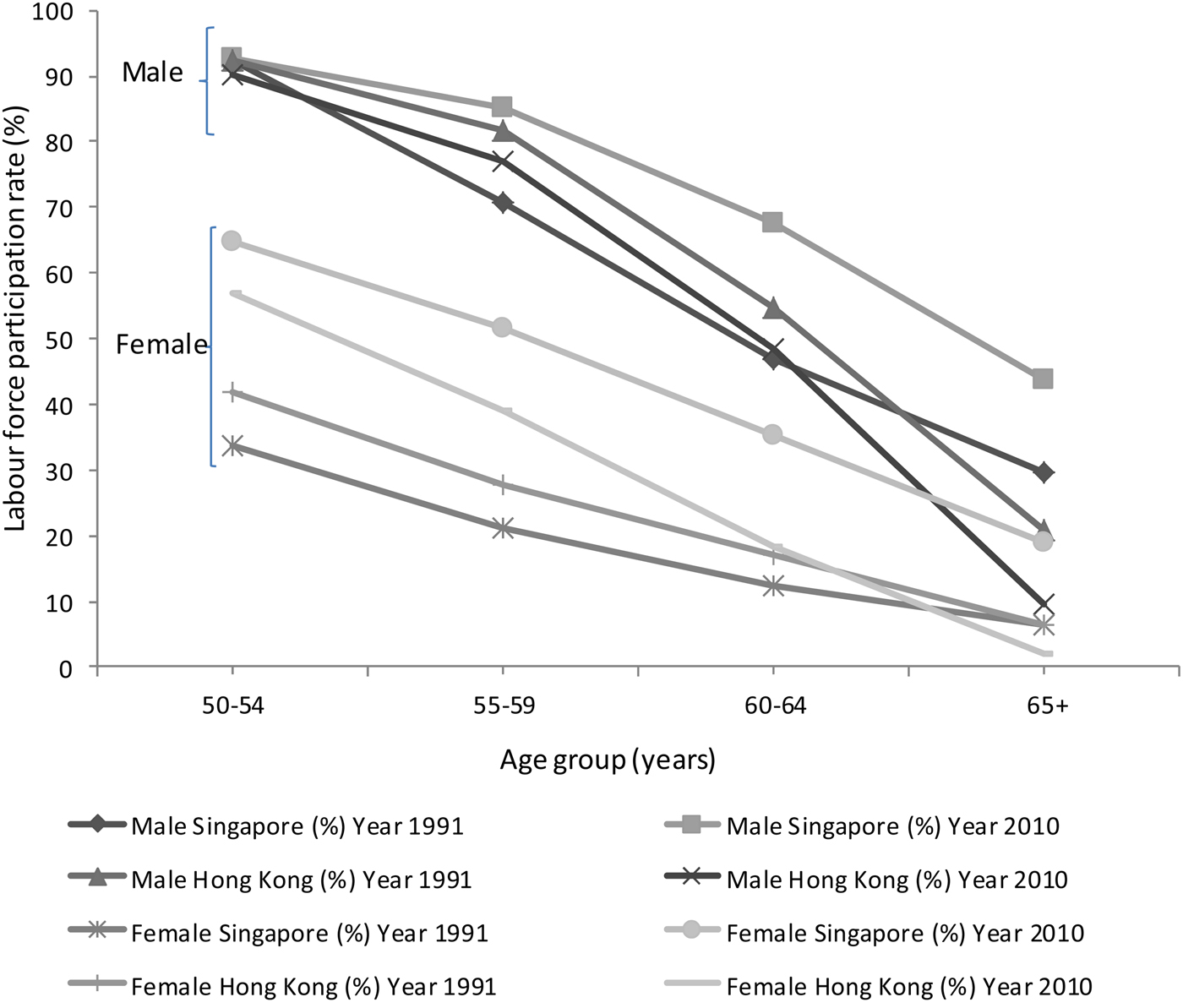
Figure 1 shows the male and female labour force participation rates (LFPR)Footnote 6 of Hong Kong and Singapore seniors across four distinct age categories using comparable 1991 and 2010 data (Census and Statistics Department 2001a; Information Services Department 2012; Ministry of Manpower 2011b). First, it can be seen that amongst the age groups considered, labour force participation declines with age, both in Hong Kong and Singapore, and for males and females alike. Second, across all age categories, more Singapore males participated in the labour force in 2010 compared to 1991, whereas the opposite situation occurs in Hong Kong. This means that the difference between older male participation rates in Hong Kong and Singapore has grown over the period, particularly amongst the two highest age categories. Third, across the same time period and amongst all categories, bar those aged over 65 in Hong Kong, more females participated in the labour force in 2010 compared to 1991.
Labour force participation rate (%) by age, Singapore and Hong Kong, 1991, 2010.

Ng (Reference Ng2013) matches participation figures for age groups ten years apart in Hong Kong and Singapore, and reveals that women's work participation has shown far more dramatic changes, especially at younger ages, and in Singapore. Between the 1930 and 1970 birth cohorts in Singapore, women's work participation at 20 years old expanded fourfold from around 20 per cent to 80 per cent (Ng Reference Ng2013). Otherwise, the work participation profiles of women in the two populations became very similar for the most recent cohorts: participation peaks at around 80 per cent at 20–30 years old, then halves by 50–55 years old and falls to a fifth or less by 60 years old (Ng Reference Ng2013). Despite the greater female labour force participation in Hong Kong and Singapore, it is less than half the corresponding male rate at age 50 and over.
One reason why seniors in Hong Kong have availed the opportunity to work in later life is that government expenditure for social assistance on social security almost doubled between 1996 and 2001, whereas the Singapore government has no responsibility for funding the CPF which greatly decreases the financial burden of social security (Holliday and Wilding Reference Holliday and Wilding2003). The costs of social assistance were only around 0.5 per cent in the early 1990s (Holliday and Wilding Reference Holliday and Wilding2003). In spite of high contribution rates, the Singapore CPF does not seem to offer its members an acceptable income in retirement. Hong Kong, on the other hand, extended social welfare spending rapidly in the 1990s, especially with regard to its two large means-tested welfare programmes: the CSSA and the social security allowance scheme (Aspalter Reference Aspalter2006). Coupled with the ‘cultural trap’ of filial piety (Chan and Wang Reference Chan and Wang2009), there is greater scope for Hong Kong seniors to leave the labour force when afforded the opportunity to do so.
A further explanation for the decline in senior labour force participation in Hong Kong is that elders are over-represented in declining industries – elementaryFootnote 7 and plant and machinery. Contemporaneously, when the LFPR among men born between 1937 and 1941 falls to less than 20 per cent when they reach ages 65–69, this could reflect the fact that they are likely to have worked in more manual occupations that are harder to sustain as people age.
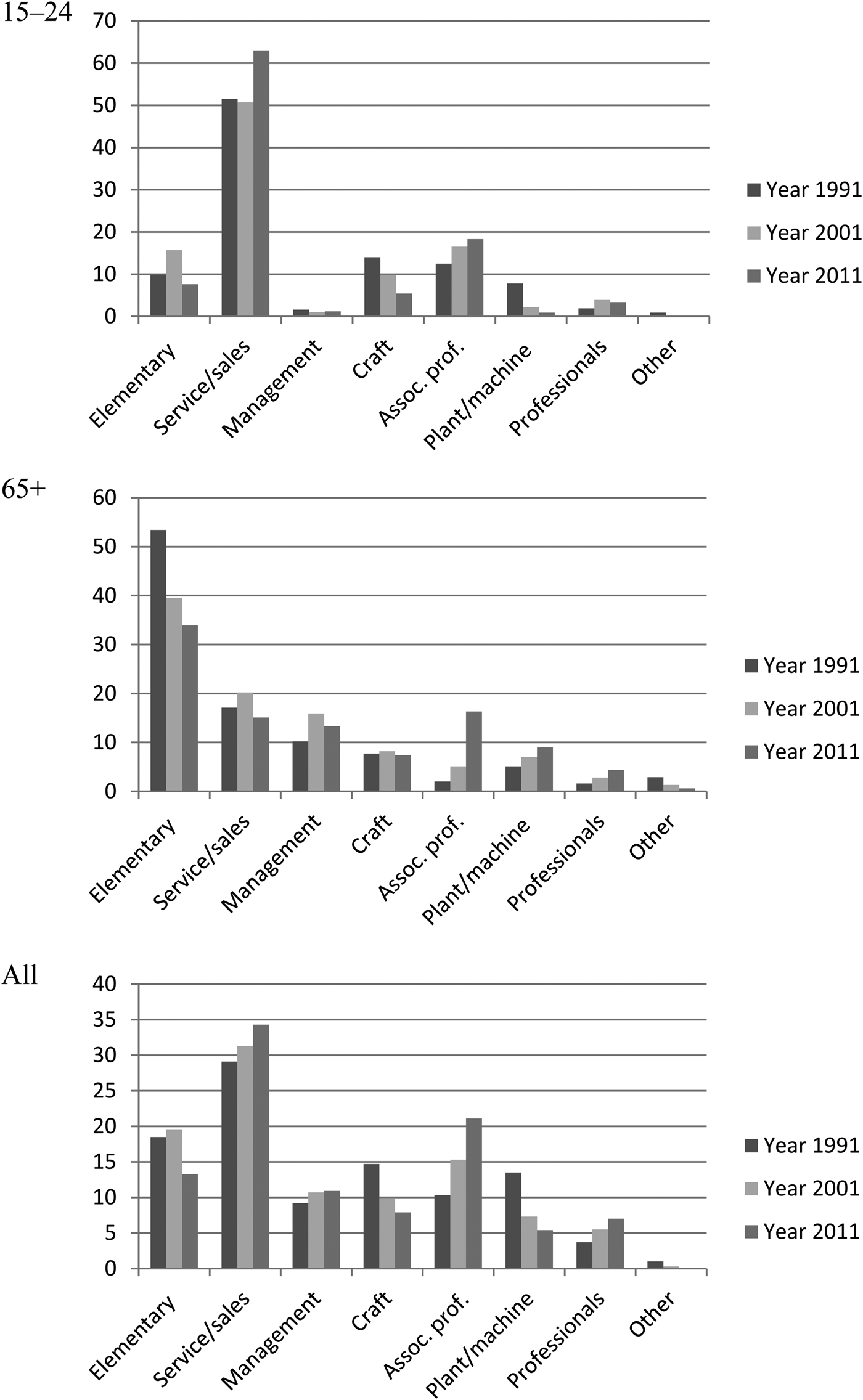
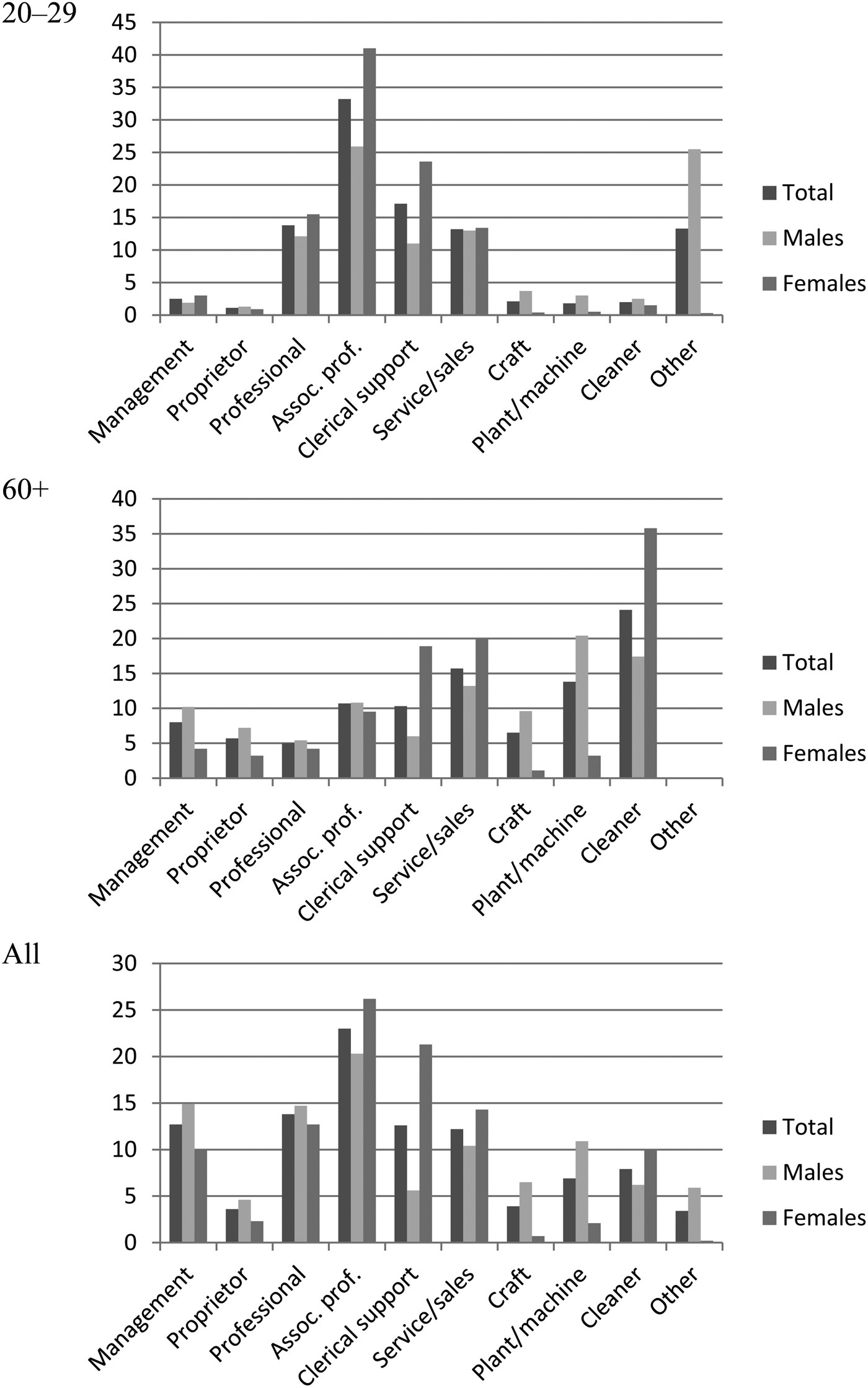
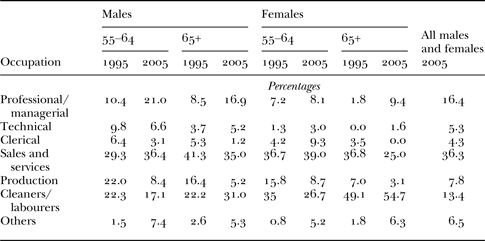
Figures 2 and 3 detail the relative occupational situation of seniors (65+ in Hong Kong and 60+ in Singapore) compared to youths (defined as those aged 15–24 in Hong Kong and as those aged 20–29 in SingaporeFootnote 8) and all employees. Since the Hong Kong data cover three distinct periods and the Singapore data only one, the latter is supplemented by further occupational data for 1995 and 2005, as shown in Table 1. In both economies, it can be seen that seniors are over-represented in such low-skilled occupations as cleaning and plant (in Singapore; Figure 3) and elementary work (in Hong Kong; Figure 2), while the corresponding ‘youth’ patterns are dominated by services and sales in Hong Kong and associate professional, clerical support, professional, and service and sales in Singapore.
Occupations by distinct age groups (%), Hong Kong, 1991, 2001, 2011.

Occupations by distinct age groups and gender (%), Singapore, 2014.

Occupations of Singapore employees, by age and gender, 1995, 2004

Source: Adapted from the Ministry of Community Development, Youth and Sports (2009b).
In Figure 2, the Hong Kong data for various population groups are shown for the years 1991, 2001 and 2011. The figure shows that seniors contribute mostly to a declining share of elementary and plant and machinery jobs, while the proportion employed as associate professionals, professionals and in plant activity seem to have increased. In Singapore, by contrast, Table 1 shows that, by occupational grouping, more seniors aged 65 and above participated in cleaning and labouring activity in 2005 (31 per cent of all males and 54.7 per cent of all females) compared to the corresponding situation in 1995 (22.2 per cent of all males and 49.1 per cent of all females) (Ministry of Community Development, Youth and Sports 2009b). At the same time, akin to the situation in Hong Kong, seniors’ share of professional/managerial work increased from 8.5 to 16.9 per cent for males and from 1.8 to 9.4 per cent for females. Otherwise, the share of Singapore seniors’ professional/managerial activity is still much smaller than the respective share for cleaning and labouring, a trend which could point to the gradual polarisation of senior employment in Singapore, as jobs in the middle, requiring a moderate level of skills, are harder to attain (Lee Reference Lee2001).
Concerning the most recent, 2014, Singapore data, Figure 3 details the occupational distribution of three population groups by gender. It shows that senior female employment patterns remain centred on cleaning occupations (approximately 35 per cent), whereas for older males plant machinery and cleaning take the largest shares, about 40 per cent combined. Overall, fewer older workers relative to all workers are occupied in associate professional services. Youths are seldom managers or proprietors and remain concentrated in the associate professional, clerical support, professional, and service and sales categories. Comparatively, more Singaporean youths are employed in associate professional roles than their Hong Kong counterparts.
When considering the structure of employment for youths compared to seniors, certain, very distinct, trends begin to emerge, which are broadly shared amongst the two locations. These include the observation that seniors remain confined to elementary, cleaning and plant jobs, while youth patterns are dominated by support services and sales, and hugely under-represented in management. In contrast, whereas Hong Kong seniors take a proportionate share of management jobs, their Singapore counterparts do not. Consequently, Hong Kong seniors divide roughly into one-third elementary, one-third services, sales and management, and one-third ‘other’ (split roughly equally between associate professional and craft/plant). Meanwhile, Singapore seniors divide into 40 per cent cleaners and plant, one-third services and sales, and the remainder (18 per cent or so) professional, managerial and propriety.
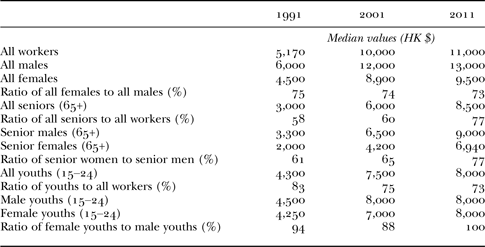
Another way to garner the occupational status of seniors is to consider their relative median monthly income from work. Here, the status of older workers’ pay will be considered by reference to all employees and youths. Despite the general improvement in the relative pay of Hong Kong older workers compared to all workers (Census and Statistics Department 2001, 2011), the median monthly income from main employment for those aged 65+ in 2011 was still only 77 per cent (HK $8,500) of the median (HK $11,000) for all employees, despite seniority. This information can be seen from Table 2 which shows the median monthly employment income of seniors (65+) compared to youths (15–24) and all workers in 1991, 2001 and 2011. The gap in earnings reflects the different types of occupations performed by seniors which, as noted above, comprise about one-third elementary workers. Although older female workers still earn less than their male counterparts, their earnings have improved relative to men since 1991. At the same time, it seems that while the situation for female youths is improving compared to male youths, the position of all youths compared to all workers has deteriorated since 1991. Employed mostly in services and sales occupations, the work performed by youths tends not to command a premium whereas management roles form part of seniors’ employment share.

The Hong Kong Census and Statistics Department (2008) attributes the low median income of the older working population to the relatively lower educational attainment of seniors. Free compulsory primary education only commenced in 1971 in Hong Kong. Before that, sons usually had a better chance of attending schools at the expense of daughters, especially in poor families (Chui Reference Chui, Boulton-Lewis and Tam2012). Accordingly, those soon-to-be-old (aged 45–59 years old) people in Hong Kong are more educated and financially more viable than the generation above them (Hong Kong Council of Social Services 2009).Footnote 9 Similar improvements in educational attainment are reported in Singapore where proportionately more seniors aged 55–64 (24.4%) than those aged 75 and above (10.4%) have at least secondary qualifications (Ministry of Community Development, Youth and Sports 2005).
Consistent with the trend reported in Hong Kong, the relative pay of older workers in Singapore also seems to be improving. In 2009, a study by the Ministry of Community Development, Youth and Sports (2009b) found that more than two-thirds of people over 65 drew gross monthly incomes of less than S $1,500 (roughly equivalent to HK $9,000) compared to about 40 per cent for all workers. However, by 2013, the figures had improved to 25.7 and 34.9 per cent, respectively. Likewise, whereas in 2009, about 60 per cent of the 70+ age group and 44 per cent of those aged 65–69 earned less than HK $1,000 compared to just over 15 per cent for the whole economy (Ministry of Community Development, Youth and Sports 2009b), the corresponding figures for 2013 were much closer at approximately 44, 31 and 10 per cent, respectively.
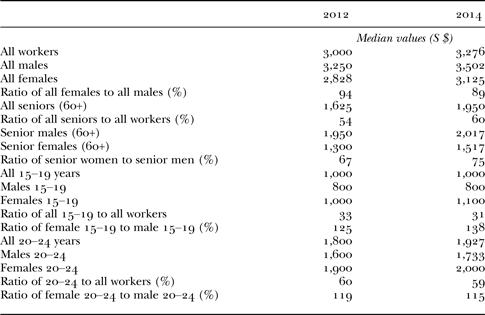
Despite the general improvement in the relative pay of older workers, the median monthly income from main employment for those aged 60+ in 2014 was still only 60 per cent (S $1,950) of the median (S $3,276) for all employees. This analysis can be seen from Table 3 which shows the median monthly income of seniors compared to youths (15–19 and 20–24) and all workers in 2012 and 2014.Footnote 10 Interestingly, whereas younger females (15–24) earn more than their male counterparts, the same is not true of senior females. Instead, it is at age 30–34 that the median incomes for males begins to be greater than the corresponding figure for females (Manpower Research and Statistics Department 2015). Amongst all listed groups in Table 3, the 15–19 age category achieves by far the lowest pay (31%, 2014) with the 20–24 (59%) and 60+ (60%) age categories achieving about the same in relation to all employees.

Fields (Reference Fields1994) examines how labour market conditions changed during the two economies’ post-war period of rapid, export-led growth and finds that once full employment was attained in Hong Kong in the 1980s real wages rose rapidly in Hong Kong and the job mix improved but in Singapore real wages barely grew because of the strong repressive hand of the Singaporean government in the labour market. At the same time, the absence of labour de-commodification in Singapore means that seniors have no choice but to keep working in badly paid, low-status jobs. Moreover, compared with their younger counterparts, older workers in Singapore are more likely to work more hours and are less likely to change jobs (Thang Reference Thang2011). Lain (Reference Lain2012) observes a similar pattern amongst older workers in the United Kingdom (UK) where, in a context of limited employee rights, employers selectively retain and recruit people in their sixties to low-status, low-pay occupations more difficult to fill with core-age workers. Meanwhile, Vickerstaff, Loretto and White (Reference Vickerstaff, Loretto, White, Vickerstaff, Loretto and White2007) draw attention to the prospect of polarisation between good and bad jobs, a trend that is apparent amongst Singaporean seniors. In Hong Kong, the presence of more extensive welfare structures, and a recent history of wage growth (Fields Reference Fields1994), suggest that seniors may not want to continue working and will choose to leave the labour market if they have the financial possibility of doing so.
Comparing predicaments in Hong Kong and Singapore
In considering the policies and practices of senior employment, this paper has shown that the Singapore approach has intervened through supply-side measures that target extended employment opportunities through an active ageing discourse, while the Hong Kong approach has tended to provide more generous public assistance. However, in the case of Singapore, it is doubtful whether the experience of seniors in the labour market is consistent with the sort of occupations that promote active ageing but merely reflects seniors being recruited into a secondary labour market to perform cleaning and labouring work that nobody else wants.
A Ministry of Community Development, Youth and Sports (2005) survey in Singapore found that the main reason why seniors sought post-retirement employment was to have the means to meet current expenses (62%). In contrast, ‘lifestyle choices’ of the type popularly stressed in Singapore's active ageing literature (Chan, Gustafsson and Liddle Reference Chan, Gustafsson and Liddle2014; K. W. Wong Reference Wong2013) were much less highly regarded. For example, only 14.1 per cent of respondents stated that they wanted ‘to lead an active life’ and half again as needing ‘something to occupy my time’ (Ministry of Community Development, Youth and Sports 2005). Previously, in 1995, approximately half of respondents combined sought extended working to ‘lead an active life’ and to ‘avoid boredom’ and fewer cited ‘needing money for expenses’ as the main reason for working.
Meanwhile, in the Hong Kong civil service, while seniors are currently being encouraged to stay in employment for longer, during the Asian financial crisis they were among the first to be jettisoned since early retirement was seen to be a less painful way to downsize the workforce than large-scale lay-offs. In the case of both age diversity and age management, then, seniors emerge as a ‘reserve army of labour’ (Taylor and Walker Reference Taylor and Walker1998), albeit utilised in different ways depending on specific economic factors. For instance, seniors are needed for their experience and succession in the civil service and for their plugging of labour shortages in the private sector.
However, in Hong Kong, since assuming power in July 2012, Chief Executive Leung Chun-Ying has clarified a suite of social welfare policiesFootnote 11 that could make employment a less attractive proposition to seniors provided income needs are satisfied (Leung Reference Leung2015). Contemporaneously, since May 2011, wages in Hong Kong have been regulated by a minimum wageFootnote 12 which could lead to employers holding ageist attitudes against older workers in certain occupations, whereas the Singapore approach allows seniors to bargain more freely on pay. An Equal Opportunities Commission study of approximately 2,000 workers in Hong Kong revealed that workplace discrimination levels in the city are ‘alarming’ and the most common form, yielding 68 per cent of claims, is ageism (Luo Reference Luo2014).
Although Singapore's 1993 Retirement Age Act attempts to end age discrimination,Footnote 13 by making it an offence for employers to force an employee who is below 60 to resign or retire because of age, its scope is limited (Debrah Reference Debrah1996). For instance, the Act does not include age discrimination in terms of, say, promotion, training and compensation (Debrah Reference Debrah1996), which suggests that it has limited impact when related institutional employment structures (e.g. a minimum wage or collective bargaining) are absent. This is an important omission because, as a Hong Kong study by Ho, Wei and Voon (Reference Ho, Wei and Voon2000) suggests, older workers are less likely to be promoted or selected for training than younger workers.
Along similar lines, although Hong Kong's Labour Department (2006) has published a set of Practical Guidelines for Employers on Eliminating Age Discrimination in Employment, there is no formal age discrimination legislation in the city. Meanwhile, in Singapore, it seems that anti-age discrimination is less likely to influence seniors’ participation in the workforce because employers can already use the extended freedoms of the market to drive down the costs (i.e. wages or CPF contributions) of employment vis-à-vis other employees. In other words, it seems that when labour protections are lacking, age discrimination becomes a less-apparent problem, at least in terms of participation. A different picture emerges, however, when substantive conditions are taken into account. According to evidence produced by union and employer groups (Haoxiang Reference Haoxiang2011), it is estimated that between a half and a third of older workers in Singapore are being re-employed on inferior terms and conditions of employment. Likewise, a survey of 218 employees (Hock, Ser and Teng Reference Hock, Ser and Teng2013) found that the current pay of Singaporean seniors was lower than the pre-retirement pay in 81.7 per cent of cases, and higher in only 2.8 per cent of cases. It suggests that Singapore's ability to enhance the LFPR of seniors probably owes much to employers using the terms and conditions of employment as a bargaining chip.
However, in the face of recent electoral woes, it seems that such substantial shortcomings have tested Singapore's faith in free-market principles with the relevant authorities forced to pay more attention to the wellbeing of the community (Yip Reference Yip2013). In 2014, the Ministry of Finance (2014) announced budget measures to provide support for lower-income households and the elderly. This includes using tax revenues to top up the wages of those in the lowest 20–30 per cent (known as Workfare), meaning that the average older lower-wage Singaporean will receive wages at least one-quarter higher than those offered by employers (Ministry of Finance 2014). Similar conditional provisions are provided in a scheme entitled Silver Support, launched in July 2016, granting the poorest 20–30 per cent of Singaporeans aged 65 and over between S $300 and 750 in benefits every three months (Ministry of Finance 2015). In contrast, as noted above (Leung Reference Leung2015; Senior Community Legal Information 2014), Hong Kong's recent efforts have been primarily devoted to enhancing social welfare provision, a position marginally supplemented in the 2015–16 Budget, which earmarked HK $5.5 billion to go towards an extra two months’ worth of allowances for recipients of CSSA, Old Age Living Allowance and Disability Allowance (Tsang Reference Tsang2015).
Although it is too early to examine the impact of the Hong Kong interventions on senior labour supply, the relevant authorities have expressed fear that too much social welfare could create disincentives to work. For instance, in the 2015 policy address, the Hong Kong Chief Executive explained that the government would ‘review the existing welfare arrangements to see if they have the effect of serving as a disincentive for older persons to continue working, and strengthen the employment support and training services for the elderly’ (Leung Reference Leung2015: section 137). While the 2015 policy statement clearly recognises the central predicament between encouraging extended employment versus enhancing welfare, it also seems to paint a rather defeatist attitude to the substantive problem of poverty. Initial evidence suggests that the spate of poverty alleviation methods enacted by the Hong Kong authorities since 2013 show strong signs of progress. For instance, it has been reported that the overall poor population in Hong Kong dropped to 970,000, below a million for the first time since initial calculation, and the poverty rate fell to a five-year low of 14.5 per cent in 2013 (Leung Reference Leung2015). It would hardly be commendable if such substantive improvement was compromised on the grounds that it somehow creates disincentives to work, when age discrimination is so prevalent (Luo Reference Luo2014).
Looking to the future, dedicated research should be conducted to examine the impact of Hong Kong's minimum wage on older workers, initially set at HK $28 dollars per hour, raised to HK $30 in 2013, to HK $32.5 in 2015 and to HK $34.5 in 2017, pending Legislative Council approval. Early indications from the 2012 report of the minimum wage commission suggest that the impact of wage regulation could be quite substantial. The report concludes that, since initial implementation, the median monthly wages of employees aged 15–24, 55 and above, and those with educational attainment of primary and below, increased by 12.5, 22.2 and 20.1 per cent, respectively (Minimum Wage Commission 2012). Moreover, the subsequent 2014 minimum wage report (Minimum Wage Commission 2014) notes that employees aged 55 and above formed the largest proportion of all employees earning the statutory minimum wage rate (35.5%). However, it is not possible to ascertain from the figures whether such workers would have otherwise earned less than the statutory minimum, in the absence of regulation.
Conclusion
This paper has compared the efforts that Hong Kong and Singapore, two of developed Asia's most ageing economies, have taken to promote the employment of seniors in conjunction with key employment data. It has examined whether the prospect of longer working lives appears to be leading to greater opportunities for ‘active ageing’ in employment or, conversely, is forcing older workers into low-status, badly paid jobs that are potentially damaging to their health and wellbeing. The paper has drawn evidence from Hong Kong and Singapore, two economies that share similar structural conditions conducive to population ageing but which have experienced different trends in senior employment experience. In comparing the evidence, the paper has identified two distinct policy approaches towards active ageing in employment and revealed differences in senior labour force participation trends, occupational statuses and pay, especially compared to youths and all workers.
The predicaments raised by the comparative evidence are that despite Singapore's more proactive approach to senior employment, the substantive conditions for older workers compares no better than the corresponding situation reported in Hong Kong. In Hong Kong, the presence of more extensive welfare structures, coupled with a recent history of wage growth (Fields Reference Fields1994), might have reduced seniors’ need to continue working. Add the likely substantive impact of Hong Kong's minimum wage ordinance and even greater differences in the substantive conditions of older workers in Hong Kong and Singapore probably now exist. Whether the prospect of a minimum wage will entice Hong Kong seniors back into the market remains to be seen.
In Singapore, continued access to the labour market provides the main route out of poverty, especially for those, potentially substantial numbers of, seniors who have not accumulated sufficient CPF savings (Ministry of Community Development, Youth and Sports 2005). Consequently, far from endorsing progressive notions of ‘active ageing’ in employment, the experience of large swathes of seniors in Singapore is akin to their deployment as a reserve army of labour to maintain their incomes while performing jobs that nobody else wants. Whether, as found in the UK (Lain Reference Lain2012), a greater concentration of seniors in low-status, badly paid jobs suggests employers, working in a context of limited employee rights, selectively retained and recruited seniors to these jobs or that the jobs simply reflect the characteristics of those choosing to work, demands further research.
Likewise, while the patterns of employment for seniors and youths differ, both tend to be outsiders to core occupational categories, while achieving comparatively less pay than their ‘all employees’ counterparts. The evidence from this paper suggests that youths and seniors follow distinct occupational patterns that transcend national borders and which are located at opposite ends of working life. Youths are predominantly employed in sales and services, seniors are predominantly employed in elementary, plant and cleaning. If labour shortages mount in any of these activities, then age-discriminatory attitudes will only foster a fresh predicament at the heart of government policy which concerns labour supply. Whereas Singapore appears to have addressed the business case for this challenge, with its high participation but low conditions trade-off, Hong Kong's more entrenched social, cultural and institutional context forces it to address the more substantive case, with the related issue of how to ensure seniors’ access to employment in the event of labour shortages.
Acknowledgements
No statement of ethical approval is required.