A growing number of older adults have become familiar with, and interested in, online dating over the past decade (Smith & Duggan, Reference Smith and Duggan2013). Facilitating networking and communication irrespective of mobility limitations or geographical barriers, the Internet enables older adults to search for and establish partnerships (Adams, Oye, & Parker, Reference Adams, Oye and Parker2003; McIntosh, Locker, Briley, Ryan, & Scott, Reference McIntosh, Locker, Briley, Ryan and Scott2011) and thus reduce social isolation. Although online dating is more prevalent among young and middle-aged adults (Smith & Duggan, Reference Smith and Duggan2013), older adults are more likely than their younger counterparts to go online in search of committed relationships (Stephure, Boon, MacKinnon, & Deveau, Reference Stephure, Boon, MacKinnon and Deveau2009).
It would appear that older adults turn to the Internet because online dating sites offer a larger, more diverse pool of potential partners than conventional ways of meeting people (e.g., going to social events) (McIntosh et al., Reference McIntosh, Locker, Briley, Ryan and Scott2011). This is particularly the case for older women, who have a smaller pool of potential partners than older men, not only because of their greater life expectancies but also because they tend to be more selective than their male counterparts regarding the characteristics of a potential partner (McIntosh et al., Reference McIntosh, Locker, Briley, Ryan and Scott2011). Despite the increasing interest in online dating among older adults, there has been little research thus far on how they present themselves – how they act and behave – in online dating settings and how their self-presentations are informed by social and cultural expectations. The study discussed in this article examined if and how older adults engage with the construct of successful aging, as conceptualized by Rowe and Kahn (Reference Rowe and Kahn1997, Reference Rowe and Kahn1998) in their online dating profiles. The goal of the study was to assess and critique the relevance of the successful aging criteria in the everyday lives of Canadians.
Self-Presentation in Online Dating Profiles and Idealized Qualities of a Partner
According to Goffman (Reference Goffman1959), in the presence of others, an individual typically adjusts his or her personal front – appearance and manner – to better match perceived ideals and thereby create a positive impression. In the context of online dating, the creation of a personal front occurs with the development of an online profile that strategically highlights desirable characteristics (Whitty, Reference Whitty, Whitty, Baker and Inman2007, Reference Whitty2008; Whitty & Carr, Reference Whitty and Carr2006) and conceals personal traits that are less socially valued (Coupland, Reference Coupland2000; McWilliams & Barrett, Reference McWilliams and Barrett2014). For example, online dating profiles often reflect and underscore idealized standards of femininity and masculinity (Frohlick & Migliardi, Reference Frohlick and Migliardi2011; Jagger, Reference Jagger2005). Thus, women tend to describe and emphasize esteemed physical attributes (e.g., presenting the self as glamorous, slim, and/or youthful), and men highlight performative qualities (e.g., presenting the self as strong, competent, and powerful) (Alterovitz & Mendelsohn, Reference Alterovitz and Mendelsohn2009; Frohlick & Migliardi, Reference Frohlick and Migliardi2011; McWilliams & Barrett, Reference McWilliams and Barrett2014; Whitty, Reference Whitty2008). To mitigate the negative images of older age, older men and women may also provide indirect age references (e.g., an age range, a decade of childhood), hide their actual age (Coupland, Reference Coupland2000; McWilliams & Barrett, Reference McWilliams and Barrett2014), or highlight their youthful mindset and health (Choi, DiNitto, & Kim, Reference Choi, DiNitto and Kim2014; Ward, Reference Ward2010, Reference Ward2013).
At the same time, men and women seek out and esteem qualities in potential partners that reflect gender ideals. For example, men rate physical attractiveness highly when considering a woman’s potential as a partner (Alterovitz & Mendelsohn, Reference Alterovitz and Mendelsohn2009; Frohlick & Migliardi, Reference Frohlick and Migliardi2011; McWilliams & Barrett, Reference McWilliams and Barrett2014; Whitty, Reference Whitty2008). Men may also be biased towards younger women (Alterovitz & Mendelsohn, Reference Alterovitz and Mendelsohn2009) because they see dating a younger woman as a symbol of success, thus giving them a kind of cultural currency (McWilliams & Barrett, Reference McWilliams and Barrett2014). For women, socioeconomic status and occupational success are important qualities in a potential male partner (Alterovitz & Mendelsohn, Reference Alterovitz and Mendelsohn2009; McWilliams & Barrett, Reference McWilliams and Barrett2014). Women prefer men older than themselves until around age 75, at which point they start seeking out younger men, presumably to avoid the risk of having to take on a caregiver role for their partners (Alterovitz & Mendelsohn, Reference Alterovitz and Mendelsohn2009).
Successful Aging
In addition to gender ideals, a cultural understanding of what it means to age successfully may influence the way older adults frame their online dating profiles. Successful aging is a construct that distinguishes between usual aging and successful aging within normal aging (Rowe & Kahn, Reference Rowe and Kahn1987). Rowe and Kahn (Reference Rowe and Kahn1997, Reference Rowe and Kahn1998) conceptualized successful aging as a state of being that meets three component standards: (a) a low probability of illness and disability, which is indicated by meeting two criteria – absence of disease and absence of risk factors for disease; (b) a high level of both physical and cognitive functional capacity; and (c) active engagement with life, which involves productive and interpersonal activities. Notably, these characteristics have been identified in only a very small percentage of older adults – for instance, researchers identified the characteristics in 19 per cent of adults in one study (Strawbridge, Wallhagen, & Cohen, Reference Strawbridge, Wallhagen and Cohen2002); other researchers identified them in 11.9 per cent of adults (McLaughlin, Connell, Heeringa, Li, & Roberts, Reference McLaughlin, Connell, Heeringa, Li and Roberts2010).
Although Rowe and Kahn’s (Reference Rowe and Kahn1997, Reference Rowe and Kahn1998) conceptualization of successful aging has been widely embraced and applied in gerontology research, it has also been subject to a number of criticisms. To begin, previous research has found that Rowe and Kahn’s criteria for aging successfully are narrow and unrealistic (Bowling & Iliffe, Reference Bowling and Iliffe2006; McLaughlin, Jette, & Connell, Reference McLaughlin, Jette and Connell2012). A second criticism is that successful aging has failed to take into account subjective perceptions of aging well (Cernin, Lysack, & Lichtenberg, Reference Cernin, Lysack and Lichtenberg2011; Strawbridge et al., Reference Strawbridge, Wallhagen and Cohen2002) such as having (a) a positive attitude towards aging (Bassett, Bourbonnais, & McDowell, Reference Bassett, Bourbonnais and McDowell2007; Reichstadt, Sengupta, Depp, Palinkas, & Jeste, Reference Reichstadt, Sengupta, Depp, Palinkas and Jeste2010), (b) an ability to adapt to age-related changes (Knight & Ricciardelli, Reference Knight and Ricciardelli2003; Romo et al., Reference Romo, Wallhagen, Yourman, Yeung, Eng, Micco and Smith2013; von Faber et al., Reference von Faber, Bootsma-van der Wiel, van Exel, Gussekloo, Lagaay, van Dongen and Westendorp2001), and (c) spiritual health (Hilton, Gonzalez, Saleh, Maitoza, & Anngela-Cole, Reference Hilton, Gonzalez, Saleh, Maitoza and Anngela-Cole2012). Third, Rowe and Kahn’s conceptualization of successful aging has been criticized for over-emphasizing personal agency and responsibility for lifestyle, thereby paying insufficient attention to structural determinants of health (Dillaway & Byrnes, Reference Dillaway and Byrnes2009; Katz, Reference Katz2013; Katz & Calasanti, Reference Katz and Calasanti2015) that augment the health disparities experienced by some groups (e.g., Native Americans) (Adelson, Reference Adelson2005; Frohlich, Ross, & Richmond, Reference Frohlich, Ross and Richmond2006; Gracey & King, Reference Gracey and King2009). Finally, Rowe and Kahn’s concept has been criticized for basing the construction of successful aging exclusively on Western values. It has been suggested that integrating other cultural perspectives would not only render it more holistic, but also introduce the notion of body and mind in harmony (Liang & Luo, Reference Liang and Luo2012; Xu, Reference Xu2010).
Although research has examined socio-demographic factors associated with successful aging as conceptualized by Rowe and Kahn (Reference Rowe and Kahn1997, Reference Rowe and Kahn1998), the few available results showed that of these factors, only age is consistently (negatively) associated with successful aging. Previous research has consistently demonstrated that among older adults, age is negatively associated with successful aging (Baker, Meisner, Logan, Kungl, & Weir, Reference Baker, Meisner, Logan, Kungl and Weir2009; McLaughlin et al., Reference McLaughlin, Connell, Heeringa, Li and Roberts2010; Meng & D’Arcy, Reference Meng and D’Arcy2014). More specifically, Weir, Meisner, and Baker (Reference Weir, Meisner and Baker2010) found that advanced age was a significant predictor of disease-related disability and impaired physical and cognitive functioning, although not of active engagement with life. Research concerning the association between socioeconomic status and successful aging has yielded inconsistent findings. Whereas Meng and D’Arcy (Reference Meng and D’Arcy2014) found no association between successful aging and income, other studies have reported a positive relationship between the two (Baker et al., Reference Baker, Meisner, Logan, Kungl and Weir2009; McLaughlin et al., Reference McLaughlin, Connell, Heeringa, Li and Roberts2010). Similarly, the findings concerning the relationship between gender and successful aging have been mixed. According to McLaughlin et al. (Reference McLaughlin, Connell, Heeringa, Li and Roberts2010), women over age 65 are more likely than their male counterparts to meet Rowe and Kahn’s criteria for successful aging, whereas Baker et al. (Reference Baker, Meisner, Logan, Kungl and Weir2009) found the opposite, and Meng and D’Arcy (Reference Meng and D’Arcy2014) found no evidence of any gender difference. Additionally, education is not a significant predictor of successful aging (Meng & D’Arcy, Reference Meng and D’Arcy2014), and McLaughlin et al. (Reference McLaughlin, Connell, Heeringa, Li and Roberts2010) found no significant differences in the prevalence of successful aging between Caucasian and non-Caucasian older adults.
As an everyday activity in which many older adults engage, online dating is a forum that allows us to explore how older adults self-present and what they consider to be ideal in potential partners. Compared with face-to-face interaction, online dating enables individuals to take more control of their presented self-images (Walther, Reference Walther1996) by suspending dialogue and affording an “opportunity for objective self-awareness, reflection, selection and transmission of preferable cues” (Walther, Reference Walther1992, p. 229). Examining to what extent Rowe and Kahn’s (Reference Rowe and Kahn1997, Reference Rowe and Kahn1998) concept of successful aging was reflected in the personal descriptions created by older online daters enabled us to ascertain the degree to which individuals had internalized cultural messages about the importance of healthy aging and the need to avoid physical and mental disability or social disengagement. We built on the extant research regarding online dating and successful aging in order to examine the relevance of Rowe and Kahn’s (Reference Rowe and Kahn1997, Reference Rowe and Kahn1998) concept to the ways in which older adults presented themselves in their online dating profiles. In particular, we wanted to investigate whether and how online dating profiles reflect elements of Rowe and Kahn’s conceptualization of successful aging and how self-presentations vary by age, gender, and race/ethnicity.
Design and Methods
In this cross-sectional study, we analysed 320 online dating profiles posted by self-identified older adults (aged 60 and older). We obtained ethical approval from the University of British Columbia.
Sample
Online profiles were sampled from the website Plenty of Fish. This site was selected because it is one of the most popular free online dating sites claiming to have over 90 million registered users worldwide (https://www.pof.com/en/press/). Plenty of Fish was selected given its popularity and because it was not exclusive to a specific religious or ethnic group. To be included in the study, the profile needed to indicate that the person posting it was Canadian, heterosexual, between 60 and 99 years of age, and either Asian, Black, Caucasian, or Native American (categories used by Plenty of Fish). Eligible profiles were limited to those posted by self-identified residents of Canada, in an attempt to limit the cultural and social variation that might have occurred if people from other countries had been included. The criterion for race/ethnicity was extrapolated from the 2011 Canada National Household Survey (Statistics Canada, 2014), which identified Caucasian, Asian, Native American, Indian, and African as the primary ethnic origins of Canadians. Each profile had to be written primarily in English and include at least 15 words of text in the free-text box About Me, where users described their “hobbies, goals and aspirations, unique aspects, and taste in music”. We chose this length because it afforded us sufficient data to analyse while also not excluding too many potential profiles. In addition to the free-text boxes, Plenty of Fish also had pre-set categories (e.g., age; gender; ethnicity; religion; education; profession; type of relationship one is looking for; an interest in having children; and consumption of alcohol, cigarettes, and drugs).
The profiles that were available between April and May in 2014 and met the above criteria were collected and stratified into 16 groups based on age (two groups: 60–69 and age 70 and older), gender, and race/ethnicity (Asian, Black, Caucasian, and Native American). We created the two age groups because the vast majority of profiles were posted by those who were younger than 80 years of age. Because the population of interest was older adults (aged 60 and older), for the sampling, we divided the range of ages 60–80 in half. It should be noted that we examined age as a categorical variable only for the bivariate analysis; we treated age as a continuous variable for the regression analyses. Indian was not included as there were not enough profiles for stratification. When eligible profiles were searched, some profiles appeared more than once (most likely these were for “premium” members as getting their profiles “the most attention” was identified on the site as one of the benefits of paying for premium membership). Thus, we retrieved all user IDs from profiles that met the criteria for each age–gender–ethnic group, eliminated duplicated IDs from the pools of eligible IDs for each group, and then randomly selected 20 profiles by using a random number generator, Research Randomizer (https://www.randomizer.org). Because the number of Caucasian older adults’ profiles that met the inclusion criteria exceeded Plenty of Fish’s capacity to display (maximum 600 profiles), we randomly sampled from among those profiles that could be displayed. In this way, the profiles of those who had visited the site long before the retrieval date were left out of the pool, as the profiles were sorted by “last visit”. We were able to randomly sample from among all of the profiles for the Asian, Black, and Native American groups. Our sampling frame included 3,634 profiles.
The sample size 320 was determined by our intention to perform logistic regression and the number of profiles available for each age–gender–ethnic group. Regression models typically require approximately 10 cases per variable entered (Peduzzi, Concato, Kemper, Holford, & Feinstein, Reference Peduzzi, Concato, Kemper, Holford and Feinstein1996). However, since we were interested in examining interactions among independent variables, we ensured that we had equal numbers of profiles among all of the intersecting categories of interest (age, gender, and ethnicity/race). As we found that almost all of the profiles of older Native American men that were available on the site (n ≃ 20) needed to be included, this number became our fundamental cell size.
Demographic and Independent Variables
The following demographic information was collected: age, gender, race/ethnicity, province of residence, religion, education, marital status, and desired relationship. Of these, age, gender, and race/ethnicity were used as independent variables.
Dependent Variables
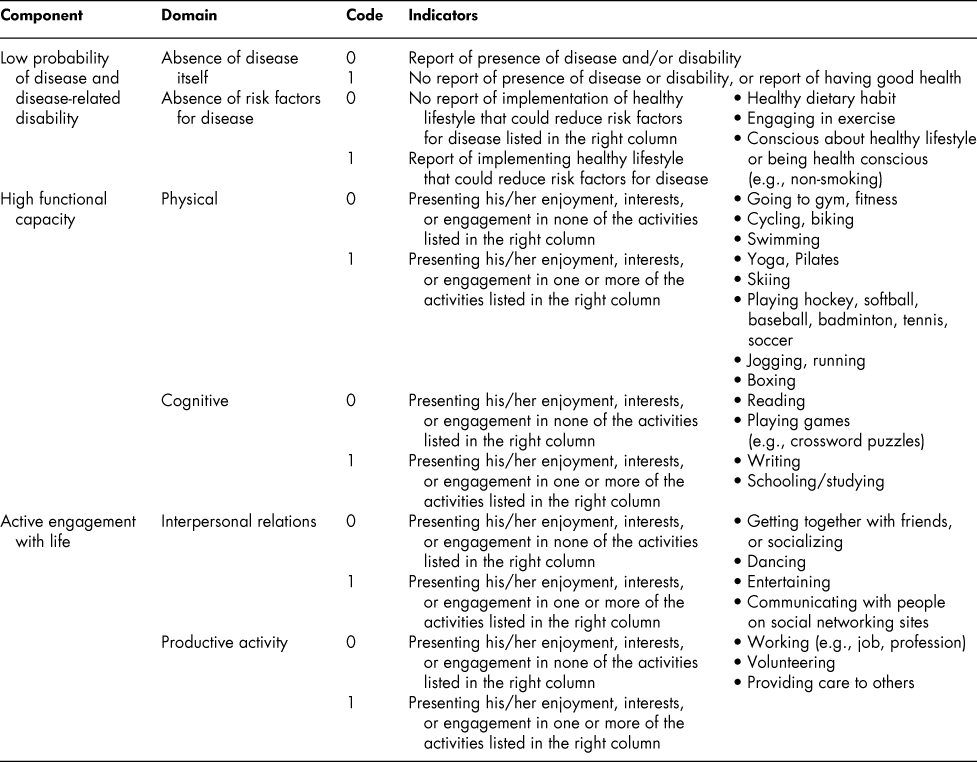
Overall successful aging and its three components were used as dependent variables. Table 1 describes the criteria used to identify whether older adults demonstrated success in each of Rowe and Kahn’s (Reference Rowe and Kahn1997) components and domains in the two free-text boxes, Interests and About Me, in the profiles. All the potential indicators for each domain of successful aging were generated from the profiles we examined. As a research team, we first reviewed the overall content of the description in the text boxes and then identified the indicators that met Rowe and Kahn’s (Reference Rowe and Kahn1997) criteria for each domain on the basis of our understanding of illnesses and disabilities and the level of functioning required for engaging in the activities described.
Digital dating coding guide

The first component, low probability of disease and disease-related disability, was determined based on whether users indicated they had either disease or disability and had risk factors for disease. A profile that indicated the presence of a disease or disability was coded 0 for this domain. Otherwise, it was coded 1. Likewise, code 0 was assigned to profiles that mentioned that the users were at risk of disease, and code 1 was given to the profiles that alluded to the users having healthy lifestyles. Those who indicated in the pre-set categories that they smoke, drink, and/or use drug(s) often mentioned their interest in the substances in the About Me section as well. If it was not mentioned, we added it to About Me and applied the codes.
The second component, high physical and cognitive functional capacity, was determined on the basis of users’ expressed interest or participation in physical and cognitive activities. Table 1 lists the activities that were mentioned in the profiles and coded as indicative of moderate to high levels of physical and cognitive functioning. We discussed and determined whether or not these activities required moderate to high physical and cognitive functioning. The activities we identified as indicative of moderate to high levels of physical functioning were classified as moderate to vigorous metabolic equivalent (METs) intensity levels (3–6 METs and > 6 METs respectively) (Ainsworth et al., Reference Ainsworth, Haskell, Leon, Jacobs, Montoye and Sallis1993). The cognitive activities we identified as indicative of moderate to high levels of cognitive functioning were fairly inclusive (e.g., reading). Physical and cognitive functional capacities were coded independently.
The third component, active engagement with life, was coded based on users’ interest and engagement in the domains of interpersonal and productive activities. We coded these activities separately. The majority of the older adults who indicated in the profession category that they employed also highlighted their engagement in paid work in the About Me section. If this was not the case, we incorporated the employed status into About Me and applied code 1.
Profiles were coded at the component level based on the domain level coding. The first component as a whole was coded – profiles that were coded 1 for both domains were assigned a component code of 1. For the second component, if profiles were coded 1 for both physical and cognitive functional capacity, they were assigned code 1 at the component level. For the third component, profiles were coded 1 if they were positive for either productive or interpersonal activities because this reflects Rowe and Kahn’s criteria (Reference Rowe and Kahn1997, Reference Rowe and Kahn1998), which acknowledge various forms of active life engagement. Overall successful aging was determined based on the three component-level codes. Code 1 was assigned if profiles were coded 1 for all three components.
Statistical Analyses
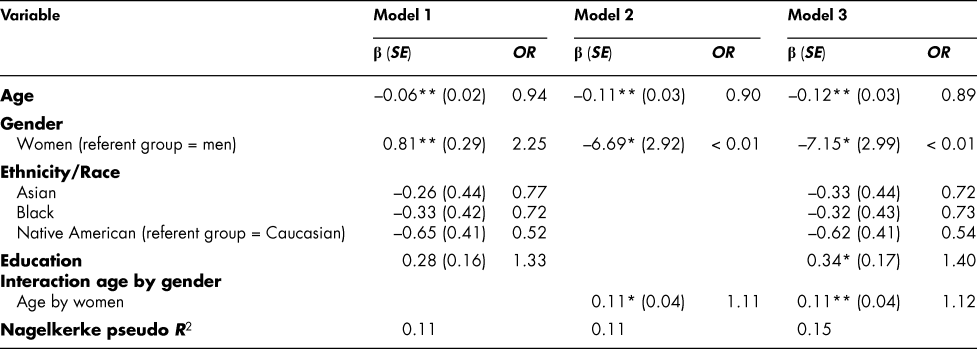
Descriptive statistics were used to characterize the sample. Chi-square tests were used to explore the bivariate relationships between independent and dependent variables. Binary logistic regression models were created to identify independent predictors of the dependent variables. Age was used as a continuous variable in the regression analyses. We entered education into each model as a surrogate for socioeconomic status to control its effect. The first regression model for each dependent variable evaluated the effect of all the independent variables on the dependent variable without interaction terms. Subsequent models identified whether there were significant interactions among each pair of independent variables in the effect on the dependent variable. When interaction terms were identified, they were included in a final model. Version 22.0 of IBM SPSS Statistics software was used for all analyses. For ease of presentation, models without significant interaction terms are not presented.
Results
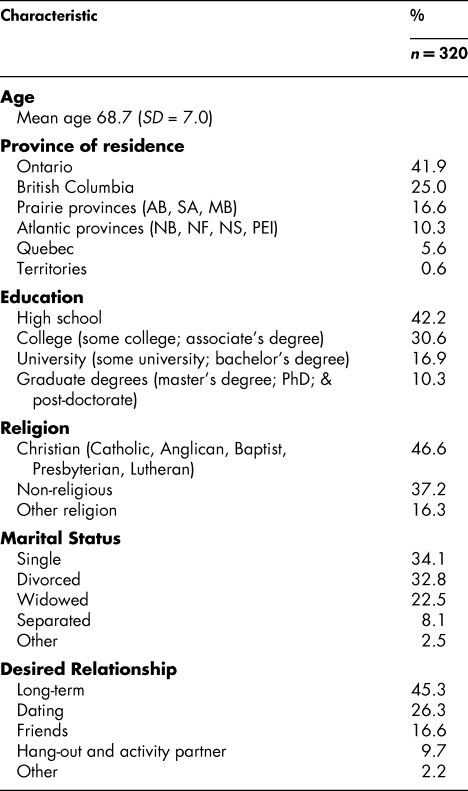
In accordance with our research plan, a total of 320 profiles were collected, with equal numbers from each self-identified race/ethnicity: 80 Asian, 80 Black, 80 Caucasian, and 80 Native American. The demographic data of the sample profiles are shown in Table 2. The majority of profiles were from users who had a high school education. About half the users reported that they were residents in the Canadian province of Ontario and identified themselves as Christian.
Demographics of sample profiles

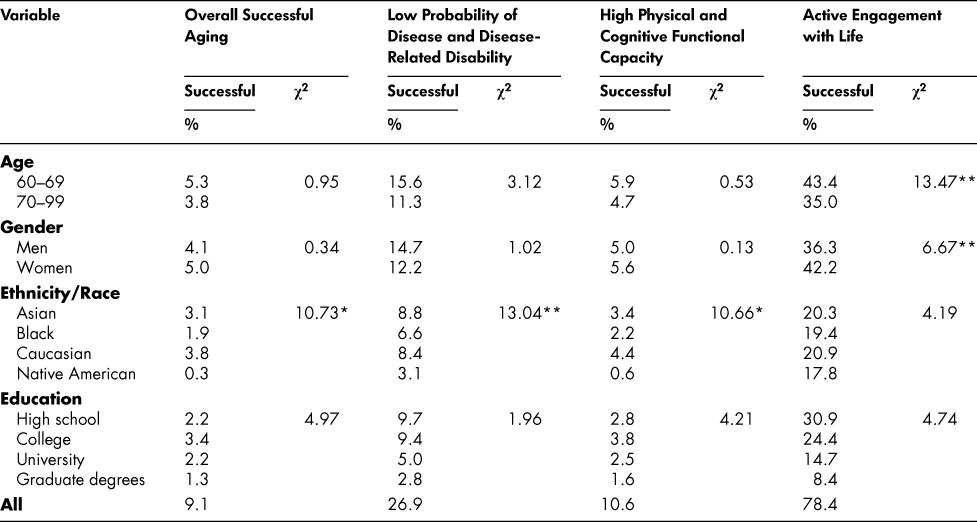
The proportion of profiles exhibiting successful aging and bivariate associations between these outcomes and the independent variables are described in Table 3. Less than 10 per cent of the sample population portrayed themselves as aging successfully. The proportion of profiles that portrayed success in each component varied. A quarter of the profiles portrayed a low probability of disease and disease-related disability, and about 10 per cent of profiles portrayed high physical and cognitive functional capacity. Approximately half of the profiles suggested that the users were cognitively competent as they mentioned their engagement in a variety of cognitive activities (e.g., reading, writing, playing games), whereas only a quarter of the profiles alluded to the users’ moderate to high level of physical functionality. Active engagement with life was most prevalent among the three components. About 60 per cent of the profiles showed the users’ interests or engagement in productive activities, while those that mentioned interpersonal activities accounted for just over 45 per cent.
Prevalence of self-presentation of successful aging according to age, gender, race/ethnicity, and education of the profile owners

χ2 = Chi-square test; *p ≤ .05, **p ≤ .01
SD = standard deviation
Several significant bivariate associations were identified. Native Americans were significantly less likely than other ethnic groups to present themselves as aging successfully in terms of probability of disease and disease-related disability, and physical and cognitive functioning, and overall success. The association between ethnic groups and their presentation of successful aging was significant for overall successful aging (p = .013), the first component (p = .005), and the second component (p = .014). The association with the first component occurred because Native American profiles were least likely to include indicators of a healthy lifestyle, whereas Asian profiles were most likely to contain descriptions of lifestyles associated with a decreased risk for disease (p = .003). Among the four ethnic groups, Native Americans were least likely to emphasize physical functioning in their profiles (p = .005), but there was no significant association with race/ethnicity and overall functioning. Profiles demonstrating active engagement with life were more common in the 60–69 age group (p < .001) as well as among women (p = .01).
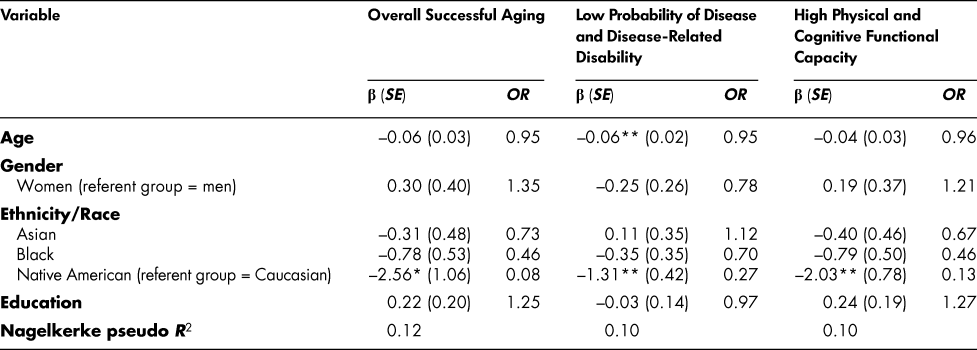
In the absence of any significant interaction effects, Table 4 presents the simple binary logistic regression models for overall successful aging, low probability of disease and disease-related disability, and high physical and cognitive functional capacity. Those who identified themselves as Native American were less likely to present themselves as aging successfully with regard to probability of disease and disease-related disability (p = .002), physical and cognitive functioning (p = .009), and overall successful aging (p = .015). In addition, older age increased the likelihood of exhibiting probability of disease and disability (p = .008).
Results of binary logistic regression analyses: Overall successful aging, low probability of disease and disease-related disability, and high physical and cognitive functional capacity

β = standardised regression coefficient; OR = odds ratio; SE = standard error; *p ≤ .05, **p ≤ .01
Table 5 shows regression models for the third component of successful aging, active engagement with life. Model 3 demonstrated that there was a significant interaction between age and gender (p = .008) in that women’s self-presentation of active engagement with life did not vary with age, whereas significantly fewer older men portrayed themselves as active.
Results of binary logistic regression analyses: Active engagement with life

β = standardised regression coefficient; OR = odds ratio; SE = standard error; *p ≤ .05, **p ≤ .01
Discussion
This study examined how relevant Rowe and Kahn’s (Reference Rowe and Kahn1997) concept of successful aging is to older adults’ lives as presented in their self-portrayals in online dating profiles and how their presentation of successful aging varies according to their socio-demographic characteristics.
Prevalence of Profiles Exhibiting Criteria of Successful Aging
Relatively few profiles were labelled as indicative of successful aging. This was due to the low prevalence of the first two components – low probability of disease and disease-related disability and high physical and cognitive functioning – in the online self-portrayals. In contrast, most profiles portrayed active engagement with life. The small proportions of the profiles highlighting the first and second components of successful aging may mirror the degree to which older adults perceived those components as essential to present in order to attract potential partners in an online dating context. Perhaps older adults did not highlight their physical and mental health in their online profiles because other qualities and behaviours (e.g., their preferred activities or personality traits) were deemed more important. Additionally, it is possible that health was not featured in the profiles because users of the system assumed that only those individuals who had low rates of disease, disability, and dysfunction would be actively dating. In other words, those posting their profiles assumed that their own health was a taken-for-granted requirement and thus not worth mentioning. Even if they had diseases or disabilities, they might be less likely to divulge this information if they believed that the disclosure might negatively affect the impression they gave to a potential partner.
However, a more compelling explanation might be that the small proportion of overall successful aging presented in the profiles accurately reflects the difficulty that older adults have meeting the first and second criteria. The low prevalence of overall successful aging (9.1%) in this study echoes the findings of previous studies which have collectively found that the majority of older adults are unable to achieve optimal aging as conceptualized by Rowe and Kahn (Reference Rowe and Kahn1997) (Bowling & Iliffe, Reference Bowling and Iliffe2006; McLaughlin et al., Reference McLaughlin, Connell, Heeringa, Li and Roberts2010; Strawbridge et al., Reference Strawbridge, Wallhagen and Cohen2002).
At the same time, the high prevalence of active engagement with life in the online self-presentation warrants further comment. The fact that this component of successful aging was often present in the profiles may simply be the result of the pre-set category – Interests – that Plenty of Fish users were expected to complete in the construction of their online dating profiles. Alternatively, the emphasis given to active engagement with life in the profiles may suggest that older adults themselves consider it to be an effective strategy for soliciting desirable romantic partners with whom they will share similar interests. Additionally, the higher prevalence of the third component in the online profiles may reflect the social realities of older adults, the majority of whom are actively engaged in life (e.g., 69.1% in Weir et al.’s Reference Weir, Meisner and Baker2010 study). A wealth of evidence suggests that older adults perceive active engagement with life to be critical to aging well even in the face of declining health and abilities (e.g., Duay & Bryan, Reference Duay and Bryan2006; Iwamasa & Iwasaki, Reference Iwamasa and Iwasaki2011; Phelan, Anderson, Lacroix, & Larson, Reference Phelan, Anderson, Lacroix and Larson2004; Reichstadt, Depp, Palinkas, Folsom, & Jeste, Reference Reichstadt, Depp, Palinkas, Folsom and Jeste2007; Troutman, Nies, & Mavellia, Reference Troutman, Nies and Mavellia2011). This is also in keeping with Rowe and Kahn’s (Reference Rowe and Kahn1997, Reference Rowe and Kahn1998) emphasis on the overarching importance of active engagement in life as a component of their model. Moreover, a number of scholars have argued that Western culture emphasizes the importance of being socially active, if not busy, in order to demonstrate and retain one’s cultural value in an ageist society that privileges independence and productivity (Katz, Reference Katz2000; McHugh, Reference McHugh2000; Rubinstein & de Medeiros, Reference Rubinstein and de Medeiros2015).
Socio-demographic Influences
Our analysis revealed that indications of successful aging among online profiles varied according to a number of socio-demographic variables. Native Americans’ profiles were less likely than other ethnic groups to highlight the first and second components of successful aging – low probability of disease and disability and high physical and cognitive functioning. Although this could be attributed to cultural differences, the low prevalence of Native Americans’ profiles portraying the two components mirrors research finding poorer health outcomes among Native Americans (e.g., higher mortality rate, and greater morbidity rate and risk of chronic disease) than in other ethnic groups (Gionet & Roshanafshar, Reference Gionet and Roshanafshar2013; MacMillan, MacMillan, Offord, & Dingle, Reference MacMillan, MacMillan, Offord and Dingle1996; Wilson, Rosenberg, Abonyi, & Lovelace, Reference Wilson, Rosenberg, Abonyi and Lovelace2010). Previous research points to the social, cultural, and economic inequalities (e.g., unemployment, lower levels of education, and poor living conditions) that contribute to health problems among Native Americans, thereby creating health disparities (e.g., Gionet & Roshanafshar, Reference Gionet and Roshanafshar2013; Gracey & King, Reference Gracey and King2009). Alternatively, boastfulness might not be a normative personality trait among Native Americans (Wisener, Brown, Liman, Jarvis-Selinger, & Woollard, Reference Wisener, Brown, Liman, Jarvis-Selinger, Woollard, Ho, Jarvis-Selinger, Lauscher, Cordeiro and Scott2012).
Advanced age was a significant predictor of references to lower physical functioning and higher risk for disease in the online profiles when other variables were controlled. This finding is not surprising given that increasing age is associated with a higher risk of multiple chronic diseases and disability (Kaplan et al., Reference Kaplan, Huguet, Orpana, Feeny, McFarland and Ross2008; Ramage-Morin, Shields, & Martel, Reference Ramage-Morin, Shields and Martel2010; Weir et al., Reference Weir, Meisner and Baker2010; Wilson et al., Reference Wilson, Rosenberg, Abonyi and Lovelace2010). Advanced age as a determinant of the decline in physical functioning and increase in health risks could also be attributed to reductions in regular physical exercise in this study, which have been noted with increasing age (Statistics Canada, 2013).
There are several possible explanations for why a significant interaction was found between age and gender in older adults’ self-portrayals of active engagement with life. On the one hand, this finding could suggest that highlighting active social engagement is particularly relevant to women in both the older and younger cohort groups because depicting sociality and playfulness is a way for women to create a youthful and traditionally feminine image (McWilliams & Barrett, Reference McWilliams and Barrett2014). On the other hand, previous research has shown that as women age, they remain more socially active than their male counterparts. For example, while declining health and disability experienced by older adults with advanced age is associated with limited participation in productive activities for both men and women (Park, Reference Park2011), the steep decline in men’s presentation of active engagement with life might be due to a significant decrease in their involvement in interpersonal activities after retirement. Cornwell (Reference Cornwell2011) found that men experience a loss of non-work social exposure as well as work-related social contact after they retire. As a result, older women spend more time on social activity than older men (Gauthier & Smeeding, Reference Gauthier and Smeeding2003). In addition, the number of women aged 55 and older who remain in the labour force is increasing (Park, Reference Park2011), which might explain why their involvement in productive activities approached that of men.
This study had two main strengths and two key limitations. Random sampling enables generalization of the findings to all the profiles of Asian, Black, and Native American ethnic origins published on the selected online dating site. Stratification of the profiles according to age, gender, and race/ethnicity permitted exploration of the associations among successful aging and those socio-demographic characteristics. The primary limitation of the study is that although Rowe and Kahn’s (Reference Rowe and Kahn1997) criteria have been criticized for their objective nature (Cernin et al., Reference Cernin, Lysack and Lichtenberg2011; Strawbridge et al., Reference Strawbridge, Wallhagen and Cohen2002), identifying indicators for them was a relatively subjective process. In particular, the authors’ judgements about activities that were indicative of moderate to high levels of cognitive functioning or of active engagement in interpersonal relations might not be shared by others. In many profiles, older adults simply mentioned activities that they were interested in or engaged in, which did not allow us to determine the level of cognitive functioning or active engagement. We might have classified fewer profiles as successful had we operationalized the criteria more rigidly. In addition, the findings may not generalize to profiles posted on other online dating sites.
This study lays the groundwork for several subsequent projects. First, exploring the profiles on various online dating sites would help us understand whether older adults’ portrayals are similar on other sites. Second, qualitative analysis would help understand how older adults present themselves more generally, especially in terms of the characteristics that they highlight. Third, focus groups or semi-structured interviews with older adult online daters might reveal what they do and do not include in their profiles and why. Fourth, semi-structured interviews with older adults could be used to explore what successful aging means to them, how important it is for them to present themselves as aging successfully in their profiles, what components they do or do not highlight in their online dating profiles, and how they decide which components to include or omit. Collecting older adults’ narratives that directly capture how older adults choose to portray themselves and the ways they are aging might further illuminate how online social interaction engages with and reflects underlying societal values.
Conclusion
Overall, the findings from this study suggest that Rowe and Kahn’s (Reference Rowe and Kahn1997) conceptualization of successful aging may not resonate with the way older adults approach online dating. The low prevalence of online dating profiles referring to low probability of disease and disease-related disability and high physical and cognitive functioning may be due to the fact that older adults consider these elements to be unimportant when seeking romantic partners. Alternatively, the low prevalence of these components may reflect that they are unachievable, particularly for Native Americans, individuals aged 70 and older, and older men, and thus risky to mention for fear of highlighting issues that undermine one’s desirability. At the same time, the relatively high proportions of profiles that made mention of active engagement with life may attest to the higher rates of activity among older adults or the importance given to social engagement in Western culture.
As originally conceptualized, successful or unsuccessful aging is primarily a result of lifestyle choices. However, given the low prevalence of successful aging among Native Americans, the study findings highlight potential structural barriers that may set up members of this group for failure to age successfully (Dillaway & Byrnes, Reference Dillaway and Byrnes2009; Holstein & Minkler, Reference Holstein and Minkler2003; Katz & Calasanti, Reference Katz and Calasanti2015). Furthermore, the low prevalence of successful aging overall emphasizes the exclusive nature of this concept, which may contribute to the marginalization of many older adults, especially those with disabilities (Laliberte Rudman, Reference Laliberte Rudman2006; Rubinstein & de Medeiros, Reference Rubinstein and de Medeiros2015). De-emphasizing the importance of lifestyle choices in this model and focusing instead on reducing structural barriers to successful aging might be a way to improve the lives of older adults, especially in terms of decreasing disease and disability and improving functioning. At the same time, it is important to avoid practices that reproduce ageist discourses around independence and productivity, to facilitate greater inclusivity, not just in terms of online dating but within society more broadly.