INTRODUCTION
After dispersal a seed may follow many possible fate paths depending on the biotic and abiotic factors it encounters (Vander Wall et al. Reference VANDER WALL, FORGET, LAMBERT, HULME, Forget, Lambert, Hulme and Vander Wall2005). Seeds deposited on the soil surface can germinate, die or be secondarily dispersed. When secondary dispersal involves seed burial, seeds become part of the underground seed bank (the concept of seed bank also includes seeds on the surface and in the leaf litter; Simpson et al. Reference SIMPSON, LECK, PARKER, Leck, Parker and Simpson1989), thus we use the term ‘underground’ to characterize the portion of the seed bank that is buried. Seeds can be buried by biotic agents (e.g. fossorial animals), abiotic agents (e.g. rain) or simply by gravity (Beattie & Culver Reference BEATTIE and CULVER1982, Marthews et al. Reference MARTHEWS, MULLINS, DALLING and BURSLEM2008).
Buried seeds remain viable during a variable period of time, depending on morpho-physiological seed traits (e.g. latency), microclimatic conditions (e.g. light, humidity) and the action of predators/pathogens (Dalling et al. Reference DALLING, DAVIS, SCHUTTE and ARNOLD2011, Garwood Reference GARWOOD, Leck, Parker and Simpson1989, Wang et al. Reference WANG, JIANG, TOSHIO and ZHOU2013). It is well established that buried seeds are better protected from detection by seed predators than seeds on the surface (Crawley Reference CRAWLEY and Fenner2000, Hulme Reference HULME, Levey, Silva and Galetti2002). Yet, the effects of other factors influencing survival of buried seeds, as well as those affecting seed germination and seedling emergence, are more unpredictable and context-specific (Dalling Reference DALLING, Forget, Lambert, Hulme and Vander Wall2005, Fenner Reference FENNER2000, Pearson et al. Reference PEARSON, BURSLEM, MULLINS and DALLING2002).
In tropical rain forests it has been shown that buried seeds, in particular those found at depths > 5 cm, may not encounter adequate conditions for germination (Pearson et al. Reference PEARSON, BURSLEM, MULLINS and DALLING2002), or may not be able to emerge as seedlings after germination has occurred (Andresen & Levey Reference ANDRESEN and LEVEY2004, Dalling Reference DALLING, Forget, Lambert, Hulme and Vander Wall2005). It has been suggested that these seeds may need to be brought back to the surface, or shallower depths, for germination and seedling establishment to occur (Donath & Eckstein Reference DONATH and ECKSTEIN2012, Grant Reference GRANT and Satchell1983, Putz & Appanah Reference PUTZ and APPANAH1987). It is to be expected that many of the animals responsible for burying seeds through their burrowing behaviour may also play a role in moving buried seeds upwards (Donath & Eckstein Reference DONATH and ECKSTEIN2012). Through upward relocation, seeds may be brought back to the surface, which we call seed exhumation, or may be brought closer to the surface, remaining buried at shallower depths.
Dung beetles (Coleoptera: Scarabaeinae) constitute an abundant and diverse insect taxon in tropical forests, and are known to play important ecological functions (see Nichols et al. Reference NICHOLS, SPECTOR, LOUZADA, LARSEN, AMEZQUITA and FAVILA2008). In the last decade several studies have shown that rain-forest dung beetles bury and/or move horizontally many vertebrate-defecated seeds (Andresen & Feer Reference ANDRESEN, FEER, Forget, Lambert, Hulme and Vander Wall2005). It has also been shown that this secondary seed dispersal by dung beetles can have a positive effect on seedling establishment through reduced predation of buried seeds (Andresen Reference ANDRESEN2001, Andresen & Levey Reference ANDRESEN and LEVEY2004) and/or a reduction in the spatial aggregation of seedlings (Lawson et al. Reference LAWSON, MANN and LEWIS2012). More recently, one study also concluded that by burying seeds, dung beetles may play a major role in structuring tropical soil seed banks (Feer et al. Reference FEER, PONGE, JOUARD and GOMEZ2013). Finally, we know that, as they dig tunnels to bury faeces, dung beetles excavate a large amount of soil (Braga et al. Reference BRAGA, KORASAKI, ANDRESEN and LOUZADA2013). Yet, the question remains: Are dung beetles, through their tunnelling and soil excavation behaviour, also moving buried seeds upwards, possibly enhancing seedling establishment?
The main objective of this study was to address this general question. With this purpose we designed field experiments to test the following hypotheses: (1) Some of the seeds buried by dung beetles are later exhumed by them, depending on seed size; (2) Through their dung-burying activity, dung beetles cause the upward movement of seeds present in the underground seed bank, which in turn promotes seedling establishment; (3) The frequency of dung beetle activity will be positively associated with seedling establishment.
METHODS
Study site
This study was carried out between September 2011 and September 2013 in the Montes Azules Biosphere Reserve (16º07′58″N, 90º56′36″W), located in the Lacandon rain-forest region in the Mexican state of Chiapas. This reserve covers an area of 3310 km2, most of which corresponds to conserved tropical rain forest (Holdridge Reference HOLDRIDGE1967). Mean annual temperature and precipitation are 24 ºC and 3000 mm, respectively (Medellín Reference MEDELLÍN1994). More information on the study site can be found elsewhere (Medellín Reference MEDELLÍN1994).
Seed exhumation
We established 12 experimental stations in three groups of four stations. In each group, stations were placed in the corners of a 50 × 50-m square; distance among groups was > 500 m. In each station we placed 50 g of fresh dung (we used the dung of the howler monkey, Alouatta pigra Lawrence) containing spherical plastic beads used as artificial seeds (Andresen Reference ANDRESEN2002). In each dung pile we introduced 50 small beads (4 mm), 20 medium beads (8 mm) and 10 large beads (12 mm). Each station was checked after 48 h, when all dung had been removed by dung beetles. We collected and counted all beads that remained on the surface. All beads that were not found on the surface were assumed to have been buried by dung beetles underneath the dung source, although some beads might have been buried at some distance from the station.
The whole experimental setup was repeated in three time periods, t1, t2, t3, with 4 mo between t1 and t2 and 8 mo between t2 and t3 (due to logistical reasons we were unable to have equal time intervals), always using the same locations. Beads were of different colours: purple in t1, pink in t2 and white in t3. Four months after t3 we again placed 50 g of dung in each station, but without beads (t4). Seed exhumation was quantified in periods t2 (February 2012), t3 (October 2012) and t4 (February 2013). In a given time period ti (where i = 2, 3 or 4) we counted the number of beads, of those that had been buried in previous time periods (ti-1 and/or earlier periods), that we found in the loose soil excavated by dung beetles. Thus, in t2 we quantified exhumation of beads that had been buried during t1; in t3 we quantified exhumation of beads buried during t1 and/or t2; finally, in t4 we quantified exhumation of beads buried during t1, t2 and/or t3.
Seedling establishment
To assess the effect of the soil-tunnelling activity of dung beetles, and of the frequency of this activity, on the establishment of seedlings from seeds naturally present in the soil seed bank we carried out two complementary experiments. Experiment 1 was designed to address both questions by comparing three treatments simultaneously (no beetle activity vs. single-time beetle activity vs. recurrent beetle activity). However, during the first months after setting up Experiment 1 we observed very few seedlings establishing and thus decided to increase sample size by setting up Experiment 2. Yet, the large scale of this second experiment did not allow us to include the ‘recurrent beetle activity’ treatment (due to the large amount of monkey dung needed).
Experiment 1. We established 1 × 1-m plots with all sides surrounded by a wire mesh (2 mm mesh size) 30 cm high and buried 5–10 cm into the ground (the mesh was buried to make sure that dung beetles started building their tunnels inside the experimental plots, so that all excavated soil would be within plots). We had a total of eight groups of three plots each, distributed in eight forest locations or blocks (N = 8), with a distance of 2 m between plots in a block and 50 m between blocks. All seedlings found inside the plots were removed. Plots within a block were randomly assigned to three treatments: (1) single-time placement of 100 g of fresh howler monkey dung (divided into three piles to mimic natural defecation patterns); (2) repeated placement of 100 g of dung, once every week, for a total of four times; and (3) control, no dung added. All seeds were removed from dung used in this experiment, except for seeds of Cecropia obtusifolia Bertol. which could not be removed due to their small size. Thus, C. obtusifolia seedlings establishing in experimental plots were excluded from analyses. During 2 d the tops of all plots were left open to allow dung beetle activity. Thereafter, all tops were covered using the same type of mesh; this was done to avoid the arrival of new seeds, and to prevent access to herbivores. Plots were checked every 2 wk for 12 mo. During every check we counted, identified and marked all seedlings of woody plant species. When possible, using several information sources (literature, internet, experts, direct measurements) we classified seedlings according to life form (tree, shrub, liana), primary seed dispersal syndrome (zoochory, anemochory, barochory) and seed size category (<5 mm and ≥5 mm).
Experiment 2. We established small circular plots, 0.17 m2 in area, by burying plastic cylinders (we used 25-cm tall buckets with bottoms removed) 5–10 cm into the soil. All seedlings found inside plots were removed. We placed 100 pairs of plots along existing trails; distance between plots in a pair was 0.5 m and distance between pairs was 30 m. Half the pairs were set out in October 2012 and the other half in February 2013. Plots in each pair were assigned randomly to two treatments: (1) single-time placement of 50 g of seedless monkey dung, and (2) control, no dung added. As in Experiment 1, plots were left open for 2 d to allow dung beetle activity; thereafter they were covered with mosquito net. Plots were checked for seedling establishment every 2 wk for 6 mo.
Data analyses
To analyse the effect of seed size on the proportion of seeds exhumed by dung beetles we used a generalized linear model with artificial seed size as the independent variable. Exhumation data obtained in the three periods were pooled for analyses. A quasi-binomial error structure was used due to overdispersion of data (Crawley Reference CRAWLEY2007).
To analyse the effect of dung beetle activity and its frequency on seedling establishment (Experiment 1) we used two generalized linear models with treatment as fixed factor with three levels (repeated dung, single-time dung, no dung). A quasi-Poisson error structure was used for each of the dependent variables: ‘number of species’ and ‘number of individuals’. Post hoc comparisons between pairs of treatments were performed using the HSD Tukey test. To analyse paired data from Experiment 2 (single-time dung vs. no dung), for the same dependent variables as in Experiment 1, we used the non-parametric Wilcoxon test for paired comparisons. G-tests were used to test for independence between seed size of established seedlings (<5 mm and ≥5 mm) and experimental treatments.
Adequacy of error structures used in the generalized linear models was corroborated with residual analyses (Crawley Reference CRAWLEY2007). Analyses were carried out in R version 2.15.3 (R Development Core Team. http://www.R-project.org/).
RESULTS
Seed exhumation
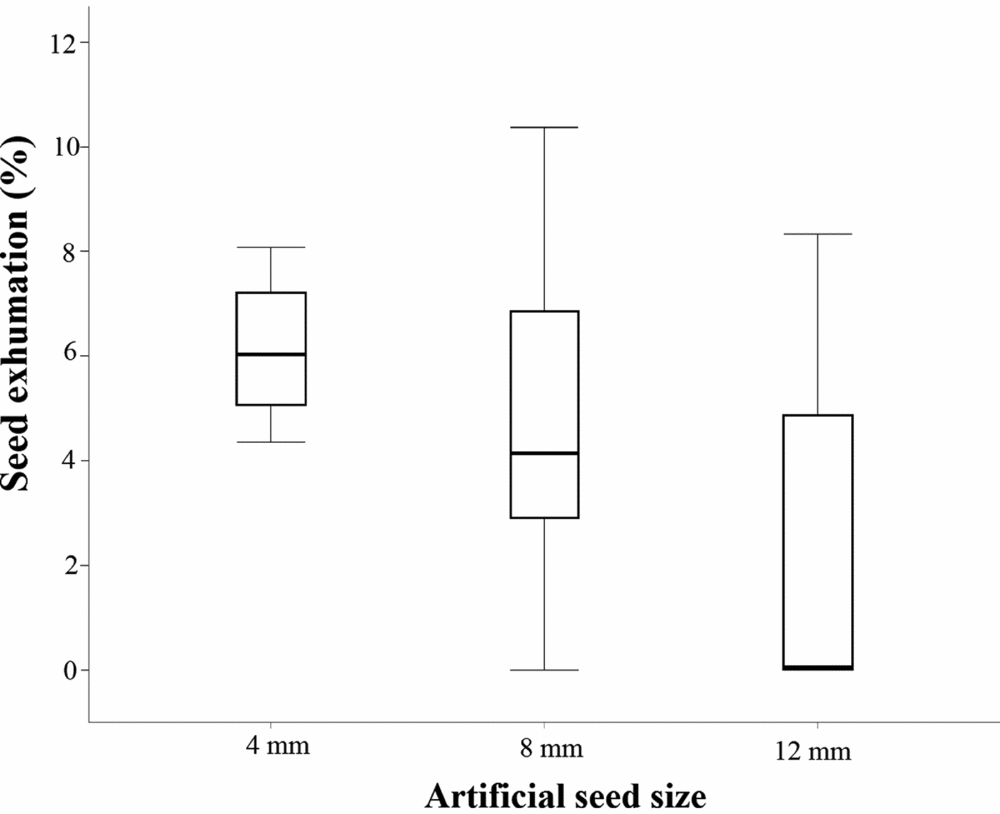
Dung beetles buried an average of 68% ± 30% (mean ± SD) of the artificial seeds (pooling all sizes) placed inside dung piles. Dung beetles exhumed 5.4% ± 1.06% of previously buried beads. As expected, smaller beads had a higher probability of being exhumed by dung beetles compared with larger beads (6.1% for small beads, 4.9% for medium beads and 2.4% for large beads; F1,34 = 8.52, P = 0.006; Figure 1).
Percentage of plastic beads used as artificial seeds, of three different sizes, exhumed by dung beetles (N = 12 for each size). Boxes represent the interval between the 25th and 75th percentiles; also shown are the positions of the medians. The whiskers indicate the minimum and maximum values observed.

Seedling establishment
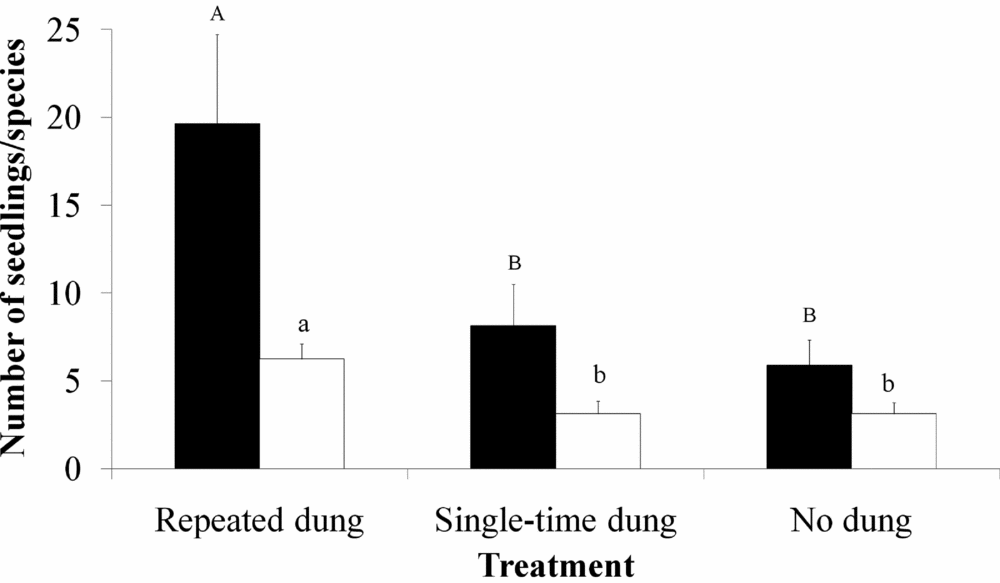
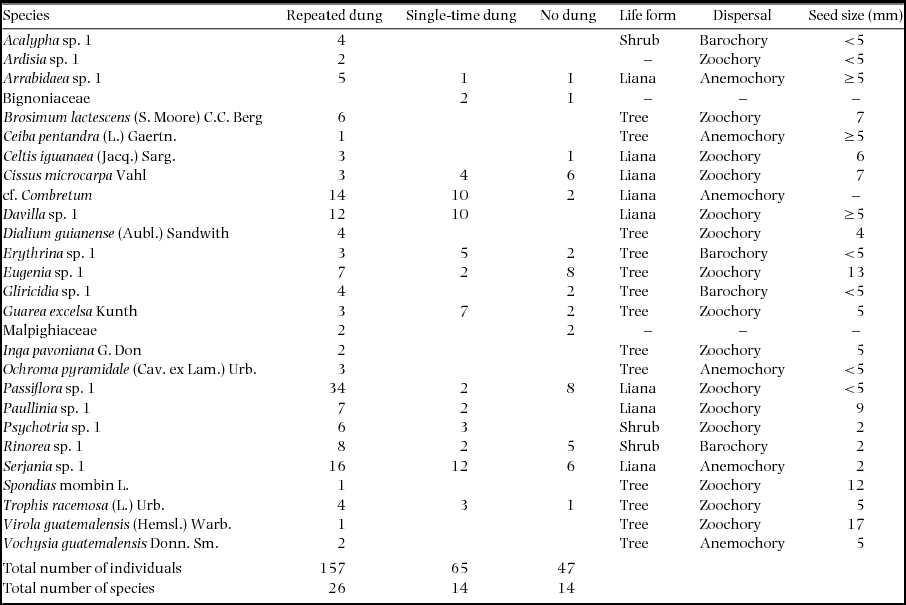
Experiment 1. Pooling the 24 plots of 1 m2 we recorded the establishment of 269 seedlings of 27 woody plant species, in 1 y (Appendix 1). Additionally, 130, 27 and 36 seedlings of C. obtusifolia established in the repeated dung, single-time dung and no dung treatments, respectively, but were not included in analyses. Both the mean number of individuals and mean number of species per plot were affected by treatment (individuals: F2,7 = 12.5, P <0.001; species: F2,7 = 6.53, P <0.001; Figure 2). Post hoc tests revealed that values were significantly higher in plots with repeated dung placement, when compared with the treatment with single-time dung placement (individuals: N = 8, Z = −3.49, P = 0.001; species: N = 8, Z = −2.98, P = 0.008) and the control treatment (individuals: N = 8, Z = 4.24, P <0.001; species: N = 8, Z = 2.98, P < 0.001). No significant differences were found between the latter two treatments (individuals: Z = 0.990, P = 0.579; species: Z <0.001, P = 1; Figure 2). Seed size (two categories: <5 mm and ≥5 mm) of established seedlings was independent of treatment (species, G = 0.047, df = 2, P = 0.977; individuals, G = 3.15, df = 2, P = 0.207).
Mean number of seedling individuals (black bars) and species (white bars) in 1-m2 plots with three different treatments: repeated placement of 100 g of dung (once a week for 4 wk), single-time placement of 100 g of dung, and no dung placement. Error bars represent 1 SE. Different letters above bars indicate statistical differences with the HSD Tukey post hoc tests; uppercase letters are for number of individuals and lowercase letters for number of species.
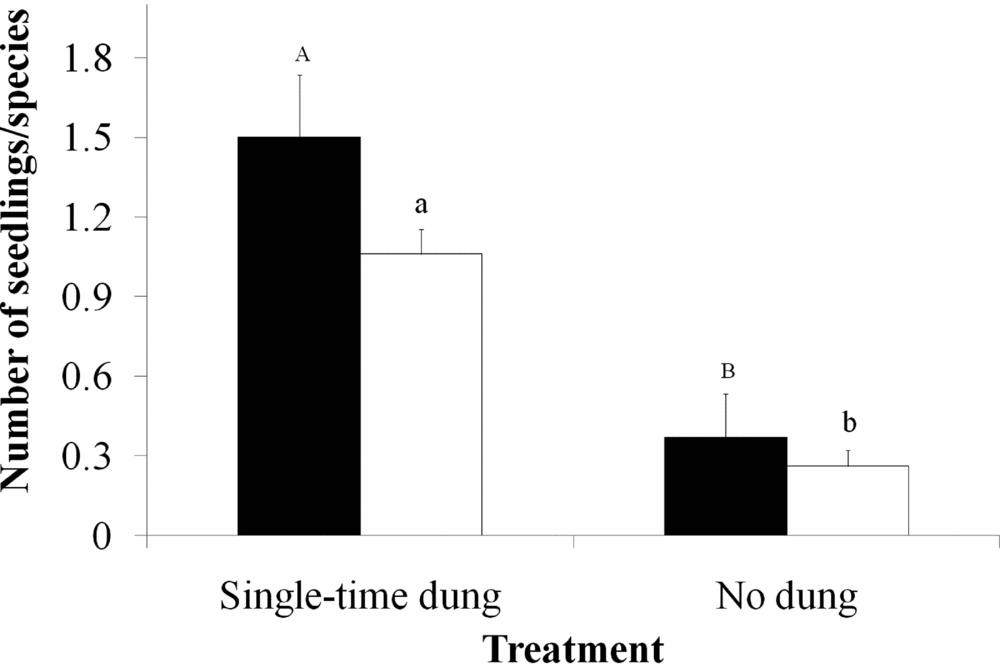
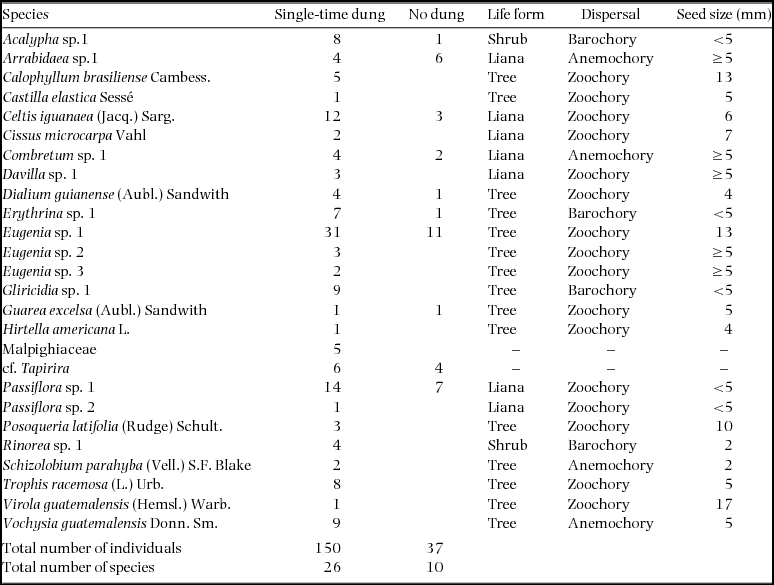
Experiment 2. In the 200 plots of 0.17 m2 pooled together we recorded the establishment of 187 seedlings of 26 woody plant species, in 6 mo (Appendix 2). Contrary to the results in the previous experiment, having increased statistical power in this experiment, we found increased seedling establishment in plots with dung beetle activity than in plots without it (individuals: Z = −5.38, N = 100, P <0.001; species: Z = −5.27, N = 100, P <0.001; Figure 3). As in Experiment 1, seed size of established seedlings was independent of treatment (species, G = 0.123, df = 1, P = 0.726; individuals, G = 0.377, df = 1, P = 0.539).
Mean number of seedling individuals (black bars) and species (white bars) in 0.17-m2 plots with two different treatments: single-time placement of 50 g of dung, and no dung placement. Error bars represent 1 SE. Different letters above bars indicate statistical differences based on the Wilcoxon paired test; uppercase letters are for number of individuals and lowercase letters for number of species.
DISCUSSION
Seed bank dynamics involves processes that are crucial for plant regeneration (Thompson Reference THOMPSON and Fenner2000), with important practical implications for management and restoration (Garwood Reference GARWOOD, Leck, Parker and Simpson1989, Skoglund Reference SKOGLUND1992). With our study we have shown that dung beetles, through their dung-processing behaviour of building underground tunnels, actively participate in seed bank dynamics, not only by burying seeds, but also by moving buried seeds upwards. We propose that upward relocation of buried seeds be added to the large list of ecological functions performed by dung beetles in tropical rain-forest ecosystems (Nichols et al. Reference NICHOLS, SPECTOR, LOUZADA, LARSEN, AMEZQUITA and FAVILA2008).
In some instances the upward relocation of seeds brings seeds back to the surface, resulting in seed exhumation. Every time rain-forest dung beetles bury a given amount of dung, they excavate more than twice that amount of soil (Braga et al. Reference BRAGA, KORASAKI, ANDRESEN and LOUZADA2013), which would be expected to contain at least some seeds in most cases (Dalling et al. Reference DALLING, SWAINE and GARWOOD1994). Although the percentage of artificial seeds exhumed estimated in our study was low (≤6%), this represents a conservative figure. We only measured exhumation for those beads buried immediately underneath the experimental station, and we assumed that all buried beads had been buried there. However, it is most likely that roller beetles incorporated some of the artificial seeds into their dung balls and buried them at some distance away from the experimental station. Thus our estimate of the total number of seeds buried underneath each station was likely overestimated, and consequently our percentages of seeds exhumed were likely underestimated.
Seed exhumation was negatively associated with seed size, as previously documented for seed burial by dung beetles (Andresen & Feer Reference ANDRESEN, FEER, Forget, Lambert, Hulme and Vander Wall2005, Culot et al. Reference CULOT, HUYNEN, GÉRARD and HEYMANN2009). However, in the case of upward seed relocation it may occur that, rather than actively being excluded by dung beetles as in the case of seed burial, the inherent size of larger seeds might hamper their upward movement through soil layers during the tunnelling activity of dung beetles. To more accurately describe and quantify seed exhumation, future studies could carry out experiments in which known numbers of beads are buried by the researcher at known depths, and in which the activity of dung beetles is restricted to a certain area. Also, use of a broader range of seed sizes, in particular small ones (1–3 mm), would be very informative. Future studies would also need to compare the role played by dung beetles in the upward relocation of buried seeds, relative to other soil-dwelling organisms. Finally, future studies on seed exhumation would need to assess the increased risk of seed predation due to seed exposure on the surface. Indeed, the best-documented advantage of secondary seed dispersal by beetles is that seeds buried by them suffer very low rates of seed predation by granivores, compared with seeds on the surface (Santos-Heredia et al. Reference SANTOS-HEREDIA, ANDRESEN and ZÁRATE2010). So, seed exhumation might have a high associated cost in terms of seed survival, one that remains to be quantified.
However, exhumed seeds represent only a proportion of all seeds moved upwards by dung beetles, and likely a small proportion, with most upward-relocated seeds remaining buried close to the surface. Yet, future studies would need to corroborate this by conducting careful experiments in which the downward and upward movements of seeds along soil profiles, as a consequence of dung beetle tunnelling activity, is measured with more detail. Although in our study we did not quantify the exhumed and relocated seed bank directly, we did so indirectly by quantifying seedling establishment, which provides a conservative estimate of actual seed bank abundance and composition (Dalling et al. Reference DALLING, SWAINE and GARWOOD1994). We found that significantly more individuals and species established as seedlings in plots in which dung beetles had buried dung and excavated soil, compared with plots where beetles had not been active (Appendix 2, Figure 3).
Studies on the ecology of tropical soil seed banks have shown that soil depth tends to be negatively associated with seed viability (Pouvelle et al. Reference POUVELLE, JOUARD, FEER, TULLY and PONGE2009) and seedling emergence (Dalling et al. Reference DALLING, SWAINE and GARWOOD1994), and that many seeds need to be in shallower depths in order to encounter conditions that trigger germination and/or allow seedling emergence (Donath & Eckstein Reference DONATH and ECKSTEIN2012, Grant Reference GRANT and Satchell1983, Pearson et al. Reference PEARSON, BURSLEM, MULLINS and DALLING2002, Putz & Appanah Reference PUTZ and APPANAH1987). Upward relocation by dung beetles may be particularly important for small seeds, which are often buried more deeply (Andresen & Feer Reference ANDRESEN, FEER, Forget, Lambert, Hulme and Vander Wall2005, Feer et al. Reference FEER, PONGE, JOUARD and GOMEZ2013), and which have greater depth constraints for seed germination and seedling emergence (Dalling Reference DALLING, Forget, Lambert, Hulme and Vander Wall2005).
Our study also showed that in specific rain-forest areas in which dung beetle activity occurs repeatedly over time, seedling establishment is further increased, in comparison to areas in which dung beetle activity is less frequent (Appendix 1, Figure 2). Recurrent dung beetle activity is expected to occur in areas which receive an equally recurrent input of dung. Many mammal species defecate repeatedly in the same sites, a pattern known as ‘latrine behaviour’ (Irwin et al. Reference IRWIN, SAMONDS, RAHARISON and WRIGHT2004). Among Neotropical frugivorous mammals, primates and tapirs are well known for this behaviour (Fragoso et al. Reference FRAGOSO, SILVIUS and CORREA2003, González-Zamora et al. Reference GONZÁLEZ-ZAMORA, ARROYO-RODRÍGUEZ, OYAMA, SORK, CHAPMAN and STONER2012), and studies focusing on the consequences of primary seed dispersal by these mammals often show increased seedling establishment of the dispersed plant species in these sites (Bravo Reference BRAVO2012, Russo & Augspurger Reference RUSSO and AUGSPURGER2004).
Such increased seedling establishment is primarily caused through the continuous seed deposition by the frugivorous mammals. However, our results suggest that dung beetle activity may also in part be responsible for facilitating such increased seedling establishment in recurrent defecation sites of frugivorous mammals. Indeed, results of a recent study suggest that the combined effect of primary seed dispersal by primates and secondary seed dispersal by dung beetles is actively shaping seed bank structure and dynamics (Feer et al. Reference FEER, PONGE, JOUARD and GOMEZ2013). That study also found that dung beetle activity was significantly higher in sites in which monkey defecation was more frequent. Our results on seedling establishment further suggest that dung beetle activity will independently enhance seedling establishment through upward relocation of seeds present in the underground seed bank, i.e. even in defecation sites of non-frugivorous mammals where seed input is not increased through primary seed dispersal. This remains to be tested through future studies.
In conclusion, our study shows that dung beetles play yet another important ecological role through their dung-relocation behaviour, namely the upward movement of buried seeds. In turn, upward seed movement is likely to be an important process in the dynamics of seed banks, with relevant consequences for plant populations and communities. We believe that our study opens up a promising avenue for future research in our way to attaining a more detailed understanding of all the possible outcomes of the interactions between seeds and dung beetles, and the overall role of this insect group in plant regeneration. Finally, as dung beetles are increasingly being used as a model taxon in studies assessing the effects of biodiversity loss on ecosystem functions and services (Braga et al. Reference BRAGA, KORASAKI, ANDRESEN and LOUZADA2013, Dangles et al. Reference DANGLES, CARPIO and WOODWARD2012), we propose that assessment protocols could easily incorporate the measurement of this new ecological function.
ACKNOWLEDGEMENTS
This research was supported by grants from the Consejo Nacional de Ciencia y Tecnología (research project SEP-CONACyT 2010–152884, graduate fellowship CONACyT 245258) and Programa de Apoyo a Proyectos de Investigación e Innovación Tecnológica (PAPIIT – UNAM, Project IN-207711). We thank the administration of the Secretaría de Medio Ambiente y Recursos Naturales (SGPA/DGVS/03075/13) and the Comisión Nacional de Áreas Naturales Protegidas (Oficio No. REBIMA/009/12) for the necessary permits and access to the Reserva de la Biosfera de Montes Azules. We are grateful to UNAM's Centro de Investigaciones en Ecosistemas (CIECO) and Programa de Posgrado en Ciencias Biológicas (PCBiol) for logistical support. This article constitutes a partial fulfillment of the requirements for obtaining the doctoral degree at PCBiol. This study would not have been possible without the help in the field of Diego A. Zárate, Rafael Lombera, Miguel Miranda, Isaías Lombera and Isidro Lopez Lira. We thank Diego A. Zárate and Rafael Lombera for seedling identification. We are grateful to two anonymous reviewers for insightful comments on a previous version of the manuscript.
Total number of seedlings established in 1-m2 plots (N = 8 plots per treatment) with three different treatments: repeated placement of 100 g of dung (once a week for 4 wk), single-time placement of 100 g of dung, and no dung placement. Information on life form, primary seed dispersal syndrome and seed size (width) are given for each species, when available. For those species, for which we could not measure seeds directly or obtain measurements from other sources, we provide two broad categories (<5 mm and ≥5 mm) based on the information available for the particular genera in our study region.
Total number of seedlings established in 0.17-m2 plots (N = 100 plots per treatment) with two different treatments: single-time placement of 50 g of dung, and no dung placement. Information on life form, primary seed dispersal syndrome and seed size (width) are given for each species, when available. For those species, for which we could not measure seeds directly or obtain measurements from other sources, we provide two broad categories (<5 mm and ≥5 mm) based on the information available for the particular genera in our study region.