In 1943 the reviewer Henry Saville declared, “As far as any one man typifies any one thing, Cecil Beaton can be considered today to symbolize the revolution the war has brought to Britain.”Footnote 1 In the 1930s, Saville alleged, Beaton had been “amusing” and “clever,” but now he had been transformed by his wartime commissions into a serious “reporter” of the human experience. Before 1939 Beaton had been Britain's leading photographic chronicler of the worlds of theater, fashion, high society, and royalty, what Beaton himself termed “the pleasure class,” or what others labeled (cleverly appreciating the fusion between a new leisured class and the mechanisms of celebrity) “the plutography.”Footnote 2 During the Second World War, Beaton's work appeared to undergo a change in direction. He was commissioned to take portraits, not of movie stars and debutantes at costume balls, but of prominent politicians and military leaders. Languid and spangly images of the rich at play gave way to somber photographs of the destruction of the London Blitz. His employment by the Ministry of Information led to assignments with the Royal Air Force and the British army in North Africa, Burma, India, and China. Beaton's wartime work appeared to represent a shift from playful frivolity to the seriousness of literally life-and-death situations, from artificial glamour to sober realism, and, most critically of all, from a celebration of privilege to a lionization of the courage and sacrifice of ordinary soldiers and civilians. In this narrative, Beaton undergoes a secular redemption, being brought into alignment with the populist and collectivist strictures of the “People's War.”Footnote 3 Moreover, for those admirers who might previously have been embarrassed by Beaton's flamboyant self-fashioning as a sexually suspect dandy, his new direction could be presented as an abandonment of private decadence in favor of civic virtue or a public eschewing of effeminacy in favor of the celebration of the robust and martial masculinity of the fighting man and those who commanded him.
The first study of Beaton's photography to highlight his apparent wartime transformation appeared in 1946. Peter Quennell, in a retrospective survey of Beaton's 1930s photographs, noted, “how odd and archaic are certain features of the world he illustrates—fancy dress parties and High Bohemian jinks and ‘amusing’ furniture, baroque knick-knacks, bead fringes and flowers under glass bells.” Quennell lauded Beaton for repudiating his earlier “spangled nebulosities and flimsy, fussy whim-whams” in favor of a “commendably direct … matter-of-fact approach.”Footnote 4 Quennell returned to this theme in the foreword to an anthology of Beaton's wartime photographs published under the auspices of the Imperial War Museum in 1981. The volume had been the idea of the photographic historian and former associate of Beaton, Gail Buckland. Buckland became a critical figure in establishing what has become the conventional wisdom about Beaton's war. In an introduction to the anthology, Buckland asserted that “the photographs he took at home and abroad in the period from 1940 to 1944 confirm that a major change took place in Cecil Beaton.”Footnote 5 Such judgments were reiterated in retrospectives of Beaton's career as a whole, for example, the 1968 exhibition directed by Roy Strong at the National Portrait Gallery and a 1980 commentary by James Danziger.Footnote 6 Further endorsement was provided in 1985 by Beaton's official biographer, Hugo Vickers, who insisted that “Cecil was not the same man in 1945 that he had been in 1939. … His values had altered. He would rather despise old friends who had remained in luxury while others had risked their lives. He had made himself useful during the war and on many occasions shown unexpected bravery and inner courage.” Footnote 7
Indeed, the notion of Beaton's war as an artistic progress from artifice to realism, a visual encapsulation of his path from privilege to participation, was a story that was as familiar to the photographer himself as to those who celebrated his artistic achievement. He told columnist Peter Stewart that wartime commissions had been a fillip to his work: “I was sick to death of posing people around apple blossom.”Footnote 8 In North Africa in 1942 he appeared to disown the prewar high society in which he had flourished, scorning “a period when, trusting in Baldwin, we went to fancy dress parties, did imitations, danced the Lindy Hop and carted heavy luggage over the face of the globe.”Footnote 9 Even his return to fashion photography at the end of the war appeared to reflect his new wartime sensibility. Taking photographs in New York in 1944, Beaton confessed that, while the “fantastic luxury that I had to portray delighted me,” nevertheless “my recent experiences in photographing some of the grimmer aspects of life had had an influence. … I tried to evolve a greater simplicity and deeper feeling of reality.” Instead of staged photographs of models taken in a studio, Beaton portrayed young women at the hairdresser, their hair in pins.Footnote 10 After the war, Beaton seemed to appreciate the wisdom of locating himself within the dominant cultural memory of World War Two as, in Geoff Eley's description, “a narrative of popular democratic accomplishment.”Footnote 11 Looking back from 1968, Beaton declared that the war years had made his 1930s images “obsolete,” for the “posed, static hands with the pointed index finger and arched wrist [had] acquired an overnight vulgarity.”Footnote 12 While Beaton himself tended to express his wartime transformation in aesthetic, rather than explicitly political, registers, he concurred with a growing consensus that he had apparently personified the redemptive quality of war. The elitist, narcissistic, and effete individualist had metamorphosed into a selfless, virile participant in the heroic wartime collectivity.
In fact, such attempts to sequester Beaton's wartime photographs to the dominant narratives of the “People's War” can only be partially successful. Beaton's work between 1939 and 1945 reveal how his prewar standard, far from being abandoned, was now redeployed to serve the needs of national mobilization. His photographs and diaries represent the continued significance, especially (although not exclusively) in the realm of the imagined and the fantastic, of a flamboyantly elitist sensibility that sat uneasily with the democratic discourses of wartime populism. Moreover, the queer gaze latent in his photographs destabilizes readings of his wartime photographs, which imply a shift from frivolous and fantasized “feminine” fashion photography to serious “masculine” documentary realism. Beaton's wartime photographs are as much political as they are cultural, texts. Film historian Tony Williams's remarks on wartime cinema could be applied with equal validity to Beaton's wartime work. “Desire,” Williams asserts, “is never entirely spontaneous but is governed by particular ideological structures operating within any historical era.” Williams, in his close reading of a variety of British wartime cinematic texts, detects a yearning for new progressive understanding of human relations that was thwarted by the dominant conservative ideology of the wartime and postwar social settlement.Footnote 13 In her study of the manner in which wartime collectivism was constructed from a series of overlapping strategies of inclusion and exclusion (in regard to class, race, and gender), Sonya Rose argues that we need to give more attention to wartime “structures of feeling,” imaginative possibilities that were not necessarily fulfilled either during, or after, the war. For Rose, at “the centre of this structure of feeling was concern about social and economic inequality and a renewed focus on ‘the social question.’”Footnote 14 A study of Beaton's photographs concurs with such problematizing of the notion of a “People's War” but differs in emphasis by highlighting a conservative strain within wartime structures of desire, albeit one that was no less disruptive of official renderings of “Britishness” than the more progressive conceptions recovered by Rose. Beaton's photographs and wartime writings were obliged to genuflect to what Rose neatly characterizes as the “egalitarian morality” that predominated in official discourses of the war, but they also revealed an individualist, elitist, and imperialist fantasizing of the wartime imaginary.Footnote 15 While never explicitly party political, they represent a visual rendering of what will be termed here “romantic Toryism.”
Romantic Toryism is best characterized as a state of mind, a sensibility in which conservatism functions not as an ideology or political movement, but as a part of British cultural life: in Alison Light's words, “a source of fantasy, inspiration and pleasure.”Footnote 16 Romantic Toryism was essentially a celebration of the poetic, heroic, and spectacular dimensions to social hierarchy at home and imperial supremacy abroad. As the name implies, it privileged fancy over reason in its enthusiasms for the mystery and ceremonial of the crown, the illustrious ancestry of the aristocrat, or the dashing chivalry of the soldier. Romantic Toryism had its origins in the early nineteenth-century medieval revivalism of Walter Scott, whose historical novels lionized a patrician noblesse oblige, which was explicitly contrasted with the leveling tendencies and selfish materialism of the new industrial order. The quintessential romantic Tory of the nineteenth century was, of course, Benjamin Disraeli, with his sparkling imagination and misty-eyed sentimentalization of venerable institutions, such as the House of Lords and the monarchy.Footnote 17 Despite Disraeli's legacy, romantic Toryism was not necessarily consonant with activism within, or even membership of, the Conservative Party. George Wyndham and Winston Churchill certainly satisfied the requirements of romantic Toryism, but, while they certainly had their moments, Robert Peel, Stanley Baldwin, and Neville Chamberlain did not. Conversely, not all romantic Tories were Conservatives. Sincere attachment to many of the tropes of romantic Toryism was evident in the historical writings of professed “lifelong socialist” A. L. Rowse and in the self-fashioning of war hero and minor royal, but also avowed supporter of the Labour Party, Lord Louis Mountbatten.Footnote 18
When Disraeli made Queen Victoria empress of India in 1876, he ensured that the magical allure of empire would now be entwined with the splendor of the crown, a heady mix that, as Churchill's tears at his first audience with the young Queen Elizabeth II in 1952 revealed, retained its emotional potency to the very end of Britain's days as an imperial power.Footnote 19 The Empire provided a space, both real and imagined, in which many of the essential qualities of romantic Toryism—the superior breeding of the upper classes, martial prowess, and sentimental patriotism—could be displayed at their most heroic and flamboyant. If glamorous imperial heroes, such as Gordon of Khartoum, T. E. Lawrence, or Frederick Burnaby, were not captivating enough, they were supplemented by the stirring fictional narratives of John Buchan or A. E. W. Mason, in which physical grace, individual initiative, and the innate supremacy of the British way of life were all consistently extolled.Footnote 20 Romantic Toryism was present in the works of historical novelists, especially those enamored of the graceful courage of the seventeenth-century cavaliers or the eighteenth-century Jacobites.Footnote 21 It was also championed by popular histories produced in the middle decades of the twentieth century, most notably Churchill's History of the English-Speaking Peoples, Keith Feiling's History of England, and the works of A. L. Rowse and Arthur Bryant.Footnote 22 At a more mundane level, romantic Toryism could be reflected in a positive valuation of national ceremony and royal pageantry or deference to patrician leadership in either national politics or on the field of battle.
Recognizing the continued vitality of romantic Toryism in the 1940s problematizes what has become a virtual orthodoxy about cultural and political developments in mid-twentieth-century Britain. Alison Light, in a highly influential intervention, asserted that, in the interwar years, there was a “move away from formerly heroic and officially masculine public rhetorics of national identity … to an Englishness at once less imperial and more inward-looking, more domestic and more private - and, in terms, of prewar standards, more ‘feminine.’”Footnote 23 Another commentator on changing conceptions of national identity has concurred with this claim for a “shift in national sensibilities” after 1918, declaring that “modern Englishness rested now unambiguously on the little things.”Footnote 24 However, the presence of romantic Toryism in British cultural life suggests that conservatism was not exclusively imagined in terms of the familiar and the sedentary. Romantic Toryism offered a colorful and picturesque alternative, emphasizing not the qualities of “ordinariness,” but rather the virtues of the uncommon man (and, occasionally, woman), whether it be the gallantry of the highly decorated gentleman-officer, the swashbuckling self-assurance of the imperial adventurer, the grand manner of the patrician statesman, or the dignity and splendor of a royal princess. Of course, it might be argued that romantic Toryism amounted to little more than an essentially residual culture by the middle of the twentieth century, a reactionary yearning for an aristocratic, militaristic, and imperial order whose days, notwithstanding a last hurrah in the wartime rhetoric of Winston Churchill, were decidedly numbered. However, this would be to underestimate the purchase of romantic Toryism beyond the compasses of the merely reactionary or nostalgic. The scripts of romantic Toryism possessed a remarkable adaptability, which rendered them available to a range of social actors. Reverence for ancestral tradition and a belief in the superiority of the ruling classes did not exclude the possibility of social outsiders such as Disraeli or Noel Coward (and, indeed, Cecil Beaton) becoming leading exemplars (or at least boosters) of the romantic Tory standard. At times of national crisis, the ordinary people of Britain (e.g., those enduring the London Blitz) might find themselves, albeit temporarily, accommodated within the romantic Tory pantheon.Footnote 25
Moreover, romantic Toryism demonstrated the capacity to merge creatively with more recent social and cultural developments to ensure its continued vitality. The increasing sophistication of the mass media and the creation of “celebrity culture,” for all their democratizing implications, created the equal possibility of new means to valorize elitist and antiegalitarian conceptualizations of the world.Footnote 26 To take just one example, in the 1930s, the screen personae of British film stars Robert Donat and Leslie Howard were essentially a refashioning of the romantic gentleman adventurer from the heyday of British imperialism.Footnote 27 It is as an illustration of a modernized, refurbished version of romantic Toryism that Cecil Beaton's wartime career will be considered in this article. Its intention is not merely to offer a critique of Beaton's alleged transformation during the war but, more broadly, to demonstrate the resilience of conservative structures of feeling in Britain during the 1940s. For all its collectivist fervor, the People's War imaginary contained space for the production and articulation of alternative aesthetic codes and, by association, for the promotion of anticollective and antipopulist social values and cultural sensibilities. Beaton did not stand alone in this respect, and similar political and cultural desiderata can be retrieved from a medley of contemporary sites (ranging, as will be seen, from the movies of Powell and Pressburger to the celebrity of wartime soldier-heroes Guy Gibson and Lord Lovat). In fact, it is evident that romantic Toryism was a far from insignificant part of Britain's wartime symbolic economy. Bringing Beaton's wartime photographs more fully into focus can therefore contribute to a more profound understanding of the elaborate confection of continuity and change that characterized British culture between 1939 and 1945.
I. Beaton's New Sensibility?
Cecil Beaton was born in 1904, the son of a timber merchant, and the grandson of a businessman who imported railway sleepers. While Beaton's father was sufficiently well off to send his son to Harrow, his business collapsed in the 1920s. Growing up, Beaton was distressed to discover that his family was not as socially elevated as he would have liked. Indeed, his maternal grandfather was later revealed to have been a blacksmith from Cumberland. Beaton desperately sought escape from his rather prosaic origins, drawing on his experiences, first at Harrow (where he was a contemporary of George Orwell) and then at Cambridge, to reinvent himself as a man of leisure. Lacking independent wealth, he needed a means of making a living that would not conflict with his snobbery and desire to live the life of a socialite. Photography, which he had pursued at an amateur level since his childhood, proved the answer. In the 1920s he became the photographer of choice for the “bright young things” and a protégé of the aesthete Stephen Tennant and the Sitwell family. By the 1930s, he was working for Vogue and regularly traveled to photograph major film stars in Hollywood. In 1939 his international reputation as a portrait photographer was secured by an invitation to photograph Queen Elizabeth at Buckingham Palace. He also produced set and costume designs for ballet, opera, and theater and became an icon of style and chic. While he was a highly professional photographer, he obscured his labors behind a facade of effortless elegance. Inevitably, sustaining such an illusion did not entirely compensate for continued private insecurities. His unexpurgated diaries revealed acerbic comments about many of his subjects, which stood in stark contrast to the glamorous and flattering photographic images he had just produced of them.Footnote 28
The outbreak of war found Beaton desperate to be “useful” in some way, tortured by his awareness that, while he was “too incompetent” to enlist in the army, he possessed a genuine desire to serve his country.Footnote 29 Such anxiety possibly had sexual, as well as patriotic, provenance. As an unmarried socialite and dandified aesthete, Beaton risked association with those upper-class “sexually suspect shirkers” singled out for scathing ridicule by the wartime popular press.Footnote 30 Beaton seemed genuinely gratified by the opportunity to work for the Ministry of Information, although his work did not always meet with total approval. He could make amends for the apparent levity and fecklessness of his prewar career and, in one particular case, apparently even offer some penitence. In 1938 he had been sacked by American Vogue after he submitted a cartoon containing a reference to “damned kikes.”Footnote 31 If such remarks reflected the casual (but no less pernicious) anti-Semitism of the prewar British high society through which Beaton moved, later compensation seemed to be offered by his poignant 1942 photograph, taken at a refugee camp in Palestine, of a young Jewish refugee from Poland.Footnote 32
Such “before and after” stories inevitably obscure complex continuities between the 1930s and 1940s. Beaton's prewar photography certainly celebrated a world of privilege, leisure, and conspicuous consumption. As befitted the temper of the times, Beaton's field of vision was plutocratic rather than aristocratic, a gilded world in which the titled elite partied and posed with fashion models, writers, artists, and stage and screen actors, in a refashioned version of the eighteenth-century beau monde, where qualities of attractiveness and fascination were not exclusively yoked to birth or title.Footnote 33 Still, it was undoubtedly a world of the smart set. Beaton had little in common with those contemporaries in the world of documentary realism, such as Humphrey Spender or Bill Brandt, who hoped to link what they saw as the essential veracity of photography to projects of social and political reform.
Beaton's prewar work was not all stylized portraiture of the well heeled and the well connected. Recent commentaries on Beaton have emphasized his virtuosity in the 1930s, highlighting his experiments in grotesque, pastiche, and caricature. The elaborately constructed backcloths to his studio portraits need to be balanced by consideration of his candid travel photographs, documentary images of Haiti, Tangiers, Mexico, Greece, Russia, Italy, and New York, which anticipated his more spontaneous war images. Beaton also sought a dialogue with surrealism, placing his fashion models among piles of debris or next to an inverted bucket of whitewash.Footnote 34 Beaton was no dilettante in the 1930s, and he clearly took seriously the duty of establishing photography as an artistic endeavor of the highest status. His contribution to the Britain in Pictures series sought to establish a British photographic canon going back to William Fox Talbot, Roger Fenton, and Julia Margaret Cameron.Footnote 35
If Beaton's photography in the 1930s was not merely an exercise in flamboyant fancy, conversely, the war years did not necessarily produce an unqualified shift toward an aura of austerity and authenticity appropriate to the life-and-death struggle against Nazism. In the winter of 1939–40, Beaton decided the most useful contribution he could make to the war effort was to produce a pantomime—Heil Cinderella—for the benefit of troops stationed on Salisbury Plain. Beaton's efforts to secure costumes, design sets, and enlist the services of a variety of amateur actors drawn from among members of the Wiltshire county set could seem an apposite metaphor for the last gasping breath of the prewar establishment during the “phoney war.”Footnote 36 Moreover, Beaton's belief that theater and fabrication were more stimulating than reality (he had given up duties as a night telephonist at an air raid precautions center to produce the play) equally might appear as a hangover from the sensibilities of a world that was soon to be lost forever, to become in Peter Quennell's words, “a kind of Troy or Babylon, a buried city.”Footnote 37 Beaton's theatrical proclivities persisted long after 1940. In 1942 he took time out from his Ministry of Information duties to design costumes for a revival of Shaw's Heartbreak House, starring Edith Evans.Footnote 38 Many of his war photographs were self-consciously theatrical. A group of identically dressed sailors on a ship in the Middle East are photographed from above in a choreographed ensemble reminiscent of a dance routine from a stage musical.Footnote 39 Groups of civilians or military personnel are frequently spread across Beaton's photographs, creating what David Alan Mellor described as “informal chorus lines in these theaters of war.”Footnote 40 War, for Beaton, remained another form of theater, an arena in which artifice and imagination could still have full license.
Nor did Beaton turn his back on fashion photography during the war, even if a wartime motif was to be regularly incorporated. He continued to work for Vogue, providing images like that of Mrs. Reginald Fellowes wearing a Paquin hat and firefighting gloves, published in 1941. In January 1943 Beaton portrayed the new uniforms of the women's auxiliary services in a highly stylized and glamorized set of poses.Footnote 41 Indeed, Beaton might be seen as a key player in Vogue's efforts to render fashion and beautification compatible with, and indeed essential to, the war effort. Beaton's photographs and articles sat cheek-by-jowl with editorials urging “Beauty Build Up,” advice on stomach-flattening exercises entitled “Limbering Up for the Big Push,” and advertisements for cosmetics that extolled women “to see that your mirror reflects your faith in victory.”Footnote 42 The relationship between fashion and war was, as studies of Vogue's other famous wartime photographer, Lee Miller, reveal, a complex one and certainly not the binary opposition that might be expected.Footnote 43 Beaton's advance from hemline to front line was not unique, another contributor to Vogue at this time being Richard Busvine, dress designer turned war correspondent.Footnote 44 When Beaton was sent to Paris in the autumn of 1944 to organize an exhibition of Ministry of Information photographs about Britain's wartime experience, he still had time to seek out France's leading fashion designers for a Vogue fashion shoot.Footnote 45
Beaton did not become a documentary realist during World War Two.Footnote 46 His
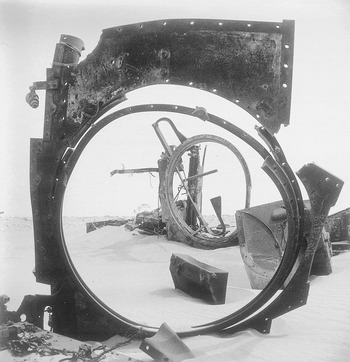
Tank remains at Halfaya Pass, 1942.

photographs remained a mix of invention and reality, a fusion of fantasy and documentation. Screens and frames, a distinctive element in his 1930s fashion studies, recurred in the staging of his wartime portraits. The Chinese police department at Chengtu, for example, is viewed through a cutout circle in the wall.Footnote 47 Strong geometric shapes—circles or squares—would always be incorporated into a photograph wherever possible. The most successful example of this is a photograph of burned-out tank remains after the battle of Halfaya Pass, where “a rhythm of circular disks stand in diminishing recession,” creating a macabre, yet decorative, landscape of war (see fig. 1). Beaton saw the sites of battle as an affirmation of the mutually enriching dialogue between surrealism and photography. Casting his gaze over the carcasses of burned-out aircraft, cars ripped apart by machine gun bullets—“their underparts pouring out in grotesque, tortured shapes”—or the bizarre sight of “some unaccountable clothing blown into telephone wires,” Beaton concluded that “the Surrealists have anticipated this battle ground.”Footnote 48 Beaton's assertion that the desert war meant Salvador Dali, Max Ernst, and Joan Miro had all “proved to be prophetic” appears to be endorsed by the reading matter of Keith Douglas during the North African campaign. In the soldier-poet's kit bag during the advance westward after El Alamein was David Gascoyne's Short Survey of Surrealism.Footnote 49 Beaton's readiness to interpret the war in surrealist terms was therefore not unique, but it certainly affirms that he had clearly retained many of his prewar stylistic prerogatives. Surrealism was put to work in the cause of wartime populism, and prewar aesthetic sensibilities were reassigned to present the British war effort to a broader public.
While Beaton's wartime photographs have a substance and power that defies the reduction of Beaton to the mere “crown prince of Brilliantia” (a label coined by a Vogue colleague), it remains true that they retain his prewar emphasis on surface, pose, and polish. They fail to disturb or provoke the viewer in the way that works by his contemporaries Bill Brandt and Lee Miller do. The viewer is rarely troubled by the potential violence and danger of war. Beaton himself conceded this absence as a weakness in his photographs. Even in Burma, the closest he came to actual combat situations, he acknowledged that his pictures “gave an almost idyllic impression of sunlight filtering through the tropical trees” and failed to provide “not even the slightest hint of the loneliness and quiet terror of jungle warfare.”Footnote 50 Since his photographs were largely commissions for a government agency, his pictures were assembled in albums that made the experience of war coherent and legible, his photographs arranged chronologically with typewritten labels precisely identifying (and thereby fixing) each subject. Any potential artistic discomposition was clearly disciplined by the bureaucratic rationalism of the warfare state. His photographs in Vogue tended to be presented in the form of informal scrapbooks, but, once again, every image was labeled, albeit in a published simulacrum of Beaton's own handwriting, rather than in the officious font of a Whitehall typewriter.Footnote 51
II. Class, Sexuality, and Masculinity
If there was a stylistic continuity between Beaton's prewar and wartime photographs, the class politics within them also failed to undergo a dramatic realignment. It is true that the field of Beaton's subjects was dramatically broadened. Beaton photographed not just senior military and political figures but also ordinary British civilians and regular servicemen. However, his photographs of the home front (despite including his most widely reproduced image, the sentimental image of the child Blitz victim Eileen Dunne) were among his least successful wartime commissions. The heroic productivity of miners and foundry workers (celebrated by artists such as Stanley Spencer or Henry Moore) or the mystical fortitude of Londoners sheltering in the Underground (captured by both Henry Moore's sketchbook and Bill Brandt's camera) failed to inspire him. Beaton lacked empathy with both industrial labor and patriotic communalism, both key ingredients in dominant constructions of the People's War.Footnote 52 His 1941 volume, Air of Glory, was a montage of photographic testimonies to the diversity of individual contributions to the war effort. It included antiaircraft crew on remote cliff tops, workers in an aircraft production factory, Royal Air Force flyers, the crews of minesweepers and corvettes, evacuees from the east end of London, housewives in their kitchens, and the polyglot crowds gathered at railway stations or service canteens. However, this celebration of individuals participating in a greater cause did not necessarily endorse the wartime rhetoric of egalitarianism. In a preface to the book, Beaton argued he had been “fortunate, more than fortunate, in being able to see … how the varying strata of humanity are rallying to the country's call.”Footnote 53 Beaton's belief in an intrinsic and rightful social hierarchy was not shaken by his wartime experience. When changes within the corridors of power suggested a new populist standard, Beaton endeavored to refashion the wartime political imaginary through a prewar aesthetic sensibility. Photographing the unimpeachably plebeian Ernest Bevin, whose appointment as minister of labour in 1940 embodied the centrality of the working class (at least in its unionized, masculine formation) to official narratives of the war effort, Beaton attempted to ensnare his sitter within the trappings of refinement by posing him against a grand staircase in his Whitehall offices. Bevin was clearly troubled by the potential association of prewar aesthetics with prewar social and political hierarchies and chided Beaton for “trying to make me look more Royalist than the King! I suppose you think America expects me to have the Duke of Buccleuch's background.”Footnote 54
Some of Beaton's wartime activities suggested a world relatively untroubled by the proximity to destruction. Beaton seemed to share the company of a number of people who were utterly indifferent to the war, such as Stephen Tennant in the decorative reclusion of his Wiltshire retreat or Gerald Berners on his family estate in Oxfordshire.Footnote 55 An article written for Vogue at the height of the London Blitz in November 1940 presented prewar society hostesses as increasingly distracted by voluntary work but reassuringly noted that “Lady Colefax still bravely continues her Monday dinner parties … even when her window-panes are blown out and the servants are ‘sheltering’ below,” while every Thursday “Her Grace of Westminster is at her home in a large pink room filled with friends and flowers.”Footnote 56 Even in Cairo, facing the advance of Rommel's panzers, Beaton could find a vibrant and exclusive social scene to participate in.Footnote 57
The apogee of Beaton's wartime romantic Toryism came in his photographs of the royal family, especially the highly idealized studies of Queen Elizabeth. Beaton's success as a royal portrait photographer was far from inevitable. For all his snobbery, his exposure to social privilege in the 1930s had largely been confined to a fashionable “fast set” to which the majority of the royal family (with the exception of the duke and duchess of Kent and Edward, Prince of Wales) did not, and did not want to, belong. However, Beaton possessed a genuine reverence for the crown and what he felt to be the intrinsic radiance of its female members.Footnote 58 Portraying the serene queen in evening dress and jewels might have appeared perverse within the rubric of a People's War, but these images of pageantry and the theatricality of dynastic power were hugely popular and widely reproduced during the war years. What has been described as “a repeated Beatonesque association of light and monarchy” invested his portraits of the House of Windsor with “royal auras,” implying a sacralized regality, if not a full-blown divine right of monarchy.Footnote 59 It has been argued that the success of the British crown in the twentieth century was based on a powerful synthesis of private probity and public grandeur.Footnote 60 However, sometimes the House of Windsor's efforts to present an image of respectable bourgeois domesticity risked creating the appearance of being mundane and prosaic. Diarist and Conservative MP Henry Channon lamented in 1940 that “the present Royal regime … do not impress or thrill me at all. … They do their job well, but ‘the divinity which doth hedge a king’ is completely lacking.”Footnote 61 Beaton, by contrast, as a romantic Tory in the Disraelian mold, was committed to emphasizing the extraordinary, rather than the ordinary, aspects of monarchy. He never quite overcame the essential banality of George VI, expressing his frustration that his portraits of the king lacked “mystery and magic.”Footnote 62 However, this disappointment was more than compensated for by the critical acclaim accorded to his portraits of the queen. In later years, Beaton's romantic representation of a fairy-book Queen Elizabeth was to enter the pantheon of camp. However, camp, as Richard Dyer reminds us, requires a separation of representation from content, a playing up of artifice to reveal the ultimate triviality of the subject portrayed.Footnote 63 This characterization hardly seems applicable to Beaton, whose belief in the matchless qualities of a hereditary monarchy was genuine and heartfelt. Moreover, if there was nothing ironic or disingenuous in Beaton's fantasia of royal splendor, neither should we ignore the fact that his romantic Tory valuation of the monarchy was widely shared, even within the imaginary of the People's War. To broad swathes of the population, the royal family represented stability and continuity, a reassuringly steadfast presence amid the violent dislocation of total war. For all the wartime discourses about participatory citizenship, Britons still fought World War Two as loyal subjects of the British-imperial crown.
In terms of military culture, Beaton was drawn to glamorous individualists rather than to the understated fortitude of the citizen-soldier. Indeed, Beaton was never more lyrical than when describing the “romantic daring” of the Royal Air Force officers whom he spent several weeks with during 1941. Typically he sequestered them to a gentlemanly and chivalric past rather than to the technological modernity suggested by the aircraft they flew. He cited with approval the group captain who organized archery practice for his aircrew, so that “these champions of the most modern of all long-range weapons are adepts at the bow and arrow, through which the English archers won the Battle of Agincourt.” He eulogized over “Digger,” a Rhodesian flyer who “looks like the traditional hero thrown back from a romantic novel,” and “Mac,” who “looks like a pale Van Dyck cavalier.”Footnote 64 In North Africa, Beaton was fascinated by the founder of the Special Air Service, the “daring highwayman” David Stirling, one of the “most romantic figures of this war.” He also lunched with the irregular soldiers of the Long Range Desert Group, whose adventures behind enemy lines were “as brightly coloured as any pirate story.”Footnote 65
Beaton seemed anxious that wartime collectivism might stifle heroic individualism. In this foreboding he was not alone. Novelist Elizabeth Bowen recalled that, during the war, “outwardly, we accepted that at this time individual destiny had to count for nothing: inwardly, individual destiny became an obsession in every heart.”Footnote 66 Beaton felt uncomfortable in military uniform and expressed relief at being discharged from duty in 1942, so as “to find again my own individuality.” He remained contemptuous of “trade,” maintaining a division of labor in which the developing and printing of his images was left to others. During wartime he never felt obliged to modify his performance as an existential dandy, heroically spurning the dictates of the masses. He would have undoubtedly recognized himself in Albert Camus’ celebration of the dandy's “aesthetic of solitary creators” in The Rebel. For Camus, the dandy's singularity had been encapsulated in the slogan, attributed to Charles Baudelaire, “to live and die before a mirror.”Footnote 67 This linkage between individualism, display, and narcissism certainly characterized the wartime Beaton, whose self-portrait regularly appears in his images of interior spaces and outdoor locations.Footnote 68 Even among the young airmen who impressed Beaton greatly (Winged Squadrons is his least self-conscious wartime book, the only written text in which he is not the central character), he still, one day in the air, observed himself reflected in the viewfinder of his camera: “The crow's feet around my eyes were those of an old man. Oh God! Was there no escape from oneself even under these unusual conditions?”Footnote 69
The fact that Beaton's social conservatism was entwined with his sexual self-fashioning had significant consequences for his representation of British masculinity during the war. In the 1920s Beaton had rejected the middle-class patriarchy of his father's Hampstead home in favor of the quasi-aristocratic matriarchy of high bohemia and, to all intents and purposes, never returned. His public performances as a dandy and his private homosexual passions in the decades to come could therefore be seen as an obliteration of both bourgeois and hegemonic masculine conventions. However, it is important to appreciate at this point that while Beaton's queer aesthetic is a regular presence in his work, Beaton's life as a gay man is much more elusive. Beaton's official biographer reflects the difficulty of capturing, let alone classifying, Beaton's homosexuality, apparently making no effort to conceal references to Beaton's same-sex relationships, while at that same time ensuring such intimations reveal little about his personal erotic preferences. For a start, Beaton was, strictly speaking, bisexual, having affairs with a number of women during his life, most famously with screen legend Greta Garbo.Footnote 70 The sexual dynamics of the relationship in the late 1920s between Beaton and his male companions, such as the aesthetes David and Stephen Tennant or the “society homosexual” Beverly Nichols, is difficult to reconstruct with any degree of certainty.Footnote 71 However, his serious love affair with Peter Watson, the son of a baronet and millionaire margarine manufacturer, suggests an affinity for homosexual hedonists from a similar, or higher, social class than his own.Footnote 72 While even less is known about his casual sexual encounters, Beaton did not appear to share the enthusiasm of many men of his temperament, class, or age for working-class “rough trade.”Footnote 73 His elitism and defense of social hierarchy seem to be relatively uncompromised by erotic imperatives that required him to cross class barriers for sexual fulfillment.
Before the war Beaton had occasionally openly flirted with transvestism (he photographed himself impersonating Elsie de Wolfe at a ball in New York in 1934) and androgyny (as in the portraits of Countess Castega or Oliver Messel). However, as with his contemporary Noel Coward, he usually preferred to deploy his bohemian-queer aesthetic more covertly, an example of what Terry Castle has categorized as “subliminal provocation.” Both Beaton and Coward utilized camp theatricality to create a “high style” that was taken up by both gay men and lesbians but that also amounted to a successful homosexual infiltration of mainstream culture in the 1920s and 1930s.Footnote 74 By contrast, more palpable renderings of same-sex desire were not on Beaton's agenda. There are distinct similarities between Beaton's photographs and those of the American George Platt Lynes. Lynes, like Beaton, was a fashion and portrait photographer and also shared the latter's interest in dance, performance, and theatrical staging. Indeed, the two men were good friends from the 1920s, and both worked for Vogue. However, while Lynes's stylized images of high glamour and Hollywood celebrity are remarkably similar to Beaton’s, Lynes simultaneously produced a series of images of male nudes that, in their extraordinarily blatant homoeroticism, anticipate the work of Robert Mapplethorpe.Footnote 75 There is, by contrast, no testimony to gay eroticism as overt as this in Beaton's opus.
Yet the potential destabilizing impact of Beaton's prewar queer aesthetic on his wartime photographs was ever present, even if it did not always manifest itself in the more obvious environments. For example, Beaton's travels in North Africa and the Middle East involved taking a journey that had registered in the northern European gay imaginary since the days of Winckelmann. However, Beaton appeared to have little interest in adopting, or reconfiguring, established Anglo-Saxon homosexual fantasies of beautiful young men with olive skin and dark eyes.Footnote 76 He certainly had read about T. E. Lawrence, whose heroic adventures in the Middle East had been accompanied by a love affair with the Arab boy Dahoum.Footnote 77 In Jordan he met the British commander of the Arab Legion, Brigadier Sir John Bagot Glubb, the famous “Glubb Pasha,” but was desperately disappointed to discover he had none of Lawrence's flamboyant charisma.Footnote 78 A photograph of a young air force flyer in conversation with a local Egyptian adolescent, which it would be tempting to read as an allusion to the Lawrence-Dahoum story, ultimately lacks any overtly sexual salience.Footnote 79 Indeed, the only mildly homoerotic passage in Beaton's Levantine diary is a description of British troops bathing, scrubbing, and soaping one another, plunging into a pool, and finally sunbathing together: “tired, they unconsciously created a living classical frieze as, letting the sun dry their apricot-coloured bodies, they sat against the silver palm-trees along the side of the pool in which Cleopatra is said to have bathed.”Footnote 80 Nor did Beaton, despite his lengthy sojourns with the armed services during the war, seem particularly responsive to the erotic spectacle of the uniformed military body, thereby confounding a long-established fetishization of the scarlet and gold of the guardsman in the British middle-class gay imaginary.Footnote 81
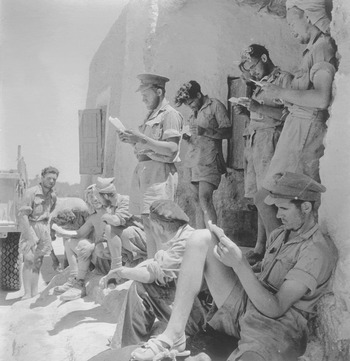
However, if Beaton's studies of military life in the Middle and Far East were rarely overtly homoeroticized, his images of wartime masculinity are not entirely unproblematic. His photographs are of men waiting or resting, and the routine of daily life, not records of frontline combat action. He made no effort to compete with the visceral images of fighting and dying offered up by the photojournalism of Robert Capa. Indeed, it is not unreasonable to categorize his studies of officers and men at lectures and briefings, reading letters from home (see fig. 2), or spending their leisure time in the mess as essentially domestic.Footnote 82 Beaton's diaries are full of domestic referents, even in the context of a homosocial military life from which the female and the familial were ostensibly banished. He described Derek Adkins, his Royal Air Force conducting officer in Egypt, buying provisions for their desert assignment, items as diverse as saucepans, towels, goggles, and toilet tissue: “There was so much to buy that it seemed like marriage, getting a trousseau and setting up house.” Beaton spoke admiringly of mess secretaries, “like housewives on shopping expeditions,” swapping sugar and tea for eggs with
Members of the Long Range Desert Patrol Group, reading letters from home in the Western Desert, 1942.

local tribesmen, or of squadron leaders using wildflowers and old Chianti bottles to create improvised floral displays in the mess tent. He noted the presence, on the desk of Air Vice Marshal Arthur Coningham, of leather frames containing photographs of his “good-looking wife, like Norma Shearer, and family.”Footnote 83 In India, women regularly intruded into his studies of the military world of headquarters and imperial administration. His Delhi photographs include groups of the viceroy's junior officers socializing with their female friends, or young married couples, such as Colonel and Mrs. Frances Humphreys.Footnote 84
In Cairo the minister of state, R. G. Casey, told Beaton that he was instructing photographers to concentrate on morale-boosting images of strong-limbed and thick-set soldiers, since “too often a freckled, spotty little chap, who may be as wiry and daring as be damned, gets into the picture, and the impression he creates doesn’t do any good.” Beaton assented, reflecting that a photographer, unlike a writer, had no possibility of demonstrating how a man's moral courage could overcome his limited physique.Footnote 85 Beaton certainly chronicled hard bodies in the desert war, for example, the toned torso of a Long Range Desert Group member stripped to the waist or buffed sailors exercising on the deck of a battleship.Footnote 86 However, it was a sensitive and slightly built bomber pilot rather than the squadron's hearties who most impressed Beaton during his time in the Royal Air Force. For Beaton, nineteen-year-old Hughie Tring, described as “the son of a clergyman, aesthetic-looking, with strong, rather feminine features, lean, with the long well-formed hands of a violinist, and the dark quiet voice of a scholar,” represented “the nobility of our cause.” Indeed, Tring is even further feminized in the transition from diary entry to published pen portrait in Winged Squadrons. When Beaton meets him he is actually reading Henry Williamson's quasi-fascistic Tarka the Otter, but Beaton reconstitutes the meeting so that the young flyer's text of choice is Jane Austen's Sense and Sensibility.Footnote 87 Here we have a rare revelation of Beaton's personal erotics, suggesting a preference for a gentle, almost androgynous, masculinity, rather than a more muscular physicality.Footnote 88 Beaton's aesthetically derived conception of male beauty makes it impossible for him to valorize masculinity solely in terms of physical strength, even when his subject is a warrior rather than a fashion model or matinee idol. Moreover, Beaton's only significant image from close to the combat zone (more precisely, the Chin Hills on the Burma front) is a study, not of male aggression, but of masculine tenderness, as a wounded Gurkha lays his cheek on the head of his comrade who is carrying him to safety.Footnote 89
Nor do Beaton's photographs of senior military figures always seem particularly martial. Air Marshal Arthur Tedder appears puckish and playful.Footnote 90 “Glubb Pasha” looks wistful rather than self-possessed, and his manly authority is undermined by a heavy black telephone that looms up in the foreground, implying power is a product of technological, rather than human, agency.Footnote 91 Veteran and Victoria Cross recipient, Lieutenant-General Adrian Carton de Wiart, stands bolt upright and stares into the distance with a steely gaze and a firmly set jaw. However, even this fierceness is mitigated by the fact that he possesses only one eye, his eyeless socket hidden away under a black eye patch. His scarred face is thereby a reminder of the vulnerability of masculinity under fire. De Wiart preserves the boundary of his body with his rigid poise, ensuring it cannot be registered as leaky or abject. Nevertheless his wound makes it impossible not to be reminded that the male body is never impenetrable, thereby compromising his performance of martial
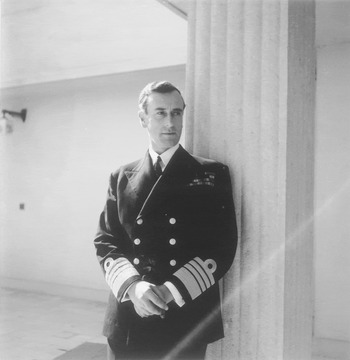
Portrait of Admiral Lord Louis Mountbatten, 1944.

masculinity.Footnote 92 When preparing for his portrait, Admiral Lord Louis Mountbatten was desperate to give an impression of toughness appropriate to his status as supreme allied commander in South East Asia. However, the ghosts of his past as a dynastic paladin and bisexual playboy haunt Beaton's image of what remains an elegant and dapper Mountbatten (see fig. 3). Beaton renders him little more than a mannequin, an androgynous fashion plate, an object of mere fascination, incapable of the agency and autonomy that hegemonic masculinity required.
The relationship of Beaton's homosexuality to the People's War imaginary is far from straightforward, especially when it is so entangled with his social self-fashioning. Beaton may have been so eager to preserve social hierarchy, at a time when this was being called into question by the imperatives of wartime populism, because his class allegiances protected his sexual affinities. After all, the democratizing aspects of wartime culture certainly did not imply a more egalitarian attitude toward alternative sexualities. While the dislocations of war, and especially military service, initially created increased opportunities for same-sex relationships, the immediate postwar years were characterized by a dramatic deterioration in the position of gay men, as the queer became a scapegoat for anxieties about the viability of family life, juvenile crime, and the decline of Britain's imperial status.Footnote 93 The failure of wartime egalitarianism to extend to the sexual domain might lead one to contend that the queer presence in Beaton's photographs established him as a social insider, but equally, a sexual outsider. Beaton's romantic Toryism, while rooted in class politics that were decidedly reactionary, also contained elements derived from the affective domain that might be judged to be distinctly subversive. What is critical here, however, is that, whether as an unapologetic snob or as a circumspect queer, Beaton emblematizes aspects of wartime culture that cannot be easily accommodated within established conceptualizations of the People's War.
III. Empire, Privilege, and Modernity
Sonya Rose has convincingly demonstrated that the predominant populist conceptions of both national identity and citizenship during the war were disturbed by racial difference and Britain's desire to remain an imperial power. Given the obvious inconsistency between a war to defend democracy and the continued denial of self-determination to Britain's colonial territories, the British government was obliged to repair relations with its imperial subjects by refashioning paternalism into the more flexible conception of “partnership.”Footnote 94 Part of Beaton's brief in India in 1944 was to produce images that would show the Empire to best advantage, a task given increased urgency by the growing confidence of Indian nationalism in the wake of Britain's military setbacks in the Far East earlier in the war. Beaton's Indian photographs made little effort to envisage empire as anything other than a fixed hierarchy of both race and class. His photographs of Indian women looking “like lotus flowers” or of the dancer Pam Gopal, while graceful and dignified, can easily be accommodated within the discourses of orientalism and the imperialist travelogue.Footnote 95 This was not surprising, given that Beaton's first exposure to Asian culture had been mediated through the extravagantly caricatured orientalist fictions of the London theater of the early 1920s, Beaton being a particular devote of plays and musicals such as The Garden of Allah, The Geisha, or The Cingalee.Footnote 96 His studies of British rulers and Indian nobility are an even clearer demonstration of how a rigidly hierarchical conception of empire was cardinal to the romantic Tory imaginary. Lady Wavell was photographed in a court dress on the stairs of Viceroy House in Delhi, Sir John and Lady Colville were pictured enthroned in majesty in the magnificent reception room of the governor's mansion in Bombay, the maharajah and maharani of Jaipur placed in a delicately ornamental wing of their palace.Footnote 97 Beaton's images are of the Raj at its most elegant, its most ornamental, and its most haughty. If they looked as if they belonged in the society pages of The Tatler, they also exemplified the Raj's salience to a romantic conservative vision of Britain that had first been articulated by Benjamin Disraeli in the 1870s.
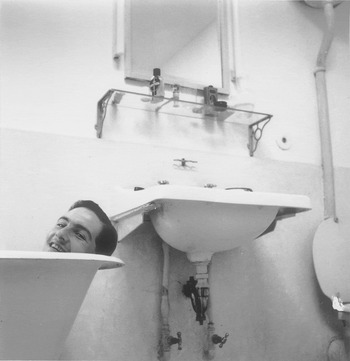
While Beaton photographed Indian princes and princesses as well as British grandees, the hierarchy he celebrated was always as much racial as social.Footnote 98 Despite the apparent commonality (and collusion) between British patricians and South Asian princes on the importance of an ordered and traditional society, race was, to co-opt Richard Dyer's influential essay on “whiteness,” “never not a factor, never not in play.”Footnote 99 One of the most obvious examples of the racialized basis of Beaton's wartime imaginary is an image of the pallid and physically delicate Felicity Wavell (the viceroy's daughter) seated on a rickshaw and attended by six Indian soldiers, their dark skins and uniforms a dramatic contrast to the young woman's ghostly whiteness.Footnote 100 Often Beaton's racial politics are covert and coded. The photograph of Lieutenant Antony Liddell enjoying a bath at the leave camp on the viceroy's estate at Simla might seem, on first impression, innocuous (see fig. 4). It presents the image of Liddell's head, photographed from below, peering over the rim of a bathtub with, in the background, a wash basin, its external plumbing in clear view, and a shelf on which is arranged a shaving brush and a bottle of antiseptic solution. However, as Anne McClintock, among others, has suggested, cleanliness was regularly deployed as a signifier of racial superiority, the white man's body protected by the commodities of European hygiene manufacturers from the contamination of the colonial other.Footnote 101 Many of Beaton's images feature this motif of European hygiene in a colonial context. He photographed washing lines of soldier's clothes in the Egyptian desert, the crisp white uniforms of sailors on the decks of ships, and the spotless dressings of wounded soldiers in hospital.Footnote 102 On visiting Air Vice-Marshal Coningham's “immaculate trailer” in the desert, Beaton waxed lyrical about its interior, of which Coningham was “justifiably proud”: “no grain of sand has penetrated past the meat-safe mesh of the entrance.”Footnote 103 It seems reasonable at this point to return to Beaton's emphasis on the domestic once again, although this time investing it with its imperial, as well as its gendered, connotations. In her study of the photographs taken by Frances Benjamin Johnson of American sailors and marines at rest and play on Admiral Dewey's flagship in 1899, Laura Wexler argues that Johnson sought to increase America's regard for empire by capturing American might “on its time off, that
Lieutenant Anthony Liddell, enjoying a bath at the viceroy's estate at Simla, 1944.

is, in domestic time.” America's imperial destiny is conceived, not in terms of military aggression, but in the form of daily life and domestic peace, from which the violence of colonial encounters has been erased.Footnote 104 Beaton, like Johnson, puts domestic sentimentalism to work as an imperial instrument, and not just in his photography. During his tour of India, he could not resist the temptation to direct both Mrs. Casey, the wife of the governor of Bengal and Lady Colville, wife of the governor of Bombay, into redesigning their living quarters. Beaton wrote of his pride in transforming the private rooms at Government House in Calcutta, so that they “became slightly Edwardian, very feminine and almost human. I strewed many books around, a few sweet dishes and even a dessert plate.”Footnote 105 Such aesthetic diversions in the nominally private sphere, inscribed as they are with concealed racial and social signifiers, need to be recognized as fundamentally political and registered as an intrinsic part of the performance of empire.
Roland Barthes contended that the photograph's ability to disturb lay partly in the way it makes it impossible for the viewer to avoid recognizing the difference between the present and the moment at which the picture was taken. The photograph, possessed of this “funeral immobility” in the midst of a moving world, is therefore an encounter with mortality.Footnote 106 One might argue that this observation is particularly pertinent in regard to Beaton's photographs of the Raj. The fact that, within three years of them being taken, Britain's Indian empire had come to an abrupt end, meant they almost immediately came to be invested with an elegiac, melancholy quality. However, while Beaton himself seemed at times to admit that the Raj lacked a long-term future (New Delhi, he wrote, was “a city built for an exhibition”),Footnote 107 it requires hindsight to see his Indian albums as an exercise in constructing nostalgia. Indeed, for all Beaton's desire to look backward, his romantic Toryism also contained a strong element of what has elsewhere been termed “conservative modernity.”Footnote 108 His photograph of Lieutenant Philip Ashley being visited in hospital by the actress Doreen Lawrence presents a perfect romantic hero, poised with an open book and holding a cigarette, his strong facial features in profile and a young woman seated at the foot of his bed.Footnote 109 It has been often remarked how similar this photograph is to a still from a Hollywood movie. Indeed, Hollywood cinematic styles afforded Beaton a means to reconcile his belief in the superiority of glamour and exclusivity with the modernizing imperatives of mass society. The imperial and dynastic world was also to be revitalized through using the Hollywood referent as a corroboration of its compatibility with modernity. His portrait of the maharajah and maharani of Jaipur emphasizes the couple's film-star good looks and contemporary informality rather than their princely status and ancient lineage.Footnote 110 In 1942 Beaton went to Tehran to photograph the young shah of Iran, Mohammed Reza Pahlevi, and his glamorous wife, Queen Fawzieh (see fig. 5). Beaton described their summer palace as being “as new as any Hollywood picture palace,” with “modernistic” decorations, California-style swimming pool, and “geometric furniture.” Aesthetics, typically, embodied politics, the shah's contemporary palace being appropriate to a ruler who, Beaton claimed, despite his destiny to “sit upon the jewel-studded, peacock throne of Aurangzebe,” supported liberal reform. He noted that the shah's wife was wearing a knee-length dress, “probably from Shaftesbury Avenue,” and was “very pretty, even beautiful, and more photogenic than most film stars. If ever … the Queen had any desire for a more histrionic career, her Botticellian plumpness of features, her piercing blue eyes, the dark chestnut hair that grows so beautifully from the forehead, the sex appeal of the Asiatic cherub, would land her plumb in the centre of the Hollywood
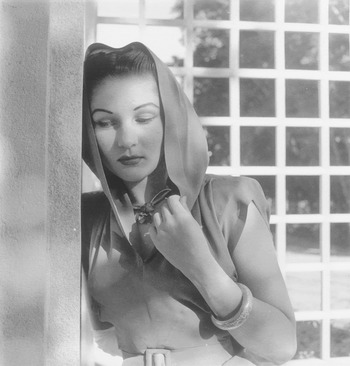
Portrait of Queen Fawzieh of Iran, 1942.

Screen.” In this description of the young royal couple, Beaton attempts to blend Hollywood glamour, the oriental exotic, and the majesty of a hereditary monarchy, oblivious to the potential incompatibilities between these elements. Indeed, he had to abandon an effort to photograph the queen in a version of the sixteenth-century miniatures of the age of Shah Abbas when she informed him she possessed only a Westernized wardrobe of contemporary dresses and negligees.Footnote 111 The ultimately elitist sensibility that Beaton expressed here was clearly light-years from the democratic and collective aspects of the People's War. However, by deploying his romantic Toryism through the filter of “conservative modernity,” Beaton ensured that his prewar sensibilities were made palatable to the broadest possible audience and that they became a significant part of the wartime imaginary.
IV. Romantic Toryism and Britain's Wartime Symbolic Economy
Beaton's romantic Toryism was not just an idiosyncratic posture against wartime populism by a man regularly identified, even by his admirers, as a monumental snob. The popularity of his wartime photographs and writings suggests he was disclosing sensibilities that had considerable purchase in the symbolic economy of the 1940s. Moreover, similar structures of desire were associated with a number of other contemporary genres and individuals, drawn from across the widely different (yet frequently interconnected) domains of the arts and entertainment, the military, and the political. The cinematic costume melodramas of the Gainsborough studios have been read as a yearning for hierarchy and expressivity that subliminally challenged official wartime discourses of egalitarianism and self-restraint. However, conservative images of glamour on screen were not confined to Gainsborough but were also a critical element of Alexander Korda's romances and historical dramas.Footnote 112 Laurence Olivier's screen adaptation of Shakespeare's Henry V celebrated a dynastic vision of British patriotism, and suggests Beaton was not alone in detecting an affinity between the officer heroes of the Royal Air Force and a romanticized image of medieval chivalry.Footnote 113 Michael Powell and Emeric Pressburger's movie I Know Where I’m Going located authenticity in the hierarchical world of a dashing Scottish laird and presented modern mass society as materialistic and soulless.Footnote 114 Film star Leslie Howard's popularity rested on serving as a paradigm of the debonair English gentleman and amateur, which in wartime was fused with a lyrical, almost ethereal, patriotism.Footnote 115 Beaton's theatricality found an echo in the suave elegance and showmanship of conductor Sir Malcolm Sargent, who, in evening dress, defiantly led classical concerts in the midst of the Blitz.Footnote 116 Noel Coward, who shared both Beaton's sexuality and his snobbery, succeeded in aligning his drawing-room elitism with a celebration of the national character at war in his incursion into movie making, In Which We Serve.Footnote 117 If Coward's vision of wartime mobilization implied that equality of sacrifice did not have to entail the dismantling of prewar social hierarchies, it should not be forgotten that In Which We Serve (rather than Carol Reed's much more egalitarian The Way Ahead, which used the same metaphor of a self-contained military unit as a personification of the nation at war) was one of the most popular cinematic releases of the entire war. Significantly, Coward and Beaton sought to bury their long-established rivalry during the war, with Coward insisting, “we really have so much in common. … Let's be buddies!”Footnote 118 The fact that these personifications of romantic Toryism were often a performance that obscured more complex social realities—both Coward and Beaton adopted an elite sophistication that belied their suburban origins, while Korda and Pressburger were émigré Hungarian Jews, as was Leslie Howard's father, the future “Englishman's Englishman,” spending part of his childhood in Vienna—should not be allowed to detract from their purchase in the wartime popular imagination.
In Which We Serve had been based on the early wartime career of Lord Louis Mountbatten. With his royal blood, glamorous social life, impeccable dress sense, and heroic war record, Mountbatten was an obvious candidate for incorporation into the romantic Tory pantheon. However, such an appropriation required a little wishful thinking, given that Mountbatten liked to claim he was a supporter of the Labour Party and his role as last viceroy, in presiding over the dismantling of Britain's Indian empire in 1947, also proved to be problematic. His predecessor as viceroy, Archibald Wavell, had ultimately proved a failure as a military commander, but he still attracted considerable adulation during the war; both Beaton and Coward presented him as a romantic cavalier, a valiant soldier who also wrote poetry and appeared to them as the reincarnation of a Jacobite prince.Footnote 119 Younger military men also offered the opportunity to recast the war in terms of splendid individualism and gentlemanly codes of honor. Wing-Commander Guy Gibson, bomber pilot and leader of “Operation Chastise” in 1943, was taken by Churchill to North America to advertise the finest qualities of the English officer class.Footnote 120 Irregular warfare provided particular scope to escape the regularization and professed meritocracy of Britain's “citizen army.”Footnote 121 Gentlemen soldiers such as Sir Fitzroy Maclean carried out daring raids behind enemy lines in Yugoslavia. Perhaps the finest exemplar of romantic Toryism in the wartime military was Simon Christopher Joseph Fraser, Seventeenth Lord Lovat, the handsome “Damascus blade” who led the commandos at Dieppe and on D-Day, singing “Jerusalem” as enemy shells whizzed over his landing craft. “Shimi” Lovat should have been a splendid anachronism, a Highland chief, territorial magnate, and head of a worldwide clan, but this decidedly feudal figure proved a compelling version of noblesse oblige, his exploits being regularly chronicled in the otherwise decidedly populist Daily Mirror.Footnote 122
While wartime romantic Toryism did not necessarily imply fealty to, or even association with, the Conservative Party, significantly, Lovat served as under-secretary at the Foreign Office in Churchill's short-lived Caretaker Government in 1945, and Guy Gibson was briefly a Conservative candidate for Macclesfield. Winston Churchill's patrician high-mindedness, sentimental patriotism, historic reverence for the monarchy, flamboyant style, and haughty imperialism all delineated him as the romantic Tory par excellence. Beaton was the author of one of the most widely reproduced photographic images of Churchill, a study of the typically pugnacious prime minister posed behind his Downing Street desk, which Beaton immodestly claimed could be found “in the place of honour … on the walls of nearly every public house in the country.”Footnote 123 Without wishing to be glib, one could argue that the wartime premier shared with Beaton a sense of the war as requiring the presence of both tradition and theatricality. Certainly, for all their obvious differences, both Winston Churchill and Cecil Beaton were equally suspect conscripts in a national endeavor that eventually came to be understood in terms of a struggle to ensure that a new, more democratic, more equitable, society would rise out of the ruins of war. Beaton's romantic Toryism was therefore far from unique and serves as a testimony to the resilience of conservative structures of feeling in Britain during the 1940s: patterns of desire whose presence in the wartime imaginary ensured that the meritocratic, technocratic, and populist discourses of 1939–45 would not go unchallenged, either during the war itself or in the years that followed.
An epilogue to Beaton's wartime story might be how the photographer, alienated from the political settlement that brought the Labour Party to power in 1945, retreated once again into the world of high style and high fashion, seeking out the comfort of nostalgia in costume designs for Edwardian-set films such as Lady Windermere's Fan, produced by that other romantic idealist-imperialist, Alexander Korda.Footnote 124 In this poignant postscript, Beaton's essentially prewar aesthetics, and their associated political connotations, are interpreted as unwelcome or redundant in the postwar New Jerusalem. The problem with such a narrative is twofold. First, it implies an inflexibility in Beaton's photography that is belied by his postwar work. In the late 1950s, Beaton returned to the more spontaneous and candid images of much of his wartime photography, for example, in his famous portraits of a weary and haunted Marilyn Monroe.Footnote 125 Second, and much more significantly, if Beaton's romantic Toryism could register so powerfully in the imaginary of the People's War, why should it not remain equally cogent in the cultural tropes of the “people's peace,” where the wartime imperatives of collectivism and egalitarianism were to be rendered less urgent and less appealing?Footnote 126 In 1953 the coronation of Queen Elizabeth II celebrated a forward-looking reconceptualization of empire as the British Commonwealth. However, at the same time it drew upon motifs of imperial, social, and dynastic continuity that were anything but democratic or modern.Footnote 127 Romantic Toryism remained an essential constituent of the British cultural imaginary at the beginning of what was being termed the New Elizabethan Age, as this rather overdrawn appellation itself all too clearly revealed. The official coronation portrait of Elizabeth II (taken in a studio against a screen image of Westminster Abbey) was simultaneously theatrical, opulent, noble, and sacred. The author of this romantic study in pageantry and deference, it almost goes without saying, was Cecil Walter Hardy Beaton.