INTRODUCTION
Use of the internet for cancer information and support is becoming commonplace (Fox, Reference Fox2011; Hong et al., Reference Hong, Pena-Purcell and Ory2011; Im, Reference Im2011). Although online use has many positive aspects, it may in part be motivated by needs not being met by real-life healthcare providers (Tustin, Reference Tustin2010). An analysis of the 2007 Health Information National Trends survey found that those who felt that their communication with providers was less patient centered were more likely to go online for information (Hou & Shim, Reference Hou and Shim2010). In a study of 178 cancer listserv users, 35% named the internet as their preferred source of healthcare information, as opposed to only 19% for their oncologists (Tustin, Reference Tustin2010). This is likely due to a combination of factors, including the typically short amount of time providers have to spend with patients and the lack of communication training for oncologists (Back et al., Reference Back, Arnold and Baile2009; Hou & Shim, Reference Hou and Shim2010; Tustin, Reference Tustin2010). Nonetheless, the public generally prefers to get medical information from healthcare providers while seeking emotional support from peers (Fox, Reference Fox2011).
Evidence to date has focused on online content and process, but there is a growing focus with regard to interventions and outcomes (Hong et al., Reference Hong, Pena-Purcell and Ory2011). Several recent reviews have explored this literature from various perspectives. An integrative review done in 2013 of supportive e-health programs for cancer patients identified 16 intervention studies. Though the nature of these interventions and the outcomes measured varied, the investigators concluded that there were positive effects for participants (Ventura et al., Reference Ventura, Ohlen and Koinberg2013). The most commonly measured outcome was health literacy, followed by decision-making variables, general health factors, overall satisfaction, and quality of life (Ventura et al., Reference Ventura, Ohlen and Koinberg2013). A review of online support for cancer survivors identified 24 studies and concluded that there was inconclusive evidence of their positive benefit, although it was early in the development of this evidence base (Hong et al., Reference Hong, Pena-Purcell and Ory2011). The most common outcomes measured in those studies were quality of life, stress, coping, access to treatment information, and social support (Hong et al., Reference Hong, Pena-Purcell and Ory2011). A review of internet interventions for improving psychosocial well-being for cancer patients identified three types of online resources: information sites, mutual support sites, and evidence-based online interventions (Leykin et al., Reference Leykin, Thekdi and Shumay2012). Evidence for the latter category was limited, and most of the interventions did not provide interactive tools to link patients and providers (Leykin et al., Reference Leykin, Thekdi and Shumay2012). The authors concluded that online psychosocial support interventions may be accessible and acceptable to patients and families dealing with cancer and could augment existing mental health services (Leykin et al., Reference Leykin, Thekdi and Shumay2012).
The majority of evidence for online cancer interventions has focused on breast cancer, followed by prostate and colorectal cancer (Ventura et al., Reference Ventura, Ohlen and Koinberg2013). This is appropriate given that these are among the most prevalent cancers (American Cancer Society, 2014). However, other cancers present particular challenges for patients and families. Pancreatic cancer is a very difficult illness with active symptoms, a short course, and poor survival (Fazal & Saif, Reference Fazal and Saif2007). Symptom burden is high (Davis, Reference Davis2005; Sheffield et al., Reference Sheffield, Boyd and Benarroch-Gampel2011), and there is no evidence to confirm that aggressive treatments such as chemotherapy reduce symptoms enough to improve quality of life (Torgerson & Wiebe, Reference Torgerson and Wiebe2013). Although hospice enrollment for patients with pancreatic cancer has increased to 67.2%, enrollment comes later in the course of the illness and after aggressive treatment such as chemotherapy or admission to an intensive care unit (Sheffield et al., Reference Sheffield, Boyd and Benarroch-Gampel2011). Palliative care, which is appropriate at the time of diagnosis and in addition to curative treatment is an option (Dahlin, Reference Dahlin2013), is not widely available or offered despite this being the recommendation of the American Society of Clinical Oncology and pancreatic cancer experts (Lazenby & Saif, Reference Lazenby and Saif2010; Smith et al., Reference Smith, Temin and Alesi2012).
There are limited online resources for pancreatic cancer, none of which specifically include palliative care (PC). The National Institutes of Health (NIH), the National Cancer Institute (NCI), and major cancer center websites offer some pancreatic cancer information and education but limited interactive options. This is unfortunate, as patients with late-stage cancers tend to use more interactive resources or support groups (Ventura et al., Reference Ventura, Ohlen and Koinberg2013). Pancreatic cancer is also rare (American Cancer Society, 2014), and there is evidence that people with rare cancers tend to seek out information online (Fox, Reference Fox2010).
We conducted an eight-week pilot study to determine whether people would visit a new webpage where they could access and interact with a palliative care nurse practitioner (PCNP). This pilot provided evidence that the internet can be used to offer PC-specific information and support to patients with pancreatic cancer and their families (Grant & Wiegand, Reference Grant and Wiegand2011; Reference Grant and Wiegand2013).
Based on its success, a new study was designed to continue the webpage for a longer period of time. Our aims were to (1) see how many people would visit the webpage, (2) see how many would ask the PCNP a question, (3) determine what type of questions would be asked, and (4) obtain feedback from participants regarding the usefulness of the webpage.
METHODS
A mixed-methods description design was employed. The new webpage was revised based on findings from the pilot study and added to the Johns Hopkins Kimmel Cancer Center (JHKCC) website, which offers information on cancer care and the various treatment options at Johns Hopkins. It is a website that is completely independent of our pilot website.
A qualitative descriptive approach was employed to guide the qualitative aspect of the study. The eight domains from the National Consensus Project were used as a framework for the analysis (Dahlin, Reference Dahlin2013). These include: (1) structure and process, (2) physical, (3) psychological, (4) social, (5) spiritual, (6) cultural, (7) imminently dying, and (8) the ethical and legal aspects of care. Participants were asked to complete an online survey where they had an opportunity to evaluate the helpfulness of the PCNP webpage. The 23-question survey was developed for our study and refined based on the pilot study (Grant & Wiegand, Reference Grant and Wiegand2011). Specifically, a section was added to probe why respondents who posted a question to the PCNP did so. The pilot's social support scale was replaced with six questions modified for pancreatic cancer from the Computer-Mediated Social Network Scale (CMSNS), a tool developed and validated to assess the use of online social support among older adults (Nahm et al., Reference Nahm, Resnick and Gaines2004). These questions asked about personal and online support resources and use of the internet for information/support. An additional eight questions asked about how often respondents had come to the PCNP webpage, how helpful reading the responses there or interacting with the PCNP had been, and why they asked the PCNP a question. The helpfulness questions used a four-point Likert-type scale: 1 = “not helpful,” 2 = “somewhat helpful,” 3 = “helpful,” and 4 = “very helpful.” Those participants who chose to complete the survey were also asked to answer several demographic questions.
Sample
A convenience sample of people participated in this investigation. Anyone on the internet could access the webpage. Participants were anonymous since the JHKCC website does not require a login. Participants were recruited or directed to the PCNP webpage from notices on the JHKCC website, links from other JHKCC and Johns Hopkins pancreatic cancer webpages, or through internet searches.
Procedures
Our study received approval from the institutional review boards at Johns Hopkins University and the University of Maryland, Baltimore. Recruitment, participation, and evaluation of the PCNP webpage were performed entirely online. Once participants accessed the webpage, they could read the questions posted there, submit a question, email the PCNP a private question, and complete an evaluation survey. Anyone coming to the webpage could access the online survey. If they sent the PCNP an email, they were also given the link to the online survey in the PCNP's emailed response.
Data Analysis
Descriptive statistics were employed to analyze the quantitative data. Traffic to the PCNP webpage was analyzed as “webpage traffic.” Questions posted to the PCNP webpage and private emails were carefully reviewed independently by two of our researchers. The main or primary issue raised in each of the posts was identified. Each of the issues was then categorized into one of the eight palliative care domains (Dahlin, Reference Dahlin2013) using deductive analysis if it included a PC-related concern. Issues that did not fit into any of the eight domains were coded as “other.” The researchers met and reviewed their separate analyses. In most cases, the researchers achieved consensus. Any discrepancies were discussed until agreement was reached.
Responses to the online survey were analyzed using such descriptive statistics as means and nominal scores. These were categorized as “online survey” and the participants considered “respondents.”
RESULTS
Webpage Traffic
The PCNP webpage was interactive from August 4, 2011 until May 14, 2012. Over the 35-week study period, there were 2174 visits to the webpage, with traffic fairly steady across the study, averaging 62 visits per week. About a quarter, 543, were repeat visits. The average time spent on the webpage was 5:03 minutes. Most of the visits (1809, 83%), came from outside of Maryland, with 494 (23%) originating outside the United States.
Questions to PCNP
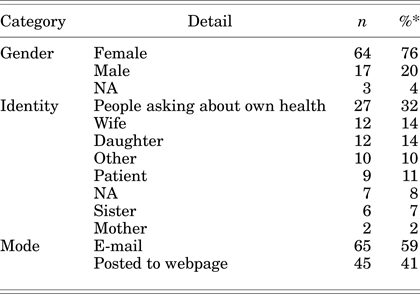
A total of 84 participants sent questions to the PCNP. Although the identity of the person asking a question was not required, it was often possible to determine it by the specifics of their question. The patient's role was often identified (e.g., husband or mother), and the person posting the question usually provided a first name. The largest category of participants comprised female relatives of those with pancreatic cancer (36, 43%). The next largest group was people asking about their own health who did not report a diagnosis of pancreatic cancer (27, 32%). Only 9 (11%) of those asking questions were actual patients with pancreatic cancer. Some questioners (20, 24%) asked the PCNP multiple questions or posted/sent multiple comments, while 2 (3%) posted a similar question to both the public PCNP webpage and in an email. The available details are summarized on Table 1.
PCNP questions/messages detail

*Numbers do not add to 100 due to rounding
A total of 110 questions were sent to the PCNP. The majority (65, 59%) were sent via email, and the rest (45, 41%) were posted onto the public PCNP webpage. The rate of questions/messages was fairly steady over the study period, with an average of 3.14 per week. Of the 110 questions, 2 (2%) were not approved, as they were either spam or inappropriate for the public webpage.
In terms of content, slightly more than half (59, 52.7%) the questions/messages had to do with palliative care issues. When categorized across the palliative care domains, the largest category was psychological aspects, with 26 questions (23.2% of total). Most of those involved anxiety about the illness 16 (14.3% of total) or concern for a familial risk of getting pancreatic cancer (8, 7.1%). The second largest domain was physical aspects, with 21 (18.8% of total). Most of these had to do with issues like pain, gastrointestinal symptoms, postoperative complications, and nutrition. The third largest domain was the structure and processes of care, with 8 questions (7.1%). There were only 3 questions in the domain on ethical and legal aspects (2.7%), and 1 in the domain of social issues (0.9%). No questions were categorized in the domains of spiritual, religious, and existential aspects, cultural aspects, or care of the imminently dying patient.
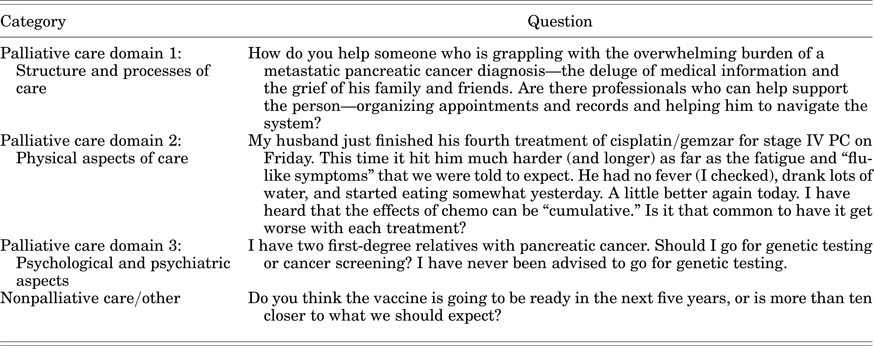
Just under half (53, 47.3%) of the questions/messages were not related to palliative care issues. Of those, 23 (20.5%) were categorized as “other” in that they did not fall into any specific category. Some of those were expressions of thanks to the PCNP (9, 8.0%) and updates on the previously queried situation (8, 7.1%). The others fell into the categories of wanting a second opinion at Johns Hopkins (7, 6.3%), or wondering about whether a vaccine was yet available for pancreatic cancer (6, 5.3%). See Table 2 for examples of questions.
Examples of PCNP questions by category

Online Survey
Some 39 participants completed the survey (57% completion rate). Respondents were predominantly female (34, 87%), white (33, 85%), older (23, 59%; range 50–69), and highly educated, with college or postgraduate studies (30, 79%). Most (35, 89.7%) were living in the United States, and 38 (97.4%) were living in English-speaking countries. A large number (17, 44%) were patients or individuals concerned about their own health, with almost all the rest being various relatives (20, 52%). Almost all (63, 92.9%) had come to the PCNP webpage for the first time, and only half (22) had had the chance to read the posts on the PCNP webpage before filling out the online survey. Therefore, their knowledge of what was on the PCNP webpage was likely limited. Only 9 respondents (13%) had asked the PCNP a question, too small a group for further analysis. Six (67%) of the 7 who had already received a response from the PCNP found communication with her “helpful” to “very helpful.”
Among the 22 who had read it, the PCNP webpage was rated at 3.3/4 as being helpful in learning about the physical symptoms/treatments of pancreatic cancer, at 3.1/4 for learning about emotional issues, at 3/4 for learning about palliative care, at 2.8/4 for learning about hospice, and at 3.3/4 for reading other people's questions.
The responses to the modified CMSNS showed that use of social networks varied. Respondents ranged in their use of social media for information on pancreatic cancer, with 14 (35.9%) not using them for this purpose to 10 respondents (25.7%) who used them daily. Most (23–30, 54.1–76.9%) did not contact people through online social media to ask for help or use internet chatrooms or discussion boards for information on pancreatic cancer.
DISCUSSION
The results of the present study supported those of the pilot study. People did come to the PCNP webpage and did ask questions. Those questions had to do with various symptoms and concerns around pancreatic cancer, and most found the PCNP webpage to be helpful. As in the pilot study, many questions included concern over a possible pancreatic cancer diagnosis or the significance of symptoms, so it was likely reassuring to be able to “talk” with a nurse practitioner about these concerns. An analysis of requests posted to online physicians via a “question-and-answer” (Q&A) board at a Korean breast cancer website found that anxiety and worry were expressed in 52.7% of requests (Cho et al., Reference Cho, Roter and Guallar2011). This confirmed that people with cancer are seeking additional information online and will make use of online healthcare providers.
Many of the questions submitted to the PCNP were about the practical aspects of the illness and its treatment, similar to a cluster analysis done of 2852 posts on several breast cancer websites (Chen, Reference Chen2012) and the Korean Q&A board study (Cho et al., Reference Cho, Roter and Guallar2011). In the Korean study, most requests sought informational support (93.5%), of which those about treatment and physical conditions were the most prevalent (38.4 and 31.7%, respectively) (Cho et al., Reference Cho, Roter and Guallar2011), which was in line with our study's findings. This suggests that people need more information about their illness and treatment than is being provided by real-life providers. An online resource might be an efficient way to provide such information, as answering the PCNP webpage questions took only 20 to 30 minutes per question, and less than that once questions began to be repeated.
A third of those asking the PCNP questions were people without a cancer diagnosis. The internet is increasingly being used as a diagnostic tool, with 35% of U.S. adults going online to diagnose their health issues according to a 2013 Pew Internet study (Fox & Duggan, Reference Fox and Duggan2013). In our study, people going online looking for help identifying vague gastrointestinal symptoms would possibly see pancreatic cancer on a list of possible diagnoses and, given its high mortality rate, might understandably seek further confirmation or reassurance. As Johns Hopkins is a leading pancreatic cancer treatment center, they would likely go to a website there for further information. Women are more likely to search for a possible diagnosis online than men and white adults, and those with a high level of education are also more inclined to use interactive online resources (Cho et al., Reference Cho, Roter and Guallar2011; David et al., Reference David, Schlenker and Prudlo2013; Fox & Duggan, Reference Fox and Duggan2013; Im, Reference Im2011), which mirrors our study's survey respondents. Healthcare providers should be aware of this phenomenon, recognize that a large number of the population are diagnosing themselves online, and consider offering appropriate online resources to their patients.
The low overall response to the online survey did not allow for a better understanding of how participants used their personal and online social networks for support nor why they were interacting with the online PCNP. This reflects multiple challenges in conducting research online. First, the low response was likely due to the lower traffic to the PCNP webpage than in the pilot study and use by participants who were not necessarily seeking online interaction. This highlights the importance of doing online research on websites that have adequate traffic and visitors open to the type of intervention being offered. The website in our pilot study had a discussion board that got dozens of posts each day, so there was much more traffic to it and users who were specifically seeking interaction online (Grant & Wiegand, Reference Grant and Wiegand2011). The format of this study's JHKCC website is purely informational, with the PCNP webpage being the only interactive page on that site. Therefore, the website's users may not have had the expectation of interaction when going there, which was confirmed by the finding that most survey respondents did not use interactive online resources for social support for pancreatic cancer. Although reminders were posted on other parts of the JHKCC website, it was not possible to do more to promote traffic during the study period. Then, in addition to affecting the number of posted questions and responses to the online survey, the JHKCC website's content also likely affected the nature of the questions. The other information on the site talked about treatment and research options, such as a vaccine trial. Therefore, people on the site may have already had an interest in those topics and accessed the PCNP for further information about them. Finally, the completion rate of the online survey varied by question and showed a dropoff after the first questions. As the survey was anonymous and administered online, it was not possible for the researchers to follow up with respondents to fill in missing information.
It is still not clear why people were asking the online PCNP questions. Those who posted questions did so for various reasons, and some asked a question they had not asked their own healthcare provider. This is also in line with online health behavior in a study where 35% of online health searchers did not visit a healthcare provider to get a professional opinion about a health concern (Fox & Duggan, Reference Fox and Duggan2013). Some evidence suggests that people with cancer seek out online resources when their needs for either information or support are high and are not being met elsewhere (Lee & Hawkins, Reference Lee and Hawkins2010).
In terms of limitations, as noted, the small online survey sample, many of whom had not read the PCNP webpage, makes these data very difficult to generalize. The sample was also drawn from only one website, and those accessing other pancreatic websites might have had different questions or characteristics. In addition, many participants were not involved with a diagnosis of pancreatic cancer. These limitations reflect the challenges of doing research online, where it is not possible to recruit for specific samples or ensure that participants complete the intervention protocol or the evaluation tools. The modified CMSNS questions on the online survey were not validated for this study or these populations.
From a practical standpoint, it is important that providers recognize the growing use of the internet for diagnostic and support purposes. This may be more true for some illnesses than others, but it will continue to grow as mobile devices that access the internet become more prevalent. Clinicians should anticipate that many of their patients will have gone online to look up information and may have even interacted with others with similar concerns. Regarding cancer, people seek out and appreciate online resources for this illness, and cancer centers may consider providing such resources as a patient/public service. Healthcare providers should be aware of those legitimate online resources in their specialty areas and recommend them to patients and families. Further research is needed on providing online interventions, doing research online, addressing the unique issues of people with pancreatic cancer and their families, and the use of online healthcare providers.
ACKNOWLEDGMENTS
This study was funded by a grant from the Skip Viragh Center for Pancreas Cancer at Johns Hopkins.