Throughout the twentieth century and into the present day the Western art music tradition has retained a strong ‘chirographic bias’.Footnote 1 By this phrase, borrowed from Walter Ong, I refer not only to the continued reliance on notation as a fundamental creative tool and a presumed condition of ‘high art’ status but also to the subtler ways in which composers are influenced by their involuntary association of musical sound with its graphic representation in any form. This influence transcends the main aesthetic or stylistic polarities of twentieth-century music (system versus freedom, serialism versus chance, etc.), since even the most radical attempts to emancipate sound from prevailing habits of thought and notation, to ‘let sounds be themselves’, have almost always involved the substitution of one form of writing for another, or the addition of new levels of graphic mediation: charts, magic squares, lists, computer languages, and so on.Footnote 2 The chirographic bias is, if anything, even more entrenched as a result of these innovations.
Perhaps the most dramatic challenge to this bias, from within the realm of scored concert music, was posed by the mature music of the Italian composer Giacinto Scelsi (1905–88). In his early works Scelsi had been torn between highly literate stylistic elements, including serial writing, and an instinct for improvisatory, intuitive reiteration. This ambivalent period was brought to an end in 1948 by a psychological breakdown, which he was convinced had been provoked by his use of abstract compositional techniques: as he put it, ‘I was thinking too much’.Footnote 3 In his subsequent work he rejected (or attempted to reject) not only these techniques but the entire rational, literate orientation of Western music, in favour of a meditative focus on ‘sound itself’, inspired by Hindu mysticism. In order to rid his music of ‘thinking’ and of the influence of writing, he proceeded by recording his improvisations, which he often executed on the ondiola, a keyboard instrument allowing pitch inflection. Notation was used only to transcribe the music – a task that he did not regard as creative, and which he delegated to assistants. The idiom of the improvisations, and thus of the finished pieces, was conditioned mainly by his practice of Yoga: avoiding systematic or quantifiable relationships of discrete notes, he instead elaborated the ‘inside’ or ‘centre’ of continuous sounds, especially unisons and octaves, by manipulating their intonation and timbre. He is thus thought to have reintroduced an element of orality into Western art music.
Scholarly interpretations of this facet of Scelsi's work are mainly of two kinds. His most passionate advocates have referred to it as a condition of the music's supposedly unique relationship with ‘sound itself’, often arguing in a manner reminiscent of the composer's own mysticism. Those attempting a more sober analysis have tended to neglect the implications of the oral element, concentrating instead on large-scale patterns and proportions as if these had been traditionally pre-planned. In my view both tendencies exaggerate the inscrutability of the music's small-scale rhetorical schemes. Although Scelsi's works are anti-constructivist, they are far from haphazard. Yet it is rarely wondered why the sound in a Scelsi piece behaves in one way rather than another, or what bearing the orality of its creation had on this.
In the following I consider the extent to which Scelsi's work may be described as oral, and I examine his late style from the perspective of rhetoric and ‘musical grammar’. These are categories normally avoided in the literature on Scelsi but are by no means incompatible with either orality or improvisation. I suggest ways in which Scelsi's idiom evokes oral thought as well as some typical characteristics of ‘secondary orality’ – the quasi-orality fostered by literates with the help of technology other than writing.Footnote 4 I then compare the two movements of the Duo of 1965 as an example of the subtlety with which he was able to vary his rhetorical schemes, and argue that the power of his music owes as much to his skilful use of this rhetoric as it does to ‘sound itself’.
Scelsi's aesthetics
Scelsi's unorthodox working methods and devaluing of notation rested on consistent mystical-aesthetic principles, which he expressed in several taped interviews and fragments, again showing a preference for (secondary) orality. At the heart of Scelsi's thinking was the notion of ‘sound itself’, that is, sound conceived as transcending its organization into music (and especially its organization into ‘notes’): ‘it is sound that counts more than its organization […]. Music cannot exist without sound. Sound exists by itself without music.’Footnote 5
On one level this was a mystical principle. Scelsi attributed the outcome of his improvisations to the agency of sound, which he viewed as an autonomous, cosmic force, preceding human activity: ‘What interests me is precisely to try to perceive, receive and manifest – with instruments or with the voice – a part, even the smallest part, of this sonorous force which is at the base of everything, which creates and often transforms men.’Footnote 6 More specifically, he believed that certain sounds – the ‘right sound’ – could be used through Yoga as a means for the perception of the ‘supernormal world’, where he ‘found’ his works. This mystical conception of inspiration is obviously incompatible with conscious thought, and thus with pen and paper, but it is indicative of Scelsi's self-consciousness that he specifically identifies this incompatibility, distinguishing the ‘right sound’ (son juste) from the ‘right note’ (note juste). The right sound is
not at all a question of the right ‘note’, in relation to whatever tonal or atonal system, European, African or Asiatic, but of the very essence of sound […]. In the Yoga of Sound, the adepts […] listen to their personal sound and, thus, to the Devic sounds. The personal sound allows the perception of the supernormal world, at the same time producing the interior equilibrium that underlies this Yoga. Often the sound manifests its own colour, but this is, again, another thing. All this naturally explains the importance of the ‘right’ sound, whether it is a matter of the human voice or an instrument. This is why I think that monody can more easily give this rightness than orchestral or symphonic works.Footnote 7
Scelsi regarded rationalist systems of notes as obstacles not only to the mystical perception of the son juste but also to the perception of the acoustic ‘depth’ of sound. He thought such systems and, by extension, the (Western) musical experience in which they prevailed to be ‘two-dimensional’:
Sound is spherical, but, listening to it, it seems to us to possess only two dimensions: pitch and duration – the third, depth, we know exists, but, in a certain sense, it escapes us. The harmonics and sub-harmonics (which one hears less) sometimes give us the impression of a vaster, more complex sound […] but it is difficult for us to perceive the complexity. In any case, musically, one would not know how to note it down […]. In general, occidental classical music has devoted practically all of its attention to the musical frame, to what one calls musical form. It has forgotten to study the laws of Sound Energy […] and thus has produced thousands of magnificent but often rather empty forms […]. The melodies pass from sound to sound, but the intervals are empty abysses since the notes lack ‘sound’ energy.Footnote 8
There is an obvious connection between this predicament of ‘two-dimensional hearing’ and the institution of the score, which privileges precisely such relationships of ‘points’ or notes. Sound seems two-dimensional to Western classical musicians only because they use staff notation.
Another text describes explicitly the shortcomings of written notation as a way of recording the moment of ‘inspiration’.Footnote 9 First, the written sketch tends to record only melody and rhythm (assuming one uses staff notation), and to neglect ‘combinations of special timbres and so on’. Second, by slowing the creative process down, it imposes the control mechanisms of thought (‘reactions physiques de contrôle de la pensée’), thus distorting ‘interior perception’. The act of writing limits the qualitative complexity of the musical idea and conditions the creative act. In other words, it imposes a chirographic bias on sound.
It is worth noting that Scelsi included post-Webernian modernism and even Cage in his critique of Western formalism, on the grounds that their increased attention to sonority and attempts to free it from existing rhetorical norms are pursued with quantifiable means (and, we might add, a reliance on writing even greater than that of classical music):
Of course, for a while sound and sound energy have been studied here in Europe, and even more in America; in that sense one is closer to the oriental conception – let's say, since Webern and Varèse up to electronic music. One is less concerned with form [cadre] and one could say that lately form has even been furiously destroyed with aleatoric technique, etc. Only, in most of these cases the research is still intellectual or scientific, mathematical or in the domain of pure acoustics. The world was perhaps created with numbers, but not by numbers (this is Goethe).Footnote 10
It is curious that Scelsi seems on the whole to have been satisfied that the transcription of his pieces – their rendering in and re-creation from ‘notes’ – did not significantly distort them and was not a concession to writing.Footnote 11
Scelsi reception and analysis
Many interpretations of Scelsi's late work, since it first became the subject of wide interest, have obligingly echoed his own extreme anti-constructivism – in particular his belief that sound in his work transcended musical organization, and his assertion that his works were not constructed from discrete parts (not ‘com-posed’).Footnote 12 Scelsi's advocates have often adopted his habit of treating sound as an alternative to organization, or at least have been unwilling to admit that musical organization might also transcend sound, on another level. For example, Castanet and Cisternino use the phrase ‘absolutely a-constructive’ to describe the way that ‘sound here is thought of not as a material, to be treated with more or less numerical-artisanal techniques and exercises to give it form and meaning, but as a sound-Klang; a sort of primordial sound’.Footnote 13 This school of thought is thus sceptical of propositions about morphology or ‘form-building’ in Scelsi's music. It has been claimed that ‘one cannot isolate any single element whose existence one could demonstrate’,Footnote 14 and that ‘Scelsi defines no single sound, marks no beginning and no end’.Footnote 15 Instead of combining sounds, Scelsi ‘dissolves’ (Metzger) or ‘de-composes’ (Murail) sonority into its component aspects: pitch, timbre, density, etc.Footnote 16 Even so, whatever is yielded by this ‘de-composition’ is still to be regarded as irreducible Klang. Intervals, for instance, are never to be considered as relations between discrete tones but only as Klang. As Metzger puts it, ‘differences are perceived not as intervals […] but as modifications, always significant, of the state of a single entity.’Footnote 17
This influential interpretation, defining the ‘musical work’ in terms of its irreducible Klang and specifically not by means of the relation of ‘parts’, undoubtedly reflects the ideology and intended artistic effect of the music, but it is difficult to sustain with rigour. First of all, Scelsi habitually improvised on two ondiolas simultaneously and used overdubbing in his improvisation process, thus immediately introducing an element of ‘com-position’.Footnote 18 Second, the precise instrumentation and, therefore, the Klang of the works were fixed after the improvisation – indeed, there are several arrangements of some of the tapes. Moreover, the scores specify relatively few gradations of timbre or vibrato, given the importance attributed to these variables, which are already those least satisfactorily expressed in staff notation. The work will thus vary in what Ingarden calls ‘the fullness of its properties and complete concretion’, from one performance to another, even more than usual.Footnote 19 It may be that only the relation of parts is recognizable. This traditional problem of the nature of the musical work arises also when one attempts to use sonogram analysis to draw conclusions about Scelsi's music.Footnote 20 Is it better to analyse the original tapes, which were not intended to be the finished ‘product’ and which in any case have deteriorated, or a performance from the published score? What is it that lends authority to either of these?
In any case, it is unclear why the seamless, ambiguous character of the material should or could prevent any listener from ‘isolating any single element’ or from perceiving intervals or voice-leading patterns (often very familiar ones) on the musical surface. Scelsi is ‘representing’ a supposedly ‘indivisible’ sound, using several sounds.Footnote 21 Moreover, he is representing a concept of ‘sound itself’ that excludes syntactical considerations altogether. His music is stylistically designed to invite us to concentrate on the quality of sound rather than its organization (the assumption being that in traditional classical music the opposite is the case); however, since it is impossible to be entirely unaware of the very novel musical grammar by which this effect is engineered, we must consciously fall in with his notion of ‘sound itself’ in order to interpret the music ‘correctly’. One might even say that sound is the ‘extra-musical’ subject matter of Scelsi's music.
There have been several attempts to analyse Scelsi's works in a more technical manner, but these have also tended to subordinate small-scale gestural activity to the whole, perhaps under the influence of the orthodoxy I have just described, and perhaps because this small-scale activity simply seems so redundant. In most cases, however, analysts have found the works far from irreducible. Harry Halbreich begins his analysis of Konx-Om-Pax by dividing each movement into regular beats, and even according to the rehearsal numbers, in order to ‘establish the formal proportions and sections’.Footnote 22 Julian Anderson's analysis of Anahit, which is refreshing in its recognition of ‘blatant references to late-Romantic harmony’ and to contemporary avant-garde works, begins with a summary of the ‘large-scale tonal plan of the work’ and provides a diagram identifying the ‘principal stages’.Footnote 23 When no such tonal overview is available, analysts have dissected the works in other ways: Giulio Castagnoli subdivides the Quattro Pezzi per orchestra (ciascuno su una nota sola) according to textural activity, distinguishing areas of relative motion and stasis (or ‘explicit motion’ and ‘latent motion’),Footnote 24 while Gregory Reish articulates the same work into ‘surges of sonic energy’.Footnote 25 Tellingly, they disagree on the work's formal articulation.
Naturally, analysis is under no obligation to omit valid observations about the form of a finished work; and the analyst cannot hope entirely to avoid assimilating Scelsi's music back into the realm of writing. Nonetheless, it is striking that the common analytical tendency that Scelsi's music provokes, which is that of dissecting the finished work and of relating each musical moment to large-scale form, is a typically literate one, at odds with the reality of his working methods and indeed with his entire project.
How ‘oral’ is Scelsi's music?
Above I summarized Scelsi's hostility to the influence of musical writing – an influence normally presumed to be beneficial in Western art music, but one that he sought to reverse in his own work.Footnote 26 Despite the esoteric language in which they are couched, his arguments resemble those used by scholars in various disciplines when discussing the transition from orality to literacy. In the following I have relied mainly on Walter Ong's analysis of the way in which ‘writing restructures consciousness’. To summarize very ruthlessly: in oral cultures thinking and speaking have a mnemonic function, which encourages them to be formulaic, redundant, and conservative; writing, by fixing a discourse in space, allows analysis, dissection, and permutation, which become habitual, internalized tendencies in the literate mind and the literate culture. Later I shall suggest ways in which these categories throw light both on Scelsi's style and on literate interpretations/assimilations of it. For the moment, the main point is that, for all the overwhelming advantages that writing confers, something is lost: sure enough, this is the primacy of sound. As Ong puts it, writing is a
pre-emptive and imperialist activity that tends to assimilate other things […]. Though words are grounded in oral speech, writing tyrannically locks them into a visual field forever. A literate person, asked to think of the word ‘nevertheless’, will normally (and I strongly suspect always) have some image, at least vague, of the spelled-out word and be quite unable ever to think of the word ‘nevertheless’ for, let us say, 60 seconds without adverting to any lettering but only to the sound.Footnote 27
This is the linguistic equivalent of Scelsi's musician who hears only ‘pitch and duration’, who cannot contemplate such a phenomenon as ‘an arpeggio’ or ‘a perfect fifth’ without involuntarily recalling two-dimensional, notational images, which would in turn imply ‘proper’ usages and so on. Like the written word, the musical note usurps the sound that it incompletely represents, providing unprecedented analytical possibilities but imposing its own conditions. Moreover, in Ong's analysis, sound is connected to ‘depth’, ‘interiority’ (above all, one's own personal interiority), and the ‘sacral’Footnote 28 – all of which are compromised by the transition to literacy, and all of which Scelsi attempted to restore to Western art music.
Scelsi distinguished himself, then, by his insight into the way the use of any writing can condition creativity, as well as by his independence in allowing himself to act on this insight by overturning the methodology expected of composers. Moreover, he did so in a period when music was in the grip of unprecedented chirographic euphoria. He was also unusual among ‘orientalist’ composers in that he did not assimilate the East directly into the realm of writing.
However, it would be far-fetched to suggest that Scelsi was able to suspend his musical literacy and education altogether, regardless of how complete these really were. The transition to literacy cannot be reversed by a mere act of will, since it alters the deep structure of the mind. Chirographic thinking must therefore permeate Scelsi's improvisations in intangible ways, and probably also his decisions about which improvisations to ‘realize’. His is an example of the secondary orality of literates, a form of quasi-orality made possible by technology, such as radio and television, or, in Scelsi's case, the ondiola and his recording equipment, which undoubtedly shaped his works as much as pen and paper would those of another composer. Although his use of transcribing assistants is consistent with an oral approach, the premeditated intention of transcribing the most successful improvisations (or of having them transcribed) reveals the self-consciousness of secondary orality. Moreover, this practice of delegation cannot be thought to have eradicated all textual mediation or editing of his work: he simply introduced someone else's mediation. He also proofread the scores, and in some cases made substantial interventions on the original improvisations, even imposing literate devices such as palindrome.Footnote 29 He certainly did not object to the music's commitment to paper per se, provided that this occurred after its ‘creation’. The improvisations then became fixed musical works in the usual individualistic sense (he consistently refers to them as ‘my music’). There is no suggestion of Scelsi's belonging to an oral tradition, even though his works may resemble such traditionsFootnote 30 and do involve a certain form of oral transmission.Footnote 31 The scores invite no further improvisation on the part of the interpreter; although it seems that Scelsi allowed considerable freedom to performers who worked closely with him,Footnote 32 most performers do not feel authorized to take similar liberties.
Scelsi criticism has often overlooked this. Freeman, for instance, describes the music as ‘conceived without the set of habits and pre-dispositions that come from a mastery of notation’,Footnote 33 disregarding both the (uncertain) extent to which Scelsi must have internalized these very habits in his earlier phase and the possibility of their creeping back into the works during the transcription process. This common tendency to exaggerate Scelsi's technical naïvety may be motivated partly by the wish to defend him against accusations of fraudulent behaviour.Footnote 34
It is also rather optimistic to imagine that Scelsi's rebellion against writing could last, as Cisternino does, for example: ‘Let us not forget that Western culture has focused strictly on the use of writing for 3000–3500 years, and through writing is conveyed the whole question of cultural hypotheses and foundations of the west […]. Scelsi did none other than put sound back in the centre.’Footnote 35 By sanctioning the publication of his scores, Scelsi himself guaranteed the assimilation of his approach to sonority into the world of writing, into the armoury of prestigious notational techniques, where it can be adopted by literate composers whenever they want to evoke an idea of ‘pure sound’. The fact that this is not even found odd shows that the chirographic bias of the milieu in question is unaffected by Scelsi's example. Indeed, is it out of the question that such a process could have affected his own work? Could he have avoided internalizing the ‘look’ of his scores entirely?Footnote 36
Formulas and rules
This is not to say that we cannot identify at least hypothetically oral traits of Scelsi's late style, however. Naturally there is stylistic variety in Scelsi's output; for the sake of argument, and of brevity, I am limiting the discussion mainly to the most characteristic ‘one-note’ idiom of works from the late 1950s and early 1960s: the period of the Quattro Pezzi per orchestra and the Second, Third, and Fourth Quartets. In the more polyphonic works, such as Anahit and Ohoi, there is usually a complex rapport between Scelsi's own rhetorical schemes and allusions to (implicitly literate) classical voice leading.
Modern insight into orality is generally traced to the work of Milman Parry and his student Albert Lord in their study of Yugoslavian (and by implication Homeric) oral epic. Parry and Lord describe how the oral poet uses prefabricated formulas in order to ‘rhapsodize’ an existing but flexible work – one that need not be repeated verbatim from one performance to the next.Footnote 37 Musicologists have attempted to apply, in particular, this kind of ‘oral-formulaic’ analysis to various musical contexts (notably Gregorian chant and jazz improvisation). The Parry–Lord model is not exactly applicable to Scelsi's work, as their concept of the ‘formula’ implies unambiguous semantic and metrical constraints. Nonetheless, I think the idea of a formulaic aspect (not a category that scholars often apply to their favourite art music) is extremely useful. I would describe Scelsi's repertoire of gestures (adjacent quarter tones, competing oscillations of various kinds, etc.) as formulaic in the constructive sense that they allow him to realize a work which, even if not existing independently in the supernormal world, at least has a comparable pre-existence to that of the epic poem, in that it is the fluent product of years of repetitive improvisation and re-combination of the same formulas.Footnote 38 It is likely that the comparison to the ‘primeval’ persona of the oral poet would also have appealed to him.
It might be objected that pre-determined formulas are a necessary characteristic of improvisation, even ‘free improvisation’. However, not all improvisatory formulas are independent of writing. Most jazz improvisation, for example, requires a literate, analytical understanding of the modes, figures, and chord changes used – complex, logical decisions are made in quick succession about scaleable materials. Indeed, jazz scholars have had to redefine orality to include the non-written activity of perfectly literate, often classically trained practitioners, who are, in effect, real-time analysts of great precision.Footnote 39 Nothing comparable occurs in late Scelsi.
Once we are willing to consider Scelsi's late style as (in a neutral sense) formulaic, some of the structural characteristics of ‘oral thought’ proposed by Ong also become relevant. I am aware that Ong's analysis refers strictly to primary orality, and, in using it as a paradigm for considering Scelsi, I am not arguing that he recovered such a state, which would be impossible, but that he came much closer to doing so than could be expected.
According to Ong, the structural characteristics of oral thought are that it is ‘additive rather than subordinative’ (paratactic rather than syntactic), ‘aggregative rather than analytic’ (in that, for mnemonic reasons, it prefers formulaic epithets such as ‘the sturdy oak’), and ‘redundant or “copious” ’. I shall concentrate on these rather than on the other, more general, characteristics: ‘conservative or traditionalist’, ‘close to the human lifeworld’, ‘agonistically toned’, ‘empathetic and participatory rather than objectively distanced’, ‘homeostatic’, and ‘situational rather than abstract’.Footnote 40
The redundant aspect of Scelsi's music is obvious, and consistent with non-written expression, in which it is necessary to repeat what has just been heard in order to maintain continuity. By contrast, ‘sparsely linear or analytical thought and speech [and music] are artificial creations, structured by the technology of writing’.Footnote 41
Despite its apparently seamless and anti-constructivist character, the music is also structurally ‘additive rather than subordinative’ in that it proceeds by an accumulation of gestures rather than a hierarchical subdivision of a preconceived whole into gestures. From this perspective, the usual analytical practice of dissecting Scelsi's works into formal stages according to the fluctuations of certain variables is typically literate, and inadvertently assimilates the music into literate territory. The gestures also tend to be ‘additive’ in the textural sense (which has no obvious equivalent in verbal discourse) that they usually consist of definable additions to a referential or temporarily prevailing sound, which may or may not be a ‘single sound’: for example, the addition of an adjacent pitch (either sustained or in the form of a tremolo), of an octave doubling, or of another tone colour. Usually any gesture has the rhetorical effect of disturbing the prevailing sound in a way that seems to demand resolution.
These gestures tend to be ‘aggregative rather than analytic’ in that different types of addition are regularly combined in a habitual or automatic way. For instance, an abrupt increase in loudness is often reinforced by an abrupt change in timbre. There is no sense that these mutual reinforcements are subject to rational permutation. Admittedly, one can reverse all this and argue that Scelsi ‘de-composes’ sound; but again this seems to me a literate, dissecting distortion.Footnote 42
However, by far the most important ‘non-analytic’ characteristic of Scelsi's approach, and in my view the one that most distinguishes his pieces from superficially comparable ones (by Ligeti, for instance), is his willingness to ‘resolve’ his gestures in formulaic ways. One can be confident that an added quarter-tone ‘auxiliary’ will sooner or later be reabsorbed into the ‘pivot’ tone or will become a new pivot; a wide vibrato will tend either to do the same or to bifurcate and become a dyad; and so on. The resolution is part of the formula. A sense of expectation is thus generated that extends to the behaviour of each gesture and not merely to its continued use. It might be objected that, given the extreme reduction of the idiom, Scelsi could hardly treat his gestures otherwise without introducing traditional ‘material’. However, it is easy to imagine an equivalent degree of reduction without this sense of formulaic resolution: as in works by the later Nono, such as No hay caminos, hay que caminar … Andrej Tarkovskij (1987).
When the expected resolution is not immediate, it is usually because of the interruption of a new additive gesture, which will also resolve in a formulaic way. In practice these interruptions are Scelsi's main rhetorical resource. They generate a complex network of overlapping and nested gestures, in which it is difficult to judge where any resolution ends, or, sometimes, whether a particular sound is to be considered a new or a temporary referential sound. At this point we may start to hear subordination and hierarchy in the music.
We might even describe these gestures and their patterns of resolution as the elements (perhaps the morphology and syntax, respectively) of a ‘musical grammar’:Footnote 43 a system of (unconscious) idiomatic rules governing the music. What makes this designation worth proposing in Scelsi's case is that his grammar, despite being that of an individual (and despite being remarkably novel), is easy to learn and understand. No matter how convoluted the overlapping of gestures becomes, it is possible for the ‘competent listener’ to relate almost every detail of the music (indeed, every ‘note’) to the fulfilment of these idiomatic rules. This is simply because of the music's economy and redundancy – because there are so few types of gesture, and, for each of these, such a small number of ‘permitted’ resolutions. The ‘competent listener’ is thus not such an implausible figure. This trait distinguishes Scelsi's work from most of the avant garde of the period, whose ‘compositional grammars’, in Lerdahl's terminology, were ‘cognitively opaque’: that is, they did not correspond in detail, or at all, to subsequent ‘listening grammars’.Footnote 44 In this respect Scelsi could indeed be described, from a High Modernist perspective, as ‘conservative or traditionalist’. The distinction between Scelsi and minimalism, on the other hand, is that to deduce the rules of a minimalist composition is to predict the course of the piece, whereas in Scelsi one can only deduce the rules and observe that (without being able to predict how) the piece obeys them.
The fact that Scelsi would probably not approve of this interpretation does not invalidate it: on the contrary, it is typical of a ‘natural’ grammarFootnote 45 that it is applied unconsciously and that the theory is deduced from the practice. It is also an interpretation consistent with the psychology of improvisation: the economy and unconsciousness of the grammar was undoubtedly conducive to both ‘automaticity’ (or, as Scelsi would put it, ‘interior perception’) and accuracy of decision-making.Footnote 46 Although Scelsi attributed a purely esoteric function to the son juste, the son juste is in fact what almost every improviser tries to find. For example, in Scelsi's idiom the continuous use of tremolo, combined with predominantly quarter-tone motion, favours ‘error avoidance’, in that any move to an adjacent microtone can be evaluated while still only implied by the tremolo. It is no surprise that the elements of Scelsi's rhetoric are almost identical to some of those of performance practice: minutiae of intonation, timing and extent of vibrato, and so on.Footnote 47
A stronger objection would be that Scelsi's music lacks the discrete material units of a musical grammar, but I would argue that Scelsi's music applies, much more extensively and ambiguously, techniques of elision and nesting comparable to those used in unequivocally ‘grammatical’ music of the tonal tradition.
Duo (1965)
The Duo for violin and cello of 1965 exemplifies the ‘one-note’ idiom of the 1960s: restricted in pitch, continuous, and formally ambiguous. Rather than dissecting this work in the usual way, articulating its formal structure, I shall concentrate on its rhetorical schemes and try to suggest how Scelsi reinterprets the same gestures and basic idiomatic rules to produce two expressively contrasting movements, marked Intenso, vibrante and Calmissimo, non espressivo. There are obvious contrasts in global features: the first movement is faster and more expansive in pitch (with secondary pitch bands around c♯1 and e2) than the second. However, there is a subtler contrast in the way the same ‘formulas’ assume different expressive functions in the two movements. In the following rhetorical analysis I have relied on the score. Although the digitized tapes of the original improvisations have recently been made available to scholars, these prove to be extremely fragmentary and ambiguous, and the daunting task of matching them to the finished pieces has hardly begun.Footnote 48
Scelsi, Duo, movement 1 (bars 1–4) and movement 2 (bars 1–4). Property of Editions Salabert, Paris. Reproduced by permission of G. Ricordi & Co (London) Ltd.

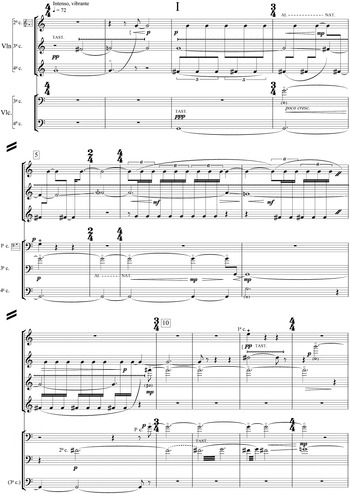
Scelsi, Duo, movement 1 (bars 1–13). Property of Editions Salabert, Paris. Reproduced by permission of G. Ricordi & Co (London) Ltd.

A glance at the openings of the two movements reveals striking similarities (see Example 1). Each unfolds in relation to a pivot, which is also privileged by the scordatura of the instruments: g1 in the first movement, a/a1 in the second. Both movements enrich this sound with the characteristic Scelsian gestures: vibrato, tremolo, octave doubling, microtonal inflection (especially the lower adjacent quarter tone), change of dynamics, and variation of timbre. Each movement begins quietly (as if da lontano) and ends by fading away, with the main mass of activity concentrated unselfconsciously in between. There is even a metrical correspondence between the opening events, which may have been exaggerated during the transcription. Nonetheless, these opening bars also establish a distinct rhetorical scheme for each movement.
In the first movement the pitch g1 (sometimes doubled with G and/or g3) forms an unambiguous pivot, against which other sounds appear, as if in relief, and towards which they then gradually resolve. The basic rhetorical pattern is established in the opening two bars, for violin only. The pivotal g1 is heard momentarily in the purest available form: a harmonic, sul tasto. The first gesture is a typical aggregate: the addition of the lower adjacent quarter tone, which is also vibrato. The vibrato serves to camouflage the pitch inflection. In bar 2 the tension is resolved in two stages: first the auxiliary and then the vibrato is withdrawn.
The rest of the movement consists of complicated echoes of this pattern. The first such echo begins immediately, in bar 3, with a recombination of the two elements of the original gesture: vibrato (this time on the pivot g1) and pitch expansion to the lower quarter tone (this time not vibrato, but in a broad tremolo with the pivot). A third element is also introduced: a doubling of the pivot, which gradually becomes audible two octaves below, where it provides a resonant, uninflected anchor, reinforcing the pivot and thus also the effect of salience of the lower quarter tone. This time the resolution is delayed by an extra gesture of disturbance, that of motion to the upper quarter tone (bars 4–7), after which the first two elements are resolved, again in stages: the vibrato dissolves in the last quaver of bar 9; the tremolo settles on the lower quarter tone, also at the end of bar 9, before resolving onto the pivot in bar 13. Also in bar 9 the doubling is interrupted by a leap into the upper register, combined with pitch inflection (the leap is to f♯3); the pitch inflection is then resolved in bar 13 (Example 2). This expanding process of disturbance and gradual resolution in the domains of intonation and register is accompanied by a change in timbre from sul tasto to that of the normal bowing position between bars 4 and 7, which is ‘resolved’ back to the sul tasto sonority in bars 11–12. In short, the question in this movement is not whether the various tensions will resolve in the expected way, but in what order.
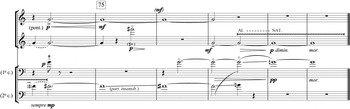
Since these gestures gradually become not only more elaborate but increasingly distinct from the pivot, there is a global centrifugal tendency in the movement, which balances the centripetal tendency at the local level. Ever more elaborate gestures are continually introduced in a kind of stretto, culminating in intense passages describing the tritone between g1 and c♯1 between bars 27 and 52. The uninflected pivot is heard only twice more, each time with octave doublings (at bars 13–14 and 58), and it is difficult not to hear these moments, in which several forms of resolution coincide, as points of expressive (and perhaps formal) repose. This balance between centripetal and centrifugal forces is sustained to the very last moment of the first movement: in the last few bars there is a gradual resolution towards the original unison g1, but just as the music fades away a final gesture of vibrato and one of ‘reaching over’ (onto the upper adjacent quarter tone) are introduced (Example 3).
Scelsi, Duo, movement 1 (bars 74–9). Property of Editions Salabert, Paris. Reproduced by permission of G. Ricordi & Co (London) Ltd.

The second movement uses similar gestures, and these follow the same rules – that is, they are transformed and resolved in the same ways. However, their expressive functions are in some ways reversed. The overall effect is centripetal, in that the music is confined to a narrow band around a and a1, almost always heard in both octaves, with just one momentary extraneous pitch, the pitch b, in bars 27–8. There is, on the other hand, what we might call an unstable, centrifugal tendency on the local level: the role of pivot seems to shift between registers and between a/a1 and the lower quarter tone, especially because the resolutions of the two lower quarter-tone auxiliaries onto a and a1 are usually staggered. This effect is compounded by the absence of a bass anchor.
Again, this is all encapsulated in the opening bars (Example 1). This time the music begins not with the pure pivot but with the vibrato lower quarter tone, which had been the main disturbance in the first movement but is now treated (at least temporarily) as a referential sound. As before, this sound is destined to resolve into the ‘real’ pivot of a/a1; however, for the first two bars, the additions of a/a1 may be heard as disturbances. As in the first movement, the first gesture is an aggregate occurring after two beats: a doubling of the opening sound at the octave above, which camouflages the addition of a1, again first heard in its ‘purest’ form as a sul tasto harmonic. This is followed by the transfer of the pivot into the lower octave, first intermittently (contained in a slow vibrato) and then sustained (on an open string). The impression of an increasingly assertive disturbance is reinforced by a crescendo to mezzo piano.
As in the previous movement, in bar 3 the ‘pure’ pivot is doubled (or rather tripled, across three octaves); this time the doubling is punctuated with pizzicato, as well as an abrupt change of dynamics and timbre. This moment has the rhetorical function of revealing a/a1 as the ‘real’ pivot. The lower quarter tone, at the bottom of the texture, is suddenly reinterpreted as the extraneous sound: as in bar 3 of the first movement, it is reinforced by the withdrawal of vibrato, as if to balance the emphatic doubling of the pivot; it is then resolved by glissando into the pivot.
Whereas the first movement rested only a few times on the uninflected, non-vibrato pivot, this movement does so more frequently (bars 3–4, 10, 14, 19, 20–21, 45), often emphasizing it with pizzicato or repeated notes. However, this salience seems only to increase the tension, destabilizing the pivot further: is it a temporarily revealed background or a temporary foreground element? The inevitable gesture of disturbance that follows thus comes as a relief rather than as a dramatic intrusion. Ambiguity is restored rather than resolved. Appropriately, the whole work ends on g♯1, the point exactly between the main pivots of each movement.
This brief discussion already gives an idea of the subtlety and flexibility with which Scelsi exploits the rhetorical possibilities of his economical idiom. In both movements of this work the main tension is between a pivotal sound using the purest resonance of the instruments and a muffled sound incorporating the lower quarter tone. The general orientation of these is that the first movement's centrifugal, unstable character is balanced by the way the pure tone serves not only as a pivot but as a kind of magnet, usually only implied, against which ‘impurities’ are thrown in relief and towards which they strive, while in the second movement the overall constriction and centripetality is balanced by the local instability of the pivot. It is hard to resist metaphorical implications of exteriority versus interiority, passion versus serenity, and so on, especially since Scelsi used similar terms on occasion, for instance in the titles of the movements of the Third String Quartet. My main point, however, is that these expressive subtleties can be attributed to the skilful distribution and manipulation of a formulaic repertoire of gestures, without appealing to transcendental notions of sound, even if such notions were a precondition of the music's existence.
Conclusions
Scelsi's orality – that is, his (attempted) transcendence of musical writing – has often been associated, correctly, with his meditation on ‘sound itself’. It does not follow, however, that sound somehow replaces musical rhetoric, or that the latter is unintelligible. On the contrary, I have argued that Scelsi's rhetoric is in several ways typically oral in character and is at least as important as ‘sound itself’ to an understanding of this music. I have also suggested that, although the music's textural ambiguity has often discouraged critics from describing it from a syntactical perspective, its formulaic aspects in fact make it typically ‘grammatical’.
Looking at his music in this way (which, of course, I am not claiming was his way) solves several problems. It demystifies the remarkable persuasiveness of his improvisationsFootnote 49 and gives some theoretical weight to his insistence that he did not impose organization or structure on them: to some extent, he did not need to do so, because the organization was already implicit in the idiom itself. It also makes it unnecessary to justify the music's frequent polyphonic moments as a property of Klang, since the flexibility of Scelsi's grammar allows it to generate not only the more austere works, such as the Quattro Pezzi, but also those that incorporate triadic polyphony, such as Anahit or Ohoi.
The recent opening of the Scelsi archives may or may not make it possible to assess precisely in what ways the improvisations were influenced by somatic factors (especially by the mechanics of Scelsi's ondiolas) and/or subsequently rationalized by his transcribing assistants. In the case of works such as the Canti del capricorno, in which the improvisation itself was collaborative,Footnote 50 the aspect of orality may be inextricably confused with the question of authorship, but this is one of many complications to be acknowledged without embarrassment.
The criteria I have sketched above (additive versus subordinative, etc.) have implications also for the reception of avant-garde music in general: not only of works apparently influenced by Scelsi (such as those of the later Nono) but of any works characterized or validated by their supposed emancipation of sound from writing or rhetorical constraint (most obviously those of Cage). This approach might offer a way of transcending the questionable opposition of sound and rhetoric that is frequently found in avant-garde music aesthetics, and of re-examining the modern chirographic bias also in its more disguised forms. If so, we would be all the more indebted to Scelsi and closer to appreciating the full implications of his work.