Increased survival in low birth weight neonates (≤2.5 kg) with congenital heart disease has led to a greater number of cardiac catheter interventions and a heightened concern over the risk that low birth weight poses in this patient population. For decades, diagnostic and therapeutic interventions including balloon pulmonary valvuloplasty, balloon aortic valvuloplasty, and balloon atrial septostomy have been used in neonates and infants with low risk;Reference Cassidy, Schmidt, Van Hare, Stanger and Teitel 1 – Reference Vitiello, McCrindle, Nykanen, Freedom and Benson 5 however, there is a paucity of data defining the specific effect of low birth weight on procedural risk and complication rates. The few reports delineating such risk are limited by lack of adequate controlsReference Chen, Hwang, Yu and Lin 6 – Reference Simpson, Moore and Teitel 8 or by low subject number.Reference McMahon, Price and Salerno 9 , Reference Sutton, Lock and Geggel 10 This study reviews comparative risk of catheter intervention in low birth weight neonates versus a control group of neonates larger than 2.5 kg at our centre.
Materials and methods
Study patients
Following approval by the Institutional Review Board, we conducted a single-centre retrospective case–control study. Cases were consecutive neonates (<28 days of age) who weighed ≤2.5 kg at the time of cardiac catheterisation between January, 2003 and January, 2009. Control patients were neonates who weighed >2.5 kg (range = 2.6–4.6 kg) and underwent cardiac catheterisation during the same time period. For each low birth weight case, three control patients >2.5 kg were randomly selected from our heart centre database during the same time period. The decision to undertake cardiac catheterisation was made at a clinical disposition conference at which all imaging and available data were reviewed and discussed on an individual case basis. Clinical data from the electronic medical record, cardiac catheterisation, and angiography reports were collected.
Catheterisation technique
During the study period, catheterisation technique included mechanical ventilation and administration of general anaesthesia for all patients in both the low birth weight group and the control group. Risk for respiratory decompensation has been reported in ∼10% of low birth weight neonates undergoing cardiac catheterisation.Reference Simpson, Moore and Teitel 8 For thromboembolic prophylaxis, each neonate received 50–100 units/kg of intravenous heparin sodium upon vascular access. Clinical assessment of femoral pulses was performed after each procedure without routine use of Doppler ultrasound, unless there was concern for pulse quality. Non-ionic, iodinated contrast agent was used for all patients.
Recording of data
Data collected included demographic characteristics, primary diagnosis, type of procedure (diagnostic versus therapeutic), fluoroscopy time, radiographic contrast volume (ml/kg), pre-procedure blood urea nitrogen to creatinine ratio, post-procedure blood urea nitrogen to creatinine ratio obtained the morning following the procedure, and all procedural complications. Procedure-type risk categories were applied to each case according to risk stratification proposed by the Congenital Cardiac Catheterization Project on Outcomes, which delineates four risk categories for both diagnostic and therapeutic procedures.Reference Bergersen, Gauvreau and Marshall 11 In brief, risk categories for diagnostic procedures are based on age, with patients ≥1 year of age at lower risk (Category 1) versus neonates <1 month of age (Category 3). Risk categories for therapeutic procedures are stratified by the type of procedure performed – for example, valvuloplasty, device or coil closure, balloon angioplasty, stent placement, etc. – age, and anatomic location – for example, pulmonary valve, aortic valve, patent ductus arteriosus, pulmonary artery, pulmonary vein, aorta, etc. – emphasising the greater risk, for example, of performing atretic valve perforation (Category 4) versus atrial septostomy (Category 3). Complications were stratified into major and minor complications. Major complications included any event requiring cardiopulmonary resuscitation, complete heart block requiring epinephrine or pacing, significant structural injury from balloon deployment, myocardial perforation, vessel perforation, central nervous system complications including stroke or haemorrhage, and/or death. Minor complications included transfusions received within the first 24 hours after the procedure, hypotension requiring intravenous fluids, deep venous thrombosis, pulse loss requiring heparin administration, metabolic acidosis requiring sodium bicarbonate administration, transient heart block, dysrhythmias requiring treatment, hypercyanotic spell, and/or balloon rupture.
Statistical analysis
Patient and catheterisation data were compared within and between groups. Analyses of categorical and continuous variables included χ2, Fisher's exact test, paired and unpaired t-tests, and logistic regression. Data analyses were performed using Statistical Package for the Social Sciences software. A p-value of <0.05 was deemed statistically significant.
Results
Demographic data
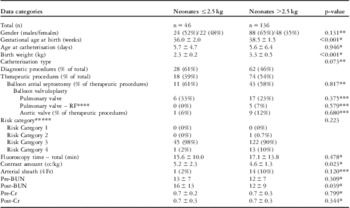
A total of 46 neonates weighing ≤2.5 kg and 136 neonates >2.5 kg underwent cardiac catheterisation and were included in the study. Neonates ≤2.5 kg had a younger gestational age at birth and lower birth weight compared with control patients >2.5 kg. There was no difference in the days of age at the time of cardiac catheterisation. Demographic characteristics and catheterisation procedural data for the study patients are summarised in Table 1.
Demographic characteristics and cardiac catheterisation data.

*p-value, unpaired t-test, independent samples, equal variances assumed
**p-value, χ2-analysis
***p-value, Fisher's exact test
****RF = radiofrequency wire or catheter
*****Risk category based on criteria from Bergersen et al11
Procedures performed
Table 1 summarises the number and percentage of diagnostic and therapeutic cardiac catheterisations performed in each group of neonates. Overall, although the percentage of diagnostic procedures in the study group was larger (61% versus 46%), the difference in diagnostic versus therapeutic procedures between groups was not statistically significant (p = 0.073). For therapeutic procedures, the rates of balloon atrial septostomy (61% versus 58%) and balloon valvuloplasty (39% versus 42%) were similar between groups. When stratified by type of interventional procedure – for example balloon atrial septostomy, pulmonary valve, pulmonary valve perforation with radiofrequency wire or catheter, or aortic valve – no significant differences were demonstrated between groups.
Procedural data
Table 1 summarises the comparison of catheterisation data between subjects and controls. Overall, total fluoroscopy times were similar between groups, but low birth weight neonates received more contrast volume compared with larger neonates (5.2 ± 2.3 versus 4.6 ± 1.3, p = 0.023). Post-procedure blood urea nitrogen was higher in the neonates ≤2.5 kg compared with the control group (16 ± 13 versus 12 ± 9 ml/dl, p = 0.039). Furthermore, there was no significant difference between the number of patients receiving 4-Fr arterial sheaths between groups.
Complication data
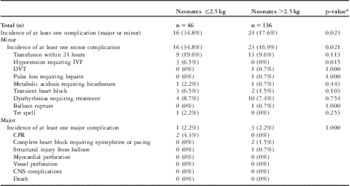
The overall incidence of procedural complications was higher in neonates ≤2.5 kg compared with neonates >2.5 kg (34.8% versus 17.6%, p = 0.023) because of a greater proportion of minor complications (34.8% versus 16.9%, p = 0.021). When specific minor complications were stratified, there was a greater incidence of hypotension requiring intravenous fluids in neonates ≤2.5 kg (6.5% versus 0%, p = 0.015; Table 2). Using logistic regression and controlling for physician performing the procedure and procedure-type risk category according to the Congenital Cardiac Catheterization Project on Outcomes,Reference Bergersen, Gauvreau and Marshall 11 neonates ≤2.5 kg were at higher risk of any complication, major or minor, compared with larger neonates >2.5 kg (adjusted odds ratio = 3.2, 95% confidence interval 1.4–7.2, p = 0.005). This increased risk can be attributed to a higher risk of any minor complication in neonates ≤2.5 kg compared with control patients (adjusted odds ratio = 3.2, 95% confidence interval 1.4–7.2, p = 0.005). The percentage of neonates having at least one major complication was not higher in the low birth weight group (2.2% versus 2.2%). No procedural deaths occurred in either group.
Incidence of complications.
CNS = central nervous system; CPR = cardiopulmonary resuscitation; DVT = deep vein thrombosis; IVF = intravenous fluids
*p-value, Fisher's exact test
Discussion
Catheterisation technique and variables
Cardiac catheterisation was successfully performed in the low birth weight neonates ≤2.5 kg. Our study demonstrated a lower risk of vascular access complications including deep venous thrombosis and pulse loss requiring heparin among low birth weight neonates compared with other studies.Reference Simpson, Moore and Teitel 8 – Reference Sutton, Lock and Geggel 10 , Reference Rhodes, Asnes, Blautox and Sommer 12 Only one neonate in the >2.5-kg group experienced these complications and no neonate <2.5 kg had a minor complication associated with vascular access. The use of small percutaneous needles, sheaths, and catheters along with consistent use of heparin may contribute to the low number of vascular access complications. Post-procedural assessment for vascular complications at our centre during the study period consisted of clinical assessment of pulses and perfusion without the routine use of Doppler ultrasound, which perhaps resulted in the underrecognition and underreporting of low-severity vascular complications.
The study also demonstrated a larger volume of contrast agent given to neonates ≤2.5 kg compared with neonates >2.5 kg (Table 1). This may reflect a tendency to view the typical weight-based contrast volumes as insufficient to adequately visualise the necessary anatomic detail in low birth weight neonates. Although pre-procedure blood urea nitrogen values were similar, post-procedure blood urea nitrogen was higher in low birth weight neonates.
Catheterisation complications
Previous studies have demonstrated an association of low weight at catheterisation with increased rates of procedure-related complications ranging from 24% to 42%,Reference Vitiello, McCrindle, Nykanen, Freedom and Benson 5 , Reference Simpson, Moore and Teitel 8 , Reference Rhodes, Asnes, Blautox and Sommer 12 , Reference Zeevi, Berant, Fogelman, Galit and Blieden 13 and mortality associated with catheterisation ranging from 0.3% to 3%.Reference Cassidy, Schmidt, Van Hare, Stanger and Teitel 1 , Reference Vitiello, McCrindle, Nykanen, Freedom and Benson 5 , Reference Simpson, Moore and Teitel 8 , Reference Rhodes, Asnes, Blautox and Sommer 12 , Reference Zeevi, Berant, Fogelman, Galit and Blieden 13 Our experience with the study group of neonates ≤2.5 kg was similar, with an incidence of at least one minor complication of 34.8% and an incidence of at least one major complication of 2.2%. The control group of neonates >2.5 kg demonstrated a lower procedural complication incidence of 17.6%, but a major complication incidence of 2.2%, identical to the low birth weight study group incidence percentage. Similar to previous studies, our study found that the most common minor complications were dysrhythmiasReference Cassidy, Schmidt, Van Hare, Stanger and Teitel 1 , Reference Cohn, Freed, Hellenbrand and Fyler 2 , Reference Simpson, Moore and Teitel 8 and blood transfusions,Reference Sutton, Lock and Geggel 10 and incidences were comparable between groups in our study. Low birth weight neonates experienced more hypotension requiring intravenous fluids compared with the control group, but whether this has a significant clinical impact is uncertain. In the 182 neonates included in the study, there were no catheterisation-related deaths.
Study limitations
Owing to the fact that the study was retrospective and relied on existing data within patients’ medical records, accuracy is limited by the possible incomplete disclosure of complications, such as underreporting of low-severity complications, and the possible inaccuracy of data input. In addition, maternal and prenatal variables contributing to low birth weight, which might confer increased risk for complications, were not included in the list of variables collected. Despite the relatively large subject number, the possibility of type II error remains, in which a significant difference between groups exists but was not identified. Characterisation of “low birth weight” as ≤2.5 kg was a cut-off chosen on the basis of convention within our centre and in other studies.Reference Simpson, Moore and Teitel 8 , Reference McMahon, Price and Salerno 9 Although increased risk of minor complications associated with neonates ≤2.5 kg was demonstrated, further study is needed to define more precisely the weight at which increased procedural risk applies.
This study highlights the difficulty of determining standardised risk adjustment for low birth weight infants due to the wide heterogeneity of the underlying cardiac anatomy, physiology, types of intervention, and multivariate comorbidities, which also contribute to procedural risk. In addition, the number of low birth weight infants undergoing cardiac catheterisation remains low, resulting in an inherently limited sample size. Furthermore, the single-centre nature of this study may limit the generalisability of our findings to other centres. We anticipate that the assessment of outcomes and complications will be enhanced by broadly collected, multi-centre, and inclusive registries such as the Improving Pediatric Adult Congenital Treatments registry, which commenced in 2011.Reference Martin, Beekman and Ing 14
Conclusions
The overall incidence of complications was higher in neonates ≤2.5 kg compared with neonates >2.5 kg because of a greater proportion of minor complications. When specific minor complications were stratified, there was a greater incidence of hypotension requiring intravenous fluids in neonates ≤2.5 kg. After controlling for physician performing procedure and procedure risk category, neonates ≤2.5 kg remained at higher risk for any complication. Neonates ≤2.5 kg also received more contrast volume, and post-procedure blood urea nitrogen was higher. The percentage of neonates having at least one major complication was not higher in the ≤2.5-kg group. No procedural deaths occurred in either group. For the clinician, these data are quite pertinent for procedural risk assessment in all neonates, and more specifically the comparative outcome data may better inform the family–physician discussion regarding procedural risk in low birth weight neonates.
Acknowledgements
The authors thank Ashley Sherman for assistance with final data analysis and data review, and Dr Karina Carlson and Dr Michael Bingler for helpful review of the manuscript.