The deployment of troops to fight the War on Terror regenerated interest in the effect of war on domestic politics and on decision makers. While public opinion in times of war enjoys a long and healthy tradition of scholarship, less is known about the impact of war on policy makers. Long-held beliefs about the impact of war on presidents, Congress, and the judiciary have only recently started receiving systematic empirical treatment and remain far from providing answers to how and why wars change the behavior of policy makers (although see Epstein et al. Reference Epstein2005; Clark Reference Clark2006; Collins Reference Collins2008; Staudt Reference Staudt2011; Howell and Ahmed Reference Howell2014).Footnote 1
Though little is known about how wars change decision making on the courts, a few notable pieces suggest that federal courts decide civil liberties and criminal issues more conservatively in times of war (Epstein et al. Reference Epstein2005; Clark Reference Clark2006; Collins et al. Reference Collins2008). We use this war effect to investigate differences in how liberals and conservatives react to threat.
Our study makes two contributions. First, we provide individual judge-level effects for war rather than focusing on court outcomes and policy shifts in order to identify whose behavior shifts during times of war.Footnote 2 If we know whose behavior changes in times of war, we gain a better understanding of why judge behavior changes in times of war. Since judges ultimately determine and legitimize the balance between security and liberties, understanding potential differences in judicial decision making in times of war is part of understanding the rule of law in the United States over the last 60 years—especially since the country has been involved in interstate wars for about one-third of the time.
Second, our results suggest that war effects are conditional on the ideological position of the judge. This article thus more broadly adds to the literature on the role of ideology in judicial decision making by suggesting that the dimensions underlying our understanding of ideology may be activated differently by contextual factors. Importantly, our results suggest that the role of ideology can be mitigated by contextual factors. Hence, we offer a more nuanced understanding of the interplay between ideology and contextual factors to provide a better understanding of the differential application of the rule of law across judges and cases.
The article will proceed in the following manner. First, we provide an overview of the explanations advanced for changes in judge behavior during times of war. We then articulate our hypotheses on whose behavior is affected during times of war, incorporating cognitive and motivational differences between liberals and conservatives offered by political psychology and public opinion scholarship. We test our hypotheses on judge votes on the courts of appeals from 1950 to 2008 and close with a discussion of the results as well as some concluding remarks addressing the article’s implications and avenues for future research.
Unpacking Judicial Behavior in Times of War
According to the late Chief Justice William Rehnquist, “it is neither desirable nor is it remotely likely that civil liberty will occupy as favored a position in wartime as it does in peacetime.” Rather, Rehnquist suspects that “laws will thus not be silent in time of war, but they will speak with a somewhat different voice” (Reference Rehnquist1998, 224–25). Much ink has been spilled, mainly by legal scholars, on whether such a “crisis” theory of judicial decision making exists (see, e.g., Fortas Reference Fortas1968; Linfield Reference Linfield1990; Stone Reference Stone2003). Unfortunately, these studies rely on the examination of selected Supreme Court cases handed down during wartime alone, not allowing for a comparison between wartime and peacetime behavior. Political scientists, on the other hand, provide some empirical support showing that judges treat cases involving foreign policy differently, thus suggesting that security concerns affect the treatment of civil liberties cases by judges (Ducat and Dudley Reference Ducat1989; Yates and Whitford Reference Yates1998; Randazzo Reference Randazzo2011). These studies, however, do not directly address the impact of war on court decision making itself.
In the first systematic, empirical study of war and peacetime differences in US Supreme Court decision making, Epstein et al. (Reference Epstein2005) show that the US Supreme Court decides civil rights and liberties cases more conservatively in times of war than in times of peace. They suggest that judges rule more conservatively in times of war because judges are people, too, and prefer a more security-oriented balance over civil liberties. In a study of district court judges, Collins et al. (Reference Collins2008) echo the same sentiment: “Though they hold a special place in society, federal judges are, after all, citizens too” (124). Clark (Reference Clark2006) offers a similar explanation, where the increased propensity of the courts of appeals to rule in favor of the government in criminal rights cases during wartime is due to a Durkheimian reaction toward criminals, where judges “sense a heightened need for ‘law and order’ and are less willing to tolerate criminal behavior” (414). Taken together, the body of work on the impact of war on courts suggests that the balance between civil liberties and security changes in times of war to favor increased security over liberties; furthermore, this change is related to sincere shifts in individuals’ preference ordering of security-rights trade-offs—not unlike the willingness of citizens to trade off some civil liberties in return for increased security in the aftermath of 9/11 (Davis and Silver Reference Davis2004).
While these empirical studies were successful in identifying decreases in protection of liberties by the courts during times of war, they fail to identify a clear causal mechanism for the shifts in individual preferences. Their focus and contribution lie in empirically evaluating long-standing, untested (and at times competing) theories of war effects on judges. For instance, Epstein et al. (Reference Epstein2005) set out to test two competing existing yet untested hypotheses of wartime courts: “(a) the Milligan thesis of the Court as a guardian of immutable rights, leading the Court to depart dramatically from the preferences of the public and elected officials; and (b) the crisis thesis, reflecting Korematsu, that the Court’s response mirrors that of the citizenry and its leaders” (18). They find support for the latter, though the findings could not be replicated for the US district courts (Collins Reference Collins2008).Footnote 3 Clark (Reference Clark2006) suggests that courts become more deferential to the executive in times of war but fails to find support outside of criminal cases, which he speculates might instead point to a sincere change in preference for heightened security.Footnote 4
We pick up where these articles left off to explain why and when such an observed wartime pattern should happen. We argue that these wartime shifts can be explained as a reaction to increased salience in security concerns that is conditional on the ideology of the judge. In other words, we do not test competing theories, but offer an individual-level causal mechanism for why wartime decisions are more conservative in times of war than in times of peace by introducing a mechanism based on political psychology. Hence, our theory supplements existing arguments by identifying the mechanisms for the presumed sincere shifts in behavior, identifying whose behavior is actually changing, and addressing under what conditions behavior changes.Footnote 5 Our research question therefore goes beyond asking whether there is an observable shift in judicial behavior during times of war. We are motivated by the following questions: Does this shift occur in all wars equally, and does this shift occur across all judges equally?
We address the first question by proposing a more nuanced measure for war. Studies have typically used a binary variable to measure war-related changes in judicial behavior, thereby treating all wars as equal.Footnote 6 We use a measure of casualties to capture war intensity, which allows variation across and within wars. Thus, the effect of war on a decision made in the days of intense conflict during the Vietnam War is weighed differently from the effect of war in the early days of the Vietnam War or in a less intense conflict, such as the Gulf War. A more detailed discussion of the measure and potential alternatives follows in the data and methods section.
We address the second question by treating war effects as conditional on judge characteristics. We borrow from theories in political psychology and public opinion to develop an explanation of wartime behavior on the bench. We start by contemplating potential differences in how liberals and conservatives are motivated by security concerns and move on to articulate potential differences in how they react to security threats presented by war.
Whose Behavior Changes?
The majority of studies in judicial politics rely on average effects, thus assuming that the effect of the variable of interest will be consistent across judges.Footnote 7 Studies in political psychology and public opinion, however, suggest that liberals and conservatives may be motivated by different considerations, including variation in the desire to manage uncertainty and threat, as well as in the value placed on collective security.Footnote 8
In a series of papers, Jost and his coauthors analyze “psychological motives and tendencies [that] underlie ideological differences between the political left and the right” (Jost et al. Reference Jost2003, 339), building on the extensive literature on authoritarianism (see Adorno et al. Reference Adorno1950; Altemeyer Reference Altemeyer1996, Reference Altemeyer1998) to argue that, among other cognitive differences between liberals and conservatives, conservatives are highly motivated by the psychological need to manage and reduce uncertainty and threat (Jost et al. Reference Jost2003, Reference Jost2007; Jost, Nosek, and Gosling Reference Jost2008). Threat management, these findings suggest, is an important motivational factor for conservatives because they are more likely to perceive the world as a dangerous place (Altemeyer Reference Altemeyer1998; Duckitt Reference Duckitt2001; Jost et al. Reference Jost2003, Reference Jost2007, Reference Jost2008).
Similarly, conservatives are also associated with motivational desires for hierarchy, order, and structure (Jost et al. Reference Jost2003, Reference Jost2007, Reference Jost2008). They embrace an “ethics of community” that prioritizes the interests and security of a community over pure individual autonomy (Shweder et al. Reference Shweder1997; Haidt and Graham Reference Haidt2007). In essence, conservatives are more likely to find value in social organizations and institutions and seek to protect these institutions’ integrity and reputation while liberals prioritize individual autonomy, promoting the exercise of individual personal preferences (Haidt and Graham Reference Haidt2007).
Such perceptions of threat and higher premiums on collective interests and security as motivational factors may explain, for example, why conservatives are generally less likely to support criminal and civil liberties claimants than liberals. In criminal cases, after all, such claims are often directly weighed against collective security interests. Even in civil liberties cases, individual rights often clash with collective security interests and social order. If liberals and conservatives are not equally motivated by uncertainty and threat or collective security, then we should expect them to react differently to changes in perceived security threats, particularly during times of war.
We are interested in analyzing whether the motivational difference of threat perception conditions the reactions of liberal and conservative judges to war. If there is a difference in how liberals and conservatives react to war, it could conceivably be through one of two mechanisms: (a) conservative judges, who generally support security measures over the protection of liberties, find their ideological preferences exacerbated in wartime; or (b) liberals, who are generally protective of liberties in times of peace, may reconsider their liberal position in times of war. Threat and collective security may increasingly become a motivational factor to liberals when security concerns become salient (such as during a time of war) and potentially eclipse peacetime concerns.
Of these two possibilities, we argue that war primarily drives changes in liberal positions, which similarly finds support in public opinion scholarship. In their analysis of public opinion during times of war, Hetherington and Suhay (Reference Hetherington2011) do not find support for war exacerbating individuals’ existing peacetime views. Instead, they argue, “it is likely not fringe elements of society who are responsible for marked increases in support for aggressive foreign policy or decreases in political tolerance when the nation’s security is seriously threatened. Authoritarians tend to have such preferences regardless. Instead, the culprits are more likely to be found among the more moderate majority” (547).Footnote 9 In other words, rather than reinforcing the views of those who strongly value security concerns, threats change the balance between security and civil liberties for those who have more room to move toward security. Under this framework, we should expect moderate or liberal judges to move toward a more conservative position in wartime.
Malhotra and Popp (Reference Malhotra2012) offer similar arguments (and supportive experimental results) in their examination of changes in antiterrorism policy support across liberals and conservatives. They assert that “Republican support for antiterrorism policies may be unaffected by higher threat information … because the policies are consistent with their ideological predispositions.” On the other hand, “it may be possible, though, for higher threat information to override Democrats’ ideological predispositions” (4). The reason for this conditional effect is that higher levels of threat, and its associated anxiety, induce less reliance on liberals’ prior attitudes by introducing new information that is inconsistent with prior ideological attitudes. On the other hand, higher levels of threat reinforce and confirm prior ideological attitudes of conservatives. Indeed, heightened sense of threat has been associated with increased attention to contemporary information, increased political learning, decreased reliance on habitual cues, and decreased reliance on ideological predispositions (Marcus and MacKuen Reference Marcus1993, Reference Marcus2001; LeDoux Reference LeDoux1996; Marcus, Neuman, and MacKuen Reference Marcus2000). Liberals are most vulnerable to these tendencies induced by threat because the new, threatening information does not reinforce their existing attitudes and prioritizations, thereby causing liberals to reprioritize during times of threat.
While Hetherington and Suhay (Reference Hetherington2011) address shifts in the public and not shifts by judges, we argue that a similar logic holds for judges, too. In peacetime, conservative judges are already more inclined to be less sympathetic to civil liberties claims than their liberal counterparts. According to Jost et al. (Reference Jost2003), conservatives view the world as a dangerous place regardless of whether the country is at war or not. When security concerns mount in times of war, their preference ordering is reinforced. Liberal judges, on the other hand, may find it hard to value civil liberties equally in times of war and peace.Footnote 10 Put another way, war does not exacerbate the view of conservative justices; it thins out the ranks of judges prioritizing civil liberties over security. Hence, the observed wartime increase in conservative rulings by courts (Epstein et al. Reference Epstein2005; Clark Reference Clark2006) does not occur because conservative judges change, but because liberal judges move closer to the conservative camp. We should therefore expect liberal judges to become more conservative in times of war.
It is unlikely that the effect of war is consistent over the time of the war. Wars are more salient and intense at some points and less at others, making security concerns and the perception of threat more salient at some points than others. Therefore, both the presence and intensity of war influence the perception of threat and can move judge votes in a more conservative direction. As such, we derive the following testable hypothesis for liberal judges.
Hypothesis 1. In times of war, and with growing intensity of war, liberal judges vote more conservatively in civil liberties and criminal cases than in times of peace.
The salience of security concerns during war simply reinforces existing (peacetime) salience of security concerns prevalent in conservative ideologies; in essence, conservative ideologies dictate that the world is a dangerous place and that security is salient even in times of peace. War, in this case, is not likely to alter conservative individuals’ behavior since it reinforces their existing prioritization of security (relative to civil liberties). Because conservatives tend to value security over liberty in times of peace as well as war, the threshold for changing the balance between liberties and security is likely higher for them than it is for liberals.
While conservatives are always motivated by security concerns, they still need to weigh these concerns against other values they hold, including individual liberties. As war intensity grows, the value they place on security versus liberties may shift, as a threshold is reached that no longer simply reinforces the worldview they have, but exacerbates it. In other words, and contrary to the effect hypothesized for liberals, wartime alone does not elevate security concerns to a prominent position for conservatives. Similarly to the effect hypothesized for liberals, however, we expect the intensity of war to mediate the relative value placed on security versus liberties. Hence, we offer a second hypothesis.
Hypothesis 2. Only in times of intense warfare do conservative judges vote more conservatively in civil liberties and criminal cases than in times of peace.
In the remainder of the article, we present our data and methods, followed by the results, and we present a discussion of the implications and avenues for future research.
Data and Methods
We use the courts of appeals for our analysis for a number of reasons. First, in all but 0.1% of cases (i.e., those that are consequently heard and decided by the US Supreme Court) the courts of appeals’ decisions stand. Second, and more importantly for this project, courts of appeals judges provide more variation in ideology, which is crucial for our individual-level analysis. Third, as Clark (Reference Clark2006) writes, unlike Supreme Court justices, circuit court judges have mandatory jurisdiction and “cannot dodge cases during contentious political moments” (402).Footnote 11
The case data come from the United States Courts of Appeals Database.Footnote 12 The database involved the coding of a random sample of 30 published decisions from each circuit for each year from 1960 to 2002, in addition to smaller samples for the period 1925–59. We selected all cases containing a criminal or civil liberties issue from 1950 through 2002. We add to these data all criminal and civil liberties cases from a random sample of 30 cases per circuit per year for the years 2003–8, using the same coding scheme as that employed in the Appeals Court Database.Footnote 13 Since we are interested in the individual judge vote as opposed to the panel case vote, we flip the database from a case level to a judge vote unit of analysis. We exclude civil rights cases, because the hypothesized mechanism explains shifts that occur on dimensions spanned by security on the one hand and individual liberty on the other. In civil rights cases, the government’s role is limited to providing equality among its citizens. Since civil rights cases primarily deal with equal opportunity issues, we do not believe that security considerations triggered by wartime perceptions of threat should influence civil rights judicial decision making.Footnote 14 Using judge votes in all criminal and civil liberties cases in the Songer et al. data set (as well as his additions for the period 2003–8) and adding all control variables, we are left with 16,320 observations.
The dependent variable in our model is whether the judge on the court of appeals casts a liberal or a conservative vote. This variable is coded 1 if the decision is liberal and 0 if it is conservative. Liberal and conservative are defined in the conventional manner used in most studies of judicial behavior in the United States (e.g., see Goldman Reference Goldman1969, Reference Goldman1975; Richardson and Vines Reference Richardson1970; Tate Reference Tate1981; Songer, Kuersten, and Kaheny Reference Songer2000; Hettinger, Lindquist, and Martinek Reference Hettinger2006; Sunstein et al. Reference Sunstein2006; Cross Reference Cross2007). Thus, a decision in favor of the party alleging that their criminal rights or civil liberties are denied is coded as liberal.
Three independent variables are central to the hypotheses tested in this research: the ideology of the judge deciding the case, the absence/presence of war at the time of the decision, and the intensity or severity of the war. We now discuss each of these in turn.
Ideology
We use Giles, Hettinger, and Peppers (GHP) scores (Giles, Hettinger, and Peppers Reference Giles2001) to account for judicial ideology.Footnote 15 Higher values correspond to more conservative judges and lower values correspond to more liberal judges, with most values falling between −0.5 and +0.5. The mean score in our database is 0.023, with a standard deviation of 0.36. We expect the variable to be significant and negatively correlated with the percentage of liberally decided cases.
War
For ease of comparison, we follow Clark’s classification of war to identify decisions made in the presence of war. As he and other scholars have done (Epstein et al. Reference Epstein2005; Clark Reference Clark2006; Collins Reference Collins2008), we use a dummy to indicate wartime decisions, where 0 indicates the absence of war and 1 indicates the presence of war. Clark’s classification of wars roughly corresponds to the wars identified in the Correlates of War (COW) database, which defines war as a conflict incurring 1,000 or more yearly battle deaths (by all participants).Footnote 16 The following wars are thus captured in the data set: the Korean War (June 30, 1950–July 27, 1953), Vietnam War (August 15, 1964–April 28, 1975), Iraq War (August 9, 1990–February 27, 1991), and the War on Terror (October 5, 2001 onward).
War Intensity
We include a second measure to capture the effect of war intensity. Previous scholarship has shown that casualty trends provide a lens to the public through which to assess the war. They represent the “most salient costs of conflict” (Gartner Reference Gartner2008, 95) and thus influence the domestic political debate and affect elections (Mueller Reference Mueller1973; Gartner and Segura Reference Gartner1998; Carson et al. Reference Carson2001; Karol and Miguel Reference Karol2007; Kriner and Shen Reference Kriner2007; Valentino, Huth, and Croco Reference Valentino2010). To account for within-war and between-war differences, we use a monthly moving average of war casualties on the US side.Footnote 17 Daily battle death figures for the Korean War and Vietnam War are obtained from the US National Archives.Footnote 18 Casualty lists for the Iraq War and the War on Terror are obtained through honor rolls and icasualties.org. To calculate the moving average, we first create a daily measure of casualties, from which we derive a running daily average (mean) of battle deaths incurred by the United States in the 30 days preceding the judge’s decision. The variable is coded 0 for all court decisions made at a time in which a war is not occurring (e.g., battle deaths are coded 0 for a decision a week after the end of a war). The measure can and does, however, take on a value of 0 during war when there are no battle deaths in a 30-day time frame.Footnote 19
The measure can be seen as a snapshot of how intense the war has been in the month preceding the decision. The advantages of this measure are that it allows for differentiation between wars, and it picks up particularly intense episodes during the course of a war. At the same time, it smooths out daily fluctuations that are unlikely to be noticed in detail, while tracing general trends that are likely to be noticed by individual judges. We realize that the time span we chose to create the moving average is somewhat arbitrary. However, because we use a running average, our measure represents a trend and is less sensitive to short-term changes. In order to test the sensitivity of our model to the chosen time span, we experimented with different time windows, taking into account a trend for up to 90 days before the decision announcement. Using different trends did not change our findings significantly.Footnote 20
Interactive Effect
In addition to these influences on judge votes—and more importantly—our hypothesis states a conditional relationship between war and ideology. More specifically, we are interested in how the effect of war may be conditioned by the judges’ ideology. In other words, the effect of war differs across liberals and conservatives.
To capture this conditional effect, we report base effects for war and ideology as well as a multiplicative term for both. To make the findings more intuitive and easily understood, we focus our discussion of results on graphs plotting predicted probabilities that address our hypothesis. We turn now to the control variables before addressing our results.
Control Variables
The US courts of appeals have a mandatory docket, which minimizes the potential of a war-related selection effect (see also Clark Reference Clark2006, 402). However, while circuit court judges have no such influence over their docket, there may be systematic differences in the types of cases that are appealed. The most likely culprits for a change in the docket are cases involving the government. It may be that the government is less respectful of rights and liberties in times of war than in times of peace, leading to a higher proportion of cases challenging the government in times of war. We therefore included an indicator for cases in which the government is the respondent in the model.
The majority of all appeals to the circuit courts are unsuccessful and lead to affirmances of the lower court decision. To create a more realistic baseline of the probability of a liberal decision given these skewed odds, we include a variable that indicates whether the lower court decision was liberal.
While Epstein et al. (Reference Epstein2005) uncovered a conservative shift in US Supreme Court decision making in times of war for civil liberties cases, they failed to do so for cases that directly related to war. They speculate that the Court “decides cases most related to war from an institutional process perspective rather than from a first-order balancing of security and liberty rights” (9). Accordingly, we add a control variable for cases related to war.
An extensive literature documents the effect of repeat players or party capability theory (see Galanter Reference Galanter1974; Wheeler et al. Reference Wheeler1987; Sheehan, Mishler, and Songer Reference Sheehan1992; Haynie Reference Haynie1994; Farole Reference Farole1999; Songer, Sheehan, and Haire Reference Songer1999; Szmer, Songer, and Bowie Reference Szmer2016). On a wide variety of courts in the United States, repeat players with substantial litigation resources tend to win more frequently than one-shot litigants with more limited resources, even after controls for issues and judge ideology. “The parties that may be presumed to be repeat players with superior resources consistently fared better than their weaker opponents and the disparity in success rates was greatest when the disparity in strength was greatest” (Songer et al. Reference Songer1999, 827). To control for these effects we add variables reflecting the general litigation status of the party advocating a liberal outcome and the party advocating a conservative outcome. We largely follow Wheeler et al. (Reference Wheeler1987) and Songer et al. (Reference Songer1999) in using five categories of parties according to their resources. From least to most resource-rich, they are categorized and coded in the following order: individuals (1), businesses and organized groups (2), local governments (3), state governments (4), and the federal government (5).Footnote 21 To capture how resources affect the probability of a liberal decision, we deduct the status of the party advocating a conservative outcome from the status of the party advocating a liberal outcome. For a case in which the federal government (5), for example, is advocating the conservative outcome and facing an individual (1) who is seeking a liberal outcome, the measure would be a 4. We anticipate that there is a positive relationship between the likelihood of a liberal decision and this calculated differential between litigant status of the party advocating a liberal outcome and the party advocating a conservative outcome.
Additionally, interviews with judges and existing scholarship on decision making in the courts of appeals (e.g., Richardson and Vines Reference Richardson1970; Howard Reference Howard1981; Klein Reference Klein2002; Bowie, Songer, and Szmer Reference Bowie2014) emphasize the importance of circuits and circuit law for appeals court decision making. Thus, to ensure a more fully specified model, we include fixed effects for the circuits, letting each circuit have its own intercept.Footnote 22 The Eighth Circuit is the excluded category used as the baseline for the interpretation of circuit effects.Footnote 23
Results
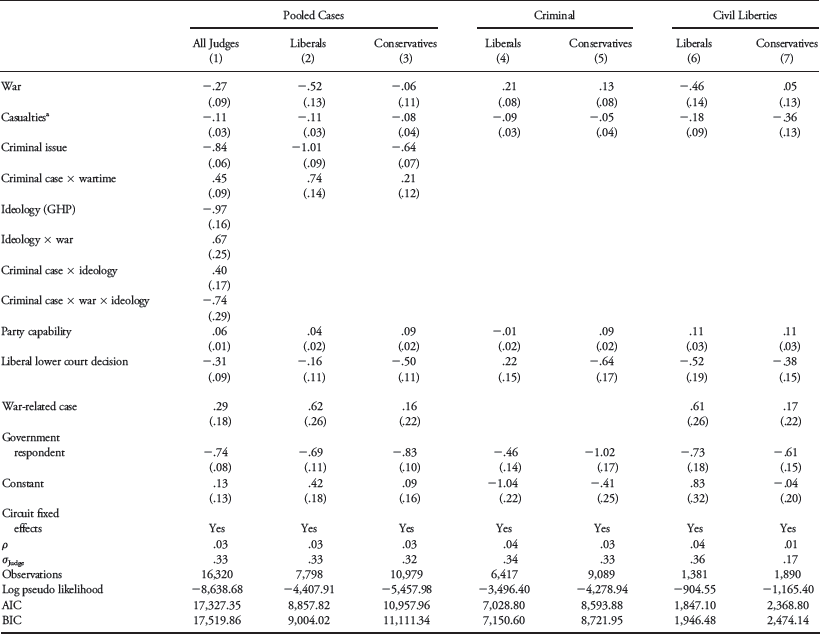
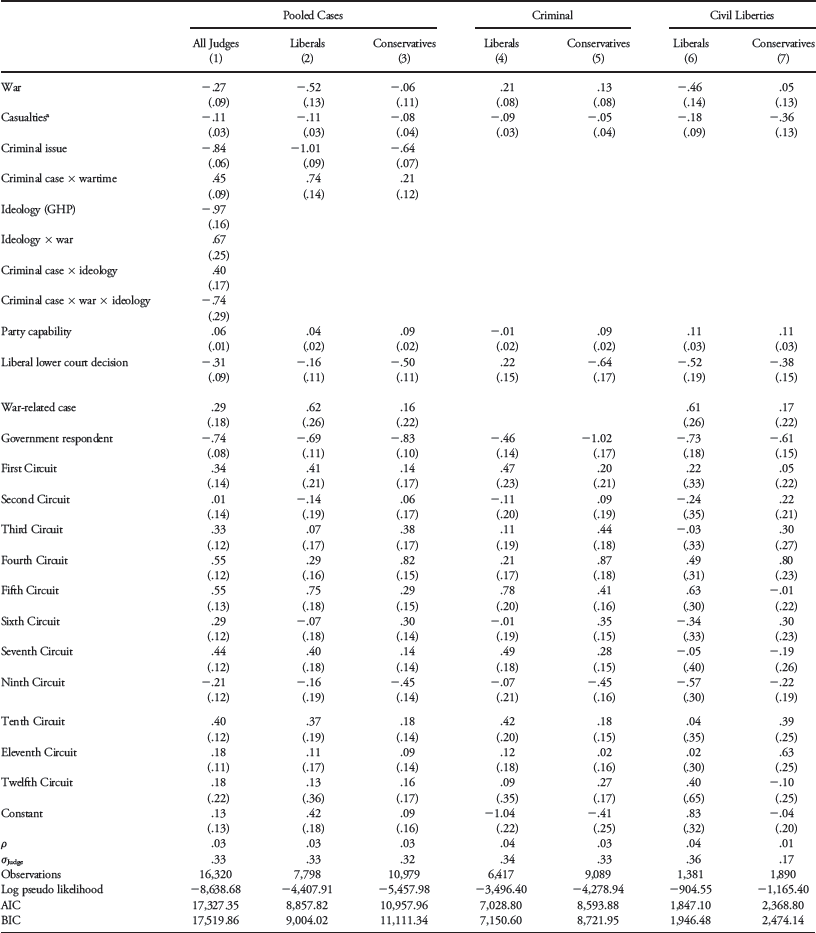
Table 1 depicts the results of our empirical tests.Footnote 24 Model 1 contains all criminal and civil liberties cases from 1950 to 2008. The dependent variable is a liberal vote. Since we are interested in a differences of a war effect between conservative and liberal judges in times of war, we run models on subsets of our data based on judge ideology, with model 2 depicting effects on liberals and model 3 reflecting effects on conservatives. We further provide separate effects for civil liberties and criminal cases in models 4–7. Teasing out these conditional effects requires a three-way interaction. To make these effects clearer, we present the results for subgroups in models 2–7 and plot predicted probabilities for values of interest in figures 1–3.
Impact of War on Liberal Judge Vote: US Courts of Appeals, 1950–2008
Note.—Random-effects logit coefficient estimates with clustered standard errors on judge in parentheses. Dependent variable indicates a liberal vote.
a. For better readability, the casualties variable has been scaled in this table to show the effect of a 10-unit change in the variable.
The results in model 1 suggest that ideology, war, and issue area all matter—and that they matter individually as well as interactively. While two of the three components of the interaction are dummy variables, the ideology measure is continuous, so that its null point does not represent the absence of ideology, thus making the coefficient estimates not intuitively interpretable. To better illustrate how these individual variables matter, we present coefficient estimates for subgroups of interest. Models 2 and 3 split the data by ideology. Model 2 captures the effect of these variables on the lower 50 percentiles (i.e., judges more liberal than the median). Model 3 does the same with the other 50 percent (judges more conservative than the median). A comparison of the coefficient estimates shows differences in how these subgroups react to war. More liberal judges (model 2) seem to respond to war in both criminal and civil liberties cases. The difference in directionality for these terms, however, suggests that these reactions to war are based on different mechanisms. Model 3 shows that conservative judges, on the other hand, may react only to high-intensity wars or times of war.
Models 4–7 further divide these ideological subgroups into voting behavior in criminal cases versus civil liberties cases. According to models 4 and 5, liberal judges tend to vote more liberal in times of war than in times of peace, though that finding may be tempered by the negative coefficient for casualties, indicating that for high-intensity wars the net effect may still be more conservative decisions in times of war than in peace. Both liberal and conservative judges react with more conservative decisions in civil liberties cases to wartime, though there are differences in how war is related to vote outcome for these subgroups. Liberal judges seem to vote more conservative in times of war, regardless of the war intensity, whereas the probability of a change in voting behavior seems to be dependent on war intensity for conservative judges.
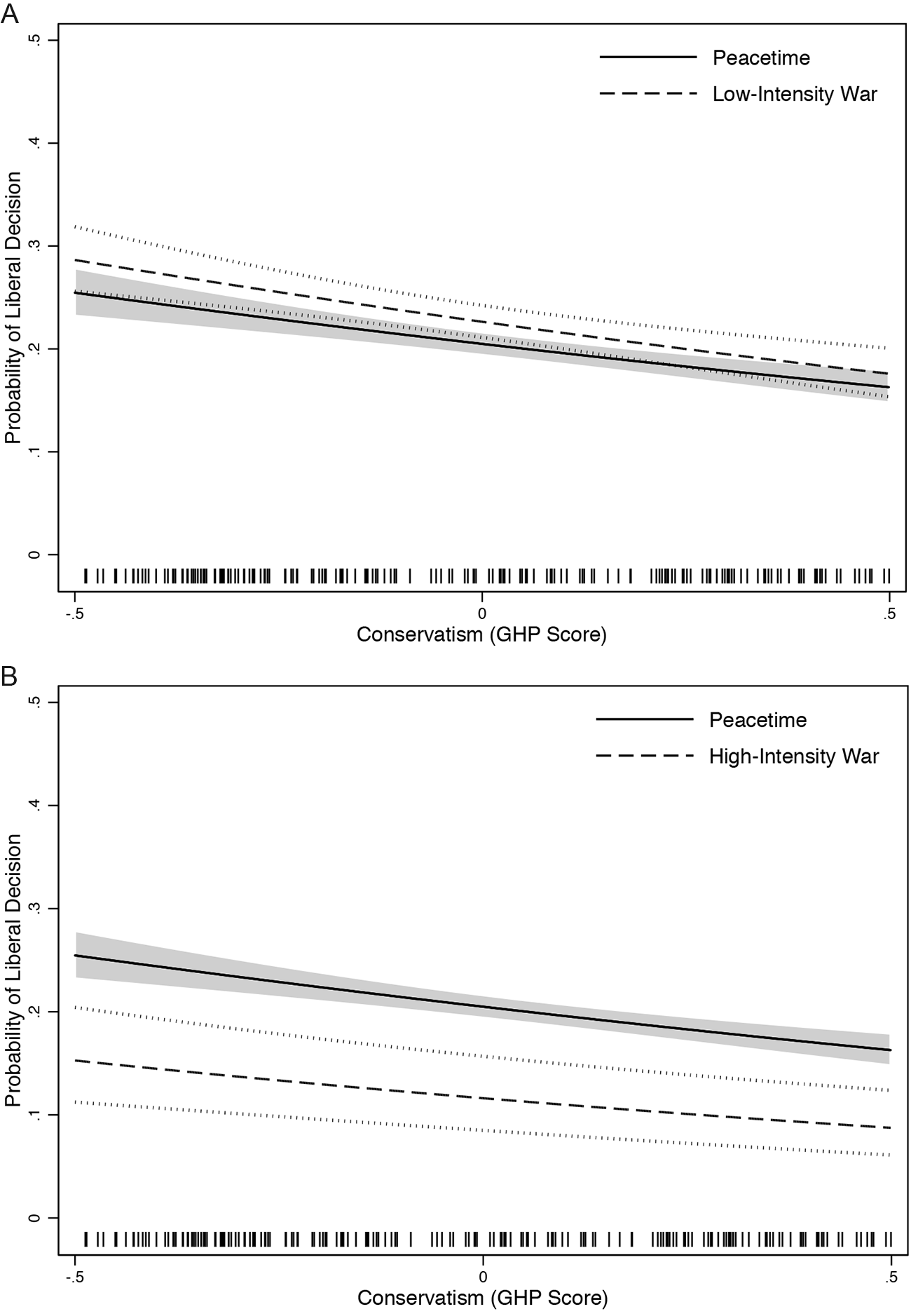
In order to gain a more complete understanding of these interactive relationships, we present predicted probabilities on values of interest derived from model 1.Footnote 25 Figure 1 traces the probability of a liberal decision in criminal cases for peacetime and low-intensity war (fig. 1A ) as well as peacetime and high-intensity war (fig. 1B ).Footnote 26
Probability of liberal decisions in criminal cases. A, Peacetime versus low-intensity war; B, peacetime versus high-intensity war. Predicted probability plots for models estimating the impact of war on the probability of liberal decisions in criminal cases on the courts of appeals, 1950–2008, by ideology. Solid lines represent votes in peacetime, while dashed lines represent the effect of a low-intensity or high-intensity war on the probability of a liberal decision. Gray areas and dotted lines represent 95% confidence intervals. Rug plot indicates the distribution of ideology scores in the data set, where lower values represent higher liberalism and higher values represent higher conservatism.
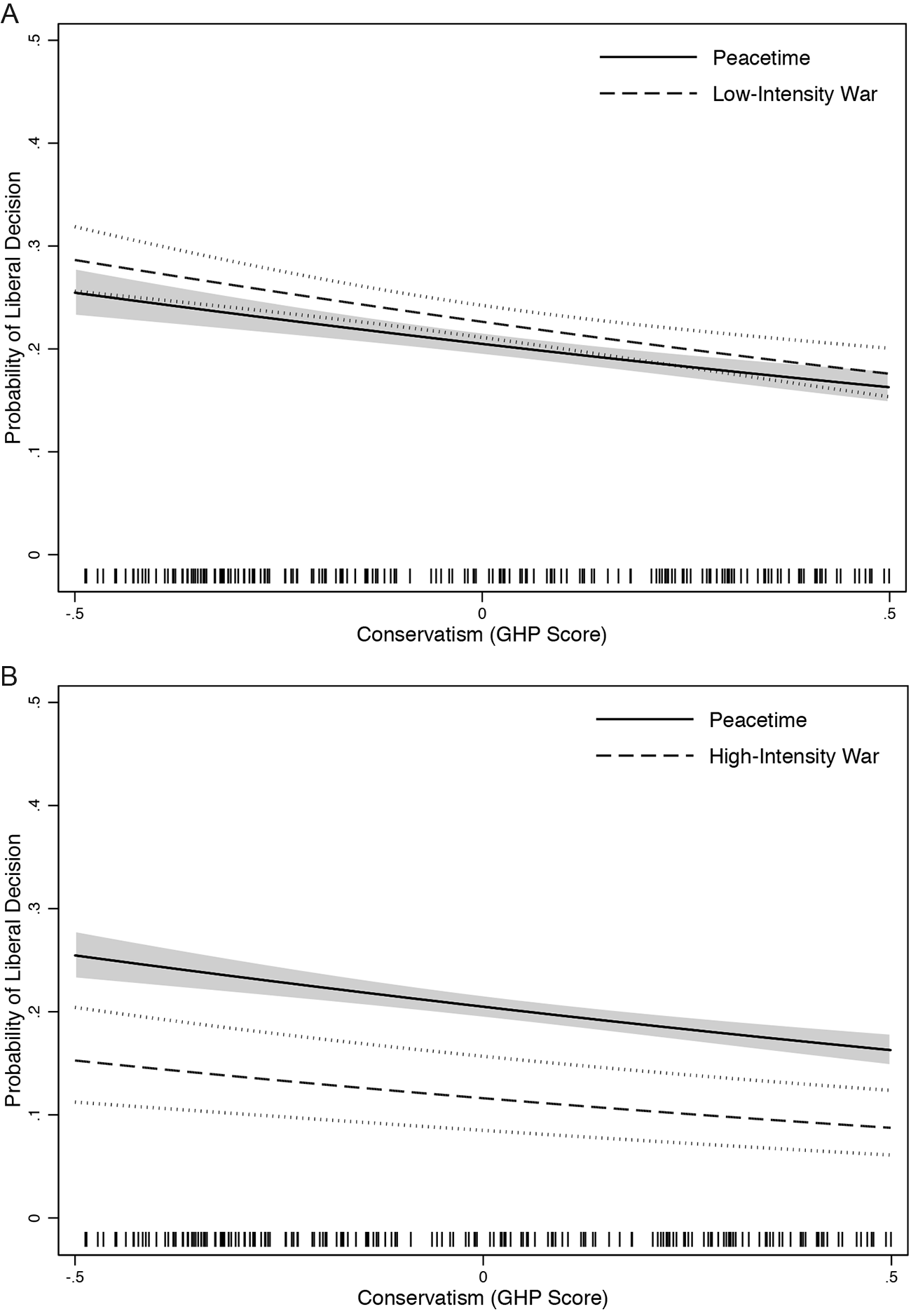
These figures show how voting behavior in these wars changes across the entire range of the ideological spectrum. Lower x-axis values represent liberal ideology and higher values represent conservative ideology. The negative slope of the solid line represents the well-documented relationship between liberal votes in criminal cases and ideology. The higher the ideology score (i.e., the more conservative the judge), the lower the probability of a liberal decision becomes in peacetime. The overall probability of a liberal decision in a criminal case is low—regardless of ideology—and spans 17%–25% in times of peace.
For low-intensity wars, there is a slight increase in the probability of a liberal decision by all but the most conservative judges in criminal cases (see fig. 1A ). As a war intensifies and casualties mount, however, the probability of a liberal decision decreases when compared to peacetime between 8 and 10 percentage points in our example, in line with our hypothesized effect for liberal judges (and Clark’s findings; see fig. 1B ). The effect, however, seems independent of ideology, contrary to our prediction. The low difference between liberals and conservatives in the probability of a liberal decision in criminal cases at peacetime may suggest that judges—regardless of ideological proclivities—place a similarly high value on security in considering the trade-off between liberties and security in criminal cases. Owing to the nature of this class of cases, security is likely to constantly be a salient motivation. The positive effect of war—for low-intensity segments (see fig. 1A )—is, however, puzzling. We believe that this effect is caused by a change in the nature of cases that are brought during times of war rather than a change in judge behavior. Governments may be more likely to push the boundaries of their power during times of war, thereby increasing the likelihood that a case will end in a vote in favor of the defendant. In other words, the observed increase may be a reaction to executive overreach (see also Clark Reference Clark2006, 414–15). That effect, however, can be outweighed by high casualty rates.
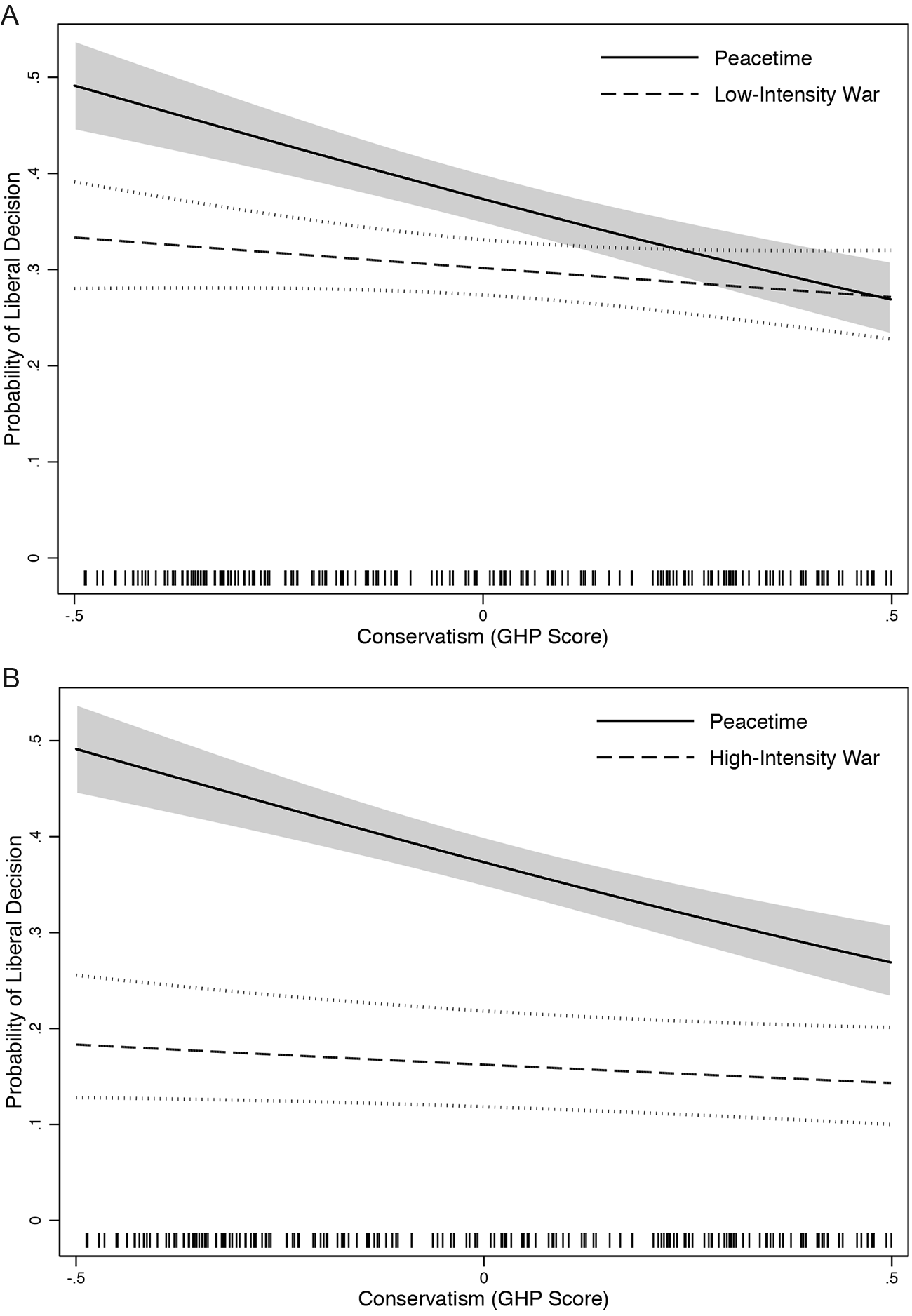
Predicted liberal votes in civil liberties cases show a different pattern. Liberal and moderate judges are less likely to vote liberal in times of war, regardless of the casualty rate, though the decrease is more pronounced for high-intensity wars. The predicted drop for a median liberal judge is around 10 percentage points for the probability of a liberal vote in low-intensity wars (and brings liberal judges on par with conservative judges in peacetime) and about 25 percentage points (down to a mere 18%) in times of high intensity (see figs. 2A and 2B, respectively). Conservative judges, on the other hand, show no war effect for low-intensity wars: the solid and dashed lines converge for higher values (see fig. 2A ), representing conservative judges. In other words, there is no statistical difference in the voting behavior of conservative judges on the court of appeals during low-intensity war- and peacetime. With higher casualties, though, they are likely to vote more conservatively, although this change is less pronounced than it is for liberal judges (see fig. 2B ). While ideology has predictive power for outcomes in both criminal and civil liberties cases on the courts of appeals in peacetime (note the slopes of the solid lines in figs. 1 and 2), wartime behavior—regardless of intensity of war—mutes ideological differences (note the almost horizontal dashed lines) in civil liberties cases. Hence, ideological differences seem to be muted in times of war for civil liberties cases (though persistent in criminal cases). In other words, liberals and conservatives behave much more alike in civil liberties cases at wartime, particularly during high-intensity wars.
Probability of liberal decisions in civil liberties cases. A, Peacetime versus low-intensity war; B, peacetime versus high-intensity war. Predicted probability plots for models estimating the impact of war on the probability of liberal decisions in civil liberties cases on the courts of appeals, 1950–2008, by ideology. Solid lines represent votes in peacetime, while dashed lines represent the effect of a low-intensity or high-intensity war on the probability of a liberal decision. Gray areas and dotted lines represent 95% confidence intervals. Rug plot indicates the distribution of ideology scores in the data set, where lower values represent higher liberalism and higher values represent higher conservatism.
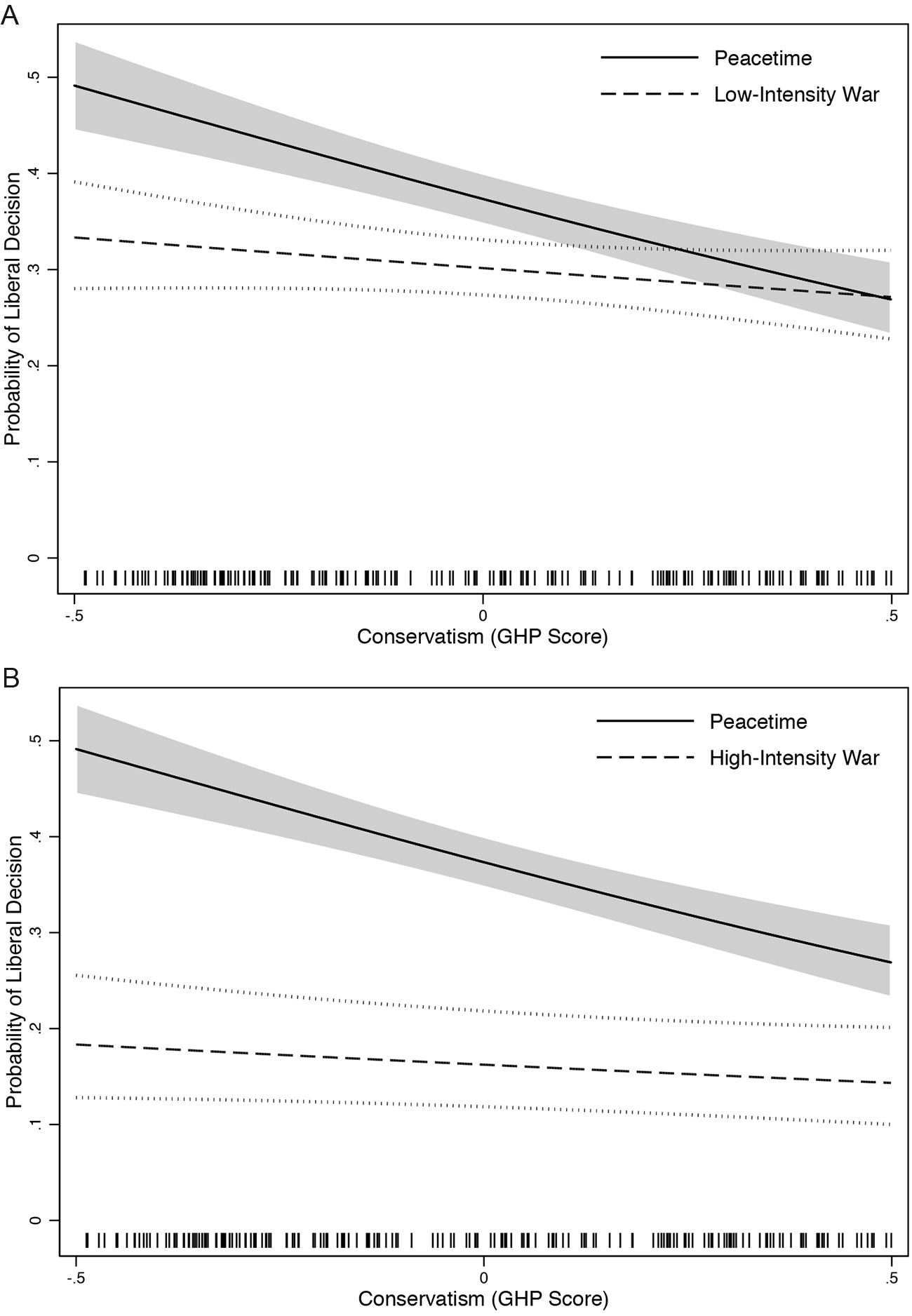
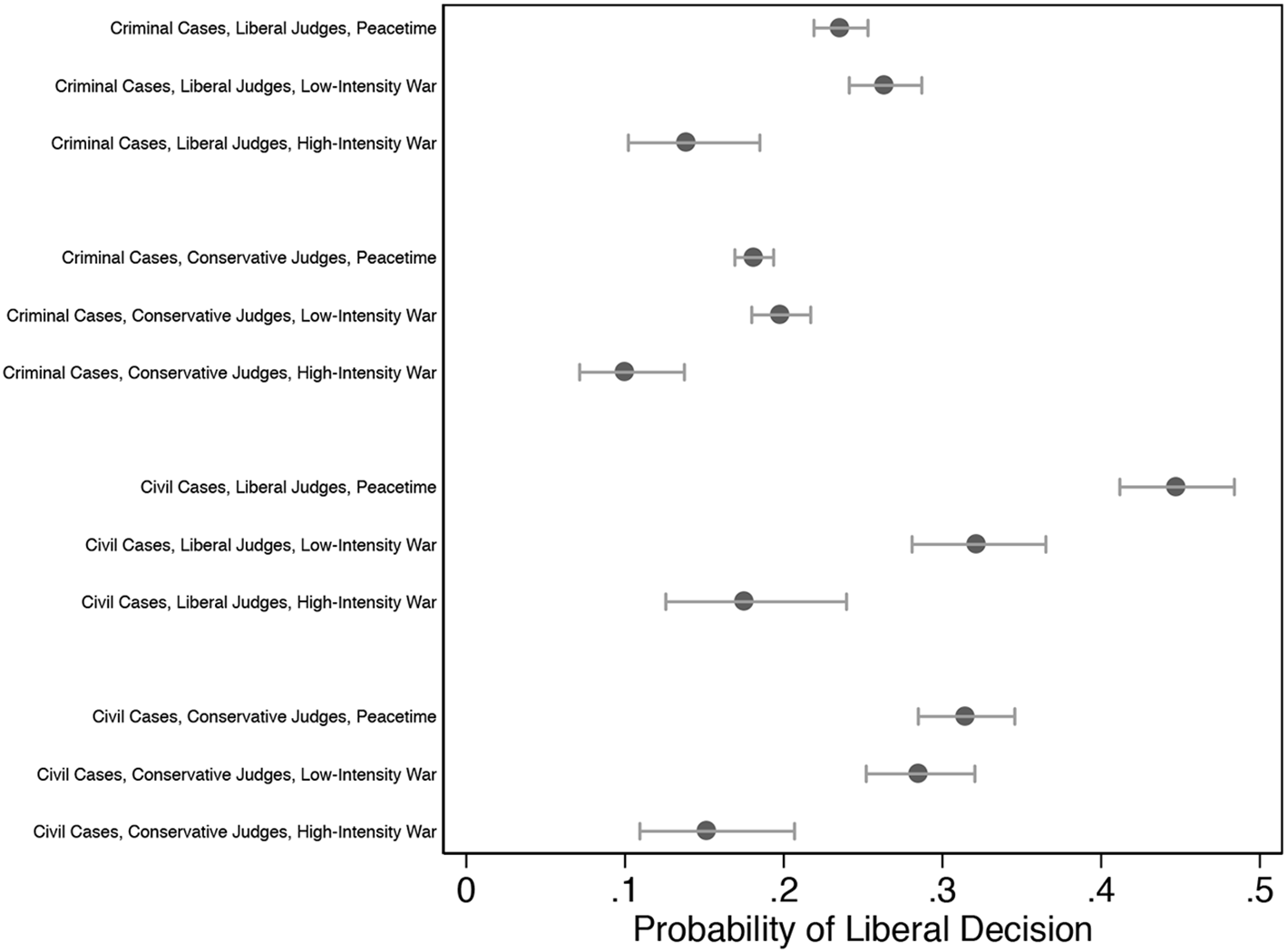
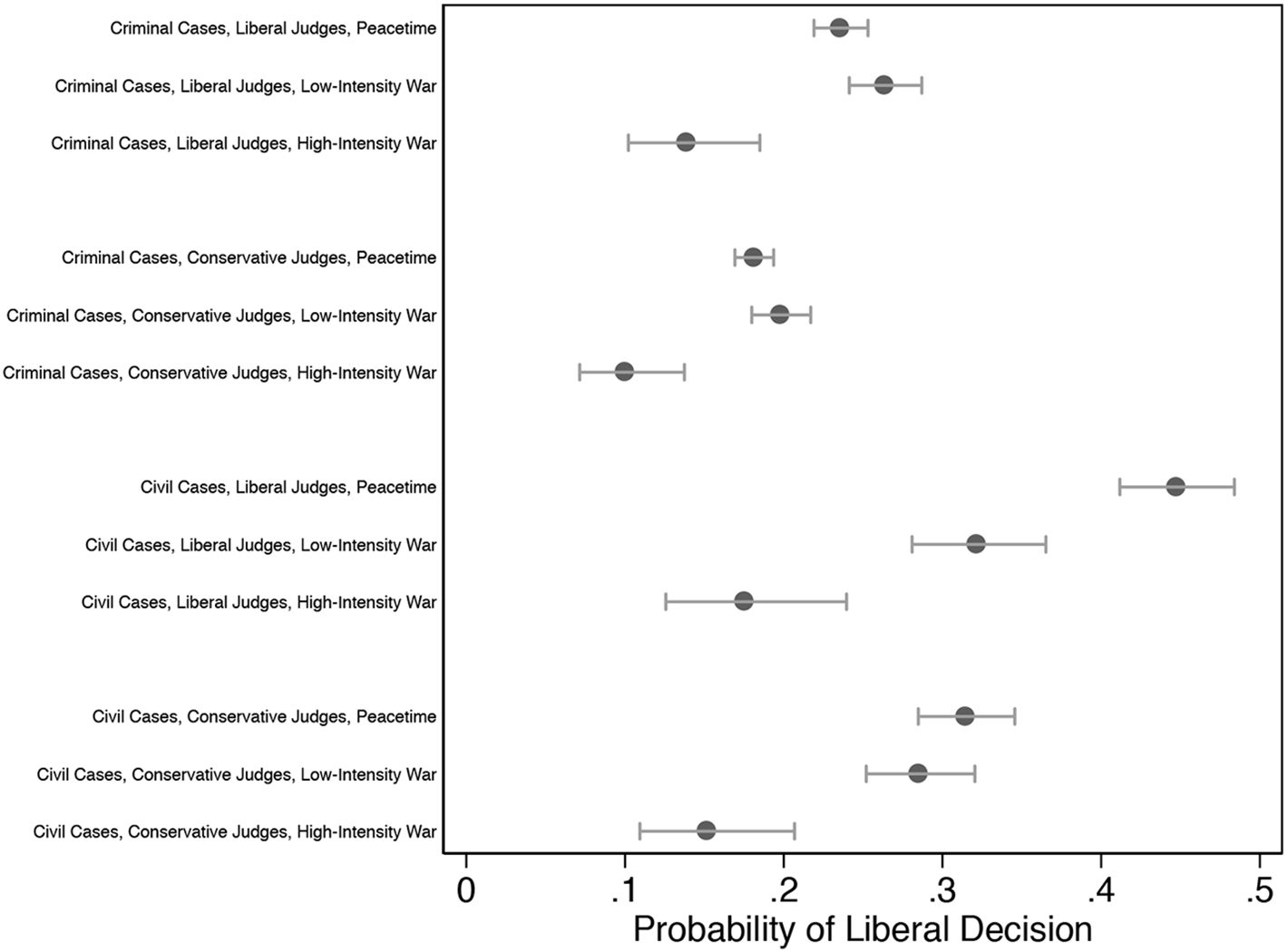
Figure 3 plots average effects across 12 values of interest: the vote of a liberal judge (set at the 25th percentile of the measure) and a conservative judge (set at the 75th percentile) during peacetime, low- and high-intensity wartime (set at 5th and 75th again, respectively) for criminal and civil liberties cases, separately. It confirms that directionality and size of war effects are fairly similar for liberal and conservative judges in criminal cases and that—except for high-intensity wars, where the confidence interval is comparatively large—the behavior between liberals and conservatives is statistically different from one another. In civil liberty cases, on the other hand, votes of liberals are strikingly different from those of conservatives only in times of peace. In low-intensity wars, the probability of a liberal vote by a liberal judge is equal to the probability of a conservative judge at peacetime and close to it at low-intensity wars. Similarly, the behavior of both is predicted to be the same in high-intensity wars.
Predicted probabilities for different combinations of the interactive term. Dots represent point prediction, with whiskers indicating the 95% confidence interval. Predicted probabilities are calculated by setting liberal and conservative judges at the 25th and 75th percentiles of the ideology measure, respectively, whereas war intensity was set to 0 for peacetime, to 5 for low-intensity wars and wartime (such as the current War on Terror or less intense times during the Vietnam War), and to 75 for high-intensity wars and wartime (for average days in the Korean War or high-intensity times during the Vietnam War). All other values are held at their means.
Discussion
The findings suggest that war effects are not uniform. We predicted a decrease in liberalism during times of war for liberal judges only. The observed shifts suggested a more complex picture. Judges across the ideological spectrum were all susceptible to war. How and when, however, seemed to vary. Liberal judges reacted with more liberal decisions to war in criminal cases. We are not the first to observe an increase in liberalism by judges in times of war. Collins (Reference Collins2008) observes an increase in liberalism by female judges on the district courts in times of war. Clark (Reference Clark2006) notes a similar effect for his sample of presidential discretion in noncriminal cases on the courts of appeals. He finds those cases to be less likely to be resolved in favor of the government in times of war. We believe these wartime effects toward increased liberalism to stem from the same mechanism. It is not clear why judges should ever become more liberal in wartime. The most reasonable explanation is that these observed increases are a reaction to executive overreach (see also Clark Reference Clark2006, 414–15). In other words, the cases decided by these judges in times of war represent a higher percentage of rights infringement, which, under certain circumstances, leads to an increase in liberal decisions on the court. While this may be seen as an encouraging finding for those who wish for the court to remain the bastion of rights protection, our findings also suggest that in times of intense war or high casualties, the probability of a liberal decision decreases across the board.
We observed our hypothesized difference between liberal and conservative judges only in civil liberties cases and not in criminal cases. It may be that the value placed on security on the continuum between security and individual rights and liberties is more similar across the ideological spectrum in criminal cases than in civil liberties cases. This may also be compounded (or merely reflected) by the fact that the discrepancy in voting behavior between conservatives and liberals is smaller and the baseline probability for a liberal outcome is lower. If the initial value placed on security concerns versus, for example, procedural safeguards protecting due process, is similar for all judges, then changes in salience for security concerns should trigger a similar reaction.
We observed findings consistent with our hypothesis in civil liberties cases. For liberal judges, intensity of the war was only a secondary consideration; the fact that the nation was at war seemed sufficient to lead to a reevaluation of the balance between security and liberty in these cases. Considering Jost et al.’s (Reference Jost2003) theory of motivated social cognition, the results support a mechanism in which war triggers security concerns in judges that are liberal and are not as motivated by security concerns in times of peace. As security concerns become salient, they receive a more prominent position in the hierarchy of values according to which judges balance competing interests. The intensity of war then intensifies this position. Conservatives, on the other hand, already value security concerns highly. It is not necessary to them to enter a state of war to reevaluate the value of security versus other liberties. High-intensity wars, however, seem to further raise the significance of security versus other liberties, much as they do with liberal judges.
Studies on judicial decision making that uncovered a shift toward increased conservatism in times of war suggested that these changes on the court were likely sincere and possibly mirrored the willingness of the public to trade off some liberties for increased security. Clark (Reference Clark2006), for example, speculated that the shift in criminal cases toward increased conservatism in his findings might be explained by changed preferences of judges for the protection of a society under attack and thus less sympathy for those who commit crimes against it. Epstein et al. (Reference Epstein2005) also suggested that the increase in conservatism they found for civil liberties cases on the Supreme Court might be due to a shift in sincere preferences. We pick up where they left off to explain why and when that should be the case. Our findings partly support this view and show that war affects all judges, but not all judges equally. Most importantly, we also find that ideology, the “most robust predictor of judicial behavior” (Epstein et al. Reference Epstein2005, 76), has little to no effect on the probability of a liberal decision in civil liberties cases in times of war, muting the influence of ideology on the outcome. As is best seen in figure 2, the probability of a liberal vote is consistent across the ideological spectrum in high-intensity war. War seems to impose a fairly consistent preference for security across the ideological spectrum in civil liberties cases. This is particularly significant, considering that the United States has been involved in wars for a third of the time these last 60 years. As Gartner (Reference Gartner2008) states, “Our understanding of politics assumes peace; we need to expand our theories to include wartime affairs” (95).
These findings are partly consistent with scholarship on political psychology (Hetherington and Suhay Reference Hetherington2011), which suggests that those who prioritize security in peacetime may be less likely to change their behavior in times of war than those who traditionally support civil liberties. Differences between liberal and conservative judges can be explained by considering variances in the motivational role of security concerns on judicial behavior (Jost et al. Reference Jost2003). Conservatives are, on average, more likely than liberals to be motivated by security concerns. In times of war, however, that difference diminishes as security concerns become more salient, making decisions by liberal judges less distinguishable from those of conservative judges. Whether conservatives are generally less likely to adapt their behavior to changed circumstances remains an open question.Footnote 27 More focus on this and other questions on motivational differences will add to recent scholarship that is pushing our knowledge of the interplay of ideology and judicial behavior beyond the now well-established, direct, one-dimensional effect.
Appendix
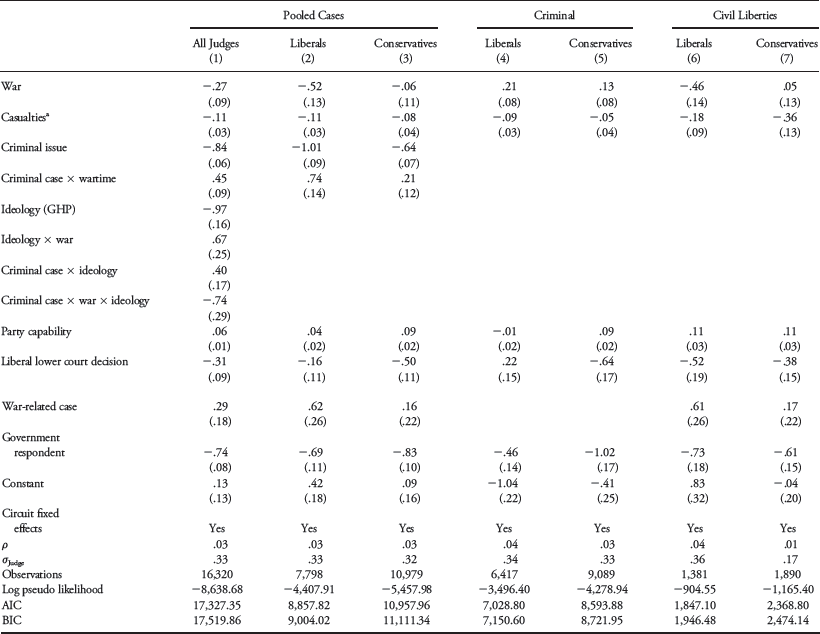
Impact of War on Liberal Judge Vote: US Courts of Appeals, 1950–2008
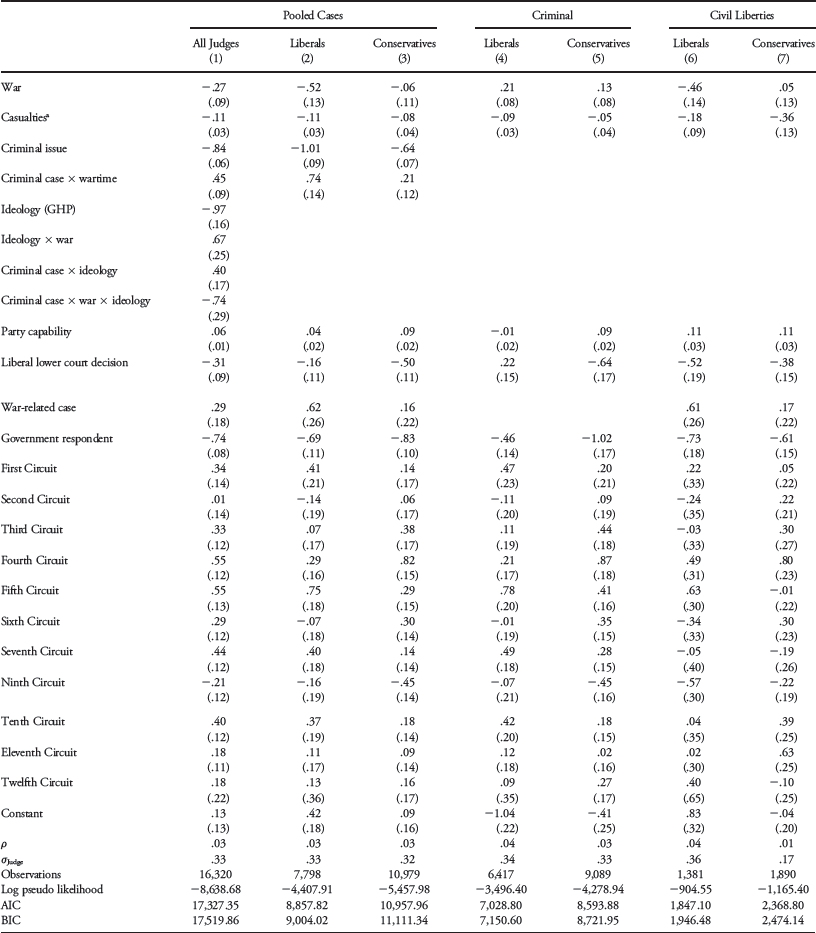
Note.—Random-effects logit coefficient estimates with clustered standard errors on judge in parentheses. Dependent variable indicates a liberal vote.
a. For better readability, the casualties variable has been scaled in this table to show the effect of a 10-unit change in the variable.
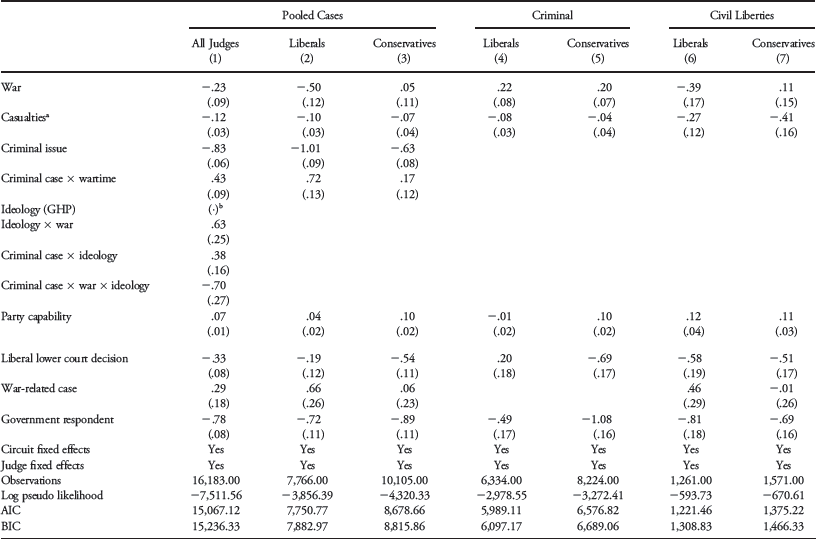
Impact of War on Liberal Judge Vote: US Courts of Appeals, 1950–2008 (Fixed Effects)
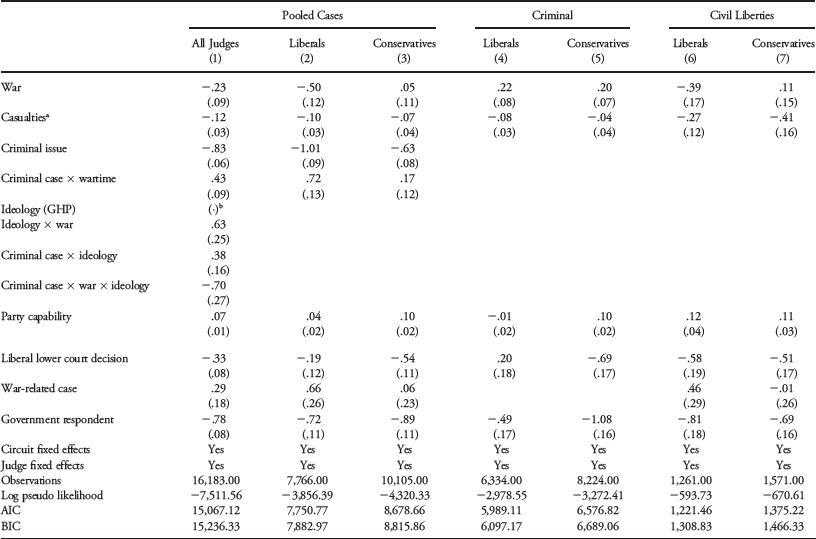
Note.—Fixed-effects logit coefficient estimates with standard errors in parentheses. Dependent variable indicates a liberal vote.
a. For better readability, the casualties variable has been scaled in this table to show the effect of a 10-unit change in the variable.
b. Because of judge-level fixed effects, no additional variation is left to calculate the independent effect of GHP scores.