Implications
The recent financial crisis and the increasingly competitive environment in sheep sector severely affect the economics of sheep farming in Greece, including that of the Chios breed. The efficient allocation of the available resources is vital for the improvement of Chios sheep farms’ profitability and competitiveness. The measurement of inefficiency and its determinants and the description of the structural and economic characteristics of the efficient Chios sheep farms can be a practical decision tool for adopting management strategies that would induce Chios breed farmers to improve their economic performance.
Introduction
Dairy sheep farming is considered as the most important livestock sector in Greece, accounting for 7.5% of the gross value of agricultural production in the country (Zygoyiannis, Reference Zygoyiannis2006). It is a well-established agricultural activity concentrated mainly in mountainous and less-favored areas where rural economy is poorly diversified and employment opportunities are limited (Tzouramani et al., Reference Tzouramani, Sintori, Liontakis, Karanikolas and Alexopoulos2011). The sheep farming sector in Greece is experiencing a major transition from a semi-extensive into an intensive production system, which is characterized by high investments in machinery and buildings and in high-quality livestock (Gelasakis et al., Reference Gelasakis, Valergakis, Fortomaris and Arsenos2010). This intensive production pattern creates new opportunities for the development of the sector; however, the economic performance of sheep farms depends heavily on their management. The rational allocation of the available resources is essential for their profitability and consequently their competitiveness.
Greek farms that rear purebred Chios sheep, which are considered as the most productive indigenous Greek breed (Valergakis et al., Reference Valergakis, Arsenos, Basdagianni and Banos2008; Valergakis et al., Reference Valergakis, Gelasakis, Oikonomou, Arsenos, Fortomaris and Banos2010), have emerged during the past few years. These farms operate under intensive production systems compared with the traditional labor-intensive production systems that prevail in the country. The economic performance and the productivity of Chios sheep farms, which participate in a recently introduced breeding program, depend heavily on the efficient utilization of the existing production technology and the management skills of farmers.
Management including entrepreneurship is an important production factor, which is difficult to model because it is unobservable and it cannot be measured directly in physical terms. The concept of technical efficiency that was initiated by Koopmans (Reference Koopmans1951) is related to producer’s management capacity and it is assumed to express differences in the level of managerial skills. Koopmans defined technical efficiency as the ability to minimize input use in the production of a given output vector, or the ability to obtain maximum output from a given input vector. Farrell (Reference Farrell1957) introduced a measure of technical efficiency, suggesting that inefficiency is the result of lack of managerial ability (Alvarez et al., Reference Αlvarez, Arias and Greene2004). Since then, several approaches have been developed for the estimation of technical efficiency, among them, stochastic frontier analysis.
Stochastic frontier analysis is a parametric approach that has become increasingly popular in the measurement of technical efficiency. This approach defines a production frontier, which represents the maximum output that can be obtained from any given input vector, and measures the efficiency of each production unit, in this case farms, relative to that frontier. Consequently, the efficient production units lie by definition on that frontier while the inefficiency of the units that are not on the frontier is indicated in direct proportion to their distance from the frontier (Greene, Reference Green2008). According to Kumbhakar and Lovell (Reference Kumbhakar and Lovell2000), the great virtue of stochastic frontier analysis models is that they allow for technical inefficiency, but they also acknowledge the fact that random shocks outside the control of producers can affect output.
The purpose of the study is to estimate the technical efficiency of farms farming solely purebred Chios breed sheep in Greece and to examine the effect of various farm-specific variables on the level of the estimated efficiency using the stochastic frontier analysis method. The study employs a Translog stochastic frontier production function, following the Battese and Coelli (Reference Battese and Coelli1995) inefficiency effects approach, on farm accounting data of 58 Chios sheep farms. The farms are categorized by using the estimated level of technical efficiency as a classification criterion and their main technical and economic characteristics are calculated and compared, providing an indicative description of their structure and productivity.
Material and methods
Stochastic production frontier
The stochastic frontier production function was simultaneously proposed by Aigner et al. (Reference Aigner, Lovell and Schmidt1977) and Meeusen and van den Broeck (Reference Meeusen and van den Broeck1977) and can be expressed as
 $$y_{i} =f(x_{i} ;\beta ) \cdot \exp \{ v_{i} {\minus}u_{i} \} {\rm }\ \ \ \ \ i=1,{\rm }2,...,{\rm }n$$
where, y
i
denotes the level of output for ith farm; χ
i
is a 1×k vector of functions of inputs used by the ith farm; β is the 1×k vector of unknown parameters to be estimated; v
i
is a symmetric random variable, independently and identically distributed (iid) with mean zero and variance
 $$\sigma _{v}^{2} $$
, which is associated with random factors that are out of the control of the farmer (e.g., random external factors, weather, misspecification of the model, measurement error in output) and captures the effects of statistical noise and u
i
is a one-sided non-negative random variable, independently and identically distributed truncations (at zero) with mean μ and variance
 $\sigma _{u}^{2} $
, which captures the effects of technical efficiency component.
The technical efficiency of the ith farm, denoted by TE i , is obtained from the ratio of the observed to the maximum attainable level of output and it can be estimated as
 $$TE_{i} =\exp ({\minus}u_{i} )$$
The prediction of technical efficiencies is based on the conditional expectation of e −u i given the values of v i −u i (Jondrow et al., Reference Jondrow, Lovell, Materov and Schmidt1982; Battese and Coelli, Reference Battese and Coelli1988). More details and further approaches can be obtained from books edited by Fried et al. (Reference Fried, Knox Lovell and Schmidt2008) and Kumbhakar and Lovell (Reference Kumbhakar and Lovell2000).
Empirical translog production function
The specified empirical version of stochastic frontier used in this study assumes a Translog production function:
 $$\eqalignno {\ln \,y_{i} &=\beta _{0} {\plus}\mathop{\sum}\limits_{j=1}^3 {\beta _{j} \ln \,x_{j} {\plus}\mathop{\sum}\limits_j^3 {\mathop{\sum}\limits_{\les k=1}^3 {\beta _{{jk}} \ln \,x_{{ji}} \ln \,x_{{ki}} }}} \cr \quad{\plus}v_{i} {\minus}u_{i} \qquad i=1,\,\ldots\,,n$$
where y i denotes the value of gross output (expressed in euros), x 1 is the flock size (number of ewes), x 2 represents labor (expressed in hours), and x 3 represents the capital cost of the farms (measured in euros).
The inefficiency effects u i are expressed as a function of explanatory factors (Kumbhakar et al., Reference Kumbhakar, Ghosh and McGuckin1991) and the parameters of the stochastic production frontier and inefficiency effects model are estimated simultaneously, following the approach proposed by Battese and Coelli (Reference Battese and Coelli1995) that overcomes the limitation of the two-step approach, which involves a contradiction of assumptions.Footnote 1 Here, u i can be specified and defined as
 $$u_{i} =\delta_{0} {\plus}\delta_{1} z_{{1i}} {\plus}\delta_{2} z_{{2i}} {\plus}\delta_{3} z_{{3i}} {\plus}\delta_{4} z_{{4i}} {\plus}\delta_{5} z_{{5i}} {\plus}\delta_{6} z_{{6i}} $$
where z’s are explanatory factors, which affect inefficiency. In this study, inefficiency is assumed to be explained by two sets of variables: socio-demographic and herd-related biophysical variables. The socio-demographic variables pertain to the characteristics of the head of farm. Specifically, z 1i represents ewe’s longevity and it is expressed in years of productive life; z 2i represents the average number of the lambs retained in the flock each year to replace ewes; z 3i represents lamb mortality (percentage of liveborn lambs dying before weaning); z 4i is a binary variable to measure the influence of agricultural training on efficiency and it is equal to one if the farmer had any training and two otherwise; z 5i is a binary variable for the marital status of the farmer, being equal to one if farmer is married and two otherwise and z 6i represents the age of the farmer and it is expressed in years.
The isolation of the sources of inefficiency can be useful in fashioning appropriate policies (Shafir and Dar, Reference Sharif and Dar1996). The objective is to associate variation in producer performance with the variation in the exogenous variables characterizing the environment in which production occurs (Kumbhakar and Lovell, Reference Kumbhakar and Lovell2000). The selection of the explanatory factors in this study is based on the relevant efficiency literature and, of course, on the availability of the appropriate data. The variables that are generally examined in studies concerning the determinants of technical efficiency at the farm level are farm characteristics, which usually include farm size, human capital variables such as education, age, agricultural training and experience of the head of the household and locational and environmental variables characterizing the conditions for farming. In this study, we attempt to explain the efficiency differentials not only through the use of the characteristics of on-farm human capital such as age, agricultural training and marital status (for the influence of marital status in decision-making process, see Nuthall (Reference Nuthall2010, pp. 162–163 and 177–178)), but also with the use of aforementioned herd-related biophysical factors. The use of herd-related factors as inefficiency determinants in sheep farms can be also found in Shomo et al. (Reference Shomo, Ahmed, Shideed, Aw-Hassan and Erkan2010) and Toro-Mujica et al. (Reference Toro-Mujica, García, Gómez-Castro, Acero, Perea, Rodríguez-Estévez, Aguilar and Vera2011).
A number of statistical tests were carried out to identify the appropriate functional form of the empirical model as well as the presence of inefficiency and its trends (Puig-Junoy, Reference Puig-Junoy2001). The hypotheses that (i) Translog is the appropriate production function for this application and not Cobb–Douglas,Footnote 2 (ii) stochastic production frontier is appropriate for the sample data and there is technical inefficiency (inefficiency effects present) in this production sector (variance parameter γ≠0), (iii) technical inefficiency function comprises a vector of explanatory variables (δ s≠0) and (iv) constant term (δ 0≠0) should be included in the inefficiency effects model are tested using the generalized likelihood-ratio (LR) statistic. The generalized LR test is λ=−2[L(H 0)−L(H 1)], where L(H 0) and L(H 1) are the values of the likelihood function under null and alternative hypothesis, respectively. It has an approximate χ 2 distribution with degrees of freedom equal to the number of independent constraints (Battese and Coelli, Reference Battese and Coelli1995). The asymptotic distribution of hypothesis tests involving a zero restriction on the parameter γ has a mixed χ 2 distribution and therefore, the appropriate critical values are obtained from Kodde and Palm (Reference Kodde and Palm1986), Table 1.
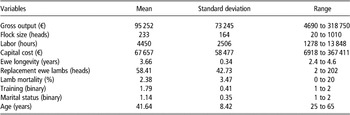
Summary statistics for survey variables

Empirical data
The farm accounting data for this empirical application were collected from the Regions of Macedonia and Thessaly, Greece, through a farm management survey involving the 58 Chios sheep nucleus farms that comprise purebred animals and participate in the Chios sheep Breeding program. These farms constitute the total population registered in the Greek herdbook of Chios sheep breed, also participating in the official milk recording program. The survey was carried out during the 2007–2008 period. The output and input variables as well as the explanatory socio-demographic variables and animal data are described in Table 1.
The summary statistics of Table 1 indicate a large variability of gross output among Chios sheep farms. The average flock size was 233 ewes, whereas the average flock size of sheep farms in Greece is 56.8 ewes per farm (data for 2006 provided by the Hellenic Statistical Authority, 2008). The share of capital cost, which is composed of variable and fixed capital cost,Footnote 3 in total production cost was 71.6%, indicating that the existing production technology among Chios sheep farms is capital intensive. The variable capital cost includes the variable capital expenses in both crop and livestock production, that is, the value of the purchased feed, the expenses for the on-farm production of feeds, the value of fuel, medicines, irrigation, hired mechanic labor and other variable inputs, whereas the fixed capital cost consists of the annual expenses of the buildings and the machinery used in the production process.
The results regarding the socio-demographic characteristics indicate that the typical farmer is middle-aged (∼42 years old), married and did not receive any agricultural training. Agricultural training, marital status and age profile, which by extension is related to farmer’s experience on farming and/or adoption of new technologies, are considered important determinants of managerial ability (Nuthall, Reference Nuthall2010) and, thus, of technical efficiency. The description of the animal data, which have been selected in the model specification as determinants of the inefficiency, shows that, on average, ewe’s longevity is 3.66 years. Longevity is normally defined as the length of ewe’s productive life, which is the period when the ewe is efficiently used in reproduction and milk production. The average rate of lamb mortality at weaning was 2.38% and the farm retains, on average, 58.41 replacement ewe lambs. These results combined with the findings that the average Chios sheep farm rears 233 ewes, whose longevity is, on average, 3.66 years, implies that the flock is replaced almost every 3 years.
Results
Estimation of stochastic frontier model
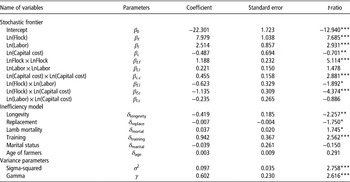
The maximum likelihood estimates of the parameters in the stochastic production frontier and the inefficiency model for the 58 Chios sheep farms are presented in Table 2; they are obtained following the Battese and Coelli (Reference Battese and Coelli1995) specification. Specifically, Table 2 reports the coefficients and the variance of the estimated variables, as well as their t-ratios. The variance parameters of the stochastic frontier model are expressed in terms of
 $$\sigma ^{2} =\sigma _{u}^{2} {\plus}\sigma _{v}^{2} $$
and
 $$\gamma =\sigma _{u}^{2} /\sigma ^{2} $$
. Most of the coefficients were statistically significant at the 1% level. The estimated values of γ and σ
2 parameters in the stochastic frontier production function were significant at the 1% level, suggesting that technical inefficiencies were present in production having a significant effect on the level and the variability of the output of the sheep farms and that the conventional ‘average’ production function is not an adequate representation of the data (Sharma et al., Reference Sharma, Leung and Zalenski1997). The estimate of γ indicates that the portion of the one-sided error component in total variance is as high as 60.2%, indicating that 60.2% of the variation in data between farms can be attributed to inefficiency, whereas the remaining 38.8% is due to pure ‘noise’. Hence, inefficiencies in production are the predominant source of random errors.
Maximum likelihood estimates of the stochastic frontier model

***, **, * indicates statistical significance at the 1%, 5% and 10% level, respectively.
The results of the LR-tests that were performed to several composite hypotheses are presented in Table 3. The first LR-test was conducted to test whether or not Translog production function was the appropriate form of the production function estimated in this model. The null hypothesis that the production technology is described by the Cobb–Douglas production function is rejected in favor of the Translog production function, which appears to provide an adequate specification of the Chios sheep farms. The second null hypothesis specifies that there are no inefficiency effects and that each farm is operating at the efficient frontier. If the null hypothesis were to be accepted, the frontier model would be equivalent to the average response function and it could be estimated by the least squares method (Battese and Broca, Reference Battese and Broca1997). The null hypothesis that γ is zero is rejected at the 5% level, emphasizing the finding that the traditional average production function is an inadequate representation for the data of Chios sheep farms. The third and fourth LR-tests consider the null hypothesis that the inefficiency effects are not a function of the explanatory variables. The null hypothesis of no-joint effects of the explanatory variables is rejected, confirming that the joint effects of the factors on technical inefficiency are statistical significant, although the individual effects of one or more of the variables may not be statistically significant. The fourth null hypothesis that the constant term δ 0 in the inefficiency effects model is zero is accepted, and therefore it is not included in the preferred model. In general, the LR tests indicate that the technical inefficiency effects are important in explaining the variation in economic performance of the Chios sheep farms and that the applied inefficiency stochastic frontier is a significant improvement over the corresponding stochastic frontier, which does not involve a model for the technical inefficiency effects (Battese and Coelli, Reference Battese and Coelli1995).
Generalized LR tests of hypotheses for parameters of the stochastic frontier production function

LR=likelihood-ratio.
λ=LR test statistic.
The estimated coefficients of the variables in the Translog production function do not have any direct interpretation; thus, the elasticity of output for each input has to be calculated as the first derivative of the output with respect to each input, using formula (5):
 $${\varepsilon}_{j} ={{\partial \ln y} \over {\partial \ln x_{j} }}=\beta _{j} {\plus}2\beta _{{jj}} \overline{x} _{{_{j} }} {\plus}\mathop{\sum}\limits_{j\,\ne\,k} {\beta _{{jk}} } \overline{x} _{{_{k} }} $$
The elasticity, ε j , measures the responsiveness of output to a 1% change in the jth input. According to Battese and Broca (Reference Battese and Broca1997), this is referred to as the elasticity of frontier output or the elasticity of best practice production with respect to the input involved. Evaluated at the sample mean, the estimated output elasticities for all three inputs were positive, as expected, indicating that the estimated Translog frontier production function is a well-behaved production technology. The elasticity of output with respect to flock size is the highest (ε flock=0.56), among all output elasticities, a finding that is similar to that of Karagiannis and Tzouvelekas (Reference Karagiannis and Tzouvelekas2005) and Karagiannis et al. (Reference Karagiannis, Tsionas and Tzouvelekas2005). Flock size is followed by capital cost (ε capital=0.37) and labor (ε labor=0.36). The sum of the output elasticities measures returns to scale, representing the percentage change in output due to a proportional change in the use of all inputs. The sum of the three output elasticities for the Chios sheep farms is estimated to be 1.29, indicating the presence of increasing returns to scale in the production and implying that the Chios sheep farms operate at a non-optimal scale.
Technical efficiency
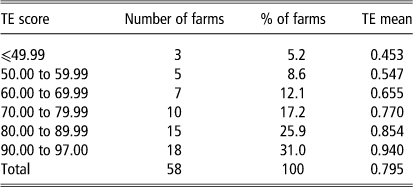
The frequency distribution of efficiency estimates obtained from the stochastic frontier model is presented in Table 4. Results indicate that there is substantial technical inefficiency in the utilization of the existing production technology and that there are considerable variations regarding the level of technical efficiency among the Chios sheep farms; technical efficiency scores range from a low of 0.421 to a high of 0.970. Table 4 shows that, according to estimations obtained from the application of the stochastic frontier analysis, the largest number of the farms, that is 18 farms (31% of the total), are allocated in the highest efficiency group (90% to 97%), 15 farms (25.9%) exhibit efficiency estimates between 80% and 90%, whereas only three farms (5.2% of the total) exhibit technical efficiency estimates less than 50%. The mean technical efficiency of the 58 farms is estimated to be 0.795 with a standard deviation of 0.149, indicating that the average Chios sheep farm produces 79.5% of the maximum attainable output. This result illustrates that, given the level of inputs and the production technology, the average Chios sheep farm could increase its production value by 20.5%, provided that it operates at the efficient frontier.
Frequency distribution of technical efficiency estimates from the stochastic frontier model

There are only two available studies in the agricultural economics literature that applied stochastic frontier analysis on Greek sheep farming, and to our knowledge, the present study is the first dealing with the estimation of technical efficiency of Chios breed flocks. Karagiannis and Tzouvelekas (Reference Karagiannis and Tzouvelekas2005) and Melfou et al. (Reference Melfou, Theocharopoulos and Papanagiotou2009), who applied frontier analysis to conventional sheep farms in Greece based on panel data, found that the overall mean technical efficiency level was 0.679 and 0.768, respectively, with the latter result being similar to ours. However, in other studies the level of technical efficiency of Greek sheep farms was estimated by means of the alternative non-parametric data envelopment analysis (DEA). On the basis of a sample of 101 sheep farms located in mountainous areas of Greece, Fousekis et al. (Reference Fousekis, Spathis and Tsiboukas2001) reported a 0.893 mean technical efficiency, whereas Psychoudakis and Theodoridis (Reference Psychoudakis and Theodoridis2006), using farm-level data from 108 sheep-goat farms in Western Macedonia, Greece, found that the DEA efficiency score was 0.694. Finally, in Theocharopoulos et al. (Reference Theocharopoulos, Melfou and Papanagiotou2007), the mean technical efficiency of 217 sheep farms was estimated to be 0.663.
Determinants of inefficiency
The identification of the determinants of technical inefficiency is of great interest, since the detection of the sources of inefficiency may contribute to the formation of policy recommendations concerning sheep farming. The factors that have an influence on efficiency are estimated simultaneously with the efficiency frontier in the stochastic frontier model, according to the Battese and Coelli (Reference Battese and Coelli1995) specification.
The results of the inefficiency model (Table 2) reveal that the estimated coefficient on the ewe’s productive longevity is negative and significant, indicating that farms that breed ewes with higher longevity tend to be more technically efficient in sheep farming, a result that was expected, as ewe’s longevity is considered a trait of high economic importance in sheep farming (Mekkawy et al., Reference Mekkawy, Roehe, Lewis, Davies, Bünger, Simm and Haresign2009; Abdelqadera et al., Reference Abdelqadera, Al Yacoubb and Gauly2012).
The coefficient of the replacement ewe lambs variable, which is the second herd-related variable used as an explanatory factor in the inefficiency model, proved to be significant and negative, although the result is relatively weak (P-value=0.087). This finding indicates that a higher number of replacement lambs in the herd is associated positively with a higher level of efficiency.
The rate of lamb mortality had a positive association with inefficiency (P-value=0.088), implying that a higher rate of lamb mortality during the weaning age is related to a lower level of technical efficiency. Lamb mortality rate has both economic and animal welfare implications in sheep production and our finding verifies its importance.
The estimated coefficient of agricultural training is positiveFootnote 4 and statistically significant, implying, as expected that farmers who received agricultural training are more technical efficient in sheep farming.
The coefficient of marital status in the model is negative in the frontier model, but not statistical significant and, hence, not correlated with efficiency. The age of the farmer is positive, but also insignificant, a finding in line with the results of Suresh et al. (Reference Suresh, Gupts and Mann2008). A positive and statistically significant effect on efficiency, implying that older farmers are expected to be more experienced and, thus, more efficient, has been identified by Karagiannis and Tzouvelekas (Reference Karagiannis and Tzouvelekas2005), Shomo et al. (Reference Shomo, Ahmed, Shideed, Aw-Hassan and Erkan2010) and Furesi et al. (Reference Furesi, Madau and Pulina2011).
The inefficient effects analysis indicated that the herd-related biophysical variables, namely ewe’s longevity, lamb mortality and ewes’ replacement lambs have an effect on the variance of technical efficiency; hence, they can partly determine the observed efficiency differentials. Regarding the socio-demographic variables used in the specification model, only the variable that measures agricultural training proved to be associated with efficiency level.
Comparative technical and economic analysis of farms
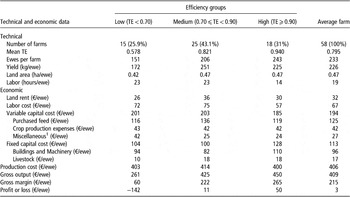
The Chios sheep farms were divided into efficiency groups on the basis of the estimated level of technical efficiency and their main technical and economic characteristics are computed and compared in order to provide an indicative picture of the structure and the productivity of the farms. The farms are categorized into three efficiency groups (low, medium and high) in order to provide a sufficient number of observations in each group, which would allow a concrete and consistent application of the descriptive analysis in terms of technical efficiency. The main technical and economic data of the 58 Chios sheep farms are presented in Table 5.
Technical and economic characteristics of the farms as a function of level of technical efficiency

1 Miscellaneous include the expenses for drugs, electricity, water and fuel.
Results in Table 5 show that the 18 sheep farms, that exhibit the highest level of technical efficiency (mean TE=0.940), had on average 243 ewes, which is the highest among the efficiency groups. This finding implies that large size farms in terms of ewes are positively associated with technical efficiency and that the farms could increase their production value and, consequently, their productivity by adjusting to an optimal size. The flock size constitutes one of the seminal factors that affect profitability of the livestock farms and a significant increase of the flock size reduces labor cost per sheep and, in some cases, increases the annual expenses of fixed capital. However, the highest milk yield (251 kg/ewe annually) is achieved by ewes reared in the farms classified at the medium efficiency group (mean TE=0.821), whereas the milk yield of ewes in the high efficiency group approximates that of the average farm (225 kg/ewe). The use of land for feedstuffs production does not vary significantly between the efficiency groups, although the farms with low technical efficiency cultivate 0.42 ha/ewe, 0.05 less than the relatively more efficient farms. The farms of the high efficiency group appear to use on average 9 h of labor less than the other efficiency groups, which could be attributed to their larger flock size, taking advantage of economies of scale.
Following the trend in the use of land and labor, the lowest land cost is €26/ewe in the case of the low-efficiency farms, whereas the lowest labor cost is €57/ewe in the case of the high-efficiency farms. In total, the variable capital cost is €185/ewe in farms of the high efficiency group; that is, €16 and €18 less than in the farms of the low and medium efficiency group, respectively. This result is attributed mainly to differences in expenses regarding purchased feed and other variable expenses in livestock production between the efficiency groups. Furthermore, Table 5 shows that the highest annual expenses of fixed capital occur in the case of the farms with the highest technical efficiency (€128/ewe), revealing that the more efficient farms operate under intensive production patterns, which depend heavily on high investments in buildings and machinery. The lowest production cost, that is €400/ewe, occurs in the case of farms that exhibit the highest efficiency score, although total production cost does not differ considerably between efficiency groups. A finding that substantially discriminates the efficiency groups is the gross output level. In the case of the low-efficiency group, gross output is €261/ewe, in the case of the medium-efficiency farms it is €425/ewe, while in the case of the high-efficiency farms the gross output is €450/ewe, indicating that a higher level of technical efficiency is associated with a higher value of production.
The gross margin, (gross output less the variable cost), which is the economic result typically used in the modern agricultural production economic analysis, is increased from €60/ewe for the farms of the low-efficiency group to €265/ewe for the farms of the high efficiency group. Consequently, the farms that exhibit the lowest efficiency scores present, on average, losses of €142/ewe, while the farms that comprise the medium and the high efficiency group present profits of €11 and €50/ewe, respectively, emphasizing that an efficient production system achieves higher economic performance.
Conclusions
The empirical results of this study indicated that the preferred stochastic frontier and inefficiency effects model was an adequate representation of the production technology of the Chios sheep farms. The mean efficiency level of technical efficiency was estimated to be 79.5%, although the majority of the farms exhibit relatively high efficiency scores. This finding reveals the presence of inefficiencies in the utilization of the current production technology and suggests that the Chios sheep farms, on average, could increase their gross output by 20.5% if all farms operate at full technical efficiency. The differences in the predicted efficiencies can be attributed to herd-related biophysical factors and to agricultural training, which proved to be significantly related to the (in)efficiencies of production. These results indicate that enhanced herd management and vocational education of farmers through proper agricultural service could have a great impact on efficiency and, hence, productivity. Moreover, results have shown that the incorporation of herd-related variables as inefficiency determinants in the model, apart from the human capital variables, provides valuable information regarding farm management. Studies concerning the investigation of efficiency determinants in the livestock sector should include herd-related biophysical variables as explanatory factors.
The estimation of the output elasticities showed that livestock capital is the most important factor of production, a finding that was consistent with a priori expectations, since the Chios sheep farms rear high-quality animals of high milk production and prolificacy (Ligda et al., Reference Ligda, Gabriilidis, Papadopoulos and Georgoudis2000; Michailidis et al., Reference Michailidis, Avdi and Pappa2007), emphasizing the potential of indigenous breeds. Results also indicated increasing returns to scale, confirming the established fact that small farm size constitutes one the main structural disadvantages of the Greek farming and suggesting that Chios sheep farms could improve their economic performance by operating at a larger scale. This finding is reinforced by the result of the descriptive analysis that large farms in terms of flock size are positively associated with a higher level of technical efficiency. Further, the empirical analysis indicated that the efficient farms achieve higher economic results, highlighting the important role of managerial ability in production and the promising perspectives of the sheep sector in Greece.
Acknowledgements
The authors would like to thank the referees whose perceptive comments and suggestions led to the strengthening of the results and the improvement of the manuscript.