INTRODUCTION
Research has shown that instruction facilitates pragmatic learning in a second language (L2). In instructed study-abroad contexts, the explicit teaching of pragmatics may be useful when learners use the language for real-world purposes (Shively, Reference Shively2011). However, most instructional-based studies have taken a quantitative approach and have examined pragmatic learning outcomes in adult learners. The question remains as to whether the effect of pragmatic instruction can be extended to younger learners. To answer this question, the present study investigated the effect of pragmatic instruction on teenagers’ production and perception of email requests while studying abroad.
BACKGROUND
Pragmatic Development in Study-Abroad Contexts
In language classrooms, teachers’ talk and textbook materials often do not provide the conditions for authentic pragmatic input (Bardovi-Harlig, Reference Bardovi-Harlig2015; Vellenga, Reference Vellenga2004). However, explicit instruction promotes awareness and improves production of pragmatic items, such as speech acts, having a positive effect on pragmatics learning (Jeon & Kaya, Reference Jeon, Kaya, Norris and Ortega2006; Taguchi, Reference Taguchi2011b, Reference Taguchi2014, Reference Taguchi2015; Takahashi, Reference Takahashi and Trosborg2010). In addition, activities such as metapragmatic discussions (Takimoto, Reference Takimoto2012) and collaborative tasks (Taguchi & Kim, Reference Taguchi and Kim2014) can trigger more opportunities for pragmatic output and feedback.
When moving from the classroom to the real world, language learners sometimes change their pragmatic style according to context (Iwasaki, Reference Iwasaki2010) but at other times do not conform to the pragmatic rules of the target language (House, Reference House and Trosborg2010). Why learners do or do not follow target language norms in real-life interactions is still an open question. Bardovi-Harlig (Reference Bardovi-Harlig2013) suggested that new research should look at learners’ authentic interactions, and the present study took up this suggestion by analyzing the real-life situations learners face during their study-abroad experiences.
Study-abroad experience does not guarantee learners’ pragmatic development (Bardovi-Harlig & Dörnyei, Reference Bardovi-Harlig and Dörnyei1998; Barron, Reference Barron2003; Félix-Brasdefer & Hasler-Barker, Reference Félix-Brasdefer and Hasler-Barker2015; Matsumura, Reference Matsumura2001; Schauer, Reference Schauer2009; Shively, Reference Shively2011; Taguchi, Reference Taguchi2008; Vilar-Beltrán, Reference Vilar-Beltrán2014). Previous studies have also pointed out that pragmatic acquisition during study abroad is largely determined by intensity of interaction with target language speakers (Bardovi-Harlig & Bastos, Reference Bardovi-Harlig and Bastos2011; Bella, Reference Bella2011). Additionally, pragmatic development is influenced by learners’ individual differences, including their initial proficiency level (Xiao, Reference Xiao2015), motivation (Eslami & Jin Ahn, Reference Eslami and Jin Ahn2014), personality (Taguchi, Reference Taguchi2014), cultural background (Sánchez-Hernández, Reference Sánchez-Hernández2017), and sociocultural adaptation to the target language environment (Sánchez-Hernández, Reference Sánchez-Hernández2017).
The interaction between pragmatic instruction and study abroad has been addressed by Winkie and Teng (Reference Winkie and Teng2010), Shively (Reference Shively2011), and Alcón-Soler (Reference Alcón-Soler2015). Winkie and Teng reported that explicit pragmatics instruction via a task-based tutorial workbook had a positive effect on students’ ability to perform requests during a summer study-abroad program in China. Shively explored the role of language socialization and explicit instruction in the development of requests by seven U.S. students who studied abroad for one semester in Toledo, Spain. Audio recordings that participants made of themselves during service encounters at three different times were examined for changes in openings and requests. Shively reported that, although participants moved from indirect to direct requests, individual variation was observed in the request forms adopted at the end of the stay abroad.
Alcón-Soler (Reference Alcón-Soler2015) also dealt with pragmatic changes during study abroad. That study explored to what extent pragmatic instruction and length of study abroad influence learners’ ability to mitigate requests in email communication. The findings showed that, although instruction has an immediate effect on the use of email request modifiers, knowledge gained from instruction is reconstructed through exposure to the target language. In fact, in spite of being instructed in request mitigators, participants showed a tendency toward the use of direct request. The study also revealed individual variation in gains from instruction and study abroad, highlighting the need to explore the reasons behind the different individual trajectories learners showed when moving from the classroom to the real world.
A study by Taguchi (Reference Taguchi2011a) also showed individual variability in pragmatic development in an immersion setting in Japan. In that study, 48 native Japanese-speaking participants completed a pragmatic speaking task at three different times during an academic year. The pragmatic speaking task measured their ability to produce requests and opinions in a high-imposition and a low-imposition situation. In addition, interview data from a subset of participants were collected to explore the relationship between types of sociocultural experiences and pragmatic gains. By combining quantitative and qualitative data, Taguchi (Reference Taguchi2011a) reported that appropriateness increased for low-imposition speech acts, but variation occurred in the patterns and pace of pragmatic development at the individual levels. Participants showed different developmental trajectories determined by their sociocultural experiences in the immersion setting. In line with Taguchi (Reference Taguchi2011a), the present study explored the reasons behind individual differences in pragmatic learning trajectories. However, the current study focuses on a different context and a different target task, thereby contributing to the overall knowledge of the factors that contribute to individual differences in L2 pragmatic development.
Pragmatic Development in Email Requests
Previous studies have explored the development of young learners’ requests in formal learning contexts (Ellis, Reference Ellis1992; Code & Anderson, Reference Code and Anderson2001; Portolés, Reference Portolés2015), and social contexts (Achiba, Reference Achiba2003; Safont, Reference Safont2013). However, the development of requests in email communication has been mainly examined in adult learners. Hartford and Bardovi-Harlig (Reference Hartford, Bardovi-Harlig and Bouton1996), one of the first pragmatics studies on L2 email requests, analyzed emails produced by native and nonnative speakers of English and asked how they were evaluated by faculty members. The findings revealed that nonnative speakers’ emails did not employ mitigation devices, emphasized students’ own needs, and lacked status-congruent language. Studies by Economidou-Kogetsidis (Reference Economidou-Kogetsidis2011), Pan (Reference Pan, Economidou-Kogetsidis and Woodfield2012), and Félix-Brasdefer (Reference Félix-Brasdefer, Economidou-Kogetsidis and Woodfield2012) also examined development of email requests in adult learners, exclusively university students. Alcón-Soler (Reference Alcón-Soler2015) is the first study, to my knowledge, that has focused on a different population, namely, late adolescent learners.
Research Questions
The present study aimed to fill a research gap in L2 instructional pragmatics studies by exploring the reasons behind individuals’ different pragmatic learning trajectories when adolescent learners move from the classroom to real-world email communication. Both the effects of pragmatic instruction and the reasons underlying learners’ pragmatic trajectories are examined. The following research question guided the study:
1. To what extent does instruction work as a means to mitigate high-imposition email requests?
2. To what extent do instruction and study-abroad experiences influence changes in production (in emails to instructors) and perception (in retrospective emails and interviews) of requests?
METHOD
Participants
A total of 60 adolescent Spanish learners of English, 16 to 17 years old, participated in the study. They had just arrived in England to study English for one academic year, and they followed intensive academic English courses. Their average level of English language proficiency was intermediate, as established by the standardized Quick Oxford Placement test (University of Cambridge Local Examinations Syndicate (UCLES), 2001). Participants were divided into two equal groups, one instructed on email requests and one not, resulting in an experimental group (n = 30) and a control group (n = 30). Six teachers of intensive academic English courses received training on teaching requests and implemented the instructional treatment in the experimental group.
Maximum variation sampling was used to select high and low producers of request modifiers from each group. For the present study, I examined the pragmatic trajectories of two participants that belonged to the experimental group: Lea, who produced request modifiers at a low rate, and Pia, who produced request modifiers at a high rate. Both Lea and Pia received pragmatic instruction on email requests, frequently used email communication both within and outside the school environment, and did not show any differences in level of proficiency or living arrangements. (They both lived with their Spanish families while in the UK.)
Instructional Treatment
The instructional treatment followed a consciousness-raising approach, in which learners’ attention was drawn to request forms, sociocultural norms, and discourse structure in academic email communication. Special attention was paid to the size of the requests and familiarity with the recipient as the two variables that influence the performance of email request. The study lasted 4 weeks and included one treatment session per week.
Session 1: A deductive teaching approach was adopted. The teacher provided an explanation on the structure of an email request as well as a list of request strategies and request modifiers. This was followed by examples of authentic email requests, pointing out how variation in the size of the request and familiarity with the email recipient might influence the use of request strategies and request modifiers.
Session 2: An inductive teaching approach was followed. Students were asked to assess the degree of appropriateness and politeness of different email requests and to justify their choice by referring to specific linguistic features from the message. Emails were selected according to variation in the size of the request and familiarity with the email recipient. Teacher feedback was provided.
Session 3: Participants wrote an email request to their home teacher in their own language and compared what they would say and how they would say it with what they had discovered in the previous sessions on email requests. Here the focus was on cultural norms.
Session 4: Students worked in groups and generated a checklist of things to consider in the performance of email request in groups, including discourse structure, choices on language form, and attention to sociocultural norms.
Data Analysis
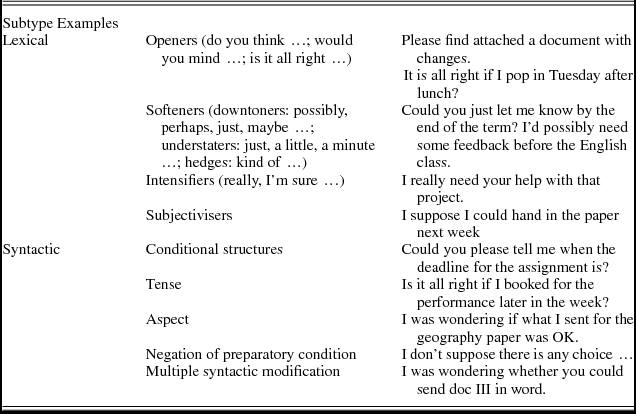
To answer the first research question, whether pragmatic instruction leads learners to mitigate high-imposition email requests, I analyzed emails that students sent to their English teachers at two different times: pretest, when they had just arrived in the country, and posttest, immediately after pragmatic instruction. A total of 360 high-imposition email requests (three emails per student in each group at the two times) that students sent to their instructors during real-life email communication were examined for level of directness before and after receiving pragmatic instruction. Requests were coded using the classification suggested by Blum-Kulka, House, and Kasper (Reference Blum-Kulka, House and Kasper1989), and modified by Biesenbach-Lucas (Reference Biesenbach-Lucas2007) and Félix-Brasdefer (Reference Félix-Brasdefer, Economidou-Kogetsidis and Woodfield2012). The presence of conventionally indirect strategies (Can I borrow your book at the end of this week?) and the presence of internal modifiers (see Table 1 for the taxonomy of modifiers) were calculated by the researcher and a trained research assistant. These elements, although optional, were used to mitigate the degree of imposition of the request and thus influence the degree of directness of the email request. The interrater agreement rate (based on 30% of the data) was 95% for conventionally indirect strategies and 91% for internal modifiers.
Lexical and Syntactic Modification Devices in Student-Initiated Email Requests

To answer the second research question, which addressed the extent to which instruction and the study-abroad experience influence individual pragmatic trajectories, I further examined the case studies of two students, Lea and Pia. A total of 40 high-imposition email requests from each learner were selected at random from four different time points and analyzed qualitatively, taking into account changes in the use of request strategies and modifiers during the year abroad. In addition, retrospective reports and guided interviews were used to explore the reasons underlying their pragmatic trajectories, following previous studies that have employed retrospective reports in combination with other elicitation instruments to examine speech act performance (e.g., Woodfield, Reference Woodfield2010; Félix-Brasdefer, Reference Félix-Brasdefer2008; Hassall, Reference Hassall, Alcón-Soler and Martinez-Flor2008). In particular, these instruments were used to investigate whether changes in email request performance could be explained by the interaction between instruction and participants’ perception of the request imposition.
Immediately after sending each email, participants received an automated email response with a series of pilot-tested questions. In this article, I focus on responses to two of these questions in which participants were asked to report on their perception of the request imposition, and whether in writing the email they had drawn on any information they had learned since they arrived in England (see example next). They could use Spanish or English in their retrospective reports.
1a. Do you think that what you are requesting of your teacher is a big favor?
1. not at all 2. a little 3. so-so 4. quite big 5. very big
1b. Give reasons that explain your choice.
2. When writing this email, have you used any information that you have learned since you arrived in England? If so, please state what.
Finally, semistructured interviews were used at four different times. At Time 1, the interview included questions on participants’ background information and how they felt about the study-abroad experience. The interviews at Times 2, 3, and 4 also started with a general question about how they were feeling during the study-abroad experience. This general question allowed for new topics to be mentioned during each interview. The interview then turned to a discussion of the retrospective reports each participant had completed. The interviews were conducted in Spanish so that participants would feel more open and comfortable expressing their feelings about their experiences.
RESULTS
Research Question 1: Is Pragmatic Instruction Effective?
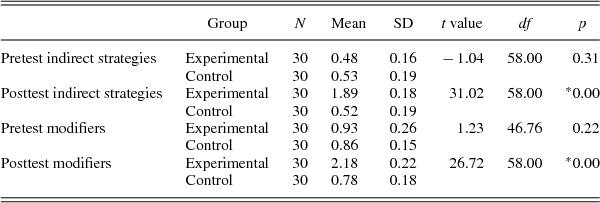
The first research question asked whether pragmatic instruction is effective for learning how to mitigate email requests. Table 2 shows the differences in means and the standard deviation of learners’ production of conventionally indirect strategies and request modifiers at pretest and posttest.
Differences in Conventionally Indirect Request Strategies and Modifiers Between Experimental and Control Groups Before and After Pragmatic Instruction

*p < .05
As shown in Table 2, there is no difference in the use of conventionally indirect strategies and request modifiers between the experimental and control groups in the pretest. However, after receiving instruction, participants in the experimental group used conventionally indirect strategies and request modifiers more frequently than participants in the control group (t = 31.02, p < .05). Participants in the experimental group showed a mean of 1.89 in the use of conventionally indirect request strategies, while participants in the control group showed a mean of 0.52. The results are similar for the frequency of request modifiers. No between-group differences were found at pretest, but at posttest the difference was significant (t = 26.72, p < .05). The mean for the experimental group was 2.18, and the mean for the control group was 0.78. These results are in line with previous investigations reporting that instruction improves pragmatic performance in formal contexts, and they provide further evidence of the teachability of pragmatics in a new setting, the instructed study-abroad context.
Research Question 2: Do Instruction and Study-Abroad Experience Affect Individual Trajectories?
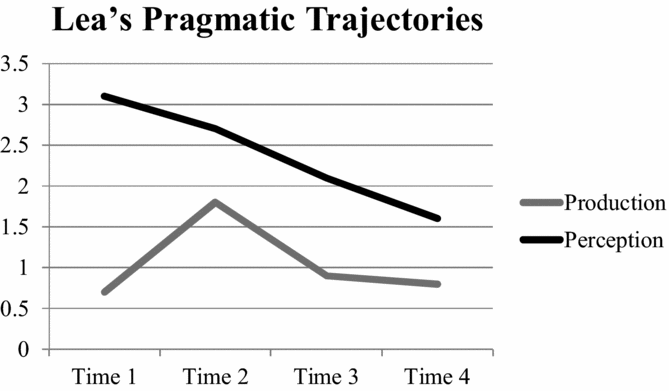
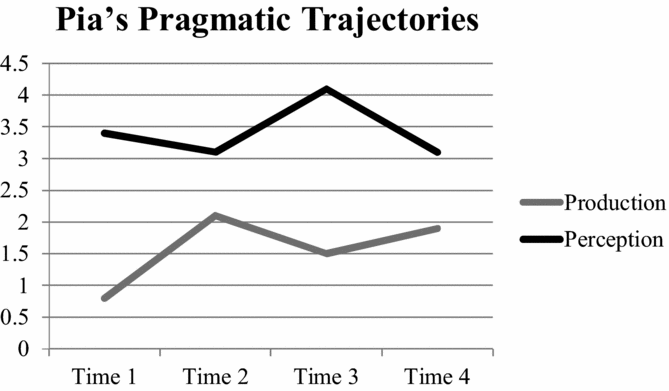
The second research question asked whether instruction and the study-abroad experience influence individual pragmatic trajectories. To address this question, the present study reports on two case studies: Lea and Pia. These learners’ emails, retrospective reports, and interviews reveal different trajectories in the use of request modifiers and the perception of request imposition during the study-abroad experience. Figures 1 and 2 show Lea's and Pia's pragmatic trajectories and perception of request imposition.
Lea's Pragmatic Trajectories in Relation to Perception of Request Imposition

Pia's Pragmatic Trajectories in Relation to Perception of Request Imposition

At Time 1, both Lea and Pia use direct requests (“I need”; “I am asking you”; “I want”), together with a speaker-oriented indirect strategy (“Can I. . . .?”). They also use request modifiers. Both show a tendency to use “please” and to overuse external modifiers, especially grounders, that is, reasons for the request (“I may send you the composition later this week because I have been sick and I have not been able to go to school this week.”). In terms of perception, neither Pia nor Lea tended to see her requests as imposing.
There are also notable differences between the two learners at Time 1. For instance, Pia uses more apologies than Lea (“I am very sorry”; “my apologies, but . . .”). They also show a difference in their use of formal versus informal salutations (e.g., Dear John/Dear Mrs. Johnson/Dear teacher versus Hi John/Hi teacher) and sign-offs (“Thanks”; Best”; “Sincerely”). At Time 1, during the semistructured interviews, the most salient difference between these two learners was that Lea showed self-confidence in facing the study-abroad experience, while Pia showed a lack of self-confidence.
At Time 2, both Lea and Pia had a lower overall perception of the imposition of their requests than they did at Time 1 (Pia scored 3.4 at Time 1 and 3.2 at Time 2, while Lea scored 3.2 at Time 1 and 1.7 at Time 2). Despite the fact that they did not perceive the imposition of the request as high, there was a shift from the use of direct strategies toward the use of the hearer-oriented indirect strategy “Can you. . . .?” In addition, the use of grounders begins to combine with the use of the syntactic modifier “could.” The first appearance of lexical modifiers—mainly “just,” “perhaps,” and “possibly”—are found at Time 2. This shift toward knowledge of how to mitigate the request is likely an effect of instruction. This effect is reinforced in their retrospective verbal reports (see Examples 1 and 2).
Example 1 from Pia (Time 2).
Dear xxx
I am writing to you ask if I can get information on Lion King. I wanted to go and when you mentioned that in class I saw the opportunity. I know that I have to study hard, but if you could send me the information I would see if I can go. I have to think about my travel to Spain too, and then, at the end of the term we have the trip. Well, if you could send me the information that would be great
Thanks a lot, xxx (name of the student)
1a. Do you think that what you are requesting of your teacher is a big favor?
1. not at all 2. a little 3. so-so 4. quite big 5. very big
1b. Give reasons that explain your choice.
“I said number 3 but I'm not sure the teacher thinks the same. It's not the first time I think one way and then I realize they think otherwise. That's why I have explained my reasons very well and I have used polite language in the email.”
2. When writing this email have you used any information that you have learned since you arrived in England? If so, please state what.
“I remember that the teacher explained how to use ‘could’ when making a request.”
Example 2 from Lea (Time 2).
Dear xxx
I am wondering if you could please send the information on how to book for Lion King? You mentioned we could write to you if interested. So, if you could just send the inf.
Thanks, (name of the student)
1a. Do you think that what you are requesting of your teacher is a big favor?
1. not at all 2. a little 3. so-so 4. quite big 5. very big
1b. Give reasons that explain your choice.
“Well, he has to go to the trouble of sending out the information, which we have in the secretary's office as well, but she offered to do it. He is really nice and I don't think there'll be any problem. I thank him too and say please when I ask him to do it.”
2. When writing this email have you used any information that you have learned since you arrived in England? If so, please state what.
“Yes, I didn't know the expression ‘I was wondering’ and I learned it in the English class.”
With regard to how they felt about the study-abroad experience during the semistructured interviews, Lea expressed positive feelings, while Pia reported negative emotions toward the target language community. For instance, during the interview, Pia was asked to whom she was referring when she said “they think otherwise” in her retrospective email (Example 1). Pia said:
Them, the English. They treat us like foreigners here, so what I might say could be different from what I am expected to say when I write to the teacher. They are really nice, but to be honest I don't know.
At Time 3, Pia and Lea both show an abrupt drop in mitigating email requests, but the drop is greater in the case of Lea. One possible explanation for this difference is that each participant starts to reconstruct her knowledge of how to perform email requests by comparing the information obtained from formal instruction with the information gained from participating in email conversations. For example, as illustrated in Lea's retrospective report at Time 3 (Example 3), she decided to use a more informal style in her email salutations (“Hi”) and sign-off (“Cheers,” used for the first time at Time 3), which she reported to have learned from engaging in teacher–student email conversations.
Example 3 from Lea (Time 3).
Hi xxx
I am back again. Could send the task for Monday? Not found in the folder
Cheers (name of the student)
1a. Do you think that what you are requesting of your teacher is a big favor?
1. not at all 2. a little `3. so-so 4. quite big 5. very big
1b. Give reasons that explain your choice.
“It's normal, it's the way we communicate with teachers here.”
2. When writing this email have you used any information that you have learned since you arrived in England? If so, please state what.
“Here, the teacher is like just another classmate and he addresses you in a familiar way, I used to think the English said please a lot, but they don't do it that often.”
During the semistructured interviews, Lea reiterated her statement from the retrospective report that she had a friendly relationship with her teacher (see below). She also reported she had been surprised when she discovered that the relationship with the teacher was more informal in the UK than in Spain. However, despite her surprise, she did not question this informal relationship and showed changes toward the pragmatic norm in the community in which she found herself.
Lea's comments on Example 3 during the interview:
Well, I don't think it's such a huge favor to ask a teacher for something like that, I have learnt to use expressions to make the request in a polite way. The English are not as polite as they say in Spain anyway. Moreover, the teacher is pretty easygoing, and I have a very cool relationship with him. When he writes to me, he doesn't make it very long-winded, he just says what he needs to say in one sentence or so. I assume that if he does that, I can do it too.
The change toward informal openings and closings and the absence of lexical modifiers in most of Lea's emails are in line with the decline in perception of request imposition shown in Figure 1. Lea's perception of request imposition as low and the directness of her email requests observed at Time 3 continue at Time 4. At Time 4, the use of informal salutations (Hi + name of the teacher) and sign-off (Cheers, See you later) are the norm rather than the exception. Her overall style by the end of the study-abroad experience could be described as informal.
Like Lea, Pia's use of request modifiers drops at Time 3. However, this is not in line with her perception of request imposition, which is highest at Time 3 (see Figure 2). Why does Pia display changes toward a more informal style and a decline in the use of modifiers while showing an increase in her perception of request imposition? The results of the semistructured interviews provide us with possible reasons underlying her pragmatic change. Pia's interview at Time 3 shows that when she evaluated the size of the requests, she was thinking about the degree of politeness expected in teacher–student email conversation. In contrast to Lea, who seemed to be comfortable using a direct and informal style in her communication with her teacher, Pia thought that more formal language was expected in teacher–student email conversations. This may explain why at Time 4, despite using the informal style she learned from engaging in teacher–student email conversations, she reported that she felt uncomfortable. During the retrospective reports and interviews, Pia reported her struggle between her own pragmatic norms, which involved indirectness, and those observed during email communication with teachers and friends, which involved directness and a more informal style (see Example 4).
Example 4 from Pia (Time 4).
Hi xxx
Please, Could you have a look at my draft before sending you the final composition?
Thanks a lot (name of the student)
1a. Do you think that what you are requesting of your teacher is a big favor?
1. not at all 2. a little 3. so-so 4. quite big 5. very big
1b. Give reasons that explain your choice.
“I have my doubts, but I try not to bother anyone and do it the way they do it. Sometimes I wonder if what's written in the books takes into account the way the English actually speak.”
2. When writing this email have you used any information that you have learned since you arrived in England? If so, please state what.
“I don't know, it's different to what I thought before coming here, now I just copy what they do because I am not going to be different, but I am not that sure about it, I often have my doubts . . . but I have learnt a lot”.
In her response to the second question in Example 4, Pia reported her attempts to be accepted in the target language community, something that the researcher confirmed during the semistructured interviews, in which Pia stated:
Personally I dislike that way of asking but I don't want to sound like a guiri (foreigner). Here everything is informal, and the relationship with the professor is as if he were a friend. I am not sure whether I request properly or not, but as I say, it seems to be the way to do it. I have to say it's not the way I would do it in Spanish.
DISCUSSION
To date, most instructional studies in pragmatics have been conducted in formal language learning contexts and have examined instructional effects in adult learners. The present study intended to advance research on instructional pragmatics by assessing the effects of pragmatic instruction on adolescent learners when they move from the classroom to real email communication. A frequency analysis of request strategies and modifiers in learners’ emails before and after instruction on request strategies indicated that instruction was effective as a means to learn how to mitigate email requests. Thus, in line with previous studies (Taguchi, Reference Taguchi2011b, Reference Taguchi2015; Takahashi, Reference Takahashi and Trosborg2010), the present study provides evidence for the positive effects of pragmatic instruction.
This study also adds further insight to Taguchi's (Reference Taguchi2011a) finding that variation in learners’ developmental trajectories with regards to L2 pragmatics could be explained by learners’ perceptions of their sociocultural experiences. An examination of the email requests, retrospective reports, and interview responses of two learners with different trajectories suggests that perception of request imposition and willingness to adopt the pragmatic norms of the target language community interact with pragmatic gains from instruction. One learner, Lea, showed a general trend toward directness in her email requests, by adopting the pragmatic norm of the community in which she found herself. This explains why, during her study-abroad experience, some forms that she produced at Time 2 (immediately after receiving instruction) disappear at Times 3 and 4 (I was wondering; I suppose), and are replaced by other linguistic forms that are more direct and informal (Cheers). Because these direct and informal strategies were not part of instruction, it can be presumed that Lea learned them from exposure to the language. At the same time, the interaction effects of pragmatic instruction and intensive exposure to email conversation may explain her ability to mitigate requests when she perceives the request as imposing.
The other student, Pia, overused request modifiers by the end of the study abroad. This can be attributed to a lack of sociopragmatic knowledge and therefore, as was the case in a study by Taguchi (Reference Taguchi2011a), incorrect assessment of the impositions of her requests in the social context. In addition, as Pia became a language user within the community in which she found herself, her beliefs about the teacher–student relationship interacted with exposure to and use of language in real email communication. This may explain why, even if she had knowledge about the pragmatic norms of the community in which she found herself, she thought that casual and direct emails were not appropriate in teacher–student email conversations.
In sum, this study's findings show that there are immediate benefits from pragmatic instruction on the email requests that adolescents studying abroad send to their language teachers. Examinations of students’ email requests over time revealed a change toward the use of conventionally indirect strategies and an increase in the use of internal request modifiers. This general pattern of change is not homogeneous during participants’ study-abroad experiences, thus suggesting individual variation on how learners’ pragmatic trajectories develop when they move from the classroom to the real world. Lea's and Pia's case studies shed light on the reasons that may interact with pragmatic instruction during real language use. Both participants’ sociocultural perspectives were reflected in their pragmatic changes. This suggests that gains from pragmatic instruction interact with language exposure and individual factors when language learners move from the classroom to real email communication. In the present study, learners’ perception of request imposition and their desire to be accepted in the community are two factors that seemed to have an impact on learners’ pragmatic development throughout their study-abroad experience.
This study also makes a methodological contribution to the field of L2 pragmatics by examining both the product and the process of pragmatic learning. This involves understanding learners’ pragmatic learning trajectories, and the reasons underlying these trajectories. Innovative research designs and methods of data collection are needed to meet the challenges of exploring how learners’ pragmatic knowledge, gained from instruction, is used in for real world purposes.
LIMITATIONS AND FURTHER RESEARCH
The study has some limitations. First, the study focused on just two target pragmatic features: request strategies and internal request modifiers. Further research should examine learners’ pragmatic development holistically rather than with a focus on specific pragmatic features. Second, the qualitative analysis was relatively small, as this study focused on the detailed development of two learners. While enlightening, this narrow focus makes it difficult to generalize to other learners. More case studies should be added to future analyses. In addition, our data suggest that changes in the teacher–student relationship during study abroad may also influence performance and patterns of pragmatic change. This could be assessed systematically in future work.
Further studies are also needed to understand young learners’ pragmatic development across language learning contexts. This study explored the effects of pragmatic instruction in the production and perception of email requests during study abroad. Another interesting setting in which to explore young learners’ pragmatic gains beyond the classroom is in lingua franca (House, Reference House and Trosborg2010) and multilingual contexts. As reported by Safont and Portolés, (Reference Safont, Portolés, Safont and Portolés2015, Reference Safont and Portolés2016) and Martín-Laguna (Reference Martín-Laguna2016), younger learners’ pragmatic production and awareness may benefit from proficiency and competence in multiple languages and cultural contexts.
Acknowledgments
As member of the LAELA (Lingüística Aplicada a l'Ensenyament de la Llengua Anglesa) research group at Universitat Jaume I (Castellón, Spain), I would like to acknowledge that this study is part of a research project funded by (a) the Spanish Ministerio de Economia y Competitividad (FFI2016-78584-P), (b) the Universitat Jaume I (P1·1B2015-20), and (c) Projectes d'Innovació Educativa de la Unitat de Suport Educatiu 3252/16.