1. INTRODUCTION
The social geography of urban centres within North America and northern and western Europe has attracted considerable scholarship, yet analysis of household composition with a focus upon lodging and boarding within working-class homes has been less developed. Research undertaken has identified several themes which appear consistent across time and place, and are related to patterns of industrialisation and immigration. Peter Laslett and Richard Wall's edited exploration of households over time and space highlights the ubiquity of opening family homes to paying guests,Footnote 1 while Michael Anderson's study of family structure in nineteenth-century Lancashire described lodging as a social lubricant for recently arrived immigrants.Footnote 2 Leonore Davidoff has argued that the presence of a lodger within the family home was not simply an economic imperative, but that relationships were often much more complex.Footnote 3 Vicky Holmes has demonstrated the complex motivations for lodging in private dwellings, which were a mix of social, economic and domestic change and turmoil,Footnote 4 while Lesley Hoskins has considered the impact of lodging on the separation of the domestic and productive spheres.Footnote 5 Although this body of work has resulted in a greater appreciation of both the frequency and experience of lodging within private homes, little work has examined these factors from a Scottish perspective.
This article examines working-class lodging practices in Govan, Lanark – a populous, industrial parish on the south side of the River Clyde, neighbouring Glasgow. In particular, this article addresses lodging practices among working-class households, with an emphasis upon immigrant households and households headed by females, features of lodging particularly evident amongst homes occupied by working-class families throughout industrialised nations.Footnote 6 Analysis of lodging patterns in Govan, using census and poor relief returns, reveals evidence of the multi-layered relationships between lodgers and householders.Footnote 7
By the 1860s, Govan was home to a developing shipbuilding industry which attracted considerable in-migration from other areas of Scotland, the British Isles and the European continent.Footnote 8 In 1861, there were over 200,000 Irish-born immigrants in Scotland comprising around 7 per cent of Scotland's population,Footnote 9 but around 18 per cent of the population of the parish of Govan.Footnote 10 By 1901, Scotland was home to over 10,000 Russian-born immigrants, with Lanark hosting over 8,000 of these.Footnote 11 Although female-headed households were to be found in all areas of Scotland, regardless of social class, lodgers played a significant part in the household economics of working-class homes lacking a traditional male breadwinner. Managing a household in this manner enabled women to retain economic control of their household, and enabled independence and the extension of personal networks.Footnote 12
In Scotland, as in many other parts of the world, the reasons for seeking lodgings were often linked to the financial conditions of the individual, and their reasons for migrating to larger urban conurbations.Footnote 13 Often the move to the city was prompted by a desire for better employment prospects and potentially higher wages. In 1871 it was estimated that 75 per cent of lodgers in the city of Glasgow were working people migrating to the city in search of employment.Footnote 14 Cities such as Glasgow, Scotland's largest, saw significant population increases during the late nineteenth and early twentieth centuries; between 1851 and 1921 the population of the city grew from under 200,000 to over 1,000,000.Footnote 15 Despite the significant increase in population there had initially been very little addition to the city's housing stock.Footnote 16
By the late nineteenth century social reformers and national authorities were becoming increasingly concerned about the condition of housing in Scotland's urban and industrial centres. These concerns were three-fold: (1) overcrowding had become a threat to health and morality; (2) housing stock was substandard; and (3) options for the houseless were grim as urban centres were ill-equipped for the growing population. Thus, housing options were limited for new arrivals and Glasgow had developed a reputation as being home to some of the worst urban poverty, and housing, in Great Britain.Footnote 17 Lodging houses were one option but one which was best avoided. According to John Smith, writing contemporaneously, Glasgow was home to around 700 lodging houses in 1846, of which fewer than 500 were registered, with the majority occupying premises around High Street, Stockwell Street and the Saltmarket; some of the poorest areas of the city.Footnote 18
Smith was well aware of why these lodging houses had increased in number during the mid part of the nineteenth century and the implications they held for the health of the city. Smith proposed the construction of habitable and reputable lodging houses to prevent the descent into squalor and crime:
The inexperienced that are daily crowding to Glasgow from the country would be saved from these dens of infamy where their ruin is speedily accomplished, and the amount of crime would consequently be greatly lessened.Footnote 19
Glasgow's reputation as the host to unspeakable horrors relating to poverty, health and overcrowding was also recognised domestically. According to the 1870 Scottish Poor Law Report, existing private lodging houses had become known as dens of iniquity,Footnote 20 run by men and women who were viewed as little more than vagrants themselves.Footnote 21 Sir Robert Anstruther, the Member of Parliament for Fife, considered private lodging houses as responsible for conditions which fostered gross immorality between the sexes.Footnote 22
The growing concern over the conditions of the urban poor in Glasgow prompted action and in 1866 the Glasgow City Improvement Act (GCIA) enabled the corporation to take measures to reduce the predominance of squalid housing in the city. Focusing on an 88-acre site in the centre of the city, the act enabled Glasgow Corporation to clear the substandard housing,Footnote 23 which William Logan, the Scottish temperance campaigner, described as nothing more than ‘slaughter pens’.Footnote 24 Glasgow also introduced the mechanism to ‘ticket’ houses not exceeding 2,000 cubic feet, with metal tags fixed to the door, which stipulated the maximum number of occupants permitted.Footnote 25 One issue that was recognised by local authorities was that a great number of those displaced by the slum clearances were lodgers,Footnote 26 about whom Dr Gairdner, the Health Officer for Glasgow, had expressed concerns. The existence of lodgers of both sexes in already crowded working-class homes was believed by Gairdner to be evidence of both moral and physical degradation.Footnote 27 Thus, for many men and women migrating to Govan and Glasgow the avoidance of lodging houses meant that many chose to lodge or board with existing working-class households, which by the 1880s promised, if not delivered, more healthy environments.
Further improvements enacted by the GCIA related to the construction of new larger tenement homes in the city during the 1880s and onwards primarily for members of the working classes.Footnote 28 As these tenements were more expensive to rent, tenants often sublet rooms to help meet the payments. Paradoxically, the building of new more spacious tenements increased the problem of overcrowding. However, there was little that parochial authorities could do: taking in boarders and lodgers was often an absolute necessity for the economic survival of the householders and their paying guests.Footnote 29 Even by the 1910s significant concerns existed within Glasgow about the health implications that continued overcrowding posed for the city's working-class population, and overcrowding was on a scale not seen outside the very worst parts of London and Plymouth.Footnote 30
Although Govan was not annexed by the city of Glasgow until 1912, the residents of this parish shared many of the problems their neighbours faced. Of particular concern to social and moral campaigners was the district of Gorbals, just over the River Clyde from Glasgow city centre, and on the eastern fringes of Govan Combination Parish. A letter was published in the Glasgow Herald in July 1863 from a concerned observer, who saw in Govan, in particular in Albert Street and Victoria Street, some of the direst housing he had seen. The author of the letter noted of the tenements:
Few or none of the houses … have more than two apartments, while a large proportion of them consists of one room only. In some of the staircases there are six houses on each landing, giving, in one land, 30 families in all. But the number of lodgers in many of these small houses […] is, in many cases, in excess of the number composing the family itself.Footnote 31
During discussions held in April 1872 concerning the progress of the GCIA, particular opprobrium was directed at the housing surrounding the main thoroughfare through the Gorbals at the eastern end of Govan Combination Parish, Main Street, where ‘many features of venerable antiquity in combination with a large measure of modern filth and wretchedness’ had resulted in slum conditions.Footnote 32 Main Street contained some of the poorest housing in the district, and over 25 per cent of the population were not Scots born. James Russell, Glasgow's first full-time Officer of Health, reported in 1887 that it was not uncommon to see 16 people living in a three-apartment house in the city, leading to localised public health crises, chiefly relating to typhus infections.Footnote 33 Russell also reported in 1901 that over a quarter of two-roomed houses in Glasgow contained lodgers, leading to a situation where ‘strange men and women associated with husbands and wives and children within the four walls of small rooms’.Footnote 34 By 1908 it was estimated that over 10,000 residents of Govan were living more than four to a room.Footnote 35
The average weekly rent for a two-room home in Glasgow was 4 shillings and 2 pence in 1908.Footnote 36 Analysis of applications for poor relief in Govan during the first decade of the twentieth century demonstrates that lodgers and boarders were paying anything between 1 shilling and over 7 shillings per week for room or room and board,Footnote 37 highlighting the economic importance of sub-letting accommodation. Yet, as Beatrice Moring,Footnote 38 Leonore DavidoffFootnote 39 and Vicky Holmes,Footnote 40 amongst others, have identified, the relationships between lodgers and boarders and their hosts were often not simply the result of economic imperatives.
2. IMMIGRANT LODGING PRACTICES IN GOVAN
This research is based on data from household databases created from the censuses of 1861, 1881, 1901 and 1911. Four Govan databases (one from each census) were constructed using transcribed Scottish census entries available from Ancestry.co.uk (1861–1901) and from Scotlandspeople.gov.uk (1911). Each database contained 1,000 households, comprising a one-in-three sample from specific streets in the parish. Specific streets in Govan were chosen due to their proximity to industrial production, with the Govan area closely associated with industry from the mid 1800s,Footnote 41 and a developing shipbuilding industry from the 1860s.Footnote 42 Specific streets in the Govan Parish, for example Govan Street, Hospital Street, Main Street, Thistle Street and Victoria Street, were selected due to the large concentration of working-class families housed there, in particular, immigrant families. Class was determined by the occupation of the head of household, with heads in these streets overwhelmingly occupied in unskilled and semi-skilled trades. A one-in-three sample was used to select households (omitting households that were not headed by individuals engaged in working-class occupations). A similar strategy was employed to create databases of households in rural Perthshire. The completed databases include detailed household composition information gleaned from the census enumeration books. Additional material was retrieved from parish records, namely applications for poor relief.
Govan, prior to annexation by Glasgow in 1912, was a particularly populous parish dominated by its developing shipbuilding industry. The Govan databases created were composed of 1,000 households containing over 5,000 individuals and offer a snapshot of lodging practices in Victorian and Edwardian Govan. Scottish census enumerators ensured a distinction between lodgers and boarders; with lodgers treated as householders in their own right, while boarders took meals with the household and were considered part of an extended unit.Footnote 43 For the purposes of this article, lodgers and boarders are considered equivalents as each was staying temporarily within already existing households.
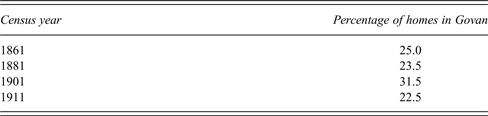
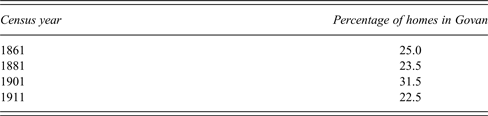
As Table 1 demonstrates, between 1861 and 1911 the percentage of working-class homes hosting boarders or lodgers never fell below 22.5 per cent, and for the period averaged 25.6 per cent.Footnote 44 There was a peak in 1901, which reflects a similar peak in overseas migration into Govan, primarily from Eastern Europe. In 1881 there were just over 6,000 foreign-born individuals in Scotland,Footnote 45 but by 1901 that figure had risen to over 22,000.Footnote 46 In 1861, there were 470 lodgers or boarders within the 1,000 Govan households. Within the 1881 database, that figure had fallen to 375 but rose significantly in the 1901 database to 562 before dropping again in the 1911 database to 349 adult lodgers or boarders.
Percentage of working-class homes in Govan containing lodgers or boarders
Source: Govan databases, Censuses of Scotland, 1861–1911.
The manner by which lodgers were dealt with in the census of 1901 might even underestimate the true figures, as those lodging within an apartment but occupying separate rooms were treated as householders in their own right. However, the head of the lodger ‘household’ was generally indicated as ‘lodger [head]’, or was denoted as ‘lodger’ but separated from the previous household by a black line. The statistics for lodging during the late nineteenth century roughly accord with analysis undertaken for other northern European cities during the period, for example, in 1890, 23.1 per cent of households in Berlin contained lodgers,Footnote 47 while in Frankfurt 24.6 per cent contained paying residents.Footnote 48
Another aspect of Govan's diversity during this period relates to its position as a host to domestic, national and international migrants. In 1901, 45 percent of the population were not born in the local area, although by 1911 this had fallen to 38 per cent. The parish was a particularly popular destination during the period 1861 to 1901 for Irish-born immigrants, who comprised 11.5 per cent of the population in 1901 and tended to be concentrated in areas along the Clyde and in the Gorbals (part of the Govan Combination Parish), just south of the river.Footnote 49 The percentage of Irish found in the Govan 1901 sample of working-class households used for this paper was slightly higher at 13.3 per cent, and by 1911, 10.9 per cent. These figures undoubtedly underestimate the prevalence of ethnically Irish individuals, born in Scotland, but from Irish parentage. Overwhelmingly, the Irish were to be found in semi-skilled and unskilled occupations including mining, labouring and dockyard work, the latter two groups found in large numbers in Govan.Footnote 50
Anderson suggests that shared nationality could be found in a significant number of adult householder–lodger relationships in urban centres; and that an absence of kin or friends to assist with the expected difficulties of settling into a new environment could lead to considerable discomfort.Footnote 51 John Modell and Tamara Hareven also note strong national origin connections amongst household head–lodger relationships in their American study.Footnote 52 Mark Peel's study of boarders and lodgers in late-nineteenth century Boston also recognises the settling effect that lodging with already established immigrant households offered.Footnote 53 In the 1911 census of Govan there is evidence that many of the new immigrants lodged with already domiciled families from their own nation; a relationship born out of shared nationality, shared language and financial necessity for both the lodgers and their hosts.Footnote 54
Although Irish migration to Scotland had begun to slow down by 1901 there were still over 200,000 Irish-born in Scotland.Footnote 55 In the 1861 sample 270 of the 1,000 heads of household were Irish born, compared with 704 Scots-born. While 148 (21 per cent) of the Scottish-headed households contained boarders or lodgers, 100 (37 per cent) of the Irish-headed households contained paying guests. The figure for Scottish-headed households and lodgers remained much the same in 1881, and 64 of the 215 (30 per cent) Irish-headed households contained boarders or lodgers. By 1911, 20 per cent of Scottish-headed households contained lodgers or boarders compared with 28 per cent of Irish households. However, potentially a larger number of second-generation Irish replaced Irish-born lodgers. As will be discussed, households headed by a female were more likely to contain lodgers or boarders, but there is little difference between the prevalence of female-headed households between Irish and Scottish households in the database, in both cases around 19 per cent of households. A similar loosening of nationality connections over the course of the late nineteenth and early twentieth centuries is evident in other studies, such as Peel's analysis of Boston.Footnote 56 However, with increased immigration to Govan by the early twentieth century, ethnic ties, especially amongst Eastern Europeans, held strong.
In homes occupied by Russian householders that also contained lodgers or boarders, in every case those lodging were themselves Russian.Footnote 57 Such households represented 107 (10.7 per cent) of the 1,000 households in the 1911 Govan database and lodgers could be found in 28 of these (26 per cent). If we compare these figures with homes occupied by Scottish householders, who amounted to 610 of the 1,000 heads (61 per cent) we find that 121 (20 per cent) contained lodgers, and 75 per cent of these lodgers or boarders were Scottish. Interestingly, only 55 per cent of Irish households with lodgers or boarders contained Irish guests, perhaps pointing to the pressing financial concerns that such households faced. The tendency for lodgers or boarders born outside of the British Isles to share a home with householders from the same nation relates to a shared heritage, religion and language, and was common to most industrialised cities.Footnote 58 The fact that Russian households only appeared to contain Russian lodgers indicates that while Irish immigrants could speak English, many of the arriving Eastern European Jews spoke only Russian and Yiddish. Glasgow was estimated in 1910 to host almost 80 per cent of Scotland's Jewish population. Jewish migrants to Glasgow, especially those coming from within Britain, formed welfare and support societies and saw it as vital to offer employment, housing and financial services to newly arriving migrants.Footnote 59 Occupational clusters were common too among Jewish households, as the Jewish community in Scotland recognised the specific difficulties facing foreign-born immigrants culturally and linguistically separated from the bulk of the local population.Footnote 60
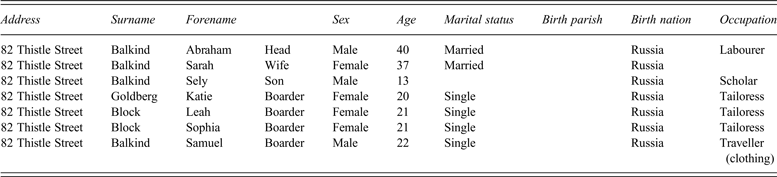
Yet, Russian Jews faced ambivalence and occasionally outright hostility when arriving in Scotland, from Jews and non-Jews alike, and many found themselves living and working in the poorest of areas. Thistle Street in the Gorbals hosted a number of poor Jews, where family breakdown and poverty was common.Footnote 61 Employment in tailoring trades and rag quilting was particularly popular in Govan and elsewhere, encompassing both home and small factory labour.Footnote 62Table 2 offers a glimpse into the household economics of Russian Jewish immigrants in Thistle Street in 1911. In the case of Russian households these were more likely to contain lodgers or boarders than their Scottish, or Irish, equivalents in all census years examined. In the case of Russian Jews, both economic and cultural reasons lay behind the decision to offer rooms to lodgers and boarders.
Russian households with boarders, Govan 1911

Source: Census of Scotland, 1911.
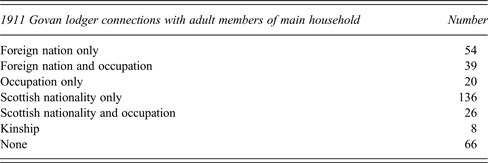
In the Govan sample from 1911, 93 out of 349 (27 per cent) adult lodgers shared a connection based upon a shared national origin other than Scotland with an adult member of the main household.Footnote 63 In 39 of these cases the lodger also shared an occupation with an adult member of the household. Despite this trend diminishing amongst Irish migrants, increased central and eastern European migration meant that the figures for shared nationality reduced only slightly between 1861 (33 per cent) and 1911 in Govan (27 per cent). Table 3 details all connections between lodgers and their hosts from the 1911 census of Govan database. In total 85 (24 per cent) lodgers shared occupational connections with their adult hosts in Govan in 1911 (primarily relating to shipyard labouring) – compared with 34 per cent in 1861 (again, chiefly related to shipyard labouring), evidence of a slightly diminishing connection amongst working-class Govan residents.
Lodger–householder connections by numbers, Govan 1911
Source: Census of Scotland, 1911.
Almost one-fifth of lodgers did not appear to share any obvious connection with an adult member of the hosting household. Yet, some of these relationships could well have been related to kinship ones. As Eleanor Gordon and Gwyneth Nair suggest, the concept of ‘hidden kin’ may account for some of those in this category. The authors suggest that in many cases relationships may have been closer than simple financial arrangements, but not immediately obvious from the census.Footnote 64 The example in Tables 4 and 5 demonstrates how the census can mask potential kinship relationships between household head and lodger; Rose and Celia were in fact sisters, despite Rose being listed as a boarder.Footnote 65 In the second example, Francis Quin is listed as a boarder, but according to the 1901 census he is James's brother.Footnote 66 Finally, the 1911 census of Scotland does not detail information regarding religion, and it can be assumed that at least some of these relationships were governed by religious preference as was the case with many cities in Great Britain and North America.Footnote 67
Masked kinship in Govan 1911 census
Source: Census of Scotland, 1911.
Masked kinship in Govan 1911 census
Source: Census of Scotland, 1911.
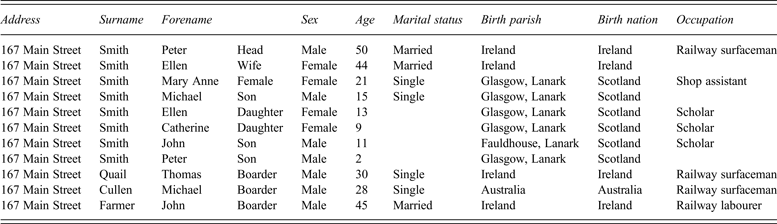
Not only were connections visible in almost half of all householder–lodger relationships, there are also examples of how connections existed between lodgers and boarders. In the example given in Table 6, a connection between the head of household and all three boarders is evident, relating to occupation on the railways. A further connection exists between two of the boarders and the head of household relating to nationality. Occupational connections appear to have been slightly more common when the households were headed by Russian or Irish heads than was the case with Scottish heads. Another significant intra-household boarder and lodger connection related to families within families. Almost one-fifth of all households with lodgers and/or boarders in Govan in 1911 contained a separate family unit, double the figure from 1881. Such arrangements were not limited to particular ethnic, religious or national groups. The construction of larger tenement apartments in the years after 1881 enabled householders to rent out additional rooms and internal space to paying guests.
Lodger connections, Govan 1881
Source: Census of Scotland, 1881.
What this analysis of lodging practices in Govan in 1911 demonstrates is that there were multiple connections between householders and their lodgers or boarders, which went beyond simple financial motivations. National, religious and language connections were particularly evident within households headed by Russian migrants to Govan, and significant connections existed which were based on occupation, either relating to domestic production or external employment. Undoubtedly, financial pressures upon working-class families necessitated opening up homes to relative strangers, yet such relationships were not simply about money but showed evidence of multi-layered connections.
3. LODGING: A GENDERED PERSPECTIVE
Jane Humphries’ research on female-headed households in early industrial Britain demonstrated that households within areas with access to industrial jobs were more likely to contain lodgers than areas dominated by agricultural labour, and that female-headed households were more likely to contain boarders or lodgers – evidence of women's economic strategies.Footnote 68 Additionally, Humphries underlines the important contribution to industrialisation that female heads of household presented through their ability to offer a migrant labour force suitable lodgings and support.Footnote 69 Moring has identified that female-headed households with lodgers were often not purely a landlord–tenant relationship, with evidence of service exchange, shared occupation, and companionate relationships that could last decades.Footnote 70 Davidoff's research has demonstrated that lodging was much more than just an economic tool or a simple social transaction.Footnote 71
In Govan in 1911, 19 per cent (189 out of 1000) of households were headed by a female. However, of households with boarders and/or lodgers, women headed 27 per cent of these. In total, 32 per cent of all female-headed households contained lodgers compared with 20 per cent of nuclear-family households, and 27 per cent of single male-headed households. Thus, single or widowed female heads of household were more likely to take in boarders or lodgers than their married counterparts. Poor relief records for Govan in May 1911 demonstrate that fewer than 1 in 10 female applicants headed a household containing lodgers or boarders; yet, what the census data show is that one-third of female-headed, working-class households contained lodgers in the wider parish. These figures indicate that many female heads of household used lodging as a method of staving off poverty. This is certainly evident in households headed by a widowed female in Govan in 1911. In the Govan database 37 of the 94 widowed, female-headed households contained boarders or lodgers; 11 out of the 15 single, female-headed households contained boarders or lodgers, compared with 59 out of 184 and 53 out of 145 for the male equivalents.
Widowed women who were in receipt of poor relief were encouraged to take in paying guests to relieve the burden from the parish and to promote economic independence but also to ensure that proper care was afforded to any children within the household.Footnote 72 It was a policy of local parish boards to offer ‘more liberal allowances’ to ‘respectable widows with young children’ to ensure that mothers did not need to seek employment outside the home.Footnote 73 According to the 1909 Royal Commission on the Poor Laws and Relief of Distress: Report on Scotland, renting out rooms by widows was discouraged in England, and the Scottish parochial boards recognised that renting rooms out to males came with its own dangers. Indeed, the Scottish authorities seemed to accept the moral dangers of ‘single’ men and women living under the same roof:
In no parish does the widow who bears one illegitimate child necessarily lose relief. Amongst the Assistant Inspectors it seemed to be considered an event that must occasionally be expected and in need of no excuse when the father of the child was a lodger.Footnote 74
The relative generosity of local parish boards towards widows of good character with children points towards a desire to ensure that mothers were left unmolested to continue childrearing and homemaking. Women were more likely to be boarders than lodgers; almost one-third of boarders in Govan were female, compared with one-fifth of lodgers. In the Govan sample, just 17 per cent of married boarders were living away from home, and away from their spouses. When compared with rural parishes, we find that in rural Perthshire in 1911, 20 per cent of boarders were listed as married, and, of these, 90 per cent were living away from their home and their spouses. These data suggest that boarding, certainly in rural Perthshire, was particularly attractive to those who travelled to the area for seasonal or fixed-term work, with a third of those boarders being women. Some of these women might not necessarily have left their spouses seeking seasonal employment and this figure may indicate that boarding offered a solution, albeit temporary, for women separated by threat of harm or marriage breakdown from their spouses.
4. THE LANDLADY–LODGER RELATIONSHIP
What census records and poor relief applications rarely tell us is the nature of the relationship between the landlady and her paying guests. In a series of letters published in the Glasgow Herald in November 1893, one pseudonymous lodger suggested that Glasgow's public houses were a respite for many a lodger whose freedoms were curtailed by the acidic manner of the some of the city's landladies.Footnote 75 ‘W’ queried what methods of relaxation would be available to the single lodger, occupying rooms within a private home, if the city's hostelries were to close:
On nights like last night, teeming with chilly rain, may I ask … what relaxation [is available] for a solitary youth who has worked all day in an office, shop, or factory, and reached his dingy room at night, wet and cold to find no fire, or a smouldering, smoky fire, that gives no heat, his room dirty and disorderly, the furniture ricketty and uncomfortable, and his food indigestible and unpalatable?Footnote 76
‘W’ complained that the chief evils of lodging were ‘discomfort, inattentions, solitude, and bad cooking’.Footnote 77 ‘W’ may well have been fortunate that his discomforts were manageable through escape to a public library or public house; the houseless who were forced to rely upon Glasgow's model lodging houses often found themselves in the most unfortunate of environments. For example, the city was home to a lodging-house specifically for women, which was commonly known as ‘the rat pit’.Footnote 78 In 1905, 39 men died in a fire at a model lodging house in Watson Street, Glasgow; the fire most probably caused by a carelessly discarded cigarette or candle setting alight wooden furniture.Footnote 79
Direct conflicts between lodgers and their landlords were relatively common, and Scottish newspapers during the late nineteenth and early twentieth century host numerous tales of physical, emotional and financial conflict. The Dundee Evening Post, in the summer of 1902, printed a series of letters concerning the many conflicts that could arise between landlady and lodger. These heated discussions followed the publication of a short humorous editorial on the peculiarities of the Scottish landlady by the correspondent ‘Truth’, who criticised the prohibitions – relating to cigarette smoking – that one particular Crieff landlady had imposed upon her tenant.Footnote 80
One respondent, who signed off as ‘A Victim’ complained that in his experience in Glasgow he ‘could hardly sneeze for fear of bringing the lady of the house down upon me in all her fury’.Footnote 81 Further, the author of the letter complained that his experiences of private lodgings were more bad than good, and the lodger who replaced him in this Glasgow residence – a Salvation Army Officer – was evicted for ‘keeping late hours’.Footnote 82
The complaints voiced by ‘A Victim’ attracted a polarised response with ‘Fair Play’, a landlady from Dundee, complaining that landladies had for too long ‘suffered in silence’ over their treatment by ‘unscrupulous lodgers’.Footnote 83 Immediately below ‘Fair Play's’ letter was one written by ‘Divinity’, from Edinburgh, who lamented that the Crieff landlady who had prevented her lodger from smoking in the house, forced his decampment, and then charged him a penalty, was ‘typical of her class’ and that ‘the majority of them [landladies] were worth watching’.Footnote 84 ‘One of Them’, a Perthshire landlady took exception to the letter from ‘A Victim’, stating that it was her ‘misfortune’ to keep lodgers, many of whom smoked ‘trashy’ cigarettes in their rooms, whistled comic songs on the Sabbath, whilst paying ‘precious little for the privilege’.Footnote 85
Another letter, from an individual with the pen-name ‘Lodger’, sprang to the defence of the landladies of Glasgow, Edinburgh and Dundee, claiming that they had never left a lodging on bad terms, despite having both good and bad experiences.Footnote 86 In response to ‘A Victim's’ claim that his bad experiences with landladies had forced him to consider marriage, ‘Lodger’ suggested sarcastically that his capture would be ‘a feather in the cap’ for the lady in question. ‘Landlady’ was equally dismissive of ‘A Victim's’ complaints suggesting that for every bad landlady there were ‘a dozen or more bad lodgers’, and suggested that the complainant should ‘put that in his pipe and smoke it anywhere he likes’.Footnote 87
5. CONCLUSION
Taking in paying guests was a popular economic strategy in late nineteenth- and early twentieth-century Scotland. This was, for many, an economic necessity as a result of low wages, high rents and well-intentioned but ultimately problematic urban regeneration. However, simple economics were not the only influence on whom householders took in. Nationality, shared culture or language, or religion all played a significant part in this process, especially amongst non-Scottish households. Connections extended beyond the householder–lodger relationship, with evidence that peer group connections existed amongst lodgers. In some cases the lodger played a part in household economics that extended beyond rent paying, with lodgers occasionally involved in small business endeavours with the householder, particularly within Russian Jewish homes. There were significant rural/urban differentials too, relating to decision making and the gendered make-up of lodging. These data throw up a number of questions regarding lodger–householder connections as, at first glance, most connections appear solely related to economic considerations – but even within the limitations of census material, connectedness can be explored further.
There were gendered dimensions to lodging and boarding evident from this Scottish data, with firm indications that the majority of female heads taking in lodgers were reacting to the limited options available for single or widowed women to ensure economic survival, a trend replicated in other studies. Widows may well have been able to apply for poor relief to support themselves but many opted to create their own economic strategy by opening their homes to paying guests, despite the risks, imagined or real. This suggests that for many single, deserted, separated or widowed women, offering lodgings was key to their economic wellbeing. However, the effects were not singular: female lodging providers offered a service which facilitated the integration of a migrant labour force into industrial communities, promoted small enterprise, and occasionally offered other women a safety net after family breakdown.
Concerns over the free mix of the sexes within small apartments still caused some agitation, a concern that was evident in many industrialised nations across the globe;Footnote 88 yet there is evidence that sexual morality was not the chief anxiety in Scotland. Not only did widows (particularly with dependent children) receive comparatively generous support from the parish, they were also encouraged to take in paying lodgers, even if these were single men. Whilst in England, widows were discouraged from taking in male boarders, this was not the case in Scotland.Footnote 89 Indeed, in Scotland the problem of male lodgers having carnal relations with their landladies was recognised by parochial boards, but unless the landlady was ‘drunken’ or ‘neglectful to her children’ or if she ‘continued [on a] course of immorality’ this did not lead to any penalties. According to evidence given by Dr C. J. Parsons to the 1909 Scottish Poor Law commission, no widow who gave birth to one illegitimate child would lose the support of the parish. Whereas south of the border, the male lodger might have been viewed as a threat to a young widow's chastity, in Scotland this was recognised almost as an occupational hazard.
Much of the handwringing evident during the late nineteenth and early twentieth centuries concerned the invasion of the steady family home by outsiders and the deleterious effects this may have had on morals and manners; however, in Scotland the health implications of overcrowding occupied much of the social campaigning drive during this period. There is also evidence that the relationships between landladies and their lodgers could be, at times, fraught, and this research adds another more personal layer to the relationships between landladies and paying guests. This research demonstrates that there were multiple methods of connection between householders and lodgers, which played a part in managing household economics and creating multi-layered connections within the family home.
ACKNOWLEDGEMENTS
The author would like to thank the unnamed referees, and Professor Eleanor Gordon, whose comments were hugely helpful. This work was supported by the Arts & Humanities Research Council (award number AH/J002542/1).