INTRODUCTION
Mesophotic coral ecosystems (MCEs) are characterized by the presence of zooxanthellate corals and associated communities typically found at depths of 30–40 m and reaching to over 100 m in the tropics (Locker et al., Reference Locker, Armstrong, Battista, Rooney, Sherman and Zawada2010). Caribbean MCEs are found on the insular and continental slopes of islands and are visually dominated by sponge and algal species, as well as scleractinian corals (Agaricia and Undaria spp.), which may be abundant until 90–100 m depth, in waters with high visibility (Sherman et al., Reference Sherman, Nemeth, Ruiz, Bejarano, Appeldoorn, Pagan, Scharer and Weil2010). These species provide habitats for a highly diverse and specialized benthic fauna.
We are particularly interested in the crustacean fauna of MCEs because it may represent a transitional fauna between the shallow and deeper habitats. The crustacean fauna associated with MCEs is relatively unexplored because MCEs are typically found at depths starting at 40–50 m (too deep for conventional diving) and extending to over 100–150 m (too shallow for oceanographic ships). New diving technology that combines Tri-Mix Diving and Rebreathers allows divers to safely collect from these depths. This method offers an alternative approach to benthic collections compared to the more destructive method of dredging.
Copepoda are the most numerous metazoan taxon at the MCEs. Preliminary examination of the copepod fauna showed that the fauna is dominated by Harpacticoida, followed by Peocilostomatoida and Cyclopoida. After examination of over 100 harpacticoid copepod specimens to the species level, the families Cletodidae, Ectinosomatidae, Laophontidae, Longipediidae, Miraciidae and Porcellidiidae are well represented at the MCEs.
The present study is part of a US National Oceanic and Atmospheric Administration-funded research programme (DeepCres) to characterize the benthic fauna associated with the MCEs. Herein, we describe the first new copepod species stemming from the DeepCres programme, a new genus and species of Louriniidae Monard, Reference Monard1927 with a new diagnosis for the family.
MATERIALS AND METHODS
Divers equipped with Tri-Mix Rebreathers collected substrata (loose rubble, corals, sponges and algae) from MCEs located near the shelf-edge of south-western Puerto Rico. Loose substrata were placed over a 1 mm and 0.125 mm sieve and washed with filtered seawater. The portion of fauna retained in the 0.125 mm sieve was extracted and examined under a microscope. The specimen was dissected in lactic acid and mounted on slides with glycerine. All observations and drawings were conducted with the aid of an Olympus BX51 compound microscope equipped with Normarsky interference contrast and using a drawing tube, at 400× and 1000× magnification.
Terminology and homologization of maxillary and maxillipedal structures follow the methods of Ferrari & Ivanenko (Reference Ferrari and Ivanenko2008). The terms seta, setules, spines and spinules are used according to the terminology proposed by Huys & Boxshall (Reference Huys and Boxshall1991).
The following abbreviations are used in the text: A1, antennule; A2, antenna; benp, basendopod; enp, endopod; enp-1 (2,3), proximal (middle, distal) segment of endopod; exp, exopod; exp-1 (2,3), proximal (middle, distal) segment of exopod; Md, mandible; Mx1, maxillule; Mx2, maxilla; Mxp, maxilliped; P1–P6, first to sixth thoracopod.
The type material is deposited at the Smithsonian National Museum of Natural History.
SYSTEMATICS
Class COPEPODA H. Milne Edwards, 1830
Order HARPACTICOIDA Sars, 1903
Family LOURINIIDAE Mohard, 1927
Archeolourinia gen. nov. type species: Archeolourinia shermani gen. et sp. nov. Male is unknown.
DIAGNOSIS
Copepoda Harpacticoida. Body elongate, almost cylindrical and with inconspicuous podoplean boundary between prosome and urosome; genital double somite with a discontinuous chitinized cuticular ridge indicating a former division between somites, absent at the dorsal and ventral surfaces; telson shorter than the last urosomite, slightly tapering posteriorly, with rectangular anal operculum in dorsal view; furca short, 1.2 times broader than long, without processes; rostrum sinusoidal, well defined at the base; A1 7-segmented with aesthetasc on the fourth segment, 1st segment without armature and ornamented with strong spinules, 1st to 4th segments are strongly developed, 5th to 7th segments much reduced in width in comparison with the previous ones; A2 biramous, with a brush-like basal seta and an abexopodal seta, exp 1-segmented with 2 setae; enp with 7 elements (5 strong spines, 1 geniculate seta and 1 modified inner spine); Mxp well developed, prehensile, composed of syncoxa, basis, one segmented endopod and one claw-like apical seta; P1 to P4 exp 3-segmented; P1 exp-3 with 2 outer spines and 2 geniculate setae; P1 enp 3-segmented, 1st segment with a modified inner seta, 2nd segment with an outer seta and enp-3 with 3 elements (1 outer geniculate setae, 1 distal long seta and 1 inner minute seta); P2, P3 and P4 with 2-segmented enp with inner seta on the 1st segment.
Armature of P1-4 is as follows:

P5 basendopod fused, well developed with 4 setae, exp well developed, 1-segmented, approximately as long as broad, with 5 setae; P6 and genital field located at the proximal margin of the double genital somite, P6 represented by an opercular plate armed with a single seta on each side; copulatory pore medially located, genital slits wide apart.
Archeolourinia shermani gen. et sp. nov.
ETYMOLOGY
The generic name is a combination of the Greek word archeos (αρχαιος), and the generic name Lourinia, alluding to the presence of some unusual plesiomorphic conditions in the species described here. The species is named after Dr Clark Sherman, Geologist at the Department of Marine Sciences, University of Puerto Rico, Mayagüez, who has been collecting many of the samples from the MCEs.
TYPE MATERIAL
Holotype: one female dissected and mounted on 8 slides (SNMNH 1188625).
TYPE LOCALITY
The single specimen was collected on 10 November 2009 from south-west Puerto Rico, offshore La Parguera, Hole-in-the-Wall (17°53′04.5960″N 67°01′18.9120″W), 67 m depth.
DESCRIPTION OF FEMALE
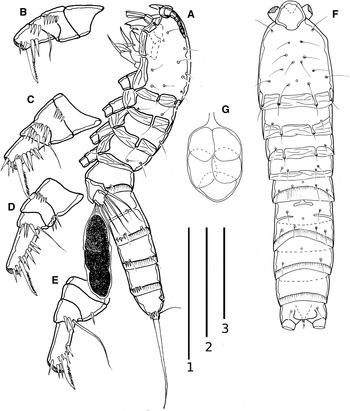
Body (Figure 1A, B) elongate, length 240 µm (measured from tip of rostrum to posterior end of telson), habitus almost cylindrical (Figure 1F) and with inconspicuous podoplean boundary between prosome and urosome (Figure 1A, B); genital double somite with a discontinuous chitinized cuticular ridge indicating a former division between somites, absent at the dorsal and ventral surfaces; free prosomites and urosomites with posterior hyaline membrane; sensilla and cuticular pores as in Figure 1A, B; telson shorter than the last urosomite, slightly tapering posteriorly, with rectangular anal operculum in dorsal view (Figure 1B) and with a strong row of spinules, laterally, near the insertion of the furca.
Archeolourinia shermani gen. et sp. nov. female, habitus in lateral (A) and dorsal views (F). Lateral view of the protopodites and first exopodite of P1 (B), P2 (C), P3 (D) and P4 (E). Ventral view of the egg sac. Scale bar 1 = 100 µm (A); scale bar 2 = 50 µm (B–E); scale bar 3 = 50 µm (F, G).

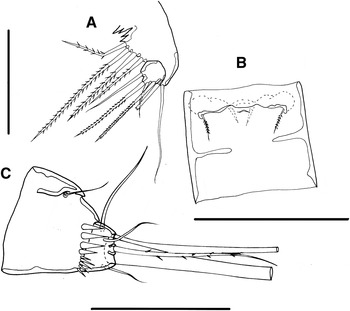
Furca (Figure 5C) short, 1.2 times broader than long without processes and with 6 setae, seta I short, seta III long, inserted in a protuberance, setae IV and V the longest, distally inserted, seta VI the shortest, seta VII long, with a socket.
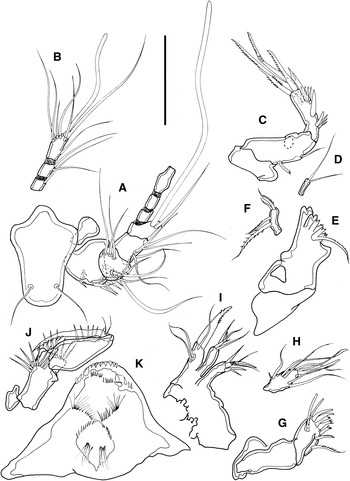
Rostrum (Figure 2A) sinusoidal and well defined at the base.
Archeolourinia shermani gen. et sp. nov. female, A1 (A, B), rostrum (A) A2 coxa, allobasis and endopod (C), A2 exopod (D), Md praecoxal arthrite and corpus mandibularis (E), Md palp (F), Mx1 praecoxal arthrite (G), Mx1 coxa, basis, enp and exp (H), Mx2 (I), Mxp (J), labrum (K). Scale bar = 50 µm.

A1 (Figure 2A, B) 7-segmented with aesthetasc on the fourth segment, 1st segment without armature and ornamented with strong spinules, 1st to 4th segments are strongly developed, 5th to 7th segments much reduced in width in comparison with the previous ones; armature as follows: 0/8/5/1 + ae/1/1/7 + ae.
A2 (Figure 2C) biramous, with indistinctly separated allobasis, with a brush-like basal seta and an abexopodal seta, exp (Figure 2D) 1-segmented with 2 setae; enp with 7 elements, 1 minute spine on the proximal inner margin, 1 larger spine medially on the inner margin and 1 transformed tryphid spine on the distal inner margin, distally with 1 serrulate seta, 2 long setae (1 geniculate) and 1 bipinate spine on the distal outer margin.
Labrum (Figure 2K) sinusoidal, ornamented distally with a row of numerous spinules-like teeth and several rows of spinules/setules on the posterior margin.
Md (Figure 2E) with a large praecoxal arthrite connecting to a strong corpus mandibularis. Md palp (Figure 2F) 1-segmented, separation between basis, exp and enp indistinct; basis with a unipinate seta and a bare small seta; exp represented by an outer bipinate seta; enp represented by a serrulate seta.
Mx1 (Figure 2G) praecoxal arthrite rectangular, apically armed with 2 blunt spines, 3 trifid spines, 2 serrulate setae on the oral margin and 2 aboral setae; coxa and basis fused (Figure 2H); coxal endite with 2 slender setae; basal endite with 2 slender setae and a long spine; enp fused to basis and represented by 2 slender setae; exp fused to the basis and represented by a short lobe armed with 1 long and slender seta and a small seta.
Mx2 (Figure 2I) syncoxa and basis fused; basis with 2 endites, 1st endite with 3 slender setae, 2 fused; 2nd endite with 3 slender setae, 1 fused; proximal endopodal segment armed with a claw like spine and a slender seta near the insertion of the spine; second endopodal segment armed with 2 slender setae.
Mxp (Figure 2J) well developed, prehensile, composed of a long syncoxa ornamented with long spinules, a long basis with long spinules along the distal margin and a 1-segmented enp armed with 2 slender setae and a strong claw like spine.
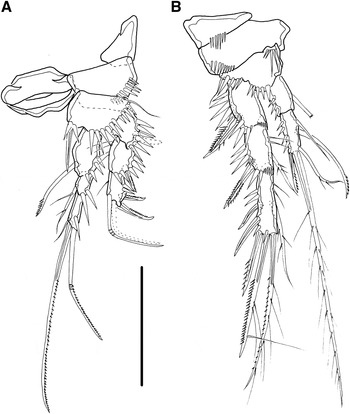
P1 (Figure 3A) intercoxal sclerite broader than long, in the shape of an irregular convex hexagon; with a large, triangular praecoxa, longer than broad; coxa with a row of strong spinules on the anterior outer margin and a row of small spinules on the posterior outer margin; basis heavily spinulated along its margins, without inner and outer spines/setae; exp 3-segmented, exp-1 and exp-2 with strong spinules along outer margin, exp-3 with 2 outer spines and 2 distal geniculate setae; enp 3-segmented, proximally of the same length of the exp, enp-1 approximately of the same length of enp-2 and enp-3 together, with a long seta on the inner margin, enp-2 the shortest, with an inner seta, enp-3 with 3 elements, 1 outer geniculate setae, 1 distal long seta and 1 inner minute seta.
Archeolourinia shermani gen. et sp. nov. female, P1 (A) and P2 (B). Scale bar = 50 µm.

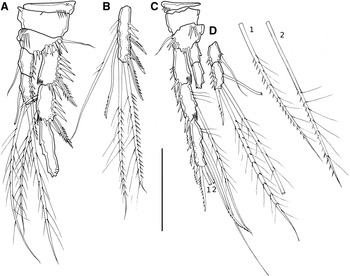
P2 to P4 (Figures 3B & 4A, B) with a large praecoxa, broader than long; P2 to P4 praecoxa with an anterior row of spinules near the outer margin; coxa large, rectangular, broader than long, with an anterior row of spinules near the outer margin of P2, not ornate in P3 and P4; basis with an outer seta, a row of strong spinules along outer and medial margin and an anterior row of strong spinules, near the inner margin. Exp-3 segmented; exp-2 of P2 with a short setae, approximately as long as exp-2; exp-2 seta longer in P3 and P4, approximately as long as the whole exp; distalmost inner seta of exp-3 of P3 and P4 distally modified (strongly serrulate). Enp of P2 to P4 2-segmented; enp-1 with inner seta, modified, with brush tip in P2; enp-2 with a serrulate seta at the distal inner margin of P2; with a brush-like seta on the inner margin of P3 and P4.
Archeolourinia shermani gen. et sp. nov. female, P3 (A), P3 exp-3 (B), P4 (C), P4 enp-1-2 (D), distal setae of exp-3 of P4 (1, 2). Scale bar = 50 µm.

Armature of P1-4 is as follows:

P5 (Figure 5A) basendopod well developed, with an outer seta, fused and with two processes on each side, at the midline; with 4 bipinate setae (refered as 1 to 4 from the inner to the outer margin), setae 1 and 4 are the smallest, 2 and 3 the longest, 2 the longer. Exp well developed, 1-segmented, approximately as long as broad, with 5 setae (referred as 1 to 5 from the inner to the outer margin); seta 1 bare and small, seta 2 and 4 bipinate and longer, seta 3 the shortest, naked, seta 5 long (broken), inserting in an outer lobe.
Archeolourinia shermani gen. et sp. nov. female, P5 (A), P6 and genital field (B), telson with furca (C). Scale bar = 50 µm.

P6 and genital field (Figure 5B) located at the proximal margin of the genital double somite, P6 represented by an opercular plate armed with a single small and bipinate seta on each side; copulatory pore medially located, genital slits set wide apart. Eggs retained in a single ventral egg sac (Figure 1 A, G).
DISCUSSION
The family Louriniidae is a poorly known and enigmatic taxon with an unclear phylogenetic relationship within the canthocamptid-like harpacticoids. Up to this date, the family was represented by a single species, Lourinia armata (Claus, 1866); although two species (Lourinia aculeata (Thompson I.C. & Scott A., 1903) and Lourinia nicobarica (Sewell, 1940)) and three subspecies (Lourinia armata major (Sewell, 1940), Lourinia armata minor (Sewell, 1940) and Lourinia armata sulamericana Jakobi, Reference Jakobi1954), now considered direct child taxa, have been proposed to belong to this family in the past.
The new genus and species described here can be easily assigned to the family Louriniidae on the basis of the following characters that we consider synapomorphic to the family: (a) rostrum well-developed with rounded tip; (b) A1 of female 7-segmented; (c) A2 with separate coxa and allobasis armed with an outer spine; (d) A2 enp with at least 5 strongly developed elements; (e) Md with well-developed gnathobasis, Md palp reduced; (f) Mx1 with well-developed praecoxal arthrite bearing about 6 distal elements, enp and exp absent; (g) Mx2 with two basal endites, enp-1 drawn into a strong claw, enp-2 represented by 3 setae; (h) P2 to P4 typically with 2 segmented enp; (i) P5 benp of female confluent, intercoxal sclerite absent, exp 1-segmented; (j) eggs retained in a single ventral egg sac; (k) body cylindrical with inconspicuous podoplean boundary; (l) telson shorter than the last urosomite, slightly tapering posteriorly; and (m) furca short and with 6 setae. Also remarkable is the presence of modified setae with brush-like or serrulate tip at the same position in different limbs such as P1 enp-1, P2 enp-1 and enp-2, P3 and P4 enp-2.
Archeolourinia shermani gen. et sp. nov. differs from Lourinia armata by the presence of a Md palp with fewer elements, totalling 2 distal setae and a vestigial enp represented by 2 setae; Mx1 basal endite with 2 setae, coxal endite with 3 setae; Mxp well developed, prehensile, composed of a long syncoxa ornamented with long spinules, a long basis with long spinules along the distal margin and a 1-segmented enp armed with 2 slender setae and a strong claw like spine; P1 enp 3-segmented, distal endopodal segment without the predominantly strong distally inserted spine that in Archeolourinia shermani gen. et sp. nov. is probably represented by the longest spine; benp of P5 of female with 4 long setae, exp with 5 setae. Additionally, P3 enp-2 of Archeolourinia shermani gen. et sp. nov. is less armed than in Lourinia armata and the exp-3 has an additional inner setae in P3 and P4.
Considering that the diagnosis for the family Louriniidae is the same diagnosis proposed for the type species Lourinia armata, in order to accommodate Archeolourinia shermani gen. et sp. nov. within Louriniidae, here we offer an amended diagnosis to the family.
Louriniidae
AMENDED DIAGNOSIS
Copepoda Harpacticoida. Body elongate, almost cylindrical and with inconspicuous podoplean boundary between prosome and urosome in lateral view; genital double somite with a discontinuous chitinized cuticular ridge indicating a former division between somites, absent at the dorsal and ventral surfaces; telson shorter than the last urosomite, slightly tapering posteriorly, furca short or cylindrical, with 6 setae; A1 of female 7-segmented with aesthetasc on the fourth segment, 1st segment without armature and ornamented with strong spinules, 1st to 4th segments are strongly developed, 5th to 7th segments much reduced in width in comparison with the previous ones; A2 biramous, with a basal seta or tiny spine, exp 1-segmented with 2 setae; enp turned outwards in lateral view, with 7 elements (at least 5 transformed spines); rostrum sinusoidal, well defined at the base; Md with well-developed gnathobasis, Md palp reduced, Mx1 praecoxal endite with about 6 distal elements, enp and exp vestigial, represented by few setae; Mx2 enp-2 vestigial and represented by 3 setae; Mxp vestigial or prehensile; P1 to P4 exp 3-segmented; P1 enp 2 or 3-segmented, 1st segment with a modified inner seta; P2, P3 and P4 with 2-segmented enp with inner seta on the 1st segment. Modified setae or spines consistently appearing on enp-1 of P1 and enp-1 and 2 of P2, P3 and P4. Male P3 enp with inner apophysis on the enp-2. Male P5 benp confluent, exp and benp fused. Eggs retained in a single ventral egg sac.
Phylogenetic remarks
The phylogenetic position of Louriniidae has been debated in the past. Monard (Reference Monard1927), following the discussion about the taxonomic composition and the phylogenetic position of the Cylindropsyllidae Sars, 1909, established the section Agnatha to accommodate the families Metidae Lang, Reference Lang1948, Darcythompsoniidae Lang, Reference Lang1936 and Louriniidae on the basis of the reduced or absent Mxp. In accordance to Monard (Reference Monard1927), only those genera with reduced Mxp could be included within the Cylindropsyllidae. This arrangement was strongly criticized by Lang (Reference Lang1936) who considered the loss of Mxp a convergent character. Additionally, Lang (Reference Lang1948) commented on the close similarity of Louriniidae with Cylindropsyllidae and namely with the Canthocamptidae Brady, 1880.
However, it is remarkable how many similarities can be enumerated between Darcythompsoniidae and the family Louriniidae. Any taxonomic conclusions are still too speculative, but it is worth mentioning that both families retain a similar body structure and a very similar female A1, A2, a high level of congruence of the armature of Md, Mx1 and Mx2, a tendency to the reduction of the Mxp and a high level of congruence concerning the armature of P1 to P4. It is especially notable how similar are Louriniidae and the genus Leptocaris Scott, 1899, the most basal species within Darcythompsoniidae in accordance to our ongoing study. These taxa share the same structure of female A1 with 1st segment without armature and ornamented with strong spinules, 1st to 4th segments are strongly developed, 5th to 7th segments much reduced in width in comparison with the previous ones. Additionally, in both taxa modified setae occur at more or less the same positions in P2 to P4.
It is well known that among the canthocamptid-like harpacticoids, such as the Louriniidae, the enp of the P3 of males may develop an apophysis that differs in high degree among species, genera and families. In fact, within some families or in an entire family, this apophysis cannot be formed (ex: in the Darcythompsoniidae, the sexual dimorphism can occur in one or more enp of the P2 to P4, but never an apophysis is formed in the enp of P3). This is a clear exception to the above-mentioned pattern, but it seems to be a consensus that the Darcythompsoniidae belong to the canthocamptid-like harpacticoids.
It would be premature to make any assumptions on the phylogenetic position of Louriniidae, but the condition of the Louriniidae as the sister group of Darcythompsoniidae should be tested in future phylogenetic studies. An alternative is that similar structures convergently evolved in Louriniidae and Darcythompsoniidae, adapting to similar habitats in shallow waters and associated with phytal substrata or decaying leaves (viz. Boxshall & Halsey, Reference Boxshall and Halsey2004).
Remarks on the ecology and distribution
There has been limited information on the ecology and distribution of Louriniidae. Most louriniidids have been collected from shallow benthic samples or washings of algae mainly from tropical and subtropical areas of the Indo-Pacific and Mediterranean (Lang, Reference Lang1948; Vervoort, Reference Vervoort1964). An exception is the reported Lourinia armata from the Korean peninsula (Yoo & Lee, Reference Yoo and Lee1993). In the Atlantic, Louriniidae have been reported from Tenerife (Noodt, Reference Noodt1955), Bermuda (Coull & Herman, Reference Coull and Herman1970) and Brazil (Jakobi, Reference Jakobi1954), all from shallow waters. Archeolourinia shermani gen. et sp. nov. was collected from substrata dominated by the scleractinian corals Agaricia spp. at 67 m depth, which was unexpected given the previous reports. Adaptation to different depths suggests ecological differences. All louriniids are characterized by a Mxp reduced to a small lobe and a seta except for A. shermani gen. et sp. nov. which bears a prehensile Mxp. This morphological difference indicates major differences in the feeding behaviour and ecology of A. shermani gen. et sp. nov. compared to the previously reported louriniids reinforcing the designation of a new genus to accommodate this species.
ACKNOWLEDGEMENTS
We thank the University of Puerto Rico, Mayagüez (UPRM), Department of Marine Sciences Diving Team: Ivonne Bejarano, Milton Carlo, Michael Nemeth, Hector Ruiz and Clark Sherman, for the collection of mesophotic samples. Funding was provided from the US National Oceanic and Atmospheric Administration's Center for Sponsored Coastal Ocean Research (Award No. NA06NOS4780190) to the Caribbean Coral Reef Institute of UPRM. The present manuscript was inspired by a short visit of the first author to UPRM sponsored by CCRI-DMS.