Introduction
On September 19, 2005, chiefs throughout Zimbabwe hosted a government-sponsored National Bira Ceremony to bring communities together in the name of national unity under the spiritual authority of President Robert Mugabe’s Zimbabwe African National Union-Patriotic Front (ZANU-PF) government. The bira is a Shona ceremony of ancestral spirit possession typically accompanied by either mbira music or drumming. The call for a National Bira was an official attempt to recapture the spiritual approval that legitimized the Second Chimurenga (the war that led to Zimbabwe’s independence and majority rule in 1980) and employ indigenous music to do so. This bira was also reminiscent of the pungwe, an all-night event of recruitment and indoctrination during the Second Chimurenga that was, in the words of Kennedy Chinyowa, “a bira in disguise” (Reference Chinyowa and Vambe2001:14).
As acting headman in Muzite in the Chipinge District near the Mozambique border, Rodwell Muzite didn’t have the authority to host a bira, but as perhaps the only area leader who publicly supported Robert Mugabe and ZANU-PF, he met no official resistance. That afternoon, hundreds of Muzite residents met at the headman’s home, ate and drank homebrewed beer, and watched the best local muchongoyo team, Muzite Mukuyu, which was guaranteed to elicit an enthusiastic response. Muchongoyo is a presentational dance/drumming genre highlighting sequences of stomps and acrobatics to impress audiences at communal events or competitions. It is the most popular Ndau dance in Zimbabwe. Footnote 1 I attended the event with the former headman, Vhukani Muzite, who was my guide to local politics and history.
It was an enjoyable if strange event. For the Ndau in Muzite, there is no such thing as a bira and no communal ancestral ceremony; thus the foreign nature of the bira, combined with antipathy in the community toward Robert Mugabe, made it awkward and confusing. Few residents of the Chipinge District have ever supported Mugabe or ZANU-PF. After losing control of ZANU, the Ndau politician Ndabaningi Sithole eventually founded his own political party, Zanu-Ndonga, which drew backing exclusively from the Ndau community. Footnote 2 Despite this, the crowd at Headman Muzite’s home was enthusiastic in their enjoyment of the dancing. Their attendance and joy at a state-imposed ritual event revealed a great deal about official attitudes toward the political utility of performance, the complex presence of modernity in people’s lives, and the legacy of nationalism throughout Zimbabwe. Sabelo Ndlovu-Gatsheni (Reference Ndlovu-Gatsheni2009) uses the term “Mugabeism” to characterize the ideology and monopolization of power surrounding Mugabe’s rule in Zimbabwe during recent years, during which the government has tried to generate an indexical connection between indigenous performance practices and a Mugabeist state ideology as “a form of populist reason” (2015:16). Footnote 3 In contexts such as the Muzite bira, participants negotiated Mugabeism through muchongoyo as a performance of identity and social belonging.
Much as his official photograph gazes ubiquitously from the wall of every school and post office in the country, President Robert Mugabe’s presence looms like a shadow over musical life in Zimbabwe. Together with his long-time ruling party, ZANU-PF, Mugabe has thought a lot about music’s power to shape the way his subjects feel about Zimbabwe and its leaders and has recognized the value of performance in solidifying the outcomes and discourses most useful to him. Increasingly, “Mugabeism” has helped transform the social power and political efficacy of indigenous performances on the margins of Zimbabwean life. In the aftermath of the Second Chimurenga, the increasing sedimentation of modernity and cosmopolitanism, and the instability of recent political and economic turmoil, the meaning of the indigenous has been contested and reconsidered.
In this article, I explore the influence of nationalism and modernity in the performing lives of contemporary Zimbabweans through muchongoyo. In particular, I address modernity’s impact in the context of Mugabeism on shifts in the presence, purpose, and performance of muchongoyo in multiple contexts in rural Chipinge and urban Harare. As the signature Ndau dance, muchongoyo has become many things to many people, redefined and reimagined through two interconnected discursive paradigms surrounding ideas of nationalism and modernity that increasingly define muchongoyo for twenty-first-century Zimbabwe. ZANU-PF’s employment of indigenous performance in the name of an intransigent and Shona-defined nationalism has changed the way many young Zimbabweans think about indigeneity. These discourses of nationalism overlap with new ideas, expectations, and aspirations of modernity, and have collectively made indigenous practices an uncomfortable option for Zimbabweans who are upwardly mobile and outwardly focused (Perman Reference Perman2012). Thus class significantly informs individual responses to modernity and nationalism.
This article explicitly critiques the common binary opposing tradition and modernity—ideas that need each other to mean anything. Authorities often employ indigenous performance practices to connect associated localities and precolonial authority to their vision of the nation. Footnote 4 In the process, local dances can stray from their original meanings and additional versions emerge. Muchongoyo, in this way, has become increasingly detached from its roots, generating a semiotic insecurity analogous to the “schizophonia” identified by Schafer (1997) and Feld (Reference Feld, Keil and Feld1994) in respect to recorded music. As Ana Maria Ochoa observed more recently, “once a musical object is separated from its original context it enters a realm of symbolic interpretation that can be highly ambiguous” (2012:399). This state might also be called “semiotic ambiguity,” a condition in which the connection of a sign (as in performance) to the object it represents is either difficult to determine or to agree upon. In this case, as muchongoyo has traveled beyond its origins in poor, rural Chipinge to urban Harare, it has been adapted to nationalist expectations, and its meaning has become ambiguous as Mugabeism informs the context through which superficially similar steps are manipulated, reinterpreted, and potentially transformed. While muchongoyo has long served as a source of strength, solidarity, and collective resilience, its efficacy is increasingly compromised by the realities of twenty-first-century Zimbabwe. Footnote 5 Colonial history, war, and postcolonial politics have slowly modified the perceived associations in local performances. Thus the semiotics of sound and movement shift, shaped as much by the ambiguities and ephemera of experience as by static political and ideological institutions.
Ndau Muchongoyo and the Legacy of Occupation
The implications of so-called schizophonia and semiotic ambiguity become particularly interesting in the case of muchongoyo, the most widespread and well-known drumming, dance, and song genre in Zimbabwe’s Ndau communities, who live along the Mozambique border. Performed at celebrations and competitions, muchongoyo has served as a source of strength and empowerment since it emerged in the nineteenth century. Yet while muchongoyo remains locally vibrant and resilient, it is gradually being transformed, like many of Zimbabwe’s other expressive practices, in the turbulence of contemporary Zimbabwe. The political unrest accompanying ZANU-PF’s longstanding rule, Shona nationalism, Zimbabwe’s ever-worsening economic degradation, and the expanding shadow of modernity have collectively reshaped muchongoyo’s efficacy and potential, but these transformations often go unrecognized in the coding of these expressive practices as part of “traditional” culture. As Stuart Hall cautions, “Time and again, what we are really looking at is the active destruction of particular ways of life, and their transformation into something new” (Reference Hall and Samuel1981:227). During recent years, economic conditions, political tensions, and the state have redefined many practices like muchongoyo.
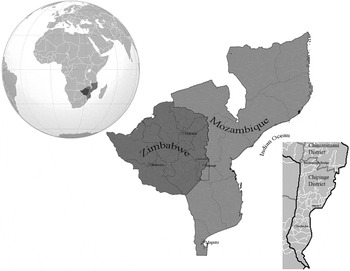
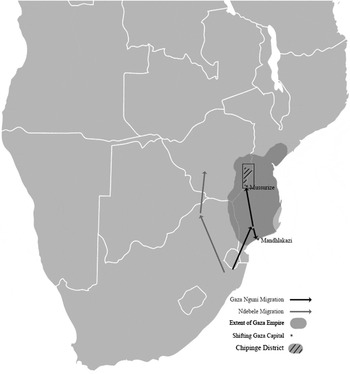
Despite the official status of the Ndau language as a dialect of Shona and of Ndau speakers as a subgroup of the dominant Shona ethnicity, Zimbabweans who identify as Ndau have rarely understood themselves as Shona (MacGonagle Reference MacGonagle2007; Perman Reference Perman2008). Most Ndau have never identified with President Mugabe or the rest of Zimbabwe’s Shona leadership and have resented Mugabe ever since he wrested control of ZANU from Chipinge’s Ndabaningi Sithole during the height of the war for independence from colonialism and white rule in 1974 (see figure 1). Footnote 6 Thus they have long been marginalized politically. While Ndau as an identity framework and a community is neither homogenous nor monolithic, much of what is shared as an Ndau identity and distinguishes Ndau from the neighboring Shona emerged during political turmoil in the nineteenth century stemming from what is now South Africa (Cobbing Reference Cobbing1988). In 1816 a local chief’s son, Shaka kaSenzangakhona (also known as Shaka Zulu), came to power in the south (Omer-Cooper Reference Omer-Cooper1966), unified the Zulu, and drove the vanquished armies of the region into what is now Mozambique and Zimbabwe (and elsewhere). This historical moment is commonly referred to as the Mfecane (see figure 2). One general, Soshangane, fled north with his Gaza-Nguni armies, and ruled over a broad swath of southeastern Africa. The Chipinge District remained under Gaza-Nguni authority from their arrival in the 1820s until it was conquered by the Portuguese in 1895 (MacGonagle Reference MacGonagle2007), a development that irrevocably altered Ndau language, religious beliefs, political structure, and performance life. But for most of the nineteenth century Ndau communities were subjects of the broad Gaza-Nguni Empire, and practices of older Chipinge residents—their pierced ears, totemic surnames, spiritual interlocutors, and sociopolitical structure—still reflect the Gaza-Nguni legacy (Liesegang Reference Liesegang1975; Rennie Reference Rennie and Schoffeleers1978; MacGonagle Reference MacGonagle2007). Ultimately, this experience of outside tyranny came to define the Ndau, both for themselves and others, even before the imposition of colonial rule by the British and the Portuguese.
The Chipinge District in Zimbabwe

Gaza-Nguni Migration North during the Mfecane
Sources: Liesegang (1970, Reference Liesegang1975); MacGonagle (Reference MacGonagle2007)

This historical moment also led to the emergence of the dance practice known as muchongoyo. Gaza-Nguni soldiers had used military dances to train and recruit new Ndau soldiers into their growing army, and not always by choice. Footnote 7 Contemporary muchongoyo evolved from the Gaza-Nguni model and shares features with related dances in Mozambique, South Africa, and Swaziland, including stomping, acrobatics, primarily duple rhythms, attire (leggings, skirts, and headgear), and a focus on competition. The recruiting dances of these imperial invaders became muchongoyo and accrued new meanings tied to collective celebration and the strength of shared Ndau identities. Thus muchongoyo needs to be viewed not only in the context of local Ndau communities, but also in the context of broader southern African communities and historical legacies (Moyana Reference Moyana1976; Meintjes Reference Meintjes2004; Perman Reference Perman2008). Importantly, as with many regional dances, muchongoyo emerged as the product of outside occupation.
Muzite Mukuyu’s performance at the Muzite bira highlighted the acrobatics, precision, and strength that define muchongoyo in Ndau-speaking Zimbabwe. While there is no single muchongoyo—since tempo, gestures, instrumentation, and preferred rhythms shift as one moves through the Ndau homeland—much is shared. Whether the dance is performed during celebrations or competitions, muchongoyo “teams” (the preferred term, rather than “ensemble” or “troupe”) perform a series of subgenres in a suitelike sequence. Muchongoyo has become a key marker of Ndau identity, ubiquitous at weddings, political events, competitions, and homecomings and used to publicly assert and collectively perform a shared sense of identity (Perman Reference Perman2010). Muchongoyo’s importance increased when it became the primary means of celebrating a worker’s return after months of work abroad in South Africa.
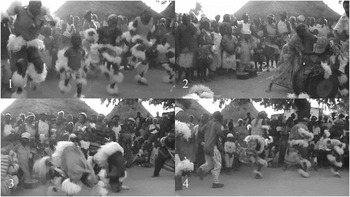
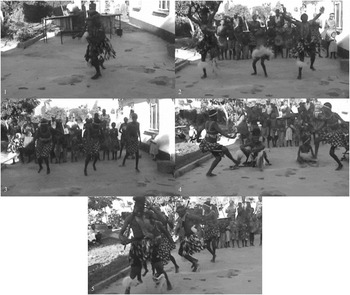
As they played at Headman Muzite’s home, the dancers of Muzite Mukuyu lined up in the typical formation, with women singing in a line at the back and two drummers in the center playing a series of duple rhythmic sequences that were tightly coordinated to the steps of the male dancers in front. The word muchongoyo derives from an Ndau verb meaning to stamp one’s feet, and it is defined by this movement, the precise execution of which appeals to judges, dancers, and audience members alike. The more precise the collective stomps, the more enthusiastic the people’s response. Their dancing at the headman’s home was fast and the drumming virtuosic, and the dancers’ aggressive steps were intricately timed so that they executed all the stomps in unison (see image 1 of figure 3), often joined by a man from the crowd (see the end of the line in image 4 of figure 3). Multiple subgenres from the muchongoyo sequence were performed, with the dancers falling to the ground at the end of each to mark a break. In these moments, the women (who never danced) would ululate and mop the brows of the fallen dancers in appreciation (image 2 of figure 3). Some of the dances included tumbling (image 3 of figure 3) or the characteristic “snaking” movement (kukakadhiriza) (image 4 of figure 3). All of them exhibited the speed, precision, and power that make muchongoyo such a popular art form. And indeed, muchongoyo is intended to impress. It is a form that capitalizes on athleticism, precision, and virtuosity to elicit enthusiastic response and achieve competitive success. During competition, teams perform a prescribed series of dances within a certain time limit for money and glory. At Headman Muzite’s, Muzite Mukuyu showed why they are so successful at local competitions, thrilling those of us in attendance with their aggression, athleticism, and coordination.
Muzite Mukuyu Exhibiting a Stomp, Acrobatics, and Kukakadhiriza

At their best, these performed exhibitions of strength and precision also allow participants to celebrate their collective unity and power. Muchongoyo is important precisely because it is not only competitive but also celebratory, demonstrating collective strength. In the twenty-first century, muchongoyo is a source of tangible pride that inspires resilience and hope. Although I do not wish to exaggerate the social value of this enjoyable leisure activity, its purpose is overt. The performance is intended to express and demonstrate specific social values: strength, cooperation, and pride. Coordinated footwork connects to social coherence. Mistimed steps are criticized for “disagreeing” (kupesana). Powerful stomps are defined and celebrated for their energy. Locals metonymically identify themselves with the moves of their local teams (saying things such as “we are strong” or “we won”).
Muchongoyo also teaches Ndau youth about communal values, offering them discipline and pride of team membership, and even helping train young boys and girls in how to become proper Ndau men and women. While women do dance muchongoyo, they do so far less frequently than men do. During one dance that the Muzite Primary School performed at a competition near Birchenough Bridge in August 2004, the boys stomped with bravado and acrobatic enthusiasm as two girls stood to the side shuffling quietly and demurely holding their hand up to the side of their head. This was one of the few moments during the performance in which the girls left their place singing in the back to join the dancing in the front. During those rare scripted moments when girls dance with the boys, the differences in their expression are marked and deliberate, intended to prepare them for the social responsibilities they will have as adults. Only when they become mothers themselves can they start to assert their own feminine strength. As the boys finished and fell conclusively to the ground, the girls looked down shyly and shuffled modestly back to their place with the other girls.
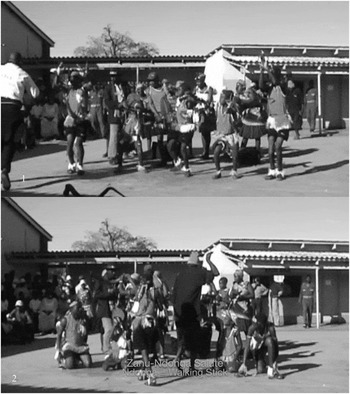
Muchongoyo performances also offer occasional opportunities for statements of political partisanship, even if these are expressed subtlely. In 2005 I witnessed a performance of the Mahachi Dance Team during a competition at the Zineku beerhall, owned by a local politician in Checheche in the lowlands of the Chipinge District. The owner of the venue represented the Ndau-centric opposition party, Zanu-Ndonga, and within the safe space of his beerhall audience members wore Zanu-Ndonga T-shirts and even incorporated the Zanu-Ndonga salute into the performance (see image 2 of figure 4). Zanu-Ndonga was a vibrant, extremely local opposition force in the Ndau region until Sithole’s death in 2000 and remains marginally popular within the Ndau community. Although not every Checheche local supports Zanu-Ndonga, and ZANU-PF has held the local parliamentary seat for several years, moments like these are rare opportunities to express collective joy, resilience, and solidarity within the context of a rapidly devolving Zimbabwe in which the Ndau rural poor generally feel marginalized and disempowered. At this event audience members expressed joy and pride by throwing money at the dancers’ feet during breaks in the action, wiping dancers’ brows (just as women did at the Muzite bira), and even giving young dancers the hats off their heads. They ran onto the dance floor to connect themselves (indexically) to the beauty of the dance, defined by the speed, precision, and strength of the young men’s movements. Much as Mahachi’s energy, skill, tight coordination, and precision (as evidenced by the unison stomp in image 1 of figure 4) earned them a victory in the competition (see Perman Reference Perman2010), the enthusiasm of the audience influenced the judges and contributed directly to their success.
Mahachi Dance Team

Muchongoyo’s value in generating feelings of solidarity makes sense given its roots in the military dances of the Gaza occupiers. It is a dance defined by strength that partially defines the Ndau. In good dancing, individual expression and virtuosity are accommodated, but they are embedded within the needs of a team. Muchongoyo’s importance as a shared performance during periods of struggle has long been a defining feature. Ndau elders like Mpondi Mhlanga connect their dancing to the years of Gaza-Nguni rule and the struggle to overcome it (interview, Muzite, Sept. 30, 2005). But in many ways the overt benefits of strength, solidarity, and socialization that have accompanied muchongoyo are now under threat, and for many dancers and listeners the surface rhythms, words, and dance steps have become detached from their historical antecedents and communal values. As Robert Mugabe and ZANU-PF have responded to the political and economic challenges of the twenty-first century, they have relied on indigenous music and dance to bolster their ideological ambitions, and postindependence nationalism and modernity have brought about a reinterpretation of these performance practices.
Shona Nationalism, Mugabeism, and Multiple Chimurengas
Robert Mugabe has ruled Zimbabwe since independence in 1980, first as prime minister and then as president. Although praised initially for helping achieve Zimbabwe’s hard-fought freedom and for some surprising gestures toward racial and political reconciliation, he has always ruled with a tenacity unforgiving of opposition. Footnote 8 After twenty years of optimism and hope, the twenty-first century has been marked by economic degradation, ZANU-PF–led totalitarianism, and a consistent crackdown on political opposition.
Sabelo Ndlovu-Gatsheni (Reference Ndlovu-Gatsheni2009) characterizes the ideology and monopolization of power surrounding Mugabe’s rule in Zimbabwe during recent years as “Mugabeism,” a term that expresses the metonymic relationship between Mugabe and the structures of power in contemporary Zimbabwe. Mugabeism, he says, “took a cultural perspective involving a hegemonic programme that included the appropriation of history, traditions, liberation songs, departed heroes, pan-Africanism, ideas of African authenticity and popular music” (2009:1150). As Moses Chikowero points out, “a related front in this consensus-building process was the propagation of a quasi-religious cult around Mugabe as Zimbabwe’s ‘chosen’ leader, as Tambaoga sang in ‘Agrimende’” (2011:13). Similarly, the performed meanings of muchongoyo have become shaped partially by the cultural perspective supporting Mugabeism’s hegemonic project.
Specifically, as local values have shifted in response to political and economic change over the past several decades, the expressive practices that articulate and embody those values have shifted as well. As Ndlovu-Gatsheni suggests, “Mugabeism drifted increasingly into ‘cultural nationalism’ at a time of serious social discord characterized by the unprecedented economic and political crises of the late 1990s and 2000s” (2009:1154). While every actor participates in these shifting expressions of shared value, Mugabeist ideology has influenced how indigenous performance practices like muchongoyo are now situated in Zimbabwean life. Footnote 9
President Mugabe’s engagement with music and dance began with his involvement in the early nationalism of colonial Zimbabwe in the 1960s as the publicity secretary of the National Democratic Party (NDP). As politicians were beginning to recognize the importance of generating a mass movement and acquiring local support and consent, Mugabe was one of the first to employ music and dance in the service of nationalist ideology and feelings of national sentiment. Zimbabwe’s first minister of information, Nathan Shamuyarira, says that once Mugabe was brought in, “thudding drums, ululation by women dressed in national costumes, and ancestral prayers began to feature at meetings more prominently than before” (Reference Shamuyarira1965:68). Nationalist rallies began to include regional dances as indices of the numerous social groups incorporated within Zimbabwe (Turino Reference Turino2000), and musical performance played an important role during Zimbabwe’s war for independence, the Second Chimurenga. Thus Mugabe had a profound grasp of the important role of performance as Zimbabwe emerged from its colonial experience, and music and dance have been incorporated into his governance. Once Zimbabwe began its descent into the quagmire of the early twenty-first century, ZANU-PF and Mugabe relied more and more on music to inspire consent, though with varying degrees of success.
Chimurenga means struggle. During the Second Chimurenga in the 1960s and 1970s, ZANU and its armed wing, ZANLA, rewrote indigenous songs and makwaya pieces with revolutionary lyrics for recruitment and education (Turino Reference Turino2000), often referencing the imagery and heroes of the First Chimurenga in 1896. Footnote 10 These were ubiquitous during the war and became celebrated as “The Songs That Won the Liberation War” after independence in 1980 (Pongweni Reference Pongweni1982). Anxious to replicate the success of these songs, Mugabe’s government has spent millions of dollars commissioning and endlessly broadcasting jingles that similarly exploit icons of indigenous music and indices of ancestral spirituality to advance Mugabe’s vision for twenty-first-century Zimbabwe (Chikowero Reference Chikowero, Ndlovu-Gatsheni and Muzondidya2011). Based on pride in the First Chimurenga and the success of the Second Chimurenga, Mugabe and others call his fight to realize this vision the Third Chimurenga.
The central pillar of the Third Chimurenga is land reform. While land reform was initiated by rural villagers near Marondera, disgruntled war veterans and others began invading commercial farms (primarily white-owned) at the turn of the twenty-first century (Raftopoulos Reference Raftopoulos, Raftopoulos and Mlambo2009). After the invasions earned the support of the ZANU-PF government, many occupied farms were redistributed to political allies and the local black majority. Fast-track land reform was intended to right the obvious historical wrongs, neglected since independence, through which white landowners enjoyed most of Zimbabwe’s rich farmland. But while the redistribution of Zimbabwe’s farmland may have been justified, the chaotic speed and politically fueled violence that marked land reform threw the country into economic and political depths from which it is still recovering (see Alexander Reference Alexander2006; Cliffe et al. 2011; Zamchiya Reference Zamchiya2011).
Just as nationalists used the memory of the First Chimurenga to inspire Zimbabweans to join their cause for freedom in the 1970s, Mugabe appealed to the legacy of the Second Chimurenga to defend land reform, attempting to semiotically connect the Third Chimurenga to the glories of the previous two. The First and Second Chimurengas relied on the support and guidance of spirit mediums and the semiotics of ancestral spirituality to provide legitimacy and authority to struggle. Mugabeism has tried to do the same during the Third Chimurenga. As fast-track land reform became official state policy at the turn of the millennium, Mugabe hired Jonathan Moyo to reignite ZANU-PF’s propaganda machine. Formerly a staunch critic of Mugabe, Moyo initiated ambitious state-sponsored recording projects, led ZANU-PF–friendly R&B groups, and helped initiate the aural onslaught of ZANU-PF promotional jingles. Footnote 11 As Banning Eyre suggests, musicians were pressured “to distort and transform their art from free expression to outright state propaganda” (Reference Eyre and Korpe2004:94). These recordings, known collectively as the “Chave Chimurenga” jingles (Sibanda Reference Sibanda2004), ran endlessly and were very expensive to produce. And as with Tambaoga’s recording of “Agrimende,” many of these songs employed explicitly indigenous performance indices such as the mbira, jiti drumming, or kongonya dancing (Gonye Reference Gonye2013). The mbira in particular, heard in so many of the “Chave Chimurenga” jingles, is an explicit index of ancestral authority for most Shona speakers, since it is played primarily during ancestral spirit possession ceremonies.
The National Bira Ceremony held in 2005 in Muzite was a direct result of the national government’s efforts to reclaim the spiritual authority that helped bring about independence in 1980. However, local residents in Muzite had no prior experience with bira ceremonies and had never fully embraced the political authority of President Mugabe and his ruling ZANU-PF. So why participate? For one thing, communal events and collective performance are important for the sake of social cohesion. But in a sense, attendance was simply pragmatic. Failing to participate would likely have led to unpleasant encounters with government authorities at best, and violent recrimination from soldiers, war veterans, or agents of Zimbabwe’s Central Intelligence Organization at worst. Vhukani Muzite, my host during the Muzite bira, told me with pride how the Ndau could be relied upon to attend every government function, patiently participating without drawing unwanted attention, and simply voting for someone else during elections. Many others shared similar boasts with me over the years. Their attendance kept the community together without drawing unwanted government attention. Because these Ndau communities had supported Sithole’s Zanu-Ndonga Party over ZANU-PF since independence, the government paid particular attention to local political activities during Mugabe’s reenergized push for totalitarian control in the twenty-first century.
As the economy collapsed and ZANU-PF enforcers began invading white commercial farms, the founding of the Movement for Democratic Change (MDC) in 1999 offered a welcome political alternative to many Zimbabweans. Combining the working-class base of the trade unions, led by Morgan Tsvangirai, with the intelligentsia, led by Welshman Ncube, the MDC became the political destination for everyone opposed to Robert Mugabe and his violent form of Shona-based nationalism. Footnote 12 As such, the MDC distanced itself from Zimbabwe’s recent socialist past, ZANU-PF’s overt reliance on a “traditional” rural support network, and the isolationist approach inherent in Mugabe’s foreign policies. The MDC quickly gained wide support. It was the first viable alternative to Mugabe’s ZANU-PF that offered the possibility of success, however unlikely, and filled the political void as the economy collapsed and ZANU-PF enforcers began invading white commercial farms. For Ndau residents of Chipinge, it also offered a potential alternative for locals frustrated with the increasing impotence of Zanu-Ndonga. For people like my friend Duma, a local internet entrepreneur, as with most urban Zimbabweans, the MDC became the “modern” Zimbabwean political party (personal communication). Footnote 13
Modernity and Muchongoyo
As with everyone caught in the wake of colonialism, Zimbabweans have had to struggle with the challenges of modernity. For many, modernity (as an idea and an experience) is closely connected to the West, capitalism, progress, and the pursuit of financial well-being. For Mugabe and ZANU-PF, modernity is the byproduct of British colonialism and continued Western imperialism. So despite his love for Saville Row suits and connection to global Catholicism, Mugabe paints the MDC as the puppet of meddling Western powers and the engine of Great Britain’s new imperialist desires (Ndlovu-Gatsheni Reference Ndlovu-Gatsheni2009). Mugabe’s us–them rhetoric of the Third Chimurenga deliberately relies on a series of familiar dichotomies in an effort to control the discourse of local identity, history, and political authority, posing tradition, socialism, freedom, and Africa (on his side) against modernism, capitalism, imperialism, and the West (on the other). According to Ndlovu-Gatsheni, “Mugabe began to divide Zimbabweans into traitors, puppets, sell-outs, enemies of the nation versus patriots and authentic national subjects” (2009:1140).
The word modernity is complicated here, and there is a central tension at play between two separate, but closely intertwined, discourses of modernity. To paraphrase Jonathan Sterne (2003), when I use the word modern as an anthropologically trained ethnomusicologist, I do not mean quite the same thing as residents of Chipinge; modernity is now at large (Appadurai Reference Appadurai1996). On the one hand, as a discursive category it typically refers to a set of values and institutions organized along ideals of progress and newness transferred around the world through the colonial project that both shapes and is shaped by the conditions it describes. Many ethnographers, however, resist using the notion of modernity as a theoretical tool and are critical of it as a means of analysis (Turino Reference Turino2000).
On the other hand, modernity is also a term within a local Zimbabwean discourse referring to the same set of issues, but more functionally and less critically. Within the unique conditions of colonial and postcolonial Zimbabwe, the terms, premises, and logics of modernity have become locally specific, and in Zimbabwean conversations the modern and the traditional operate in opposition. Tradition is defined as culture, with clear links to a precolonial past. Modernity opposes the precolonial past and shapes aspirations of a postcolonial future. Thus “culture” and “tradition” are often referred to interchangeably in Zimbabwe, in opposition to modernity. Although it may be appropriate to deconstruct ideas of tradition and modernity, they continue to operate formatively in many people’s lives; they have become the discursive tools with which many Zimbabweans organize the complexity of contemporary life and express their own aspirations and desires for class mobility. In 2001 I asked Isaiah Magugula, a government official in Bulawayo, about the nature of popular music there. He began his response by saying, “some now is more modern than culture,” succinctly capturing the historical binaries embedded within these loaded terms; “modern culture” has become a contradiction in terms.
It requires a delicate balance to acknowledge the influence of the local discourse while also avoiding a reification of accompanying problematic binaries and teleologies. Tradition and modernity operate in tandem, but they are commonly opposed in conversations among Ndau youth who, through a combination of personal choice and socialization, have to find their way through the morass of contemporary Zimbabwe, as well as the confusing local politics of ZANU-PF, Zanu-Ndonga, and the MDC, to decide for themselves the best direction for their lives.
These days, in a Zimbabwe defined by the intersecting impact of Mugabeist nationalism and modernity, there are two muchongoyos. Both are valid, and neither is more or less authentic than the other, but they adhere to different values, expectations, and desires. One, as I’ve described, resides in the poor, rural margins of Ndau-speaking Zimbabwe. This is the muchongoyo of rural elders who reject Mugabeism’s narrow and strident vision of Zimbabwean nationalism and maintain a loyalty to their collective heritage and sense of shared identity. This muchongoyo still exists and thrives in many forms throughout the Ndau region of southeastern Zimbabwe; it is performed by all ages in a range of contexts, its vibrancy undiminished by Zimbabwe’s recent struggles. But it is confined to the Ndau homeland and is absent from the national imaginary, ignored because of geographical distance, past political infidelities, and personal grudges. Thus this version has much less power in terms of the national discourse. Its vibrancy is muted by the marginal position of local actors.
On the national stage, near centers of power, it has been replaced, like many rural dances, by a second version, a newer, nation-friendly muchongoyo adopted by and authentic to performers who identify with a more modern, multicultural Zimbabwe. This version was originally shaped by the National Dance Company (NDC), which was formed after independence to continue using dance to generate feelings of national belonging (Welsh-Asante Reference Welsh Asante2000; Turino Reference Turino2000). Tradition in this version has been leveraged for political ends and turned into something new, reimagined along national lines within a “Mugabeist” modernity.
Muchongoyo was one of the original dances included within the NDC’s canon, taught by Enos Simango. The NDC explicitly tried to update and even improve local dances; it modernized the traditional (Turino Reference Turino2000). Just as Simango did with muchongoyo, other teachers from different regions of the country were brought in to teach their specific dance, and foreign choreographers were brought in to prepare these dances for the stage. The NDC dancers who brought this second form of muchongoyo to the world were not Ndau; they were young dancers from Harare trained by the company. Once the NDC disbanded in the early 1990s these dancers started their own companies, perpetuating the NDC model. The government continues to hire these groups for Heroes’ Day celebrations, Independence Day celebrations, and other official events, essentially outsourcing the former role of the NDC to its descendants.
One successful example is the dance group Mhembero, led by Irene Chigamba in Harare. Footnote 14 This company has been one of the leading dance ensembles in Harare for years, benefiting from Chigamba’s experience with the NDC and the contributions of generations of the multitalented Chigamba family. I have attended numerous Mhembero performances sponsored by the ZANU-PF government. These shows rely on marimba performance and include all the standards of the new urban dance canon, including mbira, jerusarema, mhande, mbakumba, muchongoyo, and other regional dances.
Mhembero’s muchongoyo has some key differences from the Chipinge version. Many of the subtleties and indices that mark success and skill within rural communities have been removed. Typically, when Mhembero begins to perform muchongoyo, one male dancer leaps to the stage and enacts an unaccompanied theatrical interpretation of a crouching soldier or hunter. At the drum’s cue, boys and girls in the back begin to sing. Then three boys move to the front and dance. Their version, based on the one taught by Enos Simango (and derived from his hometown of Bangwe, in the Chipinge lowlands) is slower than that of Muzite Mukuyu or the Mahachi Dance Team. It is also performed as a single dance, as opposed to the more usual Chipinge “suite” that moves through a series of related but distinct dances with different rhythms, tempos, and steps.
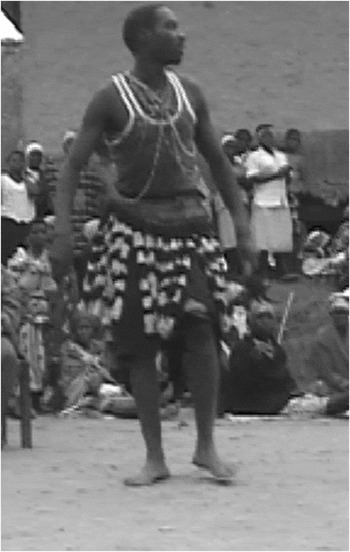
Mhembero’s dancing also reveals the stylistic influence of other Shona dances. Men dance with energy and aggression, but their stomp is rarely in precise unison (see image 2 in figure 5). They are not making a mistake; this is simply not a focal point of their performance. Two of the boys in the performance I attended were also wearing the chigejo skirt, which is usually only worn by the spirits of Gaza-Nguni soldiers from the Mfecane called madzviti during spirit possession ceremonies in Chipinge (compare image 2 of figure 5 to the dzviti medium in figure 6). In addition, gender dynamics have been modernized and “equalized.” After dancing for several minutes, the boys retreat to the line of singers and are replaced by three girls who repeat the same dance (image 3 of figure 5). The boys and girls even dance together at times, incorporating theatrical moves and dance steps from other Shona dances, such as the mbira dance, which are utterly foreign to the Ndau residents of Chipinge (image 4 of figure 5). Footnote 15 Even the snaking kukakadhiriza movement includes the boys and girls dancing together (image 5 of figure 5).
Mhembero Dancers Showing Their Muchongoyo Modifications

Dzviti Spirit in Muzite Wearing the Chigejo

Mhembero’s muchongoyo is thus a different dance from the one presented by the Ndau performers in Muzite Mukuyu or the Mahachi Dance Team. It is authentic to an identity and set of values that are different from those of rural Chipinge. Indeed, for many upwardly mobile Ndau with modernist aspirations (particularly in the middle class), the steps, stomps, and shouts of local muchongoyo have shifted from signs of empowerment to causes of embarrassment. What was once the sound of resilience and strength has become the evidence of backwardness and futility, an index of dancers’ collective limitations, shackled by the weight of so-called tradition. The ways in which Ndau youth respond to the specifics of muchongoyo reveal much about their responses to the complex and continually shifting context of Mugabeist Zimbabwe and depend on several factors, particularly socioeconomic class and political allegiance.
One option is to embrace locality, rely on the spirits, and resist the lure of an outward-oriented modernity, however defined. I call this “localist,” after Ferguson (Reference Ferguson1999). Muchongoyo can play an important role for these residents, who safely resist, protest quietly, and use the subtlety and strength of muchongoyo at every communal gathering to stay resilient. For Camps, a young spirit medium in rural Muzite, this means participating enthusiastically, avoiding overtly political events, keeping his head down, and contemplating escape to South Africa for economic reasons. In cases such as this, modernity can seem external.
A second option is to embrace a more orthodox and cosmopolitan modernity with all the aspirations and expectations that come with it. Given the successful manufacture of indexical connections between ZANU-PF, anti-Western sentiment, and ideas of tradition in Mugabeism, this modernist embrace is often accompanied by a blanket rejection of indigenous performance practices and tradition. I have known students from Zimbabwe in the U.S. who explicitly connect their own lack of interest in local “traditions” to efforts by Mugabe’s government to equate traditional practices with patriotic national sentiment. In an effort to move beyond the constraints and shackles of contemporary life in Zimbabwe, these youth are understandably attracted to the notions of progress and personal freedom associated with modernity. That this modernity necessarily includes a directional moving up, away, and beyond the history and place-bound practices of tradition is an inevitable byproduct of this modernist embrace. This viewpoint reflects the modernist-capitalist cosmopolitan formation described by Turino (Reference Turino2000) and Ferguson (Reference Ferguson1999).
When I attended the Zineku competition and the National Bira in Muzite, I invited several of my middle-class urban friends to accompany me. They turned me down. Whereas they might feel pressure from the authorities to attend an event such as this in town, where they lived, there was no expectation that urban residents would attend a rural function. For these young adults (all in their twenties and thirties), muchongoyo was embarrassing, evidence of their own parents’ dwelling in the past. On the one occasion that Duma, the internet entrepreneur, watched muchongoyo with me (Chipinge, June 24, 2005), he shook his head slowly and muttered quietly of the exuberant elderly dancers, “I hope I’m not doing that when I’m their age.” Charlene even dismissed muchongoyo derisively as “African music” (Chipinge, Nov. 26, 2003), conflating the meanings behind tradition, race, progress, and identity that typify many frustrated Zimbabweans.
Some local youth take a third position, turning to and identifying with a form of regional identity that interprets modernity through a locally specific history of labor migration and multilingual interaction that might be termed (although somewhat inadequately) a “subaltern regional cosmopolitanism.” As I have described elsewhere (Perman Reference Perman2012), these young Zimbabweans are collectively forging their own path through the complex maze of postcolonial identities, building new modes of expression that are less reliant on local pasts or foreign futures and unaccounted for by orthodox academic explanations of Zimbabwean identity. When indigenous practices defined by tradition, urban practices defined as modern, and transnational practices characterized as cosmopolitan are unsatisfying or inappropriate, many people define themselves and their communities in yet-to-be-labeled ways that are locally resonant but theoretically undefined.
Finally, local youth can embrace Mugabeism and its brand of ultra-nationalist Zimbabwean identity grounded in violence and a reimagined indigeneity. Mugabeism offers Zimbabweans an “alternative modernity” defined by a narrow nationalist vision. It offers a way to become modern, to become better and free, without having to turn one’s back on the path of history and tradition that led to this point. This alternative offers the possibility of modernity and class mobility without the appearance of local denial or Western embrace. For disaffected youth who have grown up with Mugabe’s voice in their ears, celebrating hopeful futures and cajoling them to stay brave and fight, this vision can be alluring. During the height of land reform in 2001 I met one young “war veteran” drinking beer in an upscale bar in Chipinge who found Mugabe’s call to arms during his Third Chimurenga empowering and inspiring. He credited Mugabe with granting him the freedom even to kill local white people and others who resisted Mugabe’s path toward sovereignty, if he so chose. For this young man and others like him, Mugabe managed to combine the indigenous and the African with the modern and the affluent. Footnote 16
There has been much debate in recent postcolonial studies about the relative merits and shortcomings of alternative modernities as a theoretical tool. While I accept that there are multiple discourses of modernity at play, I generally agree with James Ferguson, who said, “the application of a language of alternative modernities to the most impoverished regions of the globe risks becoming a way of . . . evading the question of a rapidly worsening global inequality and its consequences” (2006:192). As most scholars of Africa agree, modernity cannot be understood as a single, unifying project (Larkin Reference Larkin1997; Comaroff & Comaroff Reference Comaroff and Comaroff2012). But as Anthony Giddens says, this position “does not imply that all is chaos or that an infinite number of purely idiosyncratic histories can be written” (Reference Giddens1990:6). Within African studies, alternative modernities are offered as unique, moral, and legitimate realities for Africans that cannot be understood as derivative of their Western or European counterparts. But these versions often problematically detach a cultural modernity from a material one. As Comaroff and Comaroff explain, “modernity in Africa is both a discursive construct and an empirical fact” (2012:120–21). Celebrating contemporary ways of life among the marginalized and disenfranchised as somehow alternatively modern without accounting for real structural inequalities undermines the frustrations of people who feel left behind by the modern lifestyle to which they aspire. For many people in Chipinge who desire cars, houses, fancy phones, and a decent television, modernity is material, represented by those markers of achievement and improvement; there is no alternative. As Ferguson says, “Some people and places have it, others don’t” (2006:187). To be modern is to have the material indices of modernity.
Mugabeism promises these things: the continued value of tradition and the realized aspirations of modernity. Mugabeism allows for wealth and modernity without an accompanying rejection of the indigenous—a position that could make even class mobility seem unpatriotic. Footnote 17 For the youth conscripted into ZANU-PF camps and empowered to confront political opponents and white landowners, his vision can be appealing, a way out of Dipesh Chakrabarty’s “double bind” of modernity (Reference Chakrabarty2000:40) in which people, as in many postcolonial contexts, feel that they are trapped, “no longer traditional” but “not yet modern.” But a Mugabeist alternative modernity has its costs. It is a cautionary possibility rather than a celebratory alternative, as is often implied in claims of multiple modernities. The indexical associations that give discursive terms like “modern” and “culture” their power and utility can vary considerably from person to person, perhaps even from event to event. Indications of identity, indigeneity, ethnicity, and nationality obviously differ if one is dancing at the end of a ceremony in rural Chipinge among family and friends as opposed to on the stage at a nationally sanctioned competition in downtown Harare.
National Muchongoyo
Mugabeism’s narrow, Shona brand of nationalism has shaped how the indigenous is understood in practices like muchongoyo. Teachers at Muzite Primary School expressed frustration that the Ministry of Education dictated the lyrics students were expected to sing as they danced. Thus during the height of land reform the Muzite children described above sang the simple lyrics, “KwaMuzite tinorima magwere” (At Muzite we farm maize) at the government’s behest. Footnote 18 The judges I have met at national and regional competitions typically come from Harare and Mutare and have been trained on Shona dances and the legacy of the NDC. Thus schools sometimes change their dances in competition in order to appeal to urban sensibilities and ignorance about muchongoyo. Residents of Muzite now pretend that certain obscure local dances are actually the dances judges require. Some judges apparently know so little about rural muchongoyo that, to my knowledge, no one has caught on. Even so, one judge in Harare told me that rural teams can’t possibly win because they lack the variety, drama, and stagecraft of the Harare teams. Muzite schools can be marked down because the girls rarely dance, choosing instead to follow local convention by singing and clapping. The subtlety that rural audiences love so much is ineffective, officially marked as old-fashioned. Rural styles that fail to conform to the presentational ideals of post-NDC performance in Harare can be interpreted as provincial and backward. In the national competitions I attended, the representative from the Chipinge district lost to a team from Harare that often performed muchongoyo in the cosmopolitan NDC-inspired fashion exhibited by Mhembero.
There are countless reasons that performance practices shift, become redefined, split, and merge. This redefinition of muchongoyo did not come about because of a deliberate top-down decision, but rather as a process shaped by the pressures of nationalism and modernity in the context of Mugabeism. People remain the arbiters of their own style. But the judges’ preference for a newer, modern, and nation-friendly version of muchongoyo brings to mind Stuart Hall’s pointed claim that “rather than simply ‘falling into disuse’ through the Long March to modernization, things are actively pushed aside, so that something else can take their place” (1981:228). Mugabe and his compatriots have tried for years to redefine the values expressed by indigenous performance in the service of a Shona-centric, ZANU-PF–oriented nationalism. In a small but significant way, Mugabeism’s style has influenced several aspects of Zimbabweans’ performance style. Through consistent repetition and the employment of massive financial capital, “tradition” is increasingly defined as patriotic. Partially in response to this, cosmopolitan Zimbabweans with modernist aspirations, including many members of Chipinge’s middle class, have redefined ideas of tradition and have relegated muchongoyo and other indigenous performance practices to a past they hope to escape. Footnote 19 They now perceive muchongoyo and other indigenous performance practices through the discursive filter of modernity. Thus the public performances of so-called traditional musics and dances are increasingly redefined and reimagined.
Clayton Ndlovu, who taught dance for years in Harare and Bulawayo, suggested as much in a 2001 interview with the musicologist Stefan Fiol. “Muchongoyo has grown,” he said.
It is no longer Ndau dance. If an Ndau person was to dance muchongoyo and then another ethnic group was to dance muchongoyo you [would] find that the two have different approaches. The other ethnic group [would] still identify [it] as [an] Ndau dance, but a more choreographed version and more appealing version [directed] to a paying audience . . . more than the Ndau, who might be taking it for granted, [saying], “look its just a mere dance and we’re presenting it.” Footnote 20
For urban dance experts like Ndlovu, the Ndau take their version for granted as a “mere” dance that is less “appealing” than the choreographed improvement. An ostensibly Ndau dance has become freed from this narrow “ethnic” distinction and entered a national dance canon.
Conclusion
There are now, at minimum, two kinds of muchongoyo, both vibrant and authentic within their own setting but only superficially similar. A single tradition has split into two broad categories, caused by the schizophonic detachment of the original from its source due to the influences of urbanization, political redefinition, cosmopolitan modernization, and Mugabeist intervention. Discourses of nationalism and modernity intersect in Zimbabwe under Mugabe and they have shifted the discursive frameworks through which local practices are defined and understood. Mugabeism has determined style as much as it has controlled the land and the people, connecting the military, the political, and the ideological. Although Mugabe is by no means the only actor or voice in the turmoil of Zimbabwe’s political and ideological shifts, it is in the shaping of the social values that become celebrated and expressed through performance that Zimbabwe under Mugabe is increasingly being transformed. Thus, within Mugabeism, the meaning of expressive practices is in flux, redefined by their discursive contexts, their employment for propaganda, and the frustrations of Ndau communities with their continued marginalization.
The stylistic preferences and practices in each version of muchongoyo reflect very different sets of social and expressive values. Depending on which of the possible responses to these national and discursive pressures locals embrace, their response to performance can be quite different. For some of Chipinge’s cosmopolitan youth, the standard steps and sounds have been separated from the resilience of communal strength and celebration rooted in a specific historical narrative, diminishing the dance’s historical depth and contemporary relevance. Decades of nationalism have reshaped how the indigenous is defined and valued, reframed it through the discursive lens of modernity as merely “traditional,” and created an opposition between modernity and muchongoyo. Hence the shame Duma felt about the idea of dancing muchongoyo like his elders. There are still many Chipinge residents who respond to the pressures of nationalism and modernity differently and for whom muchongoyo still matters—deeply. But for members of the Ndau community who still rely on dances like muchongoyo to elevate their communities and remain resilient in the face of oppression, its value is often drowned out by the noise of Zimbabwe’s dominant discursive ideologies.
Acknowledgments
Many thanks to the dancers and musicians in Mhembero, Mahachi, and Muzite Mukuyu, as well as the broader communities in Checheche and Muzite, for their hospitality and patience. This material was first presented at the Dictatorial Aesthetics Symposium at Duke University on April 5, 2013. I’d like to thank Louise Meintjes and Nomi Dave for inviting me to participate. I also presented this material at a colloquium at the University of Illinois and thank the graduate students for their hospitality and feedback. Stefan Fiol, Thomas Turino, Jennifer Kyker, and Huan Perman each provided helpful critique and suggestions. The anonymous ASR reviewers provided insightful and constructive critiques of an earlier draft.