INTRODUCTION
Porcellanidae is one of the common decapod crustacean groups in tropical coastal waters. The anomuran family includes 30 extant genera and about 280 species in the world (Osawa & McLaughlin, Reference Osawa and McLaughlin2010). Prakash et al. (Reference Prakash, Ajith Kumar and Khan2013) provided an updated checklist of porcellanids recorded from India, including 30 species in 11 genera. Among them, Neopetrolisthes maculatus (H. Milne Edwards, 1837) (recorded as Petrolisthes ohshimai in Miyake, 1937) was the sole species of the genus known from India and it was recorded from the Gulf of Mannar (Sankarankutty, Reference Sankarankutty1963). In the present paper, we report a second Indian species of the genus, Neopetrolisthes spinatus Osawa & Fujita, Reference Osawa and Fujita2001, based on a single female specimen collected from the Andaman Islands.
MATERIAL AND METHODS
Neopetrolisthes spinatus is the 31st porcellanid species from India and is recorded from the Indian Ocean for the first time. The collection site, Rutland Island (11°30′N 92°40′E) is located across the Macpherson Strait and the southern side of South Andaman Island in the eastern Indian Ocean (Figure 1). The island spans an area of approximately 109.3 km2 and has a coastline measuring 60 km.
Map showing the locality where the present specimen of Neopetrolisthes spinatus Osawa & Fujita, Reference Osawa and Fujita2001 was collected: Rutland Island, South of Andaman Islands, India.

In January 2012, surveys were conducted on the coral reefs of Rutland Island to assess the reef-associated crab diversity. Most specimens were collected by hand picking in the intertidal and shallow subtidal zones. Among them, a single female of N. spinatus was found as commensal on a large sea anemone. The sea anemone identification up to species level was carried out using the available literature, such as Fautin et al. (Reference Fautin, Tan and Tan2009) on Heteractis crispa (Hemprich & Ehrenberg in Ehrenberg, 1834), and was collected at depths ranging from 12 to 15 m by SCUBA diving. The collected specimen was preserved in 5–10% formalin for laboratory examination and was then deposited in the National Zoological Collections of the Zoological Survey of India (ZSI) at Port Blair. Terminology and species diagnosis was made following Osawa & Chan (Reference Osawa, Chan and Chan2010).
The total length of the specimen depends upon the carapace length, which was measured from the tip of the rostrum to the postero-median margin of the carapace.
RESULTS
SYSTEMATICS
Order DECAPODA Latreille, 1802
Infraorder ANOMURA Macleay, 1838
Superfamily GALATHEOIDEA Samouelle, 1819
Family PORCELLANIDAE Haworth, 1825
Genus Neopetrolisthes Miyake, 1937
Neopetrolisthes spinatus Osawa & Fujita, Reference Osawa and Fujita2001
(Figures 2 & 3)
Neopetrolisthes spinatus Osawa & Fujita, Reference Osawa and Fujita2001: 163, Figures 1–4 (type locality: Okinawa Island, Ryukyu Islands, Japan); Osawa et al. (Reference Osawa, Chan and Hsieh2007): 734, Figures 2A–E & 3; Osawa & Chan, Reference Osawa, Chan and Chan2010: 98, Figures 68, 69.
Neopetrolisthes spinatus Osawa & Fujita, Reference Osawa and Fujita2001, ovigerous female (carapace length, 12 mm), ZSI, Reg. No. 6973. A, B: Live specimen, associated with large sea anemone, Heteractis crispa (Hemprich & Ehrenberg in Ehrenberg, 1834); C: N. spinatus entire specimen, dorsal view; D: N. spinatus ventral view; E: N. spinatus anterior view.
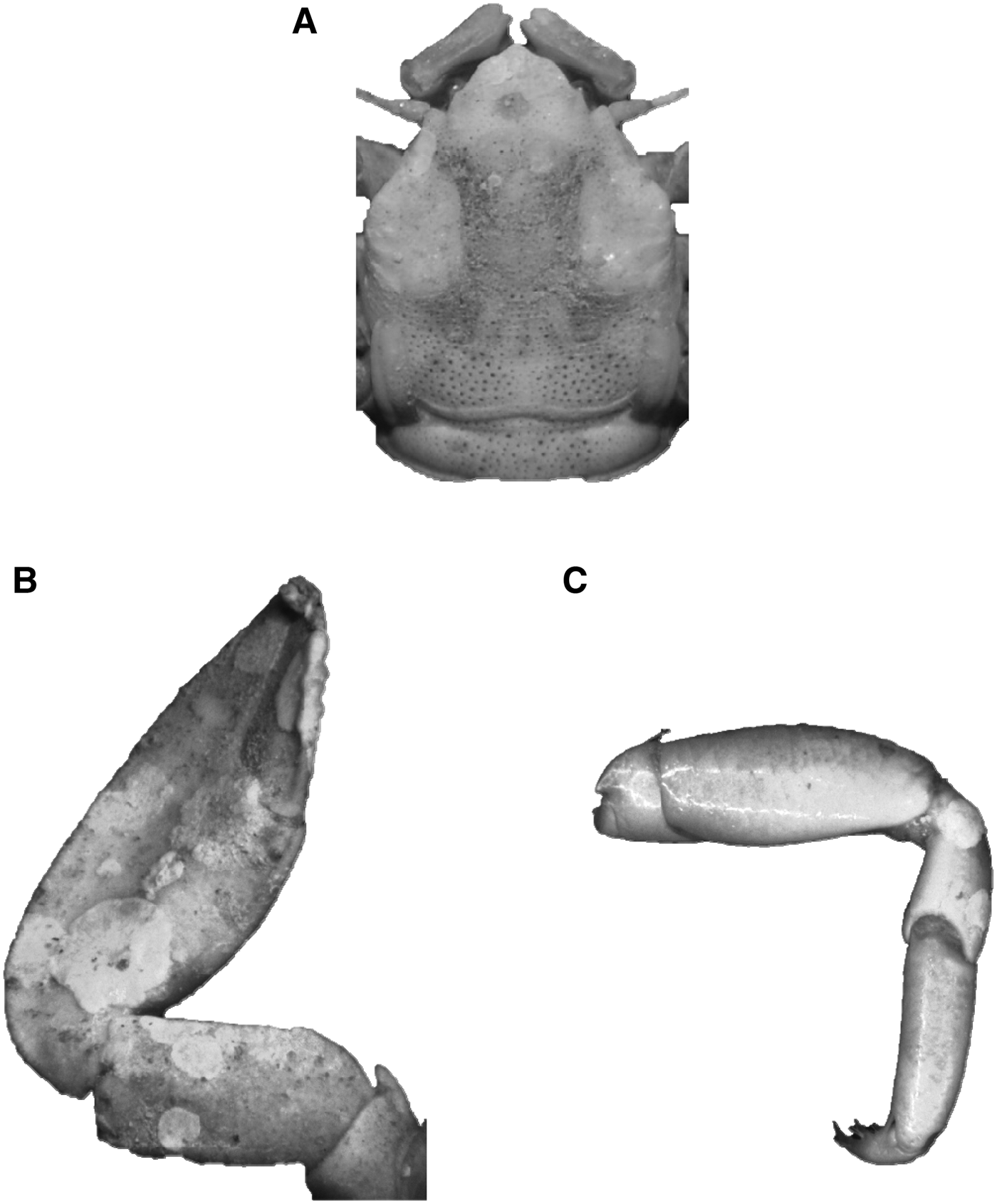
Neopetrolisthes spinatus Osawa & Fujita, Reference Osawa and Fujita2001, ovigerous female (carapace length, 12 mm), ZSI Reg. No. 6973. A: Carapace and anterior appendages, dorsal view; B: Left cheliped. dorsal view; C: Right third ambulatory leg, lateral view.
MATERIAL EXAMINED
Rutland Island, Andaman Islands, 12–15 m, associated with Heteractis crispa, one ovigerous female (carapace length 12 mm), ZSI. Reg. No. 6973.
DIAGNOSIS
Carapace with numerous short striae: protogastric ridges strongly elevated, directed anteriorly; branchial regions each with two elevated parts; supra-ocular and epibrachial spines present; rostrum with median groove. Chelipeds with numerous short striae on dorsal surface of carpus and palm; carpus lacking distinct teeth or lobes on dorsoflexor margin, no projection at dorso-extensor end. Ambulatory legs subcylindrical, slender; propodi comparatively short, each with two corneous spines at distoflexor end; dactyli each armed with two corneous spines on flexor margin.
COLORATION
Antero lateral parts of carapace – chelae, and meri of ambulatory legs whitish, numerous reddish-purple dots present on body and pereopods. Dark reddish on median and posterior parts of carapace, carpus of cheliped and proximal half of merus of each ambulatory leg. See Figure 2.
DISTRIBUTION
Okinawa Island in south Japan, Lanyu Island in south Taiwan, Bali Island in Indonesia; at depths of 5.0–19.7 m (Osawa et al., Reference Osawa, Chan and Hsieh2007). Presently, also from Rutland Island, Andaman Islands in the eastern Indian Ocean.
REMARKS
Neopetrolisthes spinatus is morphologically similar to Neopetrolisthes alobatus, (Laurie, 1926) but is distinguished by the possession of supra-ocular spines on the carapace (Osawa & Fujita, Reference Osawa and Fujita2001). Sankarankutty (Reference Sankarankutty1963) recorded Petrolisthes ohshimai Miyake from the Gulf of Mannar, which is now synonymized as Neopetrolisthes maculates (H. Milne Edwards 1837). Neopetrolisthes spinatus is the first record for India from the Andaman and Nicobar Islands.
ACKNOWLEDGEMENTS
The authors are grateful to the Ministry of Environment, Forest and Climate Change, Government of India for financial support. The first author (S. Kumaralingam) thanks Dr Masayuki Osawa of Shimane University, Japan, for confirming the species identification.