Introduction
There is a substantial body of evidence showing that older adults respond well to a variety of forms of psychotherapy, both individual and group psychotherapies, to a degree comparable with younger age groups (APA, 2013). Efficacy has especially been demonstrated for individual cognitive-behavioral therapy (CBT) in the treatment of depression and anxiety disorders (Pinquart et al., Reference Pinquart, Duberstein and Lynness2007; Hendriks et al., Reference Hendriks, Oude Voshaar, Keijsers, Hoogduin and Van Balkom2008), and for life review therapy and group psychotherapy in the treatment of depression (Scogin et al., Reference Scogin, Welsh, Hanson, Stump and Coates2005; Krishna et al., Reference Krishna, Jauhari, Lepping, Turner, Crossley and Krishnamoorty2011).
Nevertheless, the efficacy of schema therapy (ST) in older adults remains to be explored. ST was originally developed by Young (Reference Young1990) as an individual psychotherapy for the treatment of PDs, especially the borderline PD, and has recently been elaborated for the treatment of other complex psychiatric disorders (Edwards and Arntz, Reference van Vreeswijk, Broersen and Nadort2012). In younger cohorts (18–50 years), ST has emerged as an effective treatment for personality disorders (PDs) and other patient groups such as chronic mood and anxiety disorders (Bamelis et al., Reference Bamelis, Bloo, Bernstein, Arntz, van Vreeswijk, Broersen and Nadort2012, Reference Bamelis, Evers, Spinhoven and Arntz2013). ST integrates elements of CBT, object relations theory, gestalt therapy and attachment theory into one unified, systematic approach of treatment (Young et al., Reference Young, Klosko and Weishaar2003). ST focuses on early maladaptive schemas (EMS) and how they influence daily life and interpersonal relationships. EMS are defined as self-defeating core themes that pertain to one's view of the self, others and the world. They form the core of one's self concept and are formed in childhood and adolescence. Schema domains contain several EMS related to different clusters of unfulfilled emotional needs (Young et al., Reference Young, Klosko and Weishaar2003). Schema coping styles are developed in order to cope with the early environment that led to the development of EMS. Three main categories of coping can be identified: surrendering (acting as if the EMS is completely true), avoidance (blocking thoughts, feelings, emotions linked to the EMS), or overcompensating (acting as if the opposite of the EMS is true). Schema modes are conceptualized as groups of EMS and schema coping styles that are active together and thus reflecting a particular emotional state.
ST teaches patients to respond more from “a healthy adult” perspective and to cope in a more adaptive manner when schemas are triggered in daily life by events that are linked to unfulfilled needs (Young et al., Reference Young, Klosko and Weishaar2003). ST consists of three stages. Assessment is the first phase, in which EMS, schema coping styles and schema modes are identified, commonly with the help of questionnaires. Secondly, follows the emotional awareness and experiential phase, wherein patients get in touch with these EMS and learn how to spot them when they are operating in their day-to-day life. Thirdly, behavioral and schema change becomes the focus, during which the patient is actively involved in replacing negative, habitual thoughts and behaviors with new, healthy cognitive and behavioral options. In this third phase of therapy, besides cognitive and behavioral techniques, experiential techniques seem to be powerful, especially guided imagery and rescripting (Arntz and Van Genderen, Reference Arntz and Van Genderen2009). In guided imagery the patient is helped to re-experience the situations which were crucial in forming their EMS, and express his or her emotions that are linked to these situations. In rescripting the outcome, the patient can give a different meaning to this experience. Other experiential techniques with the same objective are role-play and chair work (Arntz and van Genderen, Reference Arntz and Van Genderen2009).
ST has been modified for a group-focused approach, which is promising as a cost-effective alternative for individual treatment (Farrell, Reference Farrell, van Vreeswijk, Broersen and Nadort2012). Even a short-term group schema cognitive behavior therapy (SCBT-g; Broersen and van Vreeswijk, Reference Broersen, Van Vreeswijk, van Vreeswijk, Broersen and Nadort2012) is associated with improvements in overall symptomatology, EMS and schema modes, both in adults with PD features and long-standing mood disorders (Van Vreeswijk et al., Reference Van Vreeswijk, Spinhoven, Eurelings-Bontekoe and Broersen2012) and adolescents with PD features (Renner et al., Reference Renner, Van Goor, Huibers, Arntz, Butz and Bernstein2013). SCBT-g is primarily indicated for relapsing mood, chronic adjustment and anxiety disorders which are intermingled with comorbid PDs or PD features. SCBT-g focuses in particular on the cognitive behavioral techniques of ST.
A recent expert study on treatment of PD in older adults has led to consensus among Dutch and Belgian experts that existing evidence-based therapies for PDs in adults up to the age of 50, such as ST, are also applicable to older adults over 60 years of age (Van Alphen et al., Reference Van Alphen, Derksen, Sadavoy and Rosowsky2012). However, no research has yet been carried out on the effects of individual, nor group ST in older adults (Van Alphen et al., Reference Van Alphen2012). Providing ST in a short group format like SCBT-g might be interesting because SCBT-g seems to connect to the psychotherapy expectations of older adults, as it places emphasis on psychoeducation, is highly structured, skill-enhancing and problem-focused (Laidlaw and Thompson, Reference Laidlaw, Thompson, Laidlaw and Knight2008). It also provides social support, which tends to diminish as people age (Zarit and Zarit, Reference Zarit and Zarit2011).
The aim of this study is to evaluate, as a proof of concept, whether SCBT-g is effective in older adults with relapsing mood and chronic adjustment disorders and comorbid PDs or PD features. We hypothesized that symptom, EMS and mode severity decreases after SCBT-g treatment. A proof of concept seeks to confirm a concept by evaluating intermediate outcomes that seem relevant for the mechanism and outcome of the intervention (Lawrence Gould, Reference Lawrence Gould2005). In terms of the proof of concept, because ST is supposed to diminish EMS in order to mediate changes in symptoms, we explored whether changes in EMS indeed mediated changes in symptomatic distress as intermediate outcome. We hypothesized that changes in EMS in the first phase of SCBT-g treatment predict changes in symptomatic distress in the second phase of this treatment.
Methods
Participants
Forty-two participants, age 60 and over, with a multidisciplinary consensus diagnosis of a longstanding mood disorder or a chronic adjustment disorder with comorbid PDs or PD features, that had previously been treated by evidence based or best practice based therapy without significant improvement, were included. Exclusion criteria were (I) patients who suffered from neurodegenerative diseases, (II) patients suffering from major physical illness to such an extent that it could affect participation, (III) patients with a diagnosis of a learning disability and (IV) patients with hearing or vision problems that affected participation in a group.
Study design
To investigate whether SCBT-g is effective in older adults and whether changes in EMS mediate changes in symptomatic distress, this study was designed as a proof of concept study. A proof of concept study is very common in medicine. It has been developed to test the feasibility of a new intervention or drug in a small trial with patients (Lawrence Gould, Reference Lawrence Gould2005), and is becoming more popular for other interventions than pharmacotherapeutical ones. Such a trial investigates the activity of the intervention on the assumed therapeutic process by evaluating the effect on intermediate outcomes related to the presumed mechanism of the intervention working on the outcome, and is a preliminary phase to a randomized controlled trial (RCT) (Van der Feltz-Cornelis et al., submitted).
The DSM-IV (APA, 2000) diagnosis was based on a multidisciplinary consensus diagnosis. The outpatients participated in five consecutive schema groups of 8 to 10 participants. Measurements of symptomatic distress and EMS were conducted at pre-treatment, mid-treatment (session 10) and end-of-treatment (2 months after session 18). Measurement of schema modes was administered at pre-treatment and end-of-treatment.
The Medical Ethic Committee of the South of Holland and local research ethics committees granted ethical approval. Informed consent was obtained from all participants.
Treatment intervention
SCBT-g (Broersen and Van Vreeswijk, Reference Broersen, Van Vreeswijk, van Vreeswijk, Broersen and Nadort2012) is a short-term group therapy of 20 sessions (18 sessions of 90 min weekly and 2 follow up sessions of 90 min, one and two months after termination of treatment respectively). The highly structured protocol has a special emphasis on cognitive and behavioral techniques of ST. In accordance with the protocol, in the first stage of the therapy (session 1–9), patients were educated about the schema model, specifically in relation to their own three most prominent EMS and modes. All patients had their own schema workbook in which cognitive techniques were applied to help them test and challenge the distorted views associated with their EMS. In the second stage (session 10–20), patients were tempted to respond to situations that triggered their EMS in a more adaptive manner, using their workbook exercises and role-playing. During the entire course of therapy, the group was encouraged to explore EMS triggering as it occurred naturally in the group setting and to discuss it openly. All sessions were recorded on DVD and patients who missed any sessions were required to watch the DVD before the next session. The therapists received supervision of an experienced schema psychotherapist and co-author of the treatment protocol (Broersen). During SCBT-g, no individual psychological treatment took place. Participants who were on medication, mainly antidepressants, continued it throughout treatment.
Measures
Psychological symptoms
The primary outcome variable was the score on a symptom checklist, the Brief Symptom Inventory (BSI; De Beurs, Reference Beurs2011; translated from Derogatis, Reference Derogatis1975a). The BSI is a shorter version of the Symptom Checklist-90 (SCL-90; Derogatis, Reference Derogatis1975b), and consists of 53-items. The reliability of the Dutch BSI scales is good and the convergent and divergent validity has been found to be satisfactory (De Beurs, Reference Beurs2011). Moreover, the BSI is validated for older adults and preferable for this age group because it is less lengthy than the SCL-90 (Van Alphen et al., Reference Van Alphen, Derksen, Sadavoy and Rosowsky2012).
Early maladaptive schemas
The Young Schema Questionnaire (YSQ L-2; Young and Brown, Reference Young, Brown and Young1994; Dutch translation Sterk and Rijkeboer, Reference Sterk and Rijkeboer1997) is the most commonly used EMS measure. The list consists of 205 items, which are phrased as a negative core belief and rated along a 6-point scale. It measures 16 core beliefs as defined by Young et al. (Reference Young, Klosko and Weishaar2003): abandonment/instability, mistrust/abuse, emotional deprivation and social isolation/alienation (schema domain 1: disconnection and rejection); dependence/incompetence, enmeshment/undeveloped self and failure (schema domain 2: impaired autonomy and performance); entitlement/grandiosity, and insufficient self-control/self-discipline (schema domain 3: impaired limits); subjugation and self-sacrifice/approval seeking/recognition seeking (schema domain 4: other directedness); and emotional inhibition and unrelenting standards/hypercriticalness (schema domain 5: overvigilance and inhibition). The Dutch YSQ has good reliability and convergent and discriminant validity (Rijkeboer et al., Reference Rijkeboer, Van den Bergh and Van den Bout2005).
Schema modes
The Schema Mode Inventory (SMI; Dutch translation Lobbestael et al., Reference Lobbestael, Van Vreeswijk, Arntz, Spinhoven and `t Hoen2005) measures 16 modes. These modes can be divided into 4 types of modes: healthy modes, parent modes, child modes and coping modes. This test consists of 270 items, which are rated along a 6-point scale. The Dutch SMI has excellent test-retest reliability and the convergent and divergent validity of the subscales are satisfactory (Lobbestael et al., Reference Lobbestael, Van Vreeswijk, Spinhoven, Schouten and Arntz2010).
Statistical analyses
Strength of outcome was measured by calculating within subjects effect sizes Cohen's d (Cohen, Reference Cohen1988), based on the BSI and YSQ for the pre-, mid- and end-of-treatment measurements and based on the SMI for pre- and end of treatment measurements (as SMI scores were only available at pre- and end-of-treatment). According to conventional criteria, d < 0.20 is considered a small effect size, d = 0.50 a medium effect size and d > 0.80 a large effect size.
Treatment success was determined by the classification of patients as recovered, improved, unchanged or deteriorated by Lambert et al. (Reference Lambert, Hansen, Bauer, Nezu and Nezu2008). We first calculated changes between the BSI pre-treatment to post-treatment and assessed these changes for statistically reliable change. Next, it was determined whether patients who showed reliable change also passed the clinical cut-off point (reliable change scores were 18 for men and 19 for women and clinical cut-off points 35 for men and 37 for women, based on norm group data provided in the Dutch manual of the BSI by de Beurs (Reference Beurs2011)). After these two steps each patient could be classified as recovered (reliable change and below the cut-off), improved (reliable change and above cut-off), unchanged (no reliable change) or deteriorated (reliable change in a negative direction).
Intermediate measures analysis
To examine whether pre-treatment to mid-treatment change in EMS mediated mid-treatment to end-of-treatment change in symptoms, cross-lagged correlations among residual change scores were calculated in treatment completers (Finkel, Reference Finkel1995). Hierarchical regression analyses were used to investigate whether early process changes in EMS predicted later outcome changes in symptoms after controlling for autocorrelation (the correlations of pre-treatment to mid-treatment with mid-treatment to end-of-treatment on BSI residual change scores and YSQ residual change scores) and synchronous correlations (the correlations between pre-treatment to mid-treatment or mid-treatment to end-of-treatment changes on the YSQ and the BSI, respectively). Inverse associations were also determined by regression analysis.
The Statistical Package for the Social Sciences version 19 for Windows (SPSS Inc., Chicago, USA) was used. All the analyses were two-tailed with a significance level of 5%, unless stated otherwise.
Results
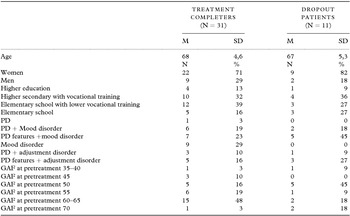
In total 31 out of 42 included older outpatients completed the therapy and filled out all measures. Of the eleven dropouts, 6 patients refused to participate in SCBT-g after completion of the questionnaires pre-treatment (pre-dropouts). During the course of this study another 5 patients (dropouts) terminated this therapy before the last session: 1 patient was admitted to a psychiatric hospital, 1 patient reported an excess of fear in the group, 1 patient left the group after a heated dispute with the other members of the group, 2 patients refrained from participation because of unknown reasons. Dropout patients were offered an alternative treatment. Table 1 gives an overview of the baseline characteristics of the patients that remained in treatment and those who left treatment prematurely. Average age of the patients who completed treatment was 67 years, (range: 60–78 years); 22 were female (71%), 9 were male (29%). Ten patients were diagnosed with a PD (32%; 6 patients with PD not otherwise specified, 3 with dependent PD and 1 with paranoid PD), of whom 6 had a comorbid mood disorder and 3 a comorbid adjustment disorder; 12 patients were diagnosed with PD features (39%; of whom 7 had a comorbid mood disorder and 5 a comorbid adjustment disorder); 9 patients were diagnosed with a longstanding mood disorder without a comorbid PD or DSM-IV (APA, 2000) PD features (29%).
Baseline characteristics

Patients who stayed in treatment (N = 31), were significantly more diagnosed with a mood disorder than the 11 patients who dropped out (N = 11) (χ2(1) = 5.061, p < 0.05).
Patients who dropped out, did not differ (χ2(9) = 16.094, p = 0.065) in global assessments of functioning (GAF, DSM-IV; APA, 2000), or in the amount of symptomatic distress at pre-treatment from those who completed treatment (t = 1.143, df = 40, p = 0.130). Nor did dropouts differ in EMS compared to the patients who completed treatment (t = 0.324, df = 40, p = 0.374). There were no significant differences between dropouts and treatment completers in all schema modes, with the exception of the healthy modes on which dropout patients did score significantly higher on the SMI (t = 2.736, df = 36, p < 0.05).
Effect of treatment
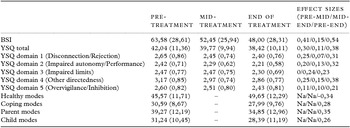
Symptomatic distress was the main outcome variable and decreased significantly from pre-treatment (M = 63.58, SD = 28.62) to end-of-treatment (M = 48, SD = 28.31). Total EMS, the most important process variable, also decreased significantly from pre-treatment (M = 42.04, SD = 11.36) to end-of-treatment (M = 38.42, SD = 10.11), as did all schema domain scores. Dysfunctional schema modes decreased significantly (Parent modes from M = 39.27, SD = 12.19 to M = 34.85, SD = 12.96; child modes from M = 31.24, SD = 10.45 to M = 28.39, SD = 11.19; coping modes from M = 30.59, SD = 8.67 to M = 27.99, SD = 9.76). Healthy modes increased significantly (from M = 45.57, SD = 11.71 to M = 49.65, SD = 12.29).
The means, SDs and effect sizes of changes in symptomatic distress, EMS and modes are presented in Table 2. Almost all effect sizes, including of decrease in symptomatic distress and total YSQ score were medium. Exceptions are the effect sizes of change in schema domain 3 (impaired limits) and 5 (overvigilance/inhibition), which were small.
Means, standard deviations, and effect sizes (with paired samples t-tests significant at p <;05) in the BSI, EMS, schema domains and mode domains

BSI = Brief Symptom Inventory total score. YSQ = Young Schema Questionnaire. Effect size values are based on the difference in scores from pre-treatment to mid-treatment (x/), from mid-treatment to end-of-treatment (/x/) and form pre-treatment to end-of-treatment (//x) divided by the mean of the corresponding standard deviation. For modes a single effect size is given because these were assessed only at pre-treatment and end-of-treatment. Na = Not available.
There was a small difference in effectiveness between patients with a PD (N = 10; d = 0,69 on symptomatic distress and d = 0,58 on total EMS) and patients with a mood disorder without a comorbid PD or PD features (N = 9; d = 0,45 on symptomatic distress and d = 0,34 on EMS), although all effect sizes were medium.
Calculation of the clinical significance of change using the BSI reliable change scores and clinical cut-off scores, showed that 26% of the patients recovered, 16% improved, 52% remained unchanged and 6% deteriorated.
Intermediate outcome analysis: mediation effects
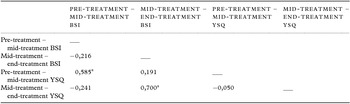
Residual change scores were calculated for the BSI and the YSQ total score (see Table 3). There was no significant auto-correlation for the BSI and the YSQ total, implying that early treatment changes in these variables were unrelated to late treatment changes in the same variables. Synchronous correlations showed a significant association of pre-treatment to mid-treatment changes in YSQ scores with pre-treatment to mid-treatment BSI changes. The mid-treatment to end-of-treatment changes in YSQ scores were also significantly associated with mid-treatment to end-of-treatment changes in BSI scores. This suggests that changes in EMS co-occur with changes in symptomatic distress. As the synchronous correlations are significant, the cross-lagged correlations ought to be treated with caution. The cross-lagged correlations showed no significant association between pre-treatment to mid-treatment YSQ change and mid-treatment to end-of-treatment BSI change. The converse correlations were also non-significant.
Zero-order correlations of residual change scores

aCorrelation is significant at the 0.01 level (2-tailed).
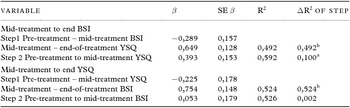
To analyse whether pre-treatment to mid-treatment YSQ change was a significant predictor of mid-treatment to end-of-treatment BSI change after controlling for variance due to pre-treatment to mid-treatment changes on BSI, and for mid-treatment to end-of-treatment changes on the YSQ, hierarchical regressions were performed (see Table 4). Pre-treatment to mid-treatment YSQ change appeared to be a significant predictor of mid-treatment to end-of-treatment BSI changes, accounting for an additional 10% of the variance apart from the variance due to pre-treatment to mid-treatment changes on BSI and for mid-treatment to end-of-treatment changes on the YSQ. The converse lagged association proved to be non-significant.
Summary of hierarchical regression analysis

Note: variables are residualized change scores.
ap < 0,05.
bp < 0,001.
Discussion
The primary aim of this proof of concept study was to investigate the feasibility of SCBT-g in older adults with PD features or longstanding mood disorders by assessing the effect on changes in global symptomatic distress. As proof of concept intermediate analysis, we investigated whether SCBT-g led to changes in EMS, and whether this mediated changes in symptoms. Our results showed that SCBT-g led to significant improvement in symptomatic distress (d = 0.54) from pre-treatment to post-treatment. Besides, changes in schemas seemed to co-occur with changes in symptomatic distress. Further analysis showed that pre-treatment to mid-treatment EMS change appeared to be a significant predictor of mid-treatment to end-of-treatment BSI changes. This implies that EMS change as process variable probably mediates changes in the outcome variable of ST, symptomatic distress. This was also found in the study of Van Vreeswijk et al. (Reference Van Vreeswijk, Spinhoven, Eurelings-Bontekoe and Broersen2012) in a younger cohort. This finding can be seen as a proof of concept that SCBT-g decreases EMS and thus lessens symptomatic distress in our sample of older adults.
The BSI effect size in this study is comparable to the medium effect size found on the SCL-90 by Van Vreeswijk et al. (Reference Van Vreeswijk, Spinhoven, Eurelings-Bontekoe and Broersen2012) in 48 adults with an average age of 39 (d = 0.66). Renner et al. (Reference Renner, Van Goor, Huibers, Arntz, Butz and Bernstein2013) found a large effect size (d = 0.81) on the SCL-90 in a sample of 26 adolescents with an average age of 22.5. Effect size on EMS was significant in our study (d = 0.38). However, it was smaller than the large effect sizes found in younger age groups (Van Vreeswijk et al.: d = 0.75; Renner et al.: d = 0.88). In the current study, 26% of the patients recovered, 16% improved, and 52% remained unchanged. Van Vreeswijk et al. (Reference Van Vreeswijk, Spinhoven, Eurelings-Bontekoe and Broersen2012) found a larger proportion of recovery (47%). To explain the difference of effect between the sample of adolescents (Renner et al., Reference Renner, Van Goor, Huibers, Arntz, Butz and Bernstein2013) and the sample of adults (Van Vreeswijk et al., Reference Van Vreeswijk, Spinhoven, Eurelings-Bontekoe and Broersen2012), Renner and colleagues proposed that EMS in younger adults are more flexible and changeable during treatment. This same explanation could clarify the differences found in the current sample of older adults, in comparison to younger adults and adolescents.
Nevertheless, SCBT-g should be made more powerful where possible, in order to generate better treatment effects. We suggest some adaptations in the SCBT-g protocol (Broersen and Van Vreeswijk, Reference Broersen, Van Vreeswijk, van Vreeswijk, Broersen and Nadort2012) to meet the needs of older patients. They probably need more time to learn the schema language and to recognize the triggering of schemas and modes in their personal life. Therefore, they may substantially benefit from having several individual ST sessions (e.g. five) prior to the start of SCBT-g. Also simplifying a number of cognitive techniques in the workbook, illustrated with examples that fit their experiential world, might improve therapy outcome.
Furthermore, offering ST individually, and providing more therapy sessions, can lead to better treatment effects in older adults, given the fact that RCTs with 50 individual sessions (40 ST sessions in the first year and 10 booster sessions in the second year) have shown higher treatment effects in adults up to the age of 50 (Giesen-Bloo et al., Reference Giesen-Bloo2006; Bamelis et al., Reference Bamelis, Evers, Spinhoven and Arntz2013). Future studies on individual ST in older adults should also integrate experiential techniques (e.g. guided imagery and rescripting), as they are thought to be more powerful at changing EMS (Arntz and Van Genderen, Reference Arntz and Van Genderen2009).
Another explanation for the differences in treatment effect in our sample, compared to the younger age groups, is that ST could probably be improved for older adults by integrating age-specific aspects into the treatment protocol, as was found in the expert study by Van Alphen et al. (Reference Van Alphen, Derksen, Sadavoy and Rosowsky2012). Examples of age-specific aspects are the changing life perspective, the beliefs about – and consequences of – somatic ailments, cohort beliefs and the sociocultural context, change in role investment and intergenerational linkages (Videler et al., Reference Videler, Van Royen and Van Alphen2012). Besides diminishing the effects of EMS, in ST with older adults, the action of premorbid positive, or functional, schemas should also be taken into account as James (Reference James, Laidlaw and Knight2008) has suggested. James called these functional schemas “worth enhancing beliefs” (WEBs) which used to be nourished by for instance social roles. If a person ages and loses these nourishing roles, positive self-beliefs are less triggered and EMS can become more influential. We further refer to James (Reference James, Laidlaw and Knight2008) for a more elaborate description of how these WEBs can be used in psychotherapy with older adults. In fact, this use of WEBs shows similarities with elements of adaptation-focused treatment as described by Van Alphen et al. (Reference Van Alphen, Derksen, Sadavoy and Rosowsky2012).
Limitations and strengths of the study
Some limitations of this study need to be addressed. Firstly, the lack of a control group limits the generalizability of our findings. However, as proof of concept study, the findings are very useful, as the next step can be a RCT with a control condition (Lawrence Gould, Reference Lawrence Gould2005). Secondly, considering the assessment, a multidisciplinary consensus diagnosis was used to establish inclusion criteria and not a semi-structured clinical interview for DSM (APA, 2000) Axis I and Axis II diagnosis. On the other hand, both DSM criteria and DSM assessment are mostly based on younger adult groups and are not adequately attuned to the living situations and experiences of older adults (Oltmanns and Balsis, Reference Oltmanns and Balsis2011; Van Alphen et al., Reference Van Alphen, Derksen, Sadavoy and Rosowsky2012). For instance 29% of the DSM criteria for PDs led to measurement errors in older adults (Balsis et al., Reference Balsis, Woods, Gleason and Oltmanns2007). However, a recent study showed the age neutrality of EMS by investigating differential item functioning (i.e. bias in item endorsement) of the Young Schema Questionnaire across age groups (Pauwels et al., Reference Pauwels2014). Thirdly, the results of this study are based on a relatively small group of participants (N = 31), consisting of a heterogeneous group of patients with longstanding mood disorders or chronic adjustment disorders with comorbid PDs or PD features. In future research it is interesting to further differentiate the efficacy in more homogeneous samples of only PDs, or only mood disorders. The current sample size restricted the number and types of analyses that could be carried out. On the other hand, such a group of participants is common in a proof of concept study.
Despite these limitations this is the first research on ST in older adults. It provides support for the concept that ST in a short group format like SCBT-g is effective in reducing EMS in older adults and thus mediates changes in symptomatic distress. Furthermore, as studies of efficacy of treatments for PD and related problems are sorely lacking (Van Alphen et al., Reference Van Alphen, Derksen, Sadavoy and Rosowsky2012), this study contributes to the current best practice regarding the treatment of PD and longstanding mood disorders in older outpatients.
Conclusion
The current proof of concept study supports the idea that ST in a short group format, like SCBT-g, is effective in reducing EMS in older adults and thus mediates changes in symptomatic distress. This finding might suggest that the belief that little can be done for older adults with PD or related psychopathology, proves to be an expression of unfounded therapeutic nihilism. ST is promising for our aging population in western and Asian countries. Still, further research is needed to fine-tune ST for use in older adults.
Conflict of interest
None.
Description of authors’ roles
A.C. Videler carried out the statistical analyses and wrote the paper. G. Rossi contributed with her knowledge of personality research in older adults and supervised the statistical analyses. M. Schoevaars collected the data and assisted in writing the paper. C.M. van der Feltz-Cornelis contributed with her knowledge of statistical analyses and assisted in writing the paper. S.P.J. van Alphen supervised the project, contributed with his clinical expertise and assisted in writing thepaper.