Introduction
The link between housing and health in later life is a fundamental but relatively untheorized concern in modern social gerontology. Since ageing populations increasingly desire to live independently within their own homes and communities, the physical structure of those homes, including the form, design and location of those homes, will be increasingly important to older adults’ independence, social interaction and overall quality of life (Phillipson Reference Phillipson2007; Wahl et al. Reference Wahl, Iwarsson and Oswald2012). It is notable that, despite extensive examination of the health-related behaviours and clinical risk factors for individuals in the ageing population, there is a relative lack of emphasis on the role of the residential environment as a structurally complex shaping factor. Historically, researchers have examined housing or neighbourhood attributes separately, that is, as separate, individual variables, thus creating a disjointed and segmented body of evidence that does not adequately convey how multiple aspects of residential settings interactively affect health in late life (Fritz et al. Reference Fritz, Cutchin, Gharib, Haryadi, Patel and Patel2020; Boak et al. Reference Boak, Rasekaba, Baxter and Blackberry2024; Chen et al. Reference Chen, Xu, Cui, Yang, Liu, Gao and Huang2025).
It is critical to recognize that older adults experience their residential environments as whole systems, not just as individual components. Older adults who navigate daily routines while residing in a high-rise, multi-unit apartment in a densely populated urban area live in a fundamentally different kind of residential environment from those who inhabit single-storey, detached dwellings in low-density neighbourhoods. The differences between these two types of environment cannot be reduced to any single housing attribute. While the cumulative combination of various dimensions of residential environments may pose unique challenges for older adults experiencing declines in functional abilities, current methodological approaches have been inadequate to capture the multifaceted nature of residential environments. This has resulted in a significant knowledge gap in our understanding of how structural residential conditions collectively associate with health outcomes, and how these associations are moderated by age, functional capacity and socio-economic position, precisely the kinds of intersecting inequalities that social gerontology is best positioned to illuminate.
In direct response to this knowledge gap, this study uses data from Round 12 of the National Health and Aging Trends Study and employs multiple correspondence analysis (MCA), a methodology designed specifically to reveal underlying patterns of organization among correlated categorical variables. This approach creates an integrated composite measure of the structural complexity of residence conditions across three housing dimensions: housing type, residential setting and building floors. This study also examines how this composite measure relates to self-rated health among older Americans and how these relationships vary by age. This study contributes to social gerontology in three ways. It first helps to develop an empirical conceptualization of residential complexity as a unified, multi-dimensional variable, offering a potential research model for the future. Second, it provides direct evidence regarding whether the person–environment fit (P–E fit) theory can be applied to the structural characteristics of houses. Third, the study has immediate practical applications related to the ageing-in-place policy. The evidence provided is about what kinds of residential configuration will be most closely associated with negative physical and mental health outcomes among different types of older adult population.
Literature review
Residential environments and health in later life: what we know
A substantial and growing body of research has established that residential environments are consequential for the health and wellbeing of older adults across multiple domains. For example, the presence of walkable areas and social support systems at the neighbourhood level can result in a reduction of depression and functional decline of up to 30 per cent (Siqueira Junior et al. Reference Siqueira Junior, Lopes, Godtsfriedt, Justina, Paiva, D’Orsi and Rech2022; Sokale et al. Reference Sokale, Conway and Douphrate2022; Leyden et al. Reference Leyden, Hogan, D’Arcy, Bunting and Bierema2024) compared to those who do not live in neighbourhoods with such supportive conditions. Social connections within the community, social cohesion and access to various services are also associated with higher subjective wellbeing and lower rates of social isolation (Barnett et al. Reference Barnett, Barnett, Nathan, Van Cauwenberg and Cerin2017; Zimmermann Reference Zimmermann2024).
The internal layout of dwellings and buildings themselves plays an additional role. Design elements that make homes more accessible, such as universal design features, allow older adults to continue living on their own longer than they otherwise would. These design elements can increase independent living time by two to five years (Forestal and Li Reference Forestal, Li and Li2022; Campbell Reference Campbell2025). Conversely, high-rise and walk-up settings have been linked to poorer self-rated health, elevated fall risk and reduced mobility among older residents (Lyu et al. Reference Lyu, Forsyth and Worthington2021; Ji et al. Reference Ji, Yin, Li and Zhou2023; Wharton et al. Reference Wharton, O’Brien, Foster, Giebel, Shenton, Akpan, Mills, Roys and Maganaris2025).
In addition to factors in the built environment, indoor environmental quality, encompassing air quality, thermal comfort and lighting, accounts for nearly 40 per cent of the variance in sleep quality among older adults (Yan et al. Reference Yan, Lan, Gong, Guo and Hou2025). Poorer sleep quality has been directly linked to declines in physical and cognitive function (Scullin and Bliwise Reference Scullin and Bliwise2015).
Social gerontologists study how the physical and social environment shapes ageing processes using environmental gerontology, a field developed from Lawton’s ecological model. Environmental gerontology focuses on how the physical and social environment shapes the ageing process throughout one’s lifetime (Lawton and Nahemow Reference Lawton, Nahemow, Eisdorfer and Lawton1973; Wahl et al. Reference Wahl, Iwarsson and Oswald2012).
Environmental gerontology has provided many researchers with valuable insights into the importance of the residential environment. It has been demonstrated that the residential environment serves not just as a structure but also as a social institution, providing older adults with access to care and socialization opportunities and helping to shape their sense of identity. While individual experiences also play a role, the physical aspects of residential environments are shaped by larger societal structures such as class, race, sex and age (Phillipson Reference Phillipson2007; Sixsmith and Sixsmith Reference Sixsmith and Sixsmith2008).
For example, housing type is indicative of individuals’ place in society because of its relationship to social inequality and the structural barriers experienced by certain groups. Housing type varies according to social class, income level and other socio-economic determinants that accumulate over generations (Dannefer Reference Dannefer2003; Shaw Reference Shaw2004). Therefore, housing type does not solely correlate with health outcomes but is associated with them in ways that intersect with broader social inequalities.
The knowledge gap: the fragmentation problem and the case for multi-dimensional analysis
Despite the advances described earlier, at least two fundamental limitations characterize the existing literature on residential environments and health in later life, and this study is designed to address both. First, studies have generally looked at one environmental factor or dimension at a time – just one neighbourhood walkability score, one housing type variable or one building characteristic, rather than investigating how multiple dimensions combine to form coherent residential profiles. This ignores the fact that different elements of a residential area tend to occur together in predictable patterns (i.e. they are correlated), and that examining them independently can lead to statistical errors and misspecifications. In addition, such an analysis is also a conceptual disservice to older people who live in residential areas. Residential settings are perceived by older adults as comprehensive entities rather than distinct parts that can be broken down into separate components. The lack of common frameworks to assess this complexity was recently identified as one of the biggest weaknesses in the literature on the relationship between residential environments and health outcomes in later life (Fritz et al. Reference Fritz, Cutchin, Gharib, Haryadi, Patel and Patel2020; Boak et al. Reference Boak, Rasekaba, Baxter and Blackberry2024).
Second, the literature on the association between residential environments and health has largely focused on objective, clinical and biomedical indicators of health status (e.g. doctor-assessed medical diagnosis, functional assessment, biological markers) rather than subjective/person-centred indicators (i.e. what older adults themselves say about their health status) (Taylor et al. Reference Taylor, Buchan and Van Der Veer2019). Why does this matter? While self-rated health may simply serve as a surrogate for clinical health status, it itself is an independent risk factor for declines in functioning, health-care service use and mortality among older people (Wuorela et al. Reference Wuorela, Lavonius, Salminen, Vahlberg, Viitanen and Viikari2020; Almevall et al. Reference Almevall, Almevall, Öhlin, Gustafson, Zingmark, Niklasson, Nordström, Rosendahl, Söderberg and Olofsson2024). Self-rated health captures dimensions of wellbeing (including psychological, social and experiential aspects) that are not captured by clinical measures. Therefore, self-rated health is both practically convenient and theoretically justified as an outcome variable for a study examining how older adults experience their residential environment and how that environment relates to their health. This aligns with social gerontology’s long-standing commitment to holistic and person-centred approaches to health and wellbeing in later life (Taylor et al. Reference Taylor, Buchan and Van Der Veer2019).
These shortcomings, together, create a body of literature that is rich in detail regarding many aspects of the built environment but poor in understanding how residential environments function as integrated systems and how they relate to the diversity of health among older adults. To remedy this deficiency will require a combination of a new methodology for measuring residential complexity as a multi-dimensional concept and a theoretical perspective explaining why residential complexity is associated with health outcomes and for whom.
Demographic and socio-economic context: why this matters now
The need to understand how different types of residence are associated with the health of older adults has taken on greater importance in the United States. Nearly all older adults in the United States prefer to age in place (Skira et al. Reference Skira, Wang and Konetzka2022). However, approximately 80 per cent of homes lack sufficient accessible features to support continued independent living as physical function declines (Campbell Reference Campbell2025). In addition, older adults are distributed highly unevenly across residential environments designed to promote health, reflecting decades of race-based housing policies, neighbourhood disinvestment and socio-economic segregation (Shaw Reference Shaw2004; Phillipson Reference Phillipson2007). This unevenness is compounded by the fact that older Black and Hispanic adults tend to live in multi-unit, high-density settings that are less likely to have many accessible elements and have higher levels of environmental obstacles than other settings (Dannefer Reference Dannefer2003). All these factors combine with the fact that Black and Hispanic older adults experience greater levels of health disadvantage than White older adults (Gee Reference Gee2008). Furthermore, the ageing of America is producing increasing urbanization among older adults and large-scale development of purpose-built retirement and assisted living communities (Wahl et al. Reference Wahl, Iwarsson and Oswald2012; Sheppard et al. Reference Sheppard, Kwon, Yau, Rios, Austen and Hitzig2023). Given this rapidly changing environment, there is an urgent need for researchers to develop new methodologies and theories to explain how the structural configuration of residential environments relates to older adults’ self-rated health.
Theoretical framework
The ecological theory of ageing and environmental press
Two complementary theoretical traditions within environmental gerontology guide this study. Lawton’s ecological theory of ageing (Lawton and Nahemow Reference Lawton, Nahemow, Eisdorfer and Lawton1973; Lawton Reference Lawton1977) provides the primary framework for understanding how the relationship between an older person’s capacity to adapt and their environment creates the conditions necessary for maintaining health and wellbeing. Personal capacity encompasses biological health, sensorimotor capacity, cognitive functioning and psychological resources. Specifically, Lawton argued that as an individual’s capacity to adapt diminishes, they become more sensitive to environmental demands. While a younger, functionally capable older adult in their sixties or early seventies may be able to manage the demands imposed by a complex living environment, those who have experienced a decline in either physical or sensory capabilities will find it difficult. Consequently, this ‘docility’ theory predicts that the association between residential complexity and self-rated health will be stronger among older adults with greater age and declining functional capacity.
The application of Lawton’s ecological theory to questions of housing design, neighbourhood design and assistive technology has been extensive (Wahl et al. Reference Wahl, Iwarsson and Oswald2012; Cao and Hou Reference Cao and Hou2022). However, its application to broader aspects of residential complexity (rather than specific attributes) has been limited. This study, therefore, extends the application of Lawton’s ecological framework by examining how the combined structural dimensions of the residential environment, rather than any single feature, are associated with self-rated health across different age groups.
P–E fit theory: congruence, complexity and health
The study draws upon the ecological model of Lawton to develop an understanding of how the P–E fit theory (Cao and Hou Reference Cao and Hou2022; De Cooman and Vleugels Reference De Cooman, Vleugels and Bergh2022; Zhang et al. Reference Zhang, Zhang, Zhang, Chen, Wang, Fujii and Furuya2025) proposes that health and wellbeing outcomes are optimized when there is congruence between an individual’s personal capabilities and the demands imposed by their environment. The P–E fit theory extends the simple linear relationship between environmental complexity and health. It enables the possibility that two older people living in the same area may be affected differently, depending on the degree of congruence between their personal capabilities and the demands of their surrounding environment. In doing so, it provides an opportunity to explain differences in responses to residential environments.
For example, a functionally capable, socially active younger older adult may view a complex urban residential environment, characterized by multi-unit housing, walkable streets and proximity to services and amenities, as a beneficial place to live. This would provide for social interaction, access to health care and social care, and increased opportunity for physical activity. On the other hand, for the oldest-old with cumulative loss of ability, sensory degeneration and decreased functional stability, such a population-dense area could be over-demanding owing to limited mobility, increased fall risk and potential for social isolation.
One of the unique advantages of the P–E fit theory is that it enables us to understand that a given residential environment can have both positive and negative effects, depending on which group of older adults resides there. Therefore, policies designed to promote the health and wellbeing of older adults should be developed to address the specific needs and capacities of each subgroup rather than to be universally applied across all subgroups. Furthermore, the decline in the association between residential density and health, once adjusted for functional capacity and socio-economic status, does not reflect confounding in a pure statistical sense. Instead, it reflects the theoretical relevance of personal competence and social resources as moderators of the association between residential environments and health.
Although models of P–E fit cover multiple areas, including social, cognitive and technology-based dimensions of both the person and the environment, this article will focus exclusively on the structural aspects of the immediately surrounding residential environment. These structural aspects, housing type, residential location and building design, are what we define as structural residential complexity. This focus is intentional and justified on three grounds: structural characteristics are more amenable to broad policy intervention at the population level through housing design standards, planning regulations and infrastructure investments. They are among the least studied in combination in the ageing literature, representing a significant methodological gap that this study is designed to address (Fritz et al. Reference Fritz, Cutchin, Gharib, Haryadi, Patel and Patel2020; Boak et al. Reference Boak, Rasekaba, Baxter and Blackberry2024). Finally, these structural dimensions are most directly associated with older adults’ experience of their living environment as either a barrier or a facilitator to continued mobility and independence as functional capacity declines (Fritz et al. Reference Fritz, Cutchin, Gharib, Haryadi, Patel and Patel2020; Boak et al. Reference Boak, Rasekaba, Baxter and Blackberry2024; Campbell Reference Campbell2025).
Methodology
Data source and study sample
The study utilized data from Round 12 of the National Health and Aging Trends Study (NHATS), a nationally representative longitudinal study of older adults in the United States who are Medicare beneficiaries. Data in NHATS are collected using in-person interviewing. The initial sample comprised 6,327 older individuals. However, the sample sizes differed across analyses owing to missing data resulting from non-response on other variables. This is evident in two main variables, housing type and self-rated health, which included around 5,900 valid cases. Variables such as building floors and residential district/type had significantly fewer records of valid responses (931 and 4,704, respectively), likely owing to non-response or partial applicability. For instance, respondents in single-level facilities or certain housing types may have logically skipped the ‘building floors’ question, creating structured missingness.
For our primary analysis, we employed a complete-case approach, yielding an analytical sample of 930 respondents with non-missing data on all variables of interest. Multiple imputation was employed to assess the robustness of the findings to potential bias arising from missingness not at random. To this end, we conducted a sensitivity analysis using multiple imputation by chained equations (MICE) to create 20 imputed datasets.
Variables
Residential variables
Three categorical variables were used to define the structural and contextual dimensions of the living environment – housing type, residential district/type and building floors. The question ‘What type of residence is this?’ was used to assess the subjects’ housing type. The responses included a home, an apartment, a room in a house/apartment, a unit in a retirement community, a suite in an assisted living facility, and other. For analysis purposes, these responses were re-coded into four broader classes (independent, multi-unit, supported housing and other) to reflect the structural form and the independence factor associated with the living arrangement. This classification is consistent with established frameworks in housing and ageing research that identify residential arrangements along a continuum of independence and institutional support (Phillipson Reference Phillipson2007; Wahl et al. Reference Wahl, Iwarsson and Oswald2012; Sheppard et al. Reference Sheppard, Kwon, Yau, Rios, Austen and Hitzig2023). The degree of autonomy embedded in a housing type is recognized as being associated with older adults’ ability to maintain health, engage socially and access services and care. Independent housing and supported housing represent meaningfully distinct environmental contexts that may be associated with health outcomes through differences in the physical demands placed upon residents, opportunities for social interaction and availability of supportive services. These differences are theoretically consistent with the environmental press concept within the P–E fit framework (Lawton Reference Lawton1977; Cao and Hou Reference Cao and Hou2022).
The respondents were asked, ‘What kind of building or community is this residence in?’ to assess residential district/type. Responses included detached house, attached house (i.e. townhouse, rowhouse), mobile home, multi-unit building or other. Mobile homes were excluded from the analysis given their small sample size and heterogeneous structural characteristics, consistent with prior studies that have similarly excluded this category to ensure analytical coherence (Fritz et al. Reference Fritz, Cutchin, Gharib, Haryadi, Patel and Patel2020). All remaining responses were re-coded into two categories: detached (single-family or stand-alone houses) and attached (townhouses, multi-unit dwellings and other). This two-category classification is well-established in neighbourhood density and built environment research, where the detached–attached distinction is consistently used to capture differences in environmental density, physical accessibility, and exposure to neighbourhood-level conditions relevant to older adult health (Barnett et al. Reference Barnett, Barnett, Nathan, Van Cauwenberg and Cerin2017; Lyu et al. Reference Lyu, Forsyth and Worthington2021; Zimmermann Reference Zimmermann2024). Research has found that residents of attached or multi-unit dwellings are exposed to greater environmental complexity, including shared common areas, stairwells, high-density surroundings and limited private outdoor space, compared to those residing in detached single-family homes. These conditions are associated with greater physical and navigational demands on older adults with declining functional capacity (Ji et al. Reference Ji, Yin, Li and Zhou2023; Wharton et al. Reference Wharton, O’Brien, Foster, Giebel, Shenton, Akpan, Mills, Roys and Maganaris2025).
Building floors were measured by asking ‘Does the building where you live have more than one floor?’. The responses were coded as one floor or several floors. This variable indicates the physical accessibility of the home environment, a crucial consideration for older adults who may have mobility limitations or be at risk of falls. Multi-storey buildings without adequate accessibility features such as lifts, ramps or step-free access represent a significant source of environmental press for older adults, and are associated with elevated risk of fall-related injuries, social isolation and reduced independence among older residents (Fallah et al. Reference Fallah, Nazari, Choobineh, Morowatisharifabad and Jafarabadi2021; Campbell Reference Campbell2025; Wharton et al. Reference Wharton, O’Brien, Foster, Giebel, Shenton, Akpan, Mills, Roys and Maganaris2025).
These three variables provided an overview of the participants’ environment through structural housing type, neighbourhood setting and building design. They also represented the theoretical areas related to health outcomes in later life.
Outcome variable
Self-rated health is the principal outcome variable analysed in this study. The participants were asked ‘Would you say that your health is excellent, very good, good, fair or poor?’ to measure this variable. Studies have shown that this self-evaluation is a reliable predictor of health problems, decline in functional capacity and mortality in older population groups (Almevall et al. Reference Almevall, Almevall, Öhlin, Gustafson, Zingmark, Niklasson, Nordström, Rosendahl, Söderberg and Olofsson2024). This measurement is a widely recognized subjective symptom of health status. To preserve the concept of health and its variations, the ordinal scale was retained with five distinct categories for analysis. This measure encompasses the respondent’s self-evaluation of their health, combined with cognitive evaluation, social comparison against their expectations, and clinical standards.
Covariates
To minimize potential confounding factors in the analysis, two critical demographic variables were included as covariates: age and sex. Age was determined from self-rated age during the interview and analysed in five categories (65–69, 70–74, 75–79, 80–84 and 85 and older). This categorization permits monitoring of health changes in late adulthood and identifies the widening gap associated with advanced age. Sex was recorded as either male or female according to self-identification. Including sex as a covariate accounts for known differences in health, access to health services and utilization. Other variables include educational level, recorded as less than high school, high school graduate, some college or a bachelor’s degree or higher; ethnicity/race, recorded as non-Hispanic White, non-Hispanic Black, Hispanic or other. Functional capacity was assessed by counting the number of reported challenges with activities of daily living (ADLs). This assessment relied on responses to questions about whether participants needed assistance or had trouble carrying out six specific activities independently owing to health or memory issues. The activities were eating, bathing, dressing, using the toilet, transferring between beds and chairs (mobility) and managing incontinence (bladder control). For each activity, a binary variable was assigned to indicate either difficulty or need for help (1) or no difficulty (0). These values were then totalled to generate a continuous ADL difficulty score that ranges from 0 to 6; a higher score reflects greater functional impairment.
Statistical analysis
All analyses were done using Stata (version 15, StataCorp LLC, College Station, TX) and Python 3.11. Because of the complex survey design involving clustered sampling, stratification and weighting, it was necessary to specify the survey design using the svyset command.
Data preparation
As part of the project’s data preparation phase, frequency distributions were produced for all significant variables to assess the accuracy and overall quality of the data. If specified, nominal variables were converted to numeric factors to facilitate further analysis.
Multiple correspondence analysis (MCA)
Multiple correspondence analysis is a multivariate statistical technique designed to explore and summarize patterns of association among multiple categorical variables simultaneously. It functions similarly to principal component analysis (PCA), which many readers may be familiar with, but is specifically designed for categorical rather than continuous data. Analysing housing type, residential district and building floors as separate variables would risk missing important patterns of co-occurrence among them. These patterns create distinct residential profiles with cumulative health implications. Multiple correspondence analysis can identify patterns of association in data that represent how various aspects of housing relate to one another and condense the shared structure across these variables into a small number of composite dimensions. Each factor represents a latent dimension representing an underlying pattern of residential co-occurrence across the sample. The first factor usually accounts for the greatest variability in the data, and each participant was assigned a score indicating where their residential profile lies along the identified continuum. Multiple correspondence analysis has been applied extensively in ageing and health research to capture multi-dimensional constructs from categorical survey data that resist simple additive combination (Greenacre and Blasius Reference Greenacre and Blasius2006; Dreyer et al. Reference Dreyer, Bergmann, Köhler, Hochgraeber, Pinkert, Roes, Thyrian, Wiegelmann and Holle2022; Li et al. Reference Li, Legault, Girard, Ferrucci, Fried and Cohen2022).
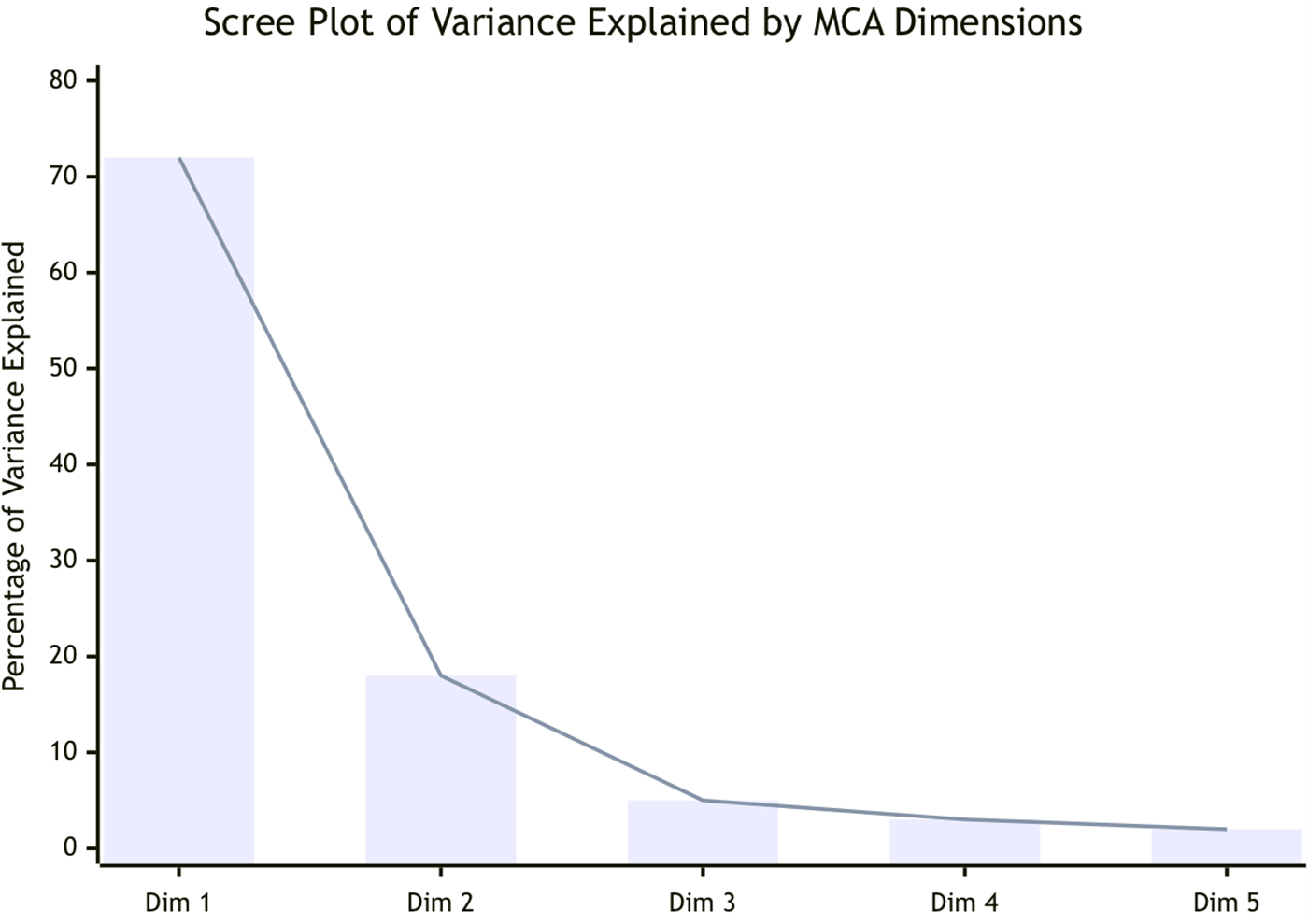
The MCA was conducted on the analytic sample (n = 930), incorporating sampling weights to ensure national representativeness. The analysis produced multiple dimensions, with the first five examined via the scree plot (Figure 2). The first dimension (MCA1) explained 72 per cent of the total variance, while the second dimension (MCA2) accounted for approximately 18 per cent. The sharp decline in explained variance after the first dimension on the scree plot supports the conclusion that MCA1 is the predominant dimension. Additionally, each of the remaining dimensions explained less than 5 per cent. Further, MCA1 was readily interpretable as a continuum ranging from low-complexity residential environments (e.g. detached, single-storey homes) to high-structural-complexity environments (e.g. multi-unit apartments located in attached buildings, which may be multi-storey). This representation aligns with our conceptualization of structural residential complexity. Therefore, factor scores for MCA1 were used as our primary exposure variable. Additionally, MCA2 and all higher dimensions were not retained for further analysis owing to their low cumulative explanatory power and lack of a clear, theoretically meaningful interpretation.
Regression modelling
The derived MCA1 scores were entered into ordinal logistic regression (OLR) models to assess their association with self-rated health. Ordinal logistic regression was selected as the most appropriate analytical approach because self-rated health is measured on a five-point ordered scale (from excellent to poor). Ordinal logistic regression is well-suited to this data structure because it preserves the meaningful rank order of the outcome variable. Therefore, this is a better choice than multinomial logistic regression, which treats outcome categories as nominally distinct and discards their inherent ordering. Ordinal logistic regression also requires that the proportional odds assumption be satisfied, that is, that the relationship between the predictor and the outcome is consistent across all thresholds of the ordinal scale. This assumption was formally tested using the Brant test and was not violated in our data (p = 0.214). This confirms that ordinal logistic regression is statistically justified and preferable to multinomial logistic regression for these data. We constructed three models to systematically evaluate this relationship. Model 1 was adjusted for age and sex; Model 2 added socio-economic confounders (education and race); and Model 3 was adjusted for functional capacity (ADL problems). All reported associations are interpreted as cross-sectional relationships and not as evidence of causal effects.
To test for effect modification, grounded in the P–E fit theory, which suggests that environmental press becomes more salient as capacity declines (Zhang et al. Reference Zhang, Zhang, Zhang, Chen, Wang, Fujii and Furuya2025), we added an interaction term between MCA1 and age groupings. We also included an interaction between MCA1 and sex to explore potential demographic heterogeneity. Significant interactions were explored using marginal effects plots.
Results
Table 1 presents descriptive statistics for the NHATS sample with valid data for each variable, alongside the restricted analytic sample (n = 930). The distributions of key characteristics in the analytic sample were largely representative of those in the broader NHATS sample with valid data, indicating no substantial selection bias owing to listwise deletion. The sample consisted of more women (58.1%) and had a fairly even distribution across age groups, with the largest percentage in the group aged 75–79 (24.4%).
Descriptive statistics with subgroup counts and percentages

Table 1 Long description
Descriptive statistics by subgroup are intended, with a column for the number of respondents with non-missing data and a column reporting either subgroup percentages or mean values with standard deviations. No rows, variables, subgroup labels, counts, percentages, or means are included in the provided input. Because the data cells are missing, key values, comparisons between subgroups, and any trends cannot be identified. Provide the table body to generate that highlights the largest subgroups, notable differences in percentages, and any meaningful differences in average values across groups.
Notes: N (valid): number of respondents with non-missing (valid) data for the variable. Regarding % or mean (SD): for categorical variables, this column reports the percentage (%) of respondents in each subgroup; for continuous variables, it reports the mean value with its standard deviation (SD) in parentheses.
Socio-demographically, the analytic sample was primarily composed of non-Hispanic Whites (74.2%), with 22.8 per cent reporting less than a high school education and 28.0 per cent holding a bachelor’s degree or higher. The functional capacity of the sample was fairly high, with an average of 0.4 (SD = 1.0) ADL difficulties.
The housing and health characteristics represented a population generally living independently. Almost 90 per cent of the population lived in detached houses (89.5%) and homes with multiple floors (83.2%). Regarding self-rated health, the sample distribution was as follows: 13.4 per cent reported excellent health, 26.9 per cent very good, 26.9 per cent good, 24.2 per cent fair and 8.6 per cent poor. This indicates that the majority (67.2%) rated their health as good, very good or excellent. Distribution of MCA1 scores by self-rated health categories is illustrated in Figure 1, suggesting some variation in characteristics related to the living environment by health status.
Residential complexity (MCA1) by self-rated health. Higher scores indicate complexity.

Multiple correspondence analysis dimensionality and the factor map (MCA)
The scree plot (Figure 2) illustrates the percentage of variance explained by the first five MCA dimensions. It shows that the first dimension (MCA1) is dominant, accounting for 72 per cent of the variance, and the second (MCA2) accounts for a further 18 per cent. The clear ‘elbow’ in the plot after the first dimension justifies its selection as the primary measure of residential complexity for all subsequent analyses.
Scree plot showing variance explained by the first five MCA dimensions.

The MCA factor map is shown in Figure 3 to display the contribution of dwelling types to the first two dimensions of the analytic sample (n = 930). It shows the contrast between the types of dwelling at the ends of the MCA1 degree-of-complexity continuum (e.g. detached to the left, multi-unit to the right). The first dimension (MCA1) represents a continuum of structural complexity, with positive loadings on multi-unit and attached housing at one end and negative loadings on detached houses at the other.
MCA factor map of housing categories.

What does MCA1 represent? Interpreting the residential complexity dimension
Prior to presenting the regression findings, it is important to describe what the first MCA dimension (MCA1) signifies in concrete housing terms, as this underpins the interpretation of all subsequent analyses. The first MCA dimension should be viewed as an operationalization of a continuous concept of residential complexity, reflecting how older adults’ housing types, residential districts and building floors cluster together.
Older adults with negative MCA1 scores typically reside in detached, single-storey homes in lower-density neighbourhood settings, the least structurally complex residential environments in the sample. This is a highly accessible, self-contained and autonomous residential environment with minimal physical and navigation demands placed on its occupants. Within the P–E fit framework, these environments are characterized by low environmental press.
At the high end of the MCA1 continuum (high positive scores) are older adults who live in the most structurally complex environments, often in multi-unit or attached dwellings such as apartments or townhouses with multiple storeys. These types of housing involve shared public spaces, shared corridors and stairways, higher neighbourhood densities and, in some cases, institutionally organized support services typical of retirement communities or assisted living settings. These environments impose greater physical and navigational demands on residents.
Mid-range values on the continuum reflect combinations of housing types (attached single-storey homes or single-family homes) in higher-density neighbourhoods. The MCA factor map shown in Figure 3 visually confirms this structure, with detached homes loading at the negative end of MCA1 and multi-unit, attached and multi-storey housing loading at the positive end.
Thus, for all subsequent analyses relating MCA1 to self-rated health, we interpret all relationships using the residential complexity continuum. While MCA provides a useful statistical summary of the co-occurrence of multiple housing characteristics, it is best viewed empirically rather than as a definitive or all-encompassing measure of residential complexity.
Ordinal logistic regression of self-rated health
The results of the OLR analyses are presented in Table 2. In the initial model, adjusted for age and sex (Model 1), residential complexity (MCA1) was significantly associated with poor self-rated health (β = −0.249, p < 0.001). This relationship was markedly attenuated when confounding socio-economic factors were included in Model 2 (β = −0.089, p = 0.062), and further attenuated towards non-significance with the inclusion of functional limitations in the final model (Model 3: β = −0.065, p = 0.148).
Ordinal logistic regression of self-rated health (analytic sample, n = 930)

Table 2 Long description
Ordinal logistic regression results for self-rated health are reported across three models with coefficients and standard errors for MCA1, demographics, and functional limitations. MCA1 is strongly negative in Model 1 (about minus 0.25) but becomes smaller and not statistically reliable in Models 2 and 3 (about minus 0.09 and minus 0.07). Female sex is linked to higher self-rated health in all models (about plus 0.11). Compared with ages 65 to 69, ages 70 to 74 and 75 to 79 show higher self-rated health, with the largest positive association for ages 75 to 79 (about plus 0.39 to plus 0.42), while ages 80 and older are not clearly different from the reference group. In Models 2 and 3, higher education shows a graded positive pattern, strongest for bachelor’s degree or higher (about plus 0.35). Race and ethnicity categories show small, non-significant differences relative to the reference group. In Model 3, higher ADL count is strongly associated with worse self-rated health (about plus 0.51), and MCA1 by age interactions become increasingly negative with age, reaching the largest negative value for ages 85 and older (about minus 0.31). Model fit is low and similar across models, so effect sizes should be interpreted cautiously even when statistically significant.
*** Notes: p < 0.001, **p < 0.01, *p < 0.05. Reference categories: male for gender; 65–69 for age group; less than high school for education; non-Hispanic White for race/ethnicity.
While the final model (Model 3) was statistically significant (LR χ2(13) = 385.24, p < 0.001), the low pseudo-R2 value (0.0071) indicated that the measured residential and demographic factors explained only a small part of the variance in self-rated health. This aligns with the understanding of health as multifaceted, with unmeasured variables such as income, social support and specific health conditions likely to be more significant.
To test for effect modification, interaction terms were included in the final model. The effects showed a significant interaction between residential complexity (MCA1) and the age group (p for interaction < 0.001). As shown in Figure 4, the MCA1‐age-group interaction showed a distinct age gradient of the adverse association between residential complexity and self-rated health. Among younger respondents aged 65 to 69 years, the association between complexity and self-rated health was negligible (β = −0.02, p = 0.812). For the groups aged 70–74 (β = −0.09, p = 0.185) and 75–79 (β = −0.15, p = 0.048), the adverse effect increased in magnitude, while its greatest effect was in the oldest-old groups aged 80–84 (β = −0.24, p = 0.005) and 85+ years (β = −0.31, p < 0.001). The interactions between MCA1 and sex were not statistically significant (p = 0.552). The proportional odds assumption was satisfied by all models (Brant test, p = 0.214).
Effect of residential complexity (MCA1) on self-rated health by age group.

Predicted probabilities of self-rated health by MCA component 1
To facilitate interpretation of the ordinal model, Table 3 presents the predicted probabilities for each self-rated health category across the range of MCA1 values from the final adjusted model (Model 3). A rather complex pattern emerges in the probabilities. When residential complexity (MCA1) increases, the probability of stating that one’s health is ‘excellent’ increases from 4.5 per cent to 11.3 per cent. A similar, but less marked, positive gradient is observed in the health answer combinations of ‘very good’ and ‘good’. On the other hand, the probabilities of answering ‘fair’ or ‘poor’ health decrease markedly with increasing values of MCA1.
Predicted probabilities of self-rated health by MCA component 1

Note: Probabilities are based on the final adjusted model (Model 3) and sum to 100 per cent within each row.
Whereas predicted probabilities indicated that high MCA1 values corresponded with better self-rated health, the adjusted regression indicated a net negative relationship, suggesting competing pathways: the benefits of urban density versus the burdens of structural complexity. The difference between the estimated regression coefficients and the estimated probability values indicates both the non-linear distribution of self-rated health and the effect of statistical adjustment for covariates. Although the pattern in marginal (unadjusted) probability suggests an association between residential complexity and self-rated health status, after adjusting for all relevant social/economic/functional confounders, the relationship between residential complexity and self-rated health is very small and not statistically significant.
Sensitivity analysis
Sensitivity analyses using multiple imputation for missing data yielded results consistent with those of the complete-case analysis. In the fully adjusted model using imputed values, the outcome for MCA1 was β = −0.071 (95% CI: −0.152 to 0.010), confirming a null-to-weak association after adjusting for potential confounders.
Discussion
This study employs an innovative analytical method, MCA, to combine housing type, residential district and building floors into a single measure of residential complexity. This technique is well-suited for creating holistic measures from categorical environmental data (Greenacre and Blasius Reference Greenacre and Blasius2006). This relational approach illustrates how associations between residential environments and health outcomes may be obscured when individual environmental characteristics are examined in isolation.
It is important to contextualize this research in the field of social gerontology as it situates our findings within the broader scholarly debates to which this study contributes. Social gerontology has long recognized that ageing occurs in a context beyond an individual’s biological processes. Ageing is also shaped by the social structures, institutions and environmental contexts where older adults live (Dannefer Reference Dannefer2003; Phillipson Reference Phillipson2007). Housing, therefore, represents a complex social institution that provides older adults with access to a range of resources and opportunities for social interaction and engagement, and that is associated with the reinforcement and construction of identities in later life (Rowles Reference Rowles2005; Sixsmith and Sixsmith Reference Sixsmith and Sixsmith2008). Therefore, the structural characteristics of a person’s living environment (i.e. housing type, building design and neighbourhood setting) represent social determinants of health in later life, both reflecting and reinforcing established patterns of socio-economic inequality and disadvantage throughout one’s lifetime (Dannefer Reference Dannefer2003; Shaw Reference Shaw2004). This study contributes to social gerontology by providing empirical evidence on how structural residential factors collectively associate with self-rated health among older adults. Self-rated health is a widely validated indicator of wellbeing and mortality risk in older populations (Wuorela et al. Reference Wuorela, Lavonius, Salminen, Vahlberg, Viitanen and Viikari2020).
Our findings reveal a complex cross-sectional association between the structural aspects of the residential environment and self-rated health among older Americans. The initial significant negative association between residential complexity and self-rated health was substantially reduced after adjusting for age, sex, education, race and functional capacity, becoming non-significant in the fully adjusted model. This suggests that the apparent health disadvantage associated with complex residential environments is largely explained by socio-economic status and pre-existing functional limitations, a pattern consistent with studies highlighting the role of health selection and social stratification in housing outcomes (Shaw Reference Shaw2004). Importantly, however, given the cross-sectional design of this study, the direction of this association cannot be established with certainty, and reverse causality cannot be ruled out. Indeed, the opposite causal direction may be equally, or more, plausible: older adults in poorer health may be more likely to reside in certain types of housing, such as supported or multi-unit dwellings, precisely because their health needs require greater care access, proximity to services or institutional support (Phillipson Reference Phillipson2007; Wahl et al. Reference Wahl, Iwarsson and Oswald2012). This health selection process, whereby health status shapes residential location rather than the other way around, is well-documented in the housing and ageing literature and represents a significant interpretive challenge for cross-sectional studies of this kind (Shaw Reference Shaw2004; Curl et al. Reference Curl, Kearns, Mason, Egan, Tannahill and Ellaway2015). All associations reported in this study should therefore be interpreted as cross-sectional correlations rather than evidence of a directional effect of residential environments on health.
Importantly, the association varied across age groups, with a stronger pattern observed across successive age groups, and it was strongest among the oldest-old. This gradient aligns with the P–E fit construct (Cao and Hou Reference Cao and Hou2022; Zhang et al. Reference Zhang, Zhang, Zhang, Chen, Wang, Fujii and Furuya2025), as the cumulative decline in physical and sensory capabilities with age (Baltes and Smith Reference Baltes and Smith2003) is likely associated with greater susceptibility to the challenges posed by complex structural environments. The oldest-old, who experience cumulative health deficits, sensory deterioration and diminished functional resilience, seem particularly vulnerable to the challenges posed by structurally complex residential environments (Rockwood and Mitnitski Reference Rockwood and Mitnitski2007; Wahl et al. Reference Wahl, Fänge, Oswald, Gitlin and Iwarsson2009). This finding goes beyond a simple binary comparison and indicates that vulnerability to environmental press intensifies progressively with age.
These findings suggest that residential complexity is associated with both potentially supportive and potentially hindering factors for healthy ageing. While regression results indicated an overall negative effect, predicted probabilities showed potential benefits for functionally capable or younger older adults, highlighting conflicting mechanisms. For an older adult with mobility issues, navigating multi-storey buildings may be associated with greater barriers to independence and an elevated risk of accidents and social isolation (Domènech-Abella et al. Reference Domènech-Abella, Switsers, Mundó, Dierckx, Dury and De Donder2021; Xue et al. Reference Xue, Lu, Zheng, Zhang, Lin, Qin and Zhang2021). Conversely, for a younger, functionally capable older adult, the same urban environment may be associated with better access to amenities, health care and social opportunities, potentially reflecting a ‘density benefit’ that is documented in the urban health literature (Vlahov et al. Reference Vlahov, Freudenberg, Proietti, Ompad, Quinn, Nandi and Galea2007; Michael and Yen Reference Michael and Yen2009). This duality is fundamental to the P–E fit framework, where health outcomes depend on the match between personal capabilities and environmental demands (Cao and Hou Reference Cao and Hou2022; De Cooman and Vleugels Reference De Cooman, Vleugels and Bergh2022; Zhang et al. Reference Zhang, Zhang, Zhang, Chen, Wang, Fujii and Furuya2025). From a social gerontological perspective, this duality reflects the principle of cumulative disadvantage, the process by which social inequalities accumulate over the lifecourse such that older adults with fewer economic, social and physical resources are disproportionately exposed to the adverse aspects of complex residential environments while being least equipped to benefit from their potential advantages (Crystal and Shea Reference Crystal and Shea1990; Dannefer Reference Dannefer2003). The attenuation of the association between residential complexity and self-rated health after adjusting for socio-economic status and functional capacity is consistent with this framework, suggesting that it is the intersection of residential environment with social disadvantage, rather than the physical environment alone, that is most consequential for health in later life. This has important implications for social gerontology’s long-standing concern with health inequalities among older adults, pointing to the need for analyses that move beyond individual-level health behaviours to consider how structural residential conditions interact with social position to shape ageing outcomes (Phillipson Reference Phillipson2007; Marmot Reference Marmot2020).
Our findings support existing research on the significance of the built environment. Accessible housing, walkable neighbourhoods and good indoor environmental quality are well-established correlates of health in later life (Carson et al. Reference Carson, Conway, Perez, Frank, Saelens, Cain and Sallis2023; Leyden et al. Reference Leyden, Hogan, D’Arcy, Bunting and Bierema2024; Yan et al. Reference Yan, Lan, Gong, Guo and Hou2025), as framed by ecological models of ageing that emphasize the role of the physical environment (Lawton and Nahemow Reference Lawton, Nahemow, Eisdorfer and Lawton1973; Lawton Reference Lawton1977). This study confirms the findings of a recent study (Lyu et al. Reference Lyu, Forsyth and Worthington2021) that observed poorer self-rated health among older adults living in walk-up apartments, and aligns with research linking neighbourhood social cohesion and access to services with improved wellbeing (Barnett et al. Reference Barnett, Barnett, Nathan, Van Cauwenberg and Cerin2017; Zimmermann Reference Zimmermann2024). The mixed findings in the literature, including studies indicating negative effects for low-income older adults (Yun Reference Yun2021), further emphasize the P–E fit principle that the same environment can either hinder or help, depending on an individual’s resources and capacities.
Methodologically, using MCA represents an advance as it more holistically measures the multi-dimensionality of residential environments rather than analysing isolated housing characteristics (Li et al. Reference Li, Legault, Girard, Ferrucci, Fried and Cohen2022; Leyden et al. Reference Leyden, Hogan, D’Arcy, Bunting and Bierema2024). The very low explanatory power of our model highlights that the structural features measured are only a small part of the overall picture. Factors like social networks (Berkman et al. Reference Berkman, Glass, Brissette and Seeman2000), detailed neighbourhood attributes (Brown et al. Reference Brown, Mason, Lombard, Martinez, Plater-zyberk, Spokane, Newman, Pantin and Szapocznik2009) and psychological resources are likely to show much stronger associations with self-rated health (Barnett et al. Reference Barnett, Barnett, Nathan, Van Cauwenberg and Cerin2017; Ozili Reference Ozili2023).
Social gerontology extends theory to practice through its application to policy and practice. A central concern of social gerontology is ageing in place, the ability to stay in one’s home and community while ageing independently with dignity and maintaining social connections. The findings of this study suggest that the structural characteristics of the residential environment represent an important yet under-appreciated dimension of ageing in place. Current ageing-in-place initiatives have primarily focused on individual adaptability, such as making changes to the home, using technology to enhance living conditions and accessing supportive care (Wiles et al. Reference Wiles, Leibing, Guberman, Reeve and Allen2012). However, the structural residential complexities identified in this study, encompassing housing type, building design and neighbourhood setting, operate at a structural level that individual adaptations alone cannot adequately address. This points to the need for upstream, structural interventions in housing policy and urban planning that go beyond individual-level home modifications. The association between the oldest-old and the poorer self-rated health in structurally complex residential settings is consistent with social gerontology’s long-standing concern with the fourth age, which represents a time of heightened risk for dependency, loss of autonomy and social isolation in late life (Baltes and Smith Reference Baltes and Smith2003; Gilleard and Higgs Reference Gilleard and Higgs2010). Therefore, policies addressing housing needs and ageing-in-place requirements must acknowledge the diversity within the older adult population. A one-size-fits-all approach to designing housing and providing ageing-in-place support will fail to meet the needs of the most vulnerable members of this population.
The main methodological strength of this study is its novel application of MCA to derive a latent construct of residential complexity from categorical housing data, combined with ordinal regression to model its relationship with health. This integrated approach allows for a nuanced examination of non-linear trends and subgroup differences that conventional methods might miss. Despite a robust design and nationally representative data, several limitations must be acknowledged. First, the cross-sectional nature of the data, collected at a single point in time, precludes any causal inference. Crucially, and relatedly, the direction of the association between residential complexity and self-rated health is ambiguous. While we have framed residential complexity as a potential correlate of self-rated health, it is also reasonable to suggest, and possibly even more intuitive, that poorer health is associated with where older adults live. For example, older adults with declining health or functional limitations may relocate to an apartment building with support services (such as a residence manager) or other forms of supportive housing (such as assisted living), not because complex residential environments are inherently preferred but because their health needs require greater care access, proximity to services or institutional support. Therefore, the relationship between residential complexity and self-rated health may reflect health status shaping residential location rather than residential complexity associating with health (Shaw Reference Shaw2004; Phillipson Reference Phillipson2007; Curl et al. Reference Curl, Kearns, Mason, Egan, Tannahill and Ellaway2015). Thus, the primary limitation of this research is the inability to differentiate the health selection bias inherent within these data from the factors being studied. Second, our operationalization of the environment was limited to three structural variables. While MCA efficiently combined these measures, our construct of ‘residential complexity’ did not capture important features such as elevator access, neighbourhood walkability or social cohesion, which are theorized to be key components of environmental press within the P–E fit model. Third, on the person side of the P–E fit model, our measures of individual capacity (SRH and ADLs) are useful but inadequate proxies for the full range of sensory, cognitive and motor capacities postulated to interact with the environment. Although sex-stratified analyses were not conducted as stand-alone models, sex was included both as a covariate and through a formal interaction term, which indicated no statistically significant difference in the association between residential complexity and self-rated health by sex. Furthermore, stratifying the analysis by sex would have reduced the analytic sample to approximately 540 women and 390 men, substantially reducing statistical power, particularly in the oldest-old age categories where cell sizes are already small. Given the well-documented sex dimensions of housing, ageing and health (Arber and Ginn Reference Arber and Ginn1991; Calasanti Reference Calasanti2010), future research with larger samples should examine whether the association between residential complexity and self-rated health varies more subtly by sex across specific housing contexts or age groups.
Future research should utilize longitudinal designs to establish temporal precedence and include more comprehensive environmental audits (e.g. geospatial walkability data, presence of elevators) and personal measures (e.g. cognitive function) to better test the P–E fit model. Mixed-methods approaches could shed light on the lived experiences of older adults navigating complex residential environments.
Conclusion
This study examined the association between structural residential complexity and self-rated health among older adults in the United States, contributing new evidence to ongoing debates in social gerontology about the role of residential environments in shaping health outcomes in later life. The findings reveal that the association between structural residential complexity and self-rated health is heterogeneous, varying considerably by socio-economic status and functional capacity. Importantly, this association showed a clear age gradient, with its magnitude increasing progressively across age groups and peaking among the oldest-old. Older adults aged 85 and over showed the strongest association between residential complexity and poorer self-rated health, suggesting that this group is particularly vulnerable to the demands of structurally complex residential environments. As such, these findings suggest the need for more tailored and specific approaches to addressing ageing-in-place policy. These findings underscore the need for housing and ageing policies that move beyond individual-level home modifications to incorporate upstream structural interventions, including accessible building design standards, age-friendly urban planning and equitable distribution of supportive housing, tailored to the specific needs and capacities of different subgroups of the older adult population.
Acknowledgements
We are grateful to the National Health and Aging Trends Study (NHATS) for having allowed us access to the data.
Financial support
This work was supported by the National Social Science Fund of China under Grant 21BSH106: Research on the Family Care Support System for Rural Disabled Older Adults from the Perspective of Multi-stakeholder Collaborative Governance.
Competing interests
The authors declare none.
Ethical standards
This study was performed in line with the principles of the Declaration of Helsinki. Approval was granted by the Johns Hopkins University Institutional Review Board. Informed consent was obtained from all individual participants included in the study.