Since stage plays are the doctrine of the devil, the counsel of the ungodly, the way of sinners, the chair of pestilence, the forerunner of a curse procured to that land wherein they flourish, how can they be suffered in this commonwealth wherein we profess the name of Christ?
—Stephen Gosson, Plays Confuted in Five Actions (1582)Footnote 1Introduction
No discussion of antitheatrical polemics can escape mention of Stephen Gosson. His characterization of theatre as the “doctrine of the devil” is found in his last of a succession of pamphlets attacking the theatre. His polemics comprise one of the most theologically nuanced arguments against the Elizabethan stage—euphuistic though they may be. Indeed, others were far more concise. The preacher William Holbrooke, for instance, made his case with efficiency when he branded stage players “scumme of the world.”Footnote 2
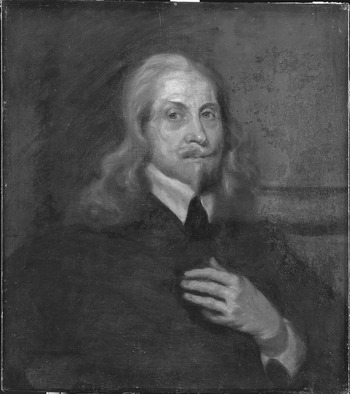
These two men were mere representatives of an antitheatricalist army writing and preaching in the late sixteenth and early seventeenth centuries. But even among those who did not share their antitheatrical position, actors were associated commonly with the likes of prostitutes and con men. It is an extraordinary curiosity, then, that we find images of actors portrayed in honorable fashion—with a hand placed gallantly over the heart—in a medium almost exclusively reserved for royals and the nobility (Figs. 1, 2). How was it that an actor whose life counted for little—even through the rise of the public theatres—found his face on the painter's canvas?
British School, called Nathan Field, ca. 1615, oil on oak panel, 56.5 × 42.2 cm, DPG385. Cartwright Bequest, 1686. By permission of the Trustees of Dulwich Picture Gallery, London.

British School, Richard Perkins, 1630s–1640s, oil on canvas, 69.8×61.9 cm, DPG423. Cartwright Bequest, 1686. By permission of the Trustees of Dulwich Picture Gallery, London.

Initially, this discussion reviews early modern English portraiture in general and establishes the meaning of a particular gesture—the hand to the heart. I suggest that this gesture is shared across portraits of preachers and players in particular, and is not found in other portrait sitters from the era. I investigate how the gesture was understood by both groups of men and how the shared iconography of these portraits relates them to one another.
Indeed, if we consider church and theatre as competing kinds of performance in early modern England, preachers and players were in competition with one another for audiences. According to Jeffrey Knapp, religious reformers wondered at the baffling paradox before them. God's word had been reinstated to its rightful place, emancipated from theatrical Catholic ritual. It was now broadcast from the pulpit in the vernacular, for listeners long deprived of the plain-spoken Gospel. Why then were people vacating their pews for a place at the theatre? Knapp suggests that a fellowship of theatre people extended to the audience to create a radically inclusive community—one that the church failed to provide, partly due to its own infighting and growing fragmentation.Footnote 3 This fellowship was competitive with the church, and Knapp synthesizes an array of literary sources to characterize an explicit preacher-versus-player dynamic. I seek to enrich this argument here by attending to visual sources that portray a relationship between preachers and players—a relationship suggested by the iconographic resemblance across portraits of these apparently adversarial groups.
An Anomaly
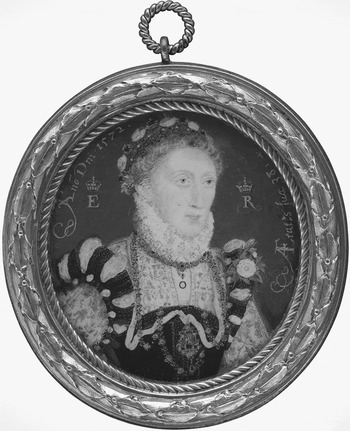
In 1969, Roy Strong, then the director of London's National Portrait Gallery, published what he called a “pioneer effort” with The English Icon: Elizabethan and Jacobean Portraiture. Footnote 4 Strong's introductory remarks highlighted the neglect of English painting in art-historical study, a neglect he believed due to a misunderstanding of style. That is, faces seen by some as “reduced to meaningless masks” had not been necessarily the result of artistic hackwork but rather a reaction to both English iconoclasm and the shadowed realism of Renaissance painting brought to England mainly by Flemish émigré painters.Footnote 5 What resulted was “the two dimensional, bright, flower-coloured world of the high-Elizabethan portrait” (Fig. 3).Footnote 6
Nicholas Hilliard, Queen Elizabeth I, 1572, watercolor on vellum, 51 mm × 48 mm, oval. Purchased 1860, NPG 108. © National Portrait Gallery, London.

Strong's voice remains influential in the study of English painting and, in particular, the English portrait. His discussion is restricted mainly to royal and court portraiture and those painters of royal and aristocratic patronage like Holbein, Eworth, and Hilliard. However, there exists another category of early modern portrait that warrants attention. Social and cultural historian Robert Tittler seeks to complement Strong's work with his 2007 The Face of the City:
[T]his study investigates the meaning and role of portraiture in the political and social discourse of the day. It does so not by examining the familiar milieu of the royal court and country house, but rather by considering the civic context of urban, pedagogical and occupational institutions.Footnote 7
When viewing the plates in Tittler's book, it is clear that we are confronted with a different kind of image. If Strong characterizes the era's court portraiture as two-dimensional, Tittler's civic images are by comparison utterly flat (Fig. 4). Images painted in the “vernacular,” according to Tittler, exhibit a certain modicum of skill but are not, however, to be assessed entirely as painterly works of art. Tittler pursues what these images reveal about civic identity outside the aristocracy, in and around London. He calls it “portraiture from below,” with an interest in how and to what effect images were displayed in livery halls, hospitals, universities, or other civic spaces.Footnote 8
Artist unknown, John Falkner, Mayor of Gloucester, ca. 1600, oil on wood panel, 82.2×73.3 cm, GLRCM Art01071. From the collections of the Gloucester Life Museum, Gloucester, England. Photo: Gloucester Museums Service Art Collection.

The portrait of prominent actor Edward Alleyn poses difficulties for both Strong and Tittler's classifications (Fig. 5). Given that Alleyn founded Dulwich College, Tittler may well claim it as a civic portrait. It now hangs at Dulwich and probably did so near the time of Alleyn's death in 1626.Footnote 9 However, the style and composition of the painting make it difficult to designate it “portraiture from below.” Even if the body is disproportionate and bulky, the eyes and hands are wrought with a masterly touch. The subtle, heavenly glow emanating from Alleyn's collar draws us to his soft eyes and even more compellingly to the hand he holds in a gesture of loyalty over his heart. In fact, it is this very gesture that sets Alleyn's portrait singularly apart from both Strong's and Tittler's categories.
British School, Edward Alleyn, 1626, oil on canvas, 203.8×114 cm, DPG443. Probably Alleyn Bequest, 1626. By permission of the Trustees of Dulwich Picture Gallery, London.

In a broad review of the portrait collections from the era in London's National Portrait Gallery and Dulwich Picture Gallery, the hand-to-the-heart gesture is remarkably rare. It is not typical of subject poses during the period. However, when subsequently delimiting a review to player portraits of the era, it appears often. There is a similar gesture, also uncommon within the larger collections, where the sitter presses a sash against his chest, but this mannerism can be differentiated from the more intentional assignment of the hand to the heart. Sarah Cohen has identified “showing the heart” as a sign of fraternity.Footnote 10 Might the gesture in portraits such as Alleyn's then indicate membership in a brotherhood of actors? After all, the all-male acting companies of the time were internally close-knit and highly competitive with one another.
Given these initial observations, where does Alleyn's quasi-aristocratic portrait fit? Actors certainly were not nobles and were widely regarded with moralistic disdain. Nor were they public servants or merchants, in Tittler's civic sense. I suggest here that player portraiture, like the players themselves, fashioned a new identity that was neither courtly nor civic. In early modern England, player portraits point to a new, self-fashioned class distinction that drew on both the occupational character of the sitter as actor and the novel relationship to both his company and his public—and perhaps, also, to his religious competitors for public attention.
Knapp and others have provided an opening for further investigation of both the local circumstances and the broader mentalité that contributed to the vital role church and theatre played as reciprocally formative partners, whether for good or ill.Footnote 11 Informed by their contributions and drawing also on Stephen Greenblatt's earlier work on Renaissance selfhood, I explore a group of early modern works of art that ostensibly should not exist—player portraits—in order to ask, simply: what were the forces at play that permitted a man who shared ranks with prostitutes and con men to find his portrait beautifully ensconced on a painter's canvas? Portraiture was reserved mainly for the representation of the nobility, or at least those with civic or mercantile responsibilities; the visage of a common player had no claim on such representation. However, I want to suggest that the church, in its intention to censure these players, generated the “bad press” that ironically helped to refashion the player's reputation, giving way to such honorific representation as found in these paintings. Further, I ask whether the entanglement itself, between preachers and players, is portrayed across these same images.
Immediate Context
In the late sixteenth and early seventeenth centuries, as is well known, there was widespread opposition to the theatre. Some of this appeared to have been motivated by fear of pickpockets who preyed on theatregoers, or of the possibility of plague spreading amid the throng who gathered in playhouses. These were not objections to theatre per se, unlike the objections raised by religious voices. Aside from the occasional concession—that is, if students enacted parts as a means to learning Latin at the universities, or if the drama conveyed a distinctly Christian moral—sentiments like Gosson's were shared by many prominent churchmen, who warned against the dangers of theatre in print and from the pulpit. For instance, in the first published attack on the public theatres—a treatise from 1577 that was both popular and influential, summoning a second printing quickly on the heels of its first—John Northbrooke proclaims,
Yea truly, for I am persuaded that Satan has not a more speedy way and fitter school to work and teach his desire, to bring men and women into his snare of concupiscence and filthy lusts of wicked whoredom, than those places, and plays, and theaters are: and therefore it is necessary that those places and players should be forbidden and dissolved and put down by authority, as the brothel houses and stews are.Footnote 12
But as Knapp shows, such objections were contested, and it was the players, rather than the preachers, he suggests, who were winning Elizabethan and Jacobean audiences: the theatre was popular. Knapp observes, “for the reformed clergy (many of whom took up the attack on the stage in their sermons), the mortification produced by [the] outrush of patrons from church to theater must have been acute.” He shows that friends and foes of the theatre alike attribute its popularity variously to the wickedness of the playgoing public, the skills of the players, and the incompetence of many a preacher to present their objections effectively.Footnote 13 Whereas Knapp goes on to develop his argument even further with a skillful appeal to literary texts, specifically Shakespeare's Henry V, my focus on player portraits offers evidence of a different sort to support Knapp's claims. The evidence offered by the player portraits I consider is best understood in relation to what Stephen Greenblatt has called, in one of his most influential contributions to our understanding of the period's mentalité, “renaissance self-fashioning.”Footnote 14
In everyday early modern English usage “to fashion” is to make, to mold, or to fit. It is used mainly in reference to materials of trade—metal, fabric, and glass. In Renaissance Self-Fashioning, Greenblatt reveals a tendency in early modern literature to use this term to describe work on one's own self. According to Greenblatt, this marked a shift away from a medieval conception of self-denial expressed, for instance, by Augustine in City of God when he wrote, “Try to build up yourself, and you build a ruin.”Footnote 15 Greenblatt argues that early modernity presented a set of conditions that enabled and encouraged intentional self-making. To make his case, Greenblatt points to a kind of “mobility” not seen before—a mobility born of the broader exposure of early modern people to new ways of addressing and negotiating the world.Footnote 16 According to Greenblatt, more widespread literacy and larger personal incomes, alongside the wide production and accessibility of printed material, were the key mobilizing factors. Players participated in this new mobility.
For instance, an actor's profession was itself enmeshed in literary production. A player had to be a skilled reader, in order to commit scripts to memory and negotiate last-minute textual changes. In fact, players may have belonged to one of the more literate groups in early modern society, since the ability to read and negotiate large amounts of text was a fundamental qualification for their profession. A player often performed the additional role of playwright or at least found himself collaborating on texts with the likes of Shakespeare and Jonson. Playmaking was a company effort, and scripts were written and rewritten continually to meet an array of needs, from adapting characters to suit different actors to incorporating the latest gossip or political intrigue.
A player's income arguably was on the rise due to the establishment of playhouses and patronage. Players just decades earlier had traveled in troupes begging consent from town magistrates to produce open-air performances. Now they had a stable, legal, and dedicated workplace. It is significant also that both Elizabeth and James I offered their royal patronage. Support and management of the playhouses came from the royal household through the office of Master of the Revels and the Lord Chamberlain. Though much of this management came in the form of state censorship, the office offered unprecedented protections as well. The prolific pamphleteering, which variously indicted and defended the theatre on moral and theological grounds, attested to its increasing social significance.
But it was also the practice of theatre itself that gave players access to the experience of a protean self. The range of class positions, gender identities, and ethnicities rendered by Renaissance dramatists—even if they did not call for the reproduction of the authentic personhood of a Jewish merchant in Venice, for instance—called upon actors to portray a wide range of different cultural traditions, economic stations, and religious convictions through the course of a weekly repertory. For the common player, theatrical performance is one answer to Greenblatt's question, “[W]hat forces were at work in sixteenth-century England that enabled individuals to conceive of themselves as malleable roles in life itself[?]”Footnote 17 Not only did the player garner an experience of a malleable self, but the audience too participated in these recreational subversions of fixed identity. That is, they witnessed the same player in a host of roles over the course of his career and sometimes within the same play. What did it mean to an impoverished man to see a poor player strutting and fretting in the costume of a nobleman, addressing his affluent peers onstage? What did it mean for any woman to witness Portia preaching and practicing the virtues of mercy in the guise of a male magistrate, holding trial over a group of men?Footnote 18 Indeed, what did it mean for clergy to have their sacred garb sullied by vagabond players in roles like Jonson's ridiculous Anabaptist Ananias from The Alchemist, or the dreaded Cardinal Pandolphe from Shakespeare's King John?
Not only did the Globe offer its performers and audiences an experience of its own namesake—a multitude of places—but Shakespeare's theatre also offered a world of ideas and modes, protean ways of being, over and against what was seemingly inescapable outside the theatre's encircling embrace. Greenblatt, in a preface added in 2005, reflects on Renaissance Self-Fashioning:
[My] vision of the nature of inner life was deeply pessimistic—the hidden place into which one might hope to retreat in order to escape a totalizing institution was itself created by that institution—but the pessimism seemed constructed around a small, irreducible core of hope: it was possible to see how it was done and therefore it was in principle possible to see how it might be undone.Footnote 19
The theatre is a place where it might be possible to realize Greenblatt's “dream of undoing.”Footnote 20 It mirrors the totalizing institution and then, with its literary content and very mode of expression, weakens the forces of that institution, undoing its grip on the inner self.
Although actors were achieving some degree of social mobility in early modern England, the puritan clergy were a powerful force working to suppress them and the theatre in general. If players were to rise in the social ranks, they would need to answer the churchmen with equal force. Gosson epitomizes the puritan attack:
Players are masters of vice. … I hope the wise will account it necessary that such … [be] cut off from the body as putrified members for infecting the rest. … God is just, his bow is bent and his arrow drawn, to send you a plague if you stay too long.Footnote 21
In leveling such accusations, Gosson attests to the player's power. Whether for good or ill, actors had risen from among the mass of common thieves and whores to aspire to a higher social status. How would they seize this new station? Would they respond to the religious attack to fashion an offstage role for the community, one that spoke to their personhood and not just their profession? The player Nathan Field did just that when he responded to a sermon preached by Thomas Sutton, offering the kind of reply that might be expected of a learned and devout Christian—and certainly not of a “putrified member[ ]” of the church body:
[Y]ou have not spared in the extraordinary violence of your passion particularly to point at me and some other of my quality, and directly to our faces in the public assembly to pronounce us damned, as though you meant to send us alive to hell in the sight of many witnesses. Christ never sought the strayed sheep in that manner; he never cursed it with acclamation or sent a barking dog to fetch it home, but gently brought it upon his own shoulders. The widow never searched for her lost groat with spleen and impatience, but gently swept her house and found it.Footnote 22
With intentional irony, Field's letter indicts the preacher on the grounds of emotional indulgence—extraordinary for an actor who exploits his own emotions to help tell a story.
That Shakespeare should write an apology for players is no surprise. However, the playwright did not reveal his personal opinion as directly as his fellow actor, Field. His public discourse is found almost exclusively in his plays. We find his actors’ apology in the words of Hamlet's instruction to the Players:
Suit the action to the word, the word to the action, with this special observance, that you o'erstep not the modesty of nature. For anything so overdone is from the purpose of playing, whose end, both at the first and now, was and is, to hold, as ’twere, the mirror up to nature, to show virtue her own feature, scorn her own image, and the very age and body of the time his form and pressure.Footnote 23
Here, Shakespeare makes a case for acting as a serious vocation, attributing to the player an almost salvific social responsibility, fashioning for the actor a self that stood in striking opposition to puritan portrayals of the derelict player.
With religious reformers bent on arresting “the rise of the common player,”Footnote 24 I offer the portrait here as another arena wherein actors fashioned a self that would rebut antitheatricalist claims. The English Renaissance portrait provided a stage outside the theatre onto which the player might project an image of the self he had fashioned. Further, the portraits I consider drew on a theatrical practice—gesture—to communicate something of these refashioned selves. The prominent early modern English physician John Bulwer offers a telling description of what these portraits’ central gesture may have intended to convey:
To lay the hand open to our heart using a kind of bowing gesture, is a garb wherein we affirm a thing, swear or call God to witness a truth, and so we seem as if we would openly exhibit unto sense, the testimony of our conscience, or take a tacit oath, putting in security, that no mental reservation doth basely divorce our words and meaning, but that all is truth that we now protest unto.Footnote 25
Guided by Bulwer's account of the meaning of this gesture, I now offer a comparative iconographic analysis of seven portraits of men who lived between the years 1566 and 1669. Each man was at least twenty years of age in 1620; the oldest, fifty-four. Of the seven portraits considered, four are of puritan preachers and three are of well-known stage players.
Honest Gestures
The first (see Fig. 5) is the only known image of Edward Alleyn (1566–1626), regarded as one of the few actors to rival the era's preeminent player, Richard Burbage. Considering its “1626” inscription in the left corner, the portrait may serve as a memorial. Additionally, it may have played a part in the dedication of Dulwich College, founded by Alleyn in 1619. Alleyn had invested early in the playhouse he served and subsequently amassed sufficient wealth before his death to be able to fund the college.
In contrast to the horizontal lines of the wainscoting and floor, the dominant line of the painting is vertical, created by the subject's full, standing body, displayed at a quarter turn away from the viewer, eyes forward. Alleyn is dressed in a black, floor-length, velvet robe, crenellated at the upper arm. He wears the ubiquitous Elizabethan white lace collar painted with scalpellike precision. Plain, stiff, white cuffs, grayed by shadow, turn out over his black sleeves, and he wears a wide-brimmed, black hat. Alleyn's left arm relaxes vertically at his side, and he holds loosely in his hand a pair of matte gold gloves.
Alleyn's face is realistically wrought, relaxed and soft—were the image a movie still, it would appear that a diffusion filter had been applied to the camera lens. Standing out from his near-alabaster complexion, Alleyn's cheeks are softly punctuated with small, ruddy circles just above the line of his beard. Like the dominant line of the painting, Alleyn's face is long, accentuated by the reach of his hat upward, countered by the length of his full and narrow beard downward.
Most of the portrait's surface area is saturated with black and deep brown hues. It is an utterly dark painting, from background to foreground. However, the glowing white collar illuminates Alleyn's face and right hand to an extent that makes them the dual focus of the painting. The collar casts light most brightly on the forehead above Alleyn's right eye and downward in an opposite trajectory onto the wrist of his right hand.
Although a portrait of a well-known person, and certainly an actor whose livelihood is tied to his very appearance, might normally be expected to draw our attention most directly to the face, the viewer is drawn here, perhaps curiously, to the hand that floats over Alleyn's breast. The hand emerges from the darkest hues of the painting, surrounded by the heavy, black fabric of the actor's robe. The last finger is spaced delicately from the others and is adorned with a small but flaming, red-orange signet ring. The subtle, heavenly glow emanating from Alleyn's collar draws us to his soft eyes but even more compellingly to the hand he holds in a gesture of loyalty over his heart. It is this gesture that makes Alleyn's portrait the starting point for the iconographical analysis that follows.
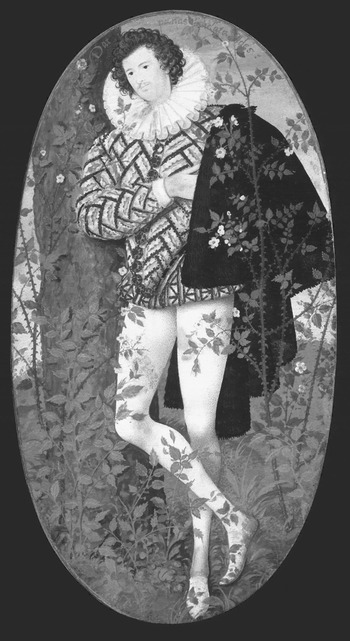
In an initial review of the portrait collections from the era in London's National Portrait Gallery and Dulwich Picture Gallery, the hand-to-the-heart gesture is by no means ubiquitous. Rather, an array of gestures is employed in royal and courtly portraiture, functioning in part to display wealth. Often, noblemen strike a pose with hand to hip, the better to show the costly detail of their costume. Women are sometimes seen clutching a sash to their chests; however, this gesture emphasizes the details of costume, as well, and is not so cleanly a direct salute to the heart. According to Strong, Nicholas Hilliard's miniature Young Man among Roses is the quintessential Elizabethan expression of romantic longing, and we do find the hand to the heart here (Fig. 6).Footnote 26 However, this is a decidedly romantic gesture and is seen in double-portraits of lovers and married couples.
Nicholas Hilliard, Young Man among Roses, ca. 1587, watercolor on vellum stuck onto card, 13.5×7.3 cm. Bequeathed by George Salting, P163-1910. © Victoria and Albert Museum, London.

In a broad review of English portrait collections, two groups, however, were consistent with Bulwer's description: preachers and players. The portrait of puritan divine John Cotton (1585–1652) is especially noteworthy.Footnote 27 The original has been altered in a number of ways. In the reconstruction of what is thought to lie beneath those alterations, Cotton's right hand rests on his breast and is framed by his simple, puritan collar above and an open Bible in his left hand below (Fig. 7). Since we are confronted directly by Cotton's gaze and the scriptures he presents, it is reasonable to imagine that the central gesture of the painting addresses us directly as well. Indeed, the hand at center appears more robust than Cotton's face, as if it were the hand of a larger man. We are meant to contemplate this hand as more than just a finished pose. According to Cohen, this gesture is enacting something central to human experience:
Touching one's heart is a gesture so well known in the modern Western world that we hardly think any more about what it means. But when a work of art makes us confront the gesture—so that we really see and consider it as an action—it emerges as one of the most expressive actions we can perform. A touch to the heart brings to the surface life's inner pulse, and reminds us that emotion is above all movement, passing from person to person in myriad, intersecting ways.Footnote 28
Artist unknown, Rev. John Cotton, 1649. Modern reconstruction courtesy Barry A. Cotton. Connecticut Historical Society, Hartford.

Although it was painted around 1649, more than twenty years after Alleyn's portrait, Cotton's gesture seems to be part of the same emotional and iconographic world: it is inspired most likely by a popular form of piety espoused by his spiritual advisor, Richard Sibbes (1577–1635), who was a contemporary of Alleyn's. Sibbes's heart-piety converted Cotton and deeply convicted other nonconformists to create a veritable brotherhood of men devoted to an affective kind of puritan devotion.Footnote 29 This spiritual fraternity included John Davenport, Jeremiah Burroughs, and Sidrach Simpson (Figs. 8–10). We see in each of their portraits Cotton's gesture repeated. These images attest to each man's affective relationship with the word of God, with the viewer, and with each other.
(right). “Davenport Limner” (American), Rev. John Davenport, 1670, oil on canvas, 69.2×58.4 cm, 1750.1. Photo: Yale University Art Gallery, New Haven, CT.

(below left). Thomas Cross, Rev. Jeremiah Burroughs, 1646, line engraving, 170×114 mm, NPG D26846. © National Portrait Gallery, London.

(below right). Artist unknown, Rev. Sidrach Simpson, ca. 1655, line engraving after painting, NPG D10590. © National Portrait Gallery, London.

Cohen demonstrates, however, that it is precisely in the very early seventeenth century that this gesture also starts to appear within a secular context. Pairs or groups of subjects portray a “central touch of hand to heart enact[ing] the emotional bonds of friendship among men.”Footnote 30 It is reasonable, then, that the gesture shared across the preacher portraits portrays both religious experience and male friendship. The gesture signals both the spiritual manner by which these men receive divine love—through Sibbes's heart-piety—and their simple belonging to a devotional brotherhood.
Nonetheless, this gesture had been understood mainly to signal religious experience and divine love. Therefore, what do we make of its appearance across another group of portraits—that of Alleyn and his camp of worldly good fellows? The religious connotations of the hand-to-the-heart gesture are unlikely simply to have disappeared, especially if preacher portraits maintained the gesture even as the player portraits entered into circulation. Nathan Field, Richard Perkins, and Edward Alleyn (see Figs. 1, 2, 5) were all prominent actors working in London at the same time. Regardless, these men are not paired or grouped as those in the secular paintings noted by Cohen. Instead, the composition of these paintings is strikingly similar to that of their puritan counterparts. Each of these actors enacts the hand-to-the-heart gesture in his portrait. The backgrounds are dark and without imagery, and their clothing is plain. As with the puritan portraits, the hand-to-the-heart itself is the subject of each of these paintings, and any theatrical costuming or display of real affluence would detract from the intended meaning of the gesture. That is, these men lay an open hand upon the heart. They are not entwined in roses or heavy-laden in rich costume. Framed with sparse backgrounds and little ornament, the gesture itself becomes the subject of these paintings. It is by no means a pose or romantic expression of lovesickness. These portraits capture an action—an oath, a testimony—that “no mental reservation doth basely divorce our words and meaning, but that all is truth that we now protest unto.”Footnote 31 By means of this gesture these portraits seem to be making a claim about the sincerity of their actor-subjects. They participate, therefore, in the contest between preachers and players for the attention and conviction of their respective but overlapping publics.
This divorce of word from meaning was a preoccupation of Reformation thought. Tanya Pollard summarizes this mentalité in reference to actors:
the volatile religious climate of the sixteenth century … contributed to broad cultural anxieties about what to believe, anxieties both mirrored in and exacerbated by the dissimulation at the core of theatrical performance. The emphasis of Protestant thought on the hypocrisy of external appearances, and the primacy of hard-to-reach interior truth, fueled these concerns. Actors, who relied on external show to deceive people for a living, seemed to many the antithesis of the ideals of sincerity and transparency.Footnote 32
Although actors were natural targets for accusations of pretense, preachers were also vulnerable to scrutiny on this score. Christopher Haigh has detailed the impact of hypocrisy on parish preaching in post-Reformation England. Scrutiny of sermons often was born of the age-old sentiment: “practice what you preach.” According to Haigh, “Moralizing sermons easily rebounded on the preachers.” For instance, Haigh reports how one parishioner, reacting to his minister's moralistic accusations, defended his own drinking habits by observing that “‘[Reverend] Tyse will do worse than that himself.’” And when a Reverend Joyner preached against malice, parishioner Thomasine Ratcliffe said from the pews “‘with a low voice that … Mr Joyner was as malicious as another.’”Footnote 33
A more deleterious aspect of Reformation preaching involves the proclivity of some rectors to levy personal indictments from the pulpit. To be expected, rectors set as examples their own congregations and sometimes individuals, exposing the community's sin as a means to suppress it and save the flock from damnation. However, some preachers used the pulpit to work out volatile, personal controversies. Thomas Sutton, for instance, was suspected in 1609 of “sexual incontinence” with one Barbara Sparrow by his parish at Northamptonshire. Sutton unabashedly used the opportunity to defend his own name while casting aspersions like “whoremaster” on his accusers from the pulpit. And in 1634, Richard Bernard's “personal preaching” was ordered to cease by the bishop when parishioners brought their rector's personal attacks to the attention of the diocesan court at Wells. Apparently, whatever disagreements Bernard engaged with members of his flock during a given week were guaranteed a full review in the following Sunday's sermon.Footnote 34
The perennial matter of religious hypocrisy acutely reemerges in the post-Settlement era of the English Reformation. Puritans, in particular, were suspicious of outward religious display, and their suspicion grew into zealous repudiation of visual culture in general. Their zealotry, in turn, earned them widespread mockery across the infamous anti-Marprelate tracts and on the public stage. Puritans were most emphatically portrayed as latent reprobates who hid their true and lustful natures behind a facade of self-righteous misanthropy.Footnote 35
Mingle-Mangle
Players enacted a fiction by pretending to be other people. Although Philip Sidney would ask, “What child is there that, coming to a play and seeing Thebes written in great letters upon an old door, doth believe that it is Thebes?,”Footnote 36 Gosson was insistent that
The mind itself is simple, without mixture of composition; therefore those instructions that are given to the mind must be simple, without mingle-mangle of fish and flesh, good and bad where both are proffered; the hereditary corruption of our nature taketh the worst and leaveth the best.Footnote 37
For Gosson, although we are conscious that theatre is based on a fiction, our minds are of a constitution that finally cannot winnow what is good from the artful (and thereby deceitful) mixture of illusion and reality.
The religious hypocrite is even more dangerous, however. Field, in the letter previously noted, explains why:
[L]et God and his working tell you whether you have not sinned in hindering the simpleness of our souls from the success of your better doctrine by laying in their ways your extravagant and unnecessary passions; … and whether you have not been a preposterous nurse to poison us with desperation instead of feeding us with instruction.Footnote 38
Though quite similar in sentiment, Field's charge singularly differs from Gosson's dogma. Unlike an actor, a pastor is not masquerading as a nurse but rather is the nurse to his flock. And rather than apply a healing balm for the soul, Field accuses his parish preacher of administering poison in the guise of a righteous sermon.
Although Gosson might disagree, an audience's awareness of the fiction is significant. Reformed congregations were assured that the minister before them was delivering the means to salvation through the preached word. The theatre made no such claims. Field's letter makes the broader argument that the purpose of theatre is to give delight, whereas that of a sermon is to assist its audience on the path to salvation. Although Gosson would accuse the theatre of offering much more (and much worse) than harmless recreation, he can never accuse the theatre of claiming that playgoing might help effect human redemption. The playwright Thomas Lodge makes claims about to the theatre's ability to instruct,Footnote 39 and Sidney definitively dignifies the literary arts (even while criticizing them) in similar terms,Footnote 40 but neither of these apologists made the kind of claims for the theatre that puritans made for the pulpit. William Perkins's seminal puritan preaching manual is clear:
Prophecie (or Prophecying) is a publique and solemne speech of the Prophet, pertaining to the worship of God, and to the saluation of our neighbor. … And euery Prophet is partly the voyce of God, to wit, in preaching: and partlie the voyce of the people, in the acte of praying. … Preaching of the word is Prophecying in the name and roome of Christ, whereby men are called to the state of Grace, and conserued in it.Footnote 41
Thus, the preacher and player portraits seem to compete for proprietary rights to a potent gesture, and maybe a lofty vocation as well. Knapp has argued for a similar conclusion using textual sources:
What if, in other words, some Elizabethans came to prefer the theater to the established church because they believed the player had subsumed the preacher's role? Surprisingly, [the preacher, John] Northbrooke himself suggests this possibility, though he treats it with contempt. So ardent for playgoing have the people become, he writes, “that they shame not to say and affirm openly, that Plays are as good as Sermons, and that they learn as much or more at a Play, than they do at God's word preached.” … [A]fter all, nothing could have been more traditional for the English stage than to serve as a platform of religious instruction; why, with the rise of the permanent theaters, should that function have simply vanished without a trace?Footnote 42
The portraits considered here seem to confirm Knapp's reasonable suspicion that players were understood by preachers and the public to subsume, or at least to compete with the preacher for, the role of moral instructor. These images might be read as visual parody that turns the clergy's oft-used charge of counterfeit back on itself. Holding a mirror up to nature, the paintings scorn the popular image of the puritan churchmen, and the preacher becomes player—a counterfeit and con man. Further, these portraits can be read as the visual expression of Nathan Field's defense of players, which he accomplishes ironically as a critique of his parish preacher's own performance in the pulpit. The gesture may also point to an important tool of the actor's trade—his heart—wherein his passions lie. In this way, the portrait fashions a player as a legitimate tradesman, sharing in the vernacular portraiture of merchants and guildsmen, which displayed their tools of trade. Most compelling, however, is the possibility that these portraits fashion a self that is at once theatrical and sincere, frivolous and faithful—brought into being in at least partly in response to the challenge posed by antitheatrical polemic.
Indeed, the hand-to-the-heart gesture is understood as one of witness, sincerity, and brotherhood. It is all these things here; however, considering the traditionally religious nature of the gesture and the edifying methexis effected by Elizabethan theatre, it is reasonable that these images perform the religious character of the player's vocation. The iconography may attest to the players’ better parts offstage, envisaged here as faithful Christians.Footnote 43
Broader Conclusions
I have focused so far on the iconography of the portraits. Further analysis may hinge on the actor's agency in defining his public image. Therefore, determining the authorship and commission of these player portraits would advance the discussion. Further research into provenance and style may help determine who painted these portraits and if the sitter had any artistic control over the composition of his image. Certainly, Alleyn had deep enough pockets to hire and direct a skilled painter. Alternatively, his portrait may have been commissioned upon his death by the school Alleyn founded. But neither Field nor Perkins likely had the resources to commission a painting.
Are these portraits gifts, given by the painters? After all, these are images of artists painted by artists. It is plausible that, in addition to a fraternity of stage players, a wider brotherhood of arts practitioners across all disciplines was emerging, especially considering the virulence of their common iconoclastic enemy. For instance, poet Philip Sidney defended the theatre when he famously defended the literary arts more broadly in The Defence of Poesy (ca. 1579). Did the iconoclastic culture of post-Reformation England engender an emerging artistic community that extended across the visual, literary, and performing arts? As they succeeded in stripping the altars, so too did England's iconoclasts rid the church of its players, sculptors, and painters. Without the church as a patron, artists may have found deeper reliance on one another to sustain their vocations. Besides, it was already common practice that actors shared in the burden of play production, including finance, costuming, set building, playhouse management, and playwriting.
Returning to more theological concerns, it is significant that precisely when the public theatres were gaining in popularity, English reformed preaching was in its formative stage. As the centerpiece of Protestant worship, the sermon would replace the narrative, ritual celebration of the Eucharist—the raison d’être of Catholic liturgy. Analysis of polemic and apologetic texts alike make it clear that the theatre, more than just a recreational alternative to Sunday worship, offered a mode of expression that had been stripped from worship in the Reformation era, and might therefore provide its audiences with a mode of religious experience of which they were otherwise deprived. Was the theatre the space for an embodied but now prohibited Catholic system of belief? More simply, did the theatre more powerfully edify its audiences than the church its congregations? In either case, the similar iconography of these preacher and player portraits suggests that the player conceived of himself as more than an entertainer.