




No CrossRef data available.
Article contents
Antisocial behavior in the transition to adulthood: The independent and interactive roles of developmental history and emerging developmental tasks
Published online by Cambridge University Press: 01 December 2004
Abstract
Although the turning points theory posits that the successful engagement of the romantic and work domains in young adulthood represents an important opportunity for disrupting antisocial pathways, others have recently speculated that such turning points may be most applicable to the majority of antisocial youth who begin offending in adolescence (Adolescence-Onset [AO]), rather than those who begin early in childhood and persist (Early-Onset/Persistent [EOP]). This study was designed (a) to attempt replication of recent evidence that AOs demonstrate problem behaviors intermediate to EOP and Never Antisocial youth in young adulthood, which was confirmed; and (b) to examine the correlates of lower levels of antisocial offending among AOs and EOPs in the transition to adulthood. As expected, AOs were more likely than EOPs to desist by age 23. Nonetheless, positive work and romantic involvement between the ages of 21 and 23 were significantly associated with less externalizing problems for EOPs, but not AOs. In addition, illicit substance use and deviant peer association proved to be associated with externalizing problems at age 23, irrespective of the patterning of young adults' antisocial behavior in childhood and adolescence. Results suggest that the unique opportunities available in the transition to adulthood may hold particular promise for youth with persistently troubled early histories.The authors acknowledge financial support for this research from the National Institutes of Mental Health to Byron Egeland, L. Alan Sroufe, and W. Andrew Collins (MH40864).
Information
- Type
- Research Article
- Information
- Copyright
- © 2004 Cambridge University Press
In recent years, a good deal of attention has been turned toward examining how young people successfully transition to their adult roles. Although few coherent theoretical accounts have emerged to explain individual differences in such transitions, there is a dawning consensus in the field that the years between 18 and 25 may represent a distinct developmental period in postindustrialized societies, which Arnett (2000) has dubbed “emerging adulthood.” According to Arnett, these transition years are marked by relative instability in terms of youths' experiences in various salient life domains, a theoretical supposition that appears consistent with emerging evidence (Cohen, Kasen, Chen, Hartmark, & Gordon, 2003). Although some have gone so far as to suggest that no normative pattern therefore adequately characterizes the lives of emerging adults, a somewhat broader view suggests that what emerging adulthood may represent is a period within which prior adaptations are consolidated toward scaffolding the emergence of the twin developmental tasks of adulthood: romantic and work competence.
In a recent article, Roisman, Masten, Coatsworth, and Tellegan (2004) formalize such a perspective by suggesting that the transition years are indeed a period where young people develop the skills necessary to fill adult roles as workers and romantic partners. However, adaptation within these domains is not yet fully mature, hence the presence of both major inroads toward accepting adult roles (e.g., engaging in longer term relationships, preparing for a career) as well as significant retrograde experiences (e.g., breaking up with a long-term partner) during these years. Importantly, Roisman et al. (2004) found little evidence that successfully engaging the emerging domains of work and romantic relationships within the transition years predicted adult adaptation within these roles at age 30, demonstrating instead that social skills underlying the development of successful friendships and academic performance in the transition years set the stage for adult success in work and love.
Roisman et al. (2004), nonetheless, emphasized the conditional significance of work and romantic experiences in the transition years. Substantial evidence suggests that, under certain circumstances, work and romantic experiences may play supportive or undermining roles in the lives of emerging adults, particularly when such experiences are promotive of or interfere with educational performance and opportunities. For example, intense work experiences are clearly associated with disengagement from school, even after controlling for selection effects (Roisman, 2002; Steinberg, Fegley, & Dornbusch, 1993). Nonetheless, when coupled with saving for college, sociological data suggest that high quality involvement in work in the transition years can also represent a positive marker (Marsh, 1991). Incipient romantic experiences may likewise play positive or negative roles in the lives of emerging adults in that they can provide opportunities to move beyond a troubled family background or to be further victimized (Collins, 2003).
Perhaps the most important role for romantic and work experiences in the transition years, however, is described in the literature on desistence in antisocial offending. According to turning points theory (Laub, Nagen, & Sampson, 1998), what is coming on-line in the transition to adulthood is an unprecedented opportunity structure for youth, perhaps particularly so for those with antisocial histories. Although the work and romantic domains are likely not full-fledged developmental tasks in the early 20s, they provide an opportunity for youth to get involved in negotiating tasks that will ultimately become salient markers of being a successful adult in arenas that may be quite outside of the contexts of child and adolescent development that have historically sustained their developmental failures (e.g., their family, school system, etc.). This article examines the unique opportunities available to youth as they transition to adulthood to better understand mechanisms of continuity and change in antisocial behavior.
Substantial evidence has emerged supporting the existence of multiple developmental pathways to antisocial behavior problems in childhood, adolescence, and beyond (see, e.g., Aguilar, Sroufe, Egeland, & Carlson, 2000; Farrington & Loeber, 2000; Moffitt, Caspi, Harrington, & Milne, 2002; Patterson & Yoerger, 1997). Because early-emerging antisocial behavior problems have shown strong continuity across time (Loeber & Farrington, 2000; Olweus, 1979; Robins, 1966), much of this research has focused on the Early-Onset/Persistent (EOP) pathway. Although there is some disagreement regarding the progression of manifest antisocial behaviors within this pathway (e.g., Loeber's overt versus covert pathway; Loeber & Stouthamer–Loeber, 1998), most authors agree that the typical progression is: tantruming in early childhood; oppositional, defiant, and aggressive behaviors during middle childhood; shoplifting, lying, fighting, and involvement in more serious crimes during adolescence; and various forms of violent and serious criminal and antisocial behavior in adulthood (see Coie & Dodge, 1997, for a review).
In addition to high-level antisocial behavior, the EOP pathway has been reliably linked with problems in multiple domains of functioning across all major developmental periods (Aguilar et al., 2000; Moffitt, Caspi, Harrington, & Milne, 2002; Robins, 1966). In reviewing the consequences of early-starting and persisting antisocial behaviors, Farrington and Loeber (2000) concluded the following: (a) the repeated practice of disruptive behaviors and delinquent acts during formative periods contributes to the subsequent stability of such acts over time; (b) desistence is less likely, especially for those who advance to more serious forms of antisocial behavior; (c) years of engaging in antisocial behavior tend to rob youth of many opportunities to learn and practice prosocial behavior; (d) engaging in persistent antisocial behavior is often associated with poor social skills, leading to major and continued disturbances in relationships with relatives, peers, partners, employers, and coworkers; (e) low interest and motivation in acquiring an education leads to major disruption in classrooms, exposure to remedial/alternative/special education services, and eventually to chronic truancy and dropout; (f) chronically antisocial youth are more likely to become parents at a young age but are unable or unwilling to fulfill parental duties and often provide undesirable role models for their children; and (g) these youth have a high risk for depression and suicide, are at high risk for being killed or maimed for life, and often start using illicit substances at a young age, which increases their risk for becoming a persistent substance abuser.
Although adolescent antisocial behavior has its origins in childhood for some youth, there is a dramatic increase in the prevalence of antisocial behavior during the adolescence period. Citing these data, Moffitt (1993) suggested that there exists a distinguishable group of youth who show antisocial behavior that is limited to the adolescent period; they show no notable history of childhood behavior problems, and are expected to desist from offending postadolescence. Substantial research can be now cited in support of Adolescence-Onset (AO) antisocial behavior as a distinguishable pathway. Aguilar and colleagues (2000), for example, recently reported evidence for the distinctiveness of a group of youth who showed an onset of clinically elevated levels of antisocial behavior during adolescence, but did not show significant antisocial problems during earlier years.
Investigators have begun to describe and delimit pathways associated with antisocial behavior, but comparatively scant attention has been paid in the literature to understanding the (presumably differing) processes associated with the initiation of clinically significant antisocial behavior problems in adolescence versus childhood. Moffitt (1993) has theorized that, unlike the EOP group, AO antisocial behavior is not a psychopathological syndrome because it is presumed to show marked discontinuity and is statistically normative. She has argued that secular changes in health and work in Westernized countries have lengthened the duration of adolescence, leaving modern teenagers in a 5- to 10-year gap between biological and social maturity (a view not inconsistent with Arnett's [2000] theory of “emerging adulthood”). According to this view, EOP youth appear to be unaffected by this maturity gap, displaying their autonomy by engaging in such “mature” behaviors as drinking, smoking, and sexual activity. The AO pattern is thought to arise from an attempt by otherwise well-adjusted adolescents to display their independence by engaging in a kind of social mimicry of deviant peers because they want to acquire the mature status that they believe deviant behavior accords (Caspi & Moffitt, 1995).
Although the maturity gap hypothesis is intriguing and provocative, the proposition that AO antisocial behavior is essentially normative and nonpsychopathological has not yet been fully addressed with empirical research, particularly with regard to its developmental consequences in adulthood. Moreover, the emerging evidence that does exist suggests that high-level AO antisocial behavior is associated with concurrent problems such as high levels of depression/anxiety (Aguilar et al., 2000; Loeber, Russo, Stouthamer–Loeber, & Lahey, 1994) and disrupted parenting (Patterson & Yoerger, 1997), both of which are likely to have consequences beyond adolescence (Brook, Whiteman, Finch, & Cohen, 1996). In addition, although Moffitt et al. (2002) recently found partial support for their theory that the problems experienced by AO men around age 26 were of lower severity compared with those of the EOP group, the Dunedin birth cohort data nevertheless also showed that AOs have more problem behaviors in young adulthood compared with their Never Antisocial (NA) counterparts.
Despite these emerging findings regarding AO antisocial behavior, some important issues need further research emphasis. In particular, important contributions will be made by prospective, longitudinal studies that thoroughly and comprehensively examine the quality of antisocial youths' adaptation at all major developmental periods from birth to adulthood. Our own work (Aguilar et al., 2000) has shown that AOs are distinguishable from EOP youth in that their lives are marked by significantly fewer psychosocial risk factors before age 4, and they are less likely to come from a single-parent home or to have been maltreated. However, their profile beyond adolescence has not been thoroughly examined. Furthermore, extant research has not completely addressed as to whether youth who begin to show significant antisocial behavior in adolescence, in fact, desist from offending in young adulthood. Put simply, is AO antisocial behavior really limited to adolescence? Preliminary data suggest that it may not be for some individuals. As described earlier, some empirical studies have reported that a significant percentage of AO antisocial youth continue to show evidence of criminal behavior at age 26 (Moffitt et al., 2002), and as late as age 32 (Nagen, Farrington, & Moffitt, 1995).
Using data from a high-risk poverty sample, the first goal of this study was to assess whether adaptational problems during young adulthood can significantly distinguish EOP and AO youth from one another and from a NA control group. In addition to examining problem behaviors such as symptoms of externalizing and internalizing problems as well as life stress, the present study focused on success in the emerging developmental tasks of young adulthood (Roisman et al., 2004), including the engagement of the work and romantic domains. A related aim of this study was to examine whether AO antisocial youth are significantly less likely to show clinically elevated levels of antisocial behavior during young adulthood compared with EOPs.
The final goal of this study was to examine the correlates of lower levels of antisocial offending among AOs and EOPs in the transition to adulthood. Turning points theory (Sampson & Laub, 1993) posits that the successful engagement of the romantic and work domains in young adulthood represents an important opportunity for disrupting antisocial pathways. Nonetheless, Moffitt et al. (2002) have recently speculated that such turning points may be most applicable to the majority of antisocial youth who begin offending in adolescence (AO), rather than those who begin early in childhood and persist (EOP). This assertion is surprising for at least two reasons: (a) their study did not attempt to examine factors that distinguish desisters from persisters within the AO or EOP groups; and (b) given that the EOP antisocial type may result from failures in the developmental tasks of childhood and adolescence (Aguilar et al., 2000), it may be that positive experiences in the romantic and work arenas in young adulthood are particularly effective mechanisms for derailing the progression of antisocial behaviors among EOPs into adulthood. In other words, although EOP youth may be much less likely to be successful at work and love in the transition to adulthood, variation within this group may be largely attributable to success within these emerging developmental tasks. In addition to work and romantic engagement, in this study we examined the role of illicit substance use and deviant peer association in maintaining antisocial pathways. Moffitt (1993) has theorized that drug use and involvement with criminal associates are snares that maintain antisocial behavior into young adulthood, particularly among AO youth. We test this prediction here using prospective, longitudinal data.
Method
Participants
Participants were drawn from an ongoing 23-year longitudinal study (n = 170) of normative and atypical development in a high-risk urban sample of first-born children and their mothers (original N = 267). Primiparous mothers (ages 12–34) receiving prenatal care were recruited for this study from the Minneapolis Public Health Clinic between 1975 and 1977. Sixty-four percent of these mothers were unmarried, and most of the pregnancies were unplanned. These mothers were of low socioeconomic status (SES), had low educational attainment at the time of delivery, and their lives were marked by a high degree of life stress and instability. By the age-2 assessment, 212 families remained in the sample, with participants being lost primarily due to residential mobility. Since age 24 months, we have retained approximately 80% of the participants. From this larger sample, four groups were identified (NA, Childhood-Limited [CL], AO, and EOP) based on reported levels of externalizing behavior in six separate assessment points from Kindergarten through age 16.
Identification of groups
As described in Aguilar et al. (2000), the externalizing factor (composed of items that tap aggressive and delinquent behavior) from the parent (Child Behavior Checklist [CBCL]; Achenbach, 1991c), Teacher Report Form (TRF; Achenbach, 1991c), Youth Self-Report (YSR; Achenbach, 1991a), and Young Adult Self-Report (YASR; Achenbach, 1997) versions of the CBCL were used to assess levels of antisocial behavior. The teacher version was collected at five points in childhood (Kindergarten and Grades 1, 2, 3, and 6) and one point in adolescence (age 16). The parent and youth report versions were collected at age 16, and the young adult report was collected at age 23. The checklists and corresponding profiles are designed to assess children's, adolescents', and young adults' problem behaviors and adaptive functioning. These instruments have been used extensively with clinical and research samples and are described in greater depth in their published manuals (Achenbach, 1991a, 1991b, 1997; Achenbach & Edelbrock, 1986).
Achenbach (1991c) reports that a T score of 60 is the clinical cut point for the externalizing scales of the CBCL, TRF, YSR, and YASR. To decrease the probability of including false positives in the sample, a more stringent cut point of 63 (90th percentile) was utilized to define antisocial behavior during childhood and adolescence. Participants were classified as “Antisocial Early” if they received an externalizing T score of greater than or equal to 63 on at least two of the five childhood TRFs. Participants that did not meet the T ≥ 63 criterion on any of the five childhood TRFs were classified as “Not Antisocial Early.” Participants were classified as “Antisocial in Adolescence” if they received an externalizing T score greater than or equal to 63 on at least one of the three adolescent assessments. Participants that did not meet the T ≥ 63 criterion on any of the three age-16 assessments were classified as “Not Antisocial in Adolescence.”
Four groups were then identified as follows: NA (n = 34, 21 males, 13 females) in which participants were classified as “Not Antisocial Early” and “Not Antisocial in Adolescence”; CL (n = 13, 7 males, 6 females) in which participants were classified as “Antisocial Early” and “Not Antisocial in Adolescence”; AO (n = 35, 13 males, 22 females) in which participants were classified as “Not Antisocial Early” and “Antisocial in Adolescence”; and EOP (n = 38, 21 males, 17 females) in which participants were classified as “Antisocial Early” and “Antisocial in Adolescence.” That the EOP participants had persistent and serious conduct problems is confirmed by the fact that 92% of them were above the clinical cut point T score of 60 on three or more of the five childhood assessments, whereas 72% were above a T score of 60 on two or more of the three adolescence assessments (see Aguilar et al., 2000). Some participants were excluded because their status was ambiguous, for example, having one (but not two) of the five T scores greater or equal to 63 in childhood. Others were excluded because a defining piece of data was missing; for example, a participant may have had one of three T scores greater than or equal to 63 in childhood, but two other data points were missing. Although this resulted in a reduced sample size, more clearly defined categories were produced. Certain data were analyzed (reported in Aguilar et al., 2000) to ensure that those dropped did not bias the results. Excluding those whose status was ambiguous, the resulting sample (n = 120) included 62 males and 58 females, and is 65% White, 12.5% African American, 15.8% mixed race, and 6.7% classified as other. At age 23, 109 of 120 (91%) of the participants categorized into antisocial behavior groups participated in an assessment focused primarily on work and romantic relationships. All age-23 analyses were based on 102 participants with complete data at age 23 (NA = 31, CL = 13, AO = 29; EOP = 29).
Externalizing behaviors and anxiety/depression at age 23 were generally analyzed in this study using continuous scores based on participants' self-reports on the YASR. In addition, however, in supplementary analyses desistance was defined in the following manner: using the YASR, we chose a liberal cutoff T score of 56 (∼75th percentile) to define persistence because we considered it important to avoid calling participants desistent who showed even moderate levels of antisocial behavior. Thus, participants with a T score ≥ 56 were labeled “Antisocial at Age 23.” Conversely, we chose a stringent cutoff T score of 50 (50th percentile) in defining desistence to provide strong evidence for an absence of notable antisocial behavior. Thus, participants with a T score ≤ 50 were labeled “Not Antisocial at Age 23.” All other cases were assigned an ambiguous status regarding desistence/persistence.
23-Year Assessment: Overview
Data collection in this project has been extensive, and has included objective psychological tests, interviews, questionnaires, and independently rated observations of mother and child interactions. To examine group differences for this study, data from the 23-year follow-up were highlighted. The age-23 assessment was approximately 3 hr in duration, and included lengthy interviews regarding participants' work/educational track record between the ages of 21 and 23, romantic involvement, and stressful life experiences, as well as a battery of self-report inventories focused on health-related behaviors and psychiatric symptomatology.
School/work status
This rating was designed to assess participants' prevailing pattern of working and/or attending school since the age of 21. Individuals rated at the high end of the scale spent the “dominant pattern” (no less than 75%) of the time since they turned 21 in full-time work, school, or a combination thereof. Participants rated at the middle of the scale were engaged in some combination of part-time work or school for the dominant pattern of the year. Those rated at the low end reported little or no work experience. This rating (as well as work ethic scale described below) was independently rated by one of two coders, both of whom were trained graduate students or staff on the Parent–Child Research Project (for additional details see Hyson, 2002). Each pair of coders also scored at least 10% of the cases in common to assess interrater reliability. Interrater reliability, as measured by an intraclass correlation coefficient, was .89 for work status. Discrepancies on reliability cases were conferenced and a consensus reached.
Work ethic
This scale addressed two primary sets of issues: (a) the degree to which the participants indicated that work was an important part of their life or identity, and (b) the level of irresponsible behavior individuals reported having engaged in at work in the past year. Participants receiving high scores on this variable were working at the time of the interview, demonstrating that work was very important to their life and their identity, and reported having engaged in very infrequent irresponsible behavior at work. Scores at the low end of the scale indicated one of two possible patterns: (a) individuals were not working and placed little or no importance on work in their life or (b) individuals were employed but saw work as of little or no importance and had engaged in frequent irresponsible behavior in vocational contexts. For example, some respondents indicated that they had a history of failing to show up for work even when they were not sick or otherwise incapacitated. The work ethic intraclass correlation between the two raters was .74.
Educational attainment
At age 23, participants indicated how far they had gone in school (0 = no degree, 1 = graduate equivalent degree, 2 = high school diploma, 3 = technical school degree, 4 = 2-year degree, 5 = 4-year degree, 6 = postgraduate degree).
Positive romantic involvement
Participants reported the degree to which their relationships were long term between the ages of 21 and 23 (0 = no relationships, 1 = short-term relationships only, 2 = mix of long- and short-term relationships, and 3 = long-term relationships).
Young Adult Daily Hassles/Stressful Life Events Scale (LES)
The LES is an adaptation of the Adolescent Perceived Events Scale (APES; Compas, Davis, Forsythe, & Wagner, 1987). The APES is the first checklist of life events for which the item pool is drawn from open-ended reports of adolescents, instead of being entirely or primarily generated by adults. This scale also included items from the Family Stressful LES that was developed by project staff and was used at every assessment wave of this project (Egeland & Kreutzer, 1991). The LES consists of a list of 89 negative, stressful events that range from minor to major stressors. For each item, the participants indicated whether a given life event happened to them within the past year and were asked to give elaborated explanation regarding how they were affected by each event. Trained independent raters coded the LES protocols for each participant, and ratings were then summed across items yielding an overall rating. The developers of the measure (Compas et al., 1987) report test–retest reliabilities ranging from .74 to .89. Our own interrater reliability analyses of the age-23 LES using intraclass correlations revealed an overall intraclass correlation of .94.
Young Adult Health Survey
This survey is a self-report questionnaire that measures risk factors for physical and/or emotional ill health that was adapted from Blum, Resnick, and Bergeisen (1989). This instrument collects comprehensive information about issues faced by youth including substance use, risk-taking behaviors, and various forms of antisocial behavior. Items ask whether the participants have engaged in each type of behavior, and responses were summed such that higher score indicated more involvement. For the current study, we used data from participants' reports of (a) their friends' involvement in a set of criminal activities ranging from petty crimes such as shoplifting to much more serious offenses such as homicide (Deviant Peer Association) and (b) the frequency that participants reported using a set of illegal substances including marijuana, PCP, LSD, inhalants, amphetamines, sedatives, cocaine, crack, and club drugs (e.g., ecstasy; Illegal Drug Use).
Results
Analytic plan
To examine group differences between AOs, EOPs, and NAs, planned comparisons were used because they are ideal in protecting against Type II error (e.g., they eliminate the need for omnibus F tests). Because a maximum of k − 1 comparisons can be completed per outcome variable using planned comparisons (where k is defined as the number of levels in the independent variable), each set of analyses described below contrasts the NAs with the EOPs and AOs as well as the AOs with the EOPs. It should be noted that, although we created a CL antisocial behavior group for later regression analyses, we opted to focus our discussion of group differences among AOs, EOPs, and NAs for two important reasons. First, the number of CL youth was especially small (n = 13), which leads us to be hesitant about making substantive interpretations regarding their developmental patterns. Second, this study's aims and hypotheses are primarily focused around differences between antisocial adolescents (EOPs vs. AOs) and how they compare with the NA control group at age 23.
In addition to examining mean-level problem behaviors and adaptation across the three antisocial behavior groups, we used hierarchical regressions to examine the correlates of higher and lower levels of antisocial behavior at age 23. In each regression, dummy variables were entered reflecting antisocial history (AO, CL, EOP).1
In each case, dummy coded group variables were coded 1 = member of group or 0 = not member of group. To prevent multicollinearity, the NA dummy variable was not entered in regressions.
Of note, EOPs were found to be more impaired than AOs by their teachers (but not by their mothers or via self-report) at age 16. To minimize the possibility that group effects (NA, CL, AO, EOP) might be spurious due to adolescent differences in severity of impairment, we covaried an average of the three informants' continuous scores on externalizing at age 16 in all regression analyses. Although we chose a multiinformant composite to maximize the validity of the assessment of antisocial impairment at age 16, the results reported replicated controlling for data from any single informant.
Group differences
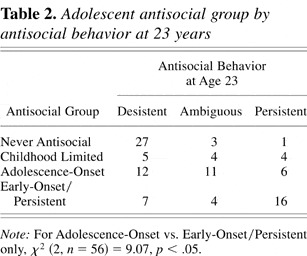
Planned comparisons described in Table 1 revealed that AOs and EOPs consistently reported significantly more total psychological problems, externalizing problems, anxiety/depression, deviant peer association, drug use, and life stress at age 23 than their NA counterparts. In addition, EOPs showed significantly higher levels of externalizing and illegal drug use than AOs (the difference between EOPs and AOs approached significance, p = .06, on total problem behaviors). EOPS and AOs, however, were not distinguishable on anxiety/depression, deviant peer association, and life stress. The final analysis within this set focused on the percentage of participants identified as antisocial in adolescence that either persisted or desisted in antisocial behavior using the criteria described in the Methods section. Table 2 shows that AOs were significantly more likely to have desisted by age 23 than EOPs. Raw data relevant to the other groups are also included in Table 2.
Symptoms of psychopathology, problem behaviors, and life stress at age 23 by antisocial group

Adolescent antisocial group by antisocial behavior at 23 years
In terms of adaptive functioning, Table 3 shows that only EOPs appeared to show significant problems compared to NAs at age 23 in the domains of work/school status, work ethic, and educational attainment. AOs were comparable to NAs on these measures and had significantly higher work ethic and educational attainment scores than EOPs (the AO vs. EOP difference on work involvement was marginally significant). Interestingly, no group differences emerged on the degree to which individuals across the antisocial groups were involved in long-term romantic relationships between ages 21 and 23.
Adaptation between ages 21 and 23 by antisocial group

The independent and interactive role of emerging developmental tasks
A set of three hierarchical regressions (see Tables 4, 5, and 6 for the final step) were estimated to examine the independent and interactive role of antisocial history and successful work/romantic engagement in predicting externalizing problems at age 23. In line with the group comparison analyses already presented, antisocial history (whether early, late, or both) was significantly associated with externalizing behavior at age 23. It is noteworthy that in all regressions antisocial history variables, as well as level of impairment (the multiinformant, continuous externalizing score composite) at age 16, strongly predicted levels of antisocial behavior at age 23 (R2 = .34 for step 1, including antisocial history and severity in all equations).
Results of regression demonstrating whether variation in externalizing behavior at age 23 is associated with developmental history of antisocial behavior, school/work status between ages 21 and 23, and their interactions

Results of regression demonstrating whether variation in externalizing behavior at age 23 is associated with developmental history of antisocial behavior, work ethic between ages 21 and 23, and their interactions

Results of regression demonstrating whether variation in externalizing behavior at age 23 is associated with developmental history of antisocial behavior, patterning of romantic relationship involvement between ages 21 and 23, and their interactions

Although school/work status, work ethic, and long-term romantic involvement in early adulthood were not directly associated with reports of externalizing behavior at age 23 across the sample (main effects were nonsignificant), in each regression these variables were associated with lower levels of externalizing in the EOP group (EOP interactions were significant). No other Antisocial Group × Turning Point Variable interactions were significant. Note that all significant interactions reflected the fact that EOP youth with positive adaptation in the work and romantic domains showed levels of externalizing problems consistent with others (at the sample mean). Successful adaptation to the work and romantic domains was essentially unrelated to externalizing problems for non-EOP youth.
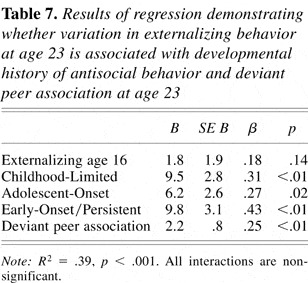
In a set of two regressions focused on deviant peer association and illegal drug use (see Tables 7 and 8), a different pattern of results emerged. For both regressions, antisocial history and concurrent deviant peer association/drug use were associated with higher levels of externalizing at age 23 (results were marginally significant for illegal drug use). Although interactions are not reported due to high levels of multicollinearity in these regression equations, none of the antisocial group interactions were significant (in addition, within group analyses revealed no obvious differences in effects by antisocial group).
Results of regression demonstrating whether variation in externalizing behavior at age 23 is associated with developmental history of antisocial behavior and deviant peer association at age 23
Results of regression demonstrating whether variation in externalizing behavior at age 23 is associated with developmental history of antisocial behavior and illegal drug use at age 23

Discussion
We found results consistent with others in the literature, including Moffitt and colleagues' (2002) recent follow-up of men in the Dunedin sample. That is, the EOP group was, indeed, more likely to show problems across all adjustment areas at age 23, demonstrating markedly high levels of illicit drug use, lower levels of academic attainment, higher levels of life stress, poorer vocational adjustment, and continued antisocial behavior. This high level of continuity has been explained in various ways. Moffitt (1993) has argued that the same “endogenous” factors that lead to early-onset antisocial behavior are partly responsible for its persistence. Although our own empirical work (Aguilar et al., 2000) has challenged the etiological aspects of this view, finding instead an important role for early psychosocial factors, we nevertheless agree with Moffitt's explanation of the persistence process. Specifically, Caspi and Moffitt (1995) have argued that the processes of cumulative continuity (Yoshikawa, 1994) are in effect such that earlier maladaptations compromise future adaptation in the form of snares, which are events or occurrences (e.g., early pregnancy, arrest record, substance addiction) that act to “tie” persons to a persistent life-course pattern of antisocial behavior because they have few or no other options and, thus, continue to experience deleteriously high levels of stress. Our own research has found similar processes to be in effect for the EOP group, including higher levels of life stress across development (Aguilar et al., 2000). This view of processes accounting for continuity is consonant with an organizational perspective on development (Sroufe, 1979), which holds that the EOP group's failure to make positive adaptations during childhood and adolescence significantly stymies their subsequent adaptational efforts.
Consistent with Moffitt et al.'s (2002) findings, we discovered in the present study that our AO group can be best described as falling between the NA and EOP groups on broad assessments of adaptation at age 23. Notably, AO youth were comparable to EOPs on several measures at age 23 (anxiety/depression, deviant peer association, and life stress), comparable to NAs in terms of successfully engaging the emerging tasks of young adulthood (e.g., work), and fell in between EOPs and NAs with regard to total problems behaviors, externalizing, and illicit drug use. An intermediate level of risk for AO youth has also been documented by Dishion and colleagues (Dishion, Patterson, Stoolmiller, & Skinner, 1991), who showed that AOs fall midway between extreme risk scores and tended to be intermediate in terms of family SES and social disadvantage.
These findings are interesting for a number of reasons. They challenge the notion that AO antisocial behavior is entirely normative in terms of the associated implication that this pattern of antisocial behavior has a benign effect on subsequent adaptation. Even temporary episodes of developmental deviation can be costly. At the same time, these results reveal the multiplicity of developmental outcomes that are possible following periods of maladjustment. That is, some youth are able to stage a recovery despite risky antisocial behavior, as revealed by the fact that a larger percentage of AO youth self-reported nonclinical levels of externalizing behaviors at age 23 than did EOPs.
Moffitt (1993) has hypothesized that the maturity gap and association with deviant peers are responsible for AO antisocial behavior, and that this behavior will remit in due time. This theoretical formulation, however, seems to fall short of actually explaining desistence. Although we agree that AOs are more likely to desist than EOPs, we maintain that the processes underlying desistence need to be more thoroughly explained, especially given that not all AOs desist or escape maladjustment following adolescence. Conversely, given the rather large variability observed in the outcomes associated with the EOP trajectory, theories of desistence must be developed and explicitly tested among EOP youth as they transition to adulthood.
At present, not enough is known about causal factors accounting for later onset of antisocial behavior as well desistence among EOP and AO youth from adolescence to adulthood (Loeber & Stouthamer–Loeber, 1998). Some authors have argued that desistence is best explained by the acquisition of strong ties to adult institutions such as marriage, parenthood, and postsecondary education (Loeber & Hay, 1997; Sampson & Laub, 1993). Others suggest that individuals most likely to desist are those who have the capacity to plan their life course in ways that increase the likelihood of forming prosocial attachments (Ferguson, Lynskey, & Horwood, 1996). These views have been elaborated by Sampson and Laub, who have argued that “attachments” to social institutions are primary factors accounting for desistence. Indeed, many authors have found that such “turning points” as getting married, having a baby, or attending postsecondary school are associated with desisting from serious antisocial behavior (e.g., Laub et al., 1998).
Although Moffitt et al. (2002) examined the adaptational fate of EOP and late-onset antisocial adolescents, they did not account for factors associated with low (or high) externalizing scores at age 26 except for the patterning of youths' antisocial histories (e.g., continuity). Drawing on the fact that EOP youth on average demonstrated markedly poor functioning across domains of adaptation relative to others, these researchers concluded that (a) it is rare that EOPs make use of life course turning points such as successful romantic and work involvement to stage a recovery in young adulthood and therefore (b) “turning points theory may be most applicable to the majority of offenders who are AL [Adolescence-Limited], not LCP [Life-Course Persistent]” (p. 199). Although the former assertion follows directly from their analysis, the latter does not. Specifically, the question of who benefits from positive life experiences in young adulthood can only be answered by focusing on correlates of variation in outcome within groups, not mean differences between them.
By systematically examining correlates of variability in antisocial behavior within the AO and EOP groups using interaction terms, we were able to demonstrate in this study that prior experiences in the emerging life tasks of adulthood and youths' developmental histories of antisocial behavior interactively predicted participants' young adult levels of externalizing problems at age 23. Of greatest relevance to theories of desistence, successful engagement of the work and romantic domains between ages 21 and 23 appeared to be consequential for EOP youth, not, as Moffitt and colleagues (2002) suggested, for those who begin their antisocial careers in adolescence.
Although the results presented in this study are consistent with the possibility that, among EOPs, successful negotiation of the emerging domains of work and romantic competence between ages 21 and 23 predicted lower levels of externalizing problems, we acknowledge that it is problematic to sort out direction of effects in these analyses given that both externalizing problems and the work/romantic competence variables were measured concurrently. However, we would remind the reader that (a) the emerging developmental tasks domains were not broadly associated with lower levels of externalizing problems across this sample (e.g., the effect is specific, as hypothesized, to EOPs); (b) regression analyses controlled for prior externalizing problems (e.g., EOP × Work/Romantic Competence interactions predicted changes in externalizing problems); and (c) the emerging competence domains were derived from descriptive information about the patterning of youths' work activities and romantic experiences from ages 21 to 23, years between the adolescent and age 23 assessments of externalizing problems.
We would argue that theories of desistence would benefit from a developmental psychopathology perspective. The central tenet of this view is that insight into normative development informs our understanding of psychopathology (Cicchetti & Cohen, 1995; Sroufe, 1990), which would suggest that it is critical to become acquainted with the roots of initial developmental deviation to understand (potentially differential) processes of desistence operative among AO and EOP antisocial youth. Our earlier work (Aguilar et al., 2000) has provided evidence that the EOP pathway has its etiology in early socioemotional adversity and is maintained by consistent failures in the developmental tasks of childhood and adolescence. If this is true, we would speculate that what persistently antisocial youth might benefit from most is an opportunity to engage emerging developmental tasks in domains that take them outside of the failed contexts that, in transaction with individual attributes, maintain antisocial behavior. Work and romantic experiences in the transition to adulthood may represent two such domains of opportunity.
Although a complete etiological account of AO antisocial behavior is at present lacking, emerging evidence suggests that the negative consequences of AO antisocial behavior may be in general limited to the domain of problem behaviors. For example, in contrast to their EOP counterparts, AO youth do not show broad-based failures in adaptive functioning in the academic and work domains. What, then, might account for desistence in this group? One possibility, as hypothesized by Moffitt and colleagues (2002), is that AO antisocial behavior spontaneously remits in adulthood in the absence of snares that tie such youth to deviant lifestyles, including drug use and involvement with criminal associates. This possibility found partial support in the current study in that, among all youth, deviant peer association and illicit substance use were associated with higher levels of antisocial behavior at age 23. Still, this perspective on AO desistence is not completely satisfying. Involvement with deviant peers and drugs are as much indicators of antisocial behavior as they are potential moderators of it. Furthermore, these factors were not specifically associated with AO persistence in this study, as has been suggested in the literature.
Consistent with much previous research on antisocial behavior (see, e.g., Olweus, 1979), the current longitudinal study offers compelling evidence that the severity and patterning of antisocial behavior in childhood and adolescence shows strong rank order (e.g., differential) stability into the early years of adulthood. Indeed, it is noteworthy that over a third of the variation in externalizing problems at age 23 could be predicted in this sample based on prior indicators of antisocial behavior. Despite such continuity, however, not only can change in antisocial behavior be documented among persistently troubled youth, but it is also lawfully associated with adaptation within the emerging adult developmental tasks of work and romantic relationships.
References
REFERENCES
Achenbach, T. M.
(1991a).
Manual for the Youth Self-Report and 1991 Profile.
Burlington, VT:
University of Vermont Department of Psychiatry.
Achenbach, T. M.
(1991b).
Manual for the Child Behavior Checklist/4–18 and 1991
Profile.
Burlington, VT:
University of Vermont Department of Psychiatry.
Achenbach, T. M.
(1991c).
Integrative guide for the 1991 CBCL/4–18, YSR, and TRF
Profiles.
Burlington, VT:
University of Vermont Department of Psychiatry.
Achenbach, T. M.
(1997).
Manual for the Young Adult Self-Report and Young Adult Behavior
Checklist.
Burlington, VT:
University of Vermont Department of Psychiatry.
Achenbach, T. M., &
Edelbrock, C.
(1986).
Manual for the Teacher's Report Form and Teacher Version of
the Child Behavior Profile.
Burlington, VT:
University of Vermont Department of Psychiatry.
Aguilar, B.,
Sroufe, L. A.,
Egeland, B., &
Carlson, E.
(2000).
Distinguishing the early-onset/persistent and
adolescence-limited antisocial behavior types: From birth to 16
years.
Development and Psychopathology
12,
109–132.Google Scholar
Arnett, J. J.
(2000).
Emerging adulthood: A theory of development from the late teens
through the twenties.
American Psychologist
55,
469–480.Google Scholar
Blum, R. W.,
Resnick, M. D., &
Bergeisen, L. G.
(1989).
The state of adolescent health in Minnesota.
Minneapolis, MN:
University of Minnesota Adolescent Health Program.
Brook, J. S.,
Whiteman, M.,
Finch, S. J., &
Cohen, P.
(1996).
Young adult drug use and delinquency: Childhood antecedents and
adolescent mediators.
Journal of the Academy of Child and Adolescent Psychiatry
35,
1584–1592.Google Scholar
Caspi, A., &
Moffitt, T. E.
(1995).
The continuity of maladaptive behavior: From description to
understanding in the study of antisocial behavior. In
D. Cicchetti &
D. Cohen (Eds.),
Manual of developmental psychopathology (pp.
472–511).
New York:
Wiley.
Cicchetti, D., &
Cohen, D. J.
(1995).
Perspectives on developmental psychopathology.
Development and Psychopathology
1,
3–20.Google Scholar
Cohen, P.,
Kasen, S.,
Chen, H.,
Hartmark, C., &
Gordon, K.
(2003).
Variations in patterns of developmental transmissions in the
emerging adulthood period.
Developmental Psychology
39,
657–669.Google Scholar
Coie, J. D., &
Dodge, K. A.
(1997).
Aggression and antisocial behavior. In
W. Damon (Ed.) &
N. Eisenberg (Vol. Ed.),
Handbook of child psychology: Vol. 3. Social, emotional, and
personality development
(5th ed., pp.
779–862).
New York:
Wiley.
Collins, W. A.
(2003).
More than myth: The developmental significance of romantic
relationships during adolescence.
Journal of Research on Adolescence
13,
1–24.Google Scholar
Compas, B. E.,
Davis, G. E.,
Forsythe, C. J., &
Wagner, B. M.
(1987).
Assessment of major and daily stressful events during adolescence:
The Adolescent Perceived Events Scale.
Journal of Clinical and Consulting Psychology
55,
534–541.Google Scholar
Dishion, T. J.,
Patterson, G. R.,
Stoolmiller, M., &
Skinner, M. S.
(1991).
Family, school, and behavioral antecedents to early adolescent
involvement with antisocial peers.
Developmental Psychology
27,
172–180.Google Scholar
Egeland, B., &
Kreutzer, T.
(1991).
A longitudinal study of the effects of maternal stress and
protective factors on the development of high-risk children. In
E. Cummings,
A. Greene, &
K. Karraker (Eds.),
Life span perspectives on stress and coping (pp.
61–85).
New York:
Wiley.
Farrington, D. P., &
Loeber, R.
(2000).
Epidemiology of juvenile violence.
Child and Adolescent Psychiatric Clinics of North America
9,
733–748.Google Scholar
Ferguson, D. M.,
Lynskey, M. T., &
Horwood, L. J.
(1996).
Factors associated with continuity and changes in disruptive
behavior patterns between childhood and adolescence.
Journal of Abnormal Child Psychology
24,
533–553.Google Scholar
Hyson, D. M.
(2002).
Understanding adaptation to work in adulthood: A contextual
developmental approach. In
R. A. Seterresten, Jr., &
T. J. Owens (Eds.),
Advances in life course research: Vol. 7. New frontiers in
socialization.
Oxford:
Elsevier Science, Ltd.
Laub, J. H.,
Nagen, D. S., &
Sampson, R. J.
(1998).
Trajectories of change in criminal offending: Good marriages and
the desistence process.
American Sociological Review
63,
225–238.Google Scholar
Loeber, R., &
Farrington, D. P.
(2000).
Young children who commit crime: Epidemiology, developmental
origins, risk factors, early interventions, and policy
implications.
Development and Psychopathology
12,
737–762.Google Scholar
Loeber, R., &
Hay, D.
(1997).
Key issues on the development of aggression and violence from
childhood to early adulthood.
Annual Review of Psychology
48,
371–410.Google Scholar
Loeber, R.,
Russo, M. F.,
Stouthamer–Loeber, M., &
Lahey, B. B.
(1994).
Internalizing problems and their relation to the development of
disruptive behaviors in adolescence.
Journal of Research on Adolescence
4,
615–637.Google Scholar
Loeber, R., &
Stouthamer–Loeber, M.
(1998).
Development of juvenile aggression and violence: Some common
misperceptions and controversies,
American Psychologist
53,
242–259.Google Scholar
Marsh, H. W.
(1991).
Employment during high school: Character building or a subversion
of academic goals?
Sociology of Education
64,
172–189.Google Scholar
Moffitt, T. E.
(1993).
Adolescence-limited and life-course-persistent antisocial behavior:
A developmental taxonomy.
Psychological Review
100,
674–701.Google Scholar
Moffitt, T. E.,
Caspi, A.,
Harrington, H., &
Milne, B. J.
(2002).
Males on the life-course-persistent and adolescence-limited
antisocial pathways: Follow-up at age 26 years.
Developmental and Psychopathology
14,
179–207.Google Scholar
Nagen, D. S.,
Farrington, D. P., &
Moffitt, T. E.
(1995).
Life-course trajectories of different types of offenders.
Criminology
33,
111–139.Google Scholar
Olweus, D.
(1979).
Stability of aggressive reaction patterns in males: A review.
Psychological Bulletin
86,
852–875.Google Scholar
Patterson, G. R., &
Yoerger, K.
(1997).
A developmental model fro late-onset delinquency. In
D. W. Osgood (Ed.),
Nebraska Symposium on Motivation: Vol. 44. Motivation and
delinquency.
Lincoln, NE:
University of Nebraska Press.
Robins, L. N.
(1966).
Deviant children grown up: A sociological and psychiatric study of
sociopathic personality.
Baltimore, MD:
Williams & Wilkins.
Roisman, G. I.
(2002).
Beyond main effects models of adolescent work intensity, family
closeness, and school disengagement: Mediational and conditional
hypotheses.
Journal of Adolescent Research
17,
331–345.Google Scholar
Roisman, G. I.,
Masten, A. S.,
Coatsworth, J. D., &
Tellegan, A.
(2004).
Salient and emerging developmental tasks in the transition to
adulthood.
Child Development
75,
123–133.Google Scholar
Sampson, R. J., &
Laub, J. H.
(1993).
Crime in the making: Pathways and turning points through life.
Cambridge, MA:
Harvard University Press.
Sroufe, L. A.
(1979).
The coherence of individual development: Early care, attachment,
and subsequent developmental issues.
American Psychologist
34,
834–841.Google Scholar
Sroufe, L. A.
(1990).
Considering normal and abnormal together: The essence of
developmental psychopathology.
Development and Psychopathology
2,
335–347.Google Scholar
Steinberg, L.,
Fegley, S., &
Dornbusch, S. M.
(1993).
Negative impact of part-time work on adolescent adjustment:
Evidence from a longitudinal study.
Developmental Psychology
29,
171–180.Google Scholar
Yoshikawa, H.
(1994).
Prevention and cumulative protection: Effects of early family
support and education on chronic delinquency and its risks.
Psychological Bulletin
115,
28–54.Google Scholar

Symptoms of psychopathology, problem behaviors, and life stress at age 23 by antisocial group

Adolescent antisocial group by antisocial behavior at 23 years

Adaptation between ages 21 and 23 by antisocial group

Results of regression demonstrating whether variation in externalizing behavior at age 23 is associated with developmental history of antisocial behavior, school/work status between ages 21 and 23, and their interactions

Results of regression demonstrating whether variation in externalizing behavior at age 23 is associated with developmental history of antisocial behavior, work ethic between ages 21 and 23, and their interactions

Results of regression demonstrating whether variation in externalizing behavior at age 23 is associated with developmental history of antisocial behavior, patterning of romantic relationship involvement between ages 21 and 23, and their interactions

Results of regression demonstrating whether variation in externalizing behavior at age 23 is associated with developmental history of antisocial behavior and deviant peer association at age 23

Results of regression demonstrating whether variation in externalizing behavior at age 23 is associated with developmental history of antisocial behavior and illegal drug use at age 23
 You have
Access
- 49
- Cited by