INTRODUCTION
Since the construction of the Akosombo hydroelectric dam in the years immediately following independence in 1957, Ghana has generated enough electric power to export to its neighbours, Togo, Benin and Burkina Faso (Genser Energy 2014). In addition to being a regional leader in electricity provision, Ghana's political elites have continued to expand the coverage of the grid to promote both industrial development and household access (Kemausuor et al. Reference Kemausuor, Obeng, Brew-Hammond and Duker2011). In fact, 70% of Ghana's population enjoys access to electricity – far more than most sub-Saharan African countries, where the average electrification rate hovers around 30% (International Energy Agency 2011). And, yet, Ghana's electricity sector is in crisis. For all of Ghana's success in grid expansion – and indeed, perhaps in part because of it – the country is struggling to supply its citizens with adequate power. Electricity outages are common across the country, and citizens have mounted massive protests against load shedding, known popularly in the local Twi language as ‘dumsor, dumsor’, or ‘off, on, off, on’, or, more recently, the more pessimistic expression ‘dumdum’, meaning simply ‘off, off’. As of 2015, many Ghanaians had taken to Twitter, using the #dumsor tag to share their stories of power outages and to organise ‘dumsor vigils’ across the country.
Policymakers have ample reasons to want to keep electricity flowing, and Ghana is no exception. For developing countries like Ghana, electricity is widely seen as a necessary input to economic development and to citizens' quality of life. Electricity enables factories to manufacture goods, allows farmers to add value to crops, permits citizens to access information and communicate through cell phones and radios, enables clinics and hospitals to deliver better care, and allows students to study into the evening hours. In the wake of Ghana's energy crisis, Ghanaian officials have turned to a range of long-term policy approaches, including developing Ghana's natural gas resources and seeking donor funding to wring inefficiencies out of the country's existing distribution system (LB-LM-1-052714; LB-13-060314).Footnote 1
For a few critical days in June 2014, the Ghanaian government also undertook a number of short-term actions to increase the electricity supply. Ghana imported 50 MW of power from Côte d'Ivoire (Thomas Reference Thomas2014), directed the nation's largest aluminium company to cut production, and appealed to consumers to conserve electricity by turning off their freezers and air conditioners at night (Dgui_061614_1). Why did the Ghanaian state go to such great lengths to keep the lights on during this period? Not to boost industrial output or improve social outcomes, but rather to allow Ghanaians to watch their national soccer team compete in the country's third-ever appearance at a World Cup. After all, given football's popularity in Ghana, 89% of the country was expected to watch the performance of the national team known as the Black Stars (Embassy of Ghana; Shearlaw Reference Shearlaw2014).
This paper investigates the politics of the provision of electricity in Ghana. In this paper, we seek to understand the motivations behind Ghanaian officials' political responses to the current electricity crisis. To do so, we use the 2014 World Cup as a lens through which to view citizens' and politicians' expectations about electricity as a public good. Existing theories that suggest the state provides public services to serve the structural power of the industrial or urban elite or to attract the soft power of donors are inadequate (Bates Reference Bates1981; Nye Reference Nye2004). The importance of football for developing nationalism helps us understand the short-term actions but not the long-term approach to the public provision of electricity in Ghana. Political explanations about the nature of the democratic regime are a necessary starting point, but must be combined with historically rooted understandings of nationalism and citizenship. By examining the Ghanaian government's discourse over time, we show that public service provision was profoundly shaped by a history of shared expectations surrounding the rights of citizenship.
We then use the 2014 World Cup as a focal point for examining the contemporary discourse surrounding service provision. The 2014 games provide a particularly useful moment to examine because the high-stakes nature of the sporting event prompted a national conversation between politicians, policymakers and citizens about the nature of the Ghanaian state's obligation to provide electricity to its citizens. Moreover, these discourses about service provision were not unique during the World Cup; while the games focused attention on electricity, this increased attention did not alter either citizens' or politicians' underlying attitudes about the nature of service provision in Ghana. Our analysis reveals significant gaps between citizen expectations and state delivery of services.
Drawing on an analysis of archival documents, Ghanaian newspapers, international media coverage, and interviews with government, business, donor and NGO officials in the energy sector, we argue that the historical construction of national citizenship during the Nkrumah era is critical for understanding these outcomes today. We show that the Ghanaian state historically provided electricity for two purposes: to promote domestic industrial development of the country as a whole, and to support the social development of individuals as citizens of the newly independent nation. In contrast, political elites currently emphasise the importance of electricity for business development, highlighting the need to provide reliable infrastructure in order to attract foreign direct investment. When mentioned, Ghanaians are no longer portrayed as rightful citizens, but, instead, as unrealistic, dishonest and wasteful customers, who overuse, pay too little or even steal electricity through illegal connections. Experiencing a disconnect between their historically rooted expectations and their lived experience of unapologetic load shedding, Ghanaians have begun to organise more visible forms of resistance to the state, for example, protesting in the streets on major national holidays. In the end, the efforts to keep the televisions on for the 2014 World Cup constituted a short-term, populist move by the government to meet Ghanaians' patriotic needs to watch their national team but failed to address the growing gap between popular expectations of electricity as a right of national citizenship and the business-centred narrative of the state's current development goals. This analysis of the politics surrounding the contemporary electricity crisis in Ghana yields important theoretical insights that are relevant for understanding similar conflicts and protests emerging between citizens and the state in other countries such as Botswana, Malawi, Mozambique, South Africa, Zambia and Zimbabwe (Onishi Reference Onishi2016).
THEORETICAL EXPLANATIONS FOR THE PUBLIC PROVISION OF ELECTRICITY
We turn now to the existing literature to generate theoretical explanations of the politics surrounding the public provision of electricity. First, we turn to explanations that highlight the power of particular economic groups or donor interests in shaping policy outcomes. Building on Bates (Reference Bates1981), we might expect public service provision to have an urban bias in Africa. According to this view, the Ghanaian government might aggressively pursue an increase in generation capacity to respond directly to an increase in need by powerful industrial interests and urban-based consumers. Ghanaian elites would tax rural smallholders in order to subsidise the electricity infrastructure for more concentrated and threatening urban actors, both industry titans and city residents.
Yet, the Ghanaian government policy in June 2014 clearly placed citizens' interests ahead of industrial needs by directing the Volta Aluminium Company (VALCO) to reduce production. Moreover, urban residents in Accra already had near-universal access to the grid and, in many cases, to back-up generators. As a result, the move to free up generation capacity for World Cup viewing would more likely benefit citizens in less wealthy, rural areas. The rural bias of the Ghanaian government's short-term actions, unanticipated by the literature, was reinforced by the country's long-term policy of a uniform electricity tariff, where rural villagers pay the same per kWh rate as those living in cities, even though delivery to rural areas may be significantly more expensive. In fact, when asked about Ghana's universal tariff, interviewees commonly responded that rural citizens should pay the same low rate because ‘they are the ones who produce our food to eat’ and ‘it is the state's responsibility to extend electricity to everyone’ (LB-LM-08-052914). Our analysis thus suggests that it was not the absolute level of need today that shaped contemporary policies, but, instead, the historic creation of expectations by the post-independent state.
A second set of explanations focuses on the transnational power relations between donors and developing country recipients of foreign aid. Nye (Reference Nye2004) theorises the important role of ‘soft power’ in shaping other states' policies. The meaning of ‘soft power’ is the ability to influence another state's policy, not through coercion or cooptation, but by having a legitimate and appealing set of ideals, culture and policies that other states wish to follow. Where Nye emphasises foreign security, other scholars (Edwards & Hulme Reference Edwards and Hulme1996) have highlighted the way that advanced industrialised countries may shape policies in the developing world through more subtle forms of persuasion and donor pressure. Such tactics are not uncommon in the electricity sector, where donors and multilateral financiers often offer aid conditional on the recipient countries' adoption of policy provisions that align with donors' priorities. Perhaps the Ghanaian government's responses to its electricity crisis are designed to appeal to potential avenues of external financial support.
Indeed, our field interviews suggest that at least some of the Ghanaian government's policy responses to the crisis – particularly its long-term responses – may be shaped in part by donor interests in increased liberalisation and competition in the electric sector (LB-13-060314; LB-22-060614) or in renewable energy and energy conservation (LB-11-060214; LB-LM-9-052914). Yet, donor interests alone do not explain the great lengths that Ghanaian officials have gone to extend grid access to so much of Ghana's population, nor the measures taken to ensure adequate power to broadcast the World Cup games.
To seek an explanation for Ghanaian officials' short-term response to the electricity crisis during the World Cup itself, we might draw on the literature on football and nationalism (Mehler Reference Mehler2008; Darby Reference Darby2013;Wagner Reference Wagner2015). Perhaps the simple truth is that Ghanaians have an especially vibrant football culture, and the Ghanaian state recognised the potential value of being able to join together as spectators for the national team. This was the justification given by many Ghanaian officials at the time: the important link between viewing football and nation-building. Scholars, too, recognise a link between football and politics. Darby (Reference Darby2013) highlights how the nationalist excitement over Ghana's performance in the 2010 World Cup in South Africa was grounded in an earlier history when Nkrumah promoted football as a method of nation-building.Footnote 2 In a comparative analysis, Mehler (Reference Mehler2008) suggests that the political discourse in football coverage in Ghana produces a more pan-African style of patriotism that unites different sub-groups within the nation than in neighbouring Côte d'Ivoire where football language stimulates heated contestation over national belonging. Every four years, the World Cup offered a special opportunity to bridge the rivalry between the sub-national soccer clubs with their narrower, ethno-regional and partisan associations (Fridy & Brobbey Reference Fridy and Brobbey2009). This occasion for nation-building might have been perceived as particularly critical given the razor-thin electoral results between the two major political parties in the 2008 and 2012 elections. Still, despite the power of this explanation for understanding the Ghanaian government's short-term actions in June 2014, it does not explain the long-term approach to electricity provision in Ghana in the periods between highly publicised football matches.
Finding the influence of elites, soft power and even the political importance of football inadequate to fully explain officials' response to Ghana's electricity crisis, we gain analytic leverage by combining political explanations for the nature of public goods provision with theories about how different historical experiences of state-building can shape citizens' expectations of the state. We begin by observing that the character of the political regime – whether democratic or authoritarian – might shape the extent of public goods provision. According to Lake & Baum (Reference Lake and Baum2001), democracies produce a higher level of public service provision than autocracies around the world. Based on their economic theory of the state, if barriers to exit and the costs of political participation are low, as in a democracy, the state will produce more public goods and services as a sort of regulated monopoly, because citizens are able to demand these goods and services.
While the nature of the democratic regime is critical for understanding public goods provision in Ghana, we find that democracy alone does not fully explain Ghana's approach to electricity provision. Ghana was the first nation in sub-Saharan Africa to obtain independence and is currently one of the most consolidated democracies on the continent (Moehler & Lindberg Reference Moehler and Lindberg2009). However, this democratic development has not been progressively linear, and important gains in electricity provision have occurred at times when Ghana was governed by unelected officials. From the late 1960s to the early 1980s, democratic regimes were repeatedly overturned by authoritarian rule. Flt. Lt. Rawlings, a two-time coup leader, is credited with a major expansion of the electricity grid prior to the opening of a multiparty system. Moreover, analysis of contemporary Ghana suggests that even under conditions of relative democracy, public service provision is shaped by factors such as citizen expectations and the media's ability to communicate those expectations to political elites. Hence, it is important to look more deeply within the country case at the meaning of the nation and citizenship for different groups over time and how those perspectives are expressed within the regime.Footnote 3
In addition to the democratic nature of the regime, therefore, we turn to explanations that highlight how different historical experiences of state-building can shape conceptualisations of citizenship (Ekeh Reference Ekeh1975; Mamdani Reference Mamdani1996; MacLean Reference MacLean2010) and citizens' expectations from the state. Ekeh (Reference Ekeh1975) pioneers this scholarship when he theorises that the experience of authoritarian colonial rule creates ‘two publics’ in Africa, where morality continues to govern citizen action in the ‘primordial public’ but is detached from the civic public. Mamdani (Reference Mamdani1996) further shows how colonialism in British tropical Africa produces ‘bifurcated’ subjects. MacLean (Reference MacLean2010) builds on these insights to demonstrate that the experience of French and British colonialism in two similar regions on either side of the border in Ghana and Côte d'Ivoire stimulates divergent expectations of the state role in social policy. Bleck (Reference Bleck2013) and Aremu (Reference Aremu2015) examine whether secular versus religious providers in education shape citizen participation and attitudes.
In this paper, we expand on the above line of research to examine how state-building and the historic construction of citizenship may affect subsequent public service provision. While we find the popularity of football alone to be an insufficient explanation for the Ghanaian state's reaction to the electricity crisis, we find that the timing of the 2014 World Cup – coinciding with the crisis – prompted a national conversation on electricity provision that reveals the complex relationships between citizens, their expectations of the state, and government officials' reactions.
RESEARCH DESIGN, METHODOLOGY AND DATA
This paper's insights are based on a case study analysis of electricity politics in Ghana during the 2014 World Cup. Like many developing countries, Ghana adopted World Bank/IMF neoliberal economic reform in the early 1980s and then initiated a process of democratisation beginning in the early 1990s. After six elections and two peaceful alternations of power to the opposition, Ghana is recognised as a relatively consolidated democratic regime (Moehler & Lindberg Reference Moehler and Lindberg2009). Ghana is now considered a lower middle-income country according to the World Bank's classification, with a GDP per capita of $1,858 in 2014. Also like many developing countries, Ghana has taken partial steps toward privatisation and liberalisation in its electricity sector. A private generation company now operates the state-owned Volta River Authority (VRA), and independent generators are allowed to compete with the VRA to meet the nation's supply needs. The state owns the country's two electricity distribution companies and has reluctantly entered talks with donors to discuss options to further liberalise distribution (LB-13-060314; LB-22-060614). Where Ghana is relatively unique is that it boasts an electrification rate second only to South Africa on the continent.
Nevertheless, Ghana is in the midst of an electricity crisis. Blackouts occur frequently throughout the country, and politicians and policymakers are scrambling to adopt policies that will address both the current crisis and Ghana's long-term energy needs. As a result, electricity and the government's role in its provision are salient issues among politicians and citizens alike.
We focus our attention on the World Cup because it provides a useful lens for examining politicians' and citizens' ideas about the government's responsibilities to provide electricity. In the weeks leading up to the World Cup, citizens and politicians paid extra attention to the country's ongoing electricity crisis. Moreover, during the World Cup itself, the Ghanaian government undertook several extraordinary actions to ensure adequate power supplies during the games. The World Cup thus provided a focal point for citizens and government officials to engage in an ongoing conversation about public service provision, with citizens and government officials alike discussing their expectations in newspapers, on Twitter, and in the form of physical protest. Examining government actions and public discourse during the weeks leading up to and after the World Cup thus provides us with a revealing time period in which to analyse public and political attitudes regarding electricity as a public good.
The paper uses a combination of qualitative methodological techniques to collect and analyse original data to answer the question. Fieldwork was conducted in Ghana between May and June 2014.Footnote 4 Two authors conducted semi-structured interviews with government officials, donors, business leaders and NGO representatives involved in the energy sector. These interviews and our ethnographic observations while visiting hydroelectric dams and small-scale renewable energy projects in Accra, Akosombo, Koforidua, Kumasi and islands on the Volta Lake for a separate study highlighted the importance of this research question.
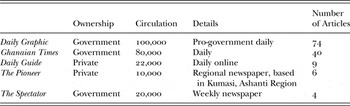
After returning from the field, we followed up the preliminary inquiry with a systematic newspaper analysis to capture how various actors were describing the nature of the problem; who was responsible for causing and resolving the problem; the identification of appropriate solutions; and the rationale provided for why the solution was necessary. We selected all newspaper articles (including news, editorials and letters to the editor) which contained any discussion of energy or electricity in five different newspapers between 1 May and 31 July 2014 (see Table I).Footnote 5 We chose newspapers with large national circulations, which were both state-run (The Daily Graphic, The Ghanaian Times and The Spectator) and privately owned with a variety of partisan affiliations (The Daily Guide and The Pioneer). We also examined mission statements, historical background, press releases, speeches and debates published on websites of political parties, civil society organisations, as well as the executive, parliament and relevant bureaucratic agencies. Finally, we analysed the speeches of Kwame Nkrumah and J.J. Rawlings.Footnote 6
Description of Sampled Newspapers and Articles

GHANA'S STATE EFFORTS TO ENSURE PUBLIC PROVISION OF ELECTRICITY DURING THE 2014 WORLD CUP
In mid-June 2014, the Ghanaian state went above and beyond usual practice to ensure that electricity was provided during the broadcast of Ghana's national team matches in the World Cup in Brazil. This section first explains the cause for concern, detailing the widespread and often unplanned interruptions in power in the years and months leading up to the summer of 2014. We then document the actions taken by the Ghanaian state to ensure power for the nation's televisions during the World Cup. We find, first, that Ghanaians' high expectations of the state prompted citizens to call for a response to the electricity crisis; second, that there are significant gaps between citizen expectations of reliable power and the ongoing situation of load shedding; and third, that while the Ghanaian state was able to temporarily resolve the crisis during the World Cup games, the crisis continued to persist after the Ghanaian team's World Cup competition in 2014.
Cause for Concern: Recent Experience of Load Shedding in Ghana Leading up to the 2014 World Cup
The government of Ghana and Ghanaians had real cause for concern regarding the prospect of having reliable electricity during the Black Stars' matches scheduled for 16 June and 26 June 2014. Even though approximately 70% of Ghana's population had access to the grid, Ghana's electricity generation capacity (2,800 MW) was not able to meet demand. The country was in the depths of an energy crisis, and so load shedding occurred frequently in the summer of 2014.
Blackouts were not new in Ghana, however. Since Ghana relied heavily on large hydro-electric dams for over 52% of its electricity, the country had experienced several earlier energy crises when drought led to unusually low water levels (Volta River Authority 2015).Footnote 7 Recurrent low water levels induced by climate change meant that the dams' turbines could not function at full capacity (Gt_060314_2). In addition, a rupture caused by pirates in the West African Gas Pipeline (WAGP) from Nigeria in 2012 disrupted fuel supplies for the country's thermal plants. Generation capacity was further diminished when the Aboadze Power Plant was shut down in early 2014. Line losses due to inefficient transmission and distribution infrastructure exceeded 25%, with some interviewees estimating losses approaching 40% (LB-LM-1-052714; LB-22-060614; LB-13-060314). The distribution and transmission lines also needed maintenance and would periodically be taken off-line while being repaired.Footnote 8 Yet, the distribution companies in charge of maintaining electricity lines were chronically under-funded, in part because the Ghanaian government – which consumes 14% of the country's electricity for power in public schools, universities, agencies, etc. – stopped paying its own electricity bills to the Electricity Company of Ghana (ECG) in 2012 (LB-22-060614). By the spring of 2014, the ECG threatened to cut power to public institutions that had accumulated massive utility bill debts. All of these challenges had reinforced each other between 2012 and 2014 while the Ghanaian government reported that demand for power was growing by 7–8% per year (Gt_052214_1). Meanwhile, the Ghanaian government continued to mandate a low-cost tariff, which allowed domestic consumers to purchase electricity at cheaper rates than industries and below production costs, thus requiring the country's distribution companies to operate at a loss (LB-13-060314).
Earlier in 2014, the Ghanaian government moved to raise electricity tariffs with the long-term goal of attracting new independent power producers. The government's goal was to rapidly increase the generation capacity from 2,800 MW in 2014 to 5,000 MW by 2016, and achieve universal access by 2020. The immediate challenge, however, continued to be the lack of reliable electricity, not access. In March 2014, the ECG announced a monthly emergency load-shedding schedule, but May's schedule was not made public until the very end of that month (Gt_052714_1), and the previous timetable had not been followed (Dg_052714_1).Footnote 9 On 28 May, the Public Utility Regulatory Commission (PURC) announced that it was going to sanction the utility providers (ECG, VRA and GRIDCo) for their inability to give information to consumers about the expected availability of the power supply (Dg_052814_1).
The typical complaints about the energy crisis (Gt_052814_1) began to heighten and become more intense as the World Cup games drew near. An editorial in the Daily Graphic (Dg_052714_2) warned: ‘In about two weeks, the biggest global soccer fiesta will kick off in Brazil, and Ghana is a big stakeholder in the 2014 Mundial. Ghanaians will need power to be part of this historic event for, after all, sports, especially competitive soccer is the unifier of the political divide.’ While conducting fieldwork in late May and early June, non-Ghanaian interview respondents often joked about this as a looming problem for the government while Ghanaian respondents more frequently acknowledged the gravity of the issue for the people. Street vendors sold Ghanaian flags and football jerseys on many corners, and many taxi drivers adorned their windshields with small Ghanaian flags. Upon finding out that we were American, every Ghanaian we encountered happily predicted their national team's upcoming victory against the USA.
Great Lengths by the GOG to Keep the Televisions On
The Ghanaian government went to great lengths to provide reliable electricity during both of the World Cup matches on 16 and 26 June 2014. These efforts were in four different areas. First, despite existing constraints, the VRA and other utility providers were told to run the power plants at absolute maximum capacity.
Second, the government imported 50 MW of power from neighbouring Côte d'Ivoire. Ghana has on several other occasions of high salience for domestic consumers purchased power from Côte d'Ivoire, for example, to enable the broadcast of the Black Stars' semi-final match during the African Cup of Nations Tournament on 5 February 2015, and to facilitate the enjoyment of the Easter holiday in April 2015. Nevertheless, these notable exceptions highlight that this was a reversal of Ghana's historic role as a regional hub and exporter of power. The recognition of this regional importance was demonstrated by the laudatory comments of a member of the political elite from Benin, a country that imports from Ghana, after a recent tour to Akosombo Dam. The President of Benin's National Assembly commended the VRA and said, ‘The whole of the West Africa sub-region is proud of Ghana's immense contribution towards the socioeconomic development of the region. And I am proud to see for myself the source of the electric power which has been the backbone of the country’ (Volta River Authority 2014b: 22).
Third, the Ghanaian government ordered VALCO, one of the largest buyers of VRA's power, to slow production. While the contemporary newspaper coverage highlights that this government pressure on a pivotal industrial company was a reversal in Ghana's formal policy, a deeper historical analysis reveals that the Ghanaian government had repeatedly asked VALCO to cut production during previous electricity shortages (i.e. 1982–1984, 1998–2000, 2006–2007). VALCO had an historic agreement to purchase a minimum of 300 MW of the Akosombo dam's power (about 30% of its total capacity) for a period of 30 years in order to stabilise investment returns for the VRA.Footnote 10 VALCO was thus not simply any big company, but was one of the first investors in the Akosombo dam, and more abstractly, one of the cornerstones of the Ghanaian national economy (Volta River Authority 2013). Whenever Nkrumah discussed electrification in Ghana, he always cited the importance of this first aluminium smelter (VALCO), not only as the major customer for the dam but also as a critical new industry for Ghana, providing industrial materials and significant employment (Nkrumah Reference Nkrumah and Obeng1961a: 42).
Fourth, the Ministry of Energy and Petroleum (MOEP) launched a national energy conservation campaign, ‘Switch off your deep freezer’, to encourage consumers to conserve electricity during peak watching times between 6 pm and midnight. Newspapers reported on the day of the first World Cup match that, according to the Deputy Minister John Jinapor, if the owners of the 1·2 million deep freezers and the 2 million refrigerators obeyed and switched them off during that peak period, over 400 MW of energy would be conserved, equal to the generation from the two Kpong power plants (Gt_061614_1). The same ministry official enlisted the help of telecommunication companies to send text messages to subscribers to remind them to switch off their freezers and appliances at night. In one interview, the CEO of the Volta River Authority appealed to the public to help conserve electricity, particularly during the 2014 World Cup tournament (Gt_061314_1).
All four of these government actions show that the government of Ghana was deeply committed to ensuring the public provision of electricity during the World Cup. What is also evident is that these bold responses were stop-gap solutions. Indeed, the government of Ghana has continued to struggle to provide enough electricity, and load shedding continues. What can these aggressive actions at this particular moment of the World Cup tell us about the provision of electricity as a public good in Ghana?
THE EXPLANATION: ELECTRICITY AND THE CONSTRUCTION OF CITIZENSHIP IN POST-INDEPENDENCE GHANA
We argue that the history of state-building in Ghana shaped how government elites and citizens understood the problem of electricity provision as well as the responsible actors and most appropriate solutions. Below, we compare the political discourse around the energy problem by President Kwame Nkrumah in the early 1960s, by Chairman Rawlings in the 1980s and 1990s, and by contemporary government elites and Ghanaian citizens in 2014. One of Nkrumah's very first priorities in post-colonial development was for the Ghanaian state to expand access to electricity. Since independence, electricity has been viewed as both a building block for industrial development and an essential right of citizenship. In contrast, contemporary government elites in Ghana now see the state's role as facilitating foreign investment in the energy sector in order to increase capacity and reliability for foreign and domestic business interests. Ghanaians are now framed by government elites as dishonest and wasteful customers, not worthy citizens. The problem arises because Ghanaian citizens continue to hold onto the notion of electricity and access to the ‘national grid’ as a right of citizenship. The disconnect between the meaning and objective of public service provision has hence spurred citizen complaints and mass protests, which prompted the Ghanaian government to pull out all of the stops to keep the power on for the televised broadcast of the Ghanaian national team competing in the World Cup matches. In each subsection below, we show how Nkrumah, Rawlings, contemporary government elites and citizens define the problem in dissimilar ways; assign blame to different actors or causes; designate diverse sets of actors as responsible parties for driving change; propose distinct solutions; and provide contrasting rationales for the proposed or implemented actions.
Nkrumah Marshalls the Newly Independent Ghanaian State to Expand Electricity Access for Domestic Industry and Ghanaian Citizens in the early 1960s
When Kwame Nkrumah came to power as Ghana's first independence leader, he defined the problem more broadly than contemporary government elites: the challenge was to achieve accelerated ‘national development’ for the country as a whole (Nkrumah Reference Nkrumah and Obeng1960h: 248). He justified the expense and effort of the Volta River project by arguing that Ghana's development crucially depended on access to electricity:
We are convinced that the accelerated development of the country will depend primarily on our success in developing cheap power resources. We therefore attach great importance to the project as our first priority. During the next five years, we will leave no stone unturned to find the funds we need to give full effect to our Second Development Plan. (Nkrumah Reference Nkrumah and Obeng1960a: 17)
In other speeches to parliament, to citizens, or to the press, he repeatedly highlighted the primary importance of increasing access to power for the economic development of Ghana. For Nkrumah, the meaning of development was both a broad process of industrialisation as well as the improvement of living standards for the Ghanaian people (Nkrumah Reference Nkrumah and Obeng1960e). He explicitly linked addressing the economic and social needs of the people to citizenship, saying that the Ghanaian Government was ‘raising the standard of life and providing amenities which give to all citizens the essential things of life’ (Nkrumah Reference Nkrumah and Obeng1960g: 156).
Articulating a bold ideological commitment to African socialism throughout his speeches, Nkrumah clearly identified the Ghanaian state as the key player in providing the electricity infrastructure through public resources (Nkrumah Reference Nkrumah and Obeng1961a). From the early planning, the Ghanaian government emphasised the need for an industrial partner that would serve as a major customer of the Akosombo dam and thus reduce the initial cost of power by sharing the bill. He acknowledged somewhat defensively that the massive scale of the Akosombo dam required significant financial support from foreign investors, notably the Americans, and even the British. This commitment thus pushed Nkrumah to allow Ghana to become heavily indebted to its former colonial master as well as the new hegemons of the post-WWII era, the USA and the World Bank. Birmingham (Reference Birmingham1998: 66, 91) argues that Nkrumah's determination to build Akosombo coupled with his ‘naïve’ approach to the negotiation resulted in unfavourable terms that made Ghana a ‘prisoner of the West’. Nkrumah, of course, resisted this idea at the time by emphasising how Ghana was a free and sovereign nation. Indeed, Nkrumah pointed to development projects, such as Akosombo Dam, as an indicator that life had changed in Ghana only three years after independence (Nkrumah Reference Nkrumah and Obeng1960d). Moreover, he insisted that while Ghana would accept financial assistance from ‘all quarters’, including both the USA and USSR, there must be ‘no strings to such aid’ (Nkrumah Reference Nkrumah and Obeng1960g: 157; see also Nkrumah Reference Nkrumah and Obeng1963a). Boateng's analysis (Reference Boateng2003: 133) of the Akosombo negotiations also reveal Nkrumah's vulnerability at the time.
For Nkrumah, his top priority was to build the electricity infrastructure of the country. He had advocated the Volta River Project since the early 1950s, promising in a CPP election manifesto in 1951 that, if elected they would ‘do everything possible to harness power from the Volta’ (Nkrumah Reference Nkrumah and Obeng1961a: 37i).Footnote 11 Once in power, Nkrumah described it as ‘foremost among the many schemes which we have for increasing our industrial productivity’ (Nkrumah Reference Nkrumah and Obeng1960f: 101). Nkrumah raised the proposal to US President Eisenhower in 1957 (the year of Ghana's independence) and was anxious to push negotiations forward with the World Bank, USA and UK, and proceed as quickly as possible to construction. During a tour of Akosombo Dam during the fieldwork in May 2014, the VRA guide pointed up to the President's villa, which had been built by Nkrumah with the express purpose of surveying the pace of the construction work. In his ‘Christmas Message’ to Ghanaians at the end of 1960, Nkrumah was proud to announce that the ‘mighty Volta River Project is under way’ and that planning had begun for a second hydro-electric dam at Bui (Nkrumah Reference Nkrumah1960i: 255).Footnote 12 Nkrumah seemed conscious of the pressure but also the opportunity to leapfrog the energy ladder (Nkrumah Reference Nkrumah and Obeng1963b), skipping over the earlier stages of coal, oil and gas within just a generation. He proudly explained how:
We are, as it were, jumping the centuries, using the knowledge and experience already available to us. What others have taken hundreds of years to do, we must achieve in a generation. It is useless to say that we must move through the stages of coal, oil, and gas to electricity; Ghana is already in the era of electricity. We have jumped from coal and kerosene to electricity within a generation. We are now face to face with atomic energy. (Nkrumah Reference Nkrumah and Obeng1963b: 163)
Although not employing the terminology of sustainability or renewable resources, Nkrumah on a couple of occasions pointed out the limitations of fossil fuel sources, which had to be imported, and the ‘intriguing possibilities’ of ‘the harnessing of energy from the sun’ (Nkrumah Reference Nkrumah and Obeng1961c: 169–70).
Unlike the more diffuse, and at times, shifting rationale of contemporary government elites, Nkrumah appears singularly focused on providing electricity to promote industrialisation and the social and economic development of the Ghanaian people. In a significant speech where he updated parliament on the Volta River Project, Nkrumah (Reference Nkrumah and Obeng1961a: 36–7) described how other more industrialised countries emerged from the development of a large and reliable source of power: ‘New nations, such as ours, which are determined by every possible means to catch up in industrial strength, must have electricity in abundance before they can expect any large-scale industrial advance. Electricity is the basis for industrialisation. That basically is the justification for the Volta River Project.’ In contrast to the contemporary government elites' emphasis on providing electricity to attract foreign businesses, Nkrumah consistently linked the provision of electricity to domestic industries, ‘our factories’ (Nkrumah Reference Nkrumah and Obeng1961d: 185).
In almost every speech, Nkrumah cited industrialisation first but then almost always extolled the benefits of a ‘national electricity grid system’ for Ghanaian citizens (Nkrumah Reference Nkrumah and Obeng1961a: 39). In an update to the National Assembly about the progress on Akosombo in 1963, he described the numerous benefits of the project for citizens, particularly in rural areas: ‘The abundant supply of electrical power will bring light to thousands of homes in the countryside where darkness now prevails’ (Nkrumah Reference Nkrumah and Obeng1963a: 22). Before the dam was even operating and the initial transmission lines were completed, Nkrumah was already pushing for future extensions of the national grid. The idea of public electricity provision was that it would be universal, available ‘throughout the towns and villages of Ghana’ and in ‘the smallest nook and corner of Ghana’ (Nkrumah Reference Nkrumah and Obeng1962a: 32, Reference Nkrumah and Obeng1962b: 152). From the beginning, Nkrumah envisioned Akosombo as a source of great national pride as ‘one of the major engineering feats of the world’ (Nkrumah Reference Nkrumah and Obeng1961a: 44). Concurrent with the development of the dam and power station was the construction of a first-class hotel for tourists so that they could ‘see this gigantic dream come true … and imbibe the message of hope and growth it conveys for our Nation’ (Nkrumah Reference Nkrumah and Obeng1963a: 23). Schoolchildren from all over Ghana as well as international visitors continue to tour Akosombo today.
For Nkrumah, a secondary, but nevertheless important, motivation for providing electricity infrastructure was to export power to neighbouring countries in the region. The development of these regional economic ties aligned well with his near-constant appeals for pan-African unity and mutual support (Nkrumah Reference Nkrumah and Obeng1961a: 40). The enduring significance of Nkrumah's legacy as a leader of development in the region is revealed by a comment from the President of Guinea when he visited Akosombo Dam in 2014. President Alpha Conde exclaimed, ‘The Akosombo Plant was such a significant and gigantic achievement that President Nkrumah was, indeed, a visionary as well as a great builder, deserving of being ranked among the world's greatest presidents' (Volta River Authority 2014a: 6).
In summary, Nkrumah conceptualised the problem at independence as one of electricity access. He strongly believed that the government of Ghana had an obligation to provide electricity infrastructure as the preeminent priority for both the development of the new nation's industry and its citizens. Below, we see how this conceptualisation has evolved and changed in important ways under Rawlings and for contemporary government elites and is currently contested by Ghanaian citizens.
Rawlings Expands Access but through Neoliberal Self-Help
Ironically, just one month after he inaugurated the Akosombo Dam on 22 January 1966, Nkrumah was overthrown by a military coup while out of the country for a state visit to North Vietnam and China (Boateng Reference Boateng2003). Over the next decade, Ghana was consumed by political instability, alternating between military regimes and brief periods of democratic rule (Ziorklui Reference Ziorklui1988). Investment in public infrastructure, including for electricity provision, was crippled by ballooning external debt and the lack of foreign exchange (Gyimah-Boadi Reference Gyimah-Boadi and Gyimah-Boadi1993: 2–3). After J.J. Rawlings came to power, expanding electricity access again became a central political objective, but the ideological paradigm had shifted away from Nkrumah's African socialism. Rawlings' initial grassroots, revolutionary rhetoric of ‘Power to the People’ evolved into a populist brand of neoliberalism by the mid-1980s (Hansen Reference Hansen1991: 130–2).
Like Nkrumah, Rawlings continued to focus on expanding access to electricity by extending the ‘national grid’ (Rawlings Reference Rawlings2000). Between the period of the late 1980s and the mid-1990s, the Ghanaian government had provided electricity to four additional regions: Brong-Ahafo, Northern, Upper East and Upper West. In a 1990 speech inaugurating the national grid extending to the northern border of the country in Bolgatanga, Rawlings described how the ‘vitalising spark of electricity’ serves to reduce isolation and strengthen national integration (Rawlings Reference Rawlings1990: 49). A decade later, in a speech to parliament in January 2000, Rawlings reiterated his goal to ‘extend electricity to all parts of Ghana’ (Rawlings Reference Rawlings2000). By the time Rawlings left office in 2001, all district capitals plus 2022 towns and villages had been connected to the grid at a cost of $291 million (Danso-Boafo Reference Danso-Boafo2014).
Despite the similarity in the overarching objective, Rawlings' approach to electricity provision and his view of who was responsible differed remarkably from Nkrumah. Where Nkrumah emphasised the state's role in providing electricity for its citizens, Rawlings urged communities to make contributions and help themselves. In addition to the National Electrification Plan (NEP), Rawlings organised the Self-Help Electrification Project (SHEP) to accomplish his goals of expanding electricity access. In 1986, at a commemoration of the commissioning of the first phase of an electrification project in Mafi-Kumase, Rawlings congratulated the community for helping to finance the project and admonished others to follow this example:
I am happy to learn that both of these projects were initiated and financed through the contributions of the people of this area … if all communities would follow such examples and do things for themselves instead of waiting for central administration to do for them what they can do for themselves, we would be making faster progress toward the improvement of the living conditions of our people. (Rawlings Reference Rawlings1986: 42)
Rawlings continued in this speech to emphasise the duties that Ghanaians had to pay their taxes. But, during this authoritarian period of PNDC rule, this obligation was not framed as a reciprocal expectation of citizenship, but, rather, as a condition of future economic development. Electricity was explicitly described as a wise investment because it was productive and could be used to ‘generate funds for further development’, and not simply providing comforts and amenities (Rawlings Reference Rawlings1986: 43). Rawlings exhorted the newly connected residents of the Upper East region that it was not enough to light up their homes, hotels and nightclubs; electrical power should be ‘properly channelled’ in light industry, processing and production (Rawlings Reference Rawlings1990: 50).
Throughout his tenure, Rawlings consistently emphasised that decentralisation and the ‘involvement of local people’ was critical for the sustainability of any infrastructure project (Rawlings Reference Rawlings1993: 39). In all sectors, not just electricity, efficient service delivery was predicated on the idea of users contributing or paying for part of the cost of what they consumed (Ninsin Reference Ninsin and Gyimah-Boadi1993: 96). Rawlings highlighted that the ‘public sector alone cannot be expected to deliver these [economic infrastructure needs] to meet our expectations’ (Rawlings Reference Rawlings1995: 122). Rawlings showcased the importance of a variety of international donors and foreign investors in financing the expansion of electricity provision, and began to increasingly emphasise and encourage the role of the private sector. Overall, Rawlings enabled the persistence of Nkrumah's legacy in terms of citizens' expectations of electricity as a right but the role of the Ghanaian state in facilitating that provision had changed considerably during this era of neoliberal globalisation.
Contemporary Government Elites Court Foreign Investors to Expand Access and Reliability of Electricity but Blame Consumers
In contrast to the blunt and concrete focus on increasing electricity access by both Nkrumah and Rawlings, contemporary government elites understood the problem in more diffuse and abstract terms as a ‘lack of energy security’. Government officials described the problem in more technocratic language, highlighting the quantitative shortfall (i.e. an ‘energy supply deficit’ (Dgui_062314_1), rather than the qualitative experience of the energy problem to Ghanaians. While the historic concern with universal access was still expressed on occasion, government elites articulated the core problem to Ghanaians as one of technical ‘generation challenges’ that has led to a lack of reliability (ECG 2014).
Notably, government officials discussed the energy problems in Ghana using passive language. Accordingly, the government of Ghana was not responsible. Instead, government officials from the executive, bureaucracy and legislature pointed to broader, structural issues such as low water levels, cost of light crude oil and the disruption in the WAGP (Dg_051214_3; Gt_060314_2; Gt_061314_1). For example, President Mahama blamed both the WAGP and the high cost of importing crude oil for thermal plants as the primary causes of the energy problem (Gt_052914_1). The weather, international commodity prices and pirates in international waters were obviously beyond the control of any one government like Ghana.Footnote 13
What was possible, according to contemporary government officials, was to increase Ghana's generation capacity to 5,000 MW by 2020. While Nkrumah also shared the same goal, the contemporary government strategy was much more focused on courting foreign, private sector companies and creating favourable conditions for private sector investment. As Vice President Kwesi Bekoe Amissah Arthur explained: ‘Power remains critical in the country's quest to accelerate its economic and social progress, and for which government will lend its weight to prudent initiatives by the private sector to add more kilowatts to address the country's ever increasing energy demand’ (Gt_071814_1).
The Vice President then proceeded to highlight the ‘congenial business atmosphere and effective legal frame’ that should encourage companies to invest in Ghana. In another example, the Acting Head of Mission of the Ghana Embassy in China described a meeting with Chinese power producers in Beijing where the Ghanaian government was encouraging Chinese investment: ‘To fill the 3,000 MW demand, government is ready for partnership with the private sector. The government is actively promoting independent power production in the country’ (Dg_051214_2). He then highlighted the numerous government policies making investment in Ghana attractive, including competitive tax rates, import duty exemptions, government rebates for locating in regional capitals, and investment protection agreements that allow 100% FDI.
In the summer of 2014, Ghanaian government officials seemed rather desperate in their search for new technocratic solutions to the problem. Ghanaian officials were clearly considering any option that might increase their generation capacity using cheaper fuels, including coal (Gt_052914_1; Gt_052214_1; Gt_061314_1), nuclear power (Gt_071714_1; Dgui_072114_1), tidal wave technology (Gt_071614_1), floating power stations (Dgui_062314_1) and cloud seeding (Dg_060914_1). Ghanaian officials generally did not share donors' concern for mitigating climate change (Gt_052614_2), and sustainability was not the driving consideration for evaluating opportunities. This point is demonstrated by the surprising number of government explanations about the benefits of adding coal-fired plants without much, or sometimes any, discussion of the environmental costs (Gt_052914_1; Gt_052214_1; Gt_061314_1; Dg_050514_2). The government has included a commitment to increase the share of renewable energy in the mix (Gt_052614_1; LB-LM-9-052914), but this effort was siloed within particular agencies in the MOEP and was drowned out by the insistence on developing capacity as quickly as possible (LB-LM-1-052714).
Thus, the common theme in many government statements was the progress made in finding new foreign investors and building new power plants. For example, the government pointed to a new 1,000 MW thermal plant in a joint venture with US-based General Electric, which would be powered by cheaper LNG. The government had also partnered to build two new solar plants, one in Western region (155 MW) and one in Navrongo (2 MW) in the northern part of the country. Government officials also announced new MOUs with the UAE for a new power plant (350 MW) and a visit by an investment team from Mauritius. The Ghanaian government was working with anyone, from the Chinese (Gt_071414_2) to the Americans (Dg_052114_2), to build power plants as fast as possible (LB-LM-7-052914).
One problem they faced in courting this foreign investment, however, was the history of heavy state subsidisation of electricity and tariffs that failed to reflect the actual costs of service. President Mahama spoke on the need to increase electricity tariffs in order to make Ghana more attractive for independent power plant investors in terms of their potential revenue generation (Gt_052914_1). Where Nkrumah lauded Ghanaians as citizens with a right to electricity, contemporary government officials bemoaned them as unrealistic customers, who had been getting away with paying unnaturally low prices for way too long (LB-LM-8-052714). In a discussion of the prospects of new power plants, government officials contended that consumers needed to ‘pay realistic prices for power’ (Gt_071114_1).
In addition to seeing Ghanaians as unjustly spoiled customers, government officials also moralised that they were wasteful (Dg_051214_3). One VRA official explained how overnight mobile phone charging of multiple phones wasted as much electricity as produced at Bui Dam (Dg_051214_3). Hence, government officials also proposed energy conservation as a response to the problem (Gt_050714_1). According to a private newspaper, the ECG claimed that ‘a ‘dumsor-free’ World Cup would only be possible if consumers switched off gadgets like freezers and air-conditioners' (Dgui_061614_1). This statement portrayed Ghanaians as the primary threat to World Cup viewing due to their frivolous use of electricity.
Ghanaian government officials went even further, however, to the point of criminalising Ghanaians. Discussions about expanding the national grid were no longer proud accounts about the state's ability to grant access to all of its citizens, but, instead, watchful worries about how to prevent dishonest customers from taking advantage of the services illegally. For example, when the MOEP announced how the government was connecting to the grid a new community in the Sekyere Afram Plains in the Ashanti region, the official described how the streetlights, which were connected in the first phase, would be disconnected after two weeks ‘to avoid the situation whereby residents would indulge in illegal wiring’ (Dg_051014_1). The solutions offered by Ghanaian government officials emphasised discouraging, arresting and prosecuting Ghanaians who had made illegal connections (Gt_052214_1; Gt_050814_1) or did not pay their bills (Gt_061314_1).
The rationale for government action had changed significantly from Nkrumah's broad prioritisation of the development of Ghana's economy and its citizens, to a more narrow focus on facilitating the growth of foreign and domestic companies. Government elites consistently mentioned the value of business and their commitment to private sector initiatives.
In sum, Ghanaian government elites today avoided blame and focused on global or international causes for the problem of energy security. Officials worked feverishly to attract foreign investors to generate more capacity for foreign and domestic business use, dismissing Ghanaians frequently as consumers, rather than citizens, who had illegal connections, unpaid bills and needed to stop wasting energy.
Ghanaian Citizens Expect Electricity as a Right of National Citizenship but Face the Limits of Customer Service in a Neoliberal Era
Where Ghanaian government officials described a challenge, Ghanaian citizens decried much more dramatically the ‘energy crisis that had engulfed the country’ (Dg_051714_1). Furthermore, where often government officials recounted dispassionately the challenge of a shortfall in electricity as a narrow and technical problem in the energy sector, Ghanaian citizens often emotionally criticised what they saw as an interlocking, multi-sectoral problem of public service delivery, not just in energy, but also water and the economy as a whole. For example, the civil society group, the Concerned Ghanaians for Responsible Government protested failing infrastructure which they described as ‘a plethora of chaos plaguing Ghana's socio-economy including: erratic supply of electricity, unreliable supply of water …’ (Dgui_072314_1).
Not only was the energy crisis much more acute to Ghanaians, the Ghanaian government was squarely to blame. Ghanaians attributed responsibility to ‘non-performing, inept and corrupt officials' (Dgui_072314_1). Even a representative of a small business selling solar power agreed that electricity provision was primarily a government responsibility (LB-LM-10-053014). Notably, the designation of responsibility was not usually done in partisan terms. While interviewees expressed frustration at government action or inaction to address the crisis, they rarely mentioned party politics. In fact, one respondent with broad experience with the electricity sector in Ghana and other African countries suggested that citizens' expectations about electricity access transcended party lines ‘because we're all Ghanaians’ (LB-13-060314). Instead, these popular expectations were sustained by regular and competitive democratic elections. One governmental official described it as follows: ‘Politicians promise a lot! Every four years, you hear that they are going to expand the grid and provide electricity to everyone. People are hopeful. They expect it will arrive. But some people are still waiting’ (LB-LM-8-052714).
Since Ghanaian citizens viewed the problem in broader terms as a multi-sectoral failure of government, the proposals for action were political, involving comprehensive reform of the government itself. Importantly, these proposals targeted the entire government, not just one ministry. For example, the Concerned Ghanaians called for ‘the present government to be fiscally responsible, monetarily wise whilst focusing on time-bound action to bring the Ghanaian economy back on track’ (Dgui_072314_1). A frequent theme was the need to fight corruption in the Ghanaian government in order to realise more effective service delivery to its citizens. When the Trades Union Congress organised a protest in late July 2014, they pushed to stamp out corruption in high office (Dgui_072614_1). Similarly, the New Patriotic Party (NPP) protesters in Kumasi in mid-June held up signs that not only demanded ‘Light now, not 2016’ but also to ‘Stop the Corruption’ (Gt_061114_1).
The rationale for action according to the Ghanaians was clearly framed in terms of their rights as citizens in the nation. It is clear that Ghanaians conceptualised electricity as a public good that was intrinsically tied to the nation. The grid was always invoked as the ‘national grid’ or ‘national electricity grid’; it was never described simply as ‘the grid’ or even ‘the central grid’ (Gt_052914_1; Gt_060714_1). Ghanaians also consistently highlighted the reciprocal duties and rights between the state and its citizens when they discussed electricity provision. For example, in one angry editorial, the author was frustrated by what he viewed as the Mahama administration's incompetence to fulfil its duties to the Ghanaian people. He rebuked:
Government's social responsibilities towards the people are not delivered … How many projects have this government not abandoned mid-way when they are not solving the problem? … The new conversation … should be that Ghanaians should praise and lie prostrate before Mahama and the bunch of incompetent appointees and say halleluiah for the mess we are in. (Dgui_071114_1)
Meanwhile, in another editorial, it is clear that the reciprocal agreement between the government and the people was strained, but the disappointment of these expectations was not highlighted in the name of a particular administration: ‘The poor generation of power, leading to the planned power outages, is one of the low points of the government's service delivery to the people and the earlier this problem is fixed, the better it will enhance the government's move to fulfil its contract with the people’ (Dg_052114_1).The conceptualisation of electricity provision as a national right was further reinforced by the symbolism of organising protests in the name of ‘Ghanaians’ on key national holidays such as the 54th anniversary of the Ghanaian Republic.
Discussion: The Disconnect between Government Objectives and Citizen Expectations Spurs Protest and the Government Responds
This analysis of how key actors conceptualised the problem, responsible parties, potential solutions, and rationale for action on the eve of the 2014 World Cup in Ghana reveals the changing construction of service provision and citizenship in Ghana. Ghanaian government officials were not motivated to increase generation capacity because of the threat of urban interests or donor pressure. Indeed, the actions taken by Ghanaian government officials benefited rural and urban communities at the expense of a major company. Furthermore, while some of Ghana's long-term plans for the electric sector, such as its slow shift toward electric sector liberalisation, were aligned with donor interests, the appeal to donors does not explain Ghana's extraordinary progress in providing grid access to its citizens, nor does it explain the Ghanaian government's actions to keep the televisions on during the World Cup. Neither were the government actions simply due to the political pressure of avid football fans or partisan politics. We argue that it is vital to put this moment in a broader historical context of state and nation-building in Ghana.
The understanding of electricity as a right of national citizenship had been established by Nkrumah immediately prior and after independence in Ghana. The analysis reveals how this view changed in different ways for contemporary Ghanaian elites and citizens, starting with Rawlings' emphasis on ‘self-help’ and persisting through the current electricity crisis. A conflict emerged during this period between the government officials' denigration of Ghanaians as unrealistic, thieving or wasteful customers, and the Ghanaians' own insistence on electricity as a core duty by the government to fulfil its contract with deserving citizens.
In addition to the divergent discourse of the two groups, the salience of the conflict was demonstrated by the intensification of social mobilisation by Ghanaians on this issue. In late May, the National Union of Ghana Students threatened a showdown with the government if utility subsidies were withdrawn. The students feared that their universities would shift the increasing costs to the students, arguing that ‘students will pay the ultimate price’ and government was ‘relinquishing its commitment to students' (Pi_052314_1). On 20 June 2014, the NPP organised a street protest in Kumasi, the party's stronghold, which drew crowds and snarled traffic (Pi_061114_1).Footnote 14 Calling the demonstration ‘Black Tuesday’, the protesters wore black and red funeral attire and wailed as if grieving the loss of a relative or loved one. The placards read, ‘Mahama will kill Ghanaians with Dumso Dumso’ (Pi_061114_1) and ‘No More Dumsor’.Footnote 15
In response to the intensification of popular protest, the Ghanaian government responded with a short-term fix to ensure that electricity was available to watch the World Cup games. One Ghanaian official from the Public Utilities Regulatory Commission (PURC) explicitly linked the government efforts to World Cup viewing: ‘These plans are put in place for consumers to watch uninterruptible football matches during the World Cup’ (Seward Reference Seward2014). This was clearly a populist move to appease the growing resistance and popular rejection of government policy objectives and practices.
The short-term nature of the response was evidenced by continued conflicts between government and citizens over electricity provision. The Ghanaian government continued to struggle, even after the 2014 World Cup games, to implement its preferred policy. Despite tremendous pressure from donors and independent power producers to increase the electricity tariff, the regulatory agency repeatedly delayed implementing the increases it had planned. For example, in July 2014, PURC decided not to increase the tariff to 31·56% as planned because of concerns about ‘current challenges facing consumers' (Gt_070414_1). The reality of raising electricity tariffs, especially in the context of continual load shedding was politically too difficult. Faced with these hurdles, the ECG then returned to its focus on consumers and reducing losses through more accurate monitoring and bill payment with the implementation of a new web-based system (Sp_062814_2). At the launch of the new service, the agency officials again warned that those who tapped power lines illegally ‘would be dealt with severely’ (Sp_062814_2).
This conflict continues to spur social protest as well. In July 2014, a letter to the editor expresses frustration that Ghanaians have to pay higher tariffs even though services continued to be interrupted. The writer concludes: ‘Ghanaians will like utility providers to come clean on what they mean by ‘realistic tariffs’. I believe that we have been exploited by these utility providers for far too long. Everything must change’ (Sp_071214_1). As problems of electricity generation and provision persist, Ghanaians have turned to civil society, in an effort to express their frustration with the government and public utility providers. The decision to stage major protests on 6 March 2015, the 58th anniversary of Ghanaian independence, combined with calls to ‘show that we love our country’, once again draw attention to the strong linkage between the ideals of Ghanaian citizenship and the right to reliable public service provision (Dgui_013015_1). In addition, the lack of partisan mobilisation continues to be evident in the statements issued by Concerned Ghanaians, which ‘urged all Ghanaians to put aside their political colours and join in the march’ (Dgui_013015_1).
CONCLUSION
This paper's analysis of the Ghanaian state's efforts to keep the televisions on during the 2014 World Cup revealed a long history of politics surrounding the public provision of electricity. Electricity in Ghana is clearly not a straightforward technical problem with an appropriately designed engineering solution; it is deeply political. Furthermore, we contend that explanations from the literature focus on the structural power of urban political elites or the soft power of donors. Instead, we combine insights recognising the importance of the longer-term experience of state-building for nationalism and the construction of citizenship in a newly democratic regime. Since the post-independence building of the Ghanaian state, electricity has been conceptualised as a fundamental right of citizenship in the nation. This perception by politicians and citizens spurred the long-term expansion of the national electric grid as well as the short-term response to the contemporary electricity crisis.
On the one hand, this historic conceptualisation of electricity access as a citizenship right, with its unusually high rates of grid-based electrification, make Ghana an outlier in Africa and in the developing world today. On the other hand, Ghana is a bellwether for what the future may hold in the developing world. Many other African countries have similar policy goals and might well be expected to achieve comparable rates of electricity access in coming decades. This analysis suggests that the provision of electricity does not simply enable economic development, but may also play a critical role in the political development of a nation. The potential political benefits of electricity provision, for example, in terms of strengthening a sense of national political community, may be underestimated in current policy evaluations.
Ghana's lived experience and the contemporary disconnect between politician and citizen expectations around electricity also suggests a potential problem for other developing countries. Ghana and other developing countries are attempting to build their electricity sector in a disruptive context of several global environmental and financial challenges. Global climate change lowers water levels in dams and increases international pressure to adopt new, renewable technologies; existing infrastructure ages and requires expensive maintenance and replacement; and the global slump in commodity prices has decreased available revenues, pushing many African countries to make new deals with the IMF (World Bank 2015: 5; International Monetary Fund 2016). All of these factors can increase the relative costs of electricity generation, making it very difficult for states to meet their citizens' expectations for abundant, reliable and inexpensive electricity. Ghana's experience shows how these challenges force politicians and policymakers to make tough political choices about whether electricity access should continue to be a universal right for citizens, and, if not, whose needs will be prioritised above others.
Finally, this analysis prompts us to consider more carefully the nature of the public good that is provided. Electricity is intrinsically different from other public goods in that it enables other services to take place. People do not crave electricity per se; rather, they want the services they can enjoy as a result of having access to electricity. The range of services that are enabled by electricity have very different meanings, however, depending on the context. For many economic elites around the world, electricity is a good that is used to facilitate large-scale production, i.e. to run factories, open businesses or provide services for communities and households. Meanwhile, for many on the economic margins, electricity may mean something entirely different – a single light to study or sew at night, or an outlet to charge a cell phone, or play a radio. In Ghana, during the summer of 2014, access to electricity meant the ability to watch the Black Stars compete in what is arguably the world's most important international sporting event. The expectation of this type of electricity access was widely shared by Ghanaian citizens, and thus became a potential political deal breaker for ruling politicians. In particular, the liberalisation of the media space has deepened public discussions around citizenship and what Ghanaians expect from the state. The consolidation of democracy in Ghana has thus produced a more informed citizenry and provided new channels to demand a range of rights, including service delivery rights, and not just the right to vote or freedom to speak. Politicians in other developing countries around the world will also face political threats depending on their own histories of state-building, the local expectations of citizenship, and the particular meaning of the public good of electricity access at that time.
Appendix 1. Codebook of Newspaper Articles; not all the articles listed in the appendix are cited in the text.