INTRODUCTION
Knowledge of Arctic, sub-Arctic and Boreal syllids is scarce. The first paper in which some species of Syllidae were described from this region is by Ørsted (Reference Ørsted1845), who described two species from the area between Denmark and Sweden. Malmgren (Reference Malmgren1867) erected three new genera and described 12 new species from material collected at Spitsbergen, Greenland and Scandinavia. Fauvel (Reference Fauvel1911) reported five species from the Kara and Barents Seas. Chamberlin (Reference Chamberlin1920) reported two species in the Canadian area. Wesenberg-Lund (Reference Wesenberg-Lund1947, Reference Wesenberg-Lund1950a, Reference Wesenberg-Lundb, Reference Wesenberg-Lund1951, Reference Wesenberg-Lund1953) reported about 15 species of syllids from several areas of the Arctic and sub-Arctic. Pettibone (Reference Pettibone1954) reported some observations about syllids from Point Barrow (Alaska). Uschakov (Reference Uschakov1955) reported 30 species of Syllidae from Russian and sub-Arctic North Pacific areas, including identification keys and species description. Eliason (Reference Eliason1962) described some specimens from the Skagerrak, running between the south-east coast of Norway, the south-west coast of Sweden, and the Jutland peninsula of Denmark, reported 40 species of Syllidae and re-described six species. Gidholm (Reference Gidholm1967) made a revision of Autolytinae, including some aspects about anatomy, reproduction process and ecology of Scandinavian species. Helgason et al. (Reference Helgason, Gadarson, Svavardson, Adalsteindottir and Gudmudson1990) studied polychaetes from Iceland and re-described five species of Syllidae for these areas. Ramos et al. (Reference Ramos, San Martín and Sikorski2010) discovered two new species representing Streptodonta San Martín & Hutchings, Reference San Martín and Hutchings2006 and Trypanosyllis Claparède, Reference Claparède1864 from the Norwegian waters. Lucas et al. (Reference Lucas, San Martín and Sikorsky2010) discovered a new genus and species Acritagasyllis longichaetosus Lucas, San Martín & Sikorsky, Reference Lucas, San Martín and Sikorsky2010, from deep-sea waters off Norway. Olivier et al. (Reference Olivier, San Martín and Archambault2013) published the most recent paper about arctic syllids from the Canadian Arctic Archipelago, describing a new species, Streptospinigera niuqtuut, explaining the differences between this species and Syllides longocirrata Ørsted, Reference Ørsted1845. Finally, Nygren & Pleijel (Reference Nygren and Pleijel2015) reported and described a total of 28 species of Syllidae for Sweden.
Collections of syllids from off Norway were sent for identification by a private company Akvaplan-niva AS (Tromsø, Norway). The results of this study of these syllids are presented herein. A total of 32 species are reported, 16 of them are reported for the first time to Norway, two species (Syllides longocirrata Ørsted, Reference Ørsted1845, and Parexogone longicirris (Webster & Benedict, Reference Webster and Benedict1887) n. comb.) are re-described. Finally, two new species are described (Sphaerosyllis tarquei and Syllis kas).
MATERIALS AND METHODS
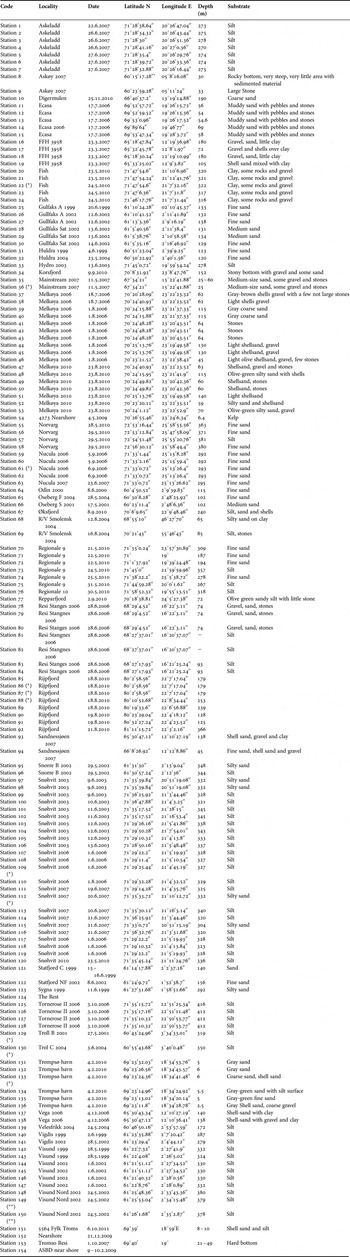
In this paper, we have examined the specimens of the family Syllidae from samples collected by Akvaplan-niva AS offshore along Norway on behalf of Norsk Hydro/Statoil Petroleum between 1999 and 2010 and in coastal zones. Norsk Hydro entrusted Akvaplan-niva to execute a regional environmental survey of the Norwegian and North Sea areas (Akvaplan, personal communication), and samples were taken in the vicinity of offshore oil platforms. The identification of polychaetes from these samples were carried out by the second author. Each station was given a subsequent number for use in this paper. Data from each station are presented in Table 1. For each species, the station numbers are given along with the numbers of specimens in brackets in the Material Examined section.
Stations, location, depth and substrate.

The specimens were collected in the North Sea, Norwegian Sea and Barents Sea. Depths vary from 2.5 to 419 m depth (Table 1). We studied 154 samples, of which 143 had specimens of syllids; samples without syllids are marked with (*) in the table. Two samples had syllids which were included in other previous papers and are marked as (**) in the table. Some samples lack some data.
The specimens were fixed in a 10% formaldehyde-seawater solution during the sampling and later transferred to a 75% alcohol solution.
The individuals were examined using both dissecting and compound light microscopes. The latter was equipped with interference contrast optics (Nomarski) and a camera-lucida drawing tube. Body width was measured across the proventricle and does not include parapodial lobes. The specimens were studied in Spain and were deposited at the Museo Nacional de Ciencias Naturales de Madrid (MNCNM), Spain, and in the collection at Akvaplan-niva (AN).
For general morphology and biology of the family Syllidae see San Martín (Reference San Martín and Ramos2003), San Martín & Aguado (Reference San Martín, Aguado and Schmidt-Rhaesa2014) and San Martín & Worsfold (Reference San Martín and Worsfold2015). The keys include all the known syllids from the area, but some were reported in previous papers (Lucas et al., Reference Lucas, San Martín and Sikorsky2010; Ramos et al., Reference Ramos, San Martín and Sikorski2010); species included in the key but not included in the report of this paper are marked with (**).
RESULTS
Checklist and key for identification of the Norwegian Syllidae
The species reported for the first time in Norway are marked with (*).
Family Syllidae Grube, Reference Grube1850
Subfamily Anoplosyllinae Aguado & San Martín, 2009: Syllides benedicti Banse, Reference Banse1971 (*); Syllides longocirrata, Ørsted, Reference Ørsted1845.
Subfamily Eusyllinae Malaquin, 1893: Eusyllis blomstrandi Malmgren, Reference Malmgren1867; Eusyllis lamelligera Marion & Bobretzky, Reference Marion and Bobretzky1875 (*); Nudisyllis divaricata (Keferstein, Reference Keferstein1862) (*); Odontosyllis fulgurans Audouin & Milne Edwards, 1833 (*); Odontosyllis gibba Claparède, Reference Claparède1863; Opisthodonta serratisetosa (López, San Martín & Jiménez, Reference López, San Martín, Jiménez, Yian and Reish1997) (*); Pionosyllis compacta Malmgren, Reference Malmgren1867; Pionosyllis nidrosiensis (Bidenkap, Reference Bidenkap1907); Streptodonta exsulis Ramos, San Martín & Sikorski, Reference Ramos, San Martín and Sikorski2010; Synmerosyllis lamelligera (Saint-Joseph, Reference Saint-Joseph1887) (*).
Subfamily Exogoninae Langerhans, Reference Langerhans1879: Exogone naidina Ørsted, Reference Ørsted1845 (*); Exogone verugera (Claparède, Reference Claparède1868) (*); Erinaceusyllis erinaceus (Claparède, Reference Claparède1863); Parexogone hebes (Webster & Benedict, Reference Webster and Benedict1884) (*); Parexogone longicirris (Webster & Benedict, Reference Webster and Benedict1887), n. comb. (*); Prosphaerosyllis tetralix (Eliason, Reference Eliason1920) (*); Sphaerosyllis tarquei sp. nov.; Sphaerosyllis taylori Perkins, Reference Perkins1981 (*); Sphaerosyllis bulbosa Southern, Reference Southern1914.
Subfamily Syllinae Grube, Reference Grube1850: Haplosyllis spongicola (Grube, Reference Grube1855) (*); Trypanosyllis troll Ramos, San Martín & Sikorsky, Reference Ramos, San Martín and Sikorski2010; Pseudosyllis brevipennis Grube, Reference Grube1863 (*); Syllis armillaris (O. F. Müller, Reference Müller1771); Syllis cornuta Rathke, Reference Rathke1843; Syllis fasciata Malmgrem, 1867; Syllis kas, sp. nov.; Syllis parapari San Martín & López 2000 (*).
Subfamily Autolytinae Langerhans, Reference Langerhans1879: Acritagasyllis longichaetosus, Lucas, San Martín & Sikorski, Reference Lucas, San Martín and Sikorsky2010; Myrianida inermis (Saint Joseph, 1887); Myrianida prolifera (O. F. Müller, Reference Müller1788); Proceraea cornuta (Agassiz, Reference Agassiz1862).
Incertae Sedis
Amblyosyllis finmarchica (Malmgren, Reference Malmgren1867), Anguillosyllis pupa (Hartman, Reference Hartman1965) (*).
KEY TO SUBFAMILIES AND INCERTAE SEDIS GENERA AND SPECIES
1. Nuchal organs as two occipital lappets (see San Martín & Aguado, Reference San Martín, Aguado and Schmidt-Rhaesa2014, Figure 6B). Pharynx more or less sinuous and coiled………2
— Nuchal organs as two ciliated pits (difficult to observe; occipital lappets absent or, if present, with transversal ridges) between prostomium and peristomium (see San Martín & Aguado, Reference San Martín, Aguado and Schmidt-Rhaesa2014, Figure 6A). Pharynx straight………3
2. Body composed of few, rhomboidal segments. Ventral cirri well developed. Last segment without chaetae, with two pairs of long cirri. Reproduction by epigamy………Amblyosyllis finmarchica
— Body composed of numerous, cylindrical segments. Ventral cirri absent or fused to parapodial lobes. All segments (except peristomium) chaetigerous. Reproduction by epigamy or schizogamy………Subfamily Autolytinae
3. Pharynx unarmed………4
— Pharynx with mid-dorsal tooth, trepan or both………5
4. Palps fused along their entire length. Antennae and tentacular cirri minute, papilliform. Single pair of tentacular cirri. Reproduction by epigamy………Anguillosyllis pupa
— Palps fused basally. Antennae and tentacular cirri more or less club-shaped. Two pairs of tentacular cirri. Reproduction by epigamy or brooding eggs ventrally………Subfamily Anoplosyllinae
5. Antennae, tentacular cirri and dorsal cirri distinctly articulated, usually long (two genera with only one spherical article). Reproduction by schizogamy (some viviparous)………Subfamily Syllinae
— Antennae, tentacular cirri and dorsal cirri smooth or weakly articulated on anterior part of body. Reproduction by epigamy (but unknown in several genera)………6
6. Palps fused entirely or at least half their length. Antennae, tentacular cirri and dorsal cirri short (sometimes papilliform). Eggs brooded dorsally on capillary notochaetae, or ventrally, attached to nephridial pores………Subfamily Exogoninae
— Palps not completely fused. Appendages long, filiform. No brooding of eggs; reproduction by epigamy (or unknown)………Subfamily Eusyllinae
Subfamily Anoplosyllinae Aguado & San Martín, Reference Aguado and San Martín2009
Genus Syllides Ørsted, Reference Ørsted1845
KEY TO SYLLIDES
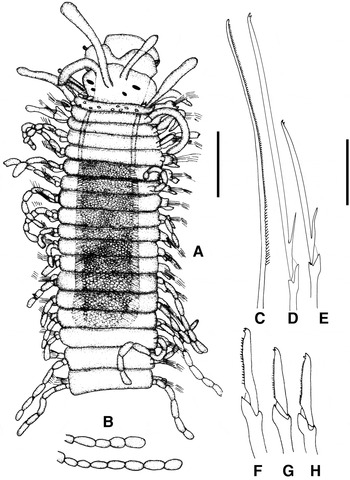
— Dorsal simple chaeta thin and long, pointed (Figure 1C). Basal spine on blades of first and second compound chaetae………Syllides longocirrata
— Dorsal simple chaeta distally blunt, with irregular distal spines (see Banse, Reference Banse1971, Figure 6C). Basal spine on blades of second compound chaetae………Syllides benedicti
Syllides longocirrata. A, anterior end, dorsal view. B, alternating dorsal cirri from midbody. C, dorsal simple chaeta. D–E, first and second most dorsal compound chaetae. F–H, compound chaetae, anterior parapodium. Scales. A–B: 0.2 mm. C–H: 20 µm.

Syllides benedicti Banse, Reference Banse1971
Syllides benedicti Banse (Reference Banse1971): p. 1478, Figure 6. Nygren & Pleijel (Reference Nygren and Pleijel2015): p. 183.
Material examined. Station 9 (1) (MNCN 16.01/17240), Station 28 (2) (AN), Station 32 (1) (MNCN 16.01/17241).
Diagnosis. Dorsal simple chaeta distally blunt, with irregular distal spines. Basal spine on blades of second pair (in dorso-ventral direction) compound chaetae.
Type locality. Eastport Maine, (Atlantic coast of USA).
Habitat. Coarse sand. Sediments related to the seagrass Zostera marina (Gil, Reference Gil2011). Intertidal to 131 m depth.
Distribution. Maine (USA), Skagerrak (W Sweden). NW Spain. First record from Norway (Gil, Reference Gil2011).
Syllides longocirrata Ørsted, Reference Ørsted1845
Figure 1
Syllis (Syllides) longocirrata Ørsted (Reference Ørsted1845): p. 408, Figures 2A, B.
Non Syllides longicirrata Webster & Benedict (Reference Webster and Benedict1887): p. 717. Eliason (Reference Eliason1962): p. 241, Figure 10A–F. Banse (Reference Banse1971): p. 1470, Figure 1A–L. Hartmann-Schröder (Reference Hartmann-Schröder1996): p. 166, Figure 71 A–G.
Non Syllides longocirrata Nygren & Pleijel (Reference Nygren and Pleijel2015): p. 184.
Material examined. Station 10 (1) (MNCN 16.01/17242), Station 11 (1) (AN), Station 12 (1) (MNCN 16.01/17243), Station 18 (8) (MNCN 16.01/17244), Station 19 (1) (AN), Station 29 (1) (MNCN 16.01/17245), Station 66 (1) (AN), Station 91 (5) (MNCN 16.01/17246), Station 92 (2) (MNCN 16.01/17247), Station 94 (1) (MNCN 16.01/17248).
Description. Body small, 5–6 mm long on complete specimens, 0.26 mm wide, without colour markings (fixed specimens). Prostomium oval, wider than long, with two pairs of eyes in open trapezoidal arrangement. Palps shorter than prostomium, each with a distal papilla (Figure 1A). Antennae smooth, club shaped; median antenna almost twice as long as lateral ones, inserted in middle of prostomium; lateral antennae inserted in front of anterior eyes. Peristomium shorter than subsequent segments, with refringent inclusions (Figure 1A); dorsal tentacular cirri slightly shorter than median antenna; ventral tentacular cirri 2/3 the length of dorsal ones. Antennae, tentacular cirri and dorsal cirri of 2 most anterior chaetigers smooth, club shaped, distally blunt. From chaetiger 3 posteriorly, dorsal cirri long and distinctly articulated, with 6–8 articles alternating irregularly with dorsal cirri shorter, with 4–5 articles (Figure 1A, B). Occasionally some cirri are much longer with more articles. Tufts of cilia on dorsal part of parapodia and on laterals of each segment. Ventral cirri digitiform, slightly longer than parapodial lobes, especially on posterior parapodia. Chaetae similar along body. One long and slender dorsal simple chaeta on each parapodium from the first chaetiger, pointed, with short subdistal spines (Figure 1C), together with 5 compound, heterogomph chaetae, with thin and distally bidentate blades, both teeth similar, smooth to slightly spinulated on margin (Figure 1F–H). Marked dorso-ventral gradation in length. Most dorsal compound chaeta with 80μm long and smooth blades, with a long basal spine (Figure 1D); second most dorsal compound chaeta similar to most dorsal one, but shorter (45 µm) (Figure 1E). Remaining chaetae distinctly shorter (25, 20 and 18 µm respectively), with short spines on margin, without basal long spine (Figure 1F–H). Single, thin acicula in each parapodium. Pharynx long, similar in length to proventricle (Figure 1A), apparently without papillae on opening. Proventricle rectangular, reaching through about 10 segments, with around 97 dense muscular fibres (Figure 1A). Pygidium with two long and articulated anal cirri.
Remarks. Ørsted (Reference Ørsted1845) based his description of Syllides longocirrata on a single specimen. He did not present any information about the chaetae, and the illustrations are scarce. The type material is lost.
The specimens examined in this study, collected relatively close to the type locality, are well preserved and closely resemble the original description of Syllides longocirrata.
Eliason (Reference Eliason1962) described one specimen from Sweden, which he considered as Syllis longicirrata. Later, Banse (Reference Banse1971) revised the genus Syllides, and remarked on the difficulties concerning Syllides longicirrata, both because the type material is lost and because the original description is lacking the description of some important characteristics. Banse considered the description made by Eliason as the valid one for the species, since that material came from the vicinity of the type locality. However, the characters of such species do not agree with those of the genus Syllides, but Streptospinigera Kudenov, 1983.
Olivier et al. (Reference Olivier, San Martín and Archambault2013) discussed this problem and re-described the species that Eliason and others reported as Syllides longocirrata as a new species of Streptospinigera, leaving the true Syllides longicirrata lacking a complete and accurate description.
In this paper the material was collected close to the area that Ørsted studied, and the individuals found, being in good condition, clearly belong to Syllides, and agree well with the original description, adding some important descriptions of some previously unknown characteristics, such as the presence of thin long simple chaeta, the presence of the spine on the tip of the shafts of the first and second chaetae, the proventricle length, the peristomial granular ring, and the longitudinal clearly articulated cirri.
Type locality. Oslo Fjord (Norway).
Habitat. Shell sand, sand, fine sediments, seaweeds; intertidal to 366 m depth.
Distribution. Skagerrak (Sweden), Norway.
Subfamily Eusyllinae Malaquin, Reference Malaquin1893
KEY TO EUSYLLINAE
1. Pharyngeal tooth absent; pharynx with an incomplete trepan formed by few teeth, backwardly directed. Occipital flap usually present (see San Martín, Reference San Martín and Ramos2003, Figure 47B)………Odontosyllis
— Pharyngeal tooth present, with or without trepan………2
2. Pharynx with mid-dorsal tooth and incomplete (sometimes complete) arc of numerous (around 30–40) pharyngeal denticles………Eusyllis
— Pharynx without denticles, only the mid dorsal tooth………3
3. A number of anterior parapodia with enlarged aciculae, distally knobbed. Pharyngeal tooth located far from anterior rim………Streptodonta exsulis
— Without enlarged aciculae. Pharyngeal tooth located anteriorly or slightly back from anterior rim………4
4. Segments posterior to proventricle fused in units of 2–3 segments. Ventral cirri of chaetiger 1 laminar, flattened………Synmerosyllis lamelligera
— Segments not fused. Ventral cirri all digitiform………5
5. Pharyngeal tooth slightly back from anterior rim. Proximal tooth of blades on compound chetae curved, almost touching with blade edge (see San Martín, Reference San Martín and Ramos2003, Figure 37E)………Opisthodonta serratisetosa
— Pharyngeal tooth on anterior margin. Blades of compound chaetae unidentate or bidentate, not curved………6
6. Palps totally separated (see San Martín & Aguado, Reference San Martín, Aguado and Schmidt-Rhaesa2014, Figure 5; San Martín & Worsfold, Reference San Martín and Worsfold2015, Figure 1). Compound chaetae almost unidentate………Nudisyllis divaricata
— Palps fused basally. Compound chaetae bidentate………Pionosyllis
Genus Eusyllis Malmgren, Reference Malmgren1867
KEY TO EUSYLLIS
— Ventral cirri of chaetiger 1 laminar, flattened. Compound chaetae with blades of different sizes………Eusyllis lamelligera
— Ventral cirri of chaetiger 1 not laminar. Compound chaetae with blades of similar sizes…Eusyllis blomstrandi
Eusyllis blomstrandi Malmgren, Reference Malmgren1867
Eusyllis blomstrandi Malmgren (Reference Malmgren1867): p. 40, Plate 4, Figure 43. Fauvel (Reference Fauvel1923): p. 293, Figure 112, H–M. Imajima (Reference Imajima1966a): p. 92, Text-Figure 29A–H. Hartmann-Schröder (Reference Hartmann-Schröder1971): p. 158, Figure 52; (1996): p. 157, Figure 68A–G. San Martín (Reference San Martín and Ramos2003): p. 112, Figure 51A–F. Kudenov & Harris (Reference Kudenov, Harris, Blake, Hilbig and Scott1995): p. 41, Figure 1.13 A–H. Ramos et al. (Reference Ramos, San Martín and Sikorski2010): p. 2. Nygren & Pleijel (Reference Nygren and Pleijel2015): p. 180.
Material examined. Station 13 (1) (MNCN 16.01/17249), Station 41 (1) (MNCN 16.01/17250), Station 44 (1) (MNCN 16.01/17251), Station 54 (5) (AN), Station 56(1) (MNCN 16.01/17252), Station 58(1) (MNCN 16.01/17253), Station 62 (1) (MNCN 16.01/17254), Station 74 (1) (MNCN 16.01/17255), Station 90 (4) (MNCN 16.01/17256), Station 97 (1) (MNCN 16.01/17257), Station 111 (1) (MNCN 16.01/17258), Station 113 (2) (MNCN 16.01/17259), Station 120 (1) (AN), Station 126 (1) (MNCN 16.01/17260).
Diagnosis. Compound chaetae with blades of similar sizes.
Type locality. Spitsbergen.
Habitat. Algae, seagrasses, sand, detritus, gravel, fine sediments, inside sponges, coralligenous concretions (San Martín, Reference San Martín and Ramos2003). Intertidal zone to more than 400 m depth.
Distribution. Boreal and Sub-Arctic, N Atlantic, N Pacific, western Mediterranean (San Martín, Reference San Martín and Ramos2003).
Eusyllis lamelligera Marion & Bobretzky, Reference Marion and Bobretzky1875
Eusyllis lamelligera Marion & Bobretzky (Reference Marion and Bobretzky1875): p. 33, Plate 3, Figure 9A–C. Fauvel (Reference Fauvel1923): p. 294, Figure 113. San Martín (Reference San Martín and Ramos2003): p. 117, Figures 54 & 55. San Martín & Hutchings (Reference San Martín and Hutchings2006): p. 278, Figures 15A–J, 16A–F.
Material examined. Station 15 (3) (MNCN 16.01/17261), Station 53 (2) (AN), Station 94 (1) (MNCN 16.01/17262), Station 123 (1) (MNCN 16.01/17263), Station 131 (1) (MNCN 16.01/17264), Station 136 (17) (AN).
Diagnosis. Ventral cirri of chaetiger 1 laminar, flattened. Compound chaetae with blades of different sizes.
Type locality. Île de Riou, Marseille (France).
Habitat. Occurring in a wide variety of substrates, intertidal zone to depths greater than 500 m (San Martín & Hutchings, Reference San Martín and Hutchings2006).
Distribution. N Atlantic, Mediterranean Sea, Australia. First record from Norway.
Genus Nudisyllis Knox & Cameron, Reference Knox and Cameron1970
Nudisyllis divaricata (Keferstein, Reference Keferstein1862)
Syllis divaricata Keferstein (Reference Keferstein1862): p. 111, Figures 1–11.
Syllis normannica Claparède (Reference Claparède1863): p. 40, Plate 13, Figure 24.
Diagnosis. Compound chaetae almost unidentate.
Material examined. Station 3 (1) (AN).
Type locality. Saint Vaast (Northern France).
Habitat. The species is only known from a few places. It has been taken from coastal dredges and down to 500 m depth. Occurs inside coralline rocks, in samples with Halimeda in shallow waters, and in ‘anfioxus’ sands (San Martin, Reference San Martín and Ramos2003).
Distribution. West Atlantic, from English Channel to Cape Verde Islands. Mediterranean. Barents Sea. Also reported from Cuba (San Martin, Reference San Martín and Ramos2003). First record from Norway.
Genus Odontosyllis Claparède, Reference Claparède1863
KEY TO ODONTOSYLLIS
— Blades of compound chaetae long and unidentate………Odontosyllis gibba
— Blades of compound chaetae short and bidentate………Odontosyllis fulgurans
Odontosyllis fulgurans Audouin & Milne Edwards, Reference Audouin and Milne Edwards1833
Syllis fulgurans Audouin & Milne Edwards (Reference Audouin and Milne Edwards1833): p. 229.
Odontosyllis fulgurans Fauvel (Reference Fauvel1923): p. 229, Figure 103F–I. Hartmann-Schröder (Reference Hartmann-Schröder1971): p. 152; (1996): p. 159. San Martín (Reference San Martín and Ramos2003): p. 104, Figures 46A–G, 47 A–D.
Material examined. Station 15 (1) (AN), Station 59 (1) (AN), Station 91 (1) (MNCN 16.01/17265), Station 127 (1) (AN).
Diagnosis. Compound chaetae with blades short and bidentate.
Type locality. Probably near Montpellier (France).
Habitat. It has been found among algae, calcareous concretions and shells, among mussels, ascidians and sponges, sand and gravel and sea grasses (San Martín, Reference San Martín and Ramos2003). Intertidal zone to more than 400 m depth.
Distribution. NE Atlantic and Mediterranean Sea. First record from Norway. This species has also been reported from other places, but these reports require verification.
Odontosyllis gibba Claparède, Reference Claparède1863
Odontosyllis gibba Claparède (Reference Claparède1863): p. 47, Plate 12, Figures 7 & 8. Fauvel (Reference Fauvel1923): p. 275, Figure 104A–E. Hartmann-Schröder (Reference Hartmann-Schröder1971): p. 152; (1996): p. 160. San Martín (Reference San Martín and Ramos2003): p. 102, Figures 44A–C, 45A, B.
Material examined. Station 71 (1) (AN), Station 96 (1) (AN), Station 143 (1) (AN).
Diagnosis. Antennae, tentacular cirri and dorsal cirri smooth. Pharyngeal tooth absent; pharynx with an incomplete trepan formed by few teeth, backwardly directed. Compound chaetae with blades elongated and unidentate.
Type locality. Near Saint Vaaste la Hougue (Normandy, France).
Habitat. Among algae, rhizoids of kelps, hydroids, bio-calcareous concretions, coarse and muddy sand. Intertidal zone to more than 300 m depth (San Martín, Reference San Martín and Ramos2003).
Distribution. Eastern Atlantic, from Scandinavia to the Mediterranean.
Remarks. Some reports in South Africa and Mozambique (Day, Reference Day1967), though these perhaps represent another species.
Genus Opisthodonta Langerhans, Reference Langerhans1879
Opisthodonta serratisetosa (López, San Martín & Jiménez, Reference López, San Martín, Jiménez, Yian and Reish1997)
Pionosyllis serratisetosa López et al. (Reference López, San Martín, Jiménez, Yian and Reish1997): p. 293, Figure 1. San Martín (Reference San Martín and Ramos2003): p. 89, Figures 37 & 38.
Opisthodonta serratisetosa San Martín et al. (Reference San Martín, López and Aguado2009): p. 1475.
Material examined. Station 1 (3) (MNCN 16.01/17266), Station 2 (8) (MNCN 16.01/17267), Station 4 (1) (AN), Station 5 (4) (MNCN 16.01/17268), Station 6 (9) (AN), Station 7 (14) (MNCN 16.01/17269), Station 38 (1) (AN).
Diagnosis. Proximal tooth of blades on compound chaetae curved, almost touching with blade edge.
Type locality. Congreso Island (Chafarinas Island, Spain, Western Mediterranean).
Habitat. Associated with anthozoans such as Corallium rubrum, Cladocora caespitosa and Madrepora oculata, or on photophilic and sciaphilic algae, or fine sediments. From depth of 1 to 760 m.
Distribution. Previously only known from the Mediterranean Sea and Banco de Galicia (NW Iberian Peninsula) (San Martín, Reference San Martín and Ramos2003). First record from Norway. As shown in this paper, O. serratisetosa is also present in the Barents Sea.
Genus Pionosyllis Malmgren, Reference Malmgren1867
KEY TO PIONOSYLLIS
— Ventral cirri of chaetiger 1 slightly laminar, flattened. Teeth of blades of longer chaetae close to each other………Pionosyllis compacta
— Ventral cirri of chaetiger 1 not laminar. Teeth of blades always distinctly separated………Pionosyllis nidrosiensis
Pionosyllis compacta Malmgren, Reference Malmgren1867
Pionosyllis compacta Malmgren (Reference Malmgren1867): p. 40, Figure 48. Pettibone (Reference Pettibone1954) (in part): p. 262, Figure 28J. Uschakov (Reference Uschakov1955): p. 166, Figure 54I–J. Hartmann-Schröder (Reference Hartmann-Schröder1996): p. 161. San Martín et al. (Reference San Martín, López and Aguado2009): p. 1482, Figures 9 & 10. Ramos et al. (Reference Ramos, San Martín and Sikorski2010): p. 2.
Material examined. Station 3 (1) (AN), Station 39 (1) (AN), Station 43 (2) (MNCN 16.01/17270), Station 46 (1) (AN), Station 52 (2) (MNCN 16.01/17271), Station 72 (2) (MNCN 16.01/17272), Station 82 (2) (AN), Station 133 (1) (AN).
Diagnosis. Ventral cirri of chaetiger 1 slightly laminar, flattened. Teeth of blades of longer chaetae close to each other.
Type locality. Spitsbergen.
Habitat. Sublittoral to 278 m depth, on different kind of sediments, like silt, fine sand, coarse sand, shells, sand and gravel and stones.
Distribution. Beaufort Sea, Canadian part of Arctic Ocean, North West Atlantic, UK, Norway.
Pionosyllis nidrosiensis (Bidenkap, Reference Bidenkap1907)
Syllis nidrosiensis Bidenkap (Reference Bidenkap1907): p. 21, Figure 7, Plate 3, Figures 19 & 20.
Hesiosyllis enigmatica Wesenber-Lund (1950a): p. 14, Plate 3, Figure 16, Plate 4, Figure 17.
Pionosyllis enigmatica San Martín (Reference San Martín and Ramos2003): p. 73, Figures 26 & 27. San Martín et al. (Reference San Martín, López and Aguado2009): p. 1482, Figures 11A–F, 12A–D, 13A–G, 14A–H.
Pionosyllis nidrosiensis Nygren & Pleijel (Reference Nygren and Pleijel2015): p. 181.
Material examined. Station 151 (19) (AN), Station 124 (18) (MNCN 16.01/17273).
Diagnosis. Teeth of blades always distinctly separated.
Type locality. Trondheimsfjorden (Norway).
Habitat. Found on mud, 90–584 m. On corals Madrepora oculata found up to 790 m depth.
Distribution. Greenland, East of Iceland, Norway, Sweden, North Sea, NW Spain.
Genus Streptodonta San Martín & Hutchings, Reference San Martín and Hutchings2006
Streptodonta exsulis Ramos et al., Reference Ramos, San Martín and Sikorski2010
Streptodonta exsulis Ramos et al., Reference Ramos, San Martín and Sikorski2010, 3, Figures 1–4.
Material examined. Station 27 (2) (AN), Station 68 (2) (AN).
Diagnosis. Pharyngeal tooth located far from anterior rim.
Type locality. Norwegian Sea.
Habitat. On fine sediments, at 68–141 m depth.
Distribution. Barents Sea, Eastern N Atlantic.
Genus Synmerosyllis San Martín et al., Reference San Martín, López and Aguado2009
Synmerosyllis lamelligera (Saint-Joseph, Reference Saint-Joseph1887)
Pionosyllis lamelligera Saint-Joseph (Reference Saint-Joseph1887): p. 163, Plate 8, Figures 30–38; Fauvel (Reference Fauvel1923): p. 288, Figure 110A–G; San Martín (Reference San Martín and Ramos2003): p. 79, Figures 30 & 31. Helgason et al. (Reference Helgason, Gadarson, Svavardson, Adalsteindottir and Gudmudson1990): p. 207.
Synmerosyllis lamelligera San Martín et al. (Reference San Martín, López and Aguado2009): p. 37.
Material examined. Station 17 (3) (AN).
Diagnosis. Ventral cirri of chaetiger 1 laminar, flattened.
Type locality. Coast of Dinard (N France).
Habitat. Among algae, kelps, Posidonia oceanica seagrass, among ascidians and bio-calcareous concretions; intertidal zone up to more than 100 m depth.
Distribution. NE Atlantic from Norway to Cape Verde Islands and the Mediterranean Sea. First record from Norway. Also reported from Cuba.
Subfamily Exogoninae Langerhans, Reference Langerhans1879
KEY TO EXOGONINAE
1. Body without papillae………2
— Body papillated………3
2. Compound chaetae all bidentate falcigers, with both teeth similar. Ventral brooding or
Viviparous………Parexogone
— Blades of compound chaetae of 2 different types; some elongated, spiniger-like, others short falcigers with proximal tooth longer than distal tooth. Ventral brooding of eggs and juveniles………Exogone
3. Prostomium with 4 eyes, no additional eyespots. Proventricle short, with few large muscular bands. Pharynx slender; pharyngeal tooth small, conical, located on anterior rim of pharynx. Aciculae with tip forming an angle (bulbous in one species). Females brooding ventrally, developing juveniles………Sphaerosyllis
— Four eyes and 2 anterior eyespots on prostomium (sometimes difficult to see). Proventricle barrel-shaped, long and relatively wide, with numerous, slender muscular bands. Pharynx relatively wide. Aciculae acuminate. Females brooding dorsally………4
4. Pharynx distinctly wide, without papillae. Antennae and dorsal cirri having a retractile cirrostyle. Dorsal cirri present on second chaetiger………Prosphaerosyllis tetralix
— Pharynx proportionally more slender, sometimes with soft papillae surrounding opening. Antennae and dorsal cirri always without retractile cirrostyle. Dorsal cirri absent on second chaetiger………Erinaceusyllis erinaceus
Genus Exogone Ørsted, Reference Ørsted1845
KEY TO EXOGONE
— Compound chaetae of 2–3 most anterior parapodia with blades very different from the others: very short, unidentate with a long basal spine. Antennae elongated. Proventricle short (2–3 segment)………Exogone naidina
— Compound chaetae similar throughout. Antennae small. Proventricle long (4 or more segments)………Exogone verugera
Exogone naidina Ørsted, Reference Ørsted1845
Exogone naidina Ørsted (Reference Ørsted1845): p. 20, Figures 1–14. Hartmann-Schröder (Reference Hartmann-Schröder1971): p. 171, Figure 56A–C; (1996): p. 170, Figure 73A–C. San Martín (Reference San Martín2005): Figure 79A–J. Ramos et al. (Reference Ramos, San Martín and Sikorski2010): p. 5. Nygren & Pleijel (Reference Nygren and Pleijel2015): p. 173.
Exogone (Exogone) naidina San Martín (Reference San Martín and Ramos2003): p. 262, Figures 142 & 143;
Exogone gemmifera Pagenstecher (Reference Pagenstecher1862): p. 267. Fauvel (Reference Fauvel1923): p. 305, Figure 117A–D.
Material examined. Station 19 (1) (AN), Station 25 (1) (AN), Station 31 (1) (AN), Station 72 (2) (MNCN 16.01/17274), Station 139 (1) (AN).
Diagnosis. Compound chaetae of 2–3 anterior segments very different from the others: very short, unidentate with a long basal spine. Antennae elongated of 2–3 anterior segments. Proventricle short.
Type locality. Near Striib, Lille Baelt Channel (Denmark).
Habitat. Common in fine mud to coarse sand containing an organic material, and in association with algae or seagrasses. From littoral zone up to 200 m depth.
Distribution. Apparently cosmopolitan.
Exogone verugera (Claparède, Reference Claparède1868)
Paedophylax veruger Claparède (Reference Claparède1868): p. 213, Plate 12, Figure 3
Exogone verugera Fauvel (Reference Fauvel1923): p. 307, Figure 117M–R. Hartmann-Schröder (Reference Hartmann-Schröder1971): p. 170; (1996): p. 172. San Martín (Reference San Martín and Ramos2003): p. 271, Figures 147A–I, 148A–F. Helgason et al. (Reference Helgason, Gadarson, Svavardson, Adalsteindottir and Gudmudson1990): p. 207, Figure 3. Ramos et al. (Reference Ramos, San Martín and Sikorski2010): p. 5. Nygren & Pleijel (Reference Nygren and Pleijel2015): p. 174.
Material examined. Station 1 (6) (AN), Station 2 (49) (AN), Station 3 (24) (AN), Station 5 (19) (AN), Station 6 (32) (AN), Station 7 (83) (AN), Station 9 (8) (AN), Station 13 (9) (AN), Station 14 (5) (AN), Station 18 (2) (AN), Station 34 (11) (MNCN 16.01/17276), Station 48 (1) (MNCN 16.01/17277), Station 51 (1) (MNCN 16.01/17278), Station 59 (8) (MNCN 16.01/17279), Station 70 (15) (MNCN 16.01/17280), Station 72 (30) (MNCN 16.01/17281), Station 79 (19) (AN), Station 80 (38) (AN), Station 83 (3) (MNCN 16.01/17282), Station 84 (10) (MNCN 16.01/17283), Station 93 (2) (MNCN 16.01/17284), Station 94 (2) (AN), Station 98 (2) (AN), Station 105 (3) (AN), Station 107 (1), Station 115 (3) (AN), Station 119 (1) (AN), Station 136 (9) (MNCN 16.01/17285), Station 138 (7) (AN).
Diagnosis. Compound chaetae similar throughout. Antennae small. Proventricle long.
Type locality. Gulf of Naples (Italy).
Habitat. Found as epibiont on algae, seagrasses, bryozoans, gorgonians, Sabellaria reefs, calcareous concretions and inside sponges. Sediments from coarse sand to mud. Intertidal to about 1100 m depth.
Distribution. Barents Sea, N Atlantic, Mediterranean and Black Sea. First record from Norway. Reports from regions outside this area may represent different species.
Genus Erinaceusyllis San Martín, Reference San Martín2005
Erinaceusyllis erinaceus (Claparède, Reference Claparède1863)
Sphaerosyllis erinaceus Claparède (Reference Claparède1863): p. 45, Plate 13, Figure 38.
Fauvel (Reference Fauvel1923): p. 302, Figure 115. Hartmann-Schröder (Reference Hartmann-Schröder1971): p. 168, Figure 55. Imajima (Reference Imajima1966b): p. 402, Figure 5. Nygren & Pleijel (Reference Nygren and Pleijel2015): p. 177.
Sphaerosyllis (Sphaerosyllis) erinaceus Hartmann-Schröder (Reference Hartmann-Schröder1996): p. 175, Figure 75.
Erinaceusyllis erinaceus Ramos et al. (Reference Ramos, San Martín and Sikorski2010): p. 6. Verdes et al. (Reference Verdes, Aguado and San Martín2013): p. 2, Figures 1 & 2.
Material examined. Station 39 (1) (AN), Station 48 (5) (AN), Station 53 (1) (AN), Station 132 (1) (MNCN 16.01/17286), Station 133 (2) (MNCN 16.01/17287), Station 136 (19) (AN).
Diagnosis. Blades of compound chaetae unidentate.
Type locality. Near St. Vaaste la Hougue (Normandie, N France).
Habitat. Associated with sand, algae, hydrozoans and other sessile invertebrates. Sublittoral zone to 115 m depth.
Distribution. Boreal, Barents Sea. NE Atlantic, Ireland, English Channel. North Pacific (Japanese Sea).
Genus Parexogone Mesnil & Caullery, Reference Mesnil and Caullery1918
KEY TO PAREXOGONE
— Compound chaetae of all parapodia with short blades, all similar or with slight dorsal to ventral gradation. Dorsal simple chaetae without aristae. Median antenna shorter than prostomium and palps together (see San Martín, Reference San Martín and Ramos2003, Figure 125A)………Parexogone hebes
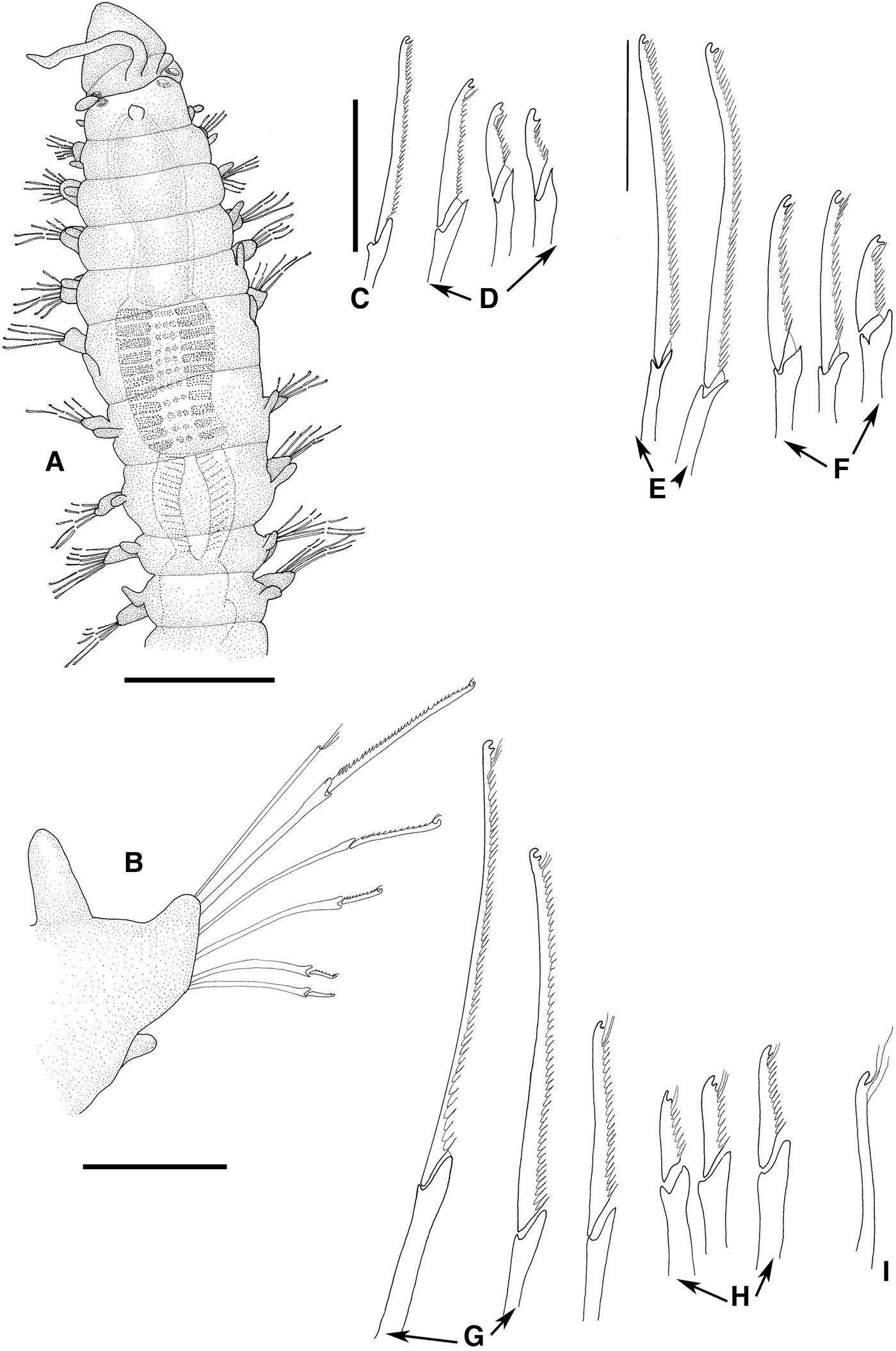
— Some compound chaetae (1–3) with long blades, at least on anterior parapodia. Dorsal simple chaetae with few (1–3) very long, thin spines (aristae), extending beyond the tips. Median antenna similar in length or longer than prostomium and palps together (Figure 2A)………Parexogone longicirris
Parexogone longicirris n. comb. A, dorsal view, anterior end. B, midbody parapodium. C, D, compound chaetae of first chaetiger. E, F, compound chaetae, anterior parapodium. G, H, compound chaetae, mid-posterior parapodium. I, dorsal simple chaeta. Scales. A: 0.2 mm. B: 48 µm. C–I: 20 µm.

Parexogone hebes (Webster & Benedict, Reference Webster and Benedict1884)
Paedophyllax hebes Webster & Benedict (Reference Webster and Benedict1884): p. 716, Plate 3, Figures 31–36.
Exogone hebes Fauvel (Reference Fauvel1923): p. 308, Figure 118G–P. Nygren & Pleijel (Reference Nygren and Pleijel2015): p. 172.
Exogone (Parexogone) hebes Hartmann-Schröder (Reference Hartmann-Schröder1996): p. 173, Figure 74A–E. San Martín (Reference San Martín and Ramos2003): p. 236, Figures 125A–H, 126E–F.
Parexogone hebes Ramos et al. (Reference Ramos, San Martín and Sikorski2010): p. 5.
Material examined. Station 8 (10) (AN), Station 9 (20) (AN), Station 17 (3) (MNCN 16.01/17288), Station 51 (1) (MNCN 16.01/17289), Station 64 (1) (MNCN 16.01/17290), Station 65 (1) (AN), Station 94 (1) (AN), Station 138 (1) (AN).
Diagnosis. Blades of compound chaetae all short.
Type locality. Provincetown or Wellfleet, Massachusetts (E coast of USA).
Habitat. Interstitial in mud to coarse sand. With low to high amounts of organic material. Intertidal to 140 m depth.
Distribution. North Atlantic, both along North America, and Europe, from the North Sea to the Mediterranean. First record from Norway.
Parexogone longicirris (Webster & Benedict, Reference Webster and Benedict1887) n. comb.
Figure 2
Paedophylax longicirris Webster & Benedict (Reference Webster and Benedict1887): p. 722, Plate 3, Figures 46–50.
Perkins (Reference Perkins1981): p. 1092, Figure 11. Helgason et al. (Reference Helgason, Gadarson, Svavardson, Adalsteindottir and Gudmudson1990): p. 207, Figure 4.
Exogone furcifera Eliason (Reference Eliason1962): p. 210, Figure 11A–F. Nygren & Pleijel (Reference Nygren and Pleijel2015): p. 171.
Material examined. Station 1 (13) (AN), Station 2 (22) (AN), Station 3 (9) (MNCN 16.01/17291), Station 5 (12) (MNCN 16.01/17292), Station 6 (20) (MNCN 16.01/17293), S7 (28) (AN), Station 21 (1) (MNCN 16.01/17294), Station 24 (5) (MNCN 16.01/17295), Station 55 (1) (AN), Station 70 (3) (MNCN 16.01/17296), Station 72 (16) (MNCN 16.01/17297), Station 76 (5) (MNCN 16.01/17298), Station 85 (1) (MNCN 16.01/17299), Station 95 (1) (AN), Station 99 (2) (AN), Station 101 (1) (AN), Station 103 (1) (AN), Station 104 (2) (AN), Station 105 (19) (AN), Station 106 (1) (AN), Station 113 (2) (AN), Station 116 (3) (AN), Station 124 (19) (AN), Station 125 (1) (AN), Station 140 (1) (AN), Station 142 (1) (AN), Station 144 (2) (AN), Station 147 (1) (AN).
Description. Body long, slender, filiform, without colour markings, up to 6.5 mm long, 0.35 mm wide, 33–35 chaetigers. Prostomium oval; 2 pairs of small eyes in trapezoidal arrangement, very close to each other on each side. Median antenna inserted between anterior eyes, cylindrical, somewhat longer than combined length of prostomium and palps; lateral antennae oval, much shorter than median antenna, slightly shorter than prostomium, similar in length to dorsal cirri, inserted in front of anterior eyes (Figure 2A). Palps about twice as long as prostomium and completely fused all along their length, forming a triangular, acute plate. Peristomium similar to or slightly longer than following segments, covering posterior part of prostomium; tentacular cirri minute, papilliform (Figure 2A). Dorsal cirri papilliform, elongate (Figure 2B), similar in length or shorter than parapodial lobes, but longer than tentacular cirri, present on all parapodia (Figure 2A). Compound chaetae with smooth shafts. Chaetae with elongate, spiniger-like, bidentate blades, both teeth small and similar (Figure 2C–H), with long, thin, erected marginal spines, extending beyond tip distally. Each parapodium also with several falcigers, more or less similar in shape to spiniger-like, but distinctly shorter (Figure 2C–H). Parapodia of 1 or 2 anterior chaetigers each with 1–2 short spiniger-like chaetae, blades about 27 µm long (Figure 2C), and about 5–6 falcigers (Figure 2D) with dorso-ventral gradation in length, 20 µm above 12 µm below. Blades progressively longer to midbody. Anterior parapodia (except most anterior) with 12–14 compound chaetae, 2–3 spiniger-like with about 45μm long blades (Figure 2E), and remaining chaetae falcigers, blades 25 µm above, 15 µm below (Figure 2F); midbody parapodia with 1–2 spiniger-like chaeta each (Figure 2G), blades about 60 µm long, and 5–7 falcigers (Figure 2H), blades 30 µm above 12 µm below; posterior parapodia each with 1 spiniger-like chaeta, and only 4 falcigers (Figure 2B). Dorsal simple chaetae from anterior parapodia, distinctly bidentate, with 3 long marginal spines (aristae), extending beyond tip (Figure 2B, I), one aristae distinctly longer than other 2, thicker. Ventral simple chaetae not seen. Acicula solitary, distally expanded and rounded. Pharynx through about 4 segments; pharyngeal tooth on anterior rim (Figure 2A). Proventricle short, through 2 segments, with about 10–11 muscle cell rows (Figure 2A).
Remarks. Although this species was previously included in the genus Exogone, its morphological characteristics show it to be a member of Parexogone.
Type locality. Eastport, Maine (E coast of USA).
Habitat. All kind of sediments. Sublittoral to more than 400 m.
Distribution. N Atlantic: Maine (USA), Øresund (between Denmark and Sweden). First report to Norway.
Genus Prosphaerosyllis San Martín, Reference San Martín1984
Prosphaerosyllis tetralix (Eliason, Reference Eliason1920)
Sphaerosyllis tetralix Eliason (Reference Eliason1920): p. 13.
Hartmann-Schröder (Reference Hartmann-Schröder1971): p. 165, Figure 54A–C. Campoy (Reference Campoy1982): p. 277. Nygren & Pleijel (Reference Nygren and Pleijel2015): p. 178.
Sphaerosyllis (Prosphaerosyllis) tetralix Hartmann-Schröder (Reference Hartmann-Schröder1996): p. 177, Figure 77.
Prosphaerosyllis tetralix San Martín (Reference San Martín and Ramos2003): p. 217, Figure 114.
Material examined. Station 2 (15) (AN), Station 3 (1) (AN), Station 5 (11) (MNCN 16.01/17300), Station 6 (7) (AN), Station 7 (18) (AN), Station 33 (1) (AN), Station 46 (1) (MNCN 16.01/17301), Station 71 (1) (MNCN 16.01/17302), Station 72 (3) (MNCN 16.01/17303).
Diagnosis. Body with 2 longitudinal rows of long papillae. Pharyngeal tooth slightly back from anterior rim.
Type locality. Øresund and Gullmarfjord (W coast of Sweden).
Habitat. Species found in muddy bottoms, detrital materials and sand, from 30 to 300 m depth.
Distribution. NE Atlantic from Scandinavia, to Mediterranean Sea, albeit scarce in the latter. First report to Norway.
Genus Sphaerosyllis Claparède, Reference Claparède1863
KEY TO SPHAEROSYLLIS
1. Aciculae straight, with a bulbous distal swelling. Mid–body parapodia with a simple chaeta by loss of blades and shaft enlargement………Sphaerosyllis bulbosa
— Aciculae distally bent at an angle. Without enlarged chaetae………2
2. Parapodial glands with fibrilar material (rods). All blades short………Sphaerosyllis taylori
— Without parapodial glands. All blades long………Sphaerosyllis tarquei sp. nov.
Sphaerosyllis tarquei sp. nov.
Figures 3 & 4
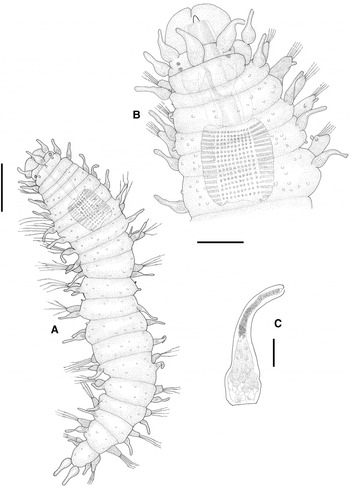
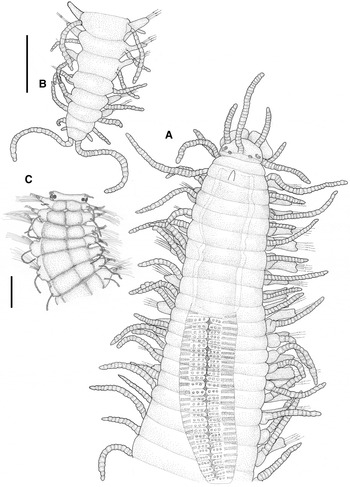
Sphaerosyllis tarquei sp. nov. Holotype (MNCNM). A, complete specimen, dorsal view. B, anterior end, dorsal view. C, detail of an anterior dorsal cirrus. Scales. A: 0.2 mm. B: 0.1 mm. C: 20 µm.

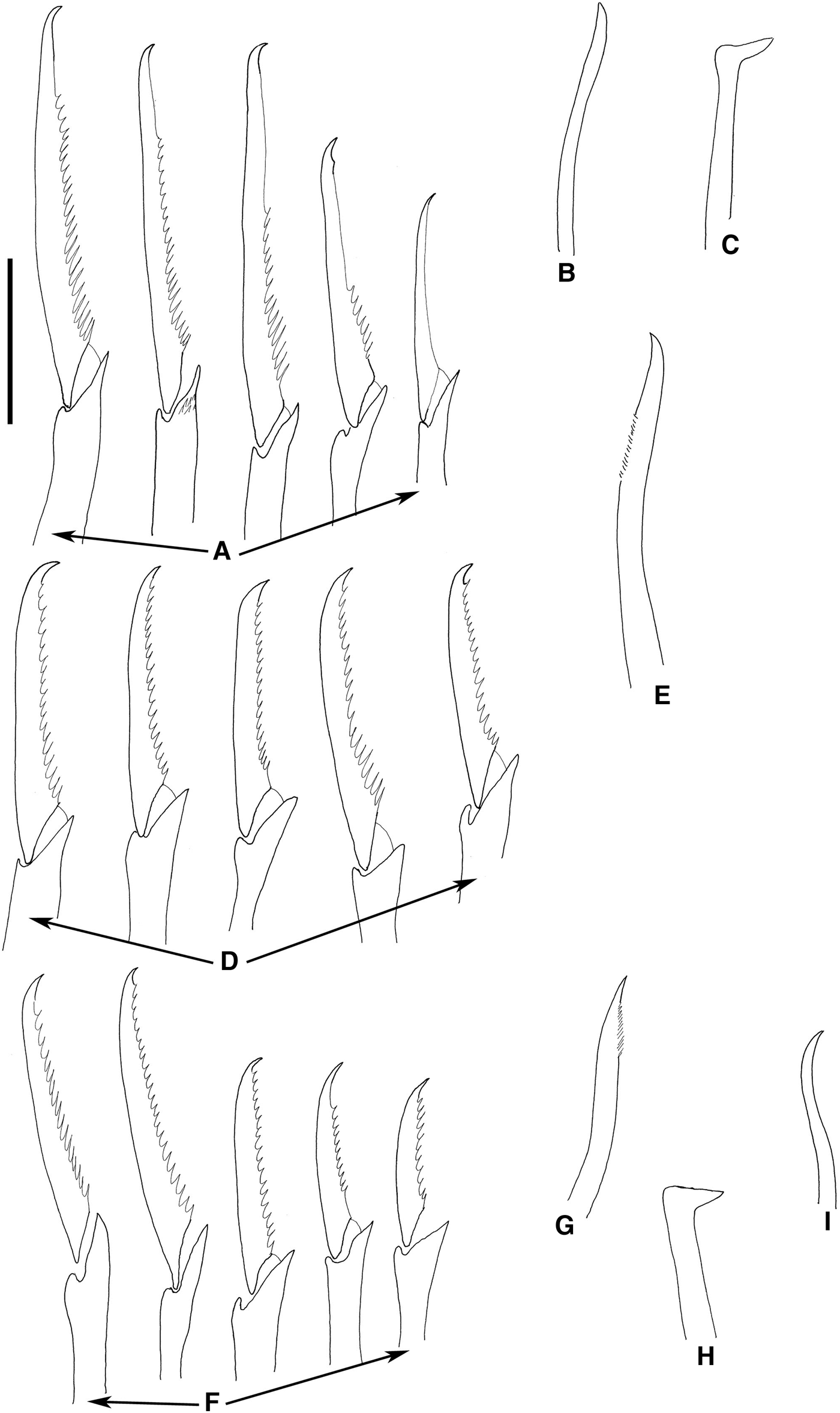
Sphaerosyllis tarquei sp. nov. Holotype (MNCNM). A, compound chaetae, anterior parapodium. B, dorsal simple chaeta, anterior parapodium. C, acicula, anterior parapodium. D, compound chaetae, midbody parapodium. E, dorsal simple chaeta, midbody parapodium. F, compound chaetae, posterior parapodium. G, dorsal simple chaeta, posterior parapodium. I, ventral simple chaeta. H, acicula, posterior parapodium. Scale. 20 µm.

Material examined. Station 2 (Holotype & 3 Paratypes) (MNCN 16.01/17304), Station 7 (22 Paratypes) (MNCN 16.01/17305).
Description. Specimens complete and in good condition. Holotype 1.57 mm long, 0.19 mm wide with 19 chaetigers (Figure 3A); longest specimen 3.7 mm long, 0.19 mm wide with 29 chaetigers. Body white to yellowish, without color pattern, covered with small, rounded, scattered papillae (Figure 3A, B). Prostomium rectangular, wider than long, partially covered by peristomium (Figure 3B); antennae longer than prostomium, antennae basally bulbous, somewhat longer at tips. Median antenna inserted behind lateral ones, between posterior pair of eyes; lateral antennae originated near anterior margin of prostomium, in front of anterior eyes. Four eyes in trapezoidal arrangement. Palps broad totally fused along their length, with dorsal groove (Figure 3A, B). Peristomium similar in length to subsequent segments, partially covering posterior part of prostomium (Figure 3A, B). Tentacular cirri similar to antennae, slightly smaller. Dorsal cirri similar to tentacular cirri, somewhat longer, absent on chaetiger 2 (Figure 3A, B). Antennae, tentacular cirri and dorsal cirri with an internal gland possessing a duct open at distal end (Figure 3C). Without parapodial glands. Anterior parapodia with 5–7 compound heterogomph chaetae; blades unidentate, distally somewhat hooked, with moderate to short spines on margin, longer basally, about 47–50 µm long dorsally, 26 µm long ventrally, ventralmost chaetae almost smooth (Figure 4A). Number of compound chaetae decreases posteriorly, 5–6 on midbody, 4–5 on posterior parapodia. Compound chaetae of midbody and posterior parapodia similar to anterior ones but with less marked differences in sizes of blades, 34–27 µm in midbody, 34–19 µm on posterior parapodia. (Figure 4D, E). Dorsal simple chaetae from anterior segments, unidentate, sigmoid, slender on anterior parapodia (Figure 4B, E, G). Ventral simple chaeta on posterior segments, smooth, unidentate, sigmoid (Figure 4I). Single acicula on each parapodium, with tip bent at right angle (Figure 4C, H). Pharynx slender, straight, extending through 5 segments, with an anterior tooth; proventricle extending through 3 segments, with 18–19 muscular cell rows (Figure 3A, B). Pygidium with two anal cirri similar in shape to antenna and dorsal cirri, somewhat bigger (Figure 3A).
Remarks. Sphaerosyllis tarquei sp. nov. is characterized by its long compound chaetae, especially on anterior segments. Sphaerosyllis longicauda Webster & Benedict, Reference Webster and Benedict1887 shows long chaetae similar in shape to those of S. tarquei, but the aciculae are completely different in shape, clearly acuminate, and the proventricle is much longer (Perkins, Reference Perkins1981); perhaps that species does not belong to Sphaerosyllis, but Erinaceusyllis. Sphaerosyllis magnidentata Perkins Reference Perkins1981, shows chaetae similar in shape and length to S. tarquei, but there is a lack of the big pharyngeal tooth in new species that characterizes S. magnidentata (Perkins, Reference Perkins1981). Sphaerosyllis boeroi Musco et al., Reference Musco, Çinar and Giangrande2005 from Italy and Cyprus, is also very similar to S. tarquei sp. nov. in general morphology and compound chaetae with long blades, however S. boeroi has parapodial glands with fibrilar rods and the blades of the compound chaetae carry a distinct, long subdistal spine (Musco et al., Reference Musco, Çinar and Giangrande2005). This is not found in S. tarquei. Sphaerosyllis iliffei Núñez, Martínez & Brito, Reference Núñez, Martínez and Brito2009, an interstitial inhabitant of submarine caves from Lanzarote (Canary Islands), also has long bladed compound chaetae, but these are very different, curved, and S. iliffei lacks eyes, has longer antennae and shorter proventricle (Núñez et al., Reference Núñez, Martínez and Brito2009). Perhaps the most similar species is Sphaerosyllis brasiliensis Nogueira et al., Reference Nogueira, San Martín and Amaral2001, from South-Eastern Brazil. Both species lack parapodial glands, short antennae and long bladed, unidentate compound chaetae (Nogueira et al., Reference Nogueira, San Martín and Amaral2001), but the posterior compound chaetae of the Brazilian species are composed of a single thick and much longer chaeta and some more slender chaetae. This contrasts to the normal dorso-ventral gradation found in S. tarquei. Furthermore, S. tarquei has glands inside the dorsal cirri, which S. brasiliensis lacks.
Similar glands inside dorsal cirri were described by San Martín (Reference San Martín2005) for the species Sphaerosyllis hirsuta Ehlers, Reference Ehlers1897 (San Martín, Reference San Martín2005), but that species has much shorter compound chaetae.
Type locality. Askeladd (Norway).
Etymology. This species is named after Carlos González Tarque, leader singer of Rock music group M-Clan, friend of the first author.
Habitat. Found on silt and clay bottom. Up to 275 m depth.
Distribution. Only know from the Type locality.
Sphaerosyllis taylori Perkins, Reference Perkins1981
Sphaerosyllis taylori Perkins (Reference Perkins1981): p. 1140, Figure 26. San Martín (Reference San Martín2003): p. 206, Figure 108. Ramos et al. (Reference Ramos, San Martín and Sikorski2010): p. 5.
Sphaerosyllis (Sphaerosyllis) hystrix Non Claparède, Hartmann-Schröder (Reference Hartmann-Schröder1996): p. 176, Figure 76.
Sphaerosyllis hystrix Non Claparède, Nygren & Pleijel (Reference Nygren and Pleijel2015): p. 178.
Material examined. Station 8 (15) (AN), Station 9 (32) (MNCN 16.01/17306), Station 44 (3) (AN), Station 45 (1) (MNCN 16.01/17307), Station 50 (2) (AN), Station 51 (1) (AN).
Diagnosis. Parapodial glands with rods. Compound chaetae unidentate.
Type locality. Hutchinson Island (Florida, USA).
Habitat. Mostly coarse sand, but also on muddy sand. Intertidal to 140 m depth.
Distribution. Florida. NE Atlantic, from Norway to Spain. Mediterranean Sea. First record from Norway.
Subfamily Syllinae Grube, Reference Grube1850
KEY TO SYLLINAE
1. All chaetae simple………Haplosyllis spongicola
— Compound chaetae………2
2. Body cylindrical. Palps fused at bases. Pharynx with a tooth, without trepan………Syllis
— Body dorsoventrally flattened. Palps separated. Pharynx with a trepan………3
3. Body distinctly wide, densely covered by small, rounded papillae. Blades of compound chaetae with short, straight spines on margin………Trypanosyllis troll
— Body not so wide, without such papillae. Distal spines of blades long, distally directed………Pseudosyllis brevipennis
Genus Haplosyllis Langerhans, Reference Langerhans1879
Haplosyllis spongicola (Grube, Reference Grube1855)
Syllis spongicola Grube (Reference Grube1855): p. 104.
Haplosyllis spongicola San Martín (Reference San Martín and Ramos2003) (in part): p. 323, Figures 179 & 180. Lattig et al. (Reference Lattig, San Martín and Martin2007): p. 554, Figures 1 & 2. Lattig & Martin (Reference Lattig and Martin2009): p. 25, Figures 17A–C, 18A–D.
Material examined. Station 146 (1) (AN).
Diagnosis. Only thick simple chaetae.
Type locality. Lošinj Island (Croatia).
Habitat. Found as symbionts of sponges, but also appearing in a large variety and depths of marine substrates.
Distribution. Mediterranean and European Atlantic coasts. This is the first report from Norway.
Genus Trypanosyllis Claparède, Reference Claparède1864
Trypanosyllis troll Ramos, San Martín & Sikorsky, Reference Ramos, San Martín and Sikorski2010
Trypanosyllis troll Ramos et al. (Reference Ramos, San Martín and Sikorski2010): p. 7, Figures 5 & 6.
Material examined. Station 2 (1) (AN), Station 7 (3) (MNCN 16.01/17308), Station 26 (2) (AN), Station 40 (1) (AN), Station 51 (1) (MNCN 16.01/17309), Station 72 (1) (MNCN 16.01/17310), Station 121 (1) (AN), Station 122 (1) (AN).
Diagnosis. Dorsum densely covered by small papillae.
Type locality. Norwegian Sea.
Habitat. Fine sediments. In depths of 115–275 m.
Distribution. Only known from the Norwegian waters.
Genus Pseudosyllis Grube, Reference Grube1863
Pseudosyllis brevipennis Grube, Reference Grube1863
Pseudosyllis brevipennis Grube (Reference Grube1863): p. 44, Plate 4, Figure 5. Álvarez-Campos et al. (Reference Álvarez-Campos, Giribet, San Martín, Rouse and Riesgoin press), Figures 6A–D, 7.
Syllis (Typosyllis) brevipennis Fauvel (Reference Fauvel1923): p. 265, Figure 99 G–K.
Trypanosyllis coeliaca Claparède (Reference Claparède1868): p. 203, Plate 13, Figure 3. Fauvel (Reference Fauvel1923): p. 270, Figure 101 F–H. San Martín (Reference San Martín and Ramos2003): p. 308, Figures 169 & 170. Nygren & Pleijel (Reference Nygren and Pleijel2015): p. 188.
Material examined. Station 72 (1) (MNCN 16.01/17311), Station 75 (3) (AN).
Diagnosis. Dorsum densely covered in minute (very difficult to see) papillae forming transversal rows.
Type locality. Rovinj (Croatia).
Remarks. Recently, Álvarez-Campos et al. (Reference Álvarez-Campos, Giribet, San Martín, Rouse and Riesgoin press) resurrected this taxon and discussed its validity.
Habitat. Hard or firm substrata: algae, corals, vermetid reefs, on hydrozoans, inside sponges, rhizomes of marine phanerogams, calcareous concretions, and coarse sand. Also in mud. Intertidal to about 300 m depth.
Distribution. NE Atlantic, from Norway to central Africa and the Mediterranean Sea. Florida and Gulf of México; some reports from the Pacific, but these require verification. First report from Norway.
Genus Syllis Savigny in Lamarck, Reference Lamarck1818
KEY TO SYLLIS
1. With spiniger-like compound chaetae………2
— Without spiniger-like compound chaetae………4
2. Dorsal cirri short, basally thick (see San Martín, Reference San Martín and Ramos2003, Figure 225B)………Syllis parapari
— Dorsal cirri elongated, filiform………3
3. Compound chaetae bidentate. Aciculae straight, protruding out from parapodial lobes………Syllis cornuta
— Compound chaetae unidentate, some with a distal long, subdistal spine. Aciculae acuminate………Syllis kas sp. nov.
4. Dorsal cirri elongated. Compound chaetae unidentate. Aciculae straight, protruding out from parapodial lobes………Syllis fasciata
— Dorsal cirri of midbody short (shorter than body width)………5
5. Dorsal cirri of midbody thick. Compound chaetae bidentate, unidentate in midbody. Aciculae acuminate………Syllis armillaris
— Dorsal cirri of midbody not thickened. Compound chaetae bidentate throughout………Syllis hyalina (**)
Syllis armillaris (O. F. Müller, Reference Müller1771)
Nereis armillaris O. F. Müller (Reference Müller1771): p. 150.
Syllis (Typosyllis) armillaris Fauvel (Reference Fauvel1923): p. 264, Figure 99 A–F.
Typosyllis armillaris Licher (Reference Licher1999): p. 189, Figure 84.
Syllis armillaris San Martín (Reference San Martín and Ramos2003): p. 423, Figures 232 & 233. Nygren & Pleijel (Reference Nygren and Pleijel2015): p. 186. Ramos et al. (Reference Ramos, San Martín and Sikorski2010): p. 6.
Material examined. Station 6 (1) (AN), Station 7 (9) (MNCN 16.01/17312), Station 8 (13) (AN), Station 11 (12) (MNCN 16.01/17313), Station 12 (24) (AN), Station 13 (14) (MNCN 16.01/17314), Station 14 (22) (AN), Station 15 (64) (MNCN 16.01/17315), Station 35 (1) (AN), Station 37 (5) (MNCN 16.01/17316), Station 38 (8) (AN), Station 39 (4) (MNCN 16.01/17317), Station 40 (11) (AN), Station 41 (24) (MNCN 16.01/17318), Station 42 (2) (AN), Station 43 (10) (MNCN 16.01/17319), Station 45 (4) (AN), Station 46 (6) (MNCN 16.01/17320), Station 48 (8) (AN), Station 50 (3) (MNCN 16.01/17321), Station 52 (15) (MNCN 16.01/17322), Station 53 (2) (AN), Station 54 (1) (MNCN 16.01/17323), Station 77 (1 Station olon) (MNCN 16.01/17324), Station 79 (2) (AN), Station 100 (1) (MNCN 16.01/17325), Station 110 (1) (AN), Station 117 (1) (MNCN 16.01/17326), Station 118 (1) (AN), Station 119 (1) (MNCN 16.01/17327), Station 136 (3) (AN).
Diagnosis. Antennae, tentacular cirri and dorsal cirri with few articles, thick in midbody. Compound chaetae with short, almost unidentate blades on midbody. Some specimens with transversal dark bands on anterior segments.
Type locality. Greenland.
Habitat. Common and abundant in all types of substrates, from intertidal to more than 300 m depth.
Distribution. Apparently cosmopolitan.
Remarks. A detailed comparison among specimens from different areas will probably reveal a complex of similar species. The species Syllis hyalina Grube, Reference Grube1863 is very similar, differing in having more elongated dorsal cirri in midbody and compound chaetae bidentate; however, there are specimens apparently intermediate; a detailed study and comparison of these two species would be necessary.
Syllis cornuta Rathke, Reference Rathke1843
Syllis cornuta Rathke (Reference Rathke1843): p. 164, Plate 7, Figure 12. Ramos et al. (Reference Ramos, San Martín and Sikorski2010): p. 6.
Chaetosyllis oerstedi Malmgren (Reference Malmgren1867): p. 45, Plate 8, Figure 51.
Typosyllis (Ehlersia) cornuta. Hartmann-Schröder (Reference Hartmann-Schröder1996): p. 155.
Typosyllis cornuta. Licher (Reference Licher1999): p. 57, Figures 27 & 28.
Material examined. Station 3 (1) (AN), Station 8 (7) (MNCN 16.01/17328), Station 11 (5) (AN), Station 12 (13) (MNCN 16.01/17329), Station 13 (11) (AN), Station 14 (5) (MNCN 16.01/17330), Station 15 (20) (AN), Station 16 (1) (MNCN 16.01/17331), Station 17 (5) (AN), Station 18 (1) (MNCN 16.01/17332), Station 19 (4) (AN), Station 37 (2) (MNCN 16.01/17333), Station 38 (1) (AN), Station 39 (4) (MNCN 16.01/17334), Station 40 (8) (AN), Station 41 (3) (MNCN 16.01/17335), Station 43 (1) (AN), Station 48 (2) (MNCN 16.01/17336), Station 73 (1) (AN), Station 76 (2) (MNCN 16.01/17337), Station 78 (1) (AN), Station 81 (1) (MNCN 16.01/17338), Station 82 (1) (AN), Station 91 (11) (MNCN 16.01/17339), Station 94 (4) (AN), Station 108 (1) (MNCN 16.01/17340), Station 117 (1) (AN), Station 127 (1) (MNCN 16.01/17341), Station 128 (1) (AN), Station 133 (2) (MNCN 16.01/17342), Station 136 (3) (AN), Station 137 (1) (MNCN 16.01/17343), Station 138 (1) (AN).
Additional material. SMNH Type–2441, Syntypes of Chaetosyllis oerstedi (numerous specimens).
Diagnosis. Antennae, tentacular cirri and dorsal cirri elongated. Compound chaetae including falcigers and spiniger-like chaetae. Aciculae straight, protruding out from parapodial lobes.
Remarks. Examination of syntypes of Chaetosyllis oerstedi shows the identity of both taxa. Chaetosyllis oerstedi are sexual stolons of the Dicerous type, with aciculae and chaetae identical to those of posterior segments of adults of Syllis cornuta, which has priority over Chaetosyllis oerstedi.
Type locality. Kristiansund (Norway).
Habitat. All kinds of marine habitats. Intertidal to more than 1000 m depth.
Distribution., N Atlantic, Boreal.
Syllis fasciata Malmgrem, 1867
Syllis fasciata Malmgren (Reference Malmgren1867): p. 161, Plate 8, Figure 47, Plate 9, Figure 52. Ramos et al. (Reference Ramos, San Martín and Sikorski2010): p. 6.
Syllis (Typosyllis) fasciata. Uschakov (Reference Uschakov1955): p. 162 (key), Figures 46B, 51A, B.
Typosyllis fasciata. Licher (Reference Licher1999): p. 241, Figure 102.
Material examined. Station 14 (1) (AN), Station 15 (3) (MNCNM), Station 24 (1) (AN), Station 40 (4) (MNCM), Station 41 (1) (AN), Station 48 (12) (MNCM), Station 53 (1) (AN), Station 92 (4) (MNCM), Station 135 (1) (AN), Station 136 (3) (MNCM).
Diagnosis. Tentacular cirri and dorsal cirri elongated. Compound chaetae unidentate falcigers. Aciculae straight, protruding out from parapodial lobes.
Type locality. Spitsbergen.
Habitat. Stony and pebbly substrate. Sublittoral, at depths ranging from intertidal zone to 366 m.
Distribution. Circumpolar.
Syllis kas, sp. nov.
Figures 5, 6
Syllis kas, sp. nov. Holotype (MNCNM). A, anterior end, dorsal view. B, posterior end, dorsal view. C, anterior end, dorsal view of a male stolon. Scale. A, B: 0.4 mm. C: 0.2 mm.

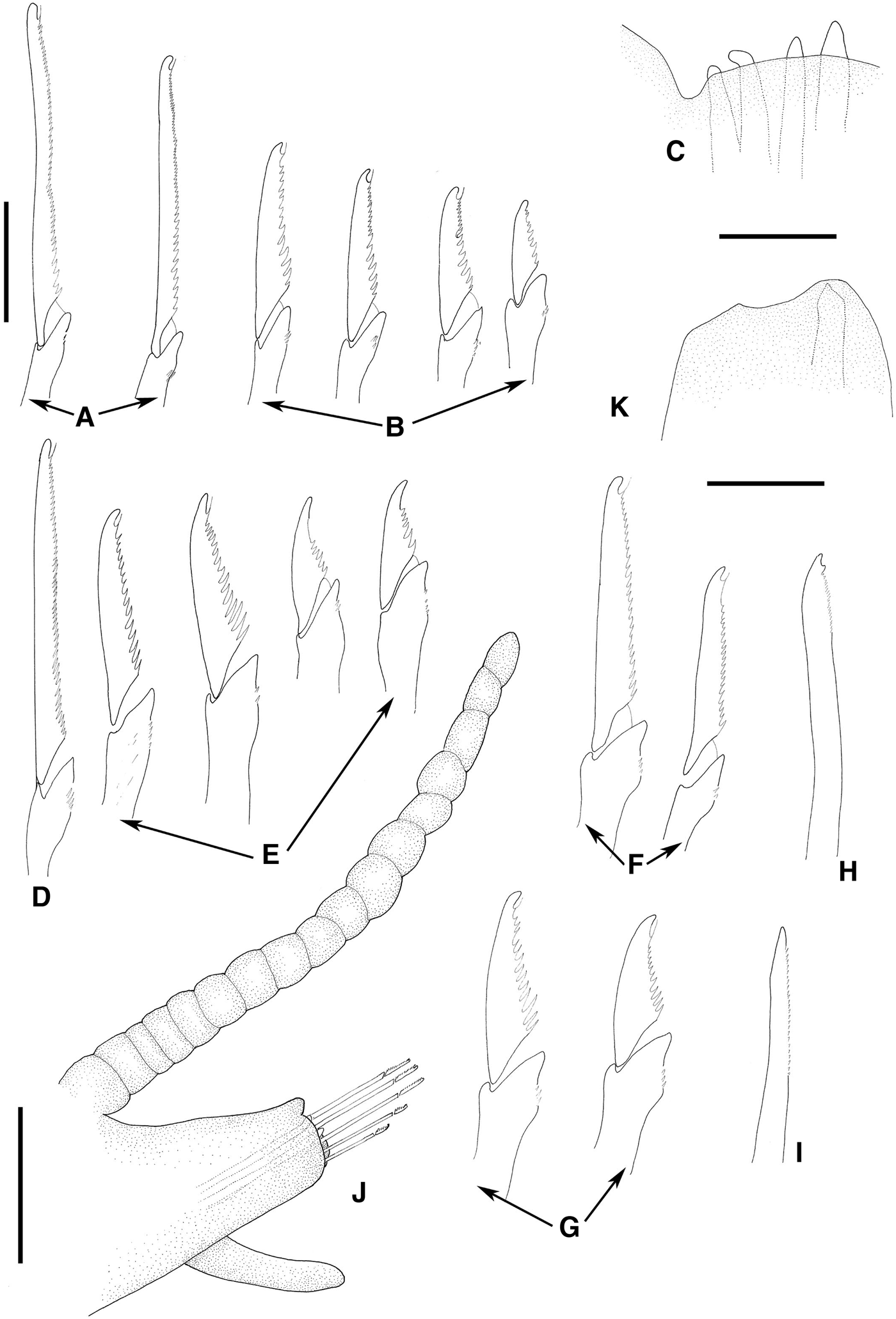
Syllis kas, sp. nov. Holotype (MNCNM). A, B, compound chaetae, anterior parapodium. C, aciculae, anterior parapodium. D, E, compound chaetae, midbody. F, G, compound chaetae, posterior parapodium. G, compound chaetae, posterior parapodium. H, ventral simple chaeta. I, dorsal simple chaeta. J, midbody parapodium. K, acicula, posterior parapodium. Scale. A–I, K: 20 µm. J: 0.1 mm.

Syllis (Ehlersia) oerstedi Non Malmgren, Uschakov (Reference Uschakov1955): p. 161 (key), Figure 50E. Ramos et al. (Reference Ramos, San Martín and Sikorski2010): p. 6.
Material examined. Station 1 (1 Paratype) (MNCN 16.01/17349), Station 3 (2 Paratypes) (MNCN 16.01/17350), Station 5 (1 Paratype) (MNCN 16.01/17351), Station 6 (Holotype and 4 Paratypes) (MNCN 16.01/17352), Station 9 (4 Paratypes) (MNCN 16.01/17353), Station 13 (11 Paratypes) (MNCN 16.01/17354), Station 14 (2 Paratypes) (MNCN 16.01/17355), Station 15 (11 Paratypes) (MNCN 16.01/17356), Station 20 (1 Paratype) (MNCN 16.01/17357), Station 24 (4) (AN), Station 34 (2 Paratypes) (MNCN 16.01/17358), Station 46 (1 Paratype) (MNCN 16.01/17359), Station 60 (1 Paratype) (MNCN 16.01/17360), Station 63 (2 Paratypes) (MNCN 16.01/17361), Station 67 (1 Paratype) (MNCN 16.01/17362), Station 70 (1) (AN), Station 115 (2 Paratypes) (MNCN 16.01/17363), Station 119 (1 Paratype) (MNCN 16.01/17364), Station 120 (1 Paratype) (MNCN 16.01/17365), Station 132 (4 Paratypes) (MNCN 16.01/17366).
Description. Holotype is in good condition. Longest and most complete specimen, 20.6 mm long, 0.97 mm wide, with 98 chaetigers. Body long, yellowish, without color pattern, slightly opaque. Prostomium semicircular to subpentagonal, two pairs of eyes in trapezoidal arrangement; anterior eyes kidney-shaped; posterior eyes oval located at posterior margin. Palps oval and somewhat longer than prostomium. Lateral antennae inserted on anterior margin, with 13–14 articles (Figure 5A). Median antenna between posterior eyes; longer than prostomium and palps together, with 28–29 articles. Tentacular segment short, well defined. Dorsal tentacular cirri slightly longer than lateral antennae, with 18–20 articles each; ventral tentacular cirri shorter, with 11–10 articles each (Figure 5A). Dorsal cirri relatively thick, blunt, alternating long (20–27 articles) and short cirri each (18–20 articles), becoming shorter posteriorly. Parapodia elongated, conical, distally slightly bilobed (Figure 6J). Ventral cirri digitiform, similar in length to parapodial lobes (Figure 6J). Anterior parapodia with 14 heterogomph compound chaetae; 1–2 dorsal spiniger-like chaeta with long blades, about 55 µm long, unidentate with rounded tip, short spines on margin. Distal spine longer and very thin, reaching tip of blade (Figure 6A); remaining chaetae falcigers, with shorter blades, but similar in shape (Figure 6B), 34–17.5 µm long. Number of compound chaetae per parapodium decreases progressively posteriorly; 10–11 chaetae in midbody parapodia, among which the 1–2 dorsal ones have pseudospiniger blades, 57 µm long, short spines on margin, distal one very thin and long, reaching the distal edge of the blade (Figure 6D); remaining blades shorter, 37–22 µm long (Figure 6E), spines on margin longer basally, distal end rounded and distal spine very thin and longer. Posterior parapodia with 5–6 chaetae, 1–2 of them spiniger-like, 36 µm long (Figure 6F), falcigers 20–32.5 µm long (Figure 6G), similar to those of midbody. Dorsal simple chaetae straight, unidentate, with minute spines on margin (Figure 6I). Ventral simple chaetae bidentate, with short spines on margin (Figure 6H). Anterior parapodia with four aciculae, three of them straight ending in blunt tip and the last one with a tip forming an angle (Figure 6C); number of aciculae per parapodium decreasing progressively to one in posterior parapodia, large and pointed (Figure 6K). Pygidium short, with two long anal cirri of about 26 articles. (Figure 5B). Pharynx reaching through 9–11 segments, pharyngeal tooth located anteriorly (Figure 5A). Proventricle long, extending through 10 segments, with 30 muscle cell rows.
Ecology. Some specimens found inside mucous tubes with attached grains of sediment.
Reproduction. We have found 8 stolons, males and females, they are typical of Dicerous type, with bilobate head (Figure 5C), two articulated antennae, two pairs of dorsal eyes and two pairs of ventral ones. About 7 mm long, with 25 segments. Dorsal cirri long, articulated. Compound chaetae and acicula as those of posterior part of the stock. Natatory chaetae from the second segment; males with spermatic sacs all along the body.
Remarks. Uschakov (Reference Uschakov1955) assigned mistakenly this species to Syllis oerstedi. Ushakov's drawings of the chaeta show that this species has relatively short spiniger-like chaetae, with blunt and rounded tips. Following Uschakov, Ramos et al. (Reference Ramos, San Martín and Sikorski2010) reported this species from Norway as Syllis oerstedi. However, after revision of the syntypes of Chaetosyllis oerstedi, we conclude that all of them are sexual stolons of Syllis cornuta (see above), being Chaetosyllis oerstedi its Junior synonymous. Therefore, the reports of Uschakov (Reference Uschakov1955) and Ramos et al. (Reference Ramos, San Martín and Sikorski2010) are that new species described here. No other species has this kind of compound chaetae (see Licher, Reference Licher1999).
Etymology. This is named after ‘Kas’, late cat of first author.
Type locality. Askeladd (Norway).
Habitat. Fine sediments, between 6 and 336 m depth.
Distribution. Boreal and sub-Arctic.
Syllis parapari San Martín & López Reference San Martín and López2000
Syllis parapari San Martín & López (Reference San Martín and López2000): p. 426, Figures 1 & 2. San Martín (Reference San Martín and Ramos2003): p. 409, Figures 224 & 225.
Material examined. St30 (1) (AN).
Diagnosis. Palps basally fused. Antennae, tentacular cirri and dorsal cirri articulated; dorsal cirri of midbody thick, conical. Compound chaetae including spiniger-like and falcigers, all slightly bidentate. Aciculae not protruding out from parapodial lobes.
Type locality. Ría de El Ferrol (Galicia, NW Spain).
Habitat. Species of soft bottoms, likes fine sands, coastal sandy loam, detritic loam, shells, coarse sands and even gravel. Commensal with sipunculans in Turritella sp. Sublittoral up to more than 300 m depth.
Distribution. NE Atlantic. New for Norway.
Subfamily Autolytinae Langerhans, Reference Langerhans1879
KEY TO AUTOLYTINAE LANGERHANS, 1879
1. Two antennae. Ventral cirri distinct, fused along ventral side of parapodial lobes.
Compound chaetae with long, filiform, unidentate blades………Acritagasyllis longichaetosus (**)
— Three antennae. Ventral cirri apparently absent (perhaps totally fused with parapodial lobes). Compound chaetae with short blades, usually with proximal tooth longer than distal………2
2. Bayonet chaetae distally thick (see San Martín & Aguado, Reference San Martín, Aguado and Schmidt-Rhaesa2014, Figure 8O).
Reproduction by anterior scissiparity………Proceraea cornuta
— Bayonet chaetae distally slender (see San Martín & Aguado, Reference San Martín, Aguado and Schmidt-Rhaesa2014, Figure 8N).
Reproduction by gemmiparity or anterior scissiparity………Myrianida
Genus Myrianida Milne Edwards, Reference Milne Edwards1845
KEY TO MYRIANIDA
1. Cirrophores swollen; cirrostyles attached subterminally on cirrophores. Trepan with indistinct teeth………Myrianida inermis
— Cirrophores not swollen; cirrostyles attached terminally on cirrophores. Trepan with distinct teeth………2
2. Trepan with unequal teeth; 4–5 large teeth and 25–39 short………Myrianida langerhansi
— Trepan with 24–34 equal teeth………Myrianida prolifera
Myrianida inermis (Saint Joseph, Reference Saint-Joseph1887)
Myrianida inermis Nygren (Reference Nygren2004): p. 135, Figure 65A–E. Ramos et al. (Reference Ramos, San Martín and Sikorski2010): p. 9. Nygren & Pleijel (Reference Nygren and Pleijel2015): p. 162.
Material examined. Station 6 (1) (AN), Station 69 (1) (MNCN 16.01/17367), Station 102 (1) (AN), Station 114 (1) (MNCN 16.01/17368).
Diagnosis. Ventral cirri absent. Palps fused. Nuchal lappets. Dorsal simple chaeta, bayonet-type, slender than shafts of compound chaetae. Trepan indistinct with minute teeth. Cirrophores swollen; cirrostyles attached subterminally on cirrophores.
Type locality. Dinard (N France).
Habitat. On hydroids, bryozoans and tunicates; sublittoral to about 350 m depth.
Distribution. N Atlantic, NE Pacific.
Myrianida prolifera (O. F. Müller, Reference Müller1788)
Myrianida prolifera. Nygren (Reference Nygren2004): p. 151, Figure 75A–E. Nygren & Pleijel (Reference Nygren and Pleijel2015): p. 164.
Autolytus prolifer. Gidholm (Reference Gidholm1967): p. 186. San Martín (Reference San Martín and Ramos2003): p. 489, Figures 269 & 270.
Material examined. Station 7 (4) (AN), Station 152 (88) (AN), Station 153 (60) (MNCN 16.01/17369).
Diagnosis. Ventral cirri absent. Palps fused. Nuchal lappets. Dorsal simple chaeta, bayonet-type, slender than shafts of compound chaetae. Trepan with 24–34 equal teeth.
Type locality. Denmark.
Habitat. On hydroids, from shallow waters to 40 m (Nygren, Reference Nygren2004).
Distribution. NE Atlantic.
Genus Proceraea Ehlers, Reference Ehlers1864
Proceraea cornuta (Agassiz, Reference Agassiz1862)
Proceraea cornuta Nygren (Reference Nygren2004): p. 47, Figure 9A–C. Nygren & Pleijel (Reference Nygren and Pleijel2015): p. 166.
Material examined. Station 154 (2) (AN).
Diagnosis. Ventral cirri absent. Palps fused. Nuchal lappets. Dorsal simple, bayonet-type, chaeta as thick as shafts of compound chaetae. Trepan with 9 large teeth alternating with 9 short teeth.
Type locality. Massachusetts Bay (New England, USA).
Habitat. Shallow waters, among algae, bryozoans or hydroids (Nygren, Reference Nygren2004).
Distribution. North Atlantic and North Pacific.
Incertae sedis
Genus Amblyosyllis Grube, Reference Grube1857
Amblyosyllis finmarchica (Malmgren, Reference Malmgren1867)
Gattiola finmarchica Malmgren (Reference Malmgren1867): p. 38, Plate 6, Figure 36.
Amblyosyllis finmarchica. Helgason et al. (Reference Helgason, Gadarson, Svavardson, Adalsteindottir and Gudmudson1990): p. 206, Figure 2.
Material examined. Station 23 (1) (AN), Station 47 (1) (MNCN 16.01/17370), Station 48 (1) (AN), Station 50 (1) (MNCN 16.01/17371), Station 52 (1) (AN), Station 131 (7) (MNCN 16.01/17372), Station 136 (1, epigamic) (MNCN 16.01/17373).
Diagnosis. Body with few trapezoidal segments with transversal pink to purple bands. Nuchal lappets.
Type locality. Finmark (Norway).
Habitat. Lithothamnium and shell gravels. From shallow waters to more than 300 m depth.
Distribution. Norway, Iceland, Newfoundland to Maine, North-west Pacific.
Genus Anguillosyllis Day, Reference Day1963
Anguillosyllis pupa (Hartman, Reference Hartman1965)
Braniella pupa Harman (Reference Hartman1965): p. 72, Plate 8.
Anguillosyllis pupa Aguado & San Martín (Reference Aguado and San Martín2008): p. 38, Figure 2.
Material examined. Station 7 (1) (AN), Station 85 (3) (MNCN 16.01/17374), Station 89 (2) (AN), Station 90 (25) (MNCN 16.01/17375), Station 92 (10) (AN).
Diagnosis. Dorsal cirri very long, convoluted.
Type locality. Off New England (USA).
Habitat. On mud, between 125 and 4892 m deep.
Distribution. Off New England, NE South-America, new for Norway.
ACKNOWLEDGMENTS
We want to give our thanks to Dr Karla Paresque and Patricia Álvarez-Campos, for their relevant comments and advice, which greatly improved the quality of this article. We wish to express our gratitude to Akvaplan Niva for the loan of the collection in which these specimens appear.