




No CrossRef data available.
A General-Purpose Technology at Work: The Corliss Steam Engine in the Late-Nineteenth-Century United States
Published online by Cambridge University Press: 29 March 2004
Abstract
The contribution to growth from the steam engine—Industrial Revolution icon and prime example of a “General Purpose Technology”—has remained unclear. This article examines the role that a particular design improvement in steam power, embodied in the Corliss engine, played in the growth of the U.S. economy in the late nineteenth century. Using detailed data on the location of Corliss engines and waterwheels and a two-stage estimation strategy, we show that the deployment of Corliss engines served as a catalyst for the industry's massive relocation into large urban centers, thus fueling agglomeration economies and further population growth.
Information
- Type
- ARTICLES
- Information
- Copyright
- © 2004 The Economic History Association
The steam engine has long been regarded as the icon of the Industrial Revolution, even though the extent of its singular contribution to growth has been the subject of much debate. A casual excursion into the history of this prime mover and of its vast array of uses suggests that the steam engine fits well the notion of “General-Purpose Technologies” (GPTs), and may constitute a prime example of such epochal innovations. From pumping water out of mines and driving the mechanized factories in Britain, to powering virtually the entire industrial sector in the United States by the early twentieth century, the steam engine found its way to the major economic activities of the industrial nations over a span of a century. Moreover, steam became in the course of the nineteenth century the main power source for water and land transportation, breaking the barriers of geographic isolation and bringing about a huge expansion of markets.
We focus in this article on the Corliss steam engine, a highly innovative embodiment of stationary, high-pressure steam engines, which became the dominant design in the United States for large stationary engines in the late nineteenth century. Indeed, we shall argue that the Corliss engine played a key role in the fierce contest between waterpower and steam power, particularly in the Northeast. In so doing it helped propel the steam engine to a dominant position in the intertwined processes of industrialization and urbanization that characterized the growth of the U.S. economy in the second half of the nineteenth century.
The notion of GPTs rests on the historical observation that whole eras of technical progress and economic growth appear to be driven by a few key technologies: closely following upon the steam engine, electricity quite likely played such a role in the early decades of the twentieth century, and information technologies may be doing as much in our era.1
See Bresnahan and Trajtenberg, “General Purpose Technologies”; David, Computer; Helpman and Trajtenberg, Time to Sow; Helpman, General Purpose; and Rosenberg, Technological Change and Technological Interdependence.
Waterpower, by far the main American power source until the mid nineteenth century, offered abundant and cheap energy for a wide range of industrial uses. However, waterpower suffered from a crucial limitation: manufacturing plants had to locate wherever topography and climate permitted, and not where key economic considerations such as access to markets for inputs and outputs would have directed. Steam engines offered the possibility of relaxing this severe locational constraint. However, in order for industry to actually relocate on a large scale, the operation of the steam engine had to be sufficiently advantageous compared to watermills. The Corliss engine, with its vast improvements both in fuel efficiency and in key performance characteristics (primarily regularity of motion and the ability to sustain sudden dramatic changes in load), greatly contributed to tipping the balance in favor of steam, particularly in and around New England.2
Elsewhere the scarcity of appropriate water sites naturally favored steam as the leading prime mover.
We document these processes with highly detailed quantitative data and econometric analysis, as well as with supporting qualitative historical evidence. The original data come from the petition that George Corliss submitted to Congress in 1869, requesting a second extension to his highly successful patents (see Figure 1). The petition contains a detailed list of buyers of Corliss engines, with their names, precise location, and horsepower, which we supplemented with information about the industrial composition of these users. Our analysis is based on these data, in conjunction with comprehensive data on waterpower (i.e., over 4,000 water sites in the north Atlantic states, with their horsepower and industrial classification), and an array of census data by counties.

We attempt to ascertain with the aid of these data the stringency of the locational constraint imposed by the reliance on waterpower, and the extent to which each of the competing power modes fostered or hindered urbanization. We do that by pivoting on the deployment of Corliss engines and of watermills in the Northeast as of 1870, by county, and looking forward and backwards in time: first, we estimate “adoption” equations for Corliss engines and for watermills as a function of population, physical and human capital, and other variables from the 1850 census. Second, we estimate a model of population growth from 1870 to 1900, as a function of the stock of Corliss engines, watermills, and controls. The findings indicate that Corliss engines did indeed agglomerate in large urban centers whereas waterwheels proliferated mostly in rural areas. Moreover, subsequent population growth was positively related to the adoption of Corliss engines, and not to the presence of waterpower-based industry.
These results support the hypothesized role of the Corliss in the dynamic interaction between industrialization and urbanization. Freed of the locational constraints of waterpower, manufacturing enterprises driven by steam chose to locate mostly in urban areas, where they could take advantage of agglomeration economies. The presence of Corliss-driven manufacturers contributed to these agglomeration effects, and probably also signaled that more were coming, as Corliss engines were “trend setters,” both in that they were deployed in advanced sectors, and in that they were of a larger scale. In time, locations with relatively many Corliss-driven establishments attracted further manufacturers and hence also fostered population growth. By contrast, watermills were not part of such a positive loop: they located in sparsely populated areas to begin with, and failed to attract further economic activity and hence further population to those areas.
The role of the Corliss in precipitating these growth-enhancing relocation processes is, we suspect, far from unique: indeed, it would seem that one of the key channels by which each successive GPT affects the economy is through the massive relocation and reorganization of economic activity that it induces, with concomitant gains in efficiency. Thus, and following the steam engine, electricity brought about the fractionalization of power within factories, enabling the much more efficient (re)location of machines on the factory floor according to the workflow and not to power requirements. The gasoline engine induced a massive relocation of people vis-à-vis the workplace, extended greatly the radius from which inputs could be drawn, and altered dramatically the loci and scale of commercial activity. In the present era information technologies appear to be redrawing once again the economic landscape, by shifting the boundaries and location of corporate activity, enabling many of the facets of globalization, and perhaps even making telecommuting a viable option. We still lack a well-defined framework to study these GPT-induced relocation processes and their impact on growth. The case of the Corliss steam engine illustrates the potential of taking such a route and, we hope, will provide the stimuli for further research along these lines.
THE STEAM ENGINE AS GPT
In order to set the stage for the subsequent discussion, it is worth recalling what a GPT is all about: first, it is a technology characterized by general applicability, that is, by the fact that it performs some generic function that is vital to the functioning of a large number of using products or production systems. Second, GPTs exhibit a great deal of technological dynamism: continuous innovational efforts increase over time the efficiency with which the generic function is performed, benefiting existing users, and prompting further sectors to adopt the improved GPT. Third, GPTs exhibit “innovational complementarities” with the application sectors, in the sense that technical advances in the GPT make it more profitable for its users to innovate and improve their own technologies. Thus, technical advance in the GPT fosters or makes possible advances across a broad spectrum of application sectors. Improvements in those sectors increase in turn the demand for the GPT itself, which makes it worthwhile to further invest in improving it, thus closing up a positive loop that may result in faster, sustained growth for the economy as a whole.3
See Bresnahan and Trajtenberg, General Purpose, for a detailed account of the characteristics of GPTs, and Helpman and Trajtenberg, Time to sow, for their impact on growth.
The universal character (and hence general applicability) of the GPTs of the first and second industrial revolutions is easy to grasp: by definition, work involves the transformation of energy from one of its possible states to any other, i.e., heat, motion (displacement), light, etc. It so happens that a vast array of disparate economic activities (in transportation, manufacturing, mining, an so on) could potentially be conducted by the application of one particular transformation, namely, that which results in continuous rotary motion, as performed by the steam engine, and later on by the electric motor.4
In steam engines the reciprocating motion of the piston was transformed into rotary motion by a variety of mechanisms, most commonly the crankshaft.
Note that many manual jobs (e.g., sewing, polishing, cutting) could hardly be seen ex ante as natural candidates for replacement by mechanical actions originating in rotary motion, and thus it must have been far from obvious that rotary motion would become such a universal functionality. Even by the mid-nineteenth century there were still very many activities that few would have dreamt to mechanize, let alone automate, with the “prime mover” being the steam engine. Indeed, in many cases the substitution did not make economic sense until ever-improving steam engines, and the Corliss among them, delivered such functionality at favorable price/performance ratios.
The technological dynamism of the steam engine has been documented extensively elsewhere, and hence we shall not dwell on it here, except for succinct descriptions of the advances that the Corliss design brought about.6
See, for example, Hunter, History (Vol. 2), and the many sources quoted there, primarily of a technical nature.
The case of electric power provides a clear illustration. See Du Boff, Introduction; Rosenberg, Technological Interdependence; and David, Computer. Electricity and electric motors diffused rapidly during the first three decades of the twentieth century, and it is widely believed that the large productivity gains registered during that period owe a great deal to this process of electrification: the new energy source fostered a more efficient (re)design of factories and a wholesale reorganization of work arrangements, taking advantage of the newfound flexibility of electric power. Indeed, as mentioned earlier, fractionalization of power brought about by electricity meant that machines could be placed on the factory floor much more efficiently according to the natural workflow, and not according to their power requirements, as was the case with the steam engine.
We also devoted significant efforts toward searching for evidence of innovational complementarities in the more straightforward sense of the Corliss engine “prompting” improvements in specific user sectors. However, we could not find compelling, first-hand evidence to that effect, and hence, while believing that the Corliss engine may have played a role along those lines, we base our analysis exclusively upon the other mechanisms. It is likely that the inducement to develop, say, better textile machinery was provided by the advent of the factory system as much as by improvements in prime movers, and hence it is inherently very difficult to identify the separate effect of these factors.
Examining the Corliss engine as a particular episode in the evolution of a GPT touches also on the fundamental methodological issues of how to assess, more generally, the economic impact of presumed “major” innovations. Robert Fogel's seminal study of railroads put forward an approach that centered on the painstaking comparison of costs between the new technology and existing best practice, in that case between railroads and water canals.9
Fogel, Railroads.
See also Fishlow, Productivity.
In our view a methodology that focuses exclusively on cost comparisons, and the concomitant cost-savings calculations, by and large misses the deeper point. As previously mentioned, the impact of a general-purpose technology on growth operates primarily through innovational complementarities and the positive loop that these set in motion, and not just through cost advantages. These complementarities, in turn, are typically the result of the interplay between a bundle of improved technological attributes that characterize the GPT, and the wider environment in which the GPT operates (e.g., downstream application sectors, geographical locations, etc.). This bundle of attributes can be subsumed in a hedonic-type cost-saving calculation, but more often than not such single-figure computation obscures the unfolding of the dynamic processes that lie at the heart of GPTs. Regardless of the size of the cost savings that a new technology might bring about, if it does not prompt down-the-line innovations and related complementary investments across a wide range of user sectors, it will not propel long-term growth, and hence it will not qualify as a GPT.11
This is as simple as the difference between a once-and-for-all change in levels, and a change in trend.
G. N. von Tunzelmann's detailed study of steam power and British industrialization starts off from a Fogel-type calculation, and also finds that the measurable impact of the steam engine in terms of costs savings was very small as a fraction of GDP in the United Kingdom, as of 1800.12
von Tunzelmann, Steam. Actually, von Tunzelmann studied the impact of Boulton & Watt steam engines, vis-à-vis all other prime movers, including Newcomen's atmospheric engines.
Lastly, the question arises as to whether the Corliss steam engine ought to be regarded as a GPT in itself, or rather as a particular episode along the evolutionary path of the steam engine GPT. It is inherently very difficult to delimit what exactly constitutes a GPT in its own terms, and one cannot expect decisive answers. Yet in our view a GPT should be associated with long-term growth, therefore it must affect the economy at large through myriad user sectors, and it has to do so over the long run. The steam engine as it evolved and spread from the late eighteenth century onwards almost certainly fits the bill, even if its full story from the GPT perspective still remains to be told. The Corliss engine was just one particular manifestation of the long march of steam: it was a mid-to-late-nineteenth-century stationary, high-pressure, large-scale engine, used primarily in manufacturing—each of these descriptive characteristics narrows down significantly the extent of “GPT-ness” that can be claimed for it. Thus our stand should be clear: the Corliss engine ought not to be regarded as a GPT by itself, yet a lot can be learned about how GPTs operate by studying the way by which the Corliss played out its role as a prominent embodiment of the steam engine GPT, during the rather crucial phase of industrialization and urbanization of the late nineteenth century.
STEAM, WATER, AND GEOGRAPHY: A HISTORICAL PERSPECTIVE
In 1829, a full 60 years after James Watt took out his critical patent on the improved steam engine, Zachariah Allen, of Providence, Rhode Island, was still able to paint a bucolic image of American manufacturing, an image that involved no mention of the steam engine. American manufacturing activities, he pointed out, “are all carried on in little hamlets, which often appear to spring up in the bosom of some forest, gathering around the water fall which serves to turn the mill wheel.”13
Allen, Science, p. 352.
Chandler, Visible Hand, pp. 61–62.
The limited intrusion of the steam engine into the American manufacturing scene during the following decade may be readily calibrated by an examination of the 1838 Treasury survey of steam engines.15
U.S. Congress, Report.
Temin, Steam, p. 190.


Figure 2 shows the tremendous growth of power deployed in manufacturing for the United States as a whole during the second half of the nineteenth century; in fact, power use increased at a staggering average annual rate of 4.7 percent throughout those 50 years. This of course mirrors the rapid growth that took place in manufacturing itself, and in fact constitutes a lower bound for it, because the efficiency in the use of power also increased during that period. The figure also makes it clear that it was indeed steam power that led the growth spurt throughout that period: starting from a bare 5 percent of total power in 1838, it overtook water by the late 1860s, and reached a peak of over 80 percent by the turn of the century, when electricity started to diffuse rapidly. Less noticeable in the figure (because of the scale) but not less important, water power kept increasing in absolute terms up to 1910, and in fact total water horsepower deployed in manufacturing was twice as much in 1900 as in 1850.
The picture that emerges is thus of a rapidly advancing power technology, the steam engine, that made possible the growth of manufacturing (and hence of the economy as a whole) during the second half of the nineteenth century, by providing it with an increasing fraction of its power needs. The Corliss engine entered the scene by mid century, and our data cover roughly the two decades 1850–1870, which, as Figure 2 reveals, was the period of intense competition between the two power sources. In the course of that period the Corliss became the dominant design for large, stationary steam engines in manufacturing, certainly after the expiration of his patents in 1870. This then is the backdrop of our study: the takeoff of industrialization in the United States, which is inextricably linked with urbanization, as steam and water fiercely competed for primacy in the process.
The first thing that needs to be said about the limitations of waterpower is that its location and kinetic potential were largely (but not entirely) fixed by geology and hydrology. It is a familiar part of the story of nineteenth-century American industrial development, that the westward movement of a growing population found itself in terrain where waterpower locations were far less abundant than they were east of the Appalachians. To this extent the westward movement after the Civil War rendered an increasing reliance on steam, at the time the only available alternative, quite unavoidable. That was not quite the case in the north Atlantic states: the total horsepower generated from water in New England continued to increase right into the early twentieth century through a combination of measures, including the introduction of new and improved turbines, but also through exploitation of marginal power sites and through improvements in dam engineering. Thus, in New England steam overtook water as the dominant power source only in the mid 1880s, whereas in the rest of the United States that happened more than two decades earlier (see Figure 3).
Several factors played a role in the century-old contest between steam and water power: exogenous movements (and growth) of population, the availability of water sites and the rather complex issue of water rights, advances both in the technology of water power and of steam engines, transportation and fuel costs, wages and capital requirements, an so on.17
On water rights, see Horwitz, Transformation, pp. 34–40.
As has been aptly done in Atack, Fact in Fiction; and Atack et al., Regional Diffusion.
As Sokoloff, Inventive Activity, has convincingly demonstrated through the use of patent records, inventive activity in the first half of the nineteenth century was closely related to urbanization and the associated growth of markets. See also Krugman, Geography.
Urbanization was already proceeding rapidly in the years preceding the Civil War. In 1820 there were only 12 cities in the United States with a population in excess of 10,000, and only two whose numbers exceeded 100,000. In 1860 there were already eight cities with over 100,000, and the population of New York City exceeded one million.
Even if focusing on measurable cost comparisons, Atack et al. amply recognized the importance of location: “We would argue, therefore, that our cost results are biased against steam. Indeed, locational freedom was an unparalleled advantage of steam.” (in Atack et al., Regional Diffusion, p. 293).
The Main Hypothesis: Removing the Locational Constraint
As already suggested, one of the key differences between water and steam power was of course the degree of flexibility in the choice of location. The use of water required that factories be located next to sufficiently copious streams having the “right” surrounding topography so that water wheels could be placed and provide the power requirements. However, it is clear that the optimal choice of location involves a variety of considerations other than the availability of appropriate streams, such as proximity to markets, transportation facilities (such as rail or ports), availability of labor, skills, and capital. The use of waterpower implied then a constraint on the effective geographic choice set, its stringency depending on the degree of coincidence between the availability of water and of the other factors. It follows that the replacement of water by steam meant at first the removal of such constraint, but in order to realize the benefits from the newly expanded choice set, firms had to engage in complementary activities. First and foremost was their actual relocation, but also involved were changes in the mix of inputs and transportation modes associated with the new locations and the (re)design of factories so as to take advantage of the specific characteristics of the steam engine as prime mover (as opposed to waterwheels).
We contend that the innovations that George Corliss introduced contributed greatly to tilting the balance away from waterpower and in favor of steam, particularly in the north Atlantic states.21
Once again, west of the Appalachians water sources were much less abundant, and hence the direct cost advantages of steam were an overriding consideration. Thus, the closest contest between water and steam took place in the North and Mid-Atlantic states.
The interesting empirical questions then have to do with the way in which the historical contest between water and steam played out in the context of the intertwined processes of industrialization and urbanization. In particular, how can we ascertain the stringency of the locational constraint imposed by the reliance on waterpower? To what extent did each of the competing power modes foster or hinder urbanization? Notice that it is one thing to say that waterpower required a particular occurrence of topography and climate, and quite another to postulate that such occurrence was necessarily at odds with the location that would have been preferred otherwise by the using industries. In other words, the stringency of the locational constraint needs to be established empirically. Second, given the locations chosen by the industries using each type of power, they could have in principle attracted further population and industrial activity to the proximity of the manufacturing sites. Thus, it is an open question to what extent the existing locations of water and steam at a point in time were propitious for further population and industrial growth, and hence for the generation of agglomeration economies around those locations.
We address these questions by pivoting on the deployment of Corliss engines and of watermills in the Northeast as of 1870, and looking forward and backwards in time: first, we estimate a location (or “adoption”) equation of Corliss engines and of watermills as of 1870 (by county), as a function of population, physical and human capital, and other variables from the 1850 census. The hypothesis is that Corliss engines gravitated towards large urban areas, offering abundant inputs, whereas watermills, constrained by geography, could not do so. Second, we estimate a model of population growth by county from 1870 onwards (up to 1900), as a function of the stock of Corliss engines, watermills, and control variables taken from the 1870 census. The hypothesis is that the presence of Corliss engines fostered further population growth, whereas watermills did not. We turn now to a description of the salient features of the Corliss engine, and of the data used in the analysis.
THE INNOVATIVE ATTRIBUTES OF THE CORLISS ENGINE
The key novelty of Corliss's engine was its automatic variable cut-off mechanism, based on an innovative design of valves. What this meant was that the speed of the engine was subjected to precise control by the ability to automatically vary the length of the time period during which steam entered the cylinder. The variation in engine speed was regulated by the governor, which retarded or advanced the point of cutoff in accordance with the rise or fall of the load that was placed upon the engine. This design feature, which made possible a more efficient exploitation of the expansive power of steam, resulted in the best-known feature of the engine: a substantial improvement in energy efficiency. But perhaps even more important was the fact that the engine was also far more “user-friendly” than its predecessors. In particular, it was capable of delivering a continuous, uniform flow of rotary power in spite of sudden changes in the load that might be imposed on the engine. The smoothness of power delivery was very important, albeit in quite different ways, to the largest manufacturing industries of the time: textiles and metallurgy. Crucially, it permitted higher speeds, while at the same time it reduced the frequency of breakage in threads that was so disruptive in the textile industry. The uniformity of power delivery became increasingly valuable as the industry moved up the quality ladder to more expensive goods. In metallurgy, where huge, abrupt and punishing variations in load were imposed on the engines that were driving the rolling mills, the engine proved capable of adjusting to these variations far better than other engines of the period.
The automatic variable cutoff capability of the Corliss engine brought a huge improvement in the efficiency with which the engine exploited the expansive power of steam. This improvement was achieved by the ingenious design and location of the valves and valve gears, a great advance over the earlier, widely used slide-valve gear that failed to make any use of steam's expansive power.22
For a detailed description of the Corliss engine see Hunter, History (Vol. 2) chapter 5, and in particular pp. 256–57.
But there was much more to the great commercial success and subsequent economic impact of the Corliss engine than the reduction in fuel costs. The ability to provide a smooth and responsive delivery of power was, as already suggested, of special importance in cotton textiles, where achievement of higher speeds was central to productivity improvement and, moreover, where irregularities in speed were very costly, due to the ease with which cotton thread was subject to breakage.23
“Increase of speed of spindles is by far the most effectual factor in obtaining this result [reduction in costs]; and hence it is that any increase of speed that can be obtained without other disadvantages is in the line of economy, regardless of the increased cost of power it may involve.” Sheldon, Power.
See Wright, Cheap Labor.
The petition exults in detailed descriptions of the operation of Corliss engines in cotton textiles, given in sworn testimonies by users of the engines, such as “the most perfect regulation of speed,”25
Corliss, Petition, p.27.
Corliss, Petition, p.32.
From “Award of the Rumford Medal” in Corliss, Petition, pp. 46–47.
Ibid.
We can translate some of the said advantages of the Corliss into cost saving figures by relying on the painstaking work of Jeremy Atack, in particular on his table that contains sensitivity computations of the annualized costs of operating steam and waterpower.29
Atack, Fact in Fiction. His table 4 shows the simulated percentage change in total operating costs per horsepower of each prime mover, in response to a 25-percent change in various cost variables (the baseline is 1870s data for 100 HP prime movers).
Atack, Fact in Fiction, table 4. This is not clear, but presumably such extrapolation gives a ballpark estimate.
After the expiration of the Corliss patents in 1870, “Corliss” became the generic name for the vast majority of large stationary steam engines produced, and in fact it emerged as the dominant design for large stationary engines. Indeed, by the end of the century Corliss-type engines, which accounted for just 10 percent of the total number of engines in the manufacturing sector, represented a staggering 46 percent of the total horsepower.31
See the 1899 Census of Manufacturers, p. 255, ft. 5.
Shillitto, Handbook.
Beyond the United States, the Corliss engine was much admired and experienced extensive sales in Europe, even at an early date. In the announcement of the award of the Rumford medal by the American Academy of Arts and Sciences to George Corliss, Scott Russell, the distinguished British engineer, was quoted as having stated that “several hundred” of Corliss's engines had been sold abroad (probably by 1867). L. C. Hunter states that Corliss engines were “widely taken up in Europe after its appearance and recognition at the Paris Exposition of 1867. Here an international jury awarded the highest competitive honor to the Corliss engine over a hundred other entries. At the Vienna Exhibition of 1873, although not represented by an engine, Corliss was given one of the highest awards available on the grounds (as stated by Robert Thurston) that “a large proportion of the steam-engines entered having been copied from his designs, he was really represented in every section of the Exhibition and by the engine-builders of every manufacturing nation.”33
Hunter, History (Vol. 2), pp. 269–70.
DATA SOURCES
Data on the Corliss Engine
Starting from Hunter's monumental work and the leads that he provides there, we have mapped a wide array of bibliographical and data sources, both primary and secondary, on the steam engine in general and the Corliss engine in particular.34
Hunter, History (Vol. 2). One of the main sources is the collection of Corliss Papers at Brown University. Corliss became a very prominent figure in his time, and had a long-time association with Brown University (located in his home town, Providence, Rhode Island). As a consequence, the Richard Hay Library at Brown University put together and maintains a special collection of the Corliss Papers, which includes about 900 original items, ranging from business contracts, to letters, to newspaper clippings.
One of the happy consequences of Corliss's unsuccessful request is that the formal petition that he submitted to Congress contains detailed information concerning his extensive business activities up to that date.35
The petition was published in 1870 as a short booklet, in Providence, Rhode Island (see Corliss, Petition).
Although extensive and detailed, the list of 257 buyers in the petition, having a stock of about 470 engines, is not comprehensive: it includes only those who were prepared to support Corliss's petition for patent extension.36
The list consists of buyers, not of single engines, and we know that many of them owned more than one engine. According to the figures in Hunter, History (Vol. 2), Corliss engines averaged 100 HP each; the list in the petition totals 46,934 HP, and hence we infer that the list comprises about 470 engines.
Hunter, History (Vol. 2), p. 282.
Corliss states in the Petition that his receipts for royalties involved payments from 11 engine builders, “… seven of whom, having manufactories in Rhode Island, Pennsylvania, Massachusetts, Delaware, New York and California, have been at liberty to build as many engines as they pleased, of any size they pleased, to be located wherever they pleased, and to get any price for the same they could …” (Corliss, Petition, p. 21).
For infringement of Corliss's patent rights, see Hunter, History (Vol. 2). Nationwide, Corliss-type engines accounted then for 15 percent of total steam power: according to the 1880 census, there were 40,191 steam engines in the United States by 1870, with a total capacity of 1.2 million HP. However, Corliss engines were much more powerful than the run-of-the-mill engines, averaging 100 HP as opposed to a mean HP of 30 for all steam engines.
The coverage of the petition list is thus quite wide, but the question is whether we can presume it to be a representative sample of the population of Corliss-type engines built by 1870. There are two issues regarding what “representative” means: first, do the buyers who signed the petition constitute a random sample of those who purchased engines from Corliss himself? Secondly, is the petition's list representative of all Corliss-type engines sold, including licensees and infringers? As already mentioned, the analysis that we perform here relies primarily on the location of Corliss engines and of water-powered sites. Thus, the issue of whether the sample of Corliss engines is “representative” or not is taken to mean whether or not the sample may suffer from noticeable biases with respect to location.
Regarding the first question, we know that the buyers of Corliss engines were engaged in a long-term relationship with Corliss, in that the latter provided maintenance, parts, upgrades, and perhaps also future additional engines. By signing the petition these buyers presumably improved the chances of getting better “service” from Corliss in the future. Thus, we expect that buyers having a larger number of engines, those more likely to acquire further engines in the future, or those for whom “uptime” was more important, would have been more prone to sign. However, and as far as we have been able to ascertain, these attributes were not correlated with location. The working assumption is thus that the willingness of buyers of Corliss engines to join in signing the petition (and hence the probability of appearing in our sample) had little to do with their specific county location. The one possible exception is Providence, Rhode Island, Corliss's hometown, and the city with the largest number of listed buyers in the petition: the close proximity to Corliss may have induced a larger number of them to sign, and hence we shall regard this observation as a potential influential outlier.
Engines built by Corliss himself accounted as said for just about 26 percent of all Corliss-type engines deployed by 1870, and hence the second question is to what extent our list of buyers is representative (once again, in the geographic sense) not just of those who purchased engines from Corliss, but of all Corliss-type engines built, including licensees and infringers. We discuss this issue extensively in Appendix 2, which contains a description of the geographic spread of Corliss engines and of watermills. We conclude that the data may indeed suffer from some specific selectivity biases, but either we can take care of it point wise (as in the case of Providence), or the biases are likely to work against our hypothesis (as in the case of eastern Pennsylvania), and hence would not impair the validity of the econometric analysis.
Data on Water Power
In order to be able to contrast the spread and impact of the Corliss steam engine to waterpower, we needed data on water wheels at a level of “resolution” similar to that of the Corliss data. We found that in the Census' “Reports on Water-Power” for 1880, containing a comprehensive listing of sites in the United States that operated water wheels, with highly detailed data for each: river or stream, location (county), kind of manufacturer, number of mills, and HP.40
U.S. Bureau of the Census, Statistics.
To be precise, these include: Maine, Vermont, New Hampshire, Massachusetts, Rhode Island, Connecticut, New York, New Jersey, Pennsylvania, Delaware, and Maryland.
The data entry and editing process were lengthy and arduous, both because the data had to be transcribed from a small-print, low-quality copy, and because the way the information is displayed in the original listing is by no means uniform.
We relied for that purpose on “net H.P.” and “utilized H.P.” In some 20 entries (for Merrimack, Massachusetts and New Hampshire), the figure reported is “Gross H.P.,” which we converted to “net H.P.” using the conversion ratio of 0.73 as suggested on page 37 of the section “Waterpower in Eastern New England,” U.S. Bureau of the Census, Statistics.
There were over 400 different textual forms for “type of manufacturer” (e.g., from “bleachery” and “bleaching and dyeing,” to “wheelbarrows” and “wheelwrighting”), which we consolidated into the then-standard 21 industrial sectors.
Census Data
We complemented the data on steam engines and waterpower with demographic data and data on manufacturing by county, from the censuses of 1850–1870, as well as population counts by county for 1880–1900.45
The census data were taken from the internet site of the Inter-university Consortium for Political and Social Research (ICPSR), in Ann Arbor, Michigan, as viewed for browsing at the site of the University of Virginia Library. See http://www.icpsr.umich.edu/index.html, and http://fisher.lib.virginia.edu/census/.
For details of the census data used see Rosenberg and Trajtenberg, “General Purpose Technology,” appendix 4.
We have also compiled data on the population of each of the 87 towns and cities where Corliss engines were located, from 1860 through 1910, and used them for descriptive purposes, and for a preliminary analysis confined to these locations (not reported here); however, we could not use these data for the full-scale analysis because we did not have data for waterpower by localities, only by counties.
Summing up, our data comprise: the stock of (a large sample of) buyers of Corliss steam engines as of 1870, and in particular the geographical location of these buyers and the installed HP, as well as their industrial composition; the location of all water-powered sites and their HP as of 1880, and their sectoral composition; demographic, human capital and wealth indicators and manufacturing data for 1850, 1860, and 1870, and population counts for every decade 1850–1900 (all these variables are by county, for the 11 North and Mid-Atlantic states); and population data for the towns and cities with Corliss engines.47
The data on buyers of Corliss steam engines are actually from 1869, but we refer to them as 1870, so as to make them fit the decennial pattern of the other data.
THE ECONOMETRIC ANALYSIS: LOCATION AND SUBSEQUENT GROWTH
The Location of Corliss Engines and of Watermills
We now turn to the analysis of what determined the location of Corliss engines on the one hand, and of watermills on the other, in order to assess the stringency of the locational constraint imposed by the geographic requirements of waterpower. The leading hypothesis is that, freed of such constraints, the Corliss engine gravitated towards locations that already had clear advantages for industry, particularly for advanced, large-scale manufacturing, in terms of availability of inputs and skills, proximity to markets, and so on. On the other hand, if indeed those constraints were binding, water-powered mills could not. We regard population size as the leading indicator for the existence of locational characteristics propitious for the development of advanced, large-scale industry: larger urban centers presumably offered a wider range of inputs and skills, constituted in and of themselves larger markets and had better access to wider markets due to the availability of transportation facilities. Beyond population, we also use as regressors other indicators that may capture the availability of inputs and skills: capital invested in manufacturing, employment in manufacturing, the number of books in public libraries, and the number of public libraries, all of these in per capita terms.48
Obviously, we were constrained in the choice of regressors by the set of variables available from the 1850 census (see Rosenberg and Trajtenberg, “General Purpose Technology,” appendix 4).
We ran two sets of regressions: one having as the dependent variable the number of Corliss buyers by county as of 1870, the other the number of watermills, each as a function of population, capital or employment in manufacturing per capita, books in public libraries per capita (all of these from the 1850 census), and state dummies.49
As already mentioned, the data for watermills come from the 1880 census (there are no detailed data for 1870), whereas that for Corliss engines come from the 1869 petition, and hence the two sets of equations are not exactly aligned time wise. We proceed on the assumption that in the intervening decade (1870–1880) the distribution of watermills across counties within the North and Mid-Atlantic states change little. We know (from Fenichel, Growth) that the total HP of watermills in New England grew just by 17 percent during that decade (from 362 thousand in 1870 to 423 in 1880), and in the Middle Atlantic states it declined slightly (from 376 to 357); this in contrast with the rapid growth of steam, which more than doubled in those regions.
Table 1 shows the results for the various specifications (for completeness we also report the OLS). The key finding, highly significant and robust across all specifications, is that population strongly impacts the location of the Corliss, but not at all the geographic distribution of waterpower. That is, counties with larger populations attracted Corliss-driven plants, whereas population size had no impact whatsoever on the location of watermills. Similarly, counties that had by 1850 relatively more capital or more employment in manufacturing (per capita) also drew larger numbers of Corliss engines, as did counties with more books or more libraries. These effects are either not significant for watermills, or much smaller than for the Corliss. The contrast between Corliss engines and watermills in terms of the significance of these variables is sharper for the Negative Binomial than for the Poisson, quite likely because the latter suffers from overdispersion.

For the sake of brevity we have suppressed in Table 1 the estimates for the state dummies; there is however one that is of interest, and that is the coefficient for Rhode Island, the hometown of Corliss.50
The other consistent finding is the very large negative coefficient for Maine in the Corliss equations, for which we do not have a convincing rationale.
It is large and significant for the Corliss engine only in the OLS equations, but these are the least plausible specifications; the base state is New York.
For the Corliss equation the right-hand variables from the 1850 census are clearly exogenous: Corliss began to build his steam engines in the late 1840s, and most of them were sold in the 1860s. For watermills that is not quite the case: presumably a large proportion of the watermills (unfortunately unknown to us) in operation at the time of the 1880 survey were already in place by 1850. Thus, the waterpower equations may suffer from simultaneity bias, in that counties that for reasons unaccounted for in the model had attracted more watermills may have also drawn in a larger population, and perhaps also more physical and human capital. However, notice that endogeneity would in this case bias the estimates upwards, blunting the difference of the effect of the regressors on the Corliss versus watermills, that is, simultaneity biases would militate against our hypothesis. Thus, the real differences may be even more pronounced than what our results indicate, and hence the presence of endogeneity in the watermills equations can only strengthen the conclusions.
Population Growth from 1870 Onwards
The second part of the interplay between power modes and population looks forward in time, the question being: to what extent did the presence of Corliss engines on the one hand, and of watermills on the other, foster population growth across different locations? At first we estimate for that purpose simple OLS equations with the rate of post-1870 population growth by county as the dependent variable, the number of Corliss buyers and of watermills as regressors, as well as a series of control variables from the 1870 census, and state dummies. The results are shown in Table 2. The population of counties with relatively many Corliss-driven establishments as of 1870 grew indeed faster in the following two to three decades, whereas counties with relatively many watermills grew at a slower pace. This key finding is both significant and very robust.52
The only qualification is that the inclusion of the 1870 population size as a regressor (to test for convergence) weakens the significance of the Corliss coefficient, but that is hardly surprising, given the high collinearity between the two.

The industrial composition of watermills versus that of Corliss users may have had something to do with the differential impact on population growth: if we split the number of watermills per county into two groups, one consisting of the top four sectors where the Corliss was deployed (textiles, primary metals, nonmanufacturing, and machinery, which accounted for 81 percent of the HP of Corliss engines), and another group with all the rest, the results are as follows: for watermills in those four sectors the coefficient is insignificant, whereas for the others it remains negative, significant, and of similar size as in the original regressions with all watermills in there. That is, locations with watermills that mimicked the industrial composition of Corliss users at least did not experience a subsequent decline in their population, whereas counties with watermills in more traditional sectors did.
The estimates for the “controls” are also of interest. Previous population growth (either 1850–1870 or 1860–1870) is meant to capture underlying trends by county that persist into the future, and hence constitutes an important overall proxy for more fundamental processes that are missing in the equation. The coefficients are large and highly significant in all specifications, suggesting that indeed there are underlying differences in the growth potential of counties that persist over the long run. The other controls constitute a snapshot of counties as of 1870:53
We tried many other such controls, including wages in manufacturing, different measures of wealth, etc. However, strong multicollinearity did not allow for precise estimation, and hence we had to make judgment calls as to which to include.
State taxes do vary across counties within states (because these are computed as per capita tax revenues), but nevertheless the variation within states is too small to allow for precise estimation, and hence we excluded this variable in all specifications where state dummies appear.
There remains though the concern that the number of Corliss buyers per county may still suffer from endogeneity, in that some underlying long-term phenomena not properly accounted for by the controls (not even by pre-1870 population growth) brought about both more adopters of Corliss steam engines prior to 1870, and faster population growth afterwards. We thus resort to instrumental variable estimation, using as instrument for the number of Corliss the predicted values from the “adoption” equations (see Table 1), i.e., from the count regressions of number of Corliss buyers per county on county variables as of 1850. The time gap between these 1850 level variables and population growth post-1870 makes it more likely that the predicted values thus computed would be truly exogenous, and hence constitute a legitimate instrument. Table 3 presents the results, for different specifications (i.e., taking the predicted values from the negative binomial, the Poisson, and the LS equations, and using in some population growth for 1860–1870 and in others that for 1850–1870). Reassuringly, the coefficient of Corliss buyers remains basically unchanged (vis-à-vis the OLS results in Table 2), but its significance declines.55
In particular, the t-values are lower when using as control 1850–1870 (rather than 1860–1870) population growth; it is not clear why that it so.

These results support then the hypothesized role of the Corliss in the dynamic interaction between industrialization and urbanization. Freed of the locational constraints of waterpower, manufacturing enterprises driven by steam engines could choose to locate “optimally,” and hence were attracted to areas where, inter alia, they could take advantage of agglomeration economies. The presence of Corliss-driven manufacturers both contributed to these agglomeration effects, and probably also signaled that more was coming: Corliss engines were after all “trend setters” for industry, both in that they were deployed in advanced sectors, and in that they were typically of a larger scale. In time, locations with relatively many Corliss-driven establishments attracted further manufacturers and hence also fostered population growth. By contrast, watermills were no part of such positive loop: they located in sparsely populated areas to begin with, and failed to attract further economic activity and hence further population to those areas. In fact, the population in locations that had relatively many watermills actually declined (recall the negative sign of the coefficients for watermills in Tables 2 and 3), gravitating instead towards the urban centers where steam took hold. To insist, this latter result is far from obvious: it was not a priori clear that the topographical requisites (and hence geographical constraints) of waterpower would also impair the clustering of industry and hence of urban centers in those sites.
It is interesting to note that many watermills had “auxiliary steam power,” which was used both to add to capacity and to run the mills at times when waterpower was unavailable due to weather conditions. The 1880 census had data on auxiliary steam power just for 62 out of the 244 counties of the North and Mid-Atlantic States; still, the total steam power reported there amounted to 64,965 HP, significantly more than the 46,339 HP of the Corliss engines listed in the petition.56
We have not made use so far of these data because the coverage, as indicated, is not comprehensive, and we do not know what determined the reporting for some but not for other locations.
Even though we have mentioned in passing various qualifications, we would like to emphasize that the results presented here should be interpreted with great caution, primarily because the Corliss variable in the growth regressions probably proxies for wider phenomena than just the number of Corliss users.57
The use of IVs hopefully mitigates the implied endogeneity, but we cannot be sure to what extent that is so.
We would have liked to include “other steam engines” as an additional regressor, but unfortunately we could not obtain county-level data for steam. It could be done by state, but then the number of observations is very small, and the level of resolution of the data seems to be too coarse for the purpose at hand.
FURTHER GPT-LIKE ATTRIBUTES AND PATHWAYS
We have shown then one key pathway by which the Corliss engine may have played its dynamic role as a particular embodiment of the steam-engine-GPT. A second pathway was the fact that the Corliss engine allowed for larger scale in manufacturing, thus contributing to the realization of scale economies and the concomitant efficiency gains that impinge on growth. Furthermore, Corliss engines were pivotal for rolling mills, which in turn fed into the rapid expansion of railroads. We begin, though, by showing that the Corliss engine had a wide range of applications, so that the dynamic interaction between it and the user sectors could indeed have economy-wide repercussions. Moreover, the data indicate that the main adopters of the Corliss engine were the advanced sectors of the time (textiles and metallurgy), in sharp contrast to the “low-tech” character of the main users of waterpower and of other steam engines.
Range of Applications and Industrial Composition
As already mentioned, the steam engine had a very wide array of users over the course of almost two centuries, primarily in manufacturing, transportation, and mining. The Corliss was, as said, a stationary engine, and a relatively powerful one at that, and hence most of its users were in the manufacturing sectors. In order to ascertain the range of uses of Corliss engines, we sought to establish the industrial sector and subsector of each buyer listed in Corliss's petition for the renewal of his patents. This proved to be an exceedingly difficult task, as it involved searching for information on firms that operated sometime during the period 1850–1870, many of which have left no paper trail. We relied for that purpose on several sources: archival materials at several libraries, city directories of the time (for some of the major cities where these firms operated), directories of New England manufacturers, business histories, county histories, etc. We thus managed to successfully classify 163 out of the 257 buyers (63.4 percent), who represent, however, 73 percent of the total horsepower installed. We assigned them to 51 “subsectors,” and aggregated them up into 17 two-digit sectors as they appear in the standard industrial classification of the late-nineteenth-century censuses.59
See Rosenberg and Trajtenberg, “General Purpose Technology,” appendix 5.
Table 4 makes it clear that the Corliss engine was indeed used in a very wide range of applications, covering most of the spectrum of productive activities that required a central power source at the time.60
Recall, though, that this constitutes only a partial picture of the range of applications of Corliss engines, both because we managed to classify only 63 percent of the buyers appearing in the petition, and because these represent only about 26 percent of Corliss engines manufactured up to 1869, including licensees and infringers (i.e., the buyers classified account for just about 15 percent of all Corliss engines). Thus, ours almost certainly understates the actual range and variety of applications.
See Hunter, History, p. 299.

Table 4 compares the distribution of Corliss engines, by sectors, to that of water power and of steam power in general (the latter inclusive of the Corliss, but recall that Corliss engines constituted just 15 percent of total steam power by 1870). The differences are quite striking: about 70 percent of Corliss engines' HP was deployed in textiles and in primary metals, as opposed to just 18 percent of waterpower, and 25 percent of steam power generally. At the other end, food and kindred products and lumber and wood products accounted for 68 percent of waterpower and 51 percent of steam power, but just for 4 percent of the Corliss engines' HP.62
Some of these differences are linked to geography: if we restrict ourselves to the North and Mid-Atlantic States (those where Corliss Engines were sold), then the share of waterpower deployed in Textiles and Primary Metals rises to 27.5 percent (from 18 percent nationwide), whereas the share of Food and Kindred and Lumber and Wood drops to 48 percent (from 68 percent nationwide). Still, the remaining differences are very large.
Textiles, primary metals, and machinery were undoubtedly key sectors propelling the process of industrialization of the late nineteenth century, with primary metals supplying critical inputs both to manufacturing at large and to the rapidly expanding railroad system. By contrast, food and kindred products and lumber and wood were two of the more traditional, technologically laggard industries, and consisted mostly of innumerable small mills that served primarily local needs. The Corliss was thus squarely positioned at the forefront of the incipient process of industrialization as of 1870, and in fact it anticipated later shifts in the locus of power deployment (see Table 5). Thus, whereas textile products and primary metals accounted for just 25 percent of total steam power in 1870, their share grew to 34 percent by the turn of the century, and conversely, the share of the “traditional” sectors declined steeply from over a half to about one-third.

Enabling Scale and Rolling On …
As already mentioned, Corliss engines were much more powerful than the vast majority of steam engines at the time, and similarly in comparison to water wheels. In fact, the average HP of users of Corliss engines was over four times larger on average than that of establishments relying on waterpower. Only in one sector, pulp and paper, were water-powered mills slightly larger than their counterpart Corliss users (see Table 4).63
Some of the mills operating water wheels had also auxiliary steam power and hence their average HP may be slightly understated, and likewise, some of the buyers of Corliss engines had also other types of engines in the same establishment.
The large scale of establishments using Corliss engines in metallurgy and in textiles is consistent with other supporting evidence.64
On metallurgy, see the discussion below on rolling mills; on textiles, we obtained information on the number of employees of 12 textile firms (out of the 60 that purchased Corliss engines): ten of them had 1,000 employees or more, one had 630, and one had between 250 and 500 employees.
See Chandler, Visible Hand.
The fact that the Corliss may have played such an enabling role does not imply that waterpower suffered from inherent technological or topographical limitations that prevented it from running large-scale plants. True, watermills were on average of a much more modest scale than plants running on Corliss engines, and moreover, there were very few of truly large size: out of almost 16,000 mills that ran on water in 1880, only 90 deployed more than 500 HP on average (just over one-half of 1 percent), and an additional 859 mills had between 100 and 500 HP. Still, the fact that we do find some watermills even with 1,000 HP and more clearly means that there were no visible absolute constraints on scale for this power source. Moreover, what we see in the data is an equilibrium distribution of scale, both between water and steam, and within waterpower—obviously we do not know what would have been the scale of watermills had steam not taken its predominant place in the upper tail of HP.
As with many other instances whereby two technologies compete, we do not need to resort to the (clearly untenable) argument that waterpower had inherent scale limitations in order to assert the enabling role of Corliss engines: it is the conjunction of purely technological advantages and of other complementary economic factors that makes one technology play that role and not the other. We conjecture that freedom of location was, once again, the critical supporting factor: large-scale production required not just the technical ability to operate large plants, but also easy access to markets, both for inputs and for outputs. There were sites that could deliver large amounts of waterpower, but the fact is that too few were located near transportation hubs and population centers. Large-scale production may have been technologically and topographically feasible with waterpower, but not economically viable.
The booming textile industry of Fall River, Massachusetts, from the 1860s through the end of the nineteenth century exemplifies the twin processes of relocation and realization of scale economies. The Corliss engine was hardly the only factor responsible for the development of Fall River, but it undoubtedly contributed to it a great deal.66
See Smith, Cotton Textile, pp. 45 and 47. Steam provided just 25 percent of the power of textile mills in the United States in 1870 and 44 percent in 1880; however, by 1875 steam had already accounted for 93 percent of the power for textile mills in Fall River. Moreover, Smith notes that in 1875 there were 81 steam engines in operation in Fall River, generating 27,992 HP, which makes for an average of 345 HP per engine, certainly a large figure for the time (Smith, Cotton Textile Industry).
Yonekawa, Flotation Booms.
The invention by George Corliss in 1848 of a regulator allowing more accurate control of the power, and hence the speed, of the machinery was important in allowing the establishment of bigger and more powerful steam engines. This in turn led to larger mills, with 30,000 spindles not being uncommon…. The installation of large steam engines made it possible to build higher capacity mills, with some 37,000 spindles and 900 looms, such as Union Mills; organized in 1859, Union Mills was one of the earliest mills to utilize steam power on this scale.68
Union Mills were located in Fall River.
However, it is the case of rolling mills, to which we now turn, that best captures the pivotal role of the Corliss, both in enabling scale per se, and in playing out the other technological advantages of the engine, particularly the ability to manage drastic fluctuations in power requirements.
Iron, Steel, and Rails: The Role of the Corliss
The operation of rolling mills, a key technology in the iron and steel industry as well as in other metallurgical industries, acquired by mid-century a critical place in the industrialization of America, particularly with the rapid expansion of the railroads. The Corliss engine came to play a pivotal role in the growth of rolling mills, both in that it allowed for a much larger scale of operations, and in that the engine's unique facility in responding to the specific requirements of the industrial user proved to be a decisive advantage. The enabling role of the Corliss for rolling mills, and through them its role in the building of railroads, constituted an important pathway along which innovational complementarities stemming from it played themselves out.
The making of wrought iron in the first half of the nineteenth century had been reshaped by the technologies of puddling furnaces and rolling mills. Puddling allowed the introduction of mineral fuels in converting pig iron into wrought iron, and the introduction of rolling offered a mechanical substitute for hugely labor-intensive hammering at the forge in converting the wrought iron into certain desired shapes. By 1856 fully 95 percent of all wrought iron was made in rolling mills.69
Temin, Iron, p. 101. Chapter 5 of Temin's book provides a useful overview of the economics of the rolling mill in the nineteenth century.
Temin, Iron, p. 108.
The new metallurgical technologies enabled a huge expansion of the industry's raw material base and the attainment of higher productivity levels, but they usually led also to an expansion in the optimal scale of plant (the dependence of the earlier technology upon the use of charcoal had effectively imposed rigid upper limits to the size of plants). The overall trend toward larger scale was persistent and was vastly intensified with the introduction of the Bessemer process, with its huge fixed-cost requirements, shortly after the end of the Civil War. Indeed the shift from iron to steel after the Civil War (by use of the Bessemer converter), and the construction of the nation's railway system, constituted one of the great transforming economic events of nineteenth-century America. To cite only one narrow measure of the impact of this transition on the operation of the railroad system itself, steel rails had an expected life more than ten times as great as rails made of iron, which they replaced.71
Fishlow, Productivity, p. 639.
An important improvement in rail mill practice that came to distinguish American practice from that in Britain, was the invention of the three-high mill by John Fritz, at the Cambria Works, in 1857. “Within a few years these mills were common throughout the country. They saved time and labor, particularly in the manufacture of railway iron, by enabling the rails to be passed through the rolls in both directions, instead of passing in only one direction as in the two-high mills still used in England …. The first American Bessemer rails produced commercially were rolled in 1867 by the Cambria Works. As steel rail manufacturing developed, special mills of a heavier type were designed to deal with the new metal.” (Clark, History of Manufactures, p. 79).
A key difficulty in rolling mills was that these huge engines were being called upon to make drastic and rapid alterations in the delivery of power. Speed in dealing with increasingly heavy loads was particularly urgent because red-hot ingots rapidly lose their malleability as they cool. The Corliss engine was especially well suited for these difficulties. It managed the fluctuations in power requirements far more successfully than other engines of the time. It is difficult to visualize how waterpower could have been used to accommodate the concentration of mechanical power at the specific points of use, as was required, in the post-1870 iron and steel industry. The huge expansion in blast furnaces and rolling mills in the Bessemer age had simply reached a point where they exceeded the capacities of flowing water.73
See Lesley, Iron; and Crump, Edwin Reynolds.
Edwin Reynolds served as superintendent of the Corliss Works, and later on became chief engineer of the Allis-Chalmers Company.
CONCLUDING REMARKS
Even though the steam engine is widely regarded as the icon of the Industrial Revolution and a prime example of a “General-Purpose Technology,” its role in driving long-term growth is far from transparent. We have argued that the Corliss engine, embodying key innovations in performance as well as fuel efficiency, helped tip the balance in the fierce contest between steam and waterpower. In so doing, it helped propel the steam engine to a dominant position in the intertwined processes of industrialization and urbanization that characterized the growth of the U.S. economy in the second half of the nineteenth century. Indeed, the deployment of Corliss engines served as a catalyst for the relocation of industry away from rural areas and into large urban centers, thus fueling agglomeration economies, attracting further population, and fostering economic growth. This illustrates what we believe is an important aspect of the dynamics of GPTs, whether it is electricity in the early twentieth century or information technologies in the present era: the fact that they induce the massive relocation (and concomitant reorganization) of economic activity, which brings about widespread productivity gains and hence long-term growth.
Appendix 1: Estimates of Steam and Water Horsepower (in HP)


Appendix 2: The Geographic Distribution of Corliss Engines: Is the Petition List a Representative Sample?
The 257 Corliss buyers listed in the petition were spread across 87 different locations (towns, cities), belonging to 48 counties, in 14 states; 95 percent of these localities were urban (i.e., had populations of at least 2,500 people), whereas for the United States as a whole only 26 percent of towns qualified as such. Moreover, Corliss engines were concentrated in very large urban centers: the average population of the five cities with the largest share of Corliss HP (Providence, Philadelphia, Boston, Pittsburgh, and New York) was of 334,797, compared to an average population of 42,156 for all of the 87 adopting localities.75
These figures are for 1860, which is a more natural reference point, given that we are talking about Corliss engines that were sold over the period 1850–1869.
Appendix Table 3 reveals that Corliss engines were more geographically concentrated than watermills: the three top states accounted for 78 percent of Corliss HP, whereas the three top states in terms of waterpower accounted for 56 percent of the region's water HP. The location with the most significant difference between the two power sources was Rhode Island, with 23.3 percent of Corliss' HP, but just a trifle—1.4 percent—of waterpower. Both are in a sense outliers: On the one hand, it is quite likely that the fact that George Corliss resided in Providence, Rhode Island, contributed to the widespread adoption of Corliss engines there, and that this close proximity made it easier to persuade users to sign the petition. On the other hand, and as revealed in the regressions, waterpower clearly failed to take hold in Rhode Island, relative to other states in the region. Thus, and mindful of the possibility that it might be an influential outlier, we conduct the econometric analysis with and without the observation for Providence.

If Providence may overstate the deployment of Corliss engines in that region, we have some fragmentary but highly suggestive evidence indicating that our data may understate the adoption of Corliss-type engines in Pennsylvania, and more specifically in locations where iron and steel were thriving at the time. Thus, we know from the petition that one of Corliss's principal licensees, Miller & Allen, was located in Chester, Pennsylvania, and built 103 Corliss-type engines in the course of the 1860s (these are not included in our data, because we do not know who purchased these engines). Chester was expanding rapidly in the decades of the 1860s and 1870s, when its population more than tripled. Its location, immediately adjacent to Philadelphia, the largest manufacturing center in the country, and on navigable waterways that connected it to the iron works of eastern Pennsylvania, was ideal for shipbuilding. By 1870 Chester had the largest shipyards in the United States as well as a diversity of manufacturing firms, including 25 textile mills, the large Eddystone Print Works, and a large number of iron-using firms.76
See Clark, History of Manufactures, pp. 146–47.
Some further evidence from Conshohocken, Pennsylvania, strengthens the presumption that our data may fall far short in the count of Corliss engines in Pennsylvania. The Wood enterprises, which had moved to Conshohocken in 1832, included in the 1850s the Schuylkill Iron Works and the Conshohocken Rolling Mill, and came to include also, and intriguingly, the Corliss Iron Works, which was built in 1864 and was eventually incorporated as the J. Wood & Brothers Company in 1886.77
The information about Wood draws upon archival records of the Hagley Library, Wilmington, Delaware and Lesley, Iron.
Thus, it is quite likely that a large portion of the iron and steel industry in eastern Pennsylvania, which had previously drawn their power from the water flow off the eastern slopes of the Allegheny mountains, acquired their first steam engines, if not from Corliss himself, then from Corliss licensees or perhaps from infringers in southeastern Pennsylvania. This happened at a crucial time, when the region made its transition from waterpower to steam engines, rolling mills, and blast furnaces fed by anthracite coal.78
See Chandler, Anthracite Coal, for the critical role played by rolling mills powered by steam in Pennsylvania, during the thrust towards industrialization in the second half of the nineteenth century.
Brent Goldfarb has been immensely helpful throughout the preparation of this article, most especially in gathering and organizing the material connected with waterpower. Stanley Engerman, Catherine de Fontenay, Kenneth Sokoloff, Peter Temin, Sidney Winter, Thomas Zeller, two referees, and the editor of this JOURNAL provided astute comments. Yael Elad and Barak Orbach provided able and dedicated research assistantship. We are also grateful to participants in the Economic Growth and Policy Program of the Canadian Institute for Advanced Research (CIAR), and to participants in the Science and Technology Workshop of the Stanford Economics Department, for constructive suggestions. We acknowledge with gratitude the financial support provided by CIAR, and by the Israel-US Binational Science Foundation.
References
Allen Zachariah.
1829
The Science of Mechanics.
Providence, RI:
Miller and Hammond
The American Machinist,
various contemporary issues.
Atack Jeremy.
1979
“Fact in Fiction? Relative Costs of Steam and Water Power: A Simulation Approach.”
Explorations in Economic History
16,
no. 10
409–37.Google Scholar
Atack Jeremy,
Fred Bateman, and
Thomas Weiss.
1980
“The Regional Diffusion and Adoption of the Steam Engine in American Manufacturing.”
This JOURNAL
40,
no. 2
281–
308.Google Scholar
Bresnahan T., and
M. Trajtenberg.
“General Purpose Technologies: Engines of Growth?”
Journal of Econometrics
65,
no. 1
1995
83–
108.Google Scholar
Burn D. L.
January 1931
“The Genesis of American Engineering Competition, 1850–1870.”
Economic History Review
2,
no. 6
292–
311.Google Scholar
Chandler A. D.
Summer, 1972
“Anthracite Coal and the Beginnings of the Industrial Revolution in the United States.”
The Business History Review
46
141–81.Google Scholar
Chandler A. D.
1977
The Visible Hand: The Managerial Revolution in American Business.
Cambridge, MA:
Belknap Press
Clark V. S.
1929
History of Manufactures in the United States: 1607–1860,
Vol. 2.
New York:
McGraw-Hill
Corliss George H.
1870
In the Matter of the Petition of George H. Corliss for an Extension of His letters Patent for Improvements in Steam Engines.
Providence, RI:
Providence Press Company, Printers
The Corliss Papers collection at the John Hay Library,
Brown University,
Providence, RI.
Crump John M. Jr.
“Edwin Reynolds.”
Northeast Florida Section, American Society of Mechanical Engineers (no date, no pagination).
David P. A.
1991
“Computer and Dynamo: The Modern Productivity Paradox in a Not-Too-Distant Mirror.”
In Technology and Productivity: The Challenge for Economic Policy,
315–47.
Paris:
OECD
Du Boff R. B.
December, 1967
“The Introduction of Electrical Power in American Manufacturing.”
Economic History Review
20
509–18.Google Scholar
Fenichel A. H.
1966
“Growth and Diffusion of Power in Manufacturing 1839–1919.”
In Output, Employment and Productivity in the United States after 1800.
National Bureau of Economic Research, Studies in Income and Wealth Vol. 30,
443–78.
New York,
Columbia University Press
Fishlow A.,
1966
“Productivity and Technological Change in the Railroad Sector, 1840–1910,”
In Output, Employment and Productivity in the United States after 1800.
National Bureau of Economic Research, Studies in Income and Wealth, Vol. 30.
New York,
Columbia University Press
Fogel Robert W.
1964
Railroads and American Economic Growth: Essays in Econometric History.
Baltimore:
The John Hopkins Press
Helpman E., and
Manuel Trajtenberg.
1998
“A Time to Sow and a Time to Reap: Growth Based on General Purpose Technologies.”
In General Purpose Technologies and Economic Growth,
edited by E. Helpman,
55–
83.
Cambridge, MA:
MIT Press
Helpman E., Ed.
1998
General Purpose Technologies and Economic Growth.
Cambridge, MA:
MIT Press
Horwitz M.,
1977
The Transformation of American Law, 1780–1860.
Cambridge, MA:
Harvard University Press
Hunter L. C.
1979
A History of Industrial Power in the US, 1780–1930,
Vol 1.
Charlottesville:
The University Press of Virginia
Hunter L. C.
1985
A History of Industrial Power in the United States, 1780–1930,
Vol. 2: Steam Power.
Charlottesville:
The University Press of Virginia
Krugman P.
1991
Geography and Trade.
Cambridge, MA and London:
MIT Press
Lesley J. P.
1859
The Iron Manufacturer's Guide to the Furnaces, Forges and Rolling Mills of the US.
New York:
J. Wiley
Manuscript Collection on the Textile Industry at the Baker Library,
Harvard Business School.
Mechanical Engineering,
various contemporary issues.
Power,
various contemporary issues.
Rosenberg Nathan.
1976
“Technological Change in the Machine Tool Industry: 1840–1910.”
In Perspectives on Technology,
9–
31.
Cambridge:
Cambridge University Press
Rosenberg Nathan.
1982
“Technological Interdependence in the American Economy.”
In Inside the Black Box: Technology and Economics,
55–
80.
Cambridge:
Cambridge University Press
Rosenberg Nathan.
1996
“Uncertainty and Technological Change.”
In The Mosaic of Economic Growth,
edited by Ralph Landau,
Timothy Taylor, and
Gavin Wright,
Part 5.
Stanford, CA:
Stanford University Press
Rosenberg Nathan, and
Manuel Trajtenberg.
September 2001
“A General Purpose Technology at Work: The Corliss Steam Engine in the Late Nineteenth Century US.”
National Bureau of Economic Research,
WP 8485Google Scholar
Sheldon F. F.
1892
“Power and Speed in Cotton Mills.”
Proceedings of the 27th Annual Meeting of the Northeast Cotton Manufacturers' Association.
Boston
Shillitto F. W.
1899
HandBook of Corliss Steam Engines,
2d ed.
Bridgeport, CT:
The American Industrial Publication Company
Smith Thomas Russell.
1944
The Cotton Textile Industry of Fall River, Massachusetts: A Study of Industrial Localization.
New York:
King's Crown Press
Sokoloff K.
1988
“Inventive Activity in Early Industrial America: Evidence from Patent Records, 1790–1846.”
This JOURNAL
48,
no. 4
813–50.Google Scholar
Taylor Frank H.
History of the Alan Wood Iron and Steel Company, 1790–1820.
Published for private circulation, no date.
Temin Peter.
1964
Iron and Steel in Nineteenth Century America, an Economic Inquiry.
Cambridge, MA:
MIT Press
Temin Peter.
1966
“Steam and Waterpower in the Early Nineteenth Century.”
This JOURNAL
26,
no. 2
187–
205.Google Scholar
Thurston R. H.
1884
Stationary Steam Engines: Especially as Adapted to Electric Lighting Purposes.
New York
Thurston R. H.
1939
A History of the Growth of the Steam Engine.
Ithaca, NY:
Cornell University Press
Transactions of the ASME,
various contemporary issues.
Tribe J.
1903
Compound Corliss Engines.
Milwaukee, WI:
Trowbridge W. P.
1880
Reports on the Water-Power of the United States: Statistics of Power and Machinery Employed in Manufactures.
Thomas Zeller 10th U.S. Census
U.S. Census Office, Department of Interior.
1885
Statistics of Power and Machinery Employed in Manufactures, Reports on the Water-Power of the United States, Part 1.
Washington, DC:
GPO
U.S. Congress, House.
1833
Documents Relative to the Manufactures in the United States, collected by the Secretary of the Treasury, Louis McLane;
Exec.Doc. No. 308, 22nd Cong., 1st sess.
U.S. Congress, House.
1838
Report on the Steam Engines in the United States,
H. Doc. No. 21, 25th Cong., 3d sess.
von Tunzelmann G. N.
1978
Steam Power and British Industrialization to 1860.
Oxford:
Oxford University Press
Wright Gavin.
1981
“Cheap Labor and Southern Textiles, 1880–1930.”
Quarterly Journal of Economics
96
605–29.Google Scholar
Yonekawa S.
“Flotation Booms in the Cotton Industry, 1870–1890: A Comparative Study.”
Business History Review
61
(Winter 1987):
551–81.
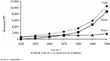
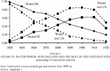
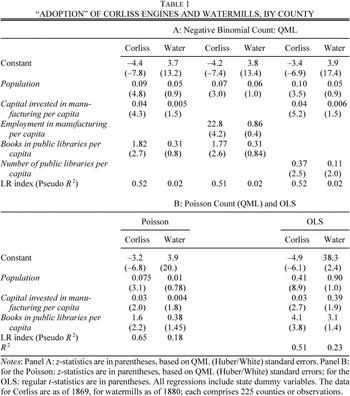
“ADOPTION” OF CORLISS ENGINES AND WATERMILLS, BY COUNTY
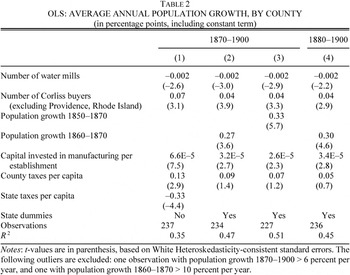
OLS: AVERAGE ANNUAL POPULATION GROWTH, BY COUNTY (in percentage points, including constant term)
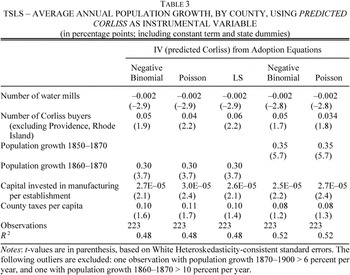
TSLS – AVERAGE ANNUAL POPULATION GROWTH, BY COUNTY, USING PREDICTED CORLISS AS INSTRUMENTAL VARIABLE (in percentage points; including constant term and state dummies)
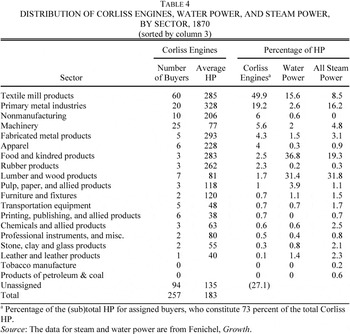
DISTRIBUTION OF CORLISS ENGINES, WATER POWER, AND STEAM POWER, BY SECTOR, 1870 (sorted by column 3)
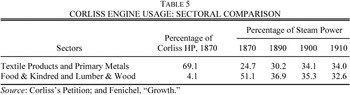
CORLISS ENGINE USAGE: SECTORAL COMPARISON
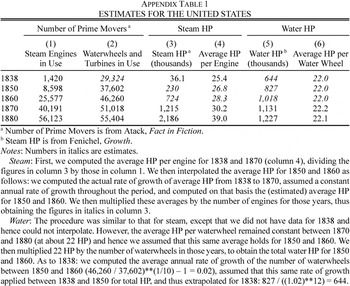
ESTIMATES FOR THE UNITED STATES
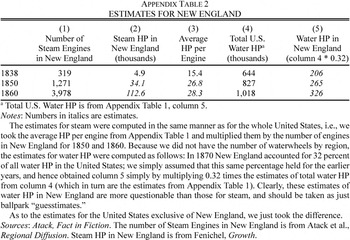
ESTIMATES FOR NEW ENGLAND
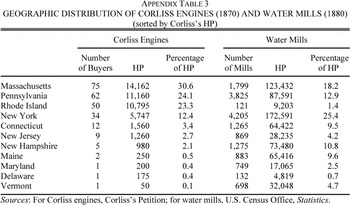
GEOGRAPHIC DISTRIBUTION OF CORLISS ENGINES (1870) AND WATER MILLS (1880) (sorted by Corliss's HP)
 You have
Access
- 148
- Cited by