INTRODUCTION
Contemporary populist radical right (PRR) parties in Europe stand among the most thoroughly researched phenomena in the scholarly literature. We probably know more about this relatively new and minor party family than we do about long-standing Christian and Social Democratic parties that still form the backbone of governing coalitions in many European countries (Mudde Reference Mudde2010). We know, for example, that PRR electorates disproportionately consist of young white men who share a distinctive set of attitudes, including hostility toward elites and minorities (Mudde Reference Mudde2007; Reference Mudde2010). But, the literature has so far paid scant attention to important areas, such as the relationship between religion and PRR support. This is a surprising omission given the long-standing scholarly pre-occupation with the social (cleavage) bases of party support (Mudde Reference Mudde2007; Reference Mudde2010); and considering that religion continues to shape mass political loyalties in the West, despite broad trends of secularization, and in the East, despite communist authoritarian regimes that sought to eradicate religiously based political loyalties (Dalton Reference Dalton2013; Knutsen Reference Knutsen2004; Putnam and Campbell Reference Campbell and Putnam2010; Norris and Inglehart Reference Norris and Inglehart2011; Wittenberg Reference Wittenberg2006).
This gap in the literature becomes even more surprising when we consider that PRR parties across religious and national contexts claim to embody and defend Christian identity and values. The Croatian Party of Rights, operating in a predominately Catholic country that spent 40 years as part of officially atheist Yugoslavia, chose the slogan “God and Croats” as its motto. In Greece, where over 90% of the population identifies as Greek Orthodox, the far-right Golden Dawn Party has called for criminal blasphemy charges against those it perceives as insulting God or the Greek Orthodox Church. From Denmark and the Netherlands to Hungary and Bulgaria, radical right parties warn of European civilization's destruction at the hands of non-Christians and the elites who abet them. Whether these parties have a genuine religious message or merely instrumentalize Christian identity in the service of other (nativist) goals, we might nonetheless expect religious Christian voters to find some appeal in parties that claim to represent them.
To date, however, direct evidence for religious bases of PRR voting remains slim. Lubbers et al. (Reference Lubbers, Gijsberts and Scheepers2002) and Norris (Reference Norris2005) found that PRR voters were actually less religious than the average voter; but other studies have concluded that religion has a weak but inconsistent effect on PRR voting (van der Brug et al. Reference Van der Brug, Fennema and Tillie2000; van der Brug and Fennema Reference Van der Brug and Fennema2003; Reference Van der Brug and Van Spanje2009). These studies present us with a paradox: PRR parties go to some lengths to identify themselves as defenders of Christian identity and values against alien cultural influences, but they do not appear to attract observant Christians as voters. This article seeks to better understand this paradox and thereby expand our understanding of the factors that drive (or inhibit) PRR party success, a matter of deep concern to scholars who worry about the illiberal and anti-pluralist inclinations of those parties (Betz and Johnson Reference Betz and Johnson2004; Abts and Rummens Reference Abts and Rummens2007; Rummens and Abts Reference Rummens and Abts2010).
RELIGIOUS CHRISTIANS AND THE POPULIST RADICAL RIGHT
Early research on the bases of far right support suggested that PRR parties create exclusive identarian divisions, validating one group as true, virtuous and good, while blaming society's ills on others. Theories of social disintegration, such as Arendt (Reference Arendt1951) and Kornhauser (1960), suggest that people who feel isolated from society are more likely to join radical or extremist groups, because these groups provide a sense of inclusion. Presumably, regular church attenders are socially integrated and therefore less likely to seek psychological compensations through a PRR party. Mayer and Moreau (Reference Mayer and Moreau1995), for example, find increased support for the far right French National Front among those with low religious attachment.
A more contemporary iteration of the social isolation thesis suggests that PRR voters represent the “losers of modernization” — those most displaced by the processes of globalization and post-industrialism, especially native-born men who are under-educated and/or under-employed. Hans-Georg Betz and others have used this theory of grievance mobilization to help explain the demographic profile of PRR voters and the particular scapegoats and mobilizing issues selected by the PRR (Betz Reference Betz1994). Following this approach, we might expect religious Christians to feel aggrieved by the secularization that accompanies socio-economic modernization and therefore affiliate with PRR parties as a mode of resistance to those changes. At the same time, those with weak religious attachments might fit the description of society's losers and therefore be more likely to seek psychological and policy compensations in a PRR party. In either event, efforts to find empirical evidence of the “losers” hypothesis — in macro-level education, unemployment, and immigration statistics or individual level socio-demographics — have been mixed and often contradictory (Bale Reference Bale, Green, Pedersen, Luther and Sitter2010; Cutts et al. Reference Cutts, Ford and Goodwin2011; van der Brug and Fennema Reference Van der Brug and Van Spanje2009).
Attitudes such as xenophobia, political dissatisfaction, and authoritarianism appear to be far more consistent drivers of PRR party support than either macro- or micro-level socio-demographic variables (e.g., Goodwin et al. 2009). The argument is simple: those with radical right attitudes are more likely to vote for radical right parties, but attitudes do not form in a vacuum. Social group affiliations and experiences may be expected to shape attitudes (Arzheimer and Carter Reference Arzheimer and Carter2003). The general literature on voting behavior finds that, even with broad trends of secularization across post-industrial societies, religion continues to help shape citizen attitudes and issue priorities (Dalton 2014; Girvan 2000; Inglehart and Norris 2004). The question for this research is whether Christian religiosity ought to make one more or less likely to hold the attitudes that drive PRR support. Some scholars theorize that Christian religiosity makes voters less likely to vote for the PRR, because contemporary Christianity prizes tolerance, compassion, and altruism; and those values stand in stark opposition to the PRR party profile (Arzheimer and Carter Reference Arzheimer and Carter2009; Billiet Reference Billiet1995). Others highlight the link between strong religiosity and “closed belief systems” that correlate with both ethno-centrism and authoritarianism (Altemeyer Reference Altemeyer2003). Some empirical studies suggest that there is no independent effect of church attendance on ethnic and racial prejudice once other factors are controlled for (Eisinga et al. Reference Eisinga, Billiet and Felling1999); others conclude that the relationship is curvilinear, with high church attenders and non-attenders less likely to hold prejudiced views than modal or infrequent attenders (Adorno et al. Reference Adorno, Frenkel-Brunswik, Levinson and Sanford1950; Billiet Reference Billiet1995; Eisinga et al. Reference Eisinga, Felling and Peters1990).
In one of the only systematic cross-national studies of the relationship between Christian religiosity and the populist radical right, Arzheimer and Carter (Reference Arzheimer and Carter2009) test the mediating effects of attitudes in eight West European countries, controlling for group characteristics, such as gender and age, known to correlate with religiosity and PRR voting (young men are both more likely to vote PRR and less likely to be religious across European societies). Drawing on data from the 2002 round of the European Social Survey (ESS), the authors find that: Christian religiosity has little direct effect on PRR vote when group characteristics are controlled for; and there is little evidence for the mediating effect of attitudes. Religious Christians are no more or less likely than other voters to hold the anti-minority attitudes that correlate with PRR voting. Arzheimer and Carter ultimately explain the reluctance of religious Christian voters to support PRR parties as the result of pre-existing identification with center-right Christian Democratic or Conservative parties. They argue that the availability of a viable mainstream rightist (MSR) party in a system produces a kind of “vaccine effect” that inoculates religious conservatives against voting for a new or marginal PRR alternative. This hypothesis is supported by cross-national research, which finds that, all other factors held constant, voters will prefer a large party over a small one (van der Brug and Fennema Reference Van der Brug and Van Spanje2009).
The current research seeks to verify and extend Arzheimer and Carter's findings in three ways: first, by expanding the design to include cases from post-communist Eastern Europe; second, by providing a disaggregated measure of PRR attitudes; and third, by more directly testing the vaccine effect with a logistic regression model that pits PRR voting directly against the choice to vote for an MSR party. We will elaborate the logic behind these extensions and then provide a general conceptual model and a set of testable hypotheses.
THE POPULIST RADICAL RIGHT ACROSS EUROPE
Many studies of the PRR phenomenon exclude post-communist cases on the justification that the electoral bases and mobilizing issues of far right parties in East Central Europe (ECE) are simply too different (e.g., Norris Reference Norris2005). There is little doubt that PRR parties in the East employ more overtly ethnocratic, racist, and anti-semitic rhetoric than their counterparts in the West. They are less likely to be viewed by their electorates as extremist; and, as a result, mainstream Right parties are less meticulous about distancing themselves from PRR ideas (Hockenos Reference Hockenos2013; Minkenberg Reference Minkenberg2002; Mudde Reference Mudde2005). Mass immigration has yet to become a problematic issue in ECE, so PRR parties are less likely to direct out-group hostility and sense of ethnic threat toward immigrants, preferring to target “internal aliens” (Roma, Jews, Muslim minorities), foreign influences, and elites perceived as insufficiently national in focus (Mudde Reference Mudde2004; Reference Mudde2007; van der Brug and Fennema Reference Van der Brug and Van Spanje2009). These differences are not trivial, but PRR parties comprise a diverse family even in Western Europe (Mudde Reference Mudde2007). The post-communist ECE parties simply offer additional manifestations of the same basic phenomenon: exclusionary identarian politics rooted in the notion of the sovereignty of a homogeneous people.
We see no reason to exclude ECE cases simply because they mobilize around different scapegoats; but neither can we ignore East-West differences. In ECE, diverse Christian traditions survived under conditions of official atheism, harassment, and restriction. Western European party systems often include long-standing Christian and Conservative parties that square off against long-standing Socialist and Social Democratic opponents. Post-communist ECE party systems, on the other hand, tend to be marked by both demand and supply side volatility (Rose and Munro Reference Rose and Munro2009). Parties emerge and drop from the political landscape, often in response to particular transitional issues and power balances rather than Left-Right ideological differences (Aspelund et al. Reference Aspelund, Lindeman and Verkasalo2013; Tavits and Letki Reference Tavits and Letki2009). Given all this, we might expect the religious context and the PRR phenomenon to be completely incommensurate in Eastern and Western Europe. Yet, gender and age gaps in support of PRR parties have been discovered all across Europe. The same appears to be true for the gap in religious support (Bíró-Nagy and Róna Reference Bíró-Nagy, Róna, Mesežnikov, Gyárfášová and Bútorová2012).
PRR parties use Christian identity in both halves of Europe to delineate the boundaries of the homogeneous people they claim to represent. In Western Europe, the shift from xenophobia to Islamophobia has involved redefining the enemy out-group from “ethnonational Turk into ethnoreligious Muslim” (Mudde 2011), from “immigrant as economic threat” to “unassimilable Muslim as cultural threat” (Hale-Williams Reference Hale-Williams2010). In post-communist ECE, the ideological vacuum left by the collapse of the Soviet Bloc created new space for nationalist and ethnocratic projects. Christian identity offered a ready set of symbols around which to develop a politics of national identity (Cassanova Reference Cassanova, Byrnes and Katzenstein2006). A recent 10-country study confirms the continued importance of religion in post-communist societies (Stan and Turescu Reference Stan and Turcescu2011). Often, religion is linked to culture wars issues that exist alongside or even supplant Left-Right economic debates. In Poland, the Catholic Church emerged from the transition period eager to flex its muscles in the new democratic landscape on issues such as opposition to abortion and gay rights (Guerra Reference Guerra and Leustean2012; Ramet Reference Ramet, Byrnes and Katzenstein2006). In Hungary, Calvinist and Roman Catholic churches managed to keep alive mass loyalties to Interwar right-wing parties and transmit those loyalties across forty years of communist rule to the post-communist political landscape (Wittenberg Reference Wittenberg2006). In places dominated by Eastern Orthodox traditions, the ecclesiastical hierarchy has seen democratization as an opportunity for “repristinization,” vigorously rejecting gay rights, liberalism, cosmopolitanism, ecumenism, and Europeanization in favor of Slavophilia and inward-looking nationalism (Ramet Reference Ramet, Byrnes and Katzenstein2006b).
THE RADICAL RIGHT ATTITUDE
Arzheimer and Carter hypothesized that the relationship between religiosity and PRR voting would be mediated by attitudes, and one attitude in particular: anti-minority sentiments, which they operationalized with a composite of survey responses about anti-immigrant xenophobia. The choice was on solid ground in terms of the empirical literature. It is widely argued that anti-immigrant attitudes provide the main commonality uniting the PRR family in Western Europe (e.g., van der Brug et al. Reference Van der Brug, Fennema and Tillie2000; Reference Van der Brug and Fennema2003; Reference Van der Brug and Van Spanje2009). This conceptualization becomes problematic, however, when we try to extend research to ECE cases. We would also argue that anti-immigrant xenophobia offers an excessively narrow conceptualization of PRR attitudes, which many scholars see as comprised of three elements: populism (a thin-centered ideology that depicts society as separated into two mutually antagonistic groups, the “pure people” versus the “corrupt elite”); nativism (the idea that states should be inhabited only by members of the native group and that non-native persons and ideas are fundamentally threatening to the homogeneity of the nation); and authoritarianism (belief in a strictly ordered society and strong punishments for those who do not submit to authoritative members of the in-group) (Mudde Reference Mudde2004; Reference Mudde2007; Reference Mudde2010; Rooduijn Reference Rooduijn2013; Stanley Reference Stanley2008).
By breaking PRR attitudes down into these component elements, we are able to provide a more nuanced account of religiosity's effect on right-wing voting behavior. Religious cleavage bases that historically divided European party systems along Christian Democratic/Conservative versus secular Socialist/Social Democratic lines continue to exert an influence over voting choice (Broughton and ten Napel Reference Broughton and ten Napel2000). We might expect religious Christians to prefer the right/conservative side of that ideological divide and therefore to be more available to right-wing parties. But, that does not explain the religion gap within the Right. One possible explanation might be that Christian religiosity has a differential impact on the three aspects of the PRR attitude cluster. Church attending Christians, for instance, might be less likely to hold populist (elite challenging) values but more likely to hold authoritarian (strong law and order) preferences, since church attendance reflects a level of comfort with hierarchy and authority that irreligious voters or infrequent church attenders might not share.
The populist piece of the PRR attitude cluster is what ties most clearly to Arzheimer and Carter's claim about the immunizing power of mainstream right alternatives in a system. They found that the main reason conservative religious Christians in Western Europe do not vote for PRR parties is that they are already committed to established Christian Democratic or Conservative parties. If religious voters are indeed less populist, this will be another reason for those voters to prefer a viable, established mainstream conservative party over a marginal populist one.
GENERAL MODEL OF RELIGIOSITY AND PRR SUPPORT
Based on the foregoing review of the literature we suggest a general model of the relationship between religiosity and PRR voting. Figure 1 may be read left-to-right beginning with broad social group characteristics. Those characteristics might have a direct and independent effect on PRR voting, or they might act through the variable of religiosity. Being young, male, and less educated might make a voter more likely to vote for the PRR. Or, there might be something specific about being a woman that lessens the PRR party appeal. A small literature has grown up to explain the gender gap in voting for the far right (see Givens Reference Givens2004; Inglehart and Norris Reference Inglehart and Norris2003; Mayer Reference Mayer2013; Mudde Reference Mudde2007; Rippeyoung Reference Rippeyoung2007). We are reminded by that research that young men (the core support base of the PRR) are less likely to be religious than women (particularly older women) in their societies. It is possible that the religion gap is simply an artifact of these group memberships or that the religion gap helps to explain gender and age gaps in the PRR electorate.
General Model of the Relationship Between Christian Religiosity and PRR Voting

Continuing through the model, we come to the three core components of the radical right attitude, as well as, conservative ideology. Attitudes could drive PRR voting independently; or attitudes and conservative ideology might serve as mediating variables, with an individual's likelihood of holding each attitude made more or less likely by that individual's level of religiosity. The positive and negative symbols on the figure indicate the expected direction of the relationship between religiosity and attitudes, on one hand, and between attitudes and likelihood of voting for the PRR, on the other. Higher levels of religiosity ought to make one less populist, more authoritarian, and more ideologically conservative based on logics articulated earlier. In turn, populism should make one more likely to vote for the PRR, authoritarianism less likely. Nativism is a main driver of PRR support according to many studies, but there is no clear evidence that religiosity makes one more or less likely to hold nativist views. The model reflects that ambiguity.
From this general model we can extract the following list of testable hypotheses:
H1:
Christian religiosity will be weakly or negatively correlated with PRR voting.
Because:
H2:
Religious Christian conservatives are more likely to vote for a mainstream Christian Democratic or Conservative party and are therefore unavailable to vote PRR.
H3:
Religious Christians are less likely to hold populist attitudes associated with the PRR party profile.
H4:
Religious Christians are more likely to hold authoritarian attitudes, but are no more likely to vote PRR, because authoritarianism also forms part of the MSR electoral appeal, and;
H4a:
Authoritarian attitudes will positively correlate with MSR vote.
H5:
Religious Christians will be no more or less likely to hold nativist views and;
H5a:
The relationship between nativist attitudes and PRR voting will be weakened by the fact that MSR parties also appeal to nativism.
H6:
Any direct relationship between religiosity and PRR voting is spurious and will disappear when other group characteristics (age, gender, education) are controlled for.
RESEARCH DESIGN AND MEASUREMENT
In order to test these hypotheses, we employ survey data from the 2010 ESS (ESS Round 5 2010). Countries were selected if they exhibited a serious populist contender in the most recent legislative election,Footnote 1 a criterion that left us with 13 countries: six from Eastern Europe and seven from Western Europe.Footnote 2 Altogether, this represents the largest cross-national study on religiosity and populism conducted to date, with over 24,000 individuals surveyed in total. It is important to note that our intention with this research is not to provide a comprehensive model of PRR voting (or MSR voting for that matter). We are concerned instead with testing the relationships suggested in Figure 1.
The 2010 ESS data contains all the necessary individual level information to code for vote choice and religiosity, as well as key attitudinal and group characteristic variables. For the dependent variable, PRR vote, the 2010 ESS asked individuals which party, if any, they had voted for in the most recent election. If a PRR party was indicated, the response was coded as (1). All other party responses were scored (0). Non-voters and those who refused to answer were treated as missing data. The MSR vote variable was similarly coded: MSR vote (1); all other party choice responses (0).
For the independent variable most central to our investigation, Christian religiosity, we created a scale to account for both intensity and frequency of religious practice. Following Arzheimer and Carter (Reference Arzheimer and Carter2009), we eliminated all respondents who identified as non-Christian. For the remaining pool, we combined responses to three survey questions to create a Christian religiosity index ranging from zero (irreligious) to seven (highly religious). The questions tapped respondents’ self-reported levels of religiosity, as well as, frequency of church attendance and frequency of private religious practice (prayer).Footnote 3
For the PRR attitude cluster, we used scaled measures of survey questions relating to populism, authoritarianism, and nativism. Populism is measured through combined responses to questions about trust in politicians and how satisfied the respondent is with the working of democracy in the country. We summed those responses and recoded the variable as a 0–6 scale running from least-to-most populist. For authoritarianism we developed a 0–5 scale based on self-reported affinity with the description of a person who “… believes that people should do what they are told … that people should follow the rules at all times, even when no-one is watching” (item H1).
The nativism measure proved more problematic. The 2010 ESS measures nativism almost exclusively in terms of anti-immigrant xenophobia. That works well enough for the PRR in Western Europe, but not ECE. Initially, we tried a straightforward question about immigration: “Using this card, would you say that the [country's] cultural life is generally undermined or enriched by people coming to live here from other countries?” Preliminary analysis showed that the question worked in a predictable fashion for all of the Western European cases but only for Poland in Eastern Europe. We enhanced the validity of the measure by combining the anti-immigrant question with two other measures: racism and traditional (antifeminist) gender ideology. PRR party appeals are often characterized by racism and a traditional gender ideology that valorizes women as the literal and symbolic reproducers of the nation (Mostov Reference Mostov and Ramet1999; Ramet Reference Ramet, Byrnes and Katzenstein2006b; Rippeyoung Reference Rippeyoung2007).Footnote 4 Recoded responses to the original xenophobia question and the two additional items were summed and recoded into a scale running from 0 (least nativist) to 6 (most nativist). The scale does not provide a perfect measure for our ECE cases, but diagnostic statistics confirm an improvement over a scale based solely on anti-immigrant sentiment.
We recoded gender so that the higher number reflects the category expected to support the PRR (female = 0, male = 1). We coded the age variable to reflect the findings of previous literature on the effect of age on PRR voting (18–29; 30–65; older than 65). Education responses were given in terms of highest level of education completed: from (1) “no primary education” to (7) “second stage of tertiary education.“Footnote 5 Ideological conservatism is based on the ESS Left-Right self-placement that runs from 0 (far left) to 10 (far right).”
ANALYSIS AND FINDINGS
The following analysis begins with bivariate correlations in each of our 13 country-cases in order to set the empirical stage, look for patterns of East-West difference, and offer an initial test of our hypotheses. We then move on to a multivariate binary logistic regression model that pits PRR voting directly against MSR voting in order to more directly test the vaccine effect (our H2) and the degree to which particular aspects of the PRR ideological core/appeal may also drive MSR support (H4–H5).
BIVARIATE RESULTS
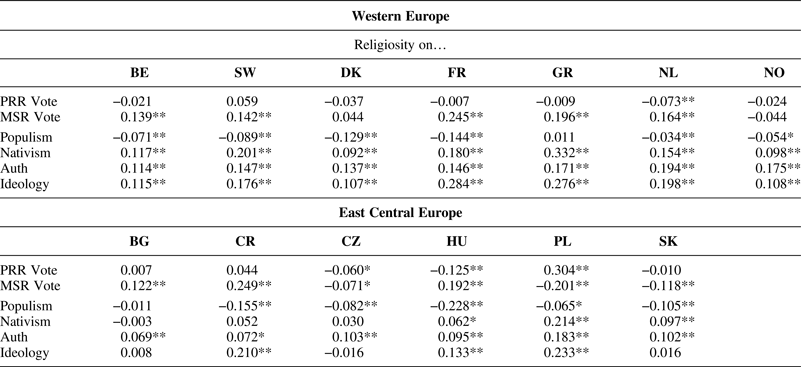
Bivariate correlations reported in Table 1 accord with earlier studies that found PRR supporters to be relatively non-religious (Lubbers et al. Reference Lubbers, Gijsberts and Scheepers2002; van der Brug et al. Reference Van der Brug, Fennema and Tillie2000; van der Brug and Fennema Reference Van der Brug and Fennema2003; Norris Reference Norris2005). With the notable exception of Poland, higher levels of Christian religiosity are weakly or negatively associated with voting for the populist radical right. The opposite is mostly true for MSR voting. Among Western European cases in our sample, only Norway defies expectation, and in that case religiosity is not positively associated with either PRR or MSR voting. In the Eastern part of the sample, the cases of Poland, Slovakia, and (to a much lesser extent) Czech Republic show a negative relationship between Christian religiosity and MSR voting. The broad cross-national trend therefore supports Arzheimer and Carter (Reference Arzheimer and Carter2009) and our first and second hypotheses. Conservative Christian voters may be less available to PRR parties, at least in part, because they are committed to a mainstream right party.Footnote 6
Christian Religiosity on Vote Choice and PRR Attitudes

*p < 0.05, **p < 0.01.
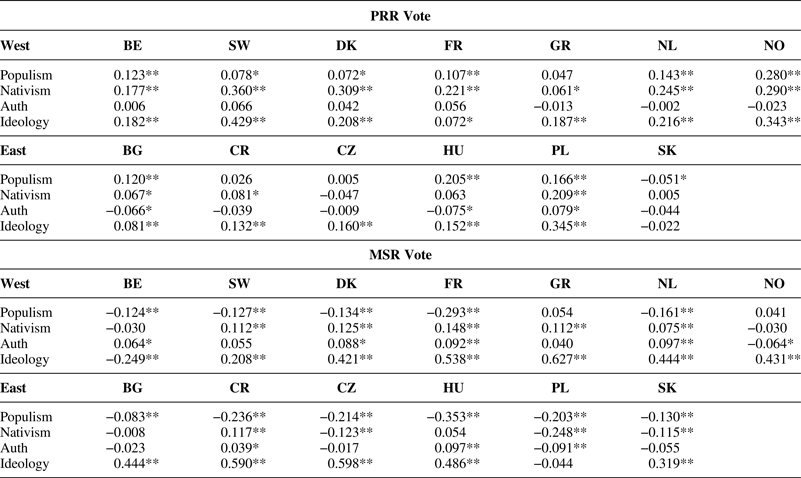
When we look at attitudes in the lower part of Table 1, we again find support for several of our hypotheses. Christian religiosity negatively correlates with populism in every country except Greece. That is significant, because Table 2 shows that in every case except Slovakia, populist attitudes help drive the PRR vote. Bivariate results therefore lend support to our H3: Religious Christians are less likely to hold populist attitudes associated with PRR party support. Authoritarianism works in the opposite direction. We found statistically significant positive correlations between religiosity and authoritarian attitudes in each country in our sample and weak or negative correlations between authoritarian attitudes and PRR voting. This is broadly consistent with the expectations of H4. We initially predicted that authoritarianism would also be an appeal of the MSR and might help to explain the attachment of religious Christians to those parties. The data, however, do not support that hypothesis. Neither the PRR nor the MSR vote appears to be particularly driven by authoritarian attitudes.
Bivariate Correlations Radical Right Attitudes and Vote Choice

*p < 0.05, **p < 0.01.
Our fifth hypothesis predicts that religious Christians will be no more or less likely to hold nativist attitudes than the rest of the voting population. The data do not entirely support that claim. In Western Europe, we find significant positive correlations between Christian religiosity and nativism in each country. This appears to refute Arzheimer and Carter's finding based on 2002 ESS data for Western Europe, but may reflect our expanded sample of country case and how that affected the way we could measure nativism. It is also possible that nativism is becoming more widely acceptable to Western publics over time. Whatever the cause, we do not find a strong relationship between religiosity and nativism in the Eastern sample. Only Poland (and to a lesser extent Slovakia) exhibits a positive relationship between religiosity and nativist attitudes. This East-West difference holds when we look at the relationship between nativism and PRR voting. In the West, nativism positively correlates with PRR voting in every case. In ECE, the PRR vote only appears to be driven by nativism in Poland.
We predicted that nativism might have become an appeal of the MSR, and in the Western European sample, there is a significant positive correlation between nativist attitudes and MSR vote in every country except Belgium and Norway. This finding provides some additional support to the vaccine effect hypothesis. If a larger MSR party in a system stakes out a nativist position, religious people with nativist attitudes may feel no compulsion to vote for a fringe party simply because it has a shriller nativist outcry. In the East, however, nativism is either weakly or negatively associated with MSR voting.
The very different patterns we find between East and West could be a by-product of the coding problems we faced for the nativism variable. In addition, the line between PRR and MSR parties is less clear in ECE. Hungary and Slovakia, for example, each have a mainstream populist nationalist party that appeals to the nativist sentiments of voters; and arguably the Polish PRR is mainstream. These differences complicate interpretation of the nativism variable for the East European cases.
IDEOLOGY
PRR parties are often labeled “extreme right,” “far right,” and “radical right,” leading to the presumption that PRR supporters would score further to the right on ideological self-placement questions than MSR supporters. The data presented in Table 2 indicate that, while PRR voting is positively correlated with self-placement on the right in every case except Slovakia, the correlation is even greater for the MSR (except in Poland). There are a couple of likely explanations. Young, unemployed or under-employed blue-collar men historically provide the electoral base for Socialist parties. That very same base may turn to the PRR if the mainstream Left parties are unable or unwilling to address socio-economic changes associated with globalization and post-industrialism (Bale Reference Bale, Green, Pedersen, Luther and Sitter2010). Statistical analysis shows that in Western Europe the effect of Left/Right self-placement is weaker for PRR than for other parties (van der Brug and Fennema Reference Van der Brug and Van Spanje2009). In Eastern Europe, the Old Left is often discredited. The economic policies of the PRR tend to be national protectionist and anti-European Union, positions that mainstream parties of Left and Right have found tricky to advocate in the context of the mass-scale economic liberalization and Europeanization.
GROUP CHARACTERISTICS AND ATTITUDES
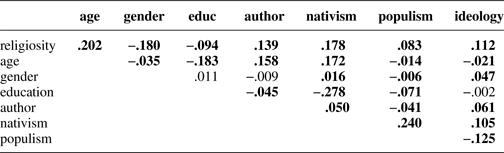
One of the possibilities raised in Figure 1 is that group characteristics overlap with Christian religiosity and with PRR attitudes. Table 3 provides bivariate correlation data to tease out those relationships more formally before we move on to our multivariate model. As we would expect, older voters, women, and the less educated are more likely to express higher levels of Christian religiosity. There is also a positive and statistically significant association in our 13-country sample between Christian religiosity and the core PRR attitudes, particularly nativism and authoritarianism and right-wing conservative ideology. Older voters, who are more likely to be religious Christians, are also more likely to hold nativist and authoritarian attitudes. They are somewhat less likely to hold populist views. Less educated voters are somewhat more likely to hold all three PRR attitudes but particularly nativism.
Bivariate Correlations Christian Religiosity, Group Characteristics, and PRR Attitudes

N = between 20,000 and 25,000 for each bivariate cell.
Note: All bold significant at the .000 level.
We expected that different aspects of the PRR appeal may cut in different directions, appeal to different parts of the electorate, and also work as appeals for MSR parties. What we did not predict was the strong and significant correlation between nativist and populist attitudes (0.240, significant at 0.000 level). This finding is consistent with the theoretical literature, however, which treats populism as a thin ideology that must syncretize with either a thick (full) ideology or another thin ideology, such as nativism, in order to offer adherents a complete worldview. Indeed, it appears to be the combination of populism and nativism that most characterizes contemporary right-wing populism (Mudde Reference Mudde2004; Stanley Reference Stanley2008). This makes the concentration of nativist attitudes among older voters particularly interesting. Older voters are more likely to be religious Christians and more likely to hold nativist views, but they appear less likely to vote for PRR parties.
MULTIVARIATE ANALYSIS
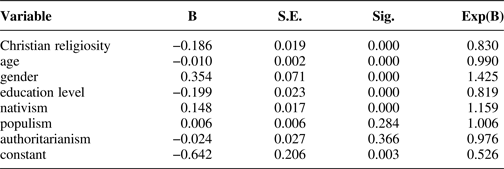
In order to further test these relationships, we employ a binary logistic regression model — the appropriate method for our dichotomous dependent variable (Hosmer and Lemeshow Reference Hosmer and Lemeshow2004). We are primarily interested in determining the degree to which Christian religiosity increases or decreases the likelihood of voting for the PRR, as compared with the likelihood of voting for the MSR, the vaccination hypothesis. We are also interested in testing the extent to which Christian religiosity acts independently and directly on PRR voting (rather than as a shaper of intermediary attitudes or as a by-product of group characteristics). Table 4 provides a model for predicting the likelihood of voting for the PRR rather than the MSR. To create this trade-off, we coded PRR vote choice as (1) and MSR vote choice as (0). All other responses were coded as missing data (Don't Know, Refused to Answer, Blank). We removed the Polish case from the sample, because Poland was a consistent outlier in bivariate analyses.Footnote 7 We will return to it in a later part of the analysis.
Logistic Regression Model: PRR Versus MSR Vote

Nagelkerke R 2 = 0.097.
N = 5344.
Independent variables in the model include our Christian religiosity measure, followed by the group characteristic variables specified in Figure 1 (age, gender, and education level) and the three variables associated with core PRR attitudes (nativism, populism, and authoritarianism). We dropped ideology from the full model, because our dependent variable now includes only respondents who said that they voted for a rightwing party in the most recent election.
Findings suggest that Christian religiosity has a weak negative relationship with voting for the PRR; therefore each unit increase in Christian religiosity leads to a decrease in the odds of voting for a PRR party and therefore an increase in the odds of voting for an MSR party instead. This is consistent with the notion of a religion gap in PRR support (H1) and a vaccine effect (H2). Among the group characteristic variables, only gender (being male) increases the likelihood of voting for a PRR party instead of a mainstream right-wing alternative. This is consistent with the empirical literature on the gender gap within the Right and studies of PRR voting cited earlier in this paper.
In keeping with bivariate results, age and education have a weaker impact in the logistic regression model than gender. Older and more educated voters are slightly less likely to choose the PRR over an MSR alternative but the magnitude of impact is small. In terms of the attitudinal variables, only nativism has a positive and statistically significant impact on the likelihood of choosing PRR over MSR.
Experiments with iterative models not shown in Table 4 suggest that the impact of Christian religiosity barely changes when social group characteristics are added to the model. Being female, older, and less educated does make a respondent less likely to vote for a PRR party than a mainstream right alternative; and those same characteristics are associated with Christian religiosity. But, the religion gap does not alter in any significant way when gender, age, and education are entered into the model. We may therefore reject H6: that the relationship between Christian religiosity and PRR voting is spurious and will disappear when group affiliations are controlled for.
Bivariate findings suggested that populism might help to account for the religion gap. Religiosity made respondents less likely to express populism; and populism appeared to be an important driver of PRR voting. But, in a logistic regression model pitting PRR voters against MSR voters the populism variable is not statistically significant. Multi-collinearity is not a problem in the model, as none of the standard errors reported exceed a value of 2. It is nevertheless possible that some of populism's effect is obscured by negative correlations between populism and age/gender (older women are slightly less likely to be populist but more likely to be religious) and the positive correlation between populism and nativism. In a practice model that dropped nativism, the populism variable became significant (at 0.000).
Taken together our findings suggest that certain kinds of conservative voters may indeed be inoculated from PRR support by their attachment to an MSR party, namely: older, religious Christian women. The only attitudinal variable that exerts an independent effect on the choice to vote PRR instead of MSR is nativism. A closer look at the Polish case offers additional insights into the conditions that may produce (or prevent) a vaccine effect.
THE POLISH EXCEPTION
Poland today is a religiously homogenous country — over 90% Roman Catholic. Other countries in our sample (notably Greece and Croatia) are also religiously homogeneous, but those cases are not outliers in terms of the religion gap and the PRR. A few factors appear to set Poland apart. Historically, nationalization of Polish Catholicism took place in the 19th century “not as a process of state formation from above, but as a process of resistance from below to foreign state power” (Cassanova Reference Cassanova, Byrnes and Katzenstein2006, 67). During periods of partition and occupation, the Church stood as the one institution that could provide a source of national unity. The Polish nation persisted even when the Polish state could not. When the Soviets liberated Poland from the Nazis they installed a communist government and attempted to impose secularization from above. This only served to legitimate and revitalize the Polish Catholic Church, which was by then operating in an ethnically homogeneous Polish state. The unique Polish ability to fuse class, religious, and national identities emerged again in the communist era with the Solidarity Trade Union's opposition to communist rule and foreign domination (Cassanova Reference Cassanova, Byrnes and Katzenstein2006).
Given the Church's role in “the legendary resistance of the Poles to tsarist rule and later to communist rule, the devotion of Polish bishops and priests to the interests of the Polish people in times of hardship, and the enormous popularity of the Church throughout the communist era and its considerable political clout in the post-communist era” we should not be surprised that, in Poland, Christian religiosity is consistent with populist attitudes (Ramet Reference Ramet, Byrnes and Katzenstein2006, 117). Nor should we be surprised that church-attending Catholics share the national-conservative-authoritarian worldview of the Church hierarchy and vote for PRR parties.
In Poland, the largest party has been the center-right Civic Platform (PO), but the PRR Law and Justice (PiS) is far from a fringe party. In its founding year, 2001, PiS won nearly 10% of the parliamentary vote. In the next election, it leapt to 27%, higher than all other parties including the PO. Since then, PiS has consistently finished second, winning close to 30% of the vote in the 2007 and 2011 elections.
As in many Eastern European countries, the axis of party competition in Poland does not lie along the traditional Left-Right economic continuum. Some parties combine a socialist economic outlook with highly nationalist, socially conservative policies. Cleavages in the party system are often based in personality conflicts and the peculiarities of Solidarity's victory and subsequent collapse. Parties invoke nationalism when they do not wish to identify as either Right or Left (Vermeersch Reference Vermeersch2013). The PiS, for example, describes itself, not as a far right party, but as the embodiment of the sovereign will of the Polish people. Because it claims to represent the Polish people as a whole, the party brands its opponents as “un-Polish.”
The PiS takes the Church's position on most issues. It promotes decommunization, conservative positions on social issues, and “Poland for the Polish” in European affairs, appealing to Europhobes, some of whom fear that Europeanization will introduce secularization and put an end to Polish exceptionalism (Cassanova 2004). Meanwhile, the party's main rival (the center-right PO) holds many similar views as the main center-left party. Some ninety percent of the PO's electorate favors the absolute separation of church and state and abortion rights (Bugajski Reference Bugajski2011). For this reason, the Church has often thrown its support directly behind PRR parties rather than the mainstream conservative PO, going so far as to offer voting instructions from the pulpit (Mudde Reference Mudde2007). While PRR parties in other countries must contend with stigma and derision, “There is no clear demarcation line between the Polish extreme right, the populist right and the mainstream right. The notion of a cordon sanitaire against the far right [has not] been accepted in Polish politics and the media” (Pankowski Reference Pankowski2012).
The Polish case suggests that a vaccine effect is neither automatic nor inevitable. Conservative religious voters will only be inoculated against the PRR if: society is secular enough to see state, national, and religious identities as separable; there is a clear line of demarcation between PRR and MSR parties in an institutionalized party system; and conservative Christian voters are able to have most of their ideological and policy needs met through a larger (presumably more viable and popularly acceptable) MSR party.
CONCLUSIONS
We began this research with a paradox: PRR parties take pains to show that they are defenders of Christian identity and values, and yet they do not widely attract religious Christian voters. Our analyses confirm that paradox. As religiosity increases, the odds of voting for a PRR party instead of a mainstream right party decline. Several relationships appear important in accounting for this outcome. Older, more religious, and female voters are attached to MSR parties and therefore may not be available to vote for new and marginal PRR alternatives. Nativism is the strongest independent attitudinal predictor of voting for a PRR rather than an MSR party; and Christian religiosity correlates positively with nativism in our study but not with populism, despite the fact that populism and nativism are strongly linked attitudes. This might be read as evidence that the populist radical right's claims to represent Christian values are in fact mostly instrumental — primarily an appeal to syncretized populism and nativism — and that the likelihood of religious Christian voters choosing a PRR party largely reflects compositional effects. Older voters and women, who happen to be more religious, resist the PRR, not so much due to religious or ideological objections but because they are more comfortable voting for a larger, more mainstream conservative party. The causes for this (and for young men's greater willingness to throw support behind often new or marginal PRR parties) call for further investigation.
Arzheimer and Carter provocatively conclude their 2009 study with the admonition that, as the trend of partisan dealignment continues in the Advanced Democracies, whatever immunizing power the MSR possesses will diminish. Financial and debt crises in Europe are placing new pressures on old and new party systems. Economic austerity may exacerbate nativist sentiments and populism. Our research offers no particular evidence that religious Christian voters (or their composite social groups) are immune to these trends. Recent PRR successes in European Parliament elections may reflect an expanding “zone of aquiescence” for intolerant parties among mass publics, a zone that is already fairly wide in ECE (Norris Reference Norris2005). Mainstream parties of the Right (and perhaps also the Left) may try to hold onto their voters by coopting PRR rhetoric and policy (Bale Reference Bale, Green, Pedersen, Luther and Sitter2010; Mudde Reference Mudde2007). If religious Christian voters are not intrinsically repelled by the PRR ideology and profile, then we should not be overly sanguine about the mainstream right's power to inoculate its traditional voting base against populist radical right insurgents.