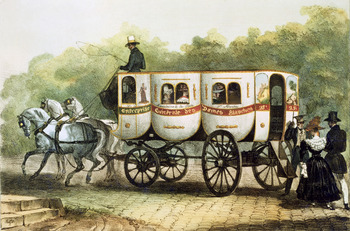
In the summer of 1828, the Entreprise générale des Dames Blanches, a public transport firm founded by entrepreneur Edme Fouquet, launched a fleet of white omnibuses drawn by white horses onto the streets of Paris. These vehicles offered one of the first mass transportation systems in the world and were an innovation that transformed urban circulation. They are also significant in the musical world as they were named and fashioned after François-Adrien Boieldieu's opéra comique, La dame blanche (1825), whose libretto by Eugène Scribe was based on themes from Sir Walter Scott's novels and poetry.Footnote 1 The omnibuses, commonly known as the Dames Blanches, overtly referenced the popular opera: their rear doors were decorated with scenes of the Scottish countryside, their flanks were painted with gesturing opera characters, and they were each equipped with custom-made mechanical horns that trumpeted road signals (see Fig. 1).
Denis Auguste Marie Raffet, Dame Blanche (1829), Bridgeman Images. (colour online)

The omnibuses operated for nearly thirty years while, in parallel, Boieldieu's opera became one of the longest-running works at the Opéra-Comique.Footnote 2 In the street, the omnibuses brought La dame blanche to the attention of those who had never heard the opera. A collection of images associated with the opera – scenes of the Scottish highland, tartan-clad characters, ghostly horses and blanched carriages – circulated through the cityscape. As this imagery permeated everyday life, Parisians came to view the opera as a publicly shared product. When the omnibuses improved the quality of working- and middle-class life, bourgeois Parisians applauded the vehicles’ egalitarian business model, and Boieldieu's opera became unexpectedly entwined in this populist rhetoric. I suggest that the Dames Blanches invited Parisians to conflate the sounds of opera and street, as demonstrated especially by Charles Valentin Alkan's piano variations Les omnibus, Op. 2 (1829), which combine operatic idioms and horn calls. Through these examples and others, this article examines how material culture affected the ways in which people engaged with and thought about a musical work.
Studies of material culture and music have traditionally centred on objects used by musical communities, such as instruments, scores and journal reviews. Through a process described by Peter Mondelli as ‘material sociability’, the popular reception of music is effectively mediated by the circulation of commodities.Footnote 3 For instance, the repetition of repertory through arrangements and transcriptions inscribe works in the public consciousness, thereby driving the formation of a popular canon.Footnote 4 Scores and reviews mobilise fans and participate in the machinery of celebrity.Footnote 5 Instrumental availability and affordability also influence compositional trends as composers create repertories that serve the ready market.
Looking beyond these categories, other material goods with musical themes, such as products in the decorative arts that proliferated during the eighteenth and nineteenth centuries, offer insight into the cultural impact of music. Artisans were inspired by the visual aspects of opera and routinely depicted scenes on residential furnishings. These included opera-themed porcelain sets, wallpaper and tapestries.Footnote 6 The Dames Blanches omnibuses similarly commercialised the imagery of a popular opera. However, the latter presents a more complex example because the omnibuses were components in a large-scale urban enterprise with extraordinary circulation in the public view. Extra-musical artefacts are less emphasised in music history, likely because they seem removed from the processes of music-making. However, the operatic omnibuses and other musically themed goods participate in reception histories by reinforcing the name-recognition of repertory through repeated use and by bringing musical works into new environments. As historian Michael Warner has shown, the durability of a composition is dependent upon its continued circulation in intertextual and intergeneric ‘environments of citation and implication’.Footnote 7 Building upon this notion, Lester Olson argues that the process of recirculation involves reframing the original text and ultimately changing its cultural meaning.Footnote 8 In the case of the Dames Blanches omnibuses, the vehicle functioned as an intertextual iteration of the opera that not only perpetuated public awareness of the work but also had the potential to reshape the cultural view of it.
This study begins by contextualising the omnibus business and how it capitalised on the initial popularity of Boieldieu's opera. Considering the Scottish trends of the time, I examine how the omnibus business compared to other ventures that marketed products fashioned after La dame blanche. I then investigate the demographics of omnibus patrons to determine if and how the vehicles were associated with certain social groups. Beyond the omnibus riders, Parisians in general would have been familiar with the omnibus as it became a regular feature of the streets. I therefore assess the space where people would encounter the carriages, recognising that in different environments, such as the household, concert hall or street, people would engage with the musical idea in different ways.Footnote 9 Next, I turn to goods that were produced in response to the operatic omnibus. These derivations, intertextual products that reference both omnibus and opera, illustrate the process by which a musical idea can evolve. Finally, I assess the broader history and significance of the omnibus, considering how its qualities and use may have influenced views of Boieldieu's opera. These factors present a culturally embedded portrait of music reception that demonstrates how the success of a work is negotiated to a significant degree through the lens of its material derivatives.
Early reception and commodification of La dame blanche
Premiered on 10 December 1825 at the Théâtre Feydeau, home of the Opéra-Comique, La dame blanche captivated the Parisian public even before themed omnibuses entered the scene. From the outset, the work was acclaimed by critics and the musical community. Boieldieu's synthesis of French and Italian comic opera styles was innovative, prompting one Figaro critic to revitalise the aesthetic debates that had fuelled the Querelles des Bouffons and to claim that La dame blanche epitomised the merits of French music culture.Footnote 10 Furthermore, Eugène Scribe's libretto, soon to be studied by subsequent composers as the definitive template for the genre, was praised for its dramatic pacing of large ensembles and provocative use of a delayed-action plot. Particularly celebrated was the Act II finale, an auction scene that enacts a bidding battle animated by solo interjections and full ensemble responses.Footnote 11
The initial success of La dame blanche can also be attributed in part to the endorsement of the Bourbon court. Boieldieu invited this validation when he dedicated the work to Charles X's daughter-in-law, the Duchess of Berry.Footnote 12 The royal family requested that Boieldieu conduct a private performance of La dame blanche for the king at the Duchess's Elysée residence, and later awarded the composer gifts and a 1,200-franc pension to honour the success of La dame blanche.Footnote 13 Boieldieu's opera undoubtedly appealed to Charles X and his court because it presented a restoration narrative that recalled the Bourbons’ return to power after Napoleon's abdication.Footnote 14 In addition, the plot hinges on questions of inheritance law, connecting closely with Charles X's domestic policy and efforts to reinstate rules of primogeniture.Footnote 15 In short, the opera dramatised the triumph of ancestral rule, allegorically substantiating the Bourbon claim to the throne. Such political parallels are easily mapped in the plot: set in rural Scotland, the opera opens with townspeople living under the governance of a corrupt steward while awaiting the return of the long-lost heir to the local Avenel estate. A passing soldier named Georges Brown sympathises with the townspeople and volunteers to visit the Avenel castle to answer a mysterious summons from the dame blanche, a legendary apparition who watched over the Avenel family. At the castle, Georges is received by Anna, an orphan raised by the Avenel family who, disguised as the white spirit, convinces Georges to participate in a plot to free the town from the steward's control. According to plan, Georges wins the keys to the old estate at a public auction. His victory is celebrated by the townspeople who sing the ‘Scottish Anthem’, a local ballade that briefly stirs Georges's forgotten childhood memories. When Georges cannot produce payment for the estate and is threatened with imprisonment, Anna, still disguised as the dame blanche, delivers the Avenel inheritance on his behalf. In the commotion, Anna is unmasked and, furthermore, Georges discovers that he is Julian Avenel. He restores order to the town as the rightful heir and lord to the Avenel estate.
Political and aesthetic merits aside, La dame blanche was well-poised for popular approval at a time when interest in pastoral Scotland was sweeping across Europe.Footnote 16 An influx of articles on Sir Walter Scott and Scottish culture appeared in French periodicals during the early 1820s.Footnote 17 The musical world also fuelled interest in the subject. Rossini translated and revised his opera La donna del lago (1819), based on Scott's poem with the same English title, for eager French audiences.Footnote 18 Anglophile interests did not wane in the following decade as Scott's novel The Bride of Lammermoor was adapted for Michele Carafa's Le nozze di Lammermoor (1829) and Gaetano Donizetti's Lucia di Lammermoor (1835). Amidst this wave of enthusiasm for Scottish lore, audiences patronised Boieldieu's La dame blanche in multitudes and, by popular demand, the Opéra-Comique presented the work more than one hundred times during its first season.Footnote 19
The public's initial enthusiasm for La dame blanche meant that it was a likely candidate for commodification. Indeed, manufacturers jumped at the opportunity to capitalise on the Scottish trends already rampant in Paris. The imagery of the opera was quickly adopted by the fashion and textile industries.Footnote 20 For instance, stylish women could purchase gauzy white hats similar to the title character's costume, and one style journalist encouraged her readers to accessorise ‘à la dame blanche’.Footnote 21 In addition, enthusiasts could purchase fabrics decorated after Boieldieu's opera, such as a three-colour wood block design that featured imprints of four separate scenes from La dame blanche on cotton fabric.Footnote 22 It was common for designers to feature opera scenes on textiles, and they typically drew inspiration from works set in distant places, such as Grétry's La caravane du Caire (1783).Footnote 23 The Scottish setting in La dame blanche was perceived to be similarly exotic, and it was presumably part of the initial allure that attracted consumers. Parisians could also procure the wallpaper Vues d’Écosse created by Jean-Michel Gué, set designer for the Opéra-Comique's production, and replicate the theatrical scenery in their homes.Footnote 24 Gué's panoramic design pictured the Scottish lake of legend surrounded by mountains with scattered country folk fishing in boats and playing Celtic harps on the shore.Footnote 25 As these themed products were absorbed into everyday life, the once exotic opera became familiar, even Parisian. Such goods were clearly aimed at female consumers and capitalised on bourgeois interests in fashion. From the start, this social group played a central role in circulating the imagery of the opera in urban culture.
Recognising that bourgeois women fuelled the consumer culture for opera-themed products, the Entreprise générale des Dames Blanches likely targeted a female clientele: its vehicles were created with an eye towards fashion and style. The spectral team of white horses pulling the carriages wore blue and gold plumed headpieces. The coachmen's costume comprising green coats and white hats detailed with gold further heightened the spectacle.Footnote 26 Passengers entered the box seating through the rear doors and were transported from the cityscape into a painted bucolic scene.
Although the omnibus served the increasing number of mobile women with social appointments, the business attracted a much broader clientele: those who required affordable transportation. Before the advent of the omnibus, Parisians who did not own a carriage could hire fiacres, contract cabs that carried four to six passengers. By contrast, the omnibus, which seated up to fifteen patrons, provided transport for one-sixth of the fiacre fare and offered the convenience of transferable tickets between intersecting lines.Footnote 27 Not surprisingly, the Entreprise générale des Dames Blanches along with its competitor, Entreprise générale des omnibus (EGO), grew rapidly to accommodate the tremendous demand for public transportation.Footnote 28 The Dames Blanches fleet boasted thirty-six coaches by 1829, and serviced two busy routes from eight in the morning until midnight: one line made designated stops between l’Église de la Madeleine and the Bastille, and a secondary line traversed the Seine, running from the Porte St Martin to Place St André-des-Arts.Footnote 29 Travelling directly past the opera district along the rue Saint-Martin, the omnibus could have conceivably transported audiences to and from performances.Footnote 30 The Dames Blanches and EGO were in such demand that, within a decade, a host of new omnibus lines was founded, including the Parisiennes, Hirondelles, Orléanaises, Citadines, Diligentes, Béarnaises, Dames françaises, Constantines, Tricycles, Batignollaises, Petites parisiennes, Écossaises, Gazelles and FavoritesFootnote 31 – totalling thirty-five lines and 409 coaches running daily.Footnote 32 The omnibus companies likely did not anticipate the magnitude of the public response. In 1836 alone, the populace of nearly 900,000 spent 4.4 million francs on omnibus transport and, by 1854, thirty-four million passengers travelled by omnibus each year.Footnote 33
The scope of the omnibus operation illustrates the high degree of public visibility that the Dames Blanches afforded Boieldieu's opera. An indirect form of advertisement, the omnibus increased box office sales by ensuring the opera remained in the public consciousness. Reciprocally, the popularity of La dame blanche boosted the financial viability of the omnibus enterprise in an impressive example of capital opportunism. This propitious symbiosis helped sustain the commercial momentum of the opera and the omnibus.
Social class and idealism of the omnibus
Because the public vehicles welcomed paying patrons without discrimination, and because the carriage compartments mixed people of different profession, gender and social status, Parisians came to view the omnibuses as cultural emblems of egalitarianism. Struck by the vehicles’ broad patronage, writer Édouard Gourdon presented a series of passenger portraits in Physiologie de l'omnibus, chronicling the social intersections of priests, merchants, bankers, children, wage earners and bourgeois women in crinolines. Gourdon concluded that the omnibus was a microcosm of humanity: ‘Everyone goes by omnibus; the story of the omnibus is the story of society.’Footnote 34 The social mixture experienced in the Dames Blanches contrasted sharply with the social divisions reinforced in the theatre. At the Opéra-Comique, tiered ticket prices and ranked seating made social classes visible in the performance venue.Footnote 35 As the Dames Blanches and other omnibus companies challenged traditional divisions between urban classes, writers examined the ways in which the omnibus subverted the status quo.Footnote 36 These egalitarian principles were even the subject of parody in the 1830 vaudeville Le bal de l'avoué. A newly minted aristocrat tries to arrange a private ride in one of the Dames Blanches and recounts incredulously the conductor's refusal: ‘He told me that the Dame Blanche, it was meant for everyone!’Footnote 37
Although the omnibus companies were committed to serving the entire urban population, the transport vehicles were not utilised equally by the city's various social groups. While the fare of 30 centimes fell within the means of working-class Parisians, this group may have hesitated to use the vehicle regularly (see Table 1).Footnote 38
Price comparison of goods, fees and working in the 1830s

a Hervé Maneglier, Paris Imperial (Paris, 1990), 238–9.
b Guerrand, ‘De l'omnibus à l'autobus’, 130.
c Huebner, ‘Opera Audiences in Paris, 1830–1870’, 219.
d Rachel Ginnis Fuchs, Poor and Pregnant in Paris: Strategies for Survival in the Nineteenth Century (New Brunswick, 1992), 137.
e Rougerie, ‘Remarques sur l'histoire des salaires’, 102–3.
The wealthiest Parisians were not likely to travel in public vehicles as they would have owned or rented private carriages and horses. In one notorious exception, the Duchess of Berry was rumoured to have ridden a Dame Blanche in disguise.Footnote 39 As the dedicatee of Boieldieu's La dame blanche and an investor in the Dames Blanches enterprise, her visible patronage would have seemed a fitting gesture of endorsement.Footnote 40 However, the Duchess concealed her identity during her alleged excursion, implying that the Dames Blanches were incongruent with high society. This notion is also validated in Charles Hugo's La bohème dorée (1859). Mademoiselle de Neilles is caught in a rainstorm with no refuge, her muslin dress in peril. As a last resort, the debutante boards a Dame Blanche. Her admirer Maurice observes the episode and expresses concern for the humiliation she may have felt in that ‘plebeian vehicle’.Footnote 41 Summoning the democratic rhetoric associated with the omnibus, he notes ironically that ‘all women are equal before God, and all faubourgs before the omnibus’.Footnote 42 Implicit in this scene is recognition that the omnibus was only as socially diverse as the patrons who deigned to ride it. As such narratives suggest, the bourgeois class, albeit encompassing a highly variegated social group with a spectrum of financial means, was likely the most common vehicular patron.Footnote 43 This population had not only the resources to ride the vehicles regularly but also the inclination: omnibuses increased the mobility of bourgeois Parisians and propelled their involvement in the city's social, commercial and political scenes.
Even though the omnibuses served the city more diversely in theory than in practice, the values that underpinned the business were symbolically significant to Parisians. The omnibuses actualised social equities that had previously seemed elusive to the French, closing gaps between elite and non-elite lifestyles. This idea resonates in the words of French historian Ulysse Tencé who wrote in 1836:
Since the revolution caused by the omnibus, one finds that a hundred thousand people who would have remained on foot now enjoy the comfort of vehicles, certainly a sign, among many others, of progressive ease within all classes of society.Footnote 44
Tencé underscores how the omnibus enacted a revolution in lifestyle, creating social transformation by democratising transportation. Carriages, which had long been a marker of privilege, had become an essential urban utility. This post-revolutionary change constituted another type of social liberation in which the omnibus played a visible role.
Similar populist rhetoric was adopted in Charles Soullier's satirical ode ‘Omnibus’ that upholds the vehicle as symbolic resistance to social inequities:
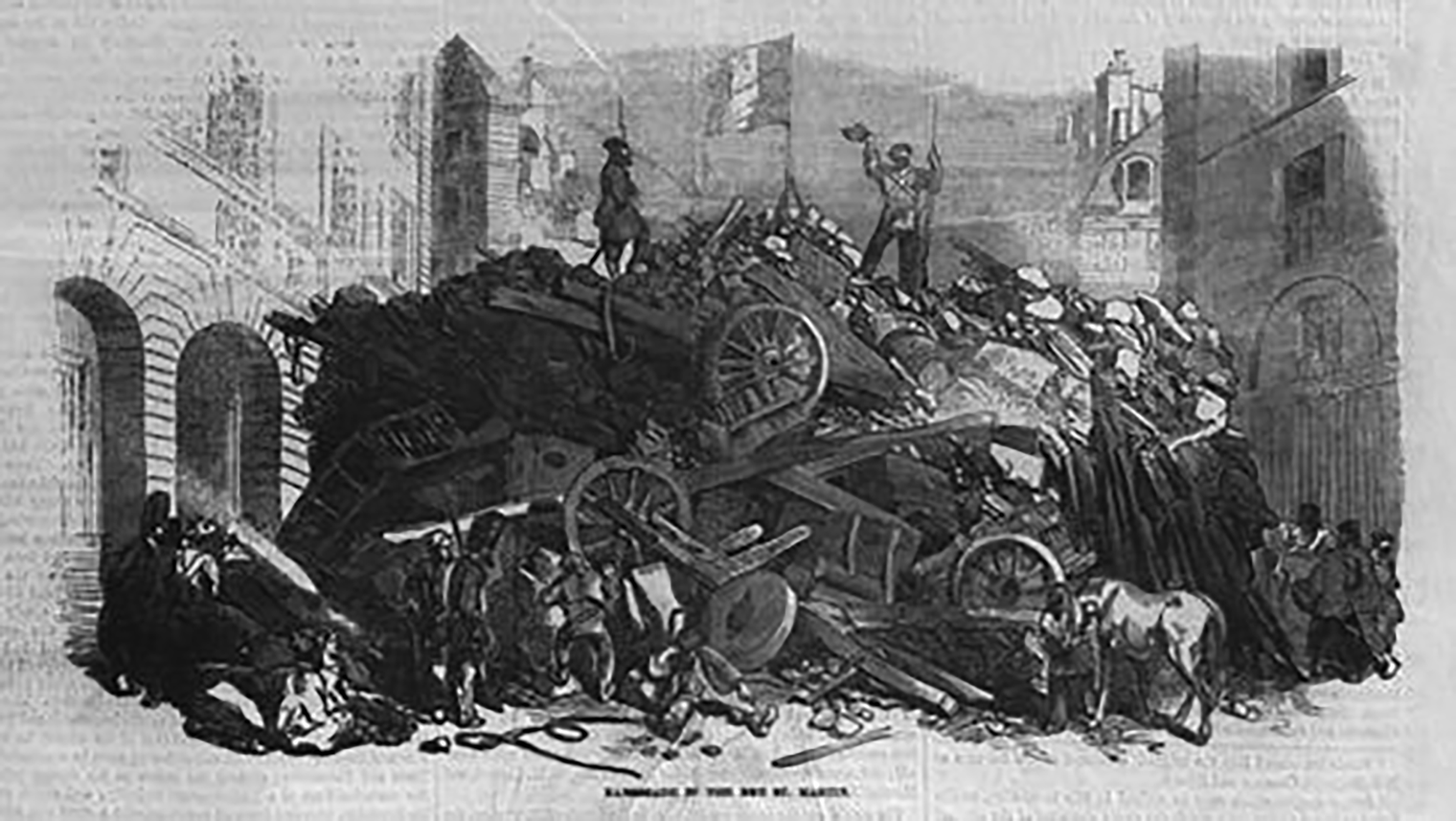
It may seem far-fetched that the omnibus served as a symbol of hegemonic opposition. However, Soullier fuses the omnibus with the ideology of the streets, a space that had historically been the milieu for revolutionary resistance. In fact, the omnibuses were quite literally entwined in street conflicts during the 1848 Revolution. During the uprising, crowds constructed barricades in the streets to protest against the Orléanist regime. An engraving by Paul Gavarni published in the Illustrated London News displays how the revolutionary barricades were crafted from repurposed materials such as planks, barrels, cobblestones and wheels.Footnote 46 The barricade was erected at the intersection of Rue St Martin and Rue St Denis, a major junction in the Dames Blanches route (see Fig. 2).Footnote 47 Lodged in the rubble, the unmistakable silhouette of an omnibus is visible on the lower left side of the mound – perhaps the pale carriage of a Dame Blanche? The image is striking to us today because omnibus culture in Paris has been portrayed as a whimsical aspect of city life. As this engraving encapsulates, however, the omnibuses were not only an example of urban eccentricity but also entangled in serious social matters.
Paul Gavarni, ‘Barricade in Rue St Martin’, Illustrated London News (4 March 1848), Mary Evans Picture Library.

One wonders, then, how the populist idealism of the Dames Blanches might have affected the way people viewed Boieldieu's opera, or even the Opéra-Comique. The institution had, after all, a long-standing reputation as the ‘bourgeois’ opera house in relation to the Opéra and Théâtre-Italien. Scholars have questioned this designation, particularly because the subscription base for the three theatres covered a similar social demographic.Footnote 48 While the less elite reputation of the Opéra-Comique likely stemmed from a variety of factors – from the timbre and training of the singers to the sentimentality of its plots – it follows that the pervasive street presence of La dame blanche reinforced and perpetuated such notions.
Sounding opera in the street
In the Parisian streets, the Dames Blanches were not the only enterprise that profited from popular music trends. One also found marchands de chansons, who sang and sold sheet music, musiciens ambulants and barrel organ players.Footnote 49 Melodies from La dame blanche were among the routine rotation of airs.Footnote 50 The repertory heard on the street was viewed as a contemporary inventory of urban musical taste. In his anthology Les refrains de la rue de 1830 à 1870, Henri Gourdon described street music as the ‘thermometer of the public spirit’.Footnote 51
Writer and music critic François-Joseph Fétis took these ideas a step further by suggesting that street space affected the reception of music in his 1835 article entitled ‘De la musique des rues’. His commentary supports the notion that the reputation of a piece of music was transformed when it was transferred to the streets. In his view, the music would lose some of its artistic esteem but would become part of shared urban culture. He wrote:
Woe betide the composer to whom such popularity falls; from the moment his work reaches the street, we cast it out of the salon. Woe betide him, I said, if he attaches importance only to the opinions of a paying audience; but if he has well-placed pride and if the free approval of the masses is sufficient recompense, he will be happy; because his music, once taken up by the [barrel] organs will become popular; it will be on everyone's lips and it will follow him everywhere, day and night.Footnote 52
Although Boieldieu's opera did not face the institutional exile predicted, Fétis's observations are nevertheless useful because they acknowledge a causal relationship between a musical work's appearance in the street and its reception in other realms. Thus the public's perception of a piece of music was inseparable from the spaces in which it circulated and the audiences to which it was known.
The Dames Blanches, however, present a more complex example than the barrel organs because they did not play melodies from Boieldieu's opera but instead circulated visual imagery. Combining fantasy with function, the vehicles also offered riders an experiential thrill as they stepped figuratively into a fabled, bucolic scene. Furthermore, the omnibus drivers performed their own ‘music’, sounding horn calls on a customised, mechanical instrument. In this novel system, the omnibus drivers used their feet to press bellows that forced air through two connected trumpets.Footnote 53 This contraption assisted the omnibus drivers whose hands were occupied with the reins of the three horses drawing the vehicle. Drivers could not only signal as often as they pleased but also, to the exasperation of urban dwellers, could execute ‘lugubrious fanfares’ at each departure on their route.Footnote 54 Since vehicular horns were not yet common in Paris during the first half of the nineteenth century, the omnibus signals were the subject of public scrutiny.Footnote 55
Accounts indicate that some Parisians were incensed by the drivers’ abundant use of horns. In 1832, a Figaro columnist complained: ‘The omnibus [drivers] abuse their trumpets, which are guilty of turning every moment into a domestic violation.’Footnote 56 The horns also inspired a satire in an 1833 Le charivari column that parodied the mechanism's range of sounds.Footnote 57 The journalist proposed that King Louis Philippe I equip his carriage with a pedal-operated organ modelled on the omnibus design.Footnote 58 This fictional instrument would play in multiple octaves and all transpositions. Furthermore, it would proclaim ‘Vive le Roà [Roi]’ with up to 100,000 independent voices.
Others found the horn signals to be inherently musical. Omnibus horns were equated to concert-style music in Deslandes and Didier's 1836 play Un véritable amour when the furniture maker Trutru likens an omnibus's fanfare to an ‘orchestra’ led by an ‘omnibus conductor, who plays the trumpet with his feet’.Footnote 59 While Trutru's comment is coloured with an air of pretention to impress his more sophisticated companions, his analogy is consistent with the nineteenth-century inclination to idealise and intellectualise Parisian street life in literature, art and music.Footnote 60 In this vein, Parisian composers elevated the omnibus’ fanfares musically, using their refrains as inspiration for musical character pieces, such as Alkan's Les omnibus (discussed later). This illustrates that the Dames Blanches were not only perceived to be musical because of their association with Boieldieu's opera, but were also deemed aesthetically appealing because of their horn calls.
Yet historical sources also suggest that Parisians freely associated the omnibus horn calls with Boieldieu's operatic melodies. In a biography of her uncle Jules Verne, Madame Marguerite Allotte de la Fuÿe presented a curious account of the Dames Blanches. She claimed that each vehicle was equipped with a custom-made music box that played excerpts from La dame blanche.Footnote 61 Allegedly, the mechanism was connected to the vehicle's wheels, whose revolutions animated the music box. Madame de la Fuÿe's assertion was given further credence when the music box was referenced in a series of scientific talks on Jules Verne hosted by the Société de géographie in 1929.Footnote 62 However, this remarkable contraption was not directly mentioned in journals or newspapers during the period of the Dames Blanches' operation, an indication that the wheel-operated music box was more likely fiction than fact.Footnote 63 Nonetheless, the fabricated memory of this contraption is compelling: the Dames Blanches did not need to quote operatic melodies to jog the public's sonic memory of the opera.
These examples illustrate how the Dames Blanches' fanfares were characterised in very different ways – as a cacophonous nuisance, as an aesthetically pleasing part of the urban soundscape, and even as a direct quotation of Boieldieu's music. But regardless of the perceived nature of the sound, the accounts agree that omnibuses had a prominent sonic presence in urban life. Furthermore, their musical refrains were inherently intertextual because they were entangled with perceptions of Boieldieu's opera.
The dynamic presence of the omnibus helped confirm La dame blanche as a cultural landmark in the cityscape. In 1841, the Presse musicale journalist Grimm discussed the unparalleled popular history of La dame blanche, marvelling at its ‘inconceivable influx of spectators’.Footnote 64 He concluded that the opera ‘never should be discarded from the [Opéra-Comique's] repertory’ – and indeed it remained until the turn of the century.Footnote 65 In the same year, a journalist for La presse claimed that Boieldieu's opera was still fresh to audiences, ‘offer[ing] the public all the attraction of something new’.Footnote 66 By 1850, the enduring merits of La dame blanche prompted Édouard Fétis to praise its longevity and declare it a ‘popular triumph’.Footnote 67
To mark the cultural importance of Boieldieu and his music in the city, Parisians decided in 1852 to honour his legacy in the public space. Napoleon III and his Minister of the Interior approved a petition submitted by members of the Académie des Beaux-Arts to rename the plaza surrounding the Opéra-Comique ‘Place Boieldieu’ (formerly the ‘Place des Italiens’ after the Théâtre-Italien).Footnote 68 This gesture made visible the composer's cultural contributions in the built environment. In an era when frequent regime changes disturbed cultural cohesion and Baron Haussmann's renovations were to level geographical markers of urban history, visible emblems such as these were even more precious to Parisians as enduring pillars of shared cultural memory. The plaza served as affirmation that Boieldieu's operas had circulated so widely that they had become inscribed in popular consciousness.Footnote 69
Interpreting opera through the omnibus
The Dames Blanches also became a lens through which Parisians viewed Boieldieu's opera. This is apparent in the variety of paintings, writings and other material goods that were produced in response to the omnibus. Such products synthesised the distinct ideas of opera and street, offering an opportunity to examine how La dame blanche evolved in urban consciousness.
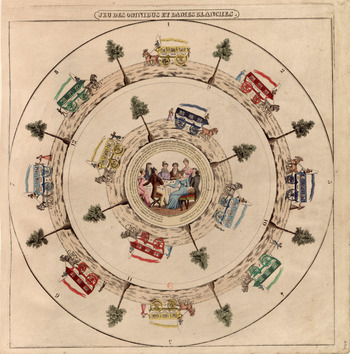
Parisians conflated the opera and omnibus in the 1830s board game Jeu des omnibus et dames blanches, an abridged version of the popular ‘Game of Goose’ (see Fig. 3).Footnote 70 As the title suggests, the board depicts a parade of Dames Blanches and EGO vehicles.Footnote 71 Players placed bets and rolled the dice to advance their pieces around the outer circle (vehicles numbered 1–8), requiring an exact roll to the ninth space to enter the inner circle (vehicles numbered 9–12). The player reaching the twelfth omnibus, appropriately named ‘Victoire’, with an exact roll would claim the winnings. The ninth omnibus was named ‘Jenny’ after the leading character in La dame blanche, a detail that would not have been missed by contemporary players. In addition, the vehicles were mainly identified by Anglo-Saxon names that recalled the opera's Scottish origin, thematically connecting the disparate media of omnibus, board game and opera. Although the commercial vehicles did not have individual names, the board game treated each carriage as if it were a character on the urban stage.
Jeu des omnibus et dames blanches, c.1830, board game, Bibliothèque nationale de France. (colour online)

The opera and omnibus also came together in a surge of compositions in 1829. For instance, Henri Herz's Fanfare des omnibus rondo brillante was dedicated to the Dames Blanches, Citadines and Tricycles.Footnote 72 Phillipe Musard's Le clic clac des omnibus is a set of six pieces each named after an omnibus line, opening with ‘Les Dames Blanches’;Footnote 73 Adolphe Adam wrote a four-hand piano piece with the same name.Footnote 74 Alkan's aforementioned piano variations Les omnibus, Op. 2, dedicated to the Dames Blanches and written when he was only sixteen, contributed to this growing genre of omnibus-themed programme pieces.
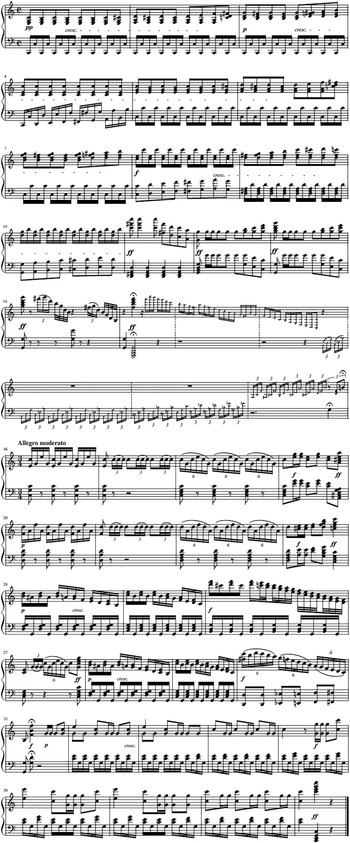
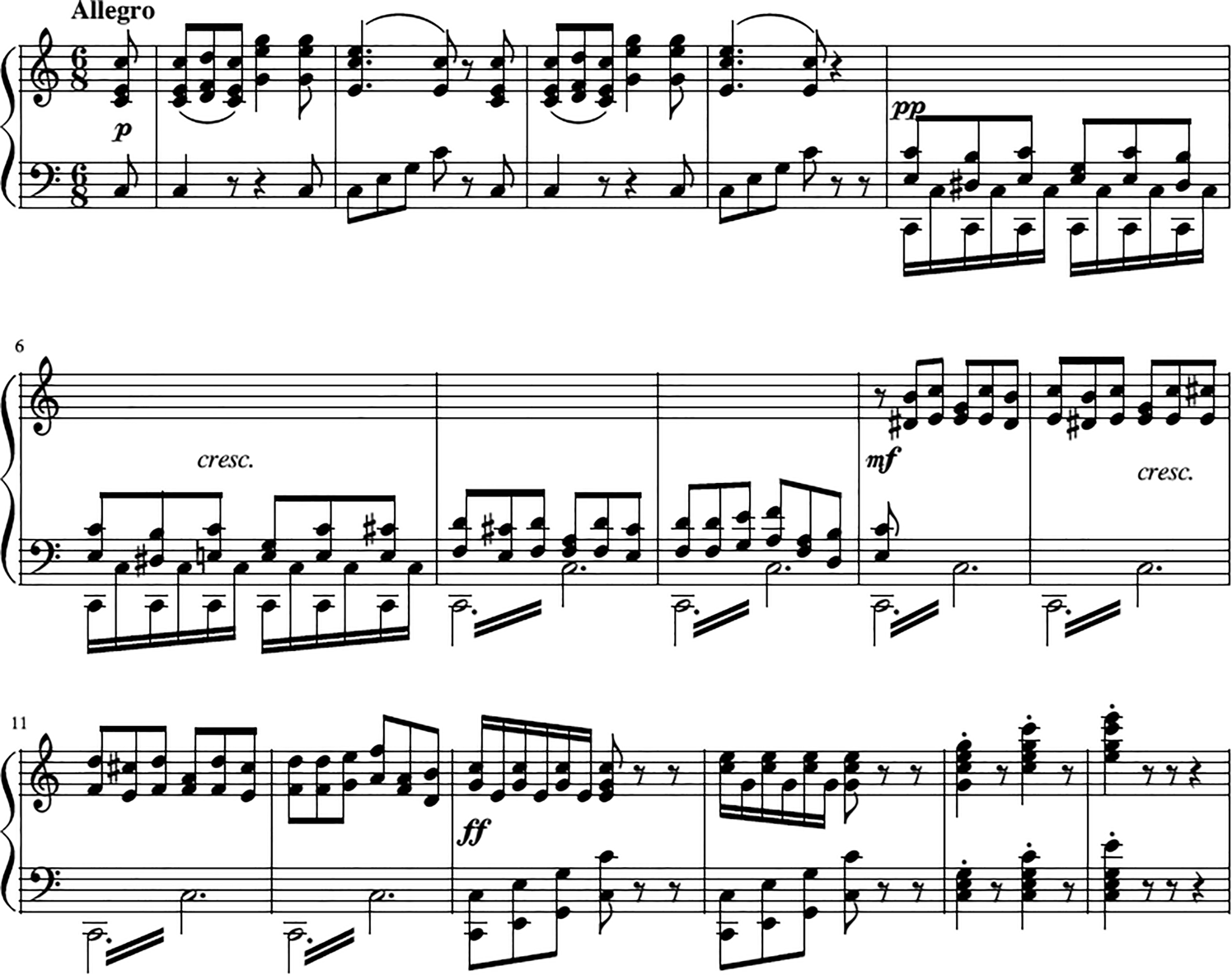
While all these works included stylised horn gestures and galloping motifs, Alkan's piece unites the Dames Blanches with the tropes of opera.Footnote 75 He accomplished this by presenting the omnibus through an operatic-style piano variation, drawing a playful parallel between the omnibus's horn call and an aria.Footnote 76 After opening with a showy introduction (bars 1–15, see Ex. 1), he introduces two different musical ideas in the thematic presentation (bars 16–39). The first thematic idea is atmospheric and situates the listener in a street.Footnote 77 The triplet figures (bars 17 and 21) evoke visions of prancing horses, and the rumbling bass chords (bars 24–31), tightly spaced in register and in fast succession, suggest a bumpy and ungainly ride. The second thematic idea presents the omnibus's horn call (bars 31–9) as a singing, solo melody that contrasts with the preceding pianistic material. In other words, Alkan treats the horn call as an aria theme for his piano variation, contextualising the omnibus's musical utterances in the clattering context of the street.
Alkan, Les omnibus, Op. 2 (1829), Introduction.

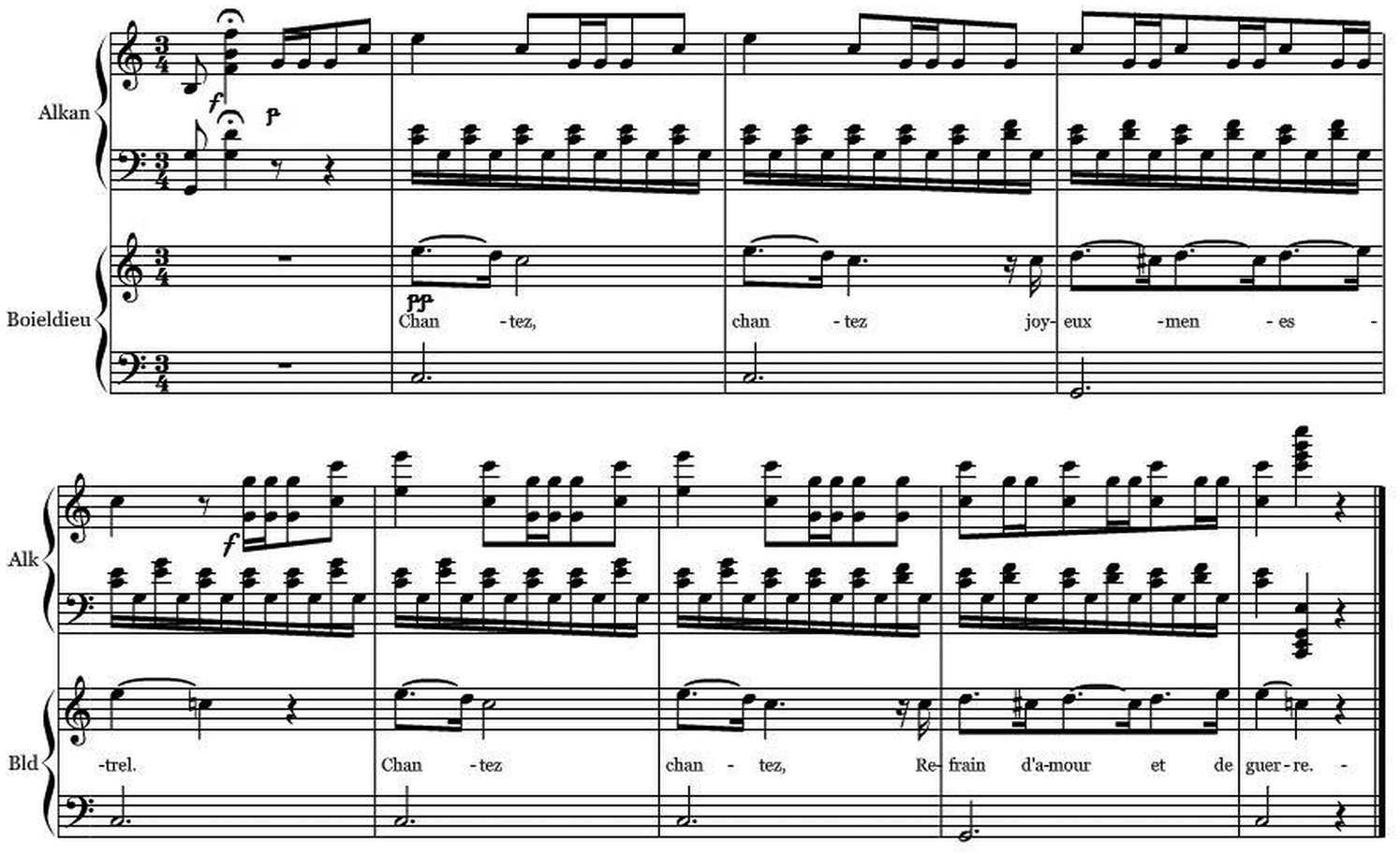
The source material for Alkan's horn call cannot be identified definitively. It is unlikely to be a quotation of the Dames Blanches' fanfare since the composer portrays a single horn rather than a multi-voiced mechanical horn. Neither does the fanfare resemble the melodies used by Musard and Adam in their compositions on the same subject. Moreover, the call does not correspond with other known road signals used in Europe at that time.Footnote 78 This would suggest that the horn material in Alkan's piece is an originally composed melody. Another possibility, however, is that Alkan presents a stylised quotation from La dame blanche: it maps most convincingly onto the ‘Scottish Anthem’ melody from Act III scene 1 (see Ex. 2). Both the horn call and the anthem are set in triple metre in the key of C major, and both melodies feature a stressed and elongated E♮ falling a major third, a pattern that is repeated twice in each phrase.
Comparing ‘Scottish Anthem’ from La dame blanche with horn call from Alkan's Les omnibus, Op. 2.

Whether Alkan was quoting Boieldieu's opera consciously or not, he uses the operatic idiom more generally to evoke the urban vehicles. For example, the opening passage over a C tremolo (bars 1–8) is reminiscent of the Rossinian crescendos that appear in Boieldieu's opera, notably in the overture and the opening to Act III scene 1. Indeed, the latter example might have been the inspiration for Alkan's opening phrase, since both crescendos feature a chromatic line rising from c1 to c3 (compare Exx. 1 and 3). By invoking operatic tropes in the introductory material and through the opera-variation form, Alkan sets up a theatrical framework for imagining the omnibuses. In this regard, his composition suggests that the vehicles are not just a souvenir of Boieldieu's opera but rather extensions of its performance.
Rossinian crescendo in Boieldieu's La dame blanche, Act III scene 1.

Writings on music and urban history during the second half of the nineteenth century also indicate that the public connected the histories of the Dames Blanches and Boieldieu's opera. The ornate paintings of opera scenes that decorated the Dames Blanches vehicles were reproduced in colour lithographs in vehicular surveys of transportation history, such as Brice Thomas's Le guide du carrossier (c.1870) and Octave Uzanne's La locomotion à travers le temps (1913).Footnote 79 In addition, Boieldieu's earliest biographer, Albert Pougin, did not fail to highlight the Dames Blanches in his 1875 profile of the composer.Footnote 80 This correlation was part of mainstream knowledge and was best summarised by journalist John Grand-Carteret at the end of the century when he noted that La dame blanche was ‘celebrated as opéra comique and as omnibus’.Footnote 81
Significance of material cultures in musical reception history
The era of symbiosis between the opera and the omnibus ultimately came to an end in 1855. The Dames Blanches and other independent omnibus lines closed to merge under the monopoly of the Compagnie générale des omnibus.Footnote 82 The merger was an initiative that aligned with Second Empire efforts to streamline urban infrastructures. The centralised system was launched in time to transport tourists attending the 1855 Exposition Universelle, improving efficiency and eliminating redundancy. Despite the merits of the new system, however, Parisians remained emotionally detached from the new fleets whose routes were differentiated by alphabetic letters and whose cabs lacked the thematic personalities of the first-generation omnibuses.Footnote 83
Evaluating the Dames Blanches' influence on the reception history of Boieldieu's opera, one must also acknowledge the extent to which La dame blanche was popularised in other ways. Not only was the opera presented perennially to audiences at the Opéra-Comique but also the work was disseminated to a significant degree through sheet music and arrangements. Equally important were salons where the opera's most popular arias, such as ‘Ah! Quel plaisir d’être soldat’, could be reinterpreted by professional and amateur performers alike.Footnote 84 Tracking the reception of a work is complex when considering the many places and forms in which a piece is presented and assessed. One might trace such evolving perspectives in the musical press, where opinions are articulated and consolidated to a certain extent. However, as the omnibus example has illustrated, the process of musical reception can also be observed when ideas become attached to material objects. The omnibus caused Parisians to engage with Boieldieu's opera in a manner that was distinctly different from how one behaved when attending salon concerts, collecting sheet music or reading reviews. The Dames Blanches operated in a realm relatively free from pre-existing musical politics and favouritism, unlike salon cliques, for instance, which often programmed works that related to their circle of familiars. Such traditional modes of musical reception should not be de-emphasised. However, the example of the omnibus illustrates how reception processes also unfold in shared urban spaces and through the economies of material culture.
The Dames Blanches reshaped the public perspective on Boieldieu's opera. Originally associated with Scottish pastoral lore, La dame blanche would eventually be perceived as quintessentially Parisian – it was one of twenty-seven operas selected for the Opéra-Comique during the 1889 Exposition Universelle in Paris, indicating that the administration considered the piece to be an important example of the institution's legacy.Footnote 85 Reporting on the proceedings, journalist Henri Lavoix was astonished at the undiminished popularity of La dame blanche, whose ticket sales were outperforming those for other operas presented in the city concurrently. He wrote:
You know well that La dame blanche is in first place … What does it have going for it, this piece that has existed for sixty-five years and persists still, irresistible in its eternal success? It is La dame blanche, it is part of Paris.Footnote 86
Lavoix's final sentence confirms that Boieldieu's opera had become culturally embedded in the city, part of Parisian social identity. Interpreted in a material sense, it also suggests that Boieldieu's music had become part of the city space, part of its urban geography. The material cultures of music are therefore useful in helping us to understand how a work becomes attached to a sense of place. The circulation of such tangible objects delineates a kind of material topography. These networks reveal vital information about the social groups that had exposure to a musical work outside the theatre.
As this case study has also shown, the omnibus contributed to the popularisation of Boieldieu's opera among the bourgeois class. As the targeted consumer market for many of the dame blanche-themed material goods, middle-class Parisians were also the principal social group that patronised the omnibus. Not surprisingly, the rhetoric surrounding the omnibus was steeped in democratic idealism, aligning with bourgeois social and political principles. As the omnibus shuttled these patrons about the city, bourgeois perspectives became enmeshed with Boieldieu's opera.
Finally, this case study demonstrates how the omnibus contributed to the longevity and metropolitan fame of Boieldieu's opera by perpetuating public familiarity with the work. Perhaps the most striking event that captures the perennial success of La dame blanche was its thousandth performance, on Wednesday 17 December 1862 at the Opéra-Comique. The celebration, attended by dignitaries including Emperor Napoleon III and Empress Eugénie, was presented between the first and second acts of the opera. Boieldieu's bust was crowned while choristers processed singing the ‘Scottish Anthem’, a ceremony that was modelled on previous commemorative events.Footnote 87 The millième event also featured the recitation of a poem written by Joseph Méry and delivered by tenor Léon Achard who also sang the role of Georges Brown. It opened with the words, ‘Glory to the work where all sing the melody’, straightaway emphasising the ubiquity of the opera.Footnote 88 The poem continued to underscore the opera's local significance by suggesting playfully that Boieldieu's spirit remained present in the Opéra-Comique:
The lines draw a parallel cleverly between Boieldieu's spirit and Avenel's phantasmagorical dame blanche. Just as the dame blanche was part of Avenel's regional lore, the poem points to Boieldieu's status as a local legend.
La dame blanche was the first Parisian opera to reach its millième representation. In the next few decades, other pieces in the Opéra-Comique's repertory also reached their thousandth performance, including Hérold's Le pré aux clercs (1832, millième 1871), Adam's Le chalet (1834, millième 1873), Auber's Le domino noir (1837, millième 1882), Massé's Les noces de Jeannette (1853, millième 1895). However, the situational factors that led to La dame blanche’s thousand performance were quite different. In fact, the Opéra-Comique's administration were probably motivated to programme subsequent operas to reach their thousandth presentation to replicate the successful precedent set by Boieldieu's opera. After all, such celebrations placed the opera house in the journalistic spotlight and revitalised public interest in the repertory. Millième events also reinforced the cultural capital of the Opéra-Comique by underscoring its prestige as an institution that generated canonic repertories. In this regard, Boieldieu's opera introduced a new horizon of expectation, proving that the Parisian public could sustain enough interest in a musical work to warrant a thousand encores. This institutional success was made possible, to a significant extent, by a multitude of publications, private performances and material products that sustained and fuelled interest.
The example of the opera and the omnibus illustrates how things become attached to ideas. In music, material objects are particularly important to audiences because they enable tangible engagement with an otherwise ephemeral musical experience. They invite people to have a palpable relationship with music, whether collecting scores or owning instruments or riding an opera-themed vehicle. However, as this case study has shown, musical objects are also a mediating force that can affect cultural reception and thought. In addition to referencing music, material goods have other decorative or utilitarian functions, which can become woven into perceptions of the music. Material objects not only serve as touchstones that remind people of a favourite work, but ultimately also affect how music circulates and how it is perceived by audiences. This is how something as unlikely as an omnibus can profoundly influence the reception history of an opera.