DNA barcoding using the internal transcribed spacer region (nuITS rDNA) is a widely used method in the identification of fungi (Schoch et al. Reference Schoch, Seifert, Huhndorf, Robert, Spouge, Levesque and Chen2012). However, sequence-based identification using databases such as GenBank should be treated with caution, as previously pointed out by Nilsson et al. (Reference Nilsson, Ryberg, Kristiansson, Abarenkov, Larsson and Kõljalg2006) who reported that c. 20% of all fungal sequences deposited there may be incorrectly annotated at species level. This may be especially difficult in the case of genera in which cryptic species have been described, and for which the proportion of mislabelled records may be even higher. Although BLAST searches facilitate quick determination of taxa based on DNA sequences, the recognition of genetically similar species may be challenging (e.g. Lücking et al. Reference Lücking, Aime, Robbertse, Miller, Ariyawansa, Aoki, Cardinali, Crous, Druzhinina and Geiser2020a, Reference Lücking, Nadel, Araujo and Gerlachb; Moncada et al. Reference Moncada, Sipman and Lücking2020).
Forests are one of the most important ecosystems and provide habitat for more than half of terrestrial biodiversity (Jaroszewicz et al. Reference Jaroszewicz, Cholewińska, Gutowski, Samojlik, Zimny and Latałowa2019). They are also under increasing threat from direct human activity (e.g. logging, expansion of invasive species) and climate change. Natural forests are vanishing along with often unique and rare species of various groups of associated organisms and the rich biodiversity (e.g. Sylvester et al. Reference Sylvester, Heitkamp, Sylvester, Jungkunst, Sipman, Toivonen, Gonzales Inca, Ospina and Kessler2017; Łubek et al. Reference Łubek, Kukwa, Jaroszewicz and Czortek2018). Białowieża Forest is one such forest ecosystem. This large forest complex is one of the best preserved primeval forests in Central-Eastern Europe (Jaroszewicz et al. Reference Jaroszewicz, Cholewińska, Gutowski, Samojlik, Zimny and Latałowa2019) and is characterized by the rich lichen biota, including a significant number of relict and rare lichens, among them rare and endangered parmelioid taxa and some recently described species (e.g. Cieśliński et al. Reference Cieśliński, Czyżewska, Faliński, Klama, Mułenko, Żarnowiec, Faliński and Mułenko1996; Motiejūnaitė et al. Reference Motiejūnaitė, Czyżewska and Cieśliński2004; Guzow-Krzemińska et al. Reference Guzow-Krzemińska, Czarnota, Łubek and Kukwa2016, Reference Guzow-Krzemińska, Łubek, Malíček, Tønsberg, Oset and Kukwa2017, Reference Guzow-Krzemińska, Łubek, Kubiak, Ossowska and Kukwa2018; Ertz et al. Reference Ertz, Guzow-Krzemińska, Thor, Łubek and Kukwa2018a, Reference Ertz, Sanderson, Łubek and Kukwab; Łubek et al. Reference Łubek, Kukwa, Jaroszewicz and Czortek2018, Reference Łubek, Kukwa, Jaroszewicz and Czortek2020). Parmelia encryptata A. Crespo et al. (Parmeliaceae, Ascomycota) was described as a cryptic species found in the Iberian Peninsula and Ireland, morphologically indistinguishable from P. sulcata Taylor (Molina et al. Reference Molina, Divakar, Millanes, Sánchez, Del-Prado, Hawksworth and Crespo2011). This species has not been reported again since it was described; however, during the examination of nuITS rDNA sequences of Parmelia species deposited in GenBank, we discovered three sequences that were similar to those of P. encryptata but were misidentified as P. sulcata. This unexpected discovery encouraged us to re-examine all sequences of the P. sulcata group, including the most similar species, P. barrenoae Divakar et al. and P. sulcata. The aim of this paper is to present new records of P. encryptata, re-evaluate molecular data and discuss its possible forest relict character.
Materials and Methods
We obtained new nuITS rDNA sequences from three specimens of P. sulcata from Estonia, Italy and Poland and one sample of P. barrenoae from Italy, which were subjected to a BLAST search (Altschul et al. Reference Altschul, Gish, Miller, Myers and Lipman1990) in order to check their identity. DNA was extracted and amplified using the protocols described in Ossowska et al. (Reference Ossowska, Guzow-Krzemińska, Dudek, Oset and Kukwa2018, Reference Ossowska, Guzow-Krzemińska, Kolanowska, Szczepańska and Kukwa2019). New sequences have been deposited in GenBank (see Supplementary Material Table S1, available online).
We downloaded all nuITS rDNA sequences of sorediate species of the P. sulcata group from GenBank (Supplementary Material Table S1). For the phylogenetic analyses the alignment was reduced to representative sequences of P. sulcata originating from all available countries, together with all sequences of P. barrenoae and P. encryptata; we used a sequence of P. saxatilis (L.) Ach. (KU845667) as an outgroup (Ossowska et al. Reference Ossowska, Guzow-Krzemińska, Dudek, Oset and Kukwa2018). The newly generated sequences and selected representatives of Parmelia spp. were automatically aligned using MAFFT (Multiple Alignment using Fast Fourier Transform; Katoh et al. Reference Katoh, Misawa, Kuma and Miyata2002) as implemented in UGENE (Okonechnikov et al. Reference Okonechnikov, Golosova and Fursov2012), followed by elimination of terminal ends. The final alignment consisted of 99 nuITS rDNA sequences and 525 characters.
We used PartitionFinder 2 (Lanfear et al. Reference Lanfear, Frandsen, Wright, Senfeld and Calcott2016) implemented on the CIPRES Science Gateway (Miller et al. Reference Miller, Pfeiffer and Schwartz2010) to determine the best substitution model for each partition under the Akaike Information Criterion (AIC) and greedy search algorithm (Lanfear et al. Reference Lanfear, Calcott, Ho and Guindon2012). Three different models were found for partitions: SYM + G for ITS1, TRNEF + I for 5.8S and K80 + G for ITS2 regions.
A Bayesian analysis was carried out using the Markov chain Monte Carlo (MCMC) method, in MrBayes v.3.2.6 (Huelsenbeck & Ronquist Reference Huelsenbeck and Ronquist2001; Ronquist & Huelsenbeck Reference Ronquist and Huelsenbeck2003) on the CIPRES Web Portal (Miller et al. Reference Miller, Pfeiffer and Schwartz2010) with the above-mentioned substitution models. Two parallel MCMC runs were performed, each using four independent chains and 10 million generations, sampling every 1000th tree. Posterior Probabilities (PP) were determined by calculating a majority-rule consensus tree after discarding the initial 25% of trees of each chain as burn-in.
A maximum likelihood (ML) analysis was performed using RAxML-HPC2 v.8.2.10 (Stamatakis Reference Stamatakis2014) with 1000 ML bootstrap iterations (BS) and the GTRGAMMAI model for both analyses. Phylogenetic trees were visualized using FigTree v.1.4.2 (Rambaut Reference Rambaut2012) and modified in Inkscape (https://inkscape.org/).
In addition, separate alignments for P. encryptata only and sequences belonging to the P. encryptata and P. sulcata clades were performed and analyzed to define intra- and interspecific variation.
Results and Discussion
The nuITS rDNA matrix consisted of 98 samples representing five Parmelia species of the P. sulcata group and one sequence of P. saxatilis (outgroup) (Supplementary Material Table S1, available online). The Parmelia sulcata group also includes sequences of P. squarrosa Hale and P. fertilis Müll. Arg., although these taxa are morphologically similar to the isidiate species of the P. saxatilis group. The phylogenetic position of these species has been discussed, for example in Molina et al. (Reference Molina, Crespo, Blanco, Lumbsch and Hawksworth2004, Reference Molina, Divakar, Goward, Millanes, Lumbsch and Crespo2017), Divakar et al. (Reference Divakar, Molina, Lumbsch and Crespo2005) and Ossowska et al. (Reference Ossowska, Guzow-Krzemińska, Dudek, Oset and Kukwa2018). The RAxML tree did not contradict the Bayesian tree topology for the strongly supported branches and only the latter is shown with posterior probabilities (PP) and bootstrap support values (BS) (see Supplementary Material Fig. S1, available online); PP ≥ 0.95 and BS ≥ 70 were considered to be significant and are shown above the branches.
The phylogenetic analyses showed that two sequences (MN387037 and MN387038) previously labelled as P. sulcata from Białowieża Forest in Poland (Singh et al. Reference Singh, Kukwa, Dal Grande, Łubek, Otte and Schmitt2019) clustered with P. encryptata in a well-supported clade including the sequence of the type (Supplementary Material Fig. S1). An additional sequence was obtained from a specimen from Switzerland (MN654571), previously identified as P. sulcata by Mark et al. (Reference Mark, Laanisto, Bueno, Niinemets, Keller and Scheidegger2020) but occurring in the same clade as P. encryptata (Supplementary Material Fig. S1); however, we have not examined this specimen. Furthermore, the single newly obtained sequence of P. barrenoae (UGDA L-26612, MW793515) represents the first record of this species from Italy confirmed by molecular methods. An additional clade formed by three sequences (EU788032, EU788033 and AY036981), all labelled as P. sulcata in GenBank but supported outside the P. sulcata clade, might represent an additional undescribed cryptic species (labelled as P. aff. sulcata in Supplementary Material Fig. S1). However, since we did not examine reference material, we refrain from describing a new species. These sequences were also used in a phylogenetic analysis by Molina et al. (Reference Molina, Divakar, Millanes, Sánchez, Del-Prado, Hawksworth and Crespo2011) and defined as clade B2.
Parmelia encryptata is morphologically and chemically identical to P. sulcata but genetically different (Molina et al. Reference Molina, Divakar, Millanes, Sánchez, Del-Prado, Hawksworth and Crespo2011), and despite similarities, these species are not closely related (Molina et al. Reference Molina, Divakar, Goward, Millanes, Lumbsch and Crespo2017). Both P. encryptata and P. sulcata have adnate to loosely adnate thalli, lobes that are sublinear with a greyish upper surface with brown tips and laminal and marginal pseudocyphellae, rhizines simple to squarrose, and soralia that are laminal (Molina et al. Reference Molina, Divakar, Millanes, Sánchez, Del-Prado, Hawksworth and Crespo2011). When examining the specimens of P. encryptata from Poland, we found that rhizines were predominantly simple, and squarrose ones appeared only in the central parts of the thalli, whereas in P. sulcata they are usually squarrose in all thallus parts. The type of rhizine is an important feature that distinguishes another morphologically similar species, P. barrenoae, from P. sulcata s. str. (Divakar et al. Reference Divakar, Molina, Lumbsch and Crespo2005; Barreno & Herrera-Campos Reference Barreno and Herrera-Campos2009; Hodkinson et al. Reference Hodkinson, Lendemer and Esslinger2010). Therefore, the abundance of squarrose in proportion to simple rhizines might be a diagnostic feature which is worth considering in the identification of P. encryptata. However, we examined only two samples of the species, which were very young, thus more material needs to be studied to evaluate whether this character is diagnostic. Another feature that separates P. sulcata from P. barrenoae is the ontogeny and abundance of the soralia (Hodkinson et al. Reference Hodkinson, Lendemer and Esslinger2010; Ossowska & Kukwa Reference Ossowska and Kukwa2016); however, in the case of P. encryptata, we have not observed any differences in comparison to P. sulcata.
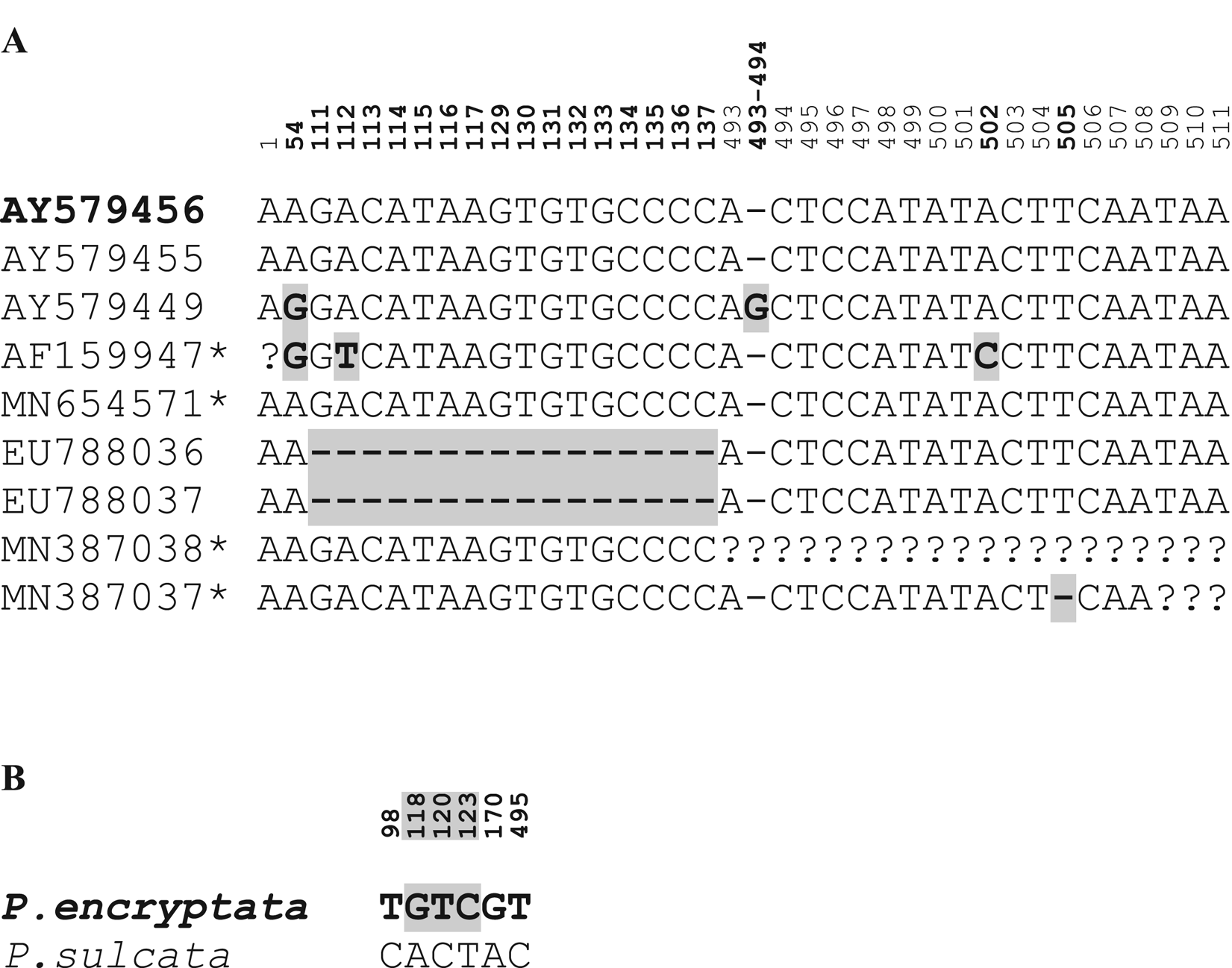
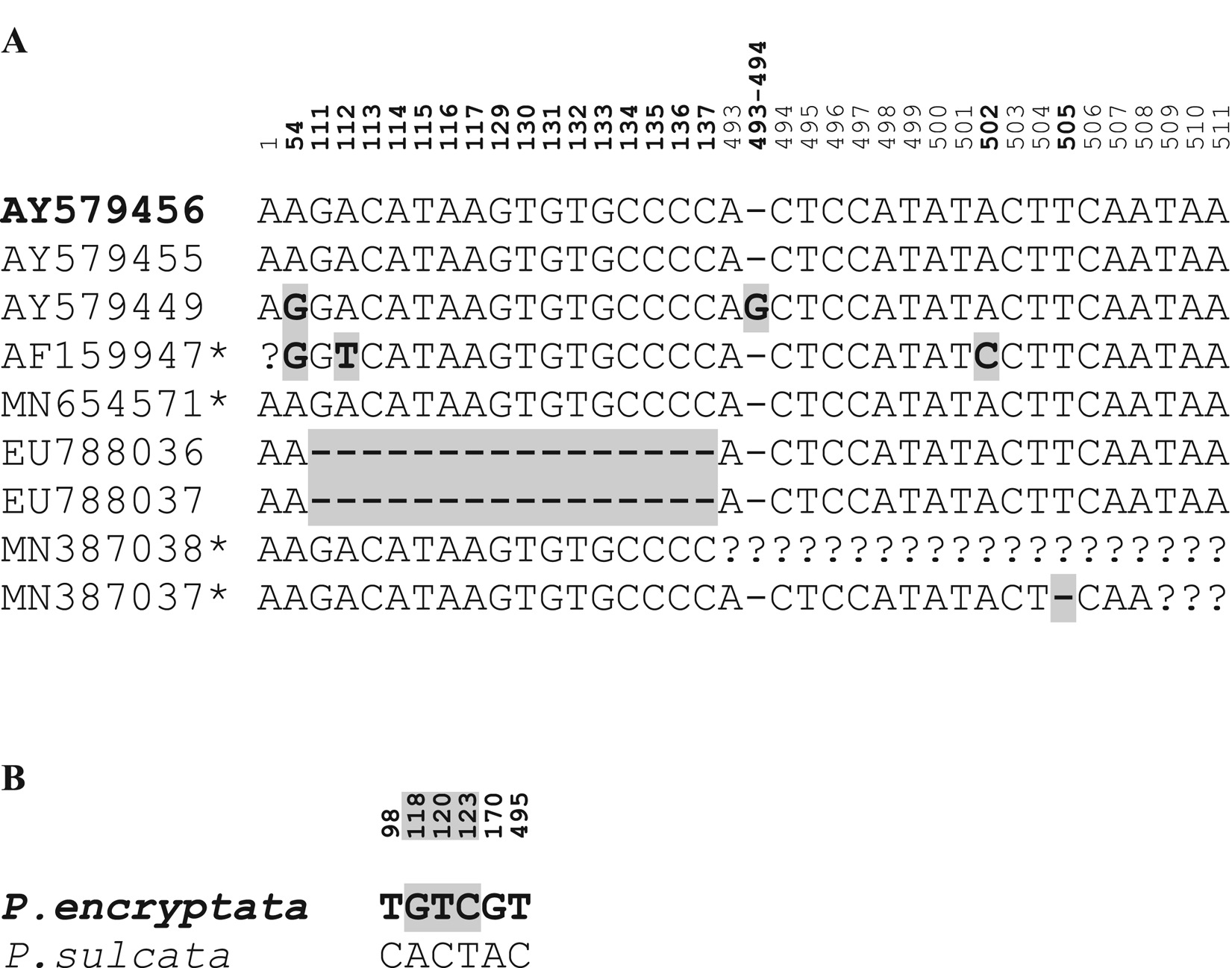
Molina et al. (Reference Molina, Divakar, Millanes, Sánchez, Del-Prado, Hawksworth and Crespo2011) provided the following diagnosis of P. encryptata: ‘Similis Parmeliis sulcatis sed differt in intron group I, et sequencis ACATAAGCTCGC in [gene ITS 1] at positions 113–124 in alignment’. They defined four autapomorphic nucleotides in ITS 1 that distinguish P. encryptata from P. sulcata. However, based on a wider sampling including all sequences of P. sulcata and P. encryptata available in GenBank, we re-evaluated these data. Of the nucleotides mentioned in the P. encryptata description by Molina et al. (Reference Molina, Divakar, Millanes, Sánchez, Del-Prado, Hawksworth and Crespo2011) in position 113 of their alignment (position 112 of sequence AY579456 obtained from the type material), we observed A, T or deletion in P. encryptata specimens (Fig. 1A) while in P. sulcata nucleotide T or deletion may occur; thus it cannot be used to distinguish these species. Therefore, based on analysis of all available sequences from GenBank, we propose here that six nucleotide positions distinguish P. encryptata from P. sulcata (Fig. 1B), of which three were previously reported as autapomorphic nucleotides by Molina et al. (Reference Molina, Divakar, Millanes, Sánchez, Del-Prado, Hawksworth and Crespo2011): 118 (equivalent to position 119 in Molina et al. (Reference Molina, Divakar, Millanes, Sánchez, Del-Prado, Hawksworth and Crespo2011)), 120 (equivalent to position 122, which, however, was mislabelled in Molina et al. (Reference Molina, Divakar, Millanes, Sánchez, Del-Prado, Hawksworth and Crespo2011) as according to their fig. 3 it should be position 121) and 123 (equivalent to 124 in Molina et al. (Reference Molina, Divakar, Millanes, Sánchez, Del-Prado, Hawksworth and Crespo2011)). Most of these differences were observed within ITS1, except position 495 which was located in ITS2 (Fig. 1B). The sequences of P. encryptata from Poland and Switzerland (MN387038, MN387037 and MN654571) do not differ from the sequence of the type specimen (Fig. 1A), except for a single deletion in MN387037 in position 505; however, both sequences from the Polish specimens contain some missing data at the 3′-ends of the nuITS rDNA sequence.
A, part of the alignment of Parmelia encryptata nuITS rDNA showing variable positions (marked in bold and grey) including missing data. Missing nucleotides are marked with ‘?’. AY579456 originating from the type specimen is treated as the reference and terminal ends of the remaining sequences were trimmed to the length of the reference. Sequences labelled as P. sulcata in GenBank and not analyzed in Molina et al. (Reference Molina, Divakar, Millanes, Sánchez, Del-Prado, Hawksworth and Crespo2011) but representing P. encryptata are marked with *. B, positions distinguishing P. encryptata from P. sulcata based on multiple alignment of all available sequences. Positions are numbered according to the reference nuITS rDNA sequence of type P. encryptata AY579456. Autapomorphic nucleotides described in Molina et al. (Reference Molina, Divakar, Millanes, Sánchez, Del-Prado, Hawksworth and Crespo2011) and confirmed in this study are marked in grey.
This study confirms that sequence-based identification using databases such as GenBank should be treated with caution, as previously pointed out by numerous researchers (e.g. Nilsson et al. Reference Nilsson, Ryberg, Kristiansson, Abarenkov, Larsson and Kõljalg2006; Lücking et al. Reference Lücking, Aime, Robbertse, Miller, Ariyawansa, Aoki, Cardinali, Crous, Druzhinina and Geiser2020a). Such databases facilitate quick determination of taxa based on DNA sequences, but are of limited use since the identification using a simple blast search of a single marker may bias the recognition of genetically similar species (e.g. Lücking et al. Reference Lücking, Nadel, Araujo and Gerlach2020b; Moncada et al. Reference Moncada, Sipman and Lücking2020). Furthermore, numerous records are mislabelled in GenBank, as recently reported by Hofstetter et al. (Reference Hofstetter, Buyck, Eyssartier, Schnee and Gindro2019). This seems to be the case with P. encryptata, for which three sequences were incorrectly identified as P. sulcata using a blast search by Singh et al. (Reference Singh, Kukwa, Dal Grande, Łubek, Otte and Schmitt2019) and Mark et al. (Reference Mark, Laanisto, Bueno, Niinemets, Keller and Scheidegger2020). This probably resulted from comparisons to sequences of P. encryptata from specimens used for the original description of P. encryptata by Molina et al. (Reference Molina, Divakar, Millanes, Sánchez, Del-Prado, Hawksworth and Crespo2011) which had incorrect names in GenBank (e.g. AY579449, EU788036 and EU788037 were labelled as P. sulcata). Nevertheless, the ITS marker can still be used as an efficient barcode in the identification of these two and other Parmelia species as it differentiates most species included in the genus (Divakar et al. Reference Divakar, Leavitt, Molina, Del-Prado, Lumbsch and Crespo2016). In all cases, identification using blast searches requires careful examination of the results or should be supplemented with phylogenetic analysis, including reference material (e.g. RefSeq or Types), which is more reliable in recognizing the identity of sequenced specimens.
Molina et al. (Reference Molina, Divakar, Millanes, Sánchez, Del-Prado, Hawksworth and Crespo2011) described P. encryptata as being characterized by the presence of the group I intron. Unfortunately, this intron sequence is not available from the type material in GenBank since it was removed from the analysis in Molina et al. (Reference Molina, Divakar, Millanes, Sánchez, Del-Prado, Hawksworth and Crespo2011), and the original sequence is trimmed. However, another sequence is available for comparison (DQ084168 originating from specimen MAF-Lich 9902 and representing P. encryptata). We analyzed sequences of P. encryptata from Białowieża Forest and found that in both specimens, partial sequences of the same intron are identical to sequence DQ084168.
The presence of P. encryptata in Poland is an unexpected discovery due to the distance from previously known localities. It has so far been confirmed only from the Białowieża Forest, the large and well-preserved temperate forest complex in Central-Eastern Europe which hosts a rich biodiversity of numerous rare and endangered species (e.g. Cieśliński et al. Reference Cieśliński, Czyżewska, Faliński, Klama, Mułenko, Żarnowiec, Faliński and Mułenko1996; Motiejūnaitė et al. Reference Motiejūnaitė, Czyżewska and Cieśliński2004; Łubek et al. Reference Łubek, Kukwa, Jaroszewicz and Czortek2018, Reference Łubek, Kukwa, Jaroszewicz and Czortek2020). Other locations of P. encryptata are also known from large forest complexes such as the Killarney National Park in Ireland, the slope of the Iberian Mountain (Molina et al. Reference Molina, Divakar, Millanes, Sánchez, Del-Prado, Hawksworth and Crespo2011) and the Swiss Alps (Mark et al. Reference Mark, Laanisto, Bueno, Niinemets, Keller and Scheidegger2020); however, we do not know their exact locations and local environmental conditions. Large forest complexes, such as Białowieża Forest, maintain internal microclimatic stability (e.g. humidity and daytime temperature), ensuring the occurrence and continuity of many lichens, including those classified as ‘indicators of primeval forests’ (Łubek et al. Reference Łubek, Kukwa, Jaroszewicz and Czortek2018). Taking into account the rarity of the species and its occurrence in the areas mentioned above, we hypothesize that P. encryptata might be a forest relict species, maintained in isolated populations in large forest ecosystems in Europe. However, it cannot be ruled out that the species requires only sheltered and humid conditions available in such ecosystems and may be found in other forests not necessarily of primeval character. Nevertheless, the species seems to be rare as, of the 44 sequences of P. sulcata s. lat. from Poland used in this study (not all of them included in the phylogenetic analyses), eight were from Białowieża Forest, and only two sequences represented P. encryptata, both originating from Białowieża Forest (Supplementary Material Fig. S1). The recently described P. rojoi A. Crespo et al. has also been considered a hypothetically relict lichen but, in contrast to P. encryptata, it did not extend its range after Pleistocene glaciations and remained in refugia in Spain (Crespo et al. Reference Crespo, Rico, Garrido, Lumbsch and Divakar2020).
In contrast to P. encryptata, P. sulcata s. str. is widely distributed with a much wider habitat amplitude and grows frequently on roadside trees, rocks, nitrogen-rich habitats and managed forest (Hawksworth et al. Reference Hawksworth, Blanco, Divakar, Ahti and Crespo2008, Reference Hawksworth, Divakar, Crespo and Ahti2011; Thell et al. Reference Thell, Thor, Ahti, Thell and Moberg2011; Tsurykau et al. Reference Tsurykau, Bely, Golubkov, Persson and Thell2019). We analyzed over 120 sequences of the P. sulcata group (not all of them included in the phylogenetic analyses) from various habitats in Europe and found no additional records of P. encryptata, showing that the latter species may be a rare lichen restricted to certain types of habitats.
The new records of P. encryptata suggest that a certain degree of caution and critical evaluation should be exercised during Parmelia species identification, as rare species may be accidentally overlooked. Parmelia encryptata is a morphologically cryptic species that can only be identified by molecular techniques. This approach is also recommended for other Parmelia species (Divakar et al. Reference Divakar, Leavitt, Molina, Del-Prado, Lumbsch and Crespo2016; Corsie et al. Reference Corsie, Harrold and Yahr2019). Our assumptions about the shape and abundance of the rhizines and the ecological requirements can be a good basis for further detailed research. Nevertheless, at this point there are too few comparative specimens and localities of the species to draw any far-reaching conclusions.
Specimen examined of Parmelia barrenoae
Italy: Valle d'Aosta: Pila, alt. 2200 m, 45°40′17″N, 7°19′07″E, on Picea sp., 22 viii 2019, R. Szymczyk s. n. (UGDA L-26612).
Specimens examined of Parmelia encryptata
Poland: Bielska Plain: Białowieża Primeval Forest, S of Czerlonka, forest section np. 469C, 52°41′16″N, 23°43′02″E, Tilio-Carpinetum with old pines, on Ulmus scabra, 2016, M. Kukwa 17942 & A. Łubek (UGDA L-24994); ibid., Białowieski National Park, forest section no. 256, Tilio-Carpinteum, on Carpinus betulus, 2015, M. Kukwa 17163 & A. Łubek (UGDA L-25048).
Specimens examined of Parmelia sulcata
Estonia: Saare County: Muhu Island, Nõmmküla alvar, 58°40′03.90″N, 23°12′21.38″E, saxicolous, 2019, M. Kukwa 20482 (UGDA).—Italy: Valle d’ Aosta: Courmayeur, 45°48′58″N, 6°57′25″E, alt. 1300 m, roadside trees, on Fraxinus sp., 21 ix 2019, R. Szymczyk s. n. (UGDA L-26630).—Poland: Western Bieszczady: Czarne forest division, forest section no. 123 g, 49°18′50″N, 22°14′18″E, alt. 654 m, saxicolous, 9 x 2019, R. Szymczyk s. n. (UGDA L-32558).
Acknowledgements
We are grateful to the curators of all herbaria for the loan of specimens and to reviewers for their helpful comments. The research was supported by the Ministry of Science and Higher Education, project no. 2012/07/N/NZ8/00061 granted to EO.
Author Contribution
Emilia Anna Ossowska and Beata Guzow-Krzemińska contributed equally as the first authors.
Author ORCIDs
Emilia A. Ossowska, 0000-0002-1357-6071; Beata Guzow-Krzemińska, 0000-0003-0805-7987; Rafał Szymczyk, 0000-0002-0567-8641; Martin Kukwa, 0000-0003-1560-909X.
Supplementary Material
To view Supplementary Material for this article, please visit https://doi.org/10.1017/S0024282921000219