Archives are sophisticated structures, dynamic sites of power where complex tensions are at play. The documents they preserve have come together via selection processes whose criteria may be partly explicit, but are also always partly hidden – even unconscious – and invariably privilege certain points of view over others, which are then excluded. Since postmodern times, however, the validity of hegemonic recountings of history – and by extension the authority of archives as information sources – keeps being challenged by communities, collectives and groups that occupy marginal, subaltern or counter positions in relation to dominant discourses, due to social, economic, ethnic, gender or other reasons. Nowadays, many of these groups are making efforts to disclose archival biases and, whenever possible, amend the ‘archival silences’ which have suppressed their stories from hegemonic historical narratives. In doing so, they bring to the fore the partiality, not only of mainstream narratives and the archives on which these are based, but also of ‘the archive’ itself as a structural filter that plays a key role in assembling and, at the same time, obscuring historical evidence. As Antoinette Burton has stated, ‘all archival sources are at once primary and secondary sources: neither raw nor fully cooked… but richly textured as both narrative and meta-narrative, as both archive and history-in-the-making’.Footnote 1
In consequence, the archive becomes not only the source, but also the object of historical research; and, as such, it is questioned in many different ways. Feminist and LGTBI+ critics and collectives, for instance, have been remarkably active in their endeavours for archival emancipation, not only building their own archives and pointing out historical absences or gaps in hegemonic documentary collections, but also identifying information categories that mainstream archives have not explicitly recorded – such as affects, feeling or emotions.Footnote 2 Their interest in these specific categories is no coincidence, since they are closely connected to narratives of trauma and, for that reason, notably significant to accounts of repression. In inquiring how archives interact with emotions, feminism and LGTBI+ perspectives are not alone: cultural, indigenous and post-colonial studies, anthropology, psychology and trauma studies also demand an ‘analysis of archives as environments that create complex circulations of affect’,Footnote 3 posing questions in relation to the emotions experienced in the past that archive records demonstrate, and also to the emotional response that such records may raise in contemporary users.
In recent times, driven by my interest in the archive as a key structure in the ‘chain of knowledge production’, I have found the first of these two aspects particularly compelling: how do archives bear witness to affects? Or, expanding the question a little: do all archives, such as, for instance, administrative archives, cartography archives – or art archives, for that matter – also record emotions and other kinds of subjectivity, or are these only limited to archives where traumas are at play? And, if they do: in what ways?
In the summer of 2018, when I was invited by the Museo Reina Sofía in Madrid to give a lecture on any topic of my choice as long as it related to the museum's archive and library, my connection to the documenta Archive, with which I had had the opportunity to collaborate in the past, seemed like a fertile context for tackling these questions. Does the documenta Archive keep accounts of affections? Is subjectivity at play in any aspect of its structure and configuration? Would it be possible to identify, from my external position as a researcher, traces of structural biases in this archive?
The documenta Archive was officially founded in 1961, shortly after the first and second documenta (1955 and 1959). The Archive was intended to fulfil the mission of compiling and preserving the documentary legacy left by successive editions of the art show. Until 2015, it operated as a municipal entity, but in January 2016 its management was transferred to the documenta GmbH and Museum Friedericianum. Since then, it is immersed in a process of expansion that, it is expected, will lead to the creation of a study and research centre, the documenta Institut, over the coming years. Along with technical information (plans, lists of works, projects, sketches), press clippings, photographs and audiovisual recordings from each edition of documenta, one of the Archive's major treasures is its epistolary collection. The collection of letters in the documenta Archive, which has had varying formats over time, ranging from handwritten and typed letters to telegrams, facsimiles and, more recently, emails, constitutes an inexhaustible reservoir of data with particular relevance to 20th and 21st century Western art history. This collection of letters, I thought, would therefore be a good place to begin my investigation. In previous consultations of the Archive, I had already noticed that a number of them encapsulated a subtext which not only revealed traits of their authors’ various personalities, but also quite often traced the emotional connections by which the key protagonists in the history of documenta were linked to one another and to the project as a whole. I remembered, in particular, having read interesting correspondence by the Swiss art historian and curator Jean-Christophe Ammann, who worked hand in hand with Harald Szeemann for the mythical documenta 5 (1972), so I chose documenta 5 for the start of my research.
What followed produced a series of discoveries that, on the one hand, demonstrate the rich variety of contents that an archive may offer to researchers when it is ‘read against the grain’, that is, approached from unexpected or unconventional perspectives (as my research at the time was); and, on the other, support my conviction that there is always something waiting to be unearthed in an archive – even if it is often not exactly what one was looking for.
Harald Szeemann (Bern, 1933 – Tegna, Switzerland, 2005) was only 37 years old when, in 1970, he was invited to join the documenta team as artistic director of the event's fifth edition. Until then, the exhibition had been curated by its founder and inspiring soul, Arnold Bode (Kassel, 1900–1977) in collaboration with art historian Werner Haftmann (Glowno, Russian Empire, 1912 – Gmund am Tegernsee, Germany, 1999). The arrival of Harald Szeemann at documenta, indeed, ‘marked the end of Arnold Bode era’.Footnote 4 Szeemann had just left his position as director of the Kunsthalle Bern, where he had starred in such scandalous successes as, among others, his famous exhibition Live in your head: When attitudes become form, and he landed in Kassel with the desire to lead documenta with a markedly personal style. But when the documenta Advisory Council decided to keep Arnold Bode on board, commissioning him to curate one of the exhibition's sections, both curatorial egos – Bode and Szeemann – were made to collaborate on the project. As the letters kept in the Archive reveal, Bode's presence was uncomfortable – if not clearly problematic – for the young and ambitious Szeemann. Bode, whose moral authority must have still been felt due to his close bond with documenta, was conceivably seen by Szeemann as some sort of burden from the past, of which he privately wished to be rid. His mistrust arose quickly, and took every detail into consideration. ‘You probably know that Bode has sold his library to [Walther] König’ – he wrote to the finance manager as early as in 1970 – ‘Isn't there anything that can be done about this? Or is the issue too thorny? I have informed Mrs. Grüterich, because she has already missed several important publications in the Archive’.Footnote 5 Later on, in 1972, he would express himself in harder terms: ‘The fact that Bode is paid as a fatherly figure is clear, understandable, etc. and I have resigned myself to this. He has, as expected, done nothing’.Footnote 6
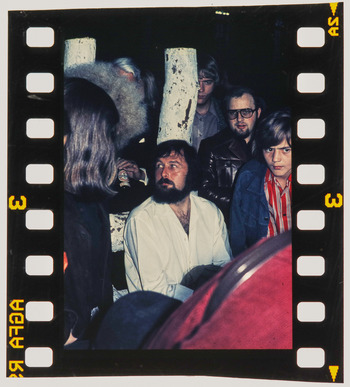
Harald Szeemann at the closing event of documenta 5, 1972. Photo: Hans-Eberhard Mons, © documenta Archiv, Kassel.

As it is well known, Szeemann's documenta was a grand achievement: it marked a turning point in the history of the event and catapulted him to the highest ranks of the curatorial league. It is no wonder, for this reason, that he would feel strongly bound to the documenta for years to come and probably considered it, to some extent, as an accomplishment of his own. Some time later, in fact, Szeemann revived his professional affiliation to the project when he resumed the artistic direction of documenta 8 (1987) together with Eddy de Wilde (Nijmegen, Holland, 1919 – Amsterdam, 2005), who had previously been the first director of the Van Abbe Museum. Regrettably, both had strong personalities and their constant confrontations ended up forcing them to tender their resignations simultaneously one year before documenta 8 was to be held. The artistic direction was eventually assumed at short notice by Manfred Schneckenberger, who had already been in charge of documenta 6.
This failed endeavour has long been considered Harald Szeemann's second, and last, connection to documenta. But actually it was not, as the records kept in the Archive prove. My first finding had to do precisely with Harald Szeemann and his third and, at the time, unsolicited attempt to pick up the artistic direction of documenta. This, in a way, closed an imaginary circle by ironically turning him, perhaps, into a slightly uncomfortable shadow of the past for the later organisers of the event, as Arnold Bode had been for him in the 1970s.
This finding was, at any rate, a fortuitous one. Browsing through one of the folders that, I believed, contained letters from documenta 5, my attention was caught by one of the first documents of the pile, where I read the words ‘Museo Reina Sofía’. That was a startling coincidence since I was perusing the Archive precisely to find material for a lecture I was to give at that institution. But I quickly realised that it was odd to find that mention there, since this museum did not exist as such in the 1970s. That chronological discrepancy compelled me to read more. The record turned out to be a fax from Harald Szeemann from 1994, addressed to Alexander Farenholtz, who had been Finance Director of documenta from 1987 to 1993 and who was, at the time, a member of the Selection Committee in search of an artistic director for documenta 10. ‘Dear Mr. Farenholtz’, Szeemann wrote, ‘for the Selection Committee I am sending you, attached, a short text where I present my “will for intensity” for documenta 10. From tomorrow onwards, I will be in Madrid for the installation of the Beuys exhibition at Museo Reina Sofía’.Footnote 7 Indeed, the four paragraphs that followed contained the theoretical standpoint that Szeemann wished to put forward for the curatorial undertaking of documenta 10. The fax was attached to a previous letter sent to the same addressee, where he asserted: ‘I would like to state again what I have already told you as well as Mr. President [Hans] Eichel: that I am very interested in taking up the direction of documenta X. The practical formula is 5 + 5 = 10, the sum of our century’.Footnote 8
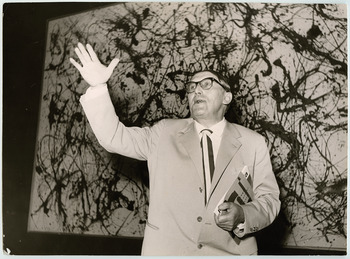
Arnold Bode in front of Jackson Pollock's Number 32 during documenta 2, 1959. Photo: Werner Lengemann, © documenta Archiv, Kassel.

That was new to me: I had never heard or read that, twenty-five years after having curated documenta 5, Szeemann had wished to become artistic director of documenta 10. As it turned out, the documenta Archive staff were also unaware of Szeemann's proposal and, therefore, as amazed as I was at the discovery; so my fortuitous finding triggered some immediate questions. How could Szeemann's proposition have remained practically unknown for so long, in spite of him being the most well-known and researched curator of the whole series of documenta exhibitions? Probably – I guessed – because the documents recording this move, sent in 1993 and 1994, had been placed in a folder containing records dated from the early 1970s. Researchers interested in the curatorial proposals competing for the artistic direction of documenta 10 would have not looked into that folder that far back, while, at the same time, somebody hunting for information about Szeemann's curatorial work for documenta 5 would perhaps not have paid much attention to the letters that he was sending out as late as 1993–94.
But then, why were documents from the 1990s placed in a 1970s folder? When deciding where to allocate them in the archive – I had to guess again – the archivist in charge must have weighed up whether to classify them according to chronology or to the notoriety of their author. In an exercise of presumably well-intentioned subjectivity, he or she must have deemed the second option more appropriate, thereby ‘hiding’ these documents inside the archive with such effectiveness that it apparently took several decades for them to surface again.
So my search moved on to the folders containing correspondence between Jean-Christophe Ammann and the documenta office, where I hoped to find at least some of those letters that I remembered as being finely written, infused with a charming and subtle sense of humour – quite formal in style in spite of the personal and sometimes ironic tone. And there they were – among them, this one from 1971:
And this one, from 1972:
And also this other one, dated in 1973:
These letters had been exchanged between curator Jean-Christophe Ammann and Ela Spornitz, a member of the documenta office team. Spornitz – the Archive staff readily explained to me – was a doctorate art historian and family friend of Arnod Bode's who started collaborating with documenta for the preparation of its fifth edition. The correspondence between her and Jean-Christophe Ammann, of which the letters above are just some examples, paints a portrait of Ammann as an amiable, enchanting freelancer and Spornitz as an efficient and formal clerk, less overtly joking but able to use irony in a subtle way. Running through their epistolary back-and-forths, a warm current of friendliness stands out against the high numbers of letters in the Archive that denote an intensively official, if not openly tense, tone.
A few months after documenta 5, in 1973 Ela Spornitz was appointed director of the documenta Archive, where she remained until her untimely death by an illness four years later. Because of her role as Archive director, she is, in fact, mentioned on the Archive's website, where the list of directors includes photographs of each one of them.Footnote 12 So as to illustrate these letters during the lecture that I was preparing, I requested from the Archive the photograph of Ela Spornitz. The digital file that I received turned out to provide, again, a new and suggestive surprise.
In the series of photographic portraits of documenta Archive directors that can be consulted online, the picture of Ela Spornitz quickly stands out: contrary to every other director before and after her, she does not seem to have been photographed in an office, nor is hers a standard professional portrait. Instead, she wears sunglasses, her back is turned to the camera, and she finds herself somewhere in the open air. It is not difficult to realise that this is a cropped photograph. I could see the complete, uncropped image when I received the digital file: she had been photographed in a snowy landscape, somewhere in a park or wood, playing with two young children. As I later discovered in conversation with the Archive staff, this photograph of Ela Spornitz was used for the website because it was almost the only one of her available in the Archive, where it had landed with the bulk of Arnold Bode's personal papers. Since Spornitz was a friend of Bode's, its provenance probably explains the spontaneous character of the image.
Historically irrelevant as this photograph may be, it raises – again – questions in relation to its archival context, which also have to do with subjectivity, now seen from a different angle. The intimate, informal character of the original picture, most evident when the image is uncropped, strongly underlines the professional look of all of the other portraits, which lack the familiar, emotional nuance of Ela Spornitz's stance. But because of the difference, her image abruptly changes the light under which the other images are viewed, bringing to the fore, by a stark contrast, the rather conventional criteria which were used for choosing the majority of them, probably aimed at building up a ‘formal gallery of portraits’. This photograph, then, materialises itself as a precise instance for one of the basic principles of archival sciences, namely that which states that one single record, when added to a collection, has the potential to modify the meaning of all of the other records already in that collection.
The examples discussed illustrate just some of the many different layers in which subjectivity and the ‘complex circulation of affects’ are at play in the documenta Archive. Indeed, subjective relations may be found in the archive on a purely documental level, that is, independently of context, such as the rivalry, egocentrism or fondness that we see permeating certain parts of the correspondence, even those written initially not for personal but professional reasons. More interestingly, however, subjectivity is also at work in the archive's actual configuration: such as when a certain freedom in the interpretation of the logic of archival classification leads to a record being almost unfindable, or when the decision to use a cropped personal photograph spotlights the conventions at play in the selection of portraits for an online gallery of biographies. Both cases reveal subjective nuances in the – apparently solid – archival structure; they work as functional cracks enabling productive glimpses into an intellectual construction that is otherwise hidden, which is what an archive is: an organisational framework aiming to attract attention and provide easy access to the records it holds and, at the same time, to camouflage itself as much as possible.
When considering archives in this light, Gérard Genette's concept of paratext is particularly apposite. Paratext, that is, the structural information surrounding a text in a book (such as title, footnotes, etc.), was described by Genette as a zone ‘between the inside and the outside’, ‘a zone not just of transition, but of transaction’.Footnote 13 Along these lines, an archive could similarly be described as a para-record: a zone of contact, a threshold of transaction between past documents and contemporary readers; ‘the privileged site of a pragmatics and of a strategy’.Footnote 14 No archive is totally free of subjectivity, and the documenta Archive is no exception. This condition of archives, which has been amply demonstrated since the authority of mainstream narratives started to be questioned, cannot be overstated; and archive users and custodians alike should be always well aware of the light and shade an archive can project on the documents it safeguards.
Author's note: This essay is based on the lecture entitled “Ela, dear, Ela. Affective Affinities and Power Relations in the documenta Archive”, which I gave at Museo Reina Sofía on November 6, 2018. For the generosity shown when sharing their knowledge with me in the preparation of the lecture and essay, I am deeply indebted to the staff of the documenta Archive and, in particular, to Martin Groh; as well as to Karin Stengel, director of the Archive from 1992 to 2014. The quoted letters, all of them preserved in the documenta Archive, were originally written in German; their translations into English are mine