Blood-injection-injury phobia in older adults
BIIP is a Specific Phobia sub-type characterized by fear and avoidance of seeing blood and receiving injections. The Baltimore Epidemiologic Catchment Area (ECA) study estimated a lifetime prevalence of 3.5%, most notably among younger women, and reported high comorbidity with other psychiatric conditions (Bienvenu and Eaton, Reference Bienvenu and Eaton1998; Bracha et al., Reference Bracha, Bienvenu and Eaton2007). Despite age-related reductions in prevalence, anxiety disorders remain highly prevalent in older adults, and become increasingly associated with physical symptoms (Trollor et al., Reference Trollor, Anderson, Sachdev, Brodaty and Andrews2007; Miloyan and Pachana, Reference Miloyan and Pachana2015; Reynolds et al., Reference Reynolds, Pietrzak, El-Gabalawy, Mackenzie and Sareen2015). BIIP may bear particular health significance in older age groups, due in part to high disability and low rates of health and mental health service use among older adults in general (Trollor et al., Reference Trollor, Anderson, Sachdev, Brodaty and Andrews2007; Lin et al., Reference Lin, Zhang, Leung and Clark2011; Brault, Reference Brault2012). For example, the results of a previous study suggest that BIIP is associated with peripheral vascular and cardiovascular disease among diabetics, presumably due to differences in general health behaviors, or specifically insulin use by injection (Bienvenu and Eaton, Reference Bienvenu and Eaton1998). However, these issues have not been addressed in older adults, for whom BIIP may bear important health implications due to the high prevalence of medical conditions that require routine compliance. The purpose of this study is to evaluate the prevalence, medical and lifetime psychiatric comorbidity, and medical service use associated with BIIP in a national sample of older adults.
Method
Sample
The NESARC was undertaken in 2001–2002 in a nationally representative sample of 43,093 civilian, non-institutionalized adults who were sampled from all 50 U.S. states and the District of Columbia (Grant et al., Reference Grant, Moore and Kaplan2003a). African-Americans, Hispanics, and young adults were purposively oversampled, and sampling weights were used to adjust data for oversampling and non-response, and to allow population estimates to be standardized against census data. The overall response rate was 81% and face-to-face interviews were conducted by trained lay interviewers using the Alcohol Use Disorder and Associated Disabilities Interview Schedule–DSM-IV version (AUDADIS-IV). In the present study, all analyses were limited to participants aged 65 years or older (N = 8,205).
Measures
Lifetime fears and 12-month non-hierarchical Social Phobia (SP) diagnoses were obtained by trained interviewers using the AUDADIS-IV, which has good overall psychometric properties (Grant et al., Reference Grant, Dawson, Stinson, Chou, Kay and Pickering2003b). Specifically, the AUDADIS-IV has been found to have good reliability for assessing lifetime SP fears (ICC: 0.71), and fair-to-moderate reliability for SP diagnoses (κ 0.40 for 12-month and 0.48 for lifetime). Sociodemographic and health variables consisted of age, sex, education, personal income, marital status, self-perceived current health, and chronic medical conditions. The presence of chronic medical conditions was determined by asking respondents to report whether they had ever had a diagnosis of any of the following conditions: arteriosclerosis, hypertension, liver cirrhosis, liver disease, angina pectoris, tachycardia, myocardial infarction, heart disease, stomach ulcer, gastritis, and arthritis. Anxiety (panic disorder with or without agoraphobia, social phobia, and generalized anxiety disorder), mood (major depression, dysthymia, mania, and hypomania), substance use (alcohol abuse or dependence, drug abuse or dependence, and nicotine dependence), and personality (conduct, antisocial, avoidant, dependent, obsessive-compulsive, paranoid, schizoid, or histrionic) disorders were diagnosed with the AUDADIS, which asks detailed questions about symptoms related to each of the psychiatric disorders. Past-year medical service use was examined using reports of the following: (a) number of days stayed in hospital, (b) number of times treated in emergency room, and (c) number of injuries that caused one to seek medical help or cut down usual activities for more than half a day.
Statistical analyses
Prevalence estimates for BIIP were calculated with survey weights to allow for comparison to census data and estimates for the entire nation. Those endorsing lifetime BIIP with and without a 12-month SP diagnosis were compared using a binary logistic regression analysis. Odds ratios predicting lifetime psychiatric conditions, chronic medical conditions, and service use from BIIP were calculated with logistic regression, with and without adjustment based on sociodemographic characteristics and psychiatric diagnoses. Due to the large number of comparisons, we opted to use a p-value threshold of 0.01 in lieu of the standard 0.05. All statistical analyses were performed using Stata 12 (StataCorp, 2011).
Results
Sociodemographic characteristics of the sample
The total sample consisted of 8,205 older adults aged 65 years or older (M age = 75±7; 62% female). Approximately 33% of participants completed high school, with 35 % completing at least some college. Eighty-five percent reported a personal income of less than $35,000 per year, with 34% reporting an annual income of less than $10,000. Forty-three percent of participants reported being married or cohabiting, 52% reported being widowed, divorced or separated, and 5% reported being widowed. Eighty-two percent of participants were White, 8% were Black, 2% were Native American, 3% were Asian, and 5% were Hispanic. Sixty-five percent of participants reported their self-perceived current health to be good, very good, or excellent, and 56% reported having a maximum of one chronic medical condition. Approximately half of all the older adults in the sample reported having at least one lifetime fear.
Prevalence of lifetime BIIP with and without 12-month SP
A total of 386 participants reported having a lifetime BIIP, corresponding to a weighted population prevalence of 4.2% (95% CI: 3.7–4.8). Among those with lifetime BIIP, a total of 51 participants met 12-month DSM-IV diagnostic criteria for SP, corresponding to a weighted population prevalence of 0.6% (95% CI: 0.4–0.8). Respondents’ age was not significantly related to the prevalence of BIIP (Table 1).
Weighted lifetime BIIP prevalence estimates among older age groups

Note: The results of binary logistic regression analyses indicated that there were no significant age-related differences in BIIP prevalence among older adults.
A binary logistic regression analysis was conducted in order to compare those who did or did not meet 12-month SP criteria (coded 1 and 0 respectively) along with their lifetime BIIP in terms of sociodemographic, health, and psychiatric characteristics. None of the variables in this model significantly differentiated the two groups at the 0.01 threshold, so subsequent analyses no longer distinguish the two groups.
Type and frequency of co-occurring lifetime fears
BIIP occurred together with other lifetime fears in over 90% of all cases (Figure 1). The two most common co-occurring lifetime fears were of animals and heights, each endorsed by approximately half of the individuals with BIIP. It is surprising that only approximately one-third of those with BIIP reported a lifetime fear of dentists and one-fifth reported a lifetime fear of hospitals.
Frequency of lifetime fears among older adults with blood-injection-injury-phobia.

Psychiatric comorbidity
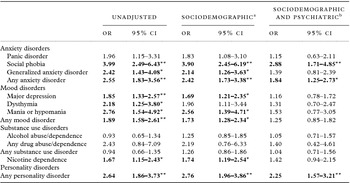
Lifetime BIIP was significantly associated with lifetime anxiety, mood, and personality disorders in the unadjusted model. These associations persisted after adjusting for sociodemographic characteristics. After adjusting for other psychiatric disorders, however, only the associations with lifetime SP, any lifetime anxiety disorder, and personality disorders remained significant (Table 2).
Prediction of lifetime psychiatric disorders from lifetime BIIP
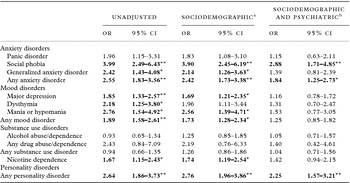
*p < 0.01, **p < 0.001.
aOdds ratios adjusted for age, sex, education, income, marital status, geographic region, and urbanicity.
bOdds ratios adjusted for age, sex, education, income, marital status, geographic region, ubranicity, and other psychiatric disorders.
Medical comorbidity
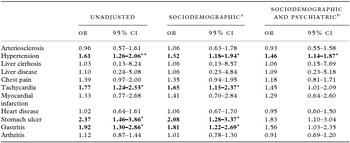
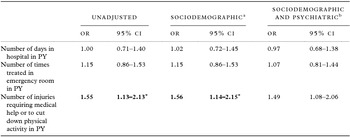
Lifetime BIIP was significantly associated with hypertension, tachycardia, stomach ulcer, and gastritis in the unadjusted model and after adjusting for sociodemographic variables. After additionally adjusting for psychiatric diagnoses, only the association with hypertension remained significant (See Table 3). With regard to service use, lifetime BIIP was significantly associated with number of injuries during the past year that required the respondent to cut down physical activity for at least half a day in the unadjusted model and after adjusting for sociodemographic characteristics, but not after additionally adjusting for lifetime psychiatric diagnoses (Table 4).
Prediction of chronic medical conditions from lifetime BIIP

*p < 0.01, **p < 0.001, PY: past year.
aOdds ratios adjusted for age, sex, education, income, marital status, geographic region, urbanicity.
bOdds ratios adjusted for age, sex, education, income, marital status, geographic region, urbanicity, and other psychiatric disorders.
Prediction of medical service use from lifetime BIIP

*p < 0.01, **p < 0.001, PY: past year.
aOdds ratios adjusted for age, sex, education, income, marital status, geographic region, urbanicity.
bOdds ratios adjusted for age, sex, education, income, marital status, geographic region, urbanicity, and psychiatric comorbidity.
Discussion
In a national sample of older American adults, the weighted lifetime prevalence of BIIP was 4.2%. The Baltimore ECA study estimated a similar lifetime prevalence of 3.5% (Bienvenu and Eaton, Reference Bienvenu and Eaton1998); however, a Swedish population register study estimated a much higher lifetime prevalence of 7.9% among older adults (Sigström et al., Reference Sigström, Östling, Karlsson, Waern, Gustafson and Skoog2011). Although reasons for this discrepancy are unclear, the actual lifetime prevalence of BIIP may in fact be significantly higher than the estimate reported in the present study, due to recall errors that lead respondents to underestimate the occurrence of psychiatric symptoms earlier in their lives (Moffitt et al., Reference Moffitt2010; Takayanagi et al., Reference Takayanagi, Spira, Roth, Gallo, Eaton and Mojtabai2014).
In the present study, those who endorsed a lifetime BIIP with or without a 12-month SP diagnosis were not differentiated by sociodemographic, health, and psychiatric characteristics. This finding is consistent with those of previous studies, which report only marginal differences between older adults with a 12-month diagnosis of SP, a lifetime diagnosis of SP, or sub-threshold SP, relative to asymptomatic controls (Chou, Reference Chou2009; Grenier et al., Reference Grenier2011).
Lifetime BIIP was significantly associated with hypertension among older adults in our sample after controlling for sociodemographic and psychiatric confounders. We are unable to draw causal inferences about this observed association due to the use of cross-sectional data. However, the higher odds of chronic medical conditions may be due to differences in preventive lifestyle or treatment-seeking behaviors earlier in life (Thyer et al., Reference Thyer, Himle and Curtis1985; Marks, Reference Marks1988). Although findings from the Baltimore ECA suggest that there may be no major health ramifications of having lifetime BIIP in terms of health-seeking behaviors (Bienvenu and Eaton, Reference Bienvenu and Eaton1998), diabetics with BIIP were more likely to report having vascular disease.
Lifetime BIIP was associated with a range of anxiety, mood, and personality disorders in our unadjusted model, and after adjusting for sociodemographic characteristics. After similar adjustments, Bienvenu and Eaton also found high lifetime comorbidity, particularly for mood and anxiety disorders, among those with a lifetime BIIP. After additionally adjusting for comorbid psychiatric conditions, we found that BIIP was significantly and most strongly associated with a lifetime diagnosis of SP and personality disorders. Similarly, Grenier and colleagues reported that older adults with a 12-month diagnosis of SP were more likely to have comorbid anxiety disorders than their sub-threshold counterparts.
Approximately 8% of those with lifetime BIIP did not report any other lifetime fears, suggesting that BIIP usually occurs in tandem with other fears. The two most commonly co-occurring lifetime fears were of animals and heights, consistent with previous findings suggesting that these are the most common fears in general (Magee et al., Reference Magee, Eaton, Wittchen, McGonagle and Kessler1996). Additionally, we found that dental phobia was not among the most frequently co-occurring lifetime fears, consistent with previous findings suggesting that BIIP and dental phobia represent two distinct SP sub-types (De Jongh et al., Reference De Jongh, Bongaarts, Vermeule, Visser, De Vos and Makkes1998; van Houtem et al., Reference van Houtem, Aartman, Boomsma, Ligthart, Visscher and de Jongh2014). Interestingly, fear of hospitals was also among the least frequently co-occurring fears.
A strength of the present study is that it was based on a large, nationally representative sample of the U.S. population. However, there are also some important limitations. First, as previously alluded to, the estimated prevalence of lifetime BIIP may have underestimated the true lifetime prevalence in our sample, due to recall errors that are known to impact the accuracy of lifetime prevalence estimates (Moffitt et al., Reference Moffitt2010; Takayanagi et al., Reference Takayanagi, Spira, Roth, Gallo, Eaton and Mojtabai2014). It is possible that those who remember having had a lifetime BIIP (those in our sample) vary in important respects to those who forget or deny earlier fears, for instance in terms of recency or severity, and other characteristics. Additionally, cohort effects may explain observed differences in the prevalence of BIIP between older adult samples (Sigström et al., Reference Sigström, Östling, Karlsson, Waern, Gustafson and Skoog2011). Second, in the structured interview, participants were only required to answer ‘yes’ or ‘no’ to whether they had any lifetime fears. Therefore, we were unable to examine whether the intensity of the fear of blood, injection, or injury has an impact on medical and psychiatric comorbidity. Finally, we were unable to investigate in greater detail whether BIIP has a general effect on health behaviors and treatment seeking due to the limited number of questions about medical service use in the AUDADIS. Longitudinal datasets with more detailed measures of health behaviors and service use are needed to further examine this issue.
Conflict of interest
None.
Description of authors’ roles
BM and WE conceived and planned the study. BM performed statistical analyses and wrote the manuscript. WE edited the manuscript for important content.
Acknowledgments
This work was supported by the Johns Hopkins Epidemiology and Biostatistics of Aging Training Program of the National Institute on Aging (NIA) under award number T32AG000247, and NIDA grant 026652 to Dr Eaton.