


Introduction
Bipolar disorder (BD) is a common long term mental health problem characterized by instability in a range of important areas including mood, sleep and behaviour that can impact on functional domains such as work and family/social relationships (Bentall and Jones, Reference Bentall and Jones2006; Goodwin and Jamison, Reference Goodwin and Jamison2007; Vance, Jones, Espie, Bentall and Tai, Reference Vance, Jones, Espie, Bentall and Tai2007). As patterns of communication, impulse control and motivation are all affected by BD, parenting is made more difficult for those individuals (Phelan, Lee, Howe and Walter, Reference Phelan, Lee, Howe and Walter2006; Vance et al., Reference Vance, Jones, Espie, Bentall and Tai2007). Furthermore, research with children of bipolar parents (CBP) indicates that offspring experience significantly elevated risk for a wide range of psychiatric conditions, including attention deficit hyperactivity disorder, anxiety, depression, substance use, and sleep disorders in addition to rates of bipolar disorder higher than those seen in the general population (Duffy, Alda, Crawford, Milin and Grof, Reference Duffy, Alda, Crawford, Milin and Grof2007; Jones and Bentall, Reference Jones and Bentall2008). Left untreated, behavioural and emotional problems in children of parents with BD can increase their risk of future mental health problems (Alloy et al., Reference Alloy, Abramson, Gibb, Crossfield, Pieracci and Spasojevic2004; Inoff-Germain, Nottelmann and Radke-Yarrow, Reference Inoff-Germain, Nottelmann and Radke-Yarrow1992; Vance et al., Reference Vance, Jones, Espie, Bentall and Tai2007). Thus in a previous study (Jones, Tai, Evershed, Knowles and Bentall, Reference Jones, Tai, Evershed, Knowles and Bentall2006) we found that although 56% of an adolescent CBP sample had current or lifetime mood symptoms on structured clinical interview, none were in receipt of psychological or psychiatric input for these difficulties. Although there is a high demand for community based parenting support, there are few evidence-based parenting interventions (Calam, Sanders, Miller, Sadhnani and Carmont, Reference Calam, Sanders, Miller, Sadhnani and Carmont2008; Sanders, Calam, Durand, Liversidge and Carmont, Reference Sanders, Calam, Durand, Liversidge and Carmont2008) and many parents with bipolar disorder do not currently have access to these. Although it might be assumed that the difficulties observed in CBP are determined by genetic factors, psychological research indicates both that family and parental communication problems are elevated in CBP and that such problems may be related to transition to bipolar disorder (Alloy et al., Reference Alloy, Abramson, Gibb, Crossfield, Pieracci and Spasojevic2004; Inoff-Germain et al., Reference Inoff-Germain, Nottelmann and Radke-Yarrow1992; Vance et al., Reference Vance, Jones, Espie, Bentall and Tai2007). Additionally, in adolescents and adults with established bipolar disorder higher levels of expressed emotion (defined by higher levels of criticism and/or over-involvement from parents or carers) are associated with worse clinical outcomes (Butzlaff and Hooley, Reference Butzlaff and Hooley1998; Miklowitz et al., Reference Miklowitz, Otto, Frank, Reilly-Harrington, Wisniewski and Kogan2007, Reference Miklowitz, Axelson, Birmaher, George, Taylor and Schneck2008).
These findings suggest that interventions that improve parenting behaviour and address emerging problems in preadolescent children might in due course have the potential to prevent the development of significant difficulties in later life. Additionally, as stressful events are a well established predictor of relapse in adults with bipolar disorder, reducing the stress of parenting for parents with bipolar disorder may, by reducing parental exposure to stressful events, have beneficial outcomes for their own clinical course. Recently conducted quantitative and qualitative work has found significant support amongst parents with BD for self-management interventions (Backer, Reference Backer2011; Murphy, Reference Murphy2011). These studies also found that parents with BD had a strong desire to parent well but due to their awareness of the impact of their illness on their parenting they experienced guilt and worry, and reported that they wanted parenting support. Such interventions are therefore likely to be especially beneficial if they can be delivered to large numbers of parents in self-help format focused on building on current skills and normalizing the experience of parenting challenges, irrespective of whether parents experience mental health issues. Sanders and colleagues, who developed the Triple P-Positive Parenting Programme, have successfully delivered it as a self-help intervention to parents without bipolar disorder, reporting significant gains in child and parenting outcomes across self-directed and more intensive clinician-led intervention formats (Calam et al., Reference Calam, Sanders, Miller, Sadhnani and Carmont2008; Sanders, Bor and Morawska, Reference Sanders, Bor and Morawska2007; Sanders et al., Reference Sanders, Calam, Durand, Liversidge and Carmont2008). Interventions of this type are delivered in formats designed to normalize the problems parents experience and to provide support around enhancing competencies rather than highlighting parental or child deficits. This approach has proved successful in engaging a wide range of families and seeks to avoid stigmatizing participants, an important consideration in the provision of preventative approaches (Sanders, Reference Sanders2008). The present paper describes the pilot evaluation of a web-based self-help parenting intervention based on Triple P principles adapted for bipolar parents. This was based on material developed for the Triple P Parenting Media Project described in Metzler, Sanders, Rusby and Crowley (Reference Metzler, Sanders, Rusby and Crowley2012), with the addition of a tip sheet for parenting on detecting and coping with mood swings. This self-management approach is consistent with UK Government recommendations and priorities for public and mental health (Darzi, Reference Darzi2008; Department of Health, 2009, 2011) to improve health, be responsive and accessible, allow choice and control, and be empowering, as it can be used autonomously. Due to limited resources in mental health, many people with BD do not have ready access to evidence-based interventions of any type, still less specific help with parenting. Web-based self-management interventions such as the one reported here do not require formal training and can reach large numbers of people at less cost than traditional therapies and may therefore in the future have potential to address inequalities in access to care (Kazdin and Blase, Reference Kazdin and Blase2011). A primary aim of this study is to determine whether there is any demand for an intervention of this type to this patient group. Additionally, we wish to determine effect sizes for perceived parenting and child behaviour outcomes to inform a future definitive trial. Specifically, it was hypothesized that web-based enhanced positive parenting training would, compared with a waiting list control group: i) Reduce parent ratings of child problems; and ii) Improve self-reported parenting skills.
Method
Ethical approval for the study was granted by the Senate Ethics Committee of the University of Manchester and all procedures are in accordance with the Helsinki Declaration of 1975.
Participants
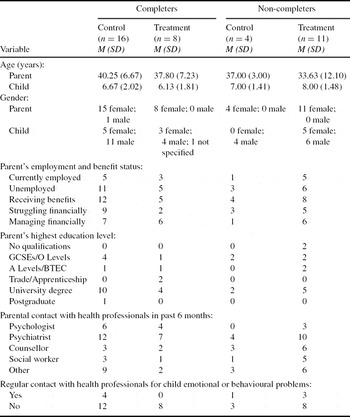
Thirty-nine parents with children in the age range 4–10 years responded to advertisements for the study and completed questionnaires online. The characteristics of the parents and children at baseline are shown in Table 1. There were 15 boys and 5 girls (follow-up data obtained from 11 boys and 5 girls) in the control condition and 10 boys and 8 girls (follow-up data obtained from 4 boys and 4 girls) in the treatment group (there was 1 child for whom parents did not record gender information). Neither age nor gender distributions differed between the control and intervention conditions. Inclusion criteria were: i) parent self-reported diagnosis of bipolar disorder and score on the Mood Disorders Questionnaire of > 9; ii) age of child (4–10 years old).
Parent, child and family demographic characteristics at baseline by group and completer status

Measures
Demographic data were collected using the Family Background Questionnaire (FBQ) adapted for UK samples as used in previous online parenting research (Calam et al., Reference Calam, Sanders, Miller, Sadhnani and Carmont2008).
Parental diagnostic and symptom measures
Mood Disorder Questionnaire (MDQ; Hirschfeld et al., Reference Hirschfeld, Williams, Spitzer, Calabrese, Flynn and Keck2000). The MDQ was developed to aid diagnosis of bipolar disorders. In the original version it covers symptom endorsement of 13 manic/hypomanic symptoms (Section 1), symptom clustering (Section 2) and severity of problem caused (Section 3). However, recent research has supported the use of Section 1 alone to avoid incorrect screening out of individuals experiencing bipolar II symptoms (Twiss, Jones and Anderson, Reference Twiss, Jones and Anderson2008). This research indicated that the optimal cut-off score was a score of 9 or more endorsed symptoms without applying the supplementary questions (sensitivity of 0.90 and 0.88 for bipolar I and bipolar II groups respectively with a specificity of 0.90).
The Center for Epidemiological Studies Depression Scale (CES-D; Radloff, Reference Radloff1991). CES-D is a 20-item self-report depression scale that detects current depressive symptoms. A score above 16 indicates possible depression (Radloff, Reference Radloff1991). Cronbach's alpha for CES-D in the current sample was 0.95.
Internal States Scale (ISS; Bauer et al., Reference Bauer, Crits-Christoph, Ball, Dewees, McAllister and Alahi1991). This is a self-report questionnaire assessing manic and depressive symptoms. Its 15 items contribute to four subscales: Activation (ISS-A), Well-Being (ISS-WB), Perceived Conflict (ISS-PC), and Depression (ISS-D). Each item relates to the preceding 24 hours. Ratings are made on a 100 mm visual analogue scale with anchor descriptions of “Not at all/Rarely” at one extreme and “Very much so/Much of the time” at the other. This measure is widely used and has good internal reliability and validity. ISS-A score above 200 indicates possible mania; ISS-WB below 125 is indicative of possible depression (Bauer et al., Reference Bauer, Crits-Christoph, Ball, Dewees, McAllister and Alahi1991). Cronbach's alphas for ISS-A and ISS-WB, the two subscales focused on for this study, were 0.87 and 0.83 respectively.
Child behaviour and perceived parenting measures
Strengths and Difficulties Questionnaire (SDQ; Goodman, Reference Goodman2001). This is a widely used 25-item questionnaire with good psychometric properties generating dimensional scores for total difficulties [clinical cut-off 14 (borderline)/17 (abnormal)]; emotional symptoms [clinical cut-off 4 (borderline)/5(abnormal)]; conduct problems [clinical cut-off 3(borderline)/4 (abnormal)]; hyperactivity [clinical cut-off 6 (borderline)/7 (abnormal)]; peer problems [clinical cut-off 3 (borderline)/4 (abnormal)], and prosocial behaviour [clinical cut off 5 (borderline)/4 (abnormal)]. Note that the total difficulties score for SDQ does not include scores from the prosocial behaviour subscale. The measure has proved capable of identifying children with depressive, conduct and hyperactive disorders. It has shown a specificity of 94.6% (95% CI 94.1–95.1%) and sensitivity of 63.3% (59.7–66.9%) in identifying children with a psychiatric diagnosis (Goodman, Ford, Simmons, Gatward and Meltzer, Reference Goodman, Ford, Simmons, Gatward and Meltzer2000). Cronbach's alpha for SDQ total score for this sample was 0.72.
The Parenting Scale (PS; Arnold, O'Leary, Wolff and Acker, Reference Arnold, O'Leary, Wolff and Acker1993). This 30-item questionnaire measures perceived dysfunctional discipline styles in parents. Test-retest reliabilities for the three subscales are .83 (Laxness), .82 (Overreactivity) and .79 (Verbosity). It reliably discriminates parents of clinical and non-clinical children (Arnold, et al., Reference Arnold, O'Leary, Wolff and Acker1993). Cronbach's alpha for PS total score in the current sample was 0.84.
Procedure
Parents with a self-reported clinical diagnosis of bipolar disorder with 4- to 10-year-old children were invited to participate in the study. Recruitment concentrated on Bipolar UK (previously the Manic Depression Fellowship), the national charity dedicated to the support of people with bipolar disorder and their families. Information on the study was provided via publicity in newsletters, e-mail circulars, and at local meetings of the MDF: The Bipolar Organization (a UK self-help organization for people with bipolar disorder) and through the MDF national magazine (Pendulum). A web link for the study was included in all advertising. All questionnaires were completed on line. Parents were randomized either to an intervention condition that received a web-based Triple P intervention or to a waiting list control. Randomization to group was done on the basis of a predetermined random sequence in blocks of six held in a sealed envelope within the website. Each participant was automatically allocated to the next available number (1 for control, 2 for treatment) upon registration with the site. In the latter condition participants were provided with access to intervention materials after their follow-up assessment but no data were collected on their use due to limited resources. All measures were completed online. A CONSORT diagram is provided in Figure 1, illustrating recruitment and retention figures for both arms of the trial. The study originally recruited 54 participants, but of these 15 had index children too young to complete the available version of SDQ and were therefore not included in this report.
CONSORT diagram showing participant flow through the study

Web-based parenting intervention
Participants in the intervention group were provided with a 10-week course on managing child behaviour. This consisted of written material in the form of a book that was posted to them at the beginning of the intervention (Markie-Dadds, Sanders and Turner, Reference Markie-Dadds, Sanders and Turner1999) as well as web-based information (released weekly to coincide with the 10 weekly chapters of the book) in written video and audio format that provided additional support for parents as they worked through the self-help workbook. The web material was taken from the Triple P Parenting Media Series that was developed for the Triple P Parenting Media Project described in Metzler et al. (Reference Metzler, Sanders, Rusby and Crowley2012). Both the workbook and web resources covered a number of key areas including:
-
• Encouraging desirable behaviour (through reinforcement, modelling and consistency);
-
• Coping with difficult behaviour (through clear ground rules and proportionate logical consequences including, where appropriate, planned ignoring and time out);
-
• Managing sleep routines (through a clear regular bedtime routine, consistently reinforcing pro-sleep behaviours and ignoring/extinguishing non-sleep behaviours);
-
• Coping with stress in the family (through identifying parental stress and addressing it with relaxation and thought challenge approaches so that the parent can apply the previous principles of positive parenting consistently).
Material in each of these areas was based on behavioural parenting principles evaluated in a wide range of Triple P studies (Calam et al., Reference Calam, Sanders, Miller, Sadhnani and Carmont2008; Sanders et al., Reference Sanders, Bor and Morawska2007, Reference Sanders, Calam, Durand, Liversidge and Carmont2008). The only amendment to the materials described above for the current study was to provide an additional tip sheet, developed for this study, specifically dealing with how parents might detect and cope with ups and downs of their own mood.
Analysis plan
Demographic and symptom information was compared using t-tests, ANOVA and Kruskal-Wallis tests as appropriate for continuous/ranked data and χ2 for categorical data. End of therapy data on the two primary outcomes, perceived parenting behaviour (measured by PS) and child behaviour problems (measured by SDQ), were obtained on only 24 out of 39 eligible participants. Crude dropout rates were 4 out of 20 and 11 out of 19 in the control and treatment groups respectively, a significant difference (X 2 = 5.39 on 1 df, p = 0.01).
A random effects model with random intercept was used to evaluate the effect of the treatment on PS and on SDQ. In both cases, the model was fitted by maximum likelihood, adjusting for the possible effects of parental depression (CESD, ISS-WB), child age, mania symptoms (ISS-A) and whether the child was in contact with professional care services (from FBQ) in the analysis. This made the analysis somewhat robust to dropouts, in the sense that it adjusted automatically for any dependence between the baseline score and the probability of dropout.
Results
Demographic information
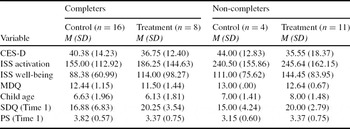
Forty-one percent (n = 16) of children were living with both their biological parents, whilst 36% (n = 14) were being raised by a single parent at the time of assessment. Detailed demographic information is presented in Table 1 for treatment and control groups with respect to completer status. Statistical testing indicated no significant differences between groups for parental or child age or gender. In the completer groups the ratio of boys to girls was higher for controls than those receiving treatment but again this difference was not statistically significant. Groups also did not differ with respect to parental employment or financial status, education level or parental or child contact with a health professional. The majority of parents assessed were unemployed (n = 25 overall; n = 16 completers) and on benefits (n = 29 overall; n = 17 completers) with almost half of the total sample and over half of completers struggling financially (n = 19 overall; n = 11 completers). The majority of parents were educated to degree level or above (n = 22 overall; n = 15 completers) and were receiving care from at least one mental health professional (overall n = 34; completers n = 20), with most of these contacts including a psychiatrist (overall n = 33; completers n = 19). In contrast, very few children were receiving professional help from paediatric, psychological or specialist school services (overall n = 8: completers n = 4). Self-report data for parents and children are presented in Table 2. Parental self-reported diagnosis of bipolar disorder (100%) was consistent with MDQ scores substantially above clinical cut-off in all cases. Parents also reported experiencing significant depressive symptoms as assessed by both the CES-D and the ISS-W. Groups did not differ significantly on mood scores.
Average ratings for parental mood and parenting behaviour and child behaviour problems at baseline by condition and completion of follow-up assessment

Notes: CES-D (Center for Epidemiological Studies Depression Scale); ISS (Internal States Scale); MDQ (Mood Disorder Questionnaire); SDQ (Strengths and Difficulties Questionnaire); PS (Parenting Scale)
Parent assessment of child behaviour and perceived parenting
At inception, children were rated as having internalizing and externalizing problems at clinically significant levels on the SDQ. Mean SDQ total score was above the clinical threshold as was the conduct problems subscale; mean emotional symptoms, hyperactivity and peer problems were all at the borderline threshold (Goodman, Reference Goodman2001). Of the participants for whom pre- and post-data were available 11/16 controls and 8/8 treatment participants had scores at or above the borderline threshold at inception: at follow-up 8/11 controls remained at this level compared with 3/8 treatment group participants.
Parents’ PS ratings indicated problematic parenting behaviour within the clinical range, as the mean PS score was above that for the clinical sample in the original development study for the measure and for a more recent study in which the children recruited all scored above clinical thresholds for the Eyberg Child Behaviour Inventory (Arnold et al., Reference Arnold, O'Leary, Wolff and Acker1993; Calam et al., Reference Calam, Sanders, Miller, Sadhnani and Carmont2008).
Outcomes for web-based parenting self-help intervention
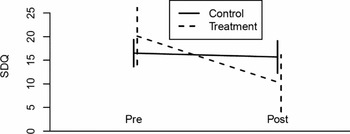
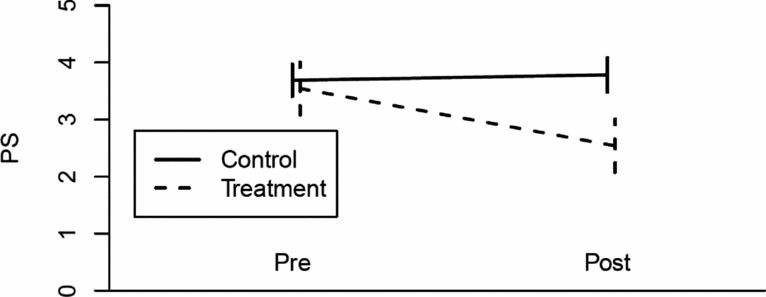
Figures 2 and 3 show scores (+/- two pointwise standard errors) at baseline and end of treatment (10 weeks post baseline) for SDQ and PS respectively. The comparison of the treatment and control groups with respect to SDQ score indicated non-significant differences between groups at baseline (mean difference = 3.31, SE = 3.81, p < .09). There was a significant change in SDQ score for treatment group (slope = −9.18, SE = 2.33, p < .001) but not for control group (slope = −0.74, SE = 3.47, p < .68). Slope in treatment group was significantly more negative than in control group, with a large effect size (difference in slope = 8.44, SE = 5.72, p < .004; d = 1.00).
Total Strengths and Difficulties Questionnaire scores comparing treatment and control group pre- and post-intervention Note: SDQ = Total Strengths and Difficulties Questionnaire Score

Total Parenting Scale scores comparing treatment and control group pre- and post-intervention Note: PS = Total Parenting Scale Score

The same comparisons with respect to PS score again showed a non-significant baseline difference between groups (mean difference = −0.21, SE = 0.24, p = .39). There was a significant change in PS score for treatment group (slope = −0.91, SE = 0.45, p < .001) but not for control group (slope = 0.03, SE = 0.33, p = .85). Slope in treatment group was significantly more negative than in control group, with a moderate effect size (difference in slope = 0.94, SE = 0.56, p < .001; d = 0.73).
Discussion
A primary aim of the current study was to indicate whether there was potential demand for a parenting intervention amongst parents with bipolar disorder. We were able to recruit 54 participants for this trial from a limited recruitment strategy focusing on members of Bipolar UK, although only 39 had children within the target age range. This suggests that there is at least some interest in parenting-support amongst bipolar parents, although large scale research in the future will evaluate this more formally. The present study suggests that it is possible to deliver a web-based parenting approach to bipolar parents and also that this approach impacts on both child behaviour and perceived parenting practices. However, consistent with this being a pilot study there are issues that need to be considered in interpreting the findings. The parents participating in this study were a self-selecting group and as self-help group members they might be unrepresentative in their levels of motivation and readiness to change. However, although most were in a stable family setting, most were not employed and almost half were struggling financially, suggesting that at least a proportion of the participants were experiencing some of the severe social and functional difficulties that some people with bipolar disorder experience. Additionally, this group of parents reported significant current depressive symptoms on both self-report measures used in this study, significant difficulties in perceived parenting and high levels of problematic behaviour in their children. For comparison, a study of 51 referrals to three English Family Support and Child and Adolescent Mental Health Services reported mean Total SDQ scores of 21 or 22 (Vostanis, Anderson and Window, Reference Vostanis, Anderson and Window2006). A pre-intervention mean Total SDQ score of 12 was reported for children in families taking part in a randomized controlled trial of a parenting programme with recruitment through general practices and pre-screening for behaviour problems prior to entry (Stewart-Brown et al., Reference Stewart-Brown, Patterson, Mockford, Barlow, Klimes and Pyper2004). The relatively high SDQ scores in the current study are particularly striking as the sample was not selected on the basis of child emotional and behavioural problems and underscores the need for an intervention that enhances child behavioural and emotional well-being for this group of children (especially as in the current sample only 20% of parents reported accessing care for their parenting issues or their children's behaviour problems). As noted in the Procedure section we originally recruited a sample including children under 4 years old. As these children are too young to be appropriately rated on the SDQ we excluded these from the report.
With relatively brief and limited publicity this study successfully recruited 39 participants within the target age range, which suggests interest in this approach from bipolar parents. The study was less successful with respect to retention; 38% of the sample were lost to follow-up, with more lost from the intervention compared to the control group (57% vs. 20%). Statistical comparisons indicated no significant demographic differences for parents or children with respect to group or completer status; however it is worth noting that the small sample sizes reduce power to detect differences and that completer controls had a higher ratio of boys to girls and a higher rate of contact with professional carers for child problems than completers in the treatment arm. In retrospect, we believe that a significant contributing factor to the loss of follow-up was providing individuals in the therapy arm with all the written therapy materials at the beginning of the intervention, thus reducing their incentive to remain in the study assessments to completion. Evidence from the self-management literature generally suggests that retention is better in supported approaches whether or not these are face to face and irrespective of the level of training of the individual providing the support (Gellatly et al., Reference Gellatly, Bower, Hennessey, Richards, Gilbody and Lovell2007). Additional elements likely to have improved retention in this study might have been delivery of written materials in a staged fashion to match web access procedure and providing participants with financial compensation for their participation in assessments. We were not able to ask participants who dropped out for their reasons directly as those who dropped out stopped responding to communication from the trial team. This means that we are not able to rule out the possibility that some participants in the treatment arm dropped out because they found aspects of the intervention unhelpful or aversive. All of these are elements that we intend to address in future research. Significant attrition (around 60% to 6-month follow-up) has also been observed in a previous study of self-management support for parenting offered to a general population sample (Calam et al., Reference Calam, Sanders, Miller, Sadhnani and Carmont2008) which offered more support and was publicized via a national prime time TV series. Such attrition issues are normally considered against the potential such interventions have to offer access to care for people who are typically not receiving this through more established channels.
Although Triple P is a widely used intervention to prevent conduct disorder in children, this is the first report applying any version of Triple P in a group of bipolar parents. In the present study web-based self-directed Triple P was offered to parents, providing them with structured guidance on effective approaches to enhance their perceived parenting and successfully address their child's behaviour problems. The current results suggest that both perceived parenting and child behaviour can feasibly be improved by offering parents with bipolar disorder a self-help web-based intervention of this type. An advantage of this form of self-help is the flexibility it offers to deliver information through a range of modalities - in the present study through text, video and audio files. It is also consistent with previous research in which parents with bipolar disorder have expressed interest in receiving self-management support for parenting issues (Backer, Reference Backer2011; Murphy, Reference Murphy2011) and with wider national policy on increasing access and choice in care for people with long term health problems (Darzi, Reference Darzi2008; Department of Health, 2009, 2011).
Although improvements with moderate to large effect sizes were obtained in both perceived parenting behaviour and child behaviour problems, it is not clear how long the benefits of the intervention persist and how replicable these effects are in a larger sample with balanced retention across treatment and control arms. Future research should therefore evaluate the intervention over longer follow-up periods in a larger scale study that addresses the issue of differential drop-out identified in the current study. Additionally, parental experience of bipolar was based on self-report of a clinical diagnosis of bipolar disorder, membership of a national self-help organization for people with bipolar disorder, and MDQ clinical threshold scores. MDQ has been used successfully in community and psychiatric samples in previous studies (Hirschfeld et al., Reference Hirschfeld, Williams, Spitzer, Calabrese, Flynn and Keck2000, Reference Hirschfeld, Calabrese, Weissman, Reed, Davies and Frye2003; Twiss et al., Reference Twiss, Jones and Anderson2008) although recent research reports that in a large mixed psychiatric sample a positive MDQ screen was associated with both bipolar disorder and borderline personality disorder (Zimmerman et al., Reference Zimmerman, Galione, Ruggero, Chelminski, Young and Dalrymple2010). Our own research, albeit with a small qualitative sample, indicates that when participants self-report a clinical diagnosis of bipolar disorder and have a positive MDQ screen they do then meet DSM-IV criteria for bipolar disorder (Lobban, Taylor, Murray and Jones, Reference Lobban, Taylor, Murray and Jones2012). It would therefore be helpful for future evaluations of this intervention to employ formal diagnostic interview assessments of parents, both to clarify primary diagnosis and current mood state and to provide more information on possible comorbid conditions. It might be expected that improvement in child behaviour would also be associated with improvements in parental outcomes as the general family environment improves. Previously it has been shown that Triple P clinician-led behavioural family interventions can reduce parental depression and improve child behaviour with gains sustained over a 6-month period (Sanders and McFarland, Reference Sanders and McFarland2000). It would therefore be important in future research with this web-based self-management approach to test whether the intervention had enhanced important clinical outcomes for the parents themselves.
If future research confirms the current promising improvements in child and perceived parenting behaviour it would also be of interest to explore their longer term impact on the increased risk of transition to bipolar disorder. Interventions of this type have the potential to be delivered to large numbers of individuals at low cost per person. This is essential as it may be necessary to deliver preventative interventions to large numbers of children of bipolar parents to significantly impact on transition rates, as recent studies differ on transition rates to diagnosable bipolar disorder by early adulthood in CBP; for example, Hillegers et al. (Reference Hillegers, Reichart, Wals, Verhulst, Ormel and Nolen2005) reported 10% transition whilst Birmaher et al. (Reference Birmaher, Axelson, Monk, Kalas, Goldstein and Hickey2009) reported an 18% transition rate.
Acknowledgements
The authors wish to thank Austin Lockwood for his work in setting up the website used in this paper.




Comments
No Comments have been published for this article.