Introduction
Depression in older adults is a serious health problem with a poor prognosis (Licht-Strunk et al., Reference Licht-Strunk, Van Der Windt, van Marwijk, de Haan and Beekman2007). Major depression occurs in approximately 1.8% of the general population aged 55 years and over, and minor depression in another 9.8% (Beekman et al., Reference Beekman, Copeland and Prince1999). Considering the high prevalence of depression in later life, there is a need for effective, low-threshold preventive interventions tailored to older adults. Indicated prevention starts tackling disorders at the symptom level (Smit et al., Reference Smit, Ederveen, Cuijpers, Deeg and Beekman2006). In contrast to universal prevention (general; aims at no specific target group) and selective prevention (focuses on risk groups with no symptoms yet), indicated prevention directly deals with the major risk factor for developing full-blown depression, particularly in old age. The major risk factor is the presence of depressive symptoms (Mrazek and Haggerty, Reference Mrazek and Haggerty1994). A recent meta-analysis shows that psychological interventions for older adults with depressive symptoms are indeed promising in preventing depressive disorders (Cuijpers et al., Reference Cuijpers, Smit and van Straaten2007).
Butler (Reference Butler1963) was the first to emphasize the importance of life review in later life. He established that older adults increasingly review their lives as they grow older. He considered life review to be the expression of a universal mental process reflecting the need to come to terms with one's past in the last phase of life. Since then, scientists and clinicians have shown a growing interest in life review, both as a phenomenon and as a method of treatment for older adults with depression (Fry, Reference Fry1983; Haight et al., Reference Haight, Coleman, Lord, Haight and Webster1995; Watt and Cappeliez, Reference Watt and Cappeliez2000). Although other psychological treatments such as cognitive behavioral therapy may also have the potential to reduce depressive symptoms in later life (Wilson et al., Reference Wilson, Mottram and Vassilas2008), life review is attractive because it fits so well with the natural tendency of older adults to reminisce.
A comprehensive model of the various functions of reminiscence was developed by Cappeliez et al. (Reference Cappeliez, O'Rourke and Chaudhury2005). It assumes that reminiscence serves three main functions: self-continuity, guidance and emotional regulation. Previous studies showed that integrative reminiscence (focusing on evaluation and synthesis) and instrumental reminiscence (focusing on former problem solving) were found to correlate with successful aging (Wong and Watt, Reference Wong and Watt1991). “Negative” reminiscence styles, such as bitterness revival and boredom reduction, correlate with higher levels of psychological distress and lower levels of life-satisfaction (Cully et al., Reference Cully, LaVoie and Gfeller2001; Cappeliez et al., Reference Cappeliez, O'Rourke and Chaudhury2005). Transforming these styles and supporting “positive” reminiscence styles may therefore reduce depressive symptoms and promote mental health among older adults. This has been confirmed by several controlled studies, showing a moderate impact of life review (Bohlmeijer et al., Reference Bohlmeijer, Smit and Cuijpers2003; Reference Bohlmeijer, Roemer, Cuijpers and Smit2007).
We developed an indicated prevention course, “Looking for Meaning”, which is a well-structured type of life review with the underlying assumption that reminiscence styles influence coping with depressive symptoms and can be changed or transformed by means of an intervention (Franssen and Bohlmeijer, Reference Franssen and Bohlmeijer2003). A pilot study with a previous version of that course exploring the impact of this approach showed promising results for the mental health of older adults (Bohlmeijer et al., Reference Bohlmeijer, Valenkamp, Westerhof, Smit and Cuijpers2005). A next step is to carry out a randomized controlled trial (RCT). In this study we describe the results of a pragmatic RCT with the following research question: does the course “Looking for Meaning” lead to a decrease in depressive symptoms and symptoms of anxiety, an increase in mastery and quality of life and significant changes in reminiscence styles among older adults with depressive symptoms, in comparison to a minimal intervention control group?
Methods
Sample
Participants were recruited in two ways: (i) via advertisements in local and national newspapers and magazines targeted at an older audience, and (ii) with the help of professionals affiliated to one of 11 regional mental health care organizations in both rural and urban areas of the Netherlands that participated in this study.
Inclusion criteria for this study were being aged 50 years or older and having at least slight depressive symptoms but no current depressive disorder. People with a depressive disorder were excluded because the “Looking for Meaning” course is intended as a preventive intervention and not as a treatment for disorders. People with a low score on the Center for Epidemiological Studies Depression Scale (i.e. CES-D = 0–4) were also excluded, because improvement would be hardly possible. In addition, people who were already receiving psychotropic or psychological treatment were excluded.
Mental health care professionals offering the intervention were responsible for screening and diagnosing people who wanted to participate in the study and obtaining informed consent. All the older adults scoring 24 or higher on the CES-D, indicating major depression, were further examined with the Mini International Neuropsychiatric Interview (MINI; Sheehan et al., Reference Sheehan, Lecrubier, Sheehan, Amorim, Janavs and Weiller1998) in order to rule out the presence of major depression. Diagnosis of major depressive disorder resulted in exclusion from the study.
Randomization of the older adults eligible to participate took place at the Netherlands Institute of Mental Health and Addiction. Randomization was stratified for gender. The outcome of the randomization procedure was sent to the mental health care professionals who allocated the participants to either the experimental or the comparison group accordingly.
In order to demonstrate a standardized effect size of 0.35 (a medium-sized effect; Cohen, Reference Cohen2005) a minimum of 80 participants in each condition was required at the time of the follow-up measurement (t2), based on a statistical power (1- beta) of 0.80, a one-sided test, and a conventional α of 0.05 (power calculation in Stata 7.0).
Experimental group
Subjects in the experimental group were assigned to the life review-based prevention course “Looking for Meaning” developed for older adults (Franssen and Bohlmeijer, Reference Franssen and Bohlmeijer2003). Groups typically consisted of eight participants. The course was conducted by two mental health care professionals with a therapeutic background or a qualification in behavioral sciences (e.g. psychology) or social work, who for this purpose completed a two-day training program in advance and one day's training during the course. The 12 sessions of two hours each are similarly structured, including sensory recall exercises, creative activity, and verbal exchange of experiences. Each session is centered on a topic related to the course of life, also making an explicit link between the past and the present.
The sessions are entitled: Your name; Smells from the past; Houses you've lived in; Recognizing your resources; Hands; Photographs; Friendship; Balance; Thread of life and turning points; Longing and desire; the Future in me; and Identity. The participants are encouraged to make use of the senses in order to evoke memories. In addition, creative exercises may open up new ways of expression besides the verbal mode. The course also offers the possibility of further reading and reflection; poems, short stories and literature suggestions are included in the course material.
Based on the experiences of participants in the pilot study (Bohlmeijer et al., Reference Bohlmeijer, Valenkamp, Westerhof, Smit and Cuijpers2005), three sessions were replaced or changed. Participants in the pilot indicated that they missed verbal exchange, and would also like to learn about problem solving techniques. These elements were added to the course after the pilot. The integration of psychotherapeutic frameworks like cognitive therapy or problem solving is recommended when life review is applied in older adults with depressive symptomatology (Westerhof et al., in press).
Comparison group
The participants assigned to the comparison group watched the video “The Art of Growing Older” (Parnassia, 2003). This 20-minute educational video supplied information about factors and skills that promote growing older successfully. This intervention was considered a minimal intervention as no treatment was involved.
Data collection
Data were collected at baseline and at 3 months and 9 months after baseline by means of self-report questionnaires. In addition to the primary outcome – depressive symptoms — four secondary outcomes were measured.
The primary outcome was measured using the CES-D, a 20-item self-report scale developed to measure depressive symptoms in the community (Radloff, Reference Radloff1977). Subjects are asked to indicate how often they experienced each symptom during the previous week. Response categories, ranging form 0 to 3, are “hardly ever”, “sometimes”, “regularly”, or “predominantly”. Summation results in a CES-D score ranging from 0 to 60. A score of 16 or higher is considered indicative of clinically relevant depressive syndromes. The psychometric properties of the scale are found to be good in older populations (Radloff and Teri, Reference Radloff and Teri1986).
Anxiety symptoms were measured as a secondary outcome, using the Hospital Anxiety and Depression Scale (HADS). The HADS is a 14-item, self-report screening scale comprising two 7-item Likert scales, measuring depression and anxiety, respectively. Respondents are asked to indicate whether they experienced feelings of restlessness, tension, or panic during the past four weeks. Items range from 0 (rarely or never) to 3 (always or most of the time). The total score ranges from 0 to 21. For this study, we only used the anxiety scale (HADS-A; Zigmond and Snaith, Reference Zigmond and Snaith1983).
Satisfaction with life was measured using the Manchester Short Assessment of Quality of Life (MANSA; Priebe, Reference Priebe, Huxley, Knight and Evans1999). The MANSA comprises 16 items: 4 objective questions and 12 subjective questions. We used the 12 subjective items: assessing satisfaction with life as a whole, employment or retirement, financial situation, friendships, leisure, accommodation, personal safety, people that the individual lives with (or living alone), sex life, relationship with family, physical health, and mental health. Each item is rated on a 7-point scale ranging from 1 (couldn't be worse) to 7 (couldn't be better). Summary scores range from 12 to 84; the higher the score the higher the satisfaction with life.
Control over one's life was measured using the Mastery Scale (Pearlin and Schooler, Reference Pearlin and Schooler1978). The Mastery Scale consists of seven items that are intended to assess beliefs of perceived control over one's life in general or beliefs regarding one's ability to control an event. We used the abbreviated version of five items, phrased in a negative way. Possible responses are given on a 5-point scale ranging from 1 (strongly disagree) to 5 (strongly agree). Summary scores range from 5 to 25. Higher scores on the scale indicate lower levels of perceived control.
As a last secondary outcome we measured change or transformation into more positive reminiscence styles, using the Reminiscence Function Scale (RFS; Webster, Reference Webster1993). The RFS is a 43-item questionnaire that can be used to assess reminiscence functions over the life course. The scale comprises eight subscales (factors) reflecting possible functions of reminiscence for the individual. The subscales are labeled “boredom reduction”, “death preparation”, “identity”, “problem-solving”, “conversation”, “intimacy maintenance”, “bitterness revival”, and “teach/inform”. Questions typically start with “when I reminisce, it is . . .” and are answered with 43 possible reasons or motivations for reminiscence. Respondents are asked to indicate the extent to which each of the 43 reasons apply to them. Possible answers range from 1 to 6 (never, rarely, seldom, occasionally, often, or very frequently). For the purpose of this research, 23 questions covering four subscales were selected: six about boredom reduction, six about identity, six about problem-solving, and five about bitterness revival. Examples are: “When I reminisce, it is to pass the time during idle or restless hours” (boredom reduction), “to see how my past fits in with my journey through life” (identity), “to help me plan for the future” (problem-solving), or “to keep painful memories alive” (bitterness revival). Scores are averaged per subscale, representing a reminiscence style for each. The higher the score, the more the indicated style was used.
Analyses
We used paired t-tests to analyze the differences between the experimental and comparison groups regarding changes from pre-test to post-test and from post-test to follow-up. In addition, we calculated effect sizes for the immediate improvement of the experimental and the comparison group on the primary and secondary outcomes by dividing the absolute difference between the post- and pre-intervention average score by the pre-intervention standard deviation. To establish the maintenance of improvement in both groups, effect sizes were calculated by dividing the absolute difference between the follow-up average score and the post-intervention average score by the post-treatment standard deviation. For between-group effect sizes, the effect size of the experimental group was subtracted from the effect size of the comparison group. Effect sizes of 0.56–1.2 can be assumed to be large, while effect sizes of 0.33–0.55 are moderate, and effect sizes of 0–0.32 are small (Lipsey and Wilson, Reference Lipsey and Wilson1993). All analyses were conducted according to the intention-to-treat principle. Therefore, all missing values were imputed. In order to replace the missing values with plausible estimates, we used the regression imputation procedure as implemented in Stata version 9.1 (StataCorp, 2005).
Trial registration
This trial was registered by Current Controlled Trials Ltd, and has registration number ISRCTN66645855.
Results
Sample characteristics
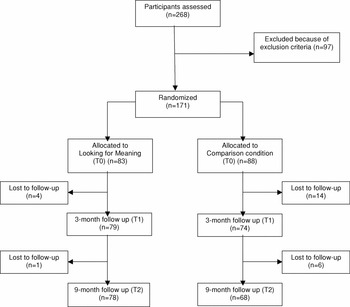
In total, 171 older adults participated in the trial: 83 in the experimental group and 88 in the comparison group (Figure 1). Ninety-seven participants were excluded because they did not fulfill the inclusion criteria. At the 3-month follow-up assessment, 152 (88.9%) participants were retained in the trial and at the 9-month follow-up assessment the response was 84.2% (144 respondents).
Participant flow and follow-up.

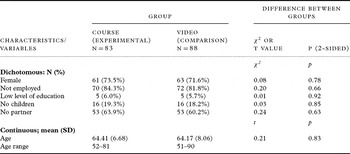
The total sample consisted of 124 females (72.5%) and 47 males (27.5%). The age of the participants ranged from 51 to 90 years (M = 64.3; SD = 7.4) and the mean CES-D score at baseline was 20.7 (SD = 7.6). There were no significant differences at baseline between the experimental and comparison conditions on sample characteristics and primary and secondary outcomes, indicating that the randomization had been successful (Tables 1 and 2).
Sample characteristics: baseline differences between experimental and comparison group

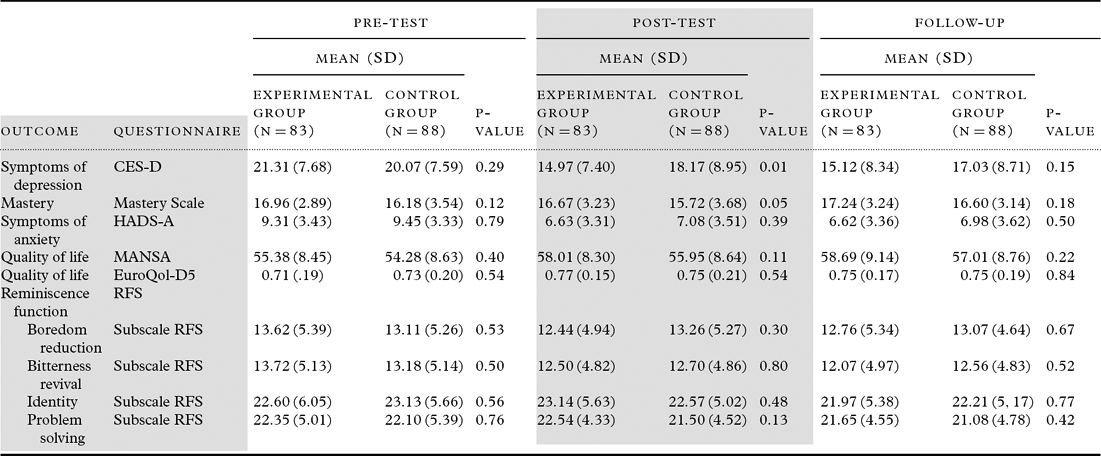
Means and standard deviations for the experimental and control group at pre-test, post-test and follow-up
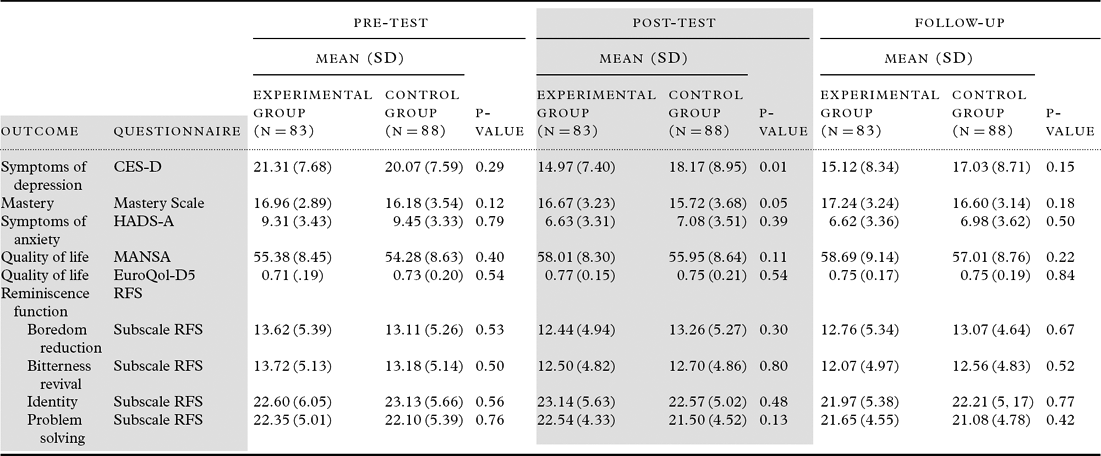
CES-D = Center for Epidemiological Studies Depression Scale; HADS-A = Hospital Anxiety and Depression Scale – Anxiety scale; MANSA = Manchester Short Assessment of Quality of Life; RFS = Reminiscence Function Scale.
Outcomes: means and effect sizes
Table 2 shows the average scores for the experimental and comparison group at baseline, post-test and follow-up measurements. T-tests comparing the means of both groups at post-measurement showed a significant difference in CES-D scores (M = 14.97 (SD = 7.40) vs. M = 18.17 (SD = 8.95); t = −2.55, p = 0.01) and in scores on the Mastery Scale (M = 16.67 (SD = 3.23) vs. M = 15.72 (SD = 3.68); t = 1.97, p = 0.05). The experimental group reported less depressive symptoms and a higher level of control over one's life. No other significant differences between the experimental and the comparison group at any of the measurements were found.
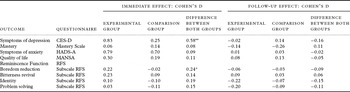
For the experimental group, the within-group effect sizes of the change between pre- and post-treatment were large for the primary outcome, the CES-D, showing a reduction in depressive symptoms after treatment (Table 3). This was not the case for the comparison group. Therefore, the between-group effect size for the change in CES-D scores at pre- and post-measurement was large (Δd = 0.58; t = 4.06, p = 0.00), showing a greater reduction in depressive symptoms for the experimental group as compared to the minimal intervention group. This reduction was maintained during follow-up (Δd = −.16; t = −1.15, p = 0.25).
Effect sizes of the differences between post-test and pre-test scores (immediate effects) and between follow-up and post-test scores (follow-up effects) for the experimental and comparison group and the differences in effect sizes between both groups (ITT analyses)

CES-D = Center for Epidemiological Studies Depression Scale; HADS-A = Hospital Anxiety and Depression Scale – Anxiety scale; MANSA = Manchester Short Assessment of Quality of Life; RFS = Reminiscence Function Scale
+p < 0.10; **p = 0.00
For both groups, the within-group effect size of the change between pre- and post-treatment was large for the secondary outcome, the HADS-A, showing a reduction in symptoms of anxiety after treatment. As a result, the between-group effect size was small and not significant. For the reminiscence style “boredom reduction”, a trend was found showing that the experimental group made less use of this style after treatment compared to the minimal intervention group (Δd = 0.24; t = 1.87, p = 0.09). All the other within-group effect sizes of the experimental group and comparison group were small.
Prognostic factors in a multivariate regression model for the primary outcome “depressive symptoms”
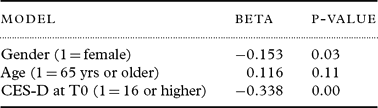
CES-D = Center for Epidemiological Studies Depression Scale.
Prognostic factors
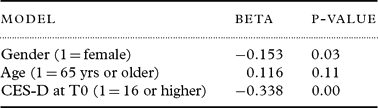
The factors gender and baseline depressive symptoms above the cut-off (CES-D >= 16) had a significant impact on the change in CES-D scores from pre- to post-treatment. Females and participants with scores beyond the cut-off showed a greater reduction in depressive symptoms. Because of these findings we conducted a post-hoc analysis, retesting the between-group effect sizes on the outcome variables for females and for participants with scores above the cut-off of the CES-D. The between-group effect size for the change in CES-D scores at pre- and post-measurement was higher for females (ΔdMALE = 0.17, ΔdFEMALE = 0.67, t = −2.80, p = 0.01) and for those with a score on the CES-D above the cut-off (ΔdCESD<16 = −.12, dCESD> = 16 = 0.77, t = −5.27, p = 0.00).
Discussion
The results of this study show that “Looking for Meaning” is an effective course for older adults aged 50 years or more: it decreased their depressive symptoms. The decrease was retained during a follow-up of 6 months after treatment. A significantly higher between-group effect size for depressive symptoms was found to the advantage of the experimental group (Δd = 0.58). There was also a similar reduction found for symptoms of anxiety, one of the secondary outcomes. However, the comparison group showed the same reduction, resulting in a small difference in effect size between the experimental and the control condition. On the other secondary outcomes (mastery, quality of life and reminiscence styles) no significant changes were found, except for a trend showing a decrease in boredom reduction for the experimental group compared to the comparison group. Gender and level of depressive symptoms were found to be prognostic factors for the change in depressive symptoms, age was not. Post-hoc analyses showed higher between-group effect sizes for the change in CES-D scores between pre- and post-treatment for females as compared to males, and for participants who scored above the cut-off on the CES-D as compared to those who scored below it.
These findings underscore the potential of life review to reduce depressive symptoms in older adults. The difference in effect size between the experimental and comparison group in this study (d = 0.58) is remarkable considering the preventive nature of the intervention. It is a little lower than the mean effect sizes found in other studies of life review among older adults (d = 0.84: Bohlmeijer et al., Reference Bohlmeijer, Smit and Cuijpers2003) or other types of psychotherapy such as cognitive behavioral therapy (d = 0.74: Cuijpers et al., Reference Cuijpers, Smit and van Straaten2007). However, in most of these other studies participants had higher levels of depressive symptoms or a clinical diagnosis of depression. Furthermore, instead of being put on a waiting list, the participants in our comparison group were, for ethical reasons, invited to view an informative video with relevant content. In this way, the “Looking for Meaning” course was compared with a minimal intervention. A consequence of a potentially effective comparison condition can be an underestimation of the incremental effect size.
“Looking for Meaning” was found to be more effective for women than for men and for those with a relatively high level of depressive symptoms (CES-D ≥ 16). The greater effect for females might be due to the content of the course. The creative components of this preventive course may be better appreciated by females. The participants were mostly female; males being more difficult to recruit. The greater impact for those with a relatively high level of depressive symptoms is in line with the aim of this course as an indicated preventive intervention.
The absence of significant effects on reminiscence styles is remarkable. An explanation might be that the Reminiscence Function Scale, the instrument we used to measure reminiscence styles, may possibly measure traits rather than states. In an earlier study, personality traits were found to be predictors of reminiscence styles (Cappeliez and O'Rourke, Reference Cappeliez and O'Rourke2002).
It is important to keep in mind that the life review course also reduced the symptoms of anxiety in the participants, although – unexpectedly – the minimal intervention video “The Art of Growing Older”, showed the same effect. It is probable that such an effect would not have been found for a control group not receiving this minimal intervention. The video's effectiveness may be attributable to the possibility that the three portraits shown of people growing older may have taken away feelings of anxiety with regard to the aging process. Although it was not the focus of this study, showing the video seems to be an efficient way of reducing anxiety symptoms among older adults.
We have to place the findings in the context of the limitations of our study. First of all, our data were not complete. At the post-test assessment, 11.1% of the data were missing and at the 6-month follow-up assessment, the loss to follow-up was 15.8%. Although this percentage is not extremely high, the imputation of missing values may still have distorted the results. Secondly, therapists were not blinded in this study, although they were encouraged to present both the experimental and the comparison condition with equal enthusiasm, in order to limit the positive effects for the experimental group. Thirdly, the trial was pragmatic, meaning that compliance with the protocol and the quality of the therapy provided were not controlled, which may have led to an underestimation of the effects. Fourthly, we did not measure depressive disorders at post-treatment, therefore the impact of the course regarding the diagnosis of depression is unknown. Finally, the “Looking for Meaning” course is not typical of life-review interventions in general. Most life-review interventions are of shorter duration (six sessions), with smaller groups (a maximum of four participants) and are supervised by only one mental health professional (Bohlmeijer et al., Reference Bohlmeijer, Smit and Cuijpers2003; Reference Bohlmeijer, Roemer, Cuijpers and Smit2007).
The indicated preventive intervention trial reported here also has a number of strengths. The size of the RCT was large by comparison with earlier studies in this field. The pragmatic character of the study also has an advantage: the generalizability to common clinical practice is high. Furthermore, it is the first time reminiscence styles have been measured in a trial of life review, although we did not find significant differences in reminiscence styles after the course between the experimental and control group. Finally, the follow-up period in this study of six months was relatively long. Usually the follow-up period, if there is one, is no longer than three months (Bohlmeijer et al., Reference Bohlmeijer, Smit and Cuijpers2003; Reference Bohlmeijer, Roemer, Cuijpers and Smit2007).
Although participants ranged in age from 50 to 90 years, the mean age of the participants was relatively low (64 years). This might be due to the way in which participants were recruited, but also to the content of the intervention. It would be worthwhile to investigate how older adults with depressive symptoms in the higher age categories could be recruited and treated in the best way and to test whether the intervention reported here would also be effective for people in the higher age categories, because this group is often excluded in studies on the effectiveness of psychological interventions (Gatz, Reference Gatz2007; Pot, Reference Pot2009).
Based on the present study, the “Looking for Meaning” course can be recommended for people aged 50 years or more, in particular females and older adults with a clinically significant level of depressive symptoms (above the cut-off of the CES-D). Studies on the working mechanisms of life review, including the role played by personal meaning, are recommended (Westerhof et al., Reference Westerhof, Bohlmeijer, van Beljouw and Pot2010).
Conflict of interest
None.
Description of authors’ roles
A. M. Pot co-designed the study, supervised the data collection, analyzed the data and wrote the paper. E. Bohlmeijer co-designed the study, supervised the data collection and assisted with writing the paper. Simone Onrust assisted with the data collection, data analysis and writing; Anne-Sophie Melenhorst assisted with the data analysis and writing; and Marjolein Veerbeek and Wilma De Vries assisted with the data collection and writing.
Acknowledgments
This study was supported by a grant from the Netherlands Organization for Health Research and Development (6220.0018). We thank all participating organizations and the participants in the trial for their help in conducting this study.