Introduction
The Sultanate of Oman in southern Arabia lies in the transition zone between the Holarctic and Palaeotropical Kingdoms, as well as between subtropical and tropical climate zones, a position reflected by the presence of species from several biogeographical regions (Miller & Nyberg, Reference Miller and Nyberg1991; Patzelt, Reference Patzelt2011). Oman is mainly characterised by arid habitats, with much of the region occupied by sand dunes or rock and gravel desert. However, and often in stark contrast to the deserts, the country also contains a number of habitats supporting high species diversity with a large number of endemic species. This is reflected in the comparatively high number of vascular plants in Oman (1208 species; Ghazanfar, Reference Ghazanfar2003).
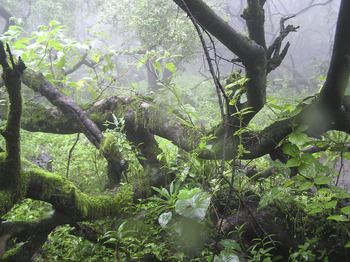
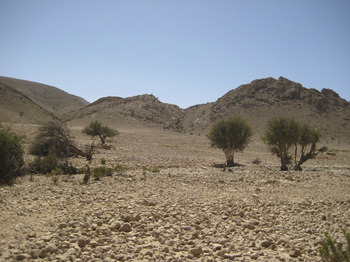
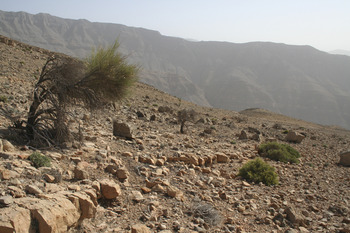
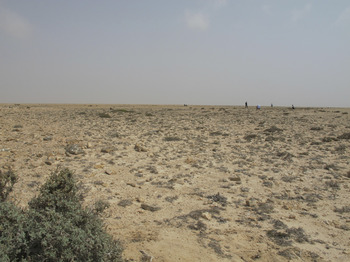
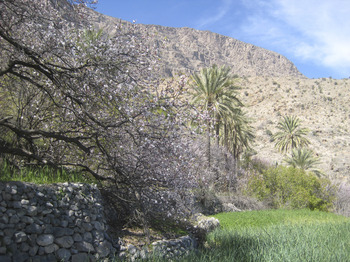
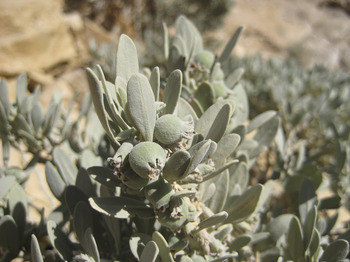
Notable species-rich habitats include southern Oman (Fig. 1), the Eastern Hajar mountains (Fig. 2), Western Hajar mountains, and the Musandam Peninsula of northern Oman (Fig. 3), as well as the coastal areas of the Central Desert including the Sahil Al Jazir and the Jiddat Al Arkad (Fig. 4). Species richness is relatively low in much of the central plains and the sand desert of the Rub Al Khali, where the flora is characterised by widespread Saharo-Arabian species. The weed vegetation of traditional agricultural terraces and farms (Fig. 5) is rich in species (Patzelt, Reference Patzelt, Buerkert and Schlecht2010), in part due to the sparse use of chemical fertiliser, insecticides and pesticides.
The southern mountains of Oman are influenced by the southwest monsoon. The steep south-facing escarpment mountains are covered by deciduous cloud forest vegetation, characterised by high levels of endemism. Photo © Annette Patzelt. (See online for a colour version of this figure.)

The Eastern Hajar mountains in northern Oman are characterised by open stony desert with scattered trees and shrubs; main tree species are Prunus arabica (Rosaceae), the Oman endemic Ziziphus hajarensis (Rhamnaceae) and the regional endemic Ceratonia oreothauma subsp. oreothauma (Fabaceae). Photo © Annette Patzelt. (See online for a colour version of this figure.)

The mountains of Musandam in northern Oman form a distinct geological and ecological unit with a characteristic and diverse flora; main species at higher altitudes are Prunus arabica (Rosaceae), Ephedra pachyclada (Ephedraceae) and Artemisia sieberi (Asteraceae). Photo © Annette Patzelt. (See online for a colour version of this figure.)
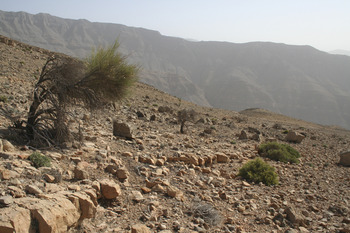
The Central Desert of Oman is a local centre of plant endemism, with c.35% of the species being endemic; the vegetation consists of low xerophytic plants. Photo © Annette Patzelt. (See online for a colour version of this figure.)

The oasis settlements in the Western Hajar mountains are thousands of years old; cultivation of temperate crop trees such as Prunus armeniaca (Rosaceae) and annual crops with endemic wheat landraces is sustained by a complex and sophisticated irrigation system. Photo © Annette Patzelt. (See online for a colour version of this figure.)

Recent research and data analysis have revealed that Oman has a total of 189 range-restricted species, representing 15.8% of the total flora (Reference PatzeltPatzelt, in press). The high proportion of range-restricted species (endemics, near-endemics and regional endemics) in the Sultanate can be explained by a unique combination of ecological factors that restricted the range of species in the past. For the purposes of this study, an ‘endemic species’ is defined as a species that occurs in only one country and a ‘near-endemic’ is defined as a species which occurs in limited numbers in no more than two countries in the Arabian Peninsula, within one geographical entity (e.g. one mountain range). A ‘regional endemic’ species occurs in more than two countries and in several geographical entities. Endemics are found in all vegetation types and throughout the country. However, some habitats are particularly rich and are of special interest, encompassing sites of maximum biodiversity.
The mountains of southern Oman (Dhofar) are influenced by the southwest monsoon, which has enabled the development of cloud forest in an otherwise arid environment. The area is an outstanding example of an island-like refugium and represents a fragile ecosystem unique on a global scale (Kürschner, Reference Kürschner, Ghazanfar and Fisher1998; Kürschner et al., Reference Kürschner, Hein, Kilian and Hubaishan2004; Hildebrandt & Eltahir, Reference Hildebrandt and Eltahir2006; Patzelt, Reference Patzelt2011; Reference PatzeltPatzelt, in press). The mountain chain in southern Oman and adjacent Yemen contains considerable plant species diversity with high levels of endemism. Southern and central Oman have been identified as one of the world’s 35 key biodiversity hotspots – areas that contain at least 1500 endemic species of vascular plants (> 0.5% of the world’s total), and where at least 70% of the natural vegetation has been lost (Mittermeier et al., Reference Mittermeier, Gil, Hoffman, Pilgrim, Boroks, Goettsch Mittermeier, Lamoreux and Da Fonseca2005). The flora and vegetation of Oman, being part of the ‘Horn of Africa’ hotspot, reflect this unique floristic diversity.
The mountains in northern Oman are part of an arid subtropical mountain system extending from southern Arabia to southwest Asia. Here, Sideroxylon mascatense–Olea europaea subsp. cuspidata woodland (an evergreen sclerophyllous open woodland community) and the high-montane needle-leaved woodland dominated by Juniperus excelsa subsp. polycarpos are unique plant communities, holding about 30% of the total flora of the country (Patzelt, Reference Patzelt2009). The species diversity of the woodland communities is diverse and holds many range-restricted and rare and threatened plant species.
Although there has been good progress in recent decades extending our knowledge of the flora of Oman (Cope, Reference Cope1985, Reference Cope2007; Miller & Morris, Reference Miller and Morris1988; Ghazanfar, Reference Ghazanfar1992, Reference Ghazanfar2003, Reference Ghazanfar2007; Miller & Cope, Reference Miller and Cope1996), detailed studies of the ecology and vegetation are still scarce and data are lacking regarding the distribution, population parameters and ecology of plant species.
This publication is an update of our knowledge of the flora of the country. The checklist of the flora of Oman (Ghazanfar, Reference Ghazanfar1992), the published floras (Ghazanfar, Reference Ghazanfar2003, Reference Ghazanfar2007; Miller & Cope, Reference Miller and Cope1996; Cope, Reference Cope2007) and recent publications (Feulner, Reference Feulner2011; Mosti et al., Reference Mosti, Raffaelli and Tardelli2012) have been used as reference sources for species currently listed for Oman. Most of the new records extend the hitherto known global distribution of species including range-restricted, rare and phytogeographically noteworthy taxa, filling distribution gaps. The new records in this paper increase the total species numbers in the country from 1208 (Ghazanfar, Reference Ghazanfar2003) to 1238.
Conservation Aspects
Although larger areas of Oman can still be considered wilderness, development in recent decades has considerably modified many natural habitats. Many of these are highly fragile and are now under pressure from agricultural intensification (mainly overgrazing), urban sprawl, and infrastructure development, as well as climate change which is expected to become an increasingly serious threat in the future. The habitats are highly diverse, but the relative importance of different threats does not vary greatly across the country’s biogeographic regions and habitats. Even though considerable efforts have been made to protect and conserve habitats and species in Oman, biodiversity decline and the associated loss of vital ecosystem services continues to be a major concern.
The Oman Botanic Garden, currently under construction, already holds the largest documented collection of Arabian plants (Patzelt et al., Reference Patzelt, Morris, Al Harthi, Al Rashdi and Spalton2008, Reference Patzelt, Al Farsi, Morris and Spalton2009), including many species listed in this publication. The garden has the unique aim of propagating and displaying the complete indigenous flora of the Sultanate of Oman, and aims to address the urgent need for conservation solutions to the biodiversity crisis. Actively addressing targets of the Global Strategy for Plant Conservation, the Oman Botanic Garden represents a new model for botanic gardens in the 21st century and is a ground-breaking initiative of ex situ conservation in Arabia.
Presentation and Documentation of Information
The species in the present account are arranged alphabetically by family. Family names and circumscriptions follow APG III (Angiosperm Phylogeny Group, 2009). The records are mainly substantiated by herbarium specimens. In a few cases, however, only photographic records or field records were taken. All material has been determined or checked by the authors, unless otherwise indicated.
Herbarium specimens cited are deposited in one or several of the following herbaria: the National Herbarium of Oman (ON), the Herbarium of Sultan Qaboos University, Oman (SQUH), the Herbarium of the Oman Botanic Garden, Oman (OBG) and the Royal Botanic Garden Edinburgh, UK (E). Specimen citation is abbreviated and standardised; herbarium voucher numbers are preceded by the initials of the collectors or the collection expedition code. The names in italics indicate the collectors. Most of the records have been collected since 1999 by A. Patzelt, and by T. Harrison from 2006 to 2009; some collections have been made by the Oman Botanic Garden team. Photographic records are accessible at Oman Botanic Garden.
Geo-reference and location details have been withheld in some cases to protect vulnerable species from collection.
New Records for Arabia
Apiaceae
Pimpinella anisum L.
This species was collected in abandoned terraces in an old village. It is likely to be an escape from cultivation. The specimens were found growing along an old irrigation channel, in the shade of date palms. Records. Northern Oman: Old Al Khod village, 23°34.245′N, 058°07.330′E, 99 m, A. Patzelt, AP 1037 (E, SQUH) and AP 2184 (OBG).
Apocynaceae
Oxystelma esculentum (L.f.) R.Br.
This species is only known from one location in Oman, the population being confined to a very small area in a wadi with permanent pools. The new record closes a distribution gap between African and Asian populations. Records. Northern Oman: Eastern Hajar mountains, Wadi Al Arbeyn, village of Suwayh, 23°01′58.4″E, 058°59′51.8″N, 106 m, A. Patzelt et al., AP 3990 (OBG).
Convolvulaceae
Merremia dissecta (Jacq.) Hallier f.
In Oman, this species is only known from a few locations, all located in villages. The new record closes the distribution gap that existed with the disjunction between Africa and SE Asia. Records. Northern Oman: Western Hajar mountains, Wadi Bani Kharous, Al Alya village, 23°10.793′N, 057°38.700′E, 875 m, A. Patzelt, AP 1615 (SQUH). Western Hajar mountains, Wadi Bani Awf, Bilad Seet, 23°11.538′N, 057°23.339′E, 960 m, A. Patzelt, AP 3704 (OBG). Western Hajar mountains, Wadi Bani Kharous, Al Alya village, 23°10.830′N, 057°38.971′E, 883 m, A. Patzelt, AP 3748 (OBG).
Solanaceae
Withania coagulans (Stocks) Dunal
This species is restricted to the high plateau of the Eastern Hajar mountains, above 1340 m (Fig. 6). It was found in six locations, typically growing in stony deserts with scattered trees such as Ceratonia oreothauma and Prunus arabica. Records. Northern Oman: Eastern Hajar mountains, Jabal Bani Jabir, 23°35.530′E, 059°01.620′E, 1426 m, A. Patzelt, AP 3765 (OBG) and T. Harrison, AP 3806 (OBG).
The collection of Withania coagulans (Solanaceae) represents a new record for Arabia. This conspicuous species is restricted to the high plateaux of Jabal Bani Jabir, Eastern Hajar mountains. Photo © Annette Patzelt. (See online for a colour version of this figure.)

New Records for Oman
Amaranthaceae
Alternanthera tenella Colla var. bettzickiana Veldk.
This is the second record of this species from the Arabian Peninsula and the first in Oman. It has been collected only once from Saudi Arabia (Miller & Cope, Reference Miller and Cope1996), where it was noted as an escape from cultivation. The record from southern Oman may also represent an escape from cultivation, as it was found in a ruderal area, on moist ground next to a spring. Records. Southern Oman: Jabal Qara, Ain Sahalnoot, 17°08.476′N, 054°10.421′E, 121 m, A. Patzelt, AP 3894 (OBG).
Apocynaceae
Desmidorchis lavranii (Rauh & Wertel) Meve & Liede
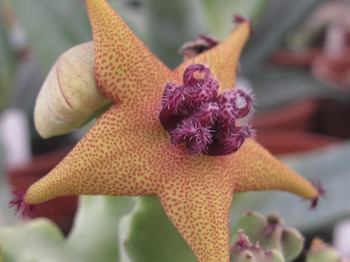
This regional endemic is known from only one location in Oman, the population consisting of just two individuals (Fig. 7) growing in xeromorphic Commiphora scrubland. The species has previously been recorded from only three locations in Yemen, and seems to be very rare in the whole Arabian Peninsula. The new record extends the hitherto known distribution by about 400 km to the east and represents the easternmost distribution of this species. Records. Southern Oman: Jabal Qamar, S. Al Hatmi & A. Patzelt (photographic record).
Desmidorchis lavranii (Apocynaceae) is only known from one location in Oman, the population consisting of just two individuals. Photo © Annette Patzelt. (See online for a colour version of this figure.)

Asteraceae
Atractylis arabica Rech.f.
This species was collected from shallow, flat-lying, silty depressions on Tertiary limestone. Records. Northern Oman: Eastern Hajar mountains, Jabal Asfar, 23°01.09′N, 058°52.57′E, 1540 m, T. Harrison, AP 3811 (OBG). Eastern Hajar mountains, Jabal Bani Jabir, Salma plateau, 22°52.02′N, 059°06.17′E, 1352 m, T. Harrison (photographic record).
Pulicaria arabica (L.) Cass.
This species was recorded on wet and moist rock faces. It also occurs in the United Arab Emirates (UAE) in similar habitats (Jongbloed, Reference Jongbloed2003). Records. Northern Oman: Western Hajar mountains, Jabal Shams, village Sap Bani Habib, 23°21.542′N, 057°20.944′E, 1872 m, A. Patzelt (photographic record). Wadi Tiwi, 22°48.271′N, 059°14.258′E, 46 m, T. Harrison (photographic record). Wadi Muzinah, 23°11.304′N, 058°18.346′E, 1872 m, T. Harrison (photographic record). Wadi Al Hedik, 23°22.202′N, 057°54.419′E, 890 m, T. Harrison (photographic record).
Xanthium strumarium L.
Xanthium strumarium is a plant of waste ground and a troublesome weed of irrigated plantations in all continents. In Oman, all three records are from cultivated or ruderal areas. Further records from Oman are expected, as this weedy species may extend its distribution. Records. Northern Oman: Wadi Al Khod, 23°32.347′N, 058°05.566′E, 104 m, A. Patzelt, AP 4235 (OBG). Eastern Hajar mountains, Wadi Tayyin, 2.5 km west of Mizbar, 23°08.44′N, 058°25.21′E, 544 m, T. Harrison (photographic record). Samail, 23°18.54′N, 058°01.07′E, 344 m, T. Harrison (photographic record).
Boraginaceae
Buglossoides tenuiflora (L.f.) I.M.Johnst.
On the Arabian Peninsula, this species was previously only known from Saudi Arabia and Kuwait. It was collected from a rocky limestone plateau with Cymbopogon jwarancusa. Records. Northern Oman: Musandam, Jabal Harim, 25°57′24″N, 056°12′14″E, 1440 m, J. Henrot, JH 90 (ON). Musandam, Jabal Harim, Sahil Al Sahosa, 25°57′51.0″N, 056°12′21.3″E, 1450 m, L. Al Harthy & A. Al Hinai, LAH 78 (OBG).
Heliotropium digynum (Forssk.) Asch. ex C.Chr.
In the UAE, the species is common and widespread (Jongbloed, Reference Jongbloed2003). In Oman, it was found to be abundant on sandy plains and on low inland sand dunes, growing together with Moltkiopsis ciliata. Records. Northern Oman: Ar Rub Al Khali, Nuwayy, Wilayat Mahadah, 24°30.110′N, 055°54.570′E, 405 m, T. Harrison, AP 3752 (OBG).
Heterocaryum szovitsianum (Fisch. & C.Mey.) A.DC.
On the Arabian Peninsula, this species has so far only been recorded from Saudi Arabia. It was collected from a rocky limestone plateau with Cymbopogon jwarancusa. Records. Northern Oman: Musandam, Jabal Harim, Sahil Al Sahosa, 25°57′51.0″N, 056°12′21.3″E, 1450 m, L. Al Harthy & A. Al Hinai, LAH 58 (OBG).
Moltkiopsis ciliata (Forssk.) I.M.Johnst.
In the UAE, the species is common and widespread (Jongbloed, Reference Jongbloed2003). In Oman, it was found to be abundant on sandy plains and on low inland sand dunes, growing together with Heliotropium digynum. Records. Northern Oman: Ar Rub Al Khali, Nuwayy, Wilayat Mahadah, 24°30.110′N, 055°54.570′E, 405 m, T. Harrison, AP 3751 (OBG).
Brassicaceae
Leptaleum filifolium (Willd.) DC.
On the Arabian Peninsula, this small annual has previously been recorded from Saudi Arabia and Kuwait (Miller & Cope, Reference Miller and Cope1996). This record closes a distribution gap between the northern Arabian Peninsula and Pakistan. It was collected from a rocky limestone plateau with Cymbopogon jwarancusa. Records. Northern Oman: Musandam, Jabal Harim, Sahil Al Sahosa, 25°57′51.0″N, 056°12′21.3″E, 1450 m, L. Al Harthy & A. Al Hinai, LAH 50 (OBG).
Caprifoliaceae
Valerianella discoidea (L.) Loisel.
This species has been collected from moist, north-facing cliffs and rocky slopes. The population is very small and an intensive search of the whole area revealed only around 80 plants. Associated species in this annual assemblage were Callipeltis cucullaris, Anagallis arvensis, Galium setaceum and Torilis stocksiana. Records. Northern Oman: Western Hajar mountains, Jabal Nakl, 23°21.572′N, 057°54.590′E, 1185 m, T. Harrison, AP 3785 (OBG) and AP 3809 (OBG).
Valerianella szovitsiana Fisch & C.A.Mey.
This small annual was collected from a rocky limestone plateau with Cymbopogon jwarancusa. Records. Northern Oman: Musandam, Jabal Harim, Sahil Al Sahosa, 25°57′51.0″N, 056°12′21.3″E, 1450 m, L. Al Harthy & A. Al Hinai, LAH 38 (OBG).
Cucurbitaceae
Momordica balsamina L.
This species was found on shady terrace walls in two locations in a village in the capital area. Records. Northern Oman: Capital area, village in Ghala and Bowshar area, 23°31′457.3″N, 58°23′00.23″E, c.100 m, A.G. Miller & S.G. Knees (photographic record).
Elatinaceae
Bergia polyantha Sond.
This inconspicuous annual only germinates after heavy rain and may be overlooked and under-collected in the country. The locations in Oman represent the easternmost distribution of this species. It has also been recently newly recorded from Somalia and Saudi Arabia (Thulin, Reference Thulin and Thulin1993). Records. Northern Oman: Eastern Hajar mountains, Wadi Muzinah, 23°14.923′N, 057°10.080′E, 700 m, T. Harrison, AP 3962 (OBG). Wadi Fida, D. Insall, DHI 27 (ON).
Euphorbiaceae
Euphorbia schimperiana Scheele
The newly recorded population is small but healthy, found amongst weedy vegetation in a mountain village. Records. Northern Oman: Western Hajar mountains, village of Wakan, 23°08.559′N, 057°44.046′E, 1496 m, A. Patzelt, AP 2921 and AP 2952 (OBG).
Fabaceae
Medicago lupulina L.
This globally widespread species was found in cultivated fields and on the margins of date groves. It is expected to be more widespread in Oman. Records. Northern Oman: Batinah, Mughrah (Ghala), 23°27.030′N, 058°13.050′E, 190 m, T. Harrison, AP 3685 (OBG).
Stylosanthes fruticosa (Retz.) Alston
On the Arabian Peninsula, this species was previously only known from Saudi Arabia (http://plantdiversityofsaudiarabia.info/biodiversity-saudi-arabia/flora/Flora.htm) and Yemen (Wood, Reference Wood1997). Records. Southern Oman: Road to Ain Razat, 7 m, S. Collenette, 8835 (ON).
Pedaliaceae
Pedalium murex L.
On the Arabian Peninsula, this species was previously only recorded from Saudi Arabia (http://plantdiversityofsaudiarabia.info/biodiversity-saudi-arabia/flora/Flora.htm) and Yemen (Wood, Reference Wood1997). Records. Southern Oman: Salalah, Ad Dahariz, 17°01′N, 054°10′E, 10 m, I.M. McLeish, 1356 (ON).
Plantaginaceae
Campylanthus antonii Thulin
Campylanthus antonii, endemic to Oman and Yemen, was found in one location, growing in fissures in limestone cliffs. This record extends the known distribution by c.350 km to the east. In Oman, it is so far only known from this location. Records. Southern Oman: Jabal Qamar, limestone, 16°52.088′N, 053°43.376′E, 57 m, A. Patzelt et al., AP 2783 (OBG).
Poaceae
Aegilops kotschyi Boiss.
On the Arabian Peninsula, this species was previously only known from Saudi Arabia, Kuwait and the UAE (Cope, Reference Cope2007). In Oman, it was recorded from a rocky limestone plateau with Cymbopogon jwarancusa. Records. Northern Oman: Musandam, Jabal Harim, Sahil Al Sahosa, 25°57′51.0″N, 056°12′21.3″E, 1450 m, L. Al Harthy & A. Al Hinai, LAH 63 (OBG).
Cenchrus echinatus L.
This weedy species is known to be invasive in other countries. Further records in Oman are therefore expected. Records. Northern Oman: Foothills of the northern mountains, village of Fanja, 23°27.350′N, 058°06.090′E, 180 m, T. Harrison, AP 3757 (OBG). Eastern Hajar, Wadi Tayyin, 23°08.43′N, 058°25.20′E, 550 m, T. Harrison (field records).
Primulaceae
Anagallis pumila Sw.
The previous record of this delicate annual from Oman was considered doubtful (Ghazanfar, Reference Ghazanfar2003) and required confirmation. The plants are very small and inconspicuous and only appear in the wettest season of the year. The species is restricted to the endemic tall-grass savannah, which is found exclusively in the monsoon-affected mountains of southern Arabia (Patzelt, Reference Patzelt2011). Records. Southern Oman: Jabal Qamar, above Dalkut, c.700 m, S. Collenette, 8944 (ON). Jabal Qamar, above Rakhyut, 16°43.572′N, 053°14.970′E, 622 m, A. Patzelt, AP 1810 (ON).
Lysimachia linum-stellatum L.
This inconspicuous species only seems to come up after heavy rain, and may be overlooked. It has been recorded as rare in the UAE (Jongbloed, Reference Jongbloed2003). Records. Northern Oman: Eastern Hajar mountains, Jabal Abu Daud, 23°22.170′N, 058°47.170′E, 472 m, T. Harrison, AP 3612 (OBG). Musandam, road from Khasab to Diba, 25°00′N, 056°00′E, I. McLeish, 3752 (ON).
Rubiaceae
Coptosperma graveolens (S.Moore) Degreef subsp. arabicum (Cuf.) Degreef
This subspecies is regionally endemic to Arabia. In Oman, it was collected on the high limestone plateau of Jabal Samhan, and from several locations on Jabal Qamar. The habitats in Oman extend from wadis and rocky slopes at lower latitudes to cliffs in the Anogeissus dhofarica forest and Euphorbia balsamifera subsp. adenensis cushion scrub at higher altitudes. The collections from southern Oman represent its easternmost occurrence. Records. Southern Oman: Jabal Samhan, 17°09.146′N, 054°45.338′E, 1404 m, A. Patzelt et al., AP 2710 (OBG). Jabal Qamar above Dalkut, 16°42.070′N, 053°07.272′E, 1155 m, A. Patzelt et al., AP 2807 (OBG). Jabal Qamar, Sarfayt, 16°41.762′N, 053°08.073′E, 670 m, A. Patzelt (field records).
Pentodon pentandrus (Schumach. & Thonn.) Vatke
This species was found on seasonally wet ground at the bottom of wadis or as a weed of cultivation. The plant is present as a weed in many parts of Muscat. The populations represent the species’ easternmost occurrence. Records. Northern Oman: Wadi Siya, 400 m, S.A. Ghazanfar, 973 (SQUH). Western Hajar mountains, Wadi Sahtan, 23°16.029′N, 057°23.875′E, 716 m, A. Patzelt, AP 926 (SQUH). Western Hajar mountains, Nakl, 23°38.857′N, 057°82.983′E, 310 m, A. Patzelt, AP 2386 (OBG).
Pyrostria phyllanthoides (Baill.) Bridson
This species is found in dense semi-deciduous fog-facing Anogeissus dhofarica forest at lower altitudes. In Oman, it is currently only known from three locations, each of which has a very small population of a few plants only. All specimens were collected after the monsoon season and were without flowers or fruits. The species was also recently reported from Yemen (Kilian et al., Reference Kilian, Hein and Hubaishan2002). The collections from Dhofar extend the known distribution by c.200 km and represent its easternmost occurrence. Records. Southern Oman: Jabal Qamar, Dalkut, 350 m, A. Patzelt, AP OM 1295 (E, ON, SQUH). Jabal Qamar, Dalkut, 360 m, A. Patzelt, AP OM 1299 (ON, SQUH). Jabal Samhan, 17°06.812′N, 054°42.854′E, 1309 m, A. Patzelt, AP 3841 (OBG). Jabal Qamar, 16°46.035′N, 053°37.008′N, 763 m, A. Patzelt & I. Al Rashdi, AP 3884 (OBG).
New Distribution Records
Pteridaceae
Onychium divaricatum (Poir.) Alston
This species was previously known only from the Musandam Peninsula (Miller & Cope, Reference Miller and Cope1996). The new records from the Hajar mountains extend the known distribution by c.500 km further south. The species is locally abundant on shaded north-facing slopes and in crevices. Records. Northern Oman: Western Hajar mountains, Jabal Nakl, Wadi Al Hedik, 23°21.572′N, 057°54.590′E, 1185 m, T. Harrison, AP 3923 (OBG). Eastern Hajar mountains, Jabal Abu Daud, 23°21.29′N, 058°47.18′E, 1125 m, T. Harrison (photographic record).
Acanthaceae
Barleria samhanensis S.G.Knees, A.G.Mill. & A.Patzelt
The distribution of the recently described endemic Barleria samhanensis has been extended. It was originally only known from the high plateau area of Jabal Samhan, between 1400 and 1600 m (Knees et al., Reference Knees, Miller and Patzelt2007), but is now recorded from much lower altitudes. Records. Southern Oman: Jabal Samhan, Wadi Dahanoot, 36 m, 17°29.027′N, 55°12.722′E, A. Patzelt et al. (photographic record).
Ruellia discifolia Oliv.
Ruellia discifolia belongs to the complex of species found in the Somali-Masai centre of endemism. This is the first record of this species from northern Oman, which extends its hitherto known distribution by c.900 km further north. Records. Northern Oman: Eastern Hajar, 22°55.228′N, 058°55.494″E, 1270 m, L. MacKinnon et al., LEM 294 (OBG).
Amaranthaceae
Alternanthera pungens Kunth
This weedy species has only recently been recorded from southern Oman (Ghazanfar, Reference Ghazanfar2003), and is now newly recorded from northern Oman. It was found in a village at high altitude. Further records are expected from other ruderal locations in Oman, as the species seems to be spreading quickly. Records. Northern Oman: Jabal Akhdar, village of Shuraija, 1786 m, 23°04.143′N, 057°39.530′E, 1786 m, A. Patzelt, AP 3817 (OBG).
Apocynaceae
Caudanthera edulis (Edgew.) Meve & Liede
In northern Oman, this species was previously only known from one location at the Dibab sinkhole (Al Faqa’ah). Recent construction of recreational facilities around this location has destroyed the population (Patzelt, pers. obs.). The population around Ibra in Acacia tortilis–Euphorbia larica woodland on the interior gravel plain is small but healthy, and represents the only known living population of this species in northern Oman. Records. Northern Oman: Ibra, S. Al Rahbi, AP 3868 (OBG).
Asteraceae
Anthemis odontostephana Boiss.
This species has been reported from northern Oman, but only from Musandam and the Eastern Hajar mountains (Mandaville, Reference Mandaville1985). The record from the Western Hajar mountains closes this distribution gap. The species was found in several different locations, on rocky slopes amongst scattered Prunus arabica trees. Records. Northern Oman: Western Hajar mountains, Jabal Nakl, Wadi Hedik, 1165 m, 23°00.05′N, 057°55.020′E, T. Harrison, AP 3786 (OBG).
Jurinea berardioides (Boiss.) O.Hoffm.
Previously only known from Musandam, this species was collected from the Eastern Hajar mountains, in a stony desert with scattered trees such as Prunus arabicus and the regional endemic Ceratonia oreothauma subsp. oreothauma. This record represents the southernmost distribution of the species and extends its global distribution by 400 km. Records. Northern Oman: Eastern Hajar mountains, Jabal Bani Jabir, 23°49.140′N, 059°00.673′E, 1600 m, A. Patzelt, AP 3770 (OBG).
Koelpinia linearis Pall.
This annual, previously only known in Oman from Musandam, was growing with other desert annuals in shallow sand over limestone in the foothills of the Western Hajar mountains. The species is very localised and subject to strong grazing pressure. It extends the hitherto known distribution by c.200 km further south. Records. Northern Oman: Ar Rub Al Khali, Nuwayy, Wilayat Mahadah, 24°30.110′N, 055°54.570′E, 405 m, T. Harrison (photographic record).
Tridax procumbens L.
This widespread tropical weedy perennial was first recorded from southern Oman (Pickering & Patzelt, Reference Pickering and Patzelt2008). Recently, it was also noted from northern Oman, as a weed in an amenity planting. Records. Northern Oman: Muscat, Muscat airport, 23°35′17.7″N, 058°17′31.6″E, 61 m, A. Patzelt (field record).
Boraginaceae
Gastrocotyle hispida (Forssk.) Bunge
This species was recorded from a rocky limestone plateau with Cymbopogon jwarancusa. Records. Northern Oman: Musandam, Jabal Harim, Sahil Al Sahosa, 25°57′51.0″N, 056°12′21.3″E, 1450 m, L. Al Harthy & A. Al Hinai, LAH 77 (OBG).
Brassicaceae
Lepidium sativum L.
This species seems to be uncommon in Oman. It may be under-collected. It has been recorded from Musandam and one location in the coastal plain north of Muscat. The new collection represents the first record from the Hajar mountains. Records. Northern Oman: Western Hajar mountains, Al Khabain, 24°18.500′N, 056°07.100′E, 638 m, T. Harrison, AP 3750 (OBG).
Capparidaceae
Cadaba heterotricha Stocks
This species was hitherto only recorded from southern Oman (Miller & Cope, Reference Miller and Cope1996), but has now been found in several locations in northern Oman, in Acacia tortilis–Euphorbia larica woodland and Acacia tortilis–Commiphora woodland. Records. Northern Oman: Foothills of the northern Hajar mountains, Muscat, 23°34.060′N, 058°20.040′E, 62 m, C. Winbow, AP 2424 (OBG). Western Hajar mountains, Jabal Misht, 23°17.151′N, 057°00.911′E, 1085 m, S. Al Hatmi, AP 3702 (OBG). Western Hajar mountains, Jabal Nakl, 23°22.181′N, 057°55.052′E, 1942 m, T. Harrison, AP 3924 (OBG). Foothills of Hajar mountains SE of Fanja, 23°26.44′N, 058°11.01′E, 438 m, T. Harrison (photographic record).
Caprifoliaceae
Lonicera hypoleuca Decne.
This species was previously considered to be restricted to the Western Hajar mountains (Ghazanfar, Reference Ghazanfar1992), but has now also been recorded in the Eastern Hajar range. In the Western Hajar mountains, the species is restricted to Sideroxylon mascatense–Olea europaea woodland, and high-montane Juniperus excelsa woodland. In the Eastern Hajar mountains, the species was found in open stony deserts with scattered trees of Prunus arabica and Ceratonia oreothauma subsp. oreothauma. The new record extends the known distribution within Oman by c.200 km to the east. Records. Northern Oman: Eastern Hajar mountains, Jabal Bani Jabir, 22°41.338′N, 059°08.506′E, 1976 m, T. Harrison, AP 3807 (OBG).
Convolvulaceae
Convolvulus acanthocladus Boiss. & Kotschy
This species was previously only recorded from Musandam and the Eastern Hajar mountains, but is now recorded from the Western Hajar mountains. The new records close the distribution gap between the Eastern Hajar mountains and Musandam. Records. Northern Oman: Jabal Shams, 23°14.923′N, 057°10.080′E, 1676 m, A. Patzelt, AP 2583 (OBG). Jabal Shams, 23°23.411′N, 057°17.868′E, 1770 m, A. Patzelt, AP 2508 (OBG). Southern foothills, Nizwa area, 22°55.203′N, 057°36.657′E, 519 m, A. Patzelt, AP 2191a (OBG).
Euphorbiaceae
Acalypha indica L.
The species is found in moist and shady locations amongst weedy vegetation in two villages. Records. Northern Oman: Eastern Hajar mountains, Mazara Village, 23°8′46.75″N, 058°49′30.43″E, 300 m, A. Patzelt, AP 289 (ON, SQU). Eastern Hajar mountains, Wadi Tiwi, 22°47′N, 059°14′E, 100 m, A. Patzelt, AP 342 (ON, SQU). Eastern Hajar mountains, Wadi Tiwi, 22°48.030′N, 059°14.370′E, 42 m, T. Harrison, AP 3800 (OBG).
Fabaceae
Argyrolobium roseum Jaub. & Spach
The previous altitudinal limit of this species in Oman was 1200 m. The new records from Olea europaea–Juniperus excelsa woodland increase the altitudinal range to 2500 m. The species is common at low and medium altitudes, but rare at higher altitudes. Records. Northern Oman: Western Hajar mountains, Jabal Akhdar, Saiq plateau, 23°11.332′N, 057°65.282′E, 2345 m, A. Patzelt, AP 2191 (OBG). Western Hajar mountains, Jabal Akhdar, Saiq plateau, 23°11.205′N, 057°65.251′E, 2380 m, A. Patzelt, AP 2196 (OBG). Western Hajar mountains, Jabal Akhdar, Saiq plateau, 23°11.083′N, 057°65.320′E, 2471 m, A. Patzelt, AP 2204 (OBG).
Dichrostachys cinerea (L.) Wight & Arn.
This rare species was previously only known from one location, where only a few trees were observed (R. Whitcombe, pers. comm.). The recently discovered population consists of two individuals only and again confirms the rarity of this small tree. Its occurrence in the Anogeissus dhofarica forest of southern Oman supports the interpretation of this deciduous cloud forest being a relict vegetation of the Tertiary semi-deciduous xero-tropical forest belt (Kürschner et al., Reference Kürschner, Hein, Kilian and Hubaishan2004). Records. Southern Oman: Jabal Qamar, Wadi Kharfoot, 16°44.050′N, 053°19.329′E, 27 m, A. Patzelt et al., AP 3934 (OBG).
Lamiaceae
Lavandula hasikensis A.G.Mill.
Lavandula hasikensis is a distinct local endemic with no clear affinities within the genus (Miller, Reference Miller1985). It was hitherto only known from very few records at high altitude between 950 and 1600 m (Miller, Reference Miller1985; Reference PatzeltPatzelt, in press). This new record extends the altitudinal range to the southern coastal plain. Records. Southern Oman: Wadi Dahanoot, 17°29.027′N, 55°12.722′E, 36 m, A. Patzelt et al., AP 3162 (OBG).
Rydingia persica (Burm.f.) Scheen & V.A.Albert
Rydingia persica has previously only been recorded in Oman from one location in the Eastern Hajar mountains, occurring in a very restricted locality from 1650 to 1800 m. The new record extends its known distribution by c.300 km to the north. The species was found on steep rocky north-facing limestone and shale slopes. Records. Northern Oman: Western Hajar mountains, Jabal Ghuwayz, 23°41.271′N, 056°48.592′E, 1100–1300 m, T. Harrison s.n. (ON).
Malvaceae
Abutilon bidentatum Hochst. ex A.Rich.
Abutilon bidentatum was previously only recorded from southern Oman, where it occurs at lower altitudes on the escarpment mountains (Ghazanfar, Reference Ghazanfar2003). This record extends the distribution of this species in Oman by c.850 km to the north. The species was found growing in the shade of date palms within a rich herbal weed community. Records. Northern Oman: Village of Al Khod, 23°34.245′N, 58°07.330′E, 99 m, A. Patzelt, AP 2936 (OBG).
Cienfuegosia welshii (T.Anders.) Garcke
In Oman, this species was previously only known from one location. The discovery of a healthy population at the edge of a large wadi system extends the known distribution range by about 400 km to the north. Many plants were found in flower and fruit, indicating low grazing pressure in the area. This perennial shrub has been wrongly recorded as being endemic to Arabia (Ghazanfar, Reference Ghazanfar2003), as it also occurs in Somalia (Thulin, Reference Thulin and Thulin1999). The species is over-grazed in Saudi Arabia and difficult to find in flower (Collenette, Reference Collenette1999). The newly discovered population in Oman, however, does not suffer from over-grazing and produces abundant flowers and fruits. Records. Central Oman: Wadi Aynaynah, 18°08.340′N, 056°12.126′E, 122 m, A. Patzelt et al., AP 3070 (OBG).
Glossostemon bruguieri Desf.
Although the species was included in the checklist by A. G. Miller (Miller & Morris, Reference Miller and Morris1988), no detailed information was provided and no voucher collection was cited from Oman. Populations fluctuate greatly between the years (Patzelt, pers. obs.); the species often survives in the ground as seed for several years before germinating after heavy rain. Records. Central Oman: Marmul area, 18°35.309′N, 055°51.915′E, 225 m, A. Patzelt, AP 3798 (OBG).
Hibiscus scindicus Stocks
This species has so far only been recorded at one location in Oman, in the foothills of the Eastern Hajar mountains (Ghazanfar, Reference Ghazanfar1992). The new record from southern Oman extends the known distribution by c.800 km and represents the southernmost known limit of this species. Records. Southern Oman: Wadi Aydam, 16°56.993′N, 053°24.447′E, 908 m, A. Patzelt et al., AP 3124 (OBG).
Senra incana Cav.
In Oman, this species has previously only been recorded from the south. The new records extend the hitherto known distribution within the country by c.850 km to the north. Records. Northern Oman: Ras Al Junayz, 22°25′N, 59°45′E, F. Lancaster (ON). Bahla, around Jabrin Fort, I. McLeish 3426 (ON). Central Oman: Wadi Aynaynah, 18°08.340′N, 056°12.126′E, 122 m, A. Patzelt et al., AP 3073 (OBG).
Plantaginaceae
Campylanthus sedoides A.G.Mill.
Collections from coastal sabkha on Bar Al-Hikman and coastal xerophytic shrub on Masirah Island extend the known distribution of this endemic species to the north and northeast. Records. Central Oman: Bar Al-Hikman, 20°35′N, 058°17′E, 5 m, A. Patzelt, AP OM 260 (SQUH). Masirah Island, 20°22′34.38″N, 58°39′33.12″E, 10 m, A. Patzelt, AP 3920 (OBG).
Polygonaceae
Rumex limoniastrum Jaub. & Spach
Rumex limoniastrum was described from the type collection on Jabal Al Akhdar in 1844 and has not been collected again until found recently in several locations both in the UAE (A. G. Miller, pers. comm.) and in Oman. These recent collections and sightings in Oman and the UAE have greatly extended its known distribution area. Records. Northern Oman: Eastern Hajar mountains, Wadi Kabbah, Batin, 22°55.530′N, 058°44.570′E, 875 m, T. Harrison, AP 3758 (OBG). Western Hajar mountains, Wadi Sahtan, 23°16.240′N, 057°15.560′E, 1625 m, T. Harrison, AP 3784 (OBG).
Rosaceae
Prunus arabica (Oliv.) Meikle
This species was previously only known from Musandam and the Eastern Hajar mountains. The new records were found in open Acacia gerrardii–Olea europaea woodland in the Western Hajar mountains on steep slopes from 950 to 1400 m. The new record closes the distribution gap that existed in the known distribution between the Eastern Hajar mountains and Musandam. Records. Northern Oman: Western Hajar mountains, Wadi Hedik, 23°22.181′N, 057°55.052′E, 1042 m, T. Harrison, AP 3922 (OBG).
Rubiaceae
Callipeltis cucullaris (L.) Steven
These collections represent the first records of this delicate annual in Oman outside Musandam. The species was found growing abundantly in small pockets of seasonally damp silty soil on limestone. Accompanying species were other annuals such as Anagallis arvensis, Castellia tuberculosa, Rostraria pumila and Galium setaceum. Records. Northern Oman: Eastern Hajar mountains, Jabal Abu Daud, 23°22.160′N, 58°47.150′E, 536 m, T. Harrison, AP 3613 (OBG). Western Hajar mountains, Jabal Nakl, Wadi Hedik, 23°00.05′N, 057°55.020′E, 1165 m, T. Harrison, AP 3810 (OBG).
Scrophulariaceae
Verbascum akhdarense (Murb.) Hub.-Mor.
This endemic species was previously only known from the Western Hajar mountains. The new records extend its distribution by c.200 km to the east. It is found growing in open stony desert with scattered trees, and also occurs in the coastal mountains of the Eastern Hajar range. Records. Northern Oman: Eastern Hajar mountains, Jabal Bani Jabir, 23°49.140′N, 59°00.673′E, 1600 m, A. Patzelt, AP 3771 (OBG).
Urticaceae
Forsskaolea viridis Ehrenb.
This collection extends the known distribution of this annual by c.800 km to the north. In southern Oman, the species is commonly found in shady and moist locations. In northern Oman, it is currently only known from one location, in the shade of wadi slopes. Records. Northern Oman: Western Hajar mountains, Wadi Bani Awf, 23°16′N, 057°27′E, 440 m, A. Patzelt, AP 3163 (SQUH).
Acknowledgements
We should like to thank all Oman Botanic Garden staff who joined our expeditions; the authors are very grateful for their support. A. G. Miller and S. Neale from the Royal Botanic Garden Edinburgh joined some of the collection expeditions and we gratefully acknowledge their contribution. We are also grateful to the National Herbarium, Ministry of National Heritage and Culture, Oman, for allowing us to work on its herbarium voucher collection.
We should like to thank Salim Al Rahbi (Oman Botanic Garden) for collecting Caudanthera edulis, Wolf-Dieter Rausch (Oman) for drawing our attention to Glossostemon bruguieri, Mats Thulin (Uppsala) for drawing our attention to Campylanthus antonii, Clive Winbow (France) for conveying one record of Cadaba heterotricha, Robert Whitcombe (UK) for information on Dichrostachys cinerea, and Ihsan Al Shehbaz (Missouri, USA) for the identification of Lepidium sativum.