The late Gerald Patterson's seminal work (Patterson, Reference Patterson and Franks1969; Patterson & Reid, Reference Patterson and Reid1984) carefully documented, using observational methods, patterns of coercive interaction between aggressive children and their parents. This observational research laid the foundations for modern parenting interventions focused on changing patterns of parent-child interaction that have helped many parents around the world struggling to manage their children's behaviour problems. Over the past four decades, a field that became variously known as parent training, behavioural parent training, parent management training, and behavioural family intervention has continued to evolve. This evolution of parenting intervention has been supported by a sustained commitment to ongoing research and development. Parenting programs based on social learning theory are now arguably the most successful and widely disseminated psychological intervention and have influenced both policy and professional practice.
In this article, I use the generic term evidence-based parenting support (EBPS) to more accurately capture the role of parenting programs in both prevention and treatment (Sanders & Prinz, Reference Sanders, Prinz, Sanders and Mazzucchelli2018). EBPS:
denotes a process of change that aims to positively influence the prosocial development, including social, emotional and physical well-being of children and youth through corresponding changes in those aspects of the family environment implicated in the development, maintenance and alteration of children's behavior and capabilities. EBPS involves the systematic application of data-based principles and techniques derived from social learning theory, public health and relevant behavioural, affective and cognitive change strategies with an emphasis on reciprocity of change and relationship building amongst family members. (Sanders & Prinz, Reference Sanders, Prinz, Sanders and Mazzucchelli2018, p. 33)
EBPS interventions feature on most reputable lists of effective prevention and treatment interventions (e.g., Blueprints for Promoting Healthy Development, California Clearing House for Evidence Based Social Work, National Institute for Clinical Excellence and Social Care, Early Intervention Foundation). Despite some inconsistencies in the specific criteria required to be considered ‘evidence based’ by different lists there is general agreement that parenting programs based on social learning, cognitive behavioural therapy (CBT) and developmental principles are effective and are a first line of intervention for children with conduct problems. Increasingly, governments around the world are funding local authorities to commission the delivery of EBPS interventions. Despite the success of these policy-led efforts (Gray, Totsika, & Lindsay, Reference Gray, Totsika and Lindsay2018), parental access to well-trained professionals is still often limited, even in countries where considerable efforts have been made to increase support for parents, particularly in the early years of life. On a global scale, EBPS programs are not widely accessible to parents in the most populated regions of the world: China, India, Indonesia, Middle East, Eastern Europe, Latin America and the Pacific Islands (Sanders, Turner, & Metzler, Reference Sanders, Turner and Metzler2019).
In this article I argue that EBPS programs are vastly underutilised resources for promotion of the mental health and wellbeing of not just children and adolescents, but also parents and entire communities. This article examines the evolution of parenting interventions over the past five decades. As a clinical researcher and program developer of the Triple P-Positive Parenting Program (Triple P system) I have had the honour of leading a talented research team in the Parenting and Family Support Centre at the University of Queensland, which is devoted to improving the wellbeing of children through developing more effective methods of supporting parents in the task of raising their children. Triple P is used as an exemplar to examine how evidence-based programs have evolved and adapted. Triple P had its origins in the late 1970s in my PhD thesis, which evaluated the generalisation effects of a home-based coaching intervention for disruptive preschool-aged children (Sanders & Glynn, Reference Sanders and Glynn1981). Since that time the core program has continued to evolve so that new innovations have been incorporated into the system of parenting support to enhance its social impact and program reach over four decades (Sanders, Reference Sanders2012; Sanders, Burke, Prinz, & Morawska, Reference Sanders, Burke, Prinz and Morawska2017).
Parenting Intervention as a Context to Promote Change
Parenting programs were developed initially to treat children with severe conduct problems. At the time, they represented a major contrast to the prevailing psychodynamic models of child therapy. Over the years, the same basic social learning and behaviour change principles that taught parents to encourage prosocial and adaptive behaviour through positive contingent attention, and to deal with problem behaviour through mild contingent disciplinary consequences, have been applied and shown to benefit a wide range of parents and children. These include parents of children with attention deficit hyperactivity disorder (ADHD; Bor, Sanders, & Markie-Dadds, Reference Bor, Sanders and Markie-Dadds2002), autism spectrum disorders (ASD) and development disabilities (Tellegen & Sanders, Reference Tellegen and Sanders2013), recurrent pain syndromes (Sanders, Shephard, Cleghorn, & Woolford, Reference Sanders, Shepherd, Cleghorn and Woolford1994), feeding problems (Morawska, Adamson, Hinchliffe, & Adams, Reference Morawska, Adamson, Hinchliffe and Adams2014), and anxiety disorders (Cobham, Filus, & Sanders, Reference Cobham, Filus and Sanders2017); children who are victims of bullying at school (Healy & Sanders, Reference Healy and Sanders2014); and children who are maltreated (Prinz, Sanders, Shapiro, Whitaker, & Lutzker, Reference Prinz, Sanders, Shapiro, Whitaker and Lutzker2009). Furthermore, parenting programs have been shown to be useful with parents who have serious mental health problems such as depression and bipolar disorder (Calam & Wittkowski, Reference Calam, Wittkowski, Sanders and Mazzucchelli2017; Sanders & McFarland, Reference Sanders and McFarland2000), high levels of couple conflict over parenting and marital breakdown (Stallman & Sanders, Reference Stallman and Sanders2014), and parents with histories of domestic violence, substance abuse and homelessness (Haskett, Armstrong, Neal, & Aldianto, Reference Haskett, Armstrong, Neal and Aldianto2018). Parenting programs can also have a multigenerational benefit, as illustrated by trials of Group Triple P with both custodial and non-custodial grandparents (Kirby & Sanders, Reference Kirby and Sanders2014; Smith, Hayslip, Hancock, Strieder, & Montoro-Rodriguez, Reference Smith, Hayslip, Hancock, Strieder and Montoro-Rodriguez2018).
A substantial evidence base involving several hundred studies has now evolved documenting the efficacy of Triple P (Sanders & Mazzucchelli, Reference Sanders and Mazzucchelli2018). The first controlled study used single-subject methods as a multiple baseline study involving five participants (Sanders & Glynn, Reference Sanders and Glynn1981). At the time of writing (November, 2018) a total of 305 evaluations of Triple P have been conducted, including 164 RCTs and seven meta-analyses. The vast majority (96%) of studies show sustained positive effects for Triple P on child and parent outcomes, with half (52%) being conducted independent of developers (Sanders & Mazzucchelli, Reference Sanders, Prinz, Sanders and Mazzucchelli2018). The most comprehensive meta-analysis to date of 101 studies that included a mix of prevention and treatment found significant short-term effects for: children's social, emotional and behavioural outcomes (d = 0.473); parenting practices (d = 0.578); parenting satisfaction and efficacy (d = 0.519); parental adjustment (d = 0.340); parental relationship (d = 0.225); and child observational data (d = 0.501). Significant effects were found for all outcomes at long term, including parent observational data (d = 0.249).
There have been a handful of null findings (Tsvisos, Callan, Sanders, & Wittkowski, Reference Tsivos, Calam, Sanders and Wittkowski2015), sometimes related to poor fidelity of implementation (e.g., Little et al., 2016). However, the overwhelming weight of evidence supports the usefulness of the intervention.
Emerging Issues in Evidence-Based Parenting Support
Adopting a Life-Span Perspective for Parenting Interventions
Parenting involves a lifetime commitment to the wellbeing of the next generation. Advocacy from multiple disciplines, including psychologists, economists, paediatricians, educators, social workers and psychiatrists, highlighting the crucial importance of parenting in the early years (particularly the first 1,000 days of life) when there is greatest developmental plasticity in brain development, has led to considerable interest in the field of early intervention (Leach, Reference Leach2018). However, focus on the early years of life should not lead to ignoring the importance of parenting and family relationships in other phases of the life cycle (preschool years, middle childhood, adolescence and young adulthood, adulthood). Every phase of development is important, and the quality of family relationships, including the ongoing relationships between parents and siblings, can influence emerging capabilities and opportunities through the life cycle. Critical, coercive, abusive or neglectful parenting can adversely affect mental health and wellbeing throughout the life span. As adults transition into other stages of life (e.g., becoming a grandparent) they can still benefit from participation in parenting programs (Kirby & Sanders, Reference Kirby and Sanders2014). Smith et al. (Reference Smith, Hayslip, Hancock, Strieder and Montoro-Rodriguez2018) in an RCT involving custodial grandparents that compared EBPS (Group Triple P), CBT and care as usual, found that both Triple P and CBT improved the grandparents’ wellbeing and reduced behaviour problems in grandchildren. Furthermore, differences in roles and expectations of grandparents based on cultural differences can create additional sources of both support and conflict. For example, in many Asian cultures, the principle of filial piety means that grandparents have a very important, respected and powerful role in raising grandchildren. This role becomes complicated when there is conflict between grandparents and biological parents.
Although a life-span perspective on parenting recognises the continuing role of parents in the lives of their offspring, parents of young adults in conflictual households can be the perpetrators and recipients of violence, maltreatment and economic abuse, and experience mental health problems as a result. While parents of adults with disabilities, substance abuse problems or serious mental health problems can potentially benefit from family interventions, the demand for more parenting support programs in later stages of development is unknown.
Continuities in Parenting Tasks and Responsibilities
From an intervention perspective, developers of evidence-based parenting support interventions must recognise that both developmental continuities and discontinuities occur in parenting roles, responsibilities and experiences associated with different phases of the life cycle. The principles of positive parenting that promote healthy development and many parenting tasks and responsibilities are enduring at least through to adolescence. They include the following.
Ensuring a safe, nurturing and engaging environment
Although this principle is applied somewhat differently for babies, toddlers, preschoolers, primary school-aged children and adolescents, to take into account children's changing developmental capabilities, protecting offspring from harm remains a fundamental task of parenthood. Parents must take actions and make decisions that keep children safe. With babies, these actions include safety proofing the home and removal of hazards they may swallow or choke on, and ensuring age-appropriate activities and supervision are available to children. With adolescents, it involves providing monitoring, effective communication of expectations and responsibilities, providing adequate supervision so parents are informed about their teenager's whereabouts, who they are with and what they are doing, and encouraging participation in activities and interests (e.g., sports, music). Observance of this enduring responsibility helps to reduce adolescents’ exposure to situations with peers that are risky or hazardous to a teenager's wellbeing. Whenever problem behaviour arises with children at different phases of development, practitioners need to be attuned to whether parents understand their basic responsibilities to ensure that children are not in risky situations that compromise their safety.
Creating a positive learning environment
Positive attending, verbal encouragement, and feedback can function as powerful reinforcers for prosocial behaviour for children of all ages. Being responsive when a child initiates interactions (asks questions, seeks help) ensures children get attention, care and guidance when they need it and that the parent's role as first teacher of their children is fulfilled. When explaining the importance of positive encouragement in actively teaching their children new skills and behaviours, it is useful to use different exemplars across siblings and age groups, including adults, to highlight the enduring importance of having a positive learning environment.
Using consistent, assertive discipline
All children benefit from certainty and predictability in having a limited number of age-appropriate basic ground rules, expectations, boundaries and limits, and age-appropriate consequences for rule breaking and cooperation with rules. However, the consequences that are effective vary depending on the child's stage of development, and the fundamental principles of actively teaching and guiding children's behaviour remains important. For example, timeout can be a very effective disciplinary method when used appropriately and can work well with older toddlers, preschool-aged children and primary school-aged children, but is not recommended with infants, teenagers or adults. In working with parents of older children and young adults, many parents feel defeated in their capacity to provide boundaries and limits and give up. They can allow themselves to be treated rudely and disrespectfully by their adult children. However, simply reminding parents that they have a right to speak up and be treated with respect in their own homes may not be enough to help if the parents feels intimidated and fear for their personal safety. At times police intervention may be required.
Having reasonable expectations of children and oneself
When parents have an understanding of what children of different ages are developmentally capable of, parents’ expectations and actions are likely to be more developmentally appropriate and the consequences of having unrealistic or inappropriate expectations can be avoided (e.g., expecting older children to supervise younger children around water). Similarly, parents’ expectations of themselves can also influence the level of stress or anxiety parents experience. Parents with very high expectations of themselves can find parenting very stressful and anxiety provoking if they fail to live up to their own high expectations. One useful context for identifying how reasonable a parent's expectation is relates to the type of goal a parent sets for their child or themselves (e.g., ‘I want all tantrums to stop forever’; ‘I will never shout at my kids’). Once an unreasonable expectation is identified, simply asking the parent to check on the reasonableness of the goal can be sufficient to change it to something more achievable and reasonable.
Taking care of oneself
Parenting tasks take place in a broader changing context of adults’ lives. Intimate partner and extended family relationships, work relationships, success at work, providing and receiving family support, social isolation and loneliness, social connectedness, having a sense of personal agency, and self-efficacy are important at every phase, from being a young parent to being a great-grandparent. Hence, learning self-care skills are essential life skills that can support or undermine a parent's best efforts to be a caring, nurturing parent. There are other life skills important to the parenting role that can be developed in the context of parenting programs. These skills include positive communication and teamwork with partners and management of conflict with significant others (grandparents, carers, kinship carers, teachers and coaches). Improving advocacy and communication skills (e.g., with teachers), improving emotion regulation (e.g., remaining calm when disciplining children), managing work-life balance (handling transitions times to and from work), learning mindfulness and other stress-coping skills, becoming self-compassionate, and having a healthy lifestyle (e.g., eating well, being active and having adequate sleep). Although all of these skills are potentially valuable, not all parents need to be taught them in parenting programs as discrete content units. To do so would increase the number of sessions, adding to the cost of programs. An alternative is to use homework tasks flexibly for behavioural experiments and assignment-targeted skills that can be practised outside sessions. However, to do so, practitioners need to obtain a mandate from parents to address non-parenting-related issues when the presenting concerns are child focused.
The core principles of positive parenting outlined above have enduring relevance so that some strategies parents can learn to tackle parenting challenges in one phase of development continue to have relevance (albeit with adaptations), and they have ongoing opportunities to practise and consolidate skills. Once learned, they should be easier to maintain over time if they still have currency and functional significance.
Discontinuities in Parenting Tasks and Responsibilities
There are also discontinuities in parenting responsibilities that mean parents have to be flexible enough to change or adjust their approach to dealing with their children over time.
Changes in parenting tasks associated with life transitions
Normal family life requires parents to be flexible enough to adjust their parenting practices, strategies and time allocated to it, depending on the impact of changes and events such as the parent having other children, children starting and finishing school, transitioning to post-secondary occupational training or studying at university, adult leaving home, moving to another state or country, partnering or getting married, having children of their own, becoming a grandparent, retiring from the paid workforce, loss of spouse and opportunities to travel. Practitioners need to be aware of the changing broader social context and phase of life challenges affecting parents, which mean the nature of parenting goals and priorities change over time.
Distressing events that disrupt family life, parenting capacity, parenting practices, and family routines
These events include becoming unemployed, serious illness or death of a family member, traumatic events (such as natural disasters, being a victim of crime, being involved in a serious motor vehicle accident, and exposure to family violence or work-related bullying, being a victim of racial discrimination). The severity of disruption to family life can be influenced by the level of trauma experienced (temporary vs. enduring). Parents seeking help for their children may have unresolved trauma, or ongoing non-child-related events can disrupt parents’ priorities and increase the level of daily stress a parent experiences.
Changes to parenting to accommodate children's emergent capabilities
As a child moves through successive stages of development, they become capable of increasing independence, have greater capacity for abstract and logical thinking and problem solving, and can participate in family decision making and a wider range of peer relationships. Parents need to recognise, acknowledge, support and where necessary scaffold these emergent capabilities (e.g., encouraging participation in family discussions and problem solving) so that children make a greater contribution to decision making and practise being responsibly independent. This means parenting actions that support children's self-regulation and personal agency should be encouraged (e.g., being given opportunities to express opinions and viewpoints about issues affecting them in the family, peers or the world) and praising children for independent problem solving. Practitioners need to encourage parents to ensure their expectations and parenting plans are developmentally appropriate and adjusted accordingly to the child's developmental capabilities.
Adjustments to parenting resulting from increasing influence of peers
Children's friendships and peer relationships are very important to them over the course of their schooling and can have a marked impact on their mental health and wellbeing. Parents have a major role to play in facilitating healthy peer relationships. Healy and Sanders (Reference Healy and Sanders2016) described a process of facilitative parenting, which comprises a set of parenting actions that assist children with making friends and dealing with peers problems such as bullying. These skills include creating opportunities for peer interaction (play dates), showing an interest in children's friends and their family, actively teaching children friendship-making skills (through modelling, prompting and reinforcing child's positive interactions with peers), managing sibling conflict and bullying effectively at home, and having a good relationship with the child's teacher. Teaching parents facilitative parenting skills reduces children's risk of being bullied by peers at school (Healy & Sanders, Reference Healy and Sanders2016). It is useful to highlight to parents the importance of children's relationships with their peers, and where problems are identified, principles of facilitative parenting can help parents to ‘coach’ their children in relevant social, interpersonal and assertiveness skills.
Disruptions associated with stressful life events
Parenting can be disrupted through alterations in the level of stressful life events the parent and family has to deal with. Stress-related disruptions include a parent losing their job and dealing with subsequent financial hardship, family having to relocate to pursue new job opportunities, an increase in job-related demands and stress, breakdown of a couple relationship and subsequent separation or divorce, and disruptions to parenting because of parental absence for work (e.g., fly-in, fly-out parents working in mines or military personnel on deployment overseas). Other disruptions can occur as a function of other major life events such as exposure to traumatic experiences (e.g., motor vehicle accidents, witnessing violent crime, experiencing natural disasters such as floods, bushfires, tsunamis), being in a warzone, becoming a refugee or internally displaced person, partner being incarcerated, experiencing partner abuse, diagnosis of a serious or life-threatening illness, and suicide of a family member. These life events can be temporary and transitional or chronic and may affect a parent's physical and mental health and parenting capacity through alteration of the immune system (increased inflammation). When parents are unwell their parenting capacity can be impaired and duty of care issues may arise if children are being neglected or are at risk of maltreatment. Therapists can identify specific new or additional challenges parents experience as a consequence of different stressors and decide whether the current level of program support is satisfactory or needs to change, or consider making referral to specialist agencies or service as required.
Disruptions due to an increase in caring responsibilities with older parents
As parents enter middle age, which for many coincides with having teenage children, they can acquire caring responsibilities that involve looking after their own ageing parents or their partners’ parents. Such caring responsibilities can be stressful and disruptive when parents have memory problems or dementia, are aggressive or difficult to manage, or become physically frail and have mobility problems. The so-called ‘sandwich’ generation of parents who have ageing parents, and adolescent children or adult children and grandchildren (‘club sandwich’ generation) enter a new phase of parenting where the joy of grandparenthood can occur but also the stress of undertaking multiple caring responsibilities. Apart from recent studies evaluating the effects of parenting programs with grandparents (Kirby & Sanders, Reference Kirby and Sanders2014; Smith et al., Reference Smith, Hayslip, Hancock, Strieder and Montoro-Rodriguez2018) and some work with separated or divorced parents (Stallman & Sanders, Reference Stallman and Sanders2014), relatively little attention has focused on preparing parents to manage other major life transitions and disruptions. From an intervention perspective, the delivery of programs can be disrupted by life events of families and these events can change over the course of an intervention. It is prudent to clarify the nature of the caring responsibilities and problems that parents have and to be attuned to the possibility that parents may need to change their approach if it is inadvertently promoting more dependency and reliance on the parent than is necessary, or suggest some respite from carers’ responsibilities (if feasible).
Innovations
One notable feature of the field of EBPS has been ongoing adaptation and innovation based on new findings and pressures to remain relevant (Sanders & Kirby, Reference Sanders and Kirby2015). Several innovations have been incorporated into the delivery of parenting programs to improve their effectiveness and reach. These changes and trends are discussed below.
Emergence of a population-based approach to parenting support
Building on successes of population health approaches to tackling physical health problems, such as smoking cessation, seatbelts for preventing injury from motor vehicle accidents, HIV Aids, and excessive water consumption, EBPS has incorporated the key principles of proportionate universalism (Marmot & Bell, 2014), minimal sufficiency, and the blending of universal and targeted interventions (Sanders, Reference Sanders2012). The Triple P multilevel system of parenting support is the most well-developed and extensively studied population-based parenting program. Several features of this model differentiate it from other parenting programs. These include the targeting of a wider age range of children (from infancy through to adolescence) and the incorporation of design features that increase the reach of the intervention. These features include the use of the social marketing communications strategy ‘Stay Positive’ to create ‘pull demand’, and use of social media to normalise and destigmatise participation in parenting programs (Wilkinson, Reference Wilkinson, Sanders and Mazzucchelli2018). Multiple empirically tested modes of delivery are used (individual, group, self-help, telephone-supported and online programs) with five different levels of intervention of intensity (from low intensity 2-hour seminars to high intensity 12-session individual programs), as well as multiple delivery contexts (clinic, home, schools, workplace, and child care), and the use of different disciplines (e.g., psychologists, social workers, nurses, family doctors and paediatricians, family support workers, counsellors and educators). In addition, the program has specific program variants developed for different populations, such as Stepping Stones Triple P for parents of children with developmental disabilities, Lifestyle Triple P for parents of obese or overweight children, Pathways Triple P for parents at risk of maltreating their children, Enhanced Triple P for parents with mental health and relationship problems, and Family Transitions Triple P for parents going through separation or divorce.
Development of a sustainable model of dissemination
A major challenge for any evidence-based program is to scale and sustain the intervention to ensure it is used by professionals. The traditional methods of dissemination in CBT involved developers writing a practitioner handbook or manual and running workshops often associated with specialist conferences (e.g., Association for Behavioral and Cognitive Therapies annual conventions, Australian Association for Cognitive and Behaviour Therapy National Conference, World Congress of Cognitive and Behavioural Therapies). This method of dissemination, sometimes referred to as ‘train and hope’ (Beidas & Kendall, Reference Beidas and Kendall2010), typically had no standardised curriculum, defined competencies or methods of assessing them, means of credentialling or licensing practitioners to deliver the programs with fidelity, and little or no post-training follow-up consultation or technical support. Furthermore, to successfully scale and disseminate an intervention involves having access to qualified trainers who can be deployed to train others to preserve the fidelity of training and a commercially viable system of dissemination that can pay for itself. Most developers do not have the funds necessary to disseminate and scale an intervention in a sustainable manner so that a revenue stream is created to support program updates and revisions so the programs remain contemporary. Video and web material can date quickly and are expensive to update every few years.
To ensure that a program can be scaled, a sustainable model of dissemination was required (McWilliam, Brown, Sanders, & Jones, Reference McWilliam, Brown, Sanders and Jones2016). This proved to be a much more complex task with Triple P than we had originally envisaged, and at the time there were no well-established examples to follow. We needed to develop a comprehensive training curriculum (Setti, Kerns, Sanders, & Ralph, Reference Sethi, Kerns, Sanders and Ralph2014) that included practitioners’ manuals, video resources and participant notes to use in training that demonstrated all key consultation skills, and parent materials (workbooks, tipsheets, online programs). As demand for training grew, it necessitated the development of a dedicated ‘train the trainer’ course to train experienced practitioners to become contract trainers to deliver professional training globally. A model of in-person training of practitioners involved delivering the programs in groups of 20 practitioners. The training curriculum content comprised written practitioner manuals, video materials, within-session activities and exercises, homework tasks, a knowledge quiz and competency-based assessment using role plays. A Director of Training position was created to oversee and manage all contract trainers and to maintain quality assurance standards required by a licensing agreement between the purveyor organisation and the university.
Increased focus on self-regulation as a primary goal
Another unique feature of the Triple P system is its strong emphasis on the development of self-regulation capacity for all actors at every level of the system, including children, parents, practitioners, supervisors and agencies (Sanders & Mazzucchelli, Reference Sanders, Prinz, Sanders and Mazzucchelli2018; Sanders et al., Reference Sanders, Turner and Metzler2019). This focus on self-regulation meant that skill-building support for individuals learning new skills is viewed as temporary and transitional, and that any scaffolding provided must eventually be withdrawn. The strong emphasis is for individuals to become independent, self-sufficient and less reliant on others to improve or maintain skills needed to use the program.
Emergence of online parenting programs
Many parents want access to parenting advice through the internet (Baker, Sanders, & Morawska, Reference Baker, Sanders and Morawska2017; Metzler, Sanders, Rusby and Crowley, Reference Metzler, Sanders, Rusby and Crowley2012). Many parenting websites provide parenting advice on a wide range of topics. However, very few online parenting websites have been evaluated, and their outcomes on parenting (other than number of visitors) and child behaviour are largely unknown. One exception is the 8-module Triple P Online program (Turner & Sanders, Reference Turner and Sanders2011) that has been tested in multiple randomised trials and has been shown to produce comparable effects to in person delivery (Day & Sanders, Reference Day and Sanders2018; Love et al., Reference Love, Sanders, Turner, Maurange, Knott, Prinz and Ainsworth2016; Sanders, Baker, & Turner, Reference Sanders, Baker and Turner2012). The availability of effective online options creates greater opportunities for parents to participate at a time that is most convenient to them.
Development of procedures that promote consumer and end-user engagement
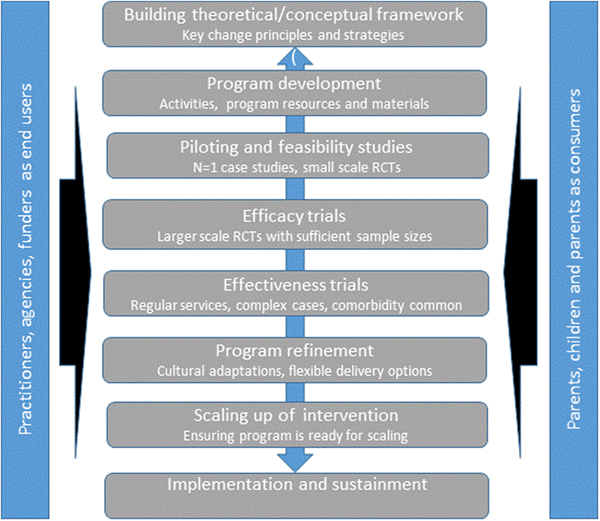
Consumer and end-user input now informs the development evaluation and dissemination of all new programs in the Triple P system. Sanders and Kirby (Reference Sanders and Kirby2015) developed a 10-step program development model (see Figure 1) that incorporated input from consumers and end users at every stage of the research, development and dissemination cycle. This model is used in undertaking all new program development activity to ensure that programs developed have a good ecological fit to the delivery context.
Consumer and end-user feedback in program development.

Development of procedures for culturally adapting parenting programs
Turner, Hodge, Forster, and McIlduff (Reference Turner, Hodge, Forster, McIlduff, Sanders and Mazzucchelli2018) developed a model for culturally adapting parenting programs with indigenous parents. This model was tested in a trial of Triple P with Maori indigenous parents in New Zealand. The adaption model, known as the Collaborative Partnership Adaptation Model (CPAM), involves using consumer and end-user input via focus groups to identify what changes, if any, are needed for an existing evidence-based parenting program, making the changes to program content and delivery, and finally, rigorously evaluating the culturally adapted program. Keown, Sanders, Franke, and Shepherd (Reference Keown, Sanders, Franke and Shepherd2018) used this approach to test the efficacy of Te Whanau Pou Toru in New Zealand, an adapted version of Triple P discussion groups (Level 3). The intervention was effective in reducing early onset conduct problems in preschool-aged children.
Procedures to promote flexibility and fidelity
One criticism of manualised evidence-based programs relates to the perceived lack of flexibility practitioners have in tailoring programs to the needs of individual families. Mazzucchelli and Sanders (Reference Mazzucchelli and Sanders2010) argued that the effective delivery of evidence-based programs requires both fidelity to the program content and process of delivery and flexibility to adapt the program to respond to the needs of individual clients. They identified a series of high- and low-risk variations to both content and process of delivery. Such guidance has been useful in countering erroneous assumptions that evidence-based programs are inherently non-responsive to the needs of clients.
Development of new applications for a wider range of child and parent problems
While much of the outcome research on parenting programs has been conducted with parents of children with conduct problems over the past two decades, EBPS programs have been successfully applied to a very broad range of child and adolescent problems. These problems include challenging behaviour in children with mixed developmental disabilities, autistic spectrum disorders, traumatic brain injuries (Sanders & Mazzucchelli, 2015; Tellegen & Sanders, Reference Tellegen and Sanders2013), recurrent pain syndromes (Sanders et al., 2004), feeding problems (Turner, Sanders, & Wall, Reference Turner, Sanders and Wall1994), anxiety disorders (Cobham, Filus et al., Reference Cobham, Filus and Sanders2017), children affected by natural disasters (Cobham, McDermott, & Sanders, Reference Cobham, McDermott, Sanders, Sanders and Mazzucchelli2017), children who are overweight or obese (West & Sanders, 2014), children with chronic health problems such as asthma, eczema and diabetes, and sexuality education (Morawska, Mitchell, Burgess, & Fraser, Reference Morawska, Mitchell, Burgess and Fraser2016, Reference Morawska, Mitchell, Burgess and Fraser2017), and parents of gifted and talented children (Morawska & Sanders, Reference Morawska and Sanders2009).
In addition, a much more diverse range of parents have successfully participated, including parents with intellectual impairments (Glazemakers & Deboutte, Reference Glazemakers and Deboutte2013), parents of children with metabolic disorders (Van Mechelen, Kessels, Simons, & Glazemakers, Reference Van Mechelen, Kessels, Simons and Glazemakers2018), parents living in homeless shelters (Haskett et al., Reference Haskett, Armstrong, Neal and Aldianto2018), parents with chronic mental health problems (Jones et al., Reference Jones, Jovanoska, Calam, Wainwright, Vincent, Asar and Lobban2017), parents experiencing separation and divorce (Stallman & Sanders, Reference Stallman and Sanders2014), working parents (Sanders, Stallman, & McHale, Reference Sanders, Stallman and McHale2011), maltreating parents (Sanders, Higgins, & Prinz, Reference Sanders, Higgins and Prinz2018), indigenous parents (Turner et al., Reference Turner, Hodge, Forster, McIlduff, Sanders and Mazzucchelli2018), and parents living in low resource settings (Mejia, Calam, & Sanders, Reference Mejia, Calam and Sanders2015).
Development of a sustainable model of dissemination
One of the greatest challenges for any program developer is to create an economically viable way to disseminate and scale up a program, resulting in sustained implementation. Triple P is considered to be one of the most successful innovations from the behavioural and social sciences to have been disseminated on a global scale. At the time of writing, Triple P training has been delivered in 35 countries, involving over 100,000 practitioners. The program has been translated into 22 languages. However, the amount of time, effort and financial resources that are needed to disseminate programs at scale should not be underestimated. There are many tasks that need to be accomplished. These are listed below and include: the securing and managing the intellectual property invested in Triple P; developing a reliable system for disclosing and managing conflicts of interests in the research process; identifying an industry partner prepared to invest in the dissemination of Triple P; developing an approach to program development to develop and evaluate programs; developing a fit-for-purpose publishing and training mechanism; developing a training, accreditation and supervision system; developing an implementation support system to provide ongoing technical and consultative support to agencies; creating and funding a commitment to ongoing research and development to ensure the program continues to evolve; developing a system for training trainers; a quality assurance system to ensure good training outcomes; developing an online system for capturing and monitoring of client outcomes; developing a quality assurance system for managing translations into other languages; and having access to legal and financial advice pertaining to trading in different countries. To fully develop these systems took a number of years, and they need to be under constant review to ensure better efficiency and quality improvement.
Development of procedures for promoting research integrity
Many program developers are also clinical researchers who need to manage the inevitable and unavoidable conflicts of interest that arise when the dissemination process generates revenues that either supports individual developers, their research team, or their employers. CBT has a history of inadequate conflict of interest disclosures through journals, inconsistent application of editorial policies, and a general lack of transparency about when, what and how to disclose and manage potential conflicts of interest (Sanders, Reference Sanders2015). However, there is no doubt that conflicts of interest must be disclosed and potential for bias managed within a research quality framework (Sanders, Reference Sanders2015).
Future Directions for Evidence-Based Parenting Support
Looking forward over the next decade, EBPS interventions are likely to continue to evolve with a sustained commitment to ongoing research and development.
Changing the language of parenting intervention
Historically, the term parent training has served the field well and differentiated behavioural approaches to parenting support from other theoretical approaches (based on psychodynamic or attachment theory) and more general parent education (e.g., playgroups). However, over time, the term has become more of a liability and it should be replaced by the more generic term evidence-based parenting support for the following reasons. First, many parents with concerns about their children's behaviour who seek professional support do not see themselves as requiring ‘training’ or ‘therapy’. Second, the traditional intensive group and individual programs used with parents of children with severe conduct problems capture only part of the evidence base used to promote better outcomes for families. In particular, the growth of low-intensity parenting seminars, discussion groups and online programs require more inclusive language based on the principle of proportionate universalism. Its meaning in the context of parenting intervention is that everyone is likely to need some support, with more intensive interventions limited to families with greatest need or who are non-responders to less intensive interventions.
Understanding mechanisms of change and non-response to intervention
The current prevention and treatment technologies that use EBPS are not a panacea and there are always non-responders to any intervention. More research is needed to identify early antecedents and indicators of premature dropout from an intervention or non-response among completers of the intervention. Also, social learning theory and contingency management principles have featured strongly in the theoretical base of parenting programs with parents and as a central explanation for improvement in child behaviour (parents become more positive and contingent and less coercive and unpredictable). However, there are other possible explanations for change in both parenting and child outcomes that should be considered in any analysis of mediators of change. These include cognitive factors such as changes in parental expectations and attributions, changes in available social support (less couple conflict, better team work), changes in parent adjustment (less stress, depression, anxiety) and the therapeutic alliance (relationship with practitioner). Research is needed that tracks change over time on multiple variables during the course of intervention to identify the timing, sequencing and patterning of change on different putative mediators. Some variables may change early, others change later, and some not at all over the course of an intervention.
From N = 1 to population level trials
The field of parenting intervention has benefitted from a wide range of methodologies. For example, research in Triple P has ranged from N = 1 experiments, to randomised clinical trials, place-based population trials, quasi-experimental evaluations, service-based evaluations, qualitative studies (focus groups, interviews), economic analyses, and meta-analyses. More population-level evaluation studies with longer periods of follow-up are needed to strengthen findings regarding the population-level effects of the Triple P system on child maltreatment and rates of social, emotional, and behavioural problems.
Search for ongoing innovation to improve outcomes
Many techniques used in positive parenting programs have been available for decades (e.g., clear instructions, praise, timeout). However, few studies have investigated how to further improve the effectiveness of specific techniques, combinations of techniques used (e.g., quiet time, timeout, descriptive praise, incidental teaching, reward charts). Salmon, Dittman, Sanders, Burson, and Hammington (Reference Salmon, Dittman, Sanders, Burson and Hammington2014) showed that adding emotional literacy training for parents did not improve the effects of Group Triple P with parents of disruptive preschool-aged children.
Procedures that enhance positive home-school communication
Many educators are concerned that too many children are inadequately prepared to begin formal schooling. Many children at school entry have delays in language, preliteracy skills, self-care skills (independent toileting), and significant social and behaviour problems. All of these difficulties can be influenced by parenting. Also, brief parenting and teacher-training programs focused on improving home-school communication seem particularly valuable. A new intervention for teachers, the Alliance of Parents and Teachers Program (APAT) has been successfully piloted (Kirby, Sanders, & Hodges, Reference Kirby, Sanders and Hodges2018) and is being prepared for more rigorous testing in a randomised trial.
Procedures to activate community level support for parenting
The population approach to parenting support needs to develop and test the effectiveness of procedures designed that mobilise community level support for parenting and the design of ‘family-friendly’ environments to raise children.
The need for business models and branded interventions
Criticism of commercially disseminated programs such as Triple P, Incredible Years, MST and PCIT because they are ‘branded therapies’ seems misplaced. The approach advocated by some involves the identification of common elements of effective intervention and disseminating them as non-branded therapies. However, all programs need an identity to be effectively promoted to parents and professionals. Furthermore, a sustainable model of dissemination requires an economically viable business model where revenue from training and sale of program resources and materials can help recover the real costs of developing and maintaining an evidence-based program (e.g., revisions and updates of professional and parent resources, written materials, videos, online programs). Without competition there are few incentives for program developers to reduce or contain costs and training, and dissemination activities become wholly reliant on subsidies from government or foundations that are usually not sustainable.
Improving population reach
The internet has markedly increased the capacity of people to share useful information, rapidly, conveniently and at no or low cost. The internet via social media (e.g., Facebook, twitter, blogs, online forums and parenting networks) has increasingly been used to encourage participation in parenting programs. However, parents are bombarded with many messages requesting their time or money. Greater attention needs to be given to identifying the best ways to create messaging that gain a parent's attention and motivates them to participate. Peer-to-peer advocacy can be a powerful inducement for parents to register for a parenting program. However, is it better to promote a program as something that will alleviate a child problem behaviour, or promote the child's wellbeing and success in life? At present it is unknown what kind of parenting messages work best to encourage parents to participate in large numbers.
Using evidence to influence policy
Much greater focus is needed to ensure that available evidence is taken into account by policy makers when making funding decisions. Few professional training or higher degree training programs provide specific training in policy analysis or how to use evidence to influence policy decisions. Skills such as how to effectively engage with and communicate scientific findings to different audiences (e.g., policymakers, mass media, and consumers) are rarely taught.
Parenting programs and adult mental services
Many adults with serious mental health problems are also parents, and their children can be at risk of mental health problems themselves because of disruptions to family life and parenting caused by parental mental illness. Many parents with mental health problems can benefit from participation in positive parenting programs. For example, Jones et al. (Reference Jones, Jovanoska, Calam, Wainwright, Vincent, Asar and Lobban2017) used the 8-module Triple P Online along with an 8-module online CBT program for parents with bipolar disorder and were able to demonstrate fewer mental health problems in children. Parenting interventions are trans-diagnostic interventions that can be applied to a wide range of problems, diagnoses and conditions. As programs such as Triple P have five core principles that are relevant to all children and 17 different strategies that can be customised to the specific concerns of parents, there is great potential for these interventions to be flexibly adapted to address the unique parenting context the parent is experiencing. To avoid the unnecessary proliferation of multiple program variants, practitioners need to be trained to flexibly apply principles and procedures to the unique circumstances of parents irrespective of diagnosis. Different variants are justified if a different skill set is needed by the parent (e.g., parenting teenagers or children with a disability) and there is additional content that a practitioner needs to understand (e.g., Lifestyle Triple P with parents of obese children).
Diversifying the workforce and use of volunteers to deliver EBPS
Although social learning theory and the principles of behaviour change have been largely derived from the discipline of psychology, for parenting programs to make a population-level impact on problems such as child maltreatment and mental health, multiple disciplines that have a mandate in their work role to provide parenting support need to be used to reach parents. In low resource settings where there are simply very few highly trained mental health specialists such as psychologists, social workers or nurses, appropriately trained and supervised non-specialist volunteers may be needed (Ward, Sanders, Gardner, Mikton, & Dawes, Reference Ward, Sanders, Gardner, Mikton and Dawes2015). This approach has been successfully used in some low- and middle-income countries such as India to deliver CBT interventions for depression and alcohol problems (Chowdhary et al., Reference Chowdhary, Anand, Dimidjian, Shinde, Weobong, Balaji and Araya2016). However, use of volunteers does not eliminate the need for sustainable system of workforce training and supervision.
Learnings from and responding to criticisms
Although EBPS has flourished and has been widely adopted, it has also received criticism. One of the most commonly voiced criticisms is that discipline methods such as timeout damage the parent-child attachment relationship and that their use is contraindicated in children with histories of trauma. The word ‘timeout’ itself has attracted bad press, particularly following a Time Magazine article by Dr Dan Siegel (Reference Siegel2014) that claimed timeout damages children's brains. There is no evidence to support this contention when timeout is used appropriately, and there are literally hundreds of well-controlled RCTs evaluating parenting programs that have used timeout showing positive effects on children's behaviour. The responses to these criticism from supporters of timeout have included writing articles that challenge the criticism and clarify the conditions for effective usage, conducting literature reviews of available literature, and challenging conclusions in professional forums. However, an alternative response could be to search for ways of using timeout that reduces the amount of distress and protest the child engages in (e.g., using behavioural rehearsal to prepare the child in advance, reminders of rules that apply in specific situations, avoidance of threats and warnings, use of shorter periods of timeout, increasing the contrast between timein and timeout by increasing positives for prosocial behaviour).
Responding to other criticisms
Other criticisms have been methodological, such as foundational trials being under powered, lack of independent evaluations by non-developers, and failure to disclose conflicts of interest (COI) in publications. Some criticisms have been valid and have resulted in a change of practice particularly with respect to COI disclosures (see Sanders, Reference Sanders2015; Sanders et al., Reference Sanders, Turner and Metzler2019). For example, lack of transparency with respect to financial benefits developers might receive from dissemination of a program has been a problem. However, the situation appears to be changing with a much higher level of disclosure of COI occurring in more recent years. Disclosure of COI, however, does not obviate the need for conflict of interest management practices to be in place and for best practice guidelines to be developed to eliminate or reduce research bias (Sanders et al., Reference Sanders, Higgins and Prinz2018).
Trauma-informed intervention
There have been increasing calls for services to identify themselves as ‘trauma-informed’ and to offer so-called ‘trauma-sensitive’ interventions. This movement stems from the work of Felletti et al. (Reference Felitti, Anda, Nordenberg, Williamson, Spitz, Edwards and Marks1998) in the United States, who identified that an individual's family of origin exposure to adversity in childhood increases lifetime risk of a range of serious mental and physical health problems. However, the specific branding of services, agencies, programs and professionals as trauma informed to differentiate them from other services is misleading and unnecessary. It is similar to branding a program as gender sensitive and culturally informed. All professionals need to be aware that problems arise in diverse contexts and that a thorough history should seek to identify past and current life circumstances and events, including trauma that has shaped the nature and severity of a parent or child's problem. Recognising that a child or parent may have been exposed to prior trauma does not automatically lead to a list of separate clinical actions that are either trauma informed or not trauma informed. Rather, everyone should be striving to respond appropriately to the assessed needs of clients in context including whether the client provides a mandate to address the trauma.
Implications for Policy
Evidence-based practice versus practice-based evidence
While the adoption and implementation of programs that have been shown to work in randomised trials is laudable, there is no guarantee that practitioners and organisations will get as good or better results from deployment of the same interventions in regular clinical practice. The essence of the scientist practitioner approach is the ongoing systematic assessment of client outcomes. Consequently, it is highly desirable that all program users collect systematic information about the effects of programs delivered in a particular setting. However, the systemic assessment of client outcomes represents a major culture shift for some practitioners and organisations where such assessments are not routinely conducted. Standardised online assessment protocols that provide rapid feedback to practitioners should be used where possible to ensure outcomes are being monitored and to determine whether outcomes match, exceed or fall short of those obtained in clinical trials with similar populations. Where trial populations differ in significant ways from routine clinical populations, it is even more important that practice-based evidence is collected and reviewed.
Parenting and sustainable development goals
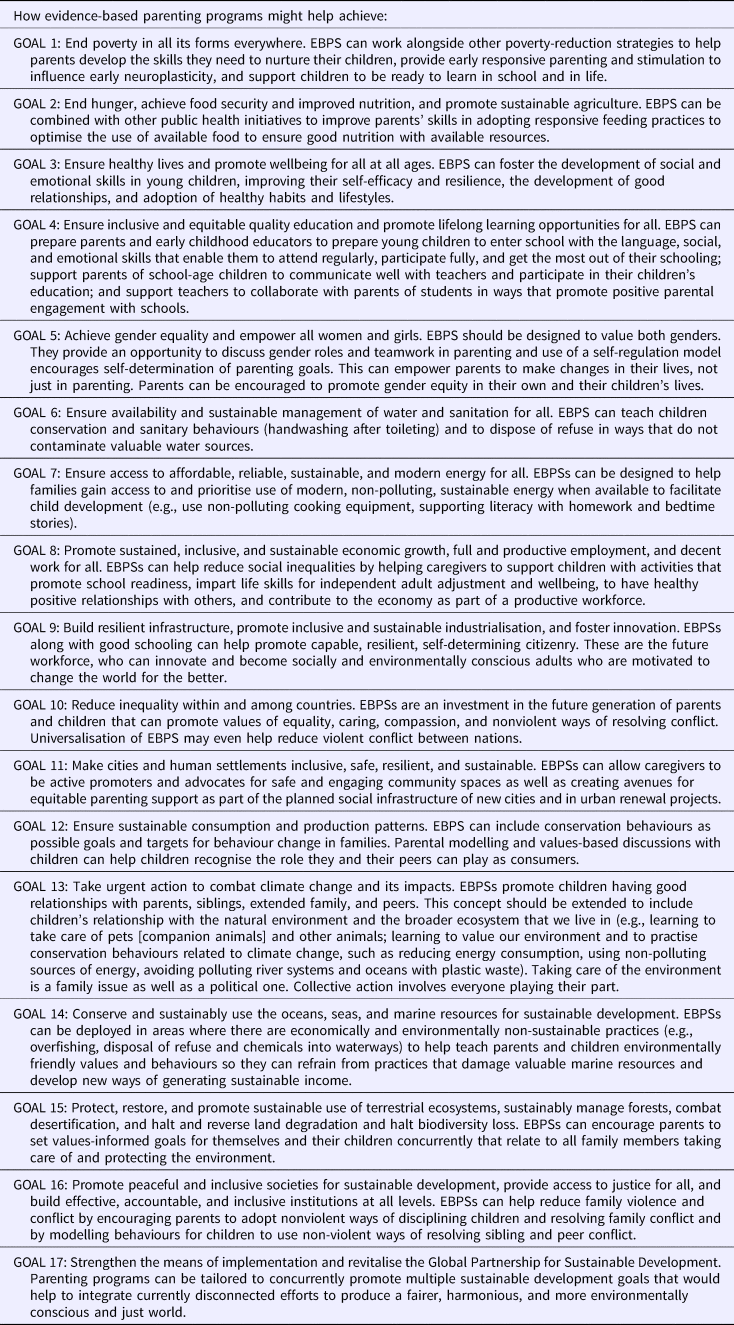
In 2015, more than 190 world leaders committed to 17 Sustainable Development Goals (SDGs) to help end extreme poverty, fight inequality and injustice, and address problems of climate change. Each country has a role to play to achieve these goals of a more prosperous, equitable, and sustainable world. Parenting programs have the potential to contribute to addressing many of these SDGs (Sanders et al., Reference Sanders, Higgins and Prinz2018). However, it will require parenting researchers and practitioners to think out of the box and to work collaboratively with other groups to achieve them. Table 1 provides some examples of how this might be done.
Parenting and the United Nations Sustainable Development Goals

Funding of parenting services and programs
In many communities, the provision of evidence-based parenting programs is poorly coordinated. The entire family support sector is under resourced, and funding from year to year is often insecure. Insufficient staffing, with poorly defined roles, poor training, poor pay and working conditions, and lack of regular supervision, can result in low morale, high stress and high staff turnover. When undertrained, underresourced staff are asked to deal with some of the most complex and challenging family situations, outcomes for children can be poor. Funding of parenting programs is often piecemeal and targets the ‘tip of the iceburg’ with only the most vulnerable families. There is a lack of coordination across different sectors, and responsibilities are distributed across different government portfolios. The sector lacks leadership, professional advocacy, accountability, training and qualification standards, best practice guidelines and codes of conduct. Compounding these difficulties, parent-consultation skills training receives little attention in most professional training courses in psychology, education, medicine or welfare. Relatively few psychologists are involved in the delivery of evidence-based parenting programs even though programs have often evolved from the discipline base of psychology. There is a need for more advanced-level specialised training with supervision for psychologists to be trained to deliver more intensive parenting interventions with complex cases that have not responded to lower intensity parenting programs.
Conclusions
From fledgling beginnings in the 1960s when parent training interventions with conduct problem children first challenged the dominant psychodynamic child therapy paradigm of the time, modern evidence-based parenting support has come a long way. It has accumulated an impressive evidence base, and parenting interventions based on social learning principles are now a dominant paradigm in the delivery of services to parents of children with disruptive behaviour problems, and programs are now much more widely available than in the past. Programs such as Triple P that have been widely disseminated have developed a large international evidence base, and thousands of practitioners globally deliver Triple P to a very culturally diverse group of parents.
However, EBPS programs are under threat and are at risk of being usurped by unqualified, self-appointed, popular parenting ‘experts’ with slick marketing strategies and websites that are largely uninformed by research of child development, social learning or cognitive behavioural principles.
There are many untapped opportunities for learnings from parenting and family research to be harnessed and applied to new problems. The next generation of parenting programs will need to tackle ‘wicked’ global problems linked to SDGs, such as climate change, family violence, and the human destruction of our oceans and animals on the planet. The family unit, when empowered through increased knowledge, skills and confidence, can become a change maker that can individually and collectively adopt ecologically sustainable ways of protecting the environment through disposing of household waste, reducing a family's carbon footprint and energy consumption patterns, and teaching children and grandchildren to be more caring and nurturing in their relationships with parents, siblings, peers, teachers, extended family members, other carers, the environment and companion animals. As a society we will be much better off if the crucial role of being a parent is taken much more seriously and given the elevated status and support it deserves as the single most important modifiable determinant of the wellbeing of the future generation.
Disclosure Statement
The Triple P – Positive Parenting Program is developed and owned by The University of Queensland (UQ). Royalties from the programs are distributed to the Parenting and Family Support Centre, School of Psychology and Faculty of Health and Behavioural Sciences at UQ, and contributory authors of published resources. Triple P International (TPI) Pty Ltd is a private company licensed by Uniquest Pty Ltd, a commercial company of UQ, to publish and disseminate Triple P and related programs worldwide. The author of this paper has no share or ownership of TPI. Matthew Sanders is the founder of Triple P and a contributory author and receives royalties from TPI.