

Introduction
Social Impact Investment Markets (SIIM) involve private capital (commercial and philanthropic) investing in a range of activity; be it a charity or social enterprise seeking to develop existing service provision and/or infrastructure, or resourcing new interventions commissioned by governments to resolve an ‘intractable’ problem such as youth unemployment or reoffending. The key issue is that social impact investment involves generating both a social return, understood in terms of improved outcomes for targeted individuals and/or society, and a financial return for investors of the original capital plus interest (OECD, 2015: 42; EPRS, 2014: 3).
The SIIM is a subject of growing academic interest and investigation, with scholars examining the commissioning, resourcing, organising, regulation and delivery of impact investments and their effectiveness (Bryan and Rafferty, Reference Bryan and Rafferty2014; Whitfield, Reference Whitfield2015; McHugh et al., Reference McHugh, Sinclair, Roy, Huckfield and Donaldson2013; Dowling and Harvie, Reference Dowling and Harvie2014; Smith and Jones, Reference Smith and Jones2015; Edmiston and Nicholls, Reference Edmiston and Nicholls2017). To date, limited attention has been given to the discourse of SIIM (Fraser et al., Reference Fraser, Tan, Lagarde and Mays2016), particularly how governments discursively construct a rationale for, and legitimation of, the turn to and development of a SIIM by drawing on particular interpretations and representations of social and economic challenges/opportunities. The original contribution of this paper is to address this ‘discourse gap’ by conducting a critical examination of SIIM discourse under the Conservative and Liberal Coalition Government (hereafter the Coalition) and the subsequent Conservative Government between 2011 and 2016. The approach taken applies the Critical Policy Discourse Analysis Framework (CPDAF), developed by Hyatt (Reference Hyatt, Huisman and Tight2013a), as a means to draw together various discourse analysis techniques into a toolkit for facilitating use in analysis of policy. The CPDAF disaggregates analysis into two distinct but connected components – contextualisation and deconstruction – creating a transparent method for examination of the link between text and broader socio-economic and political structures, and interrogation of the organisation and language of the text.
The paper proceeds as follows. Section one outlines the various components of the CPDAF; the rationale for its use and the documents purposively selected for analysis. This includes key impact investment documents for the Coalition Government and the Conservative Government along with speeches by the Prime Minister, the Secretary of State for Work and Pensions and the Minister for Civil Society. The second section provides a brief account of the evolution of social investment under New Labour and subsequent policy reforms under the Coalition and Conservatives. This provides a sense of the policy trajectory and the emergence, acceleration and embedding of a distinct impact investment market (see Whitfield, Reference Whitfield2015).
The third section applies the ‘contextualisation’ component of the CPDAF to analyse how the changes detailed in section two were accompanied by particular forms of discursive reasoning and justification (known as warrants) centred on a ‘Broken Britain–Big Society’ problem-solution narrative. By this I mean a distinct problem representation (bureaucratic welfare, fragmented communities) and desired goal (a stronger cohesive society) are threaded together to contextualise the case for, and ‘hard sell’ of, the Social Impact Investment Market. This vigorous ‘selling’ of a SIIM ‘imaginary’ (the projection of a distinct desirable reality) (Chiapello and Fairclough, Reference Chiapello and Fairclough2002: 195) that emerges from the UK Government SIIM discourse is conceptualised as an act of ‘policy boosterism’. This captures how policymakers strategically promote policies to manufacture anticipation and demand for preferred reforms, while positioning the subject boostered as a source of innovation, expertise and/or site for investment (McCann, Reference McCann2013: 5–8). Policy boostering in this example is then understood as a means to construe SIIM as the unrealised future of welfare, helping to create the supportive ideational context within which the reforms necessary to construct the SIIM as present reality proceed. Section four examines how the text positions finance as a positive force for social change and how social investment is (re) contextualised as synonymous with the distinct market hybrid concept of SIIM. This entwining of welfare with financial markets is in keeping with advancing a conservative liberal market project of utilising the state for the purpose of creating and extending the logic of a competitive market order throughout society (Amable, Reference Amable2011). The fifth section concludes.
Analytical framework
Following Howarth (Reference Howarth2010: 313) and Bacchi (Reference Bacchi2009; Reference Bacchi2012: 4) the standpoint adopted here is that policy is relatively open to being (re)made in multiple ways by the competing priorities, preferences and interpretations of actors. Inequity in resources and relations of domination/subordination mean not all begin with the same capacity to communicate and pursue realisation of their preferred reality. Powerful actors must though still work to establish their interpretation as the dominant understanding of events/circumstances and embed their preferred course of action as the most feasible (Panezzi and Miorelli, Reference Panezzi and Miorelli2013: 303). As such, the discourse of a government is entwined with the material enactment of policy, be it in the form of new legislation, institutions or practices. In turn these may re-configure the expectations, interpretations and social relations of actors in ways that (albeit temporally and spatially contingent) help to embed the dominance of a preferred discourse (Chiapello and Fairclough, Reference Chiapello and Fairclough2002: 195). Consequently, policy and political texts contain data through which researchers can examine how policymakers interpret, represent and propose to resolve an issue and how this helps constitute new policy directions (Bacchi, Reference Bacchi2012: 2–4; Bacchi and Ronnblom, Reference Bacchi and Ronnblom2014: 179).
To operationalise examination of the impact investing discourse of UK Governments between 2011 and 2016 I use Hyatt's (Reference Hyatt, Huisman and Tight2013a; Reference Hyatt2013b) CPDAF (see Wiggan, Reference Wiggan2017). The CPDAF draws together various critical discourse techniques to provide a toolkit for policy analysts seeking a theoretically informed but pragmatic means to conduct a transparent and systematic multi-pronged examination of a policy discourse and its relationship to policy action and orientation (Wiggan, Reference Wiggan2017). Disaggregating analysis into two distinct but related components – contextualisation and deconstruction of policy (Hyatt, Reference Hyatt, Huisman and Tight2013a: 43; Reference Hyatt2013b: 834) – a layered analysis is encouraged that is empirically grounded in the text but informed by and linked to the broad policy context. Moving between an examination of word use and sentence structure we can explore how a text appeals to, and represents, abstract concepts and the socio-economic context. In doing so we can draw out the underlying ideational traditions and preferences of policy actors. This helps identify how these are constructed within the text, for what purpose and how this relates (or not) to actual policy development (Hyatt and Meraud, Reference Hyatt and Meraud2015: 222).
Contextualisation involves identifying policy goals, the tools used to pursue them, the trajectories of policy and how policymakers articulate these. Hyatt drawing explicitly on Cochran-Smith and Fries (cited in Hyatt, Reference Hyatt2013b: 839) sets out how contextualisation involves unpacking how policymakers advance three distinct forms of justification (or warrant) in their discursive construction of the case for a given policy – political, accountability and evidentiary warrants. The political warrant situates a given intervention in terms of how it will help protect and/or achieve desirable (albeit) abstract social values and concepts (appeals to the nation, fairness or common good). The accountability warrant is attuned to the policy and social consequences of (in)action, where the case for a given policy is constructed in relation to what it will achieve or the negative outcomes likely if reform is obstructed. Finally, the evidentiary warrant is where policymakers situate their policy choice as credible, necessary and desirable by grounding it in an ostensibly neutral, objective reading of empirical material (Hyatt, Reference Hyatt2013b: 839; Reference Hyatt, Huisman and Tight2013a: 50–52; Wiggan, Reference Wiggan2017).
The deconstruction component of the CPDAF involves fine-grained analysis of the semantic and lexical aspects of interpreting and representing actors, practices, realities and imaginaries in the text. It includes teasing out examples of inter-discursivity and inter-textuality, which refers to how one policy discourse draws on and contributes to other discourses and is represented in and across multiple texts. Deconstruction also incorporates exploring the terminology, word use and structuring of texts (lexical-grammatical) to identify how issues are included/excluded and represented and the strategies used to encourage readers/audiences to make particular judgments on an issue (inscribed evaluation and evoked evaluation). Inscribed evaluation refers to how a positive or negative assessment is explicitly written into a text. Conversely, evoked evaluation refers to how a text seeks to prime the reader to draw a particular conclusion, or conjure up an image, without making the position of the author clear (Hyatt, Reference Hyatt, Huisman and Tight2013a: 51–55; Hyatt, Reference Hyatt2013b: 839–842; Wiggan, Reference Wiggan2017: 643). The CPDAF also incorporates the idea of four distinct Modes of legitimation drawn from Fairclough's (cited in Hyatt, Reference Hyatt2013b: 840) work. These include appeals to legitimacy rooted in the authority of the author (authorisation); to social utility (rationalisation); to political or societal definitions of desirable values (moral evaluation), and/or stories of the consequences that accompany particular choices and actions (narrative) (Wiggan, Reference Wiggan2017: 644).
Data selection
Speeches to conferences/meetings and policy strategy documents are a particular discourse genre (Chiapello and Fairclough, Reference Chiapello and Fairclough2002: 193; Fairclough, Reference Fairclough, Wodak and Meyer2001a: 123). They are a style of communication that invites selection/omission of ‘evidence’ and elaboration of preferred ideas, interpretations and policies to convey narratives intended to convince the audience(s) of the desirability of the speakers’/authors’ goals. The principal intended audience of the purposively selected texts are individuals and organisations operating in the fields of social welfare, public policy broadly and financial services. The texts primarily constitute a form of what Schmidt (Reference Schmidt2011: 117) terms a coordinative discourse (of and for policy actors), rather than a communicative discourse addressed to the public. Consequently, the data analysis helps to understand how the UK Government is (re)interpreting the social world to contextualise and articulate the turn to SIIM amongst policy-oriented actors.
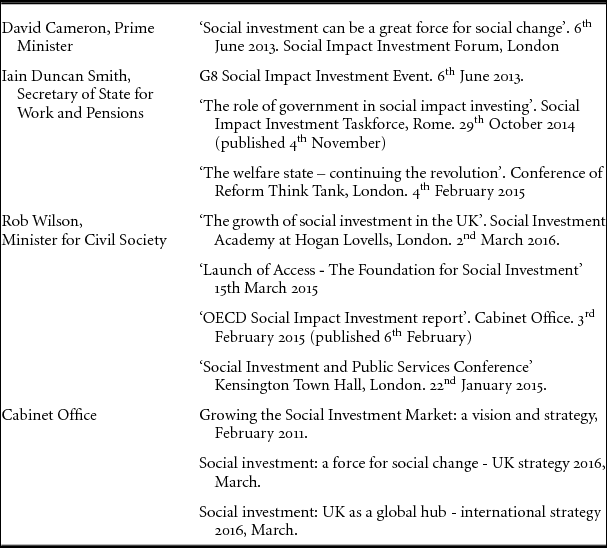
The study is based on a purposively selected sample of Ministerial speeches and UK Government strategy documents produced between 2011 and 2016 (Table 1). Three policy texts were selected for analysis, on the grounds that each marked an explicit statement of UK government strategy on social investment. One, published in 2011, represents the expressed strategy of the Coalition Government and the second and third, published in 2016, set out the strategy of the Conservative Government. The selection of speeches includes a talk given by the Prime Minister during the UK presidency of the 2013 meeting of the G8, which the UK Government themed around impact investing. Also included because of the salience of their departments to the SIIM are speeches by the then Secretary of State for Work and Pensions, Iain Duncan Smith, and the then Minister for Civil Society, Rob Wilson – located in the Cabinet Office. The Department for Work and Pensions (DWP) is directly responsible for social security and employment programmes and, between 2010 and 2016, commissioned fourteen Social Impact Bonds (SIB) making it the commissioner of the greatest number of SIB within government (DWP, 2016: 22–25). The Cabinet Office (CO) meanwhile has taken a lead role in overseeing public service reform, developing and co-ordinating government SIIM strategy and introducing measures to help support and co-ordinate market development (see below). The material was stored in a Computer Assisted Qualitative Data Analysis Software package, reviewed and initially coded according to the component elements of the contextualisation and deconstruction categories of the CPDAF. Informed by the social policy and politics literature on the Coalition and Conservative Governments, further coding was then undertaken to explore the occurrence of particular ideas, terminology and concepts to identify themes grounded in the text.
Texts analysed

The policy trajectory: community redevelopment to an impact investment market
The foundations of the contemporary impact investment market in the UK were laid during the Labour administrations between 1997 and 2010. Under Labour, individual and community access to finance was identified as a cause of, and solution to, socio-economic exclusion and a means to resource the diversification of public service providers (Mulgan, Reference Mulgan, Nicholls, Paton and Emerson2015: 55; Whitfield, Reference Whitfield2015: 7–8; Westall, Reference Westall2010). Westall (Reference Westall2010: 120–121) identifies three stages to Labour's policy focus and concomitant development of policy levers. First, a concern with underprovision of mainstream finance in ‘disadvantaged’ communities and the negative effect this had on entrepreneurial activity and scaling up commercial and social enterprises to support regeneration. This was accompanied by measures such as tax relief for community investment and support for community development financial institutions.
Second, a focus on directing public resources in the form of grants and loans to strengthen the third sector. The Futurebuilders programme, established in 2004 and closed in 2010, for example, provided over £125 million in loans during this period to third sector organisations (Wells, Reference Wells2012: 160). The aim was to increase its impact in communities and improve its capacity to participate in public service quasi-markets by encouraging greater use of loans rather than grants, adoption of more business-like practices and a concern with the social and economic value of activity (Westall, Reference Westall2010: 120–122; Affleck and Mellor, Reference Affleck and Mellor2006: 309–312).
The third stage involved a growing interest in harnessing private capital to expand social investment funding and focus providers on achieving particular social outcomes. The passing of the Dormant Bank and Building Society Accounts Act 2008, for example, meant unclaimed funds in inactive private bank accounts could be used by the state for community development and social investment. To this end the Labour Government announced in 2009 its intention to establish a Social Investment Wholesale Bank, independent of government, to allocate a portion of unclaimed assets for community redevelopment or third sector capacity building, though it lost office before it could do so (Edmonds, Reference Edmonds2015: 6–7; Westall, Reference Westall2010: 121).
Prior to leaving office in 2010 Labour also oversaw the commissioning of the first Social Impact Bond (SIB) in the UK, targeted at reducing reoffending rates at HMP Peterborough (McHugh et al., Reference McHugh, Sinclair, Roy, Huckfield and Donaldson2013: 248; Mulgan, Reference Mulgan, Nicholls, Paton and Emerson2015: 61). Unlike a standard Payment by Results (PbR) arrangement, the upfront funding to meet set-up and running costs of a SIB intervention are drawn from private investors (for-profit or philanthropic) rather than the state or service provider. In exchange the investor(s) receive a financial rate of return from the commissioner determined by the nature of the problem/population targeted and estimated future savings in public expenditure. However, should the intervention fail to achieve the target outcomes then investors receive no payment and lose their capital. By separating funding from service delivery the SIB is intended to enable private finance capital to profit from specific welfare interventions while redistributing risk of programme failure away from commissioned providers and the state, though whether the latter is realised in practice is contested (Whitfield, Reference Whitfield2015; Sinclair et al., Reference Sinclair, McHugh, Huckfield, Roy, Donaldson, Farnsworth, Irving and Fenger2014).
Creating an enabling environment for Social Impact Investment
Under the Coalition Government a suite of reforms were initiated with the aim of creating an enabling environment to grow and embed the SIIM. These reforms included changes to legislation and policy relating to outcome-based contracting; tax relief to stimulate investment; creation of new intermediary institutions and funds to build market capacity and provide information, advice and guidance. The Coalition Government's 2011 ‘Open Public Services’ White paper, for example, signalled commitment to intensifying the use of non-state public service providers (Dowling and Harvie, Reference Dowling and Harvie2014: 878), while commissioning across different policy areas shifted towards the use of contracts which paid providers on the basis of social outcomes achieved (Payment by Results) (Edmiston and Nicholls, Reference Edmiston and Nicholls2017: 3). Market rationality has consequently been mainstreamed as the principle means of shaping the behaviour of service providers and the means to hold them to account (NAO, 2015: 14–15; Painter, 2012: 7). The drive to achieve socially beneficial outcomes via markets was echoed in the Public Service (Social Value) Act 2012, which introduced a requirement for those procuring goods and services to consider social and environmental factors. This integration of ‘the social’ into procurement has been envisaged as a means to drive a reorganisation of services to reduce long-term costs, bringing a new angle to the pursuit of ‘value for money’ (Cabinet Office, 2015a: 13; Dowling and Harvie, Reference Dowling and Harvie2014: 879).
Accompanying a broader expansion of PbR contracting in public services, the Coalition oversaw the rollout of the SIB commissioned under New Labour and introduced further SIB pilots targeting improvements in employability, health, homelessness and family services (Whitfield, Reference Whitfield2015: 31). To minimise transaction costs and improve the ability of potential SIB commissioners to price interventions, the Centre for Social Impact Bonds, which had been established in the Cabinet Office, has made cost-benefit data on the performance of previous policy interventions available (Unit Cost Database) along with model service agreement contracts (Centre for Social Impact Bonds, 2017; Edmiston and Nicholls, Reference Edmiston and Nicholls2017: 6). By the end of 2016 the overall number of SIB projects in the UK was thirty-three, which is a significant increase on the single SIB inherited by the Coalition in 2010. Estimates of the total number of SIB launched globally (eighty nine) up to 2017 give credence to the Coalition Government's claims of UK global leadership in this field (Social Finance, 2017).
To open up funding for social investment, including for SIB from the charity sector, Section 15 of the Charities (Protection and Social Investment) Act 2016 gave charities a general power to make social investments, provided this accords with making a financial return and furthering their charity's purpose (Charities (Protection and Social Investment) Act 2016). To incentivise private investment meanwhile, the Coalition introduced the Social Investment Tax Relief (SITR), through the Finance Act 2014. The SITR allows investors in recognised social economy organisations and/or UK Government accredited SIB to offset their investment against income tax and Capital Gains Tax liabilities (HM Revenue and Customs, 2014; Cabinet Office, 2015b). Triodos Bank, for example, subsequently announced how its use of SITR to offset a portion of an individual's investment against income tax raised the value of the potential rate of return in two SIB from 7 per cent per annum to 19 per cent (Triodos Bank, 2015).
The harnessing of private financial resources for building SIIM infrastructure was assisted by the creation in 2012 of Big Society Capital (BSC); the Coalition's version of a Social Investment Wholesale Bank. £400 million of funds has been made available to BSC from dormant bank accounts, with a further £200 million drawn from investments by four UK banks (Big Society Capital, 2016; HM Government, 2016a: 8). The investment made by the banks in BSC can be traced to Project Merlin and the agreement the Government reached with the banks in 2011 following public disquiet about the activities of finance and its social utility. The agreement implied that banks should be improving small business lending, giving due consideration to public feeling with regard to pay, and extending support to Big Society initiatives (HM Treasury, 2011). Through support for BSC the Coalition implanted involvement of financial actors in the emergent SIIM and provided a mechanism for banks to demonstrate their commitment to the public good and their potential to be socially useful actors (Edmonds, Reference Edmonds2015: 4).
A comprehensive comparison of social investment policy and discourse pre- and post- the 2010 UK General Election is beyond the scope of this studyFootnote 1, but the overview provided here suggests that we can discern (subtle) differences between Labour- and Conservative-led Governments that perhaps reflects a mixture of ideational tradition and policy sequencing. In short, Labour's reforms developed in the context of the relative underdevelopment of social investment as a policy tool for social welfare. Labour's initial interest in social investment reflected its potential for offering a state- and market-driven approach to tackling area-based exclusion, rather than a more thorough transformation of the welfare state (Westall, Reference Westall2010: 120). Labour's approach largely retained the state as the principle funder, organiser and regulator of finance for social investment (Wells, Reference Wells2013: 80; Reference Wells2012: 173) while paving the way for subsequent Conservative-led Governments to pursue a more thorough re-configuration of the state as the enabler and guarantor of an increasingly financialised market in social investment that newly extends into areas of person-focused welfare interventions (Wells, Reference Wells2013: 80; Reference Wells2012: 173).
Unpacking the problem representation: social breakdown and the cohesive society
The reconfiguring of state intervention to foster markets in welfare and social investment as the best means for achieving economic growth and a better society is aligned with the leading Conservative politicians’ endorsement pre- and post- the 2010 General Election for constructing a ‘Big Society’. Represented as the alternative to Labour's supposed commitment to ‘Big Government’, this posed a critique of the hierarchical system of state target setting and performance management in the public sector as squeezing out local knowledge and initiative which led to unresponsive, wasteful, ineffectual services (Painter, 2012: 4; Ellison, Reference Ellison, Holden, Kilkey and Ramia2011: 53). Long-standing conservative depictions of state activity and public expenditure discouraging independence and entrepreneurialism, because people look to the state rather than themselves and their communities (Wiggan, Reference Wiggan, Holden, Kilkey and Ramia2011; Slater, Reference Slater2014: 954), were marshalled to argue that the welfare state was responsible for the fraying of social bonds, and, in the words of David Cameron, ‘a Broken Society’ (Jones, 2009: 365; Williams, Reference Williams2011).
Conversely the Big Society is premised on substituting direct public provision for mutualist, charitable and market forms of support, complementary to individual initiative, business enterprise and social cohesion through curtailment and/or decentralisation of the welfare state (Wiggan, Reference Wiggan, Holden, Kilkey and Ramia2011; Sage, Reference Sage2012: 371; Williams, Reference Williams2011: 121). As Corbett and Walker (Reference Corbett and Walker2013) and Bonefeld (Reference Bonefeld2015: 424) point out, however, at the core of the Big Society is not a rejection of market liberalism, nor a disavowal of state activity. Rather the Big Society is premised upon, and seeks a repurposing of, state authority and resources to reconfigure the management, accountability and delivery of public welfare to privilege market rationality and better accord with the expansion and protection of a competitive market order. It is a distinctly political project that paradoxically rests on the subsuming of political division and disruption that arises from antagonistic social relations associated with competitive markets (Bonefeld, Reference Bonefeld2015: 421).
Political actors have to work to make their particular problem interpretations pre-eminent, and secure support for their preferred policies and visions. It is not surprising then that threaded throughout UK Government strategy documents and speeches there is a boosterist account of the potentiality of SIIM that is rooted in a ‘Broken Britain-Big Society’ problem definition-policy solution narrative. In analysing this we draw out how the interweaving of accountability warrants (identification of social problems as rooted in social breakdown) and political warrants (appeal to an abstraction of social cohesion as the social good) contextualise and assemble the case for the SIIM turn, justify the state intervention necessary to make SIIM a feasible, sustainable reality and work to booster SIIM as innovative policy.
The text – Growing the Social Investment Market: A Vision and Strategy – quickly embeds a Broken Britain-Big Society dynamic. The Ministerial foreword opens with; ‘We want a bigger, stronger society’ (HM Government, 2011: 5) and this is followed in chapter one with ‘Britain needs new ways of tackling some very stubborn and expensive problems such as fractured communities, homelessness and high rates of re-offending’ (HM Government, 2011). This Broken Britain-Big Society theme is repeated across texts as the speech by the Minister for Civil Society illustrates.
‘Experience has taught us time and again that government does not have all the answers to the trickiest issues in our communities. Look at homelessness. Reoffending. Long term unemployment. These complex problems aren't new but their solutions have eluded successive governments for decades. . . we know that charities and social enterprises often have the local and specialist knowledge to be able to tailor services around the needs of communities and individuals. . .’ (Minister for Civil Society, Rob Wilson MP, speech to the launch of Access - The Foundation for Social Investment 15th March 2015).
Here we have an inscribed evaluation of a negative present (‘experience has taught us [. . .] government does not have all the answers’) counter-posed to the potential of non-state actors (‘specialist knowledge’). The negative judgment of state intervention, the link to social problems and positive endorsement of non-state actors craft a conservative interpretation of what the problem is and proffer a liberal market solution (opening up public services and social investment) justified by the implied consequences of no policy change (an accountability warrant). The conclusion to the Prime Minister's speech to the 2013 meeting of the G8 also shows how the case for SIIM as necessary and desirable is conveyed.
‘. . .Let me finish by saying this. Some people have asked whether I still believe in building a bigger, stronger society? I say to them – look around this room. See how social investment can help to change lives. See how social investment is bringing communities together. See how social investment is making our societies and therefore our countries stronger. Am I prepared to fight for that? You bet I am. Social investment can be a great force for social change on the planet. It can help us to build bigger and stronger societies. That power is in our hands. And together we will use it to build a better future for ourselves, for our children and for generations to come’ (Prime Minister, David Cameron MP, 2013 speech to the Meeting of the G8, London).
The Prime Minister's rhetorical question regarding his support for the Big Society sets up his subsequent use of combative language (‘am I prepared to fight for that? You bet I am’) enabling reaffirmation of passionate commitment to the Big Society concept and enlisting a new weapon in this fight – social investment. Judgements as to the power of social investment to create a stronger society can then be presented (inscribed evaluation), which imply that collective future well-being legitimates (rational legitimation) social investment reform. The Prime Minister's personal ownership of the social impact investment (SII) turn also confers social investment with legitimation by authority (authorisation). At the same time the identification of SII with the person of the Prime Minister is tempered in the text by use of the words, ‘together’, ‘us’, ‘our’ and ‘we’. Such a technique depoliticizes social impact investment as a partisan project and obfuscates who exactly ‘we’ refers to (Wodak et al., Reference Wodak, de Cillia, Reisigl and Leibhart2009: 45), dissolving the social divisions of society to conjure up a unity that elides questions as to whose interests are served, or not, through the SIIM.
The recuperation of finance capital and recontextualisation of social investment
While the concluding paragraph of the Prime Minister's speech to the G8 provides a robust endorsement of social investment as the means to bring about the Big Society, the opening paragraph provides a narrative legitimation, in the form of the Broken Britain problem representation, for the recuperation of finance capital as a socially useful actor. Given that financialisation has been associated with growing inequality and socio-economic destabilisation (Breger Bush, Reference Breger Bush2016: 132) this is seemingly a bold move. Yet, subsuming finance within a SIIM discourse of societal improvement (‘a great idea that can transform societies. . . tackle the most difficult problems’) and economic opportunities (‘potential is that big’. . . ‘sell it to the world’) diminishes the disruptive threat of financialisation, while boostering the claim that social impact investment is innovative and effective. Constructing the SIIM to repurpose and channel the avowed power of finance to transform society and advance the common good is therefore situated as legitimate as a rational course of action.
‘We've got a great idea here that can transform our societies, by using the power of finance to tackle the most difficult social problems. Problems that have frustrated government after government, country after country, generation after generation. Issues like drug abuse, youth unemployment, homelessness and even global poverty. The potential for social investment is that big. So I want to make it a success in Britain and I want to sell it all over the world. . . ‘(Prime Minister, David Cameron MP, 2013 speech to the Meeting of the G8).
Similarly speeches given by the Secretary of State for Work and Pensions offer boosterist depictions of finance-led social policy by evoking finance as a dynamic force for change which, harnessed via SIIM, can redress the problems of a fragmented society.
‘. . . Cut adrift from the labour market, all too often, those at the bottom of society come to feel they have no productive role to play. Meanwhile, at the top, we find some of our most successful and well-rewarded professionals productively involved in wealth creation. The result is we are left with a society increasingly torn, as the gap between the top and bottom grows ever wider. The question for all of us in the G8 is how we go about bringing these two ends back together – building a more cohesive society, and benefiting our economy at the same time. I believe the answer lies in social investment. . .’ (Secretary of State for Work and Pensions, Iain Duncan-Smith, 2013 meeting of the G8)
‘. . .Just imagine a social enterprise working in a particular deprived neighbourhood – be it in London, Los Angeles, Milan or Moscow. Investors buy into it and, as with any investment, will want to see it flourish. Because they are risking their money – money that could otherwise be reaping a return elsewhere – those investors will want to see that social programme succeed, bringing a whole new rigour to how it is delivered. But what's more, the same investors will want to take an interest in that community where they would otherwise be totally detached. . . brought back into contact with our most disadvantaged individuals and families, for mutual benefit. In doing so, these wealth creators could have a powerful influence on the communities themselves. . . a human interface between two polarised worlds. . . bringing success to the doorstep of failure, and two ends of our society closer together – bringing the city to the inner city, and Wall Street to poorer streets.
This, surely, is worth investing in: the prospect of sound public finances. . . at the same time, a stronger and more cohesive society’ (‘The role of government in social impact investing’, Iain Duncan Smith MP, Secretary of State for Work and Pensions, London, October 29th, 2014).
The texts provide vivid depictions of social divisions (‘bringing the city to the inner city’) but these are positioned (evoked evaluation) as rooted in exclusion (‘cut adrift from’) from direct economic production for those implied to be ‘workless’ and the (self) exclusion from society of those floating away at the top, implied to be the (sole) creators of wealth. The drawing together of political (‘cohesive society’) and accountability (‘benefiting the economy’; ‘changing lives’) warrants with rational modes of legitimation (‘sound public finances’) provides acknowledgement of persistent inequalities, but dissolves any relationship between inequality and the organisation of economy and social reproduction in a stratified society. What we have therefore is the construction of depoliticised social problems whose resolution requires no sacrifice from those at the top. Indeed the very endowments of income, wealth and power become the means to achieve social unity in a One Nation, Big (liberal market) Society and consequently this justifies SIIM reform as the mechanism to unlock power and wealth.
The positive depiction of the power of finance when channelled through SIIM is a recurring theme in the boostering of SIIM threaded through the Coalition and Conservative Governments’ texts. The document ‘Social investment: a force for social change – 2016 strategy’, for example, constructs SIIM as a new policy lever of untapped potentiality.
‘. . .A vibrant social investment market will support the growth of new businesses, drive the transformation of our public services and help us to build stronger, more cohesive communities. . . Social investment can accelerate the growth of new businesses, transforming the impact of our public services, and support stronger communities to tackle the social challenges that they face. It has the power to transform lives and I am more committed than ever to helping social investment achieve its potential’ (Minister for Civil Society, Rob Wilson MP, HM Government, 2016: 5).
The terms – ‘vibrant’, ‘growth’, ‘drive’ – generate a sense of anticipation, movement and momentum in the text, while change of state verbs such as ‘transformation’, ‘transforming’ and ‘transform’ imbue (evoked evaluation) SIIM with a spirit of dynamism which, when unleashed, will revolutionise social policy. The popularisation of the social investment concept from the mid-1990s by social democrats arguably marked an appropriation of business-friendly language to provide a new way to (re) legitimate publicly resourced, organised and provided services (Jenson, Reference Jenson2010). The discourse of Conservative UK Government Ministers inverts this, re-contextualising state support for human capital investment in a way that co-opts the social to gloss the further commodification of public provision and embedding of market rationality (Dowling, Reference Dowling2017; Keohane et al., Reference Keohane, Mulheirn and Shorthouse2013). Discussion of social investment is now situated in and saturated by financial terminology such as ‘value’, ‘returns’, ‘investment ready’, ‘assets’, ‘portfolios’ and ‘ISAs’ (HM Government, 2011: 7–8). The UK Government's notion of social investment is then (re)contextualised as a firmly hybridised market concept, premised upon harnessing private finance to unleash a diffuse network of providers to creatively secure outcomes that equate to better societies. This is evocative of what Jenson (Reference Jenson2017: 32) identifies as a broader move in European policymaking towards a new social paradigm that fuses social entrepreneurialism and social investment. These two concepts are situated as a new (third?) way to foster innovation and enterprise in order to reconfigure social policy to avoid problems ostensibly associated with public welfare bureaucracy or direct privatisation. This implies the postulated new social paradigm is, in a sense then, post neo-liberal and post state-welfarist.
The analysis here indicates, however, that while social impact investment might be included within this new paradigm, and indeed differs from public welfare, it is not a shift from liberal market precepts, but an intensification of them, involving the financialisation of the social (see Dowling and Harvie, Reference Dowling and Harvie2014; Dowling, Reference Dowling2017). This is perhaps not surprising as, for liberal conservatives, problems that we might regard as arising from the operation of markets, the financial crisis, austerity and inequality, can be solved by new market solutions (Mirowski, Reference Mirowski2014: 64). Support by the Coalition and subsequent Conservative Government for extensive state activity as SIIM builder, regulator and participant (HM Government, 2016a: 19) might appear inconsistent, but reflects a longstanding conservative-liberal recognition that the role of the state is to establish, maintain and defend a market order if competitiveness is to become the organising rationale for all social and economic life (Amable, Reference Amable2011: 10; Hayek, Reference Hayek and Hayek1948: 111; Mirowski, Reference Mirowski2014: 53). As the texts make clear, the Coalition acknowledged that, left to emerge spontaneously, the SIIM would be stymied by conflicts of interest, information asymmetries, inadequate infrastructure and lack of participants. The state must therefore construct and guide the market (HM Government, 2011: 27; HM Government, 2011: 5). The text ‘Social Investment: the UK as a global hub - 2016 international strategy’ acknowledges this by drawing attention to how ‘. . .the UK benefits from unprecedented direct government intervention to ensure that the market continues to strengthen and grow. . .’ (HM Government, 2016b: 5) implying this is a necessary, positive draw for investors (evoked evaluation).
As Descheneau and Paterson (Reference Descheneau and Paterson2011: 665) observe in relation to the construction of carbon markets, governments are not only in the business of building market infrastructure. They are also deeply involved in the generation and mobilising of ‘desire’ amongst potential market actors. The 2011 and 2016 strategy papers, for example, draw attention to the (anticipated) market value of social investment and associated scale of social enterprise in the UK and globally (HM Government, 2011: 17; HM Government, 2016b: 5). Not only does this communicate the promising opportunities for capital accumulation, the citation of ‘hard data’ from independent sources provides quantitative evidence (evidentiary warrant) which legitimates (rational legitimation) SIIM development and its boostering to possible market participants.
‘The global social investment market continues to grow. Based on the annual Global Impact Investing Network (GIIN) survey of impact investors, there was approximately £30 billion of impact investments managed globally in 2014. This has risen to over £40 billion in 2015. This is still a small proportion of the projected £66 trillion of total assets that will be under management by 2020, but demonstrates substantial growth in an emerging field’ (HM Government, 2016a: 15)
Conclusion
Applying Hyatt's (Reference Hyatt, Huisman and Tight2013) Critical Policy Discourse Analysis Framework this article provides a transparent, systematic analysis of UK Government impact investing discourse, identifying its underlying justifications and the mechanisms by which it has boostered the SIIM imaginary as the necessary, desirable welfare future. As Gutsche (Reference Gutsche2015: 499–502) identifies, while ‘boosterism’ is concerned with positive representations to sell programmes and policies, it is more than marketing froth. It typically carries within it the presumptions and preferences of a broader political-economic project (McCann, Reference McCann2013: 8). The analysis of the texts undertaken here show how multiple rationales and legitimations draw on and reproduce a distinct Conservative Broken Britain-Big Society narrative that is discursively and materially linked into advancement of a broader liberal-market project to extend a competitive market order (Amable, Reference Amable2011; Bonefeld, Reference Bonefeld2015) into new areas of welfare service provision. Accountability warrants (something should be done to halt poor social outcomes and social fragmentation), political warrants (a cohesive stronger society) and evidentiary warrants (allusions to economic value) are woven together to provide a problem diagnosis of ‘social breakdown’ and state intervention and the logical policy response (rational legitimation) of (financialised) market mechanisms and non-state actors. Consequently, how antagonistic social relations originating in societal stratification and the distribution of power and resources might contribute to the emergence of social problems is necessarily omitted. Successive UK Governments have therefore been able to construe support for SIIM as ‘in the national interest’ (HM Government, 2011: 7) by postulating that problem resolution and social cohesion will be realised from mobilisation (via SIIM) of untapped private capital. The discourse elides how the very accumulation of such resources is implicated in the social divisions and inequality SIIM is pitched to resolve, which enables Ministers to recuperate financial organisations and financialised markets as socially useful mechanisms for the attainment of social stability.