Introduction
The genus Adelphocoris (Heteroptera: Miridae) includes several voracious pests, which affect agricultural and horticultural crops worldwide (Wheeler, Reference Wheeler2001). In China, the most common Adelphocoris species of agricultural importance are A. suturalis, A. fasciaticollis and A. lineolatus (Hsiao & Meng, Reference Hsiao and Meng1963; Cao & Wan, Reference Cao and Wan1983; Lu et al., Reference Lu, Qiu, Feng, Li, Yang, Wyckhuys and Wu2008). Until recently, Adelphocoris spp. were secondary pests in cotton fields, occurring at relatively low population levels and only sporadically requiring pest management intervention (Cao & Wan, Reference Cao and Wan1983; Wu & Guo, Reference Wu and Guo2005). However, cultivation of transgenic Bt cotton in various regions of China, and the associated decrease in broad-spectrum insecticide use, has caused mirids, such as Adelphocoris spp., to become key pests of this crop (Wu et al., Reference Wu, Li, Feng and Guo2002; Wu, Reference Wu2007; Lu et al., Reference Lu, Qiu, Feng, Li, Yang, Wyckhuys and Wu2008). Furthermore, Adelphocoris spp. have spread to numerous other crops and caused considerable yield losses (Lu et al., Reference Lu, Liang and Wu2007a). Although the three most important Adelphocoris species are reported in the main cotton-growing regions of China, they appear to occur at different abundances and with distinct seasonal dynamics at a worldwide level (Cao & Wan, Reference Cao and Wan1983). The geographical distribution of A. fasciaticollis is primarily confined to China; A. suturalis is found in eastern Asia (e.g. China, Korea, Japan) and eastern Europe (e.g. Russia), and A. lineolatus is reported from Asia (e.g. China, Korea, Japan, Iran, Turkey, Syria), Africa (e.g. Egypt, Algeria, Tunisia), Europe (e.g. Russia, Italy, Germany, UK) and North America (Zhang & Zhao, Reference Zhang and Zhao1996; Lu et al., Reference Lu, Qiu, Feng, Li, Yang, Wyckhuys and Wu2008). Differences in seasonal dynamics and geographical distribution among these three species are possibly related to key facets of their biology and ecology, such as their flight behavior.
Although Adelphocoris spp. are reported from multiple host plants, many of these plants are annuals and only suitable for oviposition or feeding during short periods of time (Cao & Wan, Reference Cao and Wan1983). Meanwhile, Adelphocoris' preference for high-nitrogen or flowering plants implies that these species may actively forage throughout the landscape (Chu & Meng, Reference Chu and Meng1958; Cao & Wan, Reference Cao and Wan1983). This leads us to assume that Adelphocoris spp. have well-developed capabilities for host or habitat searching at broader spatial scales, which are inherently tied to their movement abilities. Given that mirid species greatly rely on flight for exploitation of new environments and host plants, an in-depth study of their flight behavior may prove meaningful (Blackmer et al., Reference Blackmer, Naranjo and Williams2004). Such studies yield valuable insights into Adelphocoris spatial and temporal dynamics and could constitute the basis for future forecasting and strategic pest management protocols at the landscape level. Similar studies have been conducted with other mirid pests and have facilitated the formulation of successful pest management strategies (Stewart & Gaylor, Reference Stewart and Gaylor1994; Blackmer et al., Reference Blackmer, Naranjo and Williams2004; Lu et al., Reference Lu, Wu and Guo2007b). For example, the flight propensity of two Lygus species has formed a basis for interpretation of their geographical distribution and development of pest management protocols for both species (Blackmer et al., Reference Blackmer, Naranjo and Williams2004).
This study quantifies flight performance of A. suturalis, A. fasciaticollis and A. lineolatus using a tethered-flight mill. Flight capacity of each species was recorded for certain biological conditions (i.e. age, gender and mating status) and flight propensity was monitored under a range of environmental factors (i.e. temperature and relative humidity). Subsequently, we related flight performance of each species to its geographical distribution and seasonal abundance.
Materials and methods
Insect rearing
For the establishment of laboratory cultures of the three Adelphocoris species, we collected each species in the respective geographic regions of China where they constitute pests. A. suturalis was collected from cotton fields in Xinxiang (Henan Province) (35°32′N, 113°85′E), in July 2006, while A. fasciaticollis and A. lineolatus were collected from alfalfa fields in Chanzhou (38°33′N, 116°83′E) and Langfang (39°53′N, 116°70′E) (Hebei Province), respectively, during July–August 2006. Laboratory colonies were maintained at 29±1°C, 60±5% RH and 14:10 (L:D). Insects were reared on green beans (Phaseolus vulgaris L.) and a 10% sucrose solution (Beards & Leigh, Reference Beards and Leigh1960; Lu et al., Reference Lu, Wu and Guo2007b). Beans also served as an oviposition substrate and were removed from rearing containers every other day. Subsequently, beans on which mirids oviposited were placed in 20×10×6-cm plastic containers, lined with filter paper, until nymphal emergence. Upon hatching, nymphs were moved into identical containers covered with nylon mesh. Upon adult emergence, we ensured that each container housed 50–75 individuals and 4–5 bean sections. Some containers contained both male and female adults, thereby allowing mating between individuals. To avoid using unmated individuals, we consistently selected the sex present in the lowest proportion within each rearing container. Also, mating status of mirids within these containers was confirmed by preliminary work, in which we placed male and female mirids together in the following proportions: 3♀:1♂ and 1♀:3♂ under identical rearing conditions as the ones adopted during the experiment. This work indicated that >96% of the individuals of a given sex present at the lowest proportion mated successfully. Mating status for females (and indirectly for males) was confirmed by oviposition trials, as only mated female mirids oviposit (Chu & Meng, Reference Chu and Meng1958). Unmated individuals were obtained from containers in which only female or male individuals were placed.
Flight mill and tethered flight
The flight of each Adelphocoris species was recorded with a 32-channel, computer-monitored flight-mill (Beerwinkle et al., Reference Beerwinkle, Lopez, Cheng, Lingren and Meola1995; Cheng et al., Reference Cheng, Tian, Sun, Ni and Li1997). The arm of the flight mill was a 5-cm long (0.02-cm Ø) metal wire. Individual insects were anaesthetized with CO2 (exposure time <0.5 min) and attached at the end of the flight-mill arm with cyano-acrylate Super Glue (502 Glue, Guangdong, China). The opposing end of the arm was dipped in melted paraffin until the mill was balanced. The flight mill was positioned in a climate room with adjustable temperature from 0 to 50°C and relative humidity from 30 to 95%. Temperature and relative humidity were changed automatically, while a photoperiod (14L:10D) and light intensity of 480±12 lux during photophase was maintained.
Times of flight initiation and cessation, as well as the number of mill revolutions within consecutive 2-s intervals were recorded. Flights interrupted by a ≥1-min interval were considered separate flights. Based on the number of mill revolutions over a given time period, flight distance, speed and duration for each individual were computed (Cheng et al., Reference Cheng, Tian, Sun, Ni and Li1997).
Measuring flight propensity
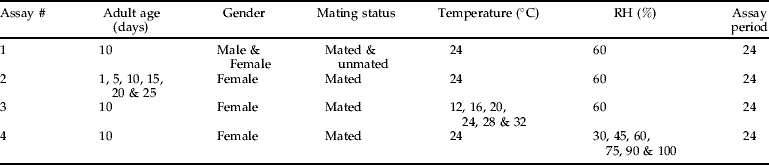
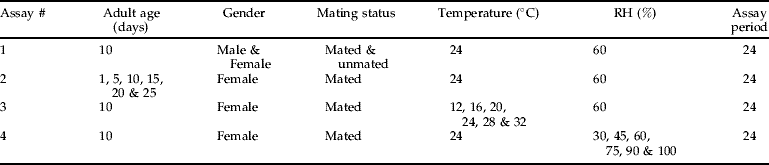
A total of four different assays were conducted, with each experiment starting at 8 am (table 1). In the first assay, we tested the effect of gender and mating status on flight of the different Adelphocoris species. In the second assay, we determined flight of mated females of each species at the ages of 1, 5, 10, 15, 20 and 25 days. In the third and fourth assays, we measured the effect of temperature and relative humidity on flight propensity of Adelphocoris spp. For these experiments, we tested ten-day-old mated females at six different temperatures (16, 20, 24, 28, 32, 36°C) and a constant 60% RH, or under variable RH (30, 45, 60, 75, 90, 100%) at a constant temperature (24°C). These four trials were conducted over 24-h periods. Each experiment was carried out with ≥23 replicates. At the end of each experiment, we checked whether tested adults were still alive, and discarded data from individuals that died over the course of the experiment.
Description of different biological and environmental conditions under which the various tethered-flight assays were conducted.
Data processing and analysis
According to Stewart & Gaylor (Reference Stewart and Gaylor1994) and Lu et al. (Reference Lu, Wu and Guo2007b), individual mirids were categorized as flyers (cumulative flight >10 min) or non-flyers (<10 min). For flyers, flight capacity was described by total flight distance, flight duration, flight speed and longest single flight (LSF). Individuals with single-time flight further than 5 km were considered as long-flyers (Schumacher et al., Reference Schumacher, Weyeneth, Weber and Dorn1997). We compared the percentage flyers between different gender and mating status, using a 2×2 factorial ANOVA. Chi-square tests were used to compare the percentage flyers and long-flyers between different age and environmental treatments. Statistical differences in certain flight parameters (i.e. distance, speed, duration) between individuals of different ages, or under given temperature and RH treatments, were determined using a one-way ANOVA, followed by a Tukey's honestly significance difference (HSD) test for mean separation. Flight data were log-transformed or ranked before analyses to meet assumptions of normality and homoscedasticity. A simple nonlinear model y=a+bx+cx2 was used to describe the relationship between flight parameters (i.e. flight distance, duration) and some key variables (i.e. age, temperature and RH). In the model, y indicates log10-transformed flight parameters, while x represents key variables, and a, b and c are constants. As flight speed did not vary distinctly and regularly with the continuous variables, data were excluded from analysis. Between-species differences in flight capacity were quantified using the method of least squares (Zar, Reference Zar1984; Gu & Danthanaryana, Reference Gu and Danthanarayana1990). All statistical analyses were executed using the software package SAS (SAS Institute, 1988).
Results
Effect of gender and mating status on flight propensity
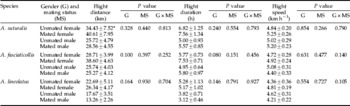
Between 71.4 and 94.4% of A. suturalis individuals (of different sex and mating status) engaged in >10 min flight, while 65.7–78.8% of A. fasciaticollis and 47.4–80.0% of A. lineolatus were considered flyers. No significant differences were found in percentage flyers between gender or mating status for any of the three species (χ2 test, P>0.05). Also, flight distance, duration and speed did not differ between gender or mating status of any of the three Adelphocoris species (Tukey's HSD, P>0.05). Lastly, interactions of gender and mating status were not significantly different (Tukey's HSD, P>0.05) (table 2).
Effect of gender and mating status on flight of Adelphocoris spp. during 24-h tethered flight assays (24°C, 60% RH).

* mean±SE.
Effect of age on flight propensity
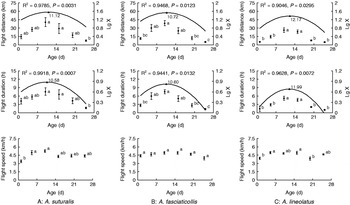
Between 53.3 and 94.4% of A. suturalis of different ages engaged in >10 min consecutive flights, while 58.6–94.7% of A. fasciaticollis and 58.6–94.7% of A. fasciaticollis were considered flyers. No significant differences were found in percentage flyers between various ages for any of the three species (χ2 test, P>0.05). Significant differences were found in flight distance, duration and speed (Tukey's HSD, P<0.05). Maximum flight distance and duration were predicted at ages of 11.1 d and 10.6 d for A. suturalis, 10.7 d and 10.6 d for A. fasciaticollis, and 12.2 d and 11.9 d for A. lineolatus, respectively (fig. 1).
Effect of age on the flight propensity of mated, female Adelphocoris spp. during 24-h tethered flight assays (24°C and 60% RH). Observed data of flight performance (◆) shown by mean±SE. Points with the same letters are not significantly different at the 5% level by Tukey's HSD test. Curve represents the relationship between flight performance and adult age. Parameter estimates (R2 and P) of the nonlinear model are labelled above the curve. ▵ and data, the optimal age for flight predicted by the model.

Effect of temperature on flight propensity
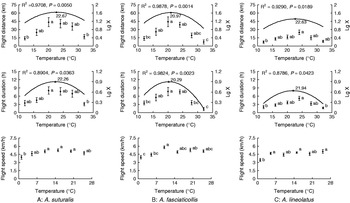
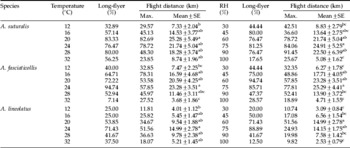
For each of the three Adelphocoris species, temperature significantly affected flight distance, duration and speed (Tukey's HSD, P<0.05). Maximum flight distance and duration were predicted to occur at temperatures of 22.7°C and 22.3°C for A. suturalis, 21.0°C and 20.3°C for A. fasciaticollis, and 22.6°C and 21.9°C for A. lineolatus, respectively (fig. 2). Among flyers, 32.89–83.33% of A. suturalis, 7.14–78.31% of A. fasciaticollis and 11.81–51.56% of A. lineolatus were considered long-flyers. The percentage long-flyers significantly differed between the three species (χ2 test, P<0.05). For each species, the average distance of the longest single flight also significantly differed between temperature treatments (Tukey's HSD, P<0.05). The longest single flight reached the peak value of 25.28 km at 20°C for A. suturalis, 14.99 km at 20°C for A. lineolatus and 23.28 km at 24°C for A. fasciaticollis (table 3).
Effect of temperature on the flight propensity of 10-day-old, mated, female Adelphocoris spp. during 24-h tethered flight assays (60% RH). Observed data of flight performance (◆) shown by mean±SE. Points with the same letters are not significantly different at the 5% level by Tukey's honestly significant different test. Curve represents the relationship between flight performance and temperature. Parameter estimates (R2 and P) of the nonlinear model are labelled above the curve. ▵ and data, the optimal temperature for flight predicted by the model.

Effect of temperature and RH on the longest single flight (LSF) of Adelphocoris spp.

For each species, values in the same column followed by the same letters are not significantly different at the 5% level by Turkey's honestly significant difference test.
Effect of relative humidity on flight propensity
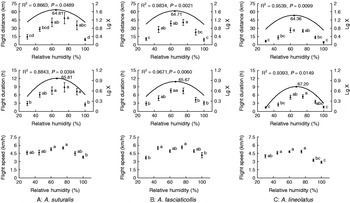
For each of the three Adelphocoris species, relative humidity significantly affected flight distance, duration and speed (Tukey's HSD, P<0.05). Maximum flight distance and duration were predicted at RH 64.8% and 65.8% for A. suturalis, RH 64.7% and 65.7% for A. fasciaticollis, and RH 64.4% and 67.2% for A. lineolatus, respectively (fig. 3). Among flyers, 44.44–81.25% of A. suturalis, 28.51–97.74% of A. fasciaticollis and 12.50–88.89% of A. lineolatus were regarded as long-flyers. The percentage long-flyers significantly differed between the three species (χ2 test, P<0.05). For each species, the distance of the longest single flight significantly differed between RH treatments (Tukey's HSD, P<0.05). The longest single flight peaked at 75% RH for A. suturalis and A. fasciaticollis, and at 60% RH for A. lineolatus (table 3).
Effect of relative humidity on the flight propensity of 10-day-old, mated, female Adelphocoris spp. during 24-h tethered flight assays (24°C). Observed data of flight performance (◆) shown by mean±SE. Points with the same letters are not significantly different at the 5% level by Tukey's honestly significant different test. Curve represents the relationship between flight performance and relative humidity. Parameter estimates (R2 and P) of the nonlinear model are labelled above the curve. ▵ and data, the optimal relative humidity for flight predicted by the model.

Comparison of flight performance between species
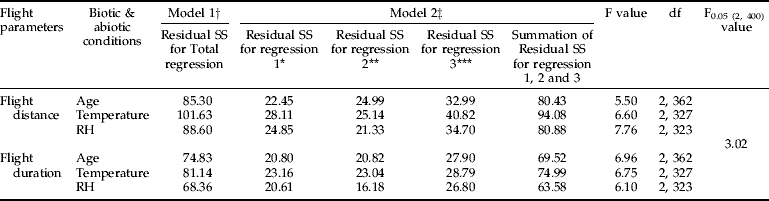
Between-species comparisons were based on two models: model 1 was a single regression (of flight distance/duration vs. selected biotic and abiotic conditions) for pooled data of the three species; and model 2 consisted of three separate regressions for each species, followed by their summation. Model 2 significantly reduced the residual sum of squares when compared with model 1 (F test, P<0.05), indicating that flight capacity significantly differs between species regardless of age or environmental effects (table 4). Further comparisons between any two species following the same method showed that A. suturalis and A. fasciaticollis had similar flight distance and duration, which were significantly greater than for A. lineolatus (F test, P<0.05) (data not shown).
Comparison of the flight potential between three Adelphocoris spp.
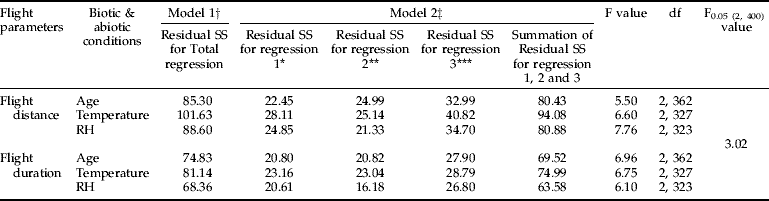
† Model 1 was the regression for pooled data of the three species; ‡ model 2 was the regression for the data of each species; * A. suturalis; ** A. fasciaticollis; *** A. lineolatus.
Discussion
Although Adelphocoris species exhibited great flight potential, there existed some notable differences and parallels in flight performance among the three species that were included in this study. Age had great effects on flight performance; and environmental factors, such as temperature and relative humidity, also affected Adelphocoris flight propensity.
Our work indicated that Adelphocoris spp. possess considerable potential to undertake long-distance flight, as reflected by a high percentage of flyers and long-flyers, and great flight performance. These results are different from flight performance of other mirid species. In flight mill experiments, Stewart & Gaylor (Reference Stewart and Gaylor1994) found that only 42% female and 16% male Lygus lineolaris engaged in >10-min cumulative flights over a 12-h period. Blackmer et al. (Reference Blackmer, Naranjo and Williams2004) found that 60–86% of L. lineolaris and Lygus hesperus did not engage in flight, while most flyers only undertook trivial (<5 min) flights. However, other species, such as Lygus lucorum, exhibited similarly great flight propensity with >80% of adults engaging in >10-min cumulative flight (Lu et al., Reference Lu, Wu and Guo2007b). In comparison with other mirid species, Adelphocoris spp. could be considered as long-distance flyers. Nevertheless, we need to use caution when extrapolating results from flight-mill experiments in laboratory conditions, as these do not necessarily explain flight under natural conditions (Armes & Cooter, Reference Armes and Cooter1991; Riley et al., Reference Riley, Downham and Cooter1997; Wu et al., Reference Wu, Wu, Wang and Guo2006; Lu et al., Reference Lu, Wu and Guo2007b). Flight-mill assays should, therefore, be complemented with an in-depth study of Adelphocoris dispersal in the field.
Flight performance differed greatly among the various Adelphocoris species, with A. suturalis and A. fasciaticollis showing similarly great flight propensity, while A. lineolatus engaged in flight to a lesser extent (table 3 and 4). This finding confirms the mark-release-recapture study. Rubidium sulphate (Rb2SO4) aqueous solution was sprayed to mark the mirids in a 0.02-ha weed field, where A. lineolatus was the most abundant species, consisting >80% of the mirid complex. Preliminary tests proved that A. suturalis and A. lineolatus had similar opportunity to be marked. More marked individuals of A. suturalis than A. lineolatus have been found 150–200 m far from the weed field 20 days later (Gao et al., Reference Gao, Li, Qiu, Wu and Jiang1992). However, our results appear in conflict with the geographic distribution of the three Adelphocoris species. The presence of A. lineolatus populations in multiple geographic regions of the world, despite their comparatively low dispersal capability, is rather surprising and should be the focus of future research. Contrastingly, A. suturalis and A. fasciaticollis, who have far more limited geographic distribution, are very likely to establish populations through long-distance dispersal. In 2006, our laboratory captured A. suturalis and A. fasciaticollis adults on Beihuang Island, 40–60 km from the mainland. As no resident individuals of these species were found during faunal surveys on the island, we can assume that these individuals were present either through long-distance flight or exploitation of wind patterns (K.M. Wu, unpublished data). Hence, more in-depth studies should determine to what extent both species engage in long-distance dispersal.
Both sexes of the different Adelphocoris species exhibited great flight propensity, with no differences between female and male individuals noted in key flight parameters. Contrastingly, female Lygus spp. tend to have greater flight capacity than males (Stewart & Gaylor, Reference Stewart and Gaylor1994; Blackmer et al., Reference Blackmer, Naranjo and Williams2004; Lu et al., Reference Lu, Wu and Guo2007b). Our research indicated that for Adelphocoris spp., mating status had little effect on flight performance, whereas age affected it greatly. Flight capacity was low for one-day-old adults and gradually increased with age up to day ten. This age-specific variation in flight capacity is similar to Lygus and has been ascribed to time-dependant development (or decay) of flight muscles and the maturation (or attenuation) of enzymes and substrates needed for flight (Johnson, Reference Johnson1969; Collatz & Wilps, Reference Collatz, Wilps, Collatz and Sohal1986; Lu et al., Reference Lu, Wu and Guo2007b).
Our study reports a sustained flight capacity for individuals up to 10–13 days old, which may be advantageous for Adelphocoris foraging, dispersal or migration. This finding is contrary to the oogenesis-flight syndrome, a phenomenon in which certain insects undertake long-duration flights until egg maturation and then cease or reduce flight activity (Johnson, Reference Johnson1969; Rankin et al., Reference Rankin, McAnelly, Bodenhamer and Danthanarayana1986; Dingle, Reference Dingle1996). Similar results were found for other mirid species, such as L. lineolaris, L. hesperus and L. lucorum (Stewart & Gaylor, Reference Stewart and Gaylor1991, Reference Stewart and Gaylor1994; Blackmer et al., Reference Blackmer, Naranjo and Williams2004; Lu et al., Reference Lu, Wu and Guo2007b). Rather, they are well-adapted colonizers that are capable of flying with a full complement of eggs, allowing them to readily exploit new habitants (Blackmer et al., Reference Blackmer, Naranjo and Williams2004).
Environmental factors, such as temperature and relative humidity, also affected Adelphocoris flight. All three species showed weak flight propensity at high temperature (32°C) or low RH (30%), which could be due to water loss during tethered flight assays (e.g. Lu et al., Reference Lu, Wu and Guo2007b). This possible confounding factor indicates the need for a more detailed study of physiological processes during flight. Optimum temperature and RH for flight of all Adelphocoris spp. ranged from 20–23°C and 64–68%, respectively. These conditions are generally observed during spring and autumn in the major cotton-growing regions of China. Consequently, these two seasons very likely favor Adelphocoris long-distance dispersal and foraging for host plants and over-wintering sites. Additional research, using light and pheromone trapping, could then shed light upon the seasonal population dynamics of the various species. Also, given the strong effects of temperature and RH on Adelphocoris flight performance, flight initiation may be greatly affected by micro-climatic conditions, which are dependant upon the structure of habitats in which these species occur.
Our work reveals Adelphocoris' potential to undertake long-distance flight and shows great variability in flight performance between the three species included in this study. This paper also reports the effects of biological and environmental factors on flight capacity and inclination of A. suturalis, A. lineolatus and A. fasciaticollis. Our results aid in understanding Adelphocoris' geographic distribution and population dynamics and form the basis for forecasting and management protocols at the regional scale.
Acknowledgements
We thank Lihong Guo for rearing the bugs for the study, Dengfa Cheng and Zhe Tian for providing the flight mill and some technological assistance, two anonymous referees for their valuable comments. This research was supported by financial assistance from Chinese Ministry of Science and Technology (973 Projects Grant, 2006CB102007) and National Natural Science Foundation of China (30625028).