The term coronary artery anomalies refers to a wide range of congenital abnormalities involving the origin, course, and structure of epicardial coronary arteries.Reference Angelini, Velasco and Flamm 1 They can be associated with other complex congenital heart diseases, but they also occur as isolated anomalies or associated with minor cardiac defects. Primary congenital coronary artery anomalies are found in approximately 1% of individuals undergoing coronary angiography and in approximately 0.3% of autopsies.Reference Engel, Torres and Page 2 – Reference Alexander and Griffith 7 Although most of the affected patients remain asymptomatic with a normal quality of life, specific forms of anomaly may induce sudden death, myocardial ischaemia, congestive heart failure, or endocarditis.Reference Taylor and Virmani 8 – Reference Werner, Wroblewska-Kaluzewska and Pleskot 16
The aim of the study was to describe our experience in the treatment of congenital coronary anomalies both in an adult and in a paediatric population and to compare the two groups for finding out differences in terms of angiographic incidence and therapeutic management.
Materials and methods
Databases at the Department of Cardiology of San Martino Adult's Hospital and of Gaslini Children's Hospital were retrospectively searched for all patients with a diagnosis of coronary artery anomaly who underwent cardiac catetherisation with coronary arteriography between January, 1994 and December, 2006. The following data were retrieved from the clinical records: gender, age at diagnosis, indication for coronary arteriography, type and proximal course of the anomalous vessel, associated extracardiac malformations or syndromes, and outcome.
An echocardiographic evaluation of the ostium and initial segment of coronary arteries was always performed before angiography in the paediatric population, with an ultrasound system provided with pulsed, continuous, and colour Doppler (HP/SONOS 5500 and 7500, Andover, Massachusetts; Prosound 5000 Aloka, Tokyo, Japan). Echo-scan was performed with the patient in the supine and left decubitus position. Coronary arteries were evaluated in the parasternal short-axis view at the level of the great arteries. Aortic angiography was performed in all children under general anaesthesia, by puncturing the femoral artery and administering a contrast agent just above the aortic valve in order to obtain a precise image of the coronary artery anatomy. Selective coronary angiography was performed in all adult patients and in a few children with suspected coronary artery anomaly. Written informed consent, according to guidelines approved by the Institutional Ethics Committee at the Giannina Gaslini Hospital and at the San Martino Hospital, was obtained, respectively, from every adult and from the parents of every child participating in the study. Detected coronary anomalies were classified in accordance with the systematic anatomic approach proposed by Angelini et al.Reference Angelini, Velasco and Flamm 1 The angiographic features of patients with coronary artery anomalies were defined according to the guidelines of Ishikawa and Brandt: the anterior course presents a cranial anterior loop of the proximal segment of the anomalous vessel, the posterior course exhibits a caudal posterior loop of the initial portion of the artery, while a course between the great vessels is recognised as a cranial posterior loop of the proximal segment of the anomalous artery.Reference Ishikawa and Brandt 17 The incidence of atherosclerotic lesion of the anomalous vessels – defined as more than 70% narrowing of intraluminal diameter – has been evaluated in each adult patient.Reference Conti, Pepine and Feldman 18 Patients with coronary anomalies associated with other complex congenital heart diseases and those with minor variations in coronary arterial origin were excluded, that is, separate ostium of the left anterior descending artery and the left circumflex artery within the left sinus of Valsalva or hypoplastic circumflex artery or right coronary artery.
Results
Adult population
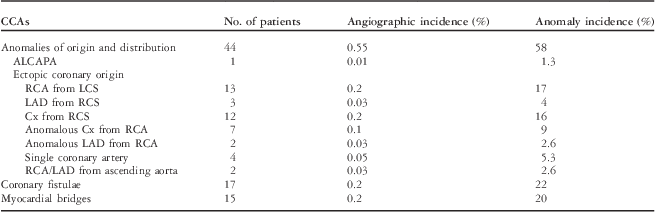
The study included 7960 adult patients who underwent diagnostic coronary arteriography at the San Martino Hospital. The incidence of major coronary artery anomalies was 1%, that is, 76 out of 7960 patients. There were 56 male and 20 female patients, and the mean age was 67 plus or minus 7.2 years. Clinical presentation consisted of angina syndrome in 58 patients, congestive heart failure or valvular disease in 12 patients, and suspected congenital heart disease in 6 patients. The characteristics of all detected coronary anomalies are reported in Table 1.
Incidence of congenital coronary anomalies in the adult population (7960 patients).

ALCAPA = anomalous left coronary artery arising from the pulmonary artery; CCAs = congenital coronary anomalies; Cx = circumflex coronary artery; LAD = left anterior descending artery; LCS = left coronary sinus; RCA = right coronary artery; RCS = right coronary sinus
Anomalous origin of coronary ostium from opposite, facing “coronary” sinus
Anomalous circumflex coronary artery was the most common detected anomaly in our series (25% of patients) and it always presented a retroaortic initial course with normal peripheral distribution. In all these cases, left anterior descending coronary artery originated from a separate ostium in the left sinus and had a normal peripheral distribution. Anomalous right coronary artery from the left coronary sinus never showed an intramural or an interarterial course and its final distribution was normal in all cases, as well as the origin and distribution of the left coronary artery. In patients with anomalous origin of the left anterior descending coronary artery from the right coronary sinus, the artery always coursed anterior to the right ventricular outflow tract with normal peripheral distribution, whereas the circumflex artery originated from the left sinus through a separate ostium with normal peripheral distribution. None of these anomalies of origin and course of the coronary arteries was treated with surgical or interventional procedure.
Anomalous location of coronary ostium outside normal “coronary” aortic sinuses
Anomalous left coronary artery from pulmonary artery was found in only one patient, a 32-year-old woman with no former clinical signs of heart disease, who had chest pain during strenuous exertion and underwent surgical repair 2 months later with an uneventful post-operative period.Reference Molinari, Balbi and Bertero 19
Anomalies of coronary termination
Coronary fistulae consisted of small haemodynamically insignificant lesions from the proximal right coronary artery or left anterior descending coronary artery to right ventricle or main pulmonary artery and none of them needed surgical treatment or coil embolisation.
Anomalies of intrinsic coronary artery anatomy
All patients with myocardial bridges were referred for angina syndrome or positive stress test and the involvement of the left anterior descending coronary artery was demonstrated in all cases. Moreover, in seven of them we observed the so-called milking effect at angiography causing myocardial perfusion defect in the absence of atherosclerotic disease. Therefore, they received beta-blocker therapy even if none of them underwent surgical or percutaneous treatment.
Coronary artery disease in anomalous coronaries
The overall incidence of atherosclerosis in anomalous coronary arteries was 11%, that is, 8 out of 76 patients.
Paediatric population
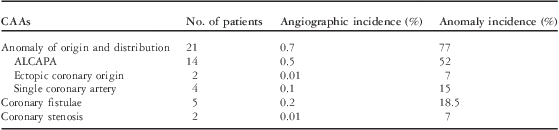
During the same period at Gaslini Institute 3026 angiocardiographies were performed and a diagnosis of congenital coronary artery anomaly was made in 28 children (0.9%), including 16 boys and 11 girls. The mean age was 3 years, ranging from 1 day to 14 years. The reasons for referral to our centre were detection of a heart murmur in 15 patients, chest pain and symptoms of circulatory insufficiency in seven patients, and other problems such as syncope or dizziness in five patients. None of them presented any associated extracardiac malformations or syndromes. The characteristics of all detected coronary anomalies are listed in Table 2.
Incidence of congenital coronary anomalies in the paediatric population (3026 patients).

ALCAPA = anomalous left coronary artery arising from the pulmonary artery; CAAs = coronary artery anomalies
Anomalous location of coronary ostium outside normal “coronary” aortic sinuses
The most common anomaly was the anomalous left coronary artery from pulmonary artery. This defect was found in eight infants and six older children. The affected infants had early clinical symptoms, such as dyspnoea and/or tachypnoea, feeding difficulties, and failure to thrive. The older children were all asymptomatic and were referred for the detection of a systolic murmur. All patients had electrocardiographic signs of anterolateral myocardial ischaemia or infarction and showed dilated cardiomyopathy with variable degree of mitral valve insufficiency and hyperechogenicity of anterior papillary muscle at echocardiography. In all, eight patients had dilated right coronary artery, whereas only three presented an evident diastolic retrograde flow in pulmonary artery. Angiography confirmed the suspected diagnosis in all cases. Left coronary artery was surgically re-implanted into the aorta in all children except one in whom it was connected to the aorta using an intrapulmonary tunnel. Ultrasound examination was repeated frequently during the first year follow-up and then annually together with stress echocardiography for assessing physical capability. Global left ventricular function improved in all patients within few weeks up to a maximum of 2 years and none died at early and late follow-up.
Anomalies of coronary termination
Among the five patients with coronary artery fistulae, two were infants who presented, respectively, with an associated muscular interventricular septal defect and a single coronary artery, and the other three were babies, older than 1 year with an isolated fistula, were referred to our centre for a murmur or palpitation at rest. The electrocardiogram results were always within the normal range. Echocardiography raised the suspicion of a coronary fistula and angiography confirmed the diagnosis. One isolated fistula from the right coronary artery to right ventricle was treated with coil embolisation, whereas one from the left main coronary artery to pulmonary artery required both percutaneous and surgical intervention because of persistent significant shunt. The small fistula associated with interventricular septal defect, extending from both left anterior descending coronary artery and right coronary artery to pulmonary artery, did not require any treatment. The one from the right coronary artery to right ventricle associated with single coronary artery was treated with coil embolisation. Post-operative course was regular in all patients, and the stress test performed annually showed absence of residual ischaemia.
Anomalous origin of coronary ostium from opposite, facing “coronary” sinus
Two patients had an ectopic coronary origin from the opposite aortic sinus; one had an anomalous origin of the left main coronary artery from the right coronary sinus with a course anterior to the pulmonary infundibulum and one had an anomalous origin of the circumflex artery from the right coronary sinus with a retroaortic course. Both of them were older than 6 years, asymptomatic, with normal electrocardiogram and treadmill stress test. They underwent coronary angiography to confirm the echocardiographic suspicion. At more than 3 years of follow-up, they remained clinically stable, without any surgical or percutaneous intervention.
There were four cases of single coronary artery: one of them was an asymptomatic 4-year-old boy with a normal electrocardiogram at rest who showed an ectopic origin of the right coronary artery, which originated from proximal main left coronary artery and coursed epicardially across the right ventricular outflow tract to the right atrioventricular groove with normal final distribution. He remained asymptomatic at follow-up without any surgical repair. In three cases, the left main coronary artery took origin from the right coronary artery with an initial course anterior to the infundibulum or retroaortic; one of them was an infant referred for a murmur and had an associated coronary fistula as we mentioned above, and the other two patients aged, respectively, 6 and 14 years were referred for chest pain and dizziness. In these latter two patients, echocardiographic examination showed, respectively, a severe discrete sub-aortic stenosis and a bicuspid aortic valve with ascending aortic aneurysm. Only angiographic examination revealed the presence of both coronary anomalies. The two patients underwent surgical repair of the associated aortic malformation, that is, sub-aortic membrane removal and replacement of the ascending aorta, without any intervention on the anomalous vessel. Follow-up consisted of annual electrocardiogram, stress test, and echocardiographic examination, which always confirmed good physical capability and ventricular contractility without evidence of myocardial ischaemia.
Anomalies of intrinsic coronary artery anatomy
Two patients with severe congenital left coronary artery stenosis became suddenly symptomatic for angina, respectively, at 10 and 12 years of age. Electrocardiogram showed signs of myocardial ischaemia and they immediately underwent revascularisation procedure with coronary artery bypass grafting. One of them needed a second surgical intervention 1 year later, whereas the other one was lost to follow-up soon after the first surgery.
Discussion
Coronary artery anomalies remain a major challenge for the cardiologist. Although the anatomic details and the pathophysiological patterns of most coronary artery anomalies are presently well known, few data exist on the clinical manifestations of each type of coronary anomaly and on their proper management and follow-up.Reference Angelini, Velasco and Flamm 1 , Reference Rigatelli and Rigatelli 9 , Reference Angelini 11 , Reference Davis, Cecchin and Jones 15
The total angiographic incidence of coronary artery anomalies of 0.9% and 1%, respectively, observed in our adult and paediatric populations approximates the incidence found in other adult and paediatric series.Reference Engel, Torres and Page 2 – Reference Garg, Tewari and Kapoor 6 , Reference Davis, Cecchin and Jones 15 , Reference Werner, Wroblewska-Kaluzewska and Pleskot 16 In our adult series, as in others, coronary artery anomalies appeared to be more common in men than in women, although this finding may reflect a higher incidence of atherosclerosis in men who are therefore in need of coronary angiography more frequently.Reference Wilkins, Betancourt and Mathur 5 , Reference Garg, Tewari and Kapoor 6 The most common coronary anomaly in the adult population was the anomalous origin of the circumflex artery from right coronary artery or right sinus of Valsalva and the rarest one was anomalous left coronary artery from pulmonary artery, in agreement again with most of the other reports.Reference Wilkins, Betancourt and Mathur 5 , Reference Garg, Tewari and Kapoor 6 , Reference Roberts 20 , Reference Page, Engel and Campbell 21 In fact, most patients with this anomaly develop symptoms of congestive heart failure or myocardial ischaemia during the first months of life and die within the first year after onset of symptoms. Survival until adult life is dependent on the development of collateral arteries between normal right coronary artery and anomalous left coronary artery, which guarantees retrograde flow in the left coronary system, as we detected in the adult patient of our series.Reference Wesselhoeft, Fawcett and Johnson 24 On the contrary, anomalous left coronary artery from pulmonary artery was the most commonly diagnosed anomaly among the paediatric population. Of the 14 patients with anomalous left coronary artery from pulmonary artery, six presented with the “infantile” course of the disease, whereas the others had the so-called “adult form”, with a dense network of collateral circulation justifying the absence of symptoms. Colour Doppler echocardiography enabled us to correctly suspect the presence of this coronary anomaly, giving us the chance to confirm and emphasise the role of this imaging modality for the diagnosis of anomalous left coronary artery from pulmonary artery among the paediatric population.Reference Werner, Wroblewska-Kaluzewska and Pleskot 16
The ectopic origin of the coronary artery from the contralateral sinus of Valsalva had a higher incidence in adult patients than in children, and it was always an occasional finding. As already demonstrated, the risk of angina syndrome and/or sudden death is strictly correlated to the pathologic anatomy of the anomalous vessel. Among coronary anomalies of origination and course, those with intramural or interarterial initial course are considered the most dangerous because they may be compressed with secondary lumen reduction during systole.Reference Davis, Cecchin and Jones 15 , Reference Roberts 20 , Reference Benge, Martins and Funk 22 , Reference Roberts, Siegel and Zipes 23 From the clinical standpoint, it has been demonstrated that affected patients with potentially “serious” coronary anomalies could suddenly die during young adulthood contrary to patients aged over 30–35 years in whom sudden death seems to be rare. Even more importantly, only 18–30% of sudden death cases in the young population were preceded by symptoms such as dizziness, syncope, or chest pain.Reference Basso, Maron and Corrado 12 , Reference Maron, Shirani and Poliac 13 , Reference Liberthson 25 Therefore, it is not surprising that patients of both our series affected by this kind of anomaly were clinically silent at investigation, that is, too young or too old for presenting symptoms or with benign coronary anatomy. Once more, it has been confirmed how important is the visualisation of coronary arteries as a routine part of any paediatric echocardiographic study, even in the absence of symptoms, for finding out clinically silent coronary anomalies that may need surgical correction or just clinical follow-up until adulthood. Equally important is a proper diagnostic evaluation of children or adolescents who complain of chest pain or have had syncope, as these could be warning signs preceding a life-threatening event.
On the contrary, the incidence of single coronary artery was lower in adult patients than in children, who often had other associated minor congenital heart defects. It has already been reported that 68% of affected patients younger than 20 years presented an associated abnormality, most frequently of the aortic valve or ascending aorta.Reference Shukla, Freedom and Black 26 For this reason, it seems easier to detect a single coronary artery in children who become early symptomatic because of the associated aortic anomaly than in adults for whom the coronary anomaly may be just an occasional benign finding during angiography.
Coronary fistulae diagnosed in the paediatric population emptied all into right cavities as in 90% of the cases reported in the literature. Most of the authors recommend occlusion of all isolated coronary fistulae to avoid possible subsequent complications such as sub-acute bacterial endocarditis, myocardial ischaemia, and rupture of an aneurysmal fistula.Reference Shyam Sunder, Balakrishnan and Tharakan 27 – Reference Tirilomis, Aleksic and Bush 30 Presence of left-to-right shunt signs, evidence of turbulent fistulous flow with high velocity, and/or evidence of coronary steal phenomenon even in the absence of ischaemia were the adopted indications for treatment of fistulae with coil embolisation at our hospitals. Spontaneous occlusion of haemodynamically insignificant coronary fistulae was never observed in the follow-up of our paediatric population, but no patients had infective or haemodynamic complications due to a possible chronic volume overflow. For this reason, we treated only fistulae that appeared big in size and haemodynamically significant, and not all the detected fistulae, as suggested by many authors.Reference Shyam Sunder, Balakrishnan and Tharakan 27 – Reference Tirilomis, Aleksic and Bush 30
Involvement of anomalous coronary arteries in atherosclerotic disease is at best controversial. Some studies reported a greater degree of acquired stenosis of the anomalous artery, especially with involvement of the anomalous circumflex artery. In our series, only a minority of adult patients showed atherosclerotic plaques only in the anomalous vessel, and in particular there was no increased incidence of atherosclerosis in the anomalous portion of the circumflex artery despite its retroaortic course. Therefore, we are in agreement with other authors suggesting that there is no predisposition for atherosclerotic involvement of coronary anomalies.Reference Wilkins, Betancourt and Mathur 5 , Reference Roberts 20 , Reference Page, Engel and Campbell 21 , Reference Click, Holmes and Vlietstra 31 – Reference Rigatelli, Gemelli and Zamboni 34
Most interestingly, none of the coronary anomalies diagnosed in the adult population was considered responsible of the ischaemic clinical picture except for the single case of anomalous left coronary artery from pulmonary artery and the multiple cases of myocardial bridges. In all other cases, acquired atherosclerotic disease involving normal and anomalous vessels justified symptoms and at the same time allowed us to detect otherwise clinically silent coronary anomalies. Therefore, these congenital anomalies could be considered of little clinical significance, unless valve surgery or coronary artery bypass surgery is performed without previous detection of the anomaly. In fact, surgical problems may follow if an anomalous vessel is excluded from perfusion during cardiopulmonary bypass or if the surgeon inadvertently incises the anomalous vessel.Reference Lonenecker, Reentsma and Creech 35 , Reference Donaldson and Raphael 36 On the contrary, the clinical picture of children with coronary artery anomalies appeared heterogeneous, that is, totally asymptomatic or haemodynamically significant.
Conclusions
In summary, the incidence and the most frequently detected types of Isolated Congenital Coronary Anomalies in our paediatric and adult populations, respectively, are almost the same as in other previous angiographic reports. Making a comparison between the two populations, we observed that the clinical picture of children with coronary artery anomalies may consist of very acute, even life-threatening symptoms, whereas in the adult population usually coronary anomalies are clinically silent and detected by accident at diagnostic angiographic examination.
Acknowledgement
We thank Anna Capurro for her help in revising the paper.