Introduction
The great grig, Cyphoderris monstrosa Uhler (Orthoptera: Prophalangopsidae), is a large (20–30 mm long, adults >1.5 g) ensiferan that inhabits montane coniferous forests of western North America (Morris and Gwynne Reference Morris and Gwynne1978; Kumala et al. Reference Kumala, McLennan, Brooks and Mason2005). Cyphoderris monstrosa is nocturnal, emerging from below-ground burrows and climbing conifers to feed on staminate cones (Caudell Reference Caudell1904; Morris and Gwynne Reference Morris and Gwynne1978; Ladau Reference Ladau2003). Males sing after dusk via tegminal stridulation (Morris and Gwynne Reference Morris and Gwynne1978) from late May or early June until late August (Mason Reference Mason1996). Cyphoderris Uhler species are active at much lower temperatures than is typical for acoustic insects, singing at temperatures near 0 °C (Morris and Gwynne Reference Morris and Gwynne1978; Dodson et al. Reference Dodson, Morris and Gwynne1983; Morris et al. Reference Morris, Gwynne, Klimas and Sakaluk1989). Cyphoderris monstrosa are thought to overwinter as late instars in burrows below the leaf litter layer (Gwynne Reference Gwynne1995), but nothing is known about their low temperature biology.
Insects employ two dominant strategies to survive subzero temperatures: freeze avoidant insects depress the temperature at which their fluids freeze, but die upon ice formation, while freeze tolerant insects can withstand internal ice formation. Although orthopteran eggs are freeze avoidant (e.g., Hao and Kang Reference Hao and Kang2004), many nymphs and adults are freeze tolerant (e.g., Alexander Reference Alexander1967). The mechanisms underlying freeze tolerance are unclear, but many freeze-tolerant insects accumulate low molecular weight cryoprotectants, including the disaccharide trehalose and free amino acid proline, both detected in hemolymph of freeze-tolerant New Zealand alpine weta, Hemideina maori Pictet and Saussure (Orthoptera: Anostosmatidae) (Neufeld and Leader Reference Neufeld and Leader1998). Many freeze-tolerant insects accumulate glycerol (Lee Reference Lee2010), but this cryoprotectant has not been detected in freeze-tolerant Orthoptera (Ramløv et al. Reference Ramløv, Bedford and Leader1992; McKinnon Reference McKinnon2015). Regulating the location and temperature of ice nucleation is thought to be essential for insect freeze tolerance (Zachariassen and Kristiansen Reference Zachariassen and Kristiansen2000). These ice nucleators may be endogenous (e.g., proteins) or exogenous (e.g., ice nucleating-active bacteria or ice crystals), and can be located in the hemolymph (e.g., H. maori; Sinclair et al. Reference Sinclair, Worland and Wharton1999) and tissues (e.g., the Malpighian tubules and fat bodies of Eurosta solidaginis; Mugnano et al. Reference Mugnano, Lee and Taylor1996).
Here, we characterise the cold tolerance strategy, the lower lethal limits, likely sites of ice nucleation, and common low molecular weight cryoprotectants of the overwintering stage of C. monstrosa.
Materials and methods
We collected 40 nymphs by hand from tree trunks in pine forests near Kamloops, British Columbia, Canada (50.45°N, 120.07°W, ~1000 m) from 27 May to 2 June 2015. During this period, the air temperature ranged from 7.3 °C to 29.3 °C, with a daily mean of 17.8 °C (Environment Canada 2015). We placed nymphs in 100 mL perforated plastic containers, with apple pieces for food. We shipped the animals on ice to the University of Western Ontario (London, Ontario, Canada), where we maintained them for two to six weeks at 4 °C until use in experiments. Nymphs fed in captivity, thus apple pieces were replaced weekly.
For low temperature exposures, we placed nymphs (fresh mass range: 0.30–1.48 g) in 35 mL plastic vials in contact with a type T (copper-constantan) thermocouple and cooled them at 0.25 °C minute−1 to the target temperature in an aluminum block through which 50% methanol was circulated from a programmable refrigerated circulator (Proline RP 55, Lauda, Wurzburg, Germany). We monitored the temperature from the thermocouple using PicoLog software via a Picotech TC-08 thermocouple interface (Pico Technology, Cambridge, United Kingdom). Our general approach to characterising cold tolerance is described by Sinclair et al. (Reference Sinclair, Alvarado and Ferguson2015). In all cases, we rewarmed the nymphs at 0.25 °C minute−1 to 4 °C, weighed them (fresh mass ±0.01 g), and transferred them to individual 100 mL containers with apple pieces at 15 °C for recovery. Nymphs were considered “alive” if they could stand and move in a coordinated fashion 48 hours after thawing. Because developmental stage of Orthoptera can modify parameters such as metabolite composition (e.g., Anand and Lorenz Reference Anand and Lorenz2008), we restricted subsequent experiments to larger nymphs (>0.9 g).
To determine the temperature at which ice formation begins (supercooling point (SCP)), we cooled nymphs in 35 mL plastic vials as described above, and recorded the lowest temperature before the exotherm due to ice formation (Sinclair et al. Reference Sinclair, Alvarado and Ferguson2015). The survival of these nymphs was monitored (details below). To determine the critical thermal minimum (CTmin), or the temperature at which the nymphs entered chill coma, we cooled six nymphs from 25 °C to the SCP as described previously (MacMillan and Sinclair Reference MacMillan and Sinclair2011). Nymphs were monitored continuously, and the CTmin was the temperature at which nymphs could no longer exhibit coordinated movement in response to probing. We determined cold tolerance strategy by monitoring survival of nymphs held for 1.5 hours at −4 °C (unfrozen) or −6 °C (frozen), with freezing confirmed by detection of the SCP exotherm of each nymph. We considered them freeze tolerant if they survived both temperatures, freeze avoidant if they survived at −4 °C but not −6 °C, or chill-susceptible if they were killed by exposure to both temperatures. We determined the lethal temperature by determining survival of nymphs exposed to temperatures between −9 °C and −16 °C for 1.5 hours. To determine lethal time, we monitored survival of nymphs kept frozen at −6 °C for time periods between 1.5 hours and 10 days, and subsequently thawed. Each nymph was exposed to only one cold treatment.
To identify likely sites of ice nucleation, we compared the SCP of hemolymph and several excised tissues (foregut, midgut, hindgut, Malpighian tubules, fat bodies, and metafemur muscle) to whole body SCP. We extracted 4 μL of hemolymph from each of three nymphs (mass 1.16, 1.25, and 1.48 g) using a 20 μL pipette, and diluted it with 12 μL 3% ascorbic acid to prevent coagulation (McKinnon Reference McKinnon2015). We dissected tissues from the same three nymphs, and placed them in 20 μL 3% ascorbic acid. We cooled hemolymph, tissue samples, and 20 μL 3% ascorbic acid in 1.7 mL microcentrifuge tubes at 0.25 °C minute−1 from 4 °C to −30 °C, with thermocouples attached to the external surface of tubes to detect temperature. We compared the mean SCP of hemolymph (in 3% ascorbic acid) to 3% ascorbic acid alone, as well as the mean SCP of hemolymph and each tissue to whole-body SCP using a one-way analysis of variance (ANOVA) with planned contrasts in R version 3.0.3 (R Core Team 2013). Means are reported ±standard error (SEM).
We also determined total hemolymph osmolality using a nanolitre osmometer (Otago Osmometers, Dunedin, New Zealand), as described previously (Crosthwaite et al. Reference Crosthwaite, Sobek, Lyons, Bernards and Sinclair2011). To quantify potential low molecular weight cryoprotectants in the hemolymph, we measured free proline (Carillo and Gibon Reference Carillo and Gibon2011), glycerol (Crosthwaite et al. Reference Crosthwaite, Sobek, Lyons, Bernards and Sinclair2011), and trehalose (Tennessen et al. Reference Tennessen, Barry, Cox and Thummel2014) in 4 μL samples of hemolymph from three to eight nymphs (mass range: 0.90–1.48 g) using enzymatic spectrophotometric assays. Hemolymph was extracted from untreated nymphs, as well as nymphs that were frozen at −6 °C for one hour. Mean osmolality and cryoprotectant concentrations are reported ±SEM.
Results and discussion
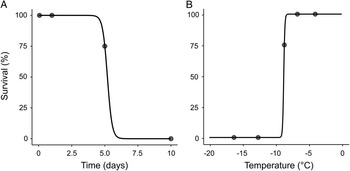
Cyphoderris monstrosa nymphs remained active as they were cooled, until they froze at a mean SCP of −4.6±0.3 °C (range: −2.4 °C to −6.8 °C). All C. monstrosa nymphs survived exposure to −4 °C (n=4, unfrozen) and −6 °C (n=4, frozen), thus we conclude that they are freeze-tolerant. Most (75%) C. monstrosa survived being frozen at −6 °C for 5 days (Fig. 1A), demonstrating survival of equilibrium ice formation (which can take several hours in large Orthoptera; Ramløv and Westh Reference Ramløv and Westh1993). However, they did not survive acute (1.5 hour) exposures at or below −12 °C (Fig. 1B). This pattern is similar to other freeze-tolerant ensiferans, such as H. maori (Ramløv et al. Reference Ramløv, Bedford and Leader1992), that freeze at moderate subzero temperatures, but have a relatively high lower lethal temperature (Sinclair et al. Reference Sinclair, Addo-Beddiako and Chown2003).
Survival of Cyphoderris monstrosa nymphs 48 hours after being frozen for different periods of time at −6 °C (A) or at different temperatures for 1.5 hours (B). n=4 for each temperature and time point. Survival curves were calculated using a generalised linear model.

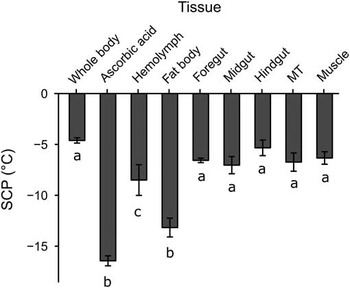
The mean fresh mass of C. monstrosa nymphs was 0.95±0.08 g (range: 0.30–1.52 g), and SCP was independent of fresh mass (linear regression, F 1,21=0.207, P=0.65), suggesting that ice formation is initiated by ice nucleating agents (Sinclair et al. Reference Sinclair, Gibbs, Lee, Rajamohan, Roberts and Socha2009). The relationship between dry mass and SCP could be examined to verify this trend (e.g., Ditrich and Koštál Reference Ditrich and Koštál2011). Cyphoderris monstrosa hemolymph froze at −8.5 °C, 8 °C higher than the ascorbic acid anticoagulant (Fig. 2), indicating the presence of a hemolymph ice nucleator (Sømme Reference Sømme1986; Sinclair et al. Reference Sinclair, Worland and Wharton1999), although the low SCP of hemolymph suggests that it is not the source of the high SCP we observe in the whole animal. Fat body did not substantially increase the SCP of ascorbic acid, but gut tissues, metafemur muscle and Malpighian tubules in ascorbic acid froze at temperatures similar to whole-body SCP (Fig. 2). Thus, it appears that although there is a nucleating agent in the hemolymph, ice formation is initiated by one or more of these tissues, similar to the ice-nucleating Malpighian tubules and fat bodies of E. solidaginis (Mugnano et al. Reference Mugnano, Lee and Taylor1996).
Mean ± standard error (SEM) supercooling point (SCP) of whole C. monstrosa nymphs, 20 μL 3% ascorbic acid, hemolymph diluted 1:3 with 3% ascorbic acid, and tissues (~10 mg) in 20 μL 3% ascorbic acid. n=23 for whole body SCP, n=3 for all other samples. Different letters indicate significant differences (α=0.05) in SCP (ANOVA with planned contrasts: F 8,21=5.671, P<0.001). MT, Malpighian tubules.

The hemolymph osmolality of C. monstrosa nymphs was 358±51 mOsm (n=4). This is lower than that of other freeze tolerant ensiferans, H. maori (700 mOsm; Ramløv Reference Ramløv1999) and Gryllus veletis Alexander and Bigelow (Orthoptera: Gryllidae) (615 mOsm; McKinnon Reference McKinnon2015). Cyphoderris monstrosa hemolymph contained 17.4±3.2 mM trehalose (n=4) and 12.7±2.6 mM proline (n=8), accounting for ~10% of total hemolymph osmolality. The concentrations of these cryoprotectants are lower than in H. maori (Ramløv et al. Reference Ramløv, Bedford and Leader1992; Neufeld and Leader Reference Neufeld and Leader1998) and G. veletis (McKinnon Reference McKinnon2015). Like G. veletis and H. maori, we detected no hemolymph glycerol in field-fresh nymphs (n=3). However, hemolymph sampled two to four weeks after the nymphs had been frozen at −6 °C contained 14.6±5.7 mM glycerol (n=3). No such changes in hemolymph concentrations of trehalose or proline were observed after freezing. The increase in glycerol suggests that C. monstrosa cryoprotectant composition is plastic, and that they may also be able to enhance freeze tolerance in response to short cold exposures, such as frosts in the fall or late spring (Marshall and Sinclair Reference Marshall and Sinclair2015). Thus, although the hemolymph osmolality we measured in C. monstrosa was not high in our spring-collected specimens, there is potential for an increase in hemolymph osmolality prior to or during the winter months, which may support lower lethal temperatures and tolerance to longer durations frozen than we observed in this study.
To our knowledge, this is the first report of freeze tolerance in Prophalangopsidae. The minimum air temperature in Kamloops during the 2014–2015 winter was −19.6 °C (Environment Canada 2015), well below the lethal temperature of C. monstrosa nymphs. However, their overwintering habitat is likely buffered by snow cover (Petty et al. Reference Petty, Zuckerberg and Pauli2015), such that burrow temperatures likely do not approach these low air temperatures. Future investigations could determine whether C. monstrosa exhibits seasonal plasticity in freeze tolerance, and which mechanisms (e.g., cryoprotectant accumulation) drive this plasticity.
Acknowledgements
Thanks to Andrew Mason, Terrence Chang, and Kevin Judge for collection advice, and two anonymous referees for comments that improved the manuscript. This research was supported by a National Sciences and Engineering Research Council (NSERC) Discovery Grant to B.J.S. and an Orthopterists’ Society Theodore J. Cohn Research Fund grant to J.T. J.T. was supported by an NSERC Canada Graduate Scholarship, and A.H.M. by an Ontario Graduate Scholarship.