Introduction
Although current psychiatric classifications are agnostic in terms of etiology and acknowledge that DSM/ICD entities do not reflect true biological processes, DSM/ICD mental disorders are defined as discrete entities characterized by distinctive signs, symptoms, and natural histories. However, clinical, epidemiological, and molecular genetic studies have repeatedly shown that symptoms and treatments overlap across disorders (Caspi et al., Reference Caspi, Houts, Belsky, Goldman-Mellor, Harrington, Israel and Poulton2014), and the same person can have symptoms of different psychiatric disorders at different points in time, suggesting possible shared etiologies across multiple psychiatric disorders.
Recent genetic studies that have found that there is an overlap in the common SNPs that influence risk for psychiatric disorders, with the degree of overlap varying for pairs or subsets of disorders (Lionel et al., Reference Lionel, Crosbie, Barbosa, Goodale, Thiruvahindrapuram, Rickaby and Scherer2011) (Consortium, Reference Consortium2013; Fromer et al., Reference Fromer, Pocklington, Kavanagh, Williams, Dwyer, Gormley and Ruderfer2014; Gatt, Burton, Williams, & Schofield, Reference Gatt, Burton, Williams and Schofield2015). These findings predict that the siblings of ill individuals should be at increased risk for the same psychiatric illness as his/her sibling, as well as for other psychiatric illnesses. Such familial clustering within and across disorders has been shown for schizophrenia and severe bipolar disorder (Lichtenstein et al., Reference Lichtenstein, Yip, Björk, Pawitan, Cannon, Sullivan and Hultman2009).
Low IQ is also familial (Plomin, Reference Plomin1999). Many patients with psychiatric disorders have low IQ, and psychiatric disorders and low IQ share risk factors such as low birth weight, preterm birth (Nosarti et al., Reference Nosarti, Reichenberg, Murray, Cnattingius, Lambe, Yin and Hultman2012) and maternal infections (Brown, Reference Brown2012). Twin studies suggest familial concurrence between low IQ and psychosis (Cannon et al., Reference Cannon, Huttunen, Lonnqvist, Tuulio-Henriksson, Pirkola, Glahn and Koskenvuo2000; Goldberg et al., Reference Goldberg, Torrey, Gold, Bigelow, Ragland, Taylor and Weinberger1995). These data suggest that low IQ should cluster within families with psychiatric illnesses. However, the clustering of psychiatric disorders, as well as low IQ, has not been comprehensively investigated in population-based epidemiological studies including less severe disorders such as anxiety and personality disorders.
A sibling's recurrence risk expresses the risk of a sibling of a person suffering from a given disorder to suffer from the same or from a different disorder. For illustration, if psychiatric disorders are labeled ‘Disorder A’, ‘Disorder B’, ‘Disorder C’ etc’, a sibling's recurrence risk for the same disorder is the risk of a sibling of a person suffering from ‘Disorder A’ to also suffer from ‘Disorder A’, and a sibling's recurrence risk for across-disorder is the risk of a sibling of a person suffering from ‘Disorder A’ to suffer from ‘Disorder B’ or ‘Disorder C’ etc’. The relative recurrence risk (RRR) quantifies this recurrence in relation to rates of disease in families without affected members. RRR can be measured for the same disorder (within-disorder RRR), or for a different disorder (across-disorder RRR).
Toward this goal, we used data from the mandatory Israeli Draft Board medical and psychiatric assessment (Goldberg et al., Reference Goldberg, Fruchter, Davidson, Reichenberg, Yoffe and Weiser2011), which includes family linkage information. Using all full siblings in the population, we determined familial clustering of psychiatric disorders and low IQ. In order to see if familial clustering of psychiatric disorders is specific for psychiatric disorders and/or low IQ, as non-CNS controls, we examined familial clustering of psychiatric disorders and low IQ in siblings of patients with Type-1 diabetes, hematological malignancies and hernia (Valdez, Yoon, Liu, & Khoury, Reference Valdez, Yoon, Liu and Khoury2007; Zöller, Ji, Sundquist, & Sundquist, Reference Zöller, Ji, Sundquist and Sundquist2013).
Methods
Data were obtained from the Israeli Draft Board Registry, which includes information on the unselected Israeli Jewish population of adolescents aged 16–21 years. The Draft Board performs a mandatory assessment of males and females, and determines medical, psychiatric and intellectual eligibility for compulsory military service. The population assessed by the draft board, therefore, includes individuals who are eligible for military service, as well as those who will be exempted due to medical, psychiatric, or social reasons.
This study was approved by the ethics committees of the Sheba Medical Center, Tel Hashomer, Israel, and the Medical Branch of the Israeli Defense Forces. Because the study used existing databases and analytic datasets were de-identified, it received a waiver of informed consent from human subjects.
Medical and psychiatric assessments
During the time covered by this study, the draft board assigned diagnoses based on the International Classification of Diseases 10th Revision (ICD-10) (World Health Organization, 1992).
Psychiatric diagnoses are assigned by a board-certified psychiatrist experienced in treating adolescents. The standard procedure for psychiatric diagnosis includes a mandatory face-to-face assessment as described in detail elsewhere (Weiser et al., Reference Weiser, Reichenberg, Kravitz, Lubin, Shmushkevich, Glahn and Davidson2008a, Reference Weiser, Werbeloff, Vishna, Yoffe, Lubin, Shmushkevitch and Davidson2008b). In the case of co-occurring psychiatric disorders, such as diagnosis of psychosis and attention-deficit hyperactive disorder (ADHD), the more severe diagnosis is assigned. Severity is determined by the disorder with the most severe symptoms and functional impairment.
For individuals with moderate to severe autism spectrum disorders (ASDs), and intellectual disability the standard procedure is modified. At age 17, their medical status is reported in detail to the draft board by the government agencies and other organizations responsible for their care and protection. Such reports include the current diagnosis according to contemporary criteria. The original childhood diagnosis and subsequent clinical history up to age 17 are also commonly reported. Based on a review of these materials, rather than a face-to-face assessment, a board-certified psychiatrist assigns a diagnosis and defers them from military service (Reichenberg et al., Reference Reichenberg, Gross, Weiser, Bresnahan, Silverman, Harlap and Lubin2006).
The psychiatric diagnoses used in this study correspond to ICD-10 criteria of psychotic disorders (F20-F29), personality disorders (F60-F61), anxiety disorders (F40-F42), mood disorders (F30-F39), severe/profound intellectual disability (F70-F79), ASD (F84), substance/alcohol abuse (F10-F19) and ADHD (F90, diagnosis available from 2008).
The medical examination was performed by a physician and includes a review of medical records and a physical examination, and when needed, a referral for a board-certified specialist's assessment. In this study, we included three non-CNS negative control groups: (1) type-1 diabetes, based on fasting glucose levels, glucose tolerance test and the presence of characteristic symptoms, (2) hernia, including present or past inguinal hernia, femoral hernia and umbilical hernia, and (3) hematological malignancies, including leukemias (acute/chronic), lymphomas (Hodgkin/Non-Hodgkin), myeloproliferative syndromes, plasma cell dyscrasias, myelodysplastic disorders and histiocytosis X. The non-CNS control diagnoses used correspond with ICD criteria for Type-1 diabetes (E10), hernia (K40-K42), and hematological malignancies (C81-C96).
Cognitive assessment
Four cognitive tests are administered in the Draft Board: an Otis-type verbal intelligence test; a verbal reasoning test; a nonverbal reasoning test similar to the Raven's Progressive Matrices; and a mathematical knowledge test (Davidson et al., Reference Davidson, Reichenberg, Rabinowitz, Weiser, Kaplan and Mark1999). The tests are progressive, beginning with relatively simple questions and becoming more difficult. The tests are computerized and time-limited. All of the scores are based on the number of correct answers. The sum of the scores for the four tests forms a validated measure of general intelligence (IQ), (Davidson et al., Reference Davidson, Reichenberg, Rabinowitz, Weiser, Kaplan and Mark1999) which is standardized against population norms and follows a Gaussian distribution. Low IQ (IQ < 70) was classified as two standard deviations or more below population means.
Covariates
Data on the year of birth and gender were available from the Draft Board. Data on socio-economic status (SES) was obtained from the Israeli Central Bureau of Statistics. This measure is based on the address and is scored on a 10-point scale (Weiser et al., Reference Weiser, Van Os, Reichenberg, Rabinowitz, Nahon, Kravitz and Noy2007).
Study population
The study population included all consecutive individuals attending the military pre-induction assessment in the Draft Board between the years 1998–2014 (n = 1 085 388, 59.1% males). Full siblings (i.e. siblings born to the same mother and father) were identified using family relationship information recorded in the registry (Weiser et al., Reference Weiser, Van Os, Reichenberg, Rabinowitz, Nahon, Kravitz and Noy2007, Reference Weiser, Reichenberg, Kravitz, Lubin, Shmushkevich, Glahn and Davidson2008a, Reference Weiser, Werbeloff, Vishna, Yoffe, Lubin, Shmushkevitch and Davidson2008b). This information is based on the unique personal identification number assigned to each Israeli citizen at birth or upon immigration, enabling accurate linkage. Because orthodox Jewish women (about 25% of women) are exempt from military service, the number of females is lower than males. There were 903 690 full siblings in the study population (58% males), including 166 359 male-male sibling pairs, 104 494 female-female sibling pairs, and 197 571 opposite-sex sibling pairs. Families could contribute more than one sibling pair. Two sibling pairs were removed due to missing data on sex.
Analytic sample
The analytic sample included all individuals with at least one sibling (n = 903 690). All individuals with a diagnosis of a psychiatric disorder, low IQ, Type-1 diabetes, hernia or hematological malignancies (‘cases’) were identified in the Draft Board cohort of full siblings. Each case was matched with 10 age-matched controls selected at random from the sample, with replacement, and for each case and matched controls, we ascertained all full siblings.
We identified 2128 cases with autistic spectrum disorder (ASD), 3272 cases with the ADHD receiving treatment, 9572 cases with severe/profound intellectual disability (ID), 7902 cases with psychotic disorders, 9704 cases with mood disorders, 10 606 cases with anxiety disorders, 24 815 cases with personality disorders, 791 cases with substance/alcohol abuse (SUD). Thirty-one thousand, one hundred and eighty-six had low IQ. There were 2770 cases with Type-1 diabetes, 30 199 cases with hernia and 931 cases with hematological malignancies. The analytic sample is presented in online Supplementary sTable 2.
Statistical analyses
The exposure variable was a sibling with or without a psychiatric disorder, low IQ or a non-CNS control disorder. The RRR (within-disorder RRR) for siblings is the risk of a diagnosis ‘A’ in a sibling of an individual with that diagnosis compared with a sibling of an individual without that diagnosis. The across-disorder RRR for siblings is the risk of diagnosis ‘B’ in a sibling of an individual with diagnosis ‘A’ compared with the risk of diagnosis ‘B’ in a sibling of an individual without diagnosis ‘A’. We estimated RRR and the associated 95% confidence interval (95% CI) using logistic regression models (Pearce, Reference Pearce2016). Because of the rarity of the disorders, we can interpret an odds ratio from the logistic regression models as a relative risk. As indicated above, an individual sibling may have contributed to more than one pair. Consequently, we used robust standard errors to account for the dependence between individuals in a family. First, an unadjusted model was fitted, followed by a model adjusting for SES, sex and year of birth.
All analyses were performed using SPSS 17.0, data visualization was performed using R3.4.2 (Team, 2013).
Results
Within-disorder RRR
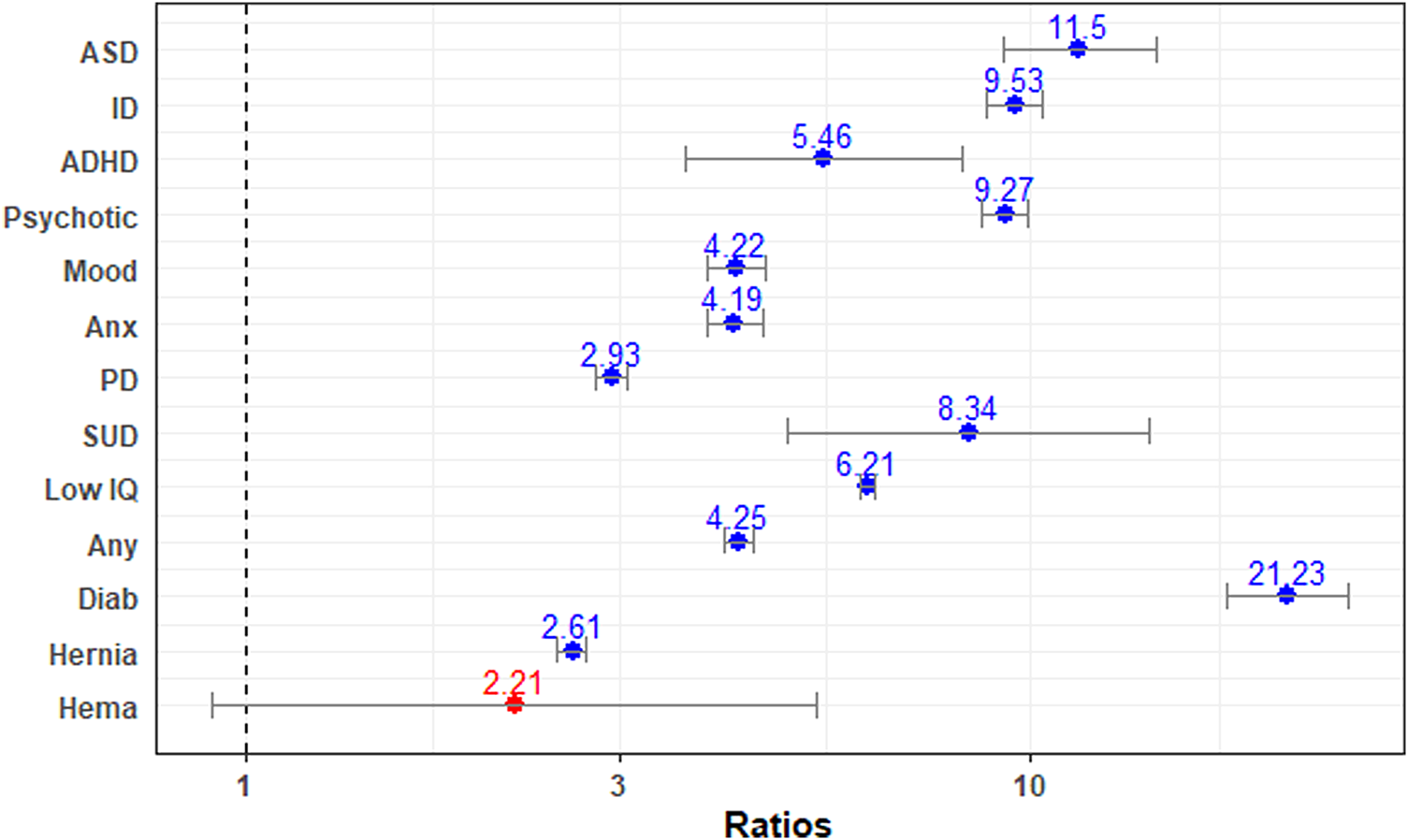
Figure 1 and Table 1 present adjusted within-disorder RRR and associated two-sided 95% CIs for the psychiatric disorders and low IQ, and non-CNS control disorders. Within-disorder RRRs were statistically significantly increased for all psychiatric disorders and low IQ. Within disorder, RRRs were 11.53 (9.23–14.40) for ASD, 9.53 (8.81–10.31) for moderate or severe intellectual disability, 5.46 (3.64–8.18) for ADHD, 9.27 (8.66–9.92) for psychotic disorders, 8.34 (4.91–14.15) for SUD, 4.22 (3.86–4.61) for mood disorders, 4.19 (3.86–4.55) for anxiety disorders, and 2.93 (2.80–3.07) for personality disorders. The within-disorder RRR for low IQ was 4.25 (4.07–4.43). In the non-CNS control conditions, the within-disorder RRRs were 2.61 (2.49–2.72) for hernia, 2.22 (0.91–5.35) for hematologic malignancies, and 21.23 (17.80–25.31) for Type-1 diabetes.
Familial clustering of psychiatric disorders low IQ and non-CNS control conditions. Within-disorder, adjusted relative recurrence risk (RRR) for full siblings and associated 95% CIs are presented. RRRs are drawn on a log-x-axis.
Note: ID intellectual disability; ASD, autism spectrum disorder; Psychotic: Psychotic Disorders; SUD, substance use disorder; ADHD, attention-deficit hyperactive disorder; Any, any psychiatric diagnosis.

Within- and cross-disorder risk ratios

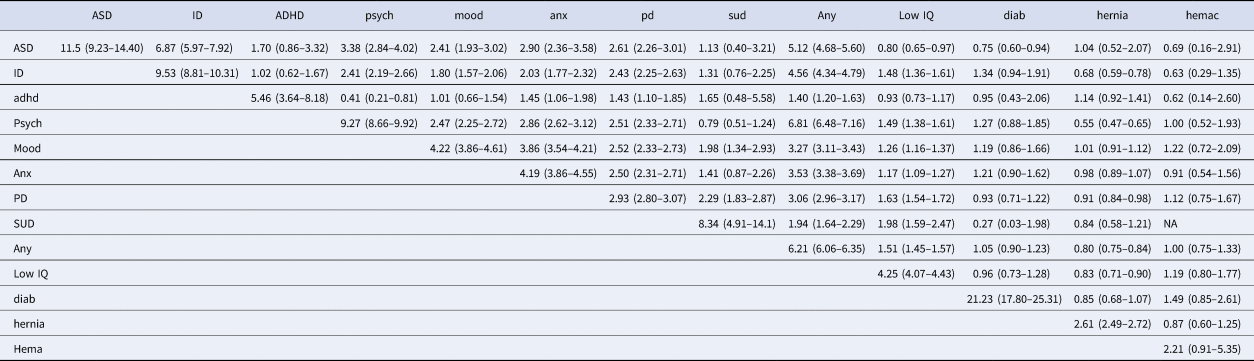
ASD, Autism Spectrum Disorders; ID, Intellectual Disability; ADHD, Attention Deficit Heyperactivity Disorder; Psych, Psychosis; ANX, Anxiety Disorders; PD, Personality Disorders; SUD, Substance Use Disorders; ANY, Any Psychiatric Disorder; DIAB, Diabetes; HEMA, Hematological Malignancies.
Across disorder RRR
Figure 2 (and online Supplementary sTable 1) presents adjusted across-disorder RRRs in the psychiatric disorders, low IQ and non-CNS control conditions. The lowest RRR, of 0.41, was for a diagnosis of ADHD and a diagnosis of a psychotic disorder (95% CI: 0.21–0.81), and the highest was 6.87 for a diagnosis of ASD and a diagnosis of ID (95% CI: 5.97–7.92). Nineteen of the 28 pairs of psychiatric disorders had RRRs greater than 1 and 95% CIs that did not include 1. The median across-disorder RRR in a sibling of a person with a disorder for any other disorder was 3.40 (95% CI: 1.94–5.12).
Familial clustering across psychiatric disorders, low IQ, and non-CNS control conditions. The color of each box indicates the magnitude of the relationship (log RRR) (see figure legend), and the size of the box indicates statistical significance. The y-axis presents the proband's psychiatric diagnosis, the x-axis the risk for a diagnosis in his or her sibling. Asterisks indicate RRRs 95% CI excluding 1 after a Bonferroni correction for multiple comparisons. ID, moderate or severe intellectual disability; ASD, autism spectrum disorder; Psychotic: Psychotic Disorders SUD, substance use disorder; ADHD, attention-deficit hyperactive disorder; Any, any psychiatric diagnosis.

The median across-disorder RRR in a sibling of a person with low IQ and a psychiatric disorder was 1.37 (95% CI: 0.93–1.98). The lowest RRR was 0.80 for a diagnosis of ASD (95% CI: 0.65–0.97), and the highest was 1.98 for a diagnosis of SUD (95% CI: 1.59–2.47) (Fig. 2).
There were no statistically significant increases in across-disorder RRRs between psychiatric disorders and low IQ, and hernia, hematological malignancies or Type-1 diabetes, except between Type-1 diabetes and moderate or severe Intellectual Disability (RRR = 1.51; 95% CI: 1.23–1.87) (Fig. 2).
Sensitivity analysis
Analyses stratified by sex gave similar results (see online Supplementary sTables 16–43).
Discussion
This study evaluated familial clustering in psychiatric disorders and low IQ. It expands on the current literature in that it is based on the systematic screening of an entire population of adolescents, included a larger number of disorders beyond those previously studied, and included less severe disorders such as anxiety and personality disorders. We observed widespread familial clustering of psychiatric disorders and low IQ. We did not find support for substantial sex-specific differences in the clustering across disorders.
This study is unique in that it uses data from the psychiatric screening of an entire population, including ambulatory cases, and is not limited to cases seeking outpatient treatment or in hospitalization registers. Thus, it is important to put the RRRs observed in the current study in a wider context by comparing it with RRRs reported elsewhere. Studies from Sweden reported within-disorder RRR for schizophrenia to be 8.5 (Lichtenstein et al., Reference Lichtenstein, Björk, Hultman, Scolnick, Sklar and Sullivan2006), and for ASD to be 10.3 (Lichtenstein et al., Reference Lichtenstein, Björk, Hultman, Scolnick, Sklar and Sullivan2006). Studies from Denmark reported within disorder RRR of 7.5 for schizophrenia (Mortensen, Pedersen, & Pedersen, Reference Mortensen, Pedersen and Pedersen2010) and 7.5 for ASD (Grønborg, Schendel, & Parner, Reference Grønborg, Schendel and Parner2013). Studies reporting across disorder RRR also observed similar estimates to the ones found in this study (RRR range 2–3), including between schizophrenia and depression (Chang et al., Reference Chang, Chen, Liu, Cheng, Ou-Yang, Chang and Hwu2002), anxiety disorders (DeVylder & Lukens, Reference DeVylder and Lukens2013), substance abuse (Smith, Barch, Wolf, Mamah, & Csernansky, Reference Smith, Barch, Wolf, Mamah and Csernansky2008), personality disorders (Mortensen et al., Reference Mortensen, Pedersen and Pedersen2010; Samaniego et al., Reference Samaniego, Oyarzábal, Gómez, Fernández, Gutiérrez-Zotes and Alquézar2011), ASD, and ADHD (Larsson et al., Reference Larsson, Rydén, Boman, Långström, Lichtenstein and Landén2013). Differences with earlier research may be attributed to sampling, case ascertainment and analytical approach.
The RRRs between pairs of family members offers a quantitative, intuitive measure of familial risk, which includes both genetic and non-genetic influences. Thus, the RRR has an important role distinguishing it from the more theoretical measures of genetic association, including heritability and genetic correlation. For example, although genetic factors account for 80% of individual differences in risk for schizophrenia and ASD, and although the genetic correlation between schizophrenia and ASD is 0.2 (Anttila et al., Reference Anttila, Bulik-Sullivan, Finucane, Walters, Bras, Duncan and Neale2018), a sibling of a proband with ASD who shares 50% of her/his genes with her/his sibling has a two-fold increase in risk for schizophrenia. This can potentially be applied at an individual level for genetic counseling.
Although our study cannot determine the factors underlying the observed associations, some inferences can be made based on the range of disorders examined in this study. For example, the within-disorder RRRs are highest for psychotic disorders (RRR = 9) and ASD (RRR = 11), disorders with well-established high genetic influence (heritability ~80%) (Cardno et al., Reference Cardno, Marshall, Coid, Macdonald, Ribchester, Davies and Murray1999; Tick, Bolton, Happé, Rutter, & Rijsdijk, Reference Tick, Bolton, Happé, Rutter and Rijsdijk2016). Therefore, it is plausible that higher RRRs within and across disorders reflect greater genetic contribution to unique and shared etiologies. The study draws particular attention to across-disorder RRR of psychotic disorders, which has uniquely strong links with the majority of the other disorders studied, across-disorders RRR for any psychiatric disorders = 6.8.
The presence of significant associations between low IQ and most but not all psychiatric disorders is interesting. While the relationship between low IQ and psychiatric disorders may reflect, at least in part, that the same genetic or non-genetic factors increase the risk for both, this finding might reflect a mediating role for IQ, whereby low IQ leads to frustration and cognitive biases (ranging from negative emotions to anxiety to delusions and schizophrenia), conferring risk to multiple psychiatric disorders.
The wide range of within and cross disorders RRRs suggests that the genetic underpinnings of some psychiatric disorders are stronger than others. These data indicate that there might be several disorders with greater familial contribution, while others have non-familial causes, and that there are some clusters of disorder more related to each other than others. These data are very similar to those discussed by Caspi & Moffitt (Reference Caspi and Moffitt2018) which indicate three different clusters, internalizing, externalizing and though disorders that overlap with each other. Namely, the results support the finding of partial overlap of pathogenic processes, but nothing in these results contradicts the idea that there are also likely to be disorder-specific factors. The negative associations between low IQ and ASD or ADHD is in line with recent studies reporting that the genetic liability to ASD is associated with higher IQ in family members (Jacquemont et al., Reference Jacquemont, Coe, Hersch, Duyzend, Krumm, Bergmann and Eichler2014), and ADHD has not been consistently associated with low IQ (Bridgett & Walker, Reference Bridgett and Walker2006).
The study has limitations. First, due to the psychiatric classification system used by the Israeli military, we were not able to assess the risk for bipolar disorder and depression separately, but instead used a broad category of mood disorders including both disorders. Second, although the psychiatric diagnoses were clinical and not research-based, the diagnoses are assigned by a board-certified psychiatrist. Third, the military diagnostic system does not allow the diagnosis of comorbid psychiatric disorders in the same individual. Nevertheless, the most severe diagnosis is assigned. Fourth, the lack of correlation between ADHD and psychiatric disorders contradicts previous studies (Dalsgaard et al., Reference Dalsgaard, Mortensen, Frydenberg, Maibing, Nordentoft and Thomsen2014). However, those findings are mixed, and other studies reported that ADHD is mainly associated with SUD and personality disorders, but not with mood and anxiety disorders (Mannuzza, Klein, Bessler, Malloy, & LaPadula, Reference Mannuzza, Klein, Bessler, Malloy and LaPadula1998). Fifth, all cases, siblings and controls were assessed between ages 17 and 21. While previous studies have found that more than 50% of psychiatric disorders arise by the age of 18 (Wray & Gottesman, Reference Wray and Gottesman2012), some of the seemingly healthy participants may later go on to be diagnosed with psychiatric disorders. Finally, the prevalence of SUD is low. This likely reflects the fact that drug use in Israeli society, although increasing in recent years, is considerably lower in comparison to other Western countries (Neumark, Grotto, & Kark, Reference Neumark, Grotto and Kark2004).
Conclusions
In this population-based study we provide strong evidence of shared familial risk across multiple psychiatric disorders and low IQ. These findings are inconsistent with simple categorical diagnostic models of psychiatric disorders. While categorical approaches presume the existence of psychiatric disorders as separate, unrelated entities (Kihlstrom, Reference Kihlstrom2002; Kraemer, Noda, & O'Hara, Reference Kraemer, Noda and O'Hara2004). These results support research showing partial overlap of pathogenetic processes across psychiatric disorders (Insel et al., Reference Insel, Cuthbert, Garvey, Heinssen, Pine, Quinn and Wang2010). At the same time, the greater within- v. across-disorder RRR's coupled with the wide range of cross disorders RRRs suggests that the genetic underpinnings of some psychiatric disorders are stronger than others, with a potential presence of disorder-specific factors. Further studies are needed to identify shared and specific genetic and environmental causes of psychiatric disorders and low IQ, with the goal of eventually improving the diagnosis and treatment of these disorders.
Supplementary material
The supplementary material for this article can be found at https://doi.org/10.1017/S0033291721004852.
Authors contributions
Mark Weiser conceived the study, wrote the protocol, obtained the data, oversaw the analyses, wrote the first draft; Or Frenkel analyzed the data and drafted the manuscript; Daphna Fenchel analyzed data and drafted the manuscript; Dorit Tzur obtained the data and participated in the analyses; Sven Sandin participated in the analyses and drafted the manuscript; Magdalena Janecka participated in the analyses and drafted the manuscript; Linda Levi drafted the manuscript; Michael Davidson made critical comments on the analyses and the manuscript; Lucian Laor obtained access to the data and made critical comments on the manuscript; Eyal Fruchter obtained access to the data and made critical comments on the manuscript; Abraham Reichenberg oversaw the analyses and made critical comments on the manuscript.
Financial support
This research received no specific grant from any funding agency, commercial or not-for-profit sectors.
Conflicts of interest
Mark Weiser: Over the past 36 months Dr Weiser has received payment for advisory boards/ fees/speaker fees/performed PANSS training from Teva, Jansen, Dexel and Lundbeck. Or Frenkel: Mr. Frenkel has no potential conflicts of interest to disclose. Daphna Fenchel: Mrs. Fenchel has no potential conflicts of interest to disclose. Dorit Tzur: Mrs. Tzur has no potential conflicts of interest to disclose. Sven Sandin: Dr Sandin has no potential conflicts of interest to disclose. Magdalena Janecka: Dr Janecka has no potential conflicts of interest to disclose. Linda Levi: Ms. Levi has no potential conflicts of interest to disclose. Michael Davidson: Dr Davidson is an employee and owns stock options of Minerva Neurosciences a Biotech developing CNS drugs. Lucian Laor: Dr Laor has no potential conflicts of interest to disclose. Eyal Fruchter: Dr Fruchter has no potential conflicts of interest to disclose. Abraham Reichenberg: Dr Reichenberg has no potential conflicts of interest to disclose.
Ethical standards
The authors assert that all procedures contributing to this work comply with the ethical standards of the relevant national and institutional committees on human experimentation and with the Helsinki Declaration of 1975, as revised in 2008.