Introduction
With the projected increase in world population to 10 billion over the next four decades, an immediate priority for agriculture is to achieve maximum production of food and other commodities in a manner that is environmentally sustainable and cost-effective. Insect herbivores cause losses estimated at 10–20% for major crops, and thus constitute a significant limiting factor to food production (Ferry et al., Reference Ferry, Edwards, Gatehouse and Gatehouse2004).
The Mediterranean flour moth Anagasta kuehniella (Zeller) (Lepidoptera: Pyralidae) is a serious pest of stored food products, especially fruits, nuts and stored or milled grains (Coelho et al., Reference Coelho, Marangoni and Macedo2007). It is of major economic importance as a flour and grain feeder, and is often a severe pest in flour mills (Van Damme et al., Reference Van Damme, Peumans, Barre and Rougé1998). Few stored and dried vegetable products are safe from this small but voracious moth – nuts, fruits, chocolate, biscuits, cakes, jellies and candies are consumed as well. A. kuehniella multiplies rapidly in storage; a single female can lay around 600 eggs depending on ambient temperature and humidity. Its control generally requires the use of chemical insecticides that are toxic to humans, domestic animals and the environment.
Plants synthesise a variety of molecules to defend themselves against insect attack (Bate and Rothstein, Reference Bate and Rothstein1998). Among these are secondary compounds such as terpenic metabolites, phenols, alkaloids and cyanogenic glycosides. It has also been reported that proteins are involved in the defensive repertoire of many green plants (Uchôa et al., Reference Uchôa, DaMatta, Retamal, Albuquerque-Cunha, Souza, Samuels, Silva and Xavier-Filho2006). Examples of defensive proteins include digestive enzyme inhibitors, chitinases, vicilins, lectins and lectin-like proteins.
Many proteins that bind to chitin are related to plant defence mechanisms against organisms that contain the polysaccharide as a constituent of their membranes. Examples include the chitin-binding lectins Talisia esculenta lectin and Koelreuteria paniculata lectin (KpLec), and chitin-binding lectin-like proteins such as labramin and arcelin that are toxic to insects, but also affect the development of fungi (Fabre et al., Reference Fabre, Causse, Mourey, Koninkx, Riviere, Puzo, Samama and Rougé1998; Macedo et al., Reference Macedo, Freire, Novello and Marangoni2002, Reference Macedo, Damico, Freire, Toyama, Marangoni and Novello2003, Reference Macedo, Freire, Martins, Martinez, Gomes, Smolka, Toyama, Marangoni and Coelho2004). The mode of action of these proteins is unknown, but it is thought that they interfere with the uptake of nutrients by binding to chitin in larval midgut membranes (Vasconcelos and Oliveira, Reference Vasconcelos and Oliveira2004).
Boleti et al. (Reference Boleti, Freire, Coelho, Silva, Baldasso, Gomes, Marangoni, Novello and Macedo2007) recently isolated pouterin, a lectin-like protein, from Pouteria torta seeds (family Sapotaceae), known locally as abiu-piloso. Pouterin showed one protein band of 14 kDa in SDS-PAGE and agglutination of human and animal erythrocytes. In previous investigations, pouterin displayed fungicidal, insecticidal and cytotoxic properties (Boleti et al., Reference Boleti, Freire, Coelho, Silva, Baldasso, Gomes, Marangoni, Novello and Macedo2007, Reference Boleti, Ventura, Justo, Silva, Sousa, Ferreira, Yano and Macedo2008). We have shown that pouterin is toxic to the primary pest of the cowpea, the bruchid weevil Callosobruchus maculatus (F.) (Coleoptera: Bruchidae), on which it negatively affects larval development.
The study reported here investigated the effect of pouterin on the growth and development of A. kuehniella larvae, as well as on larval food consumption, absorption and utilisation, and midgut and faecal proteolytic activity.
Materials and methods
Insects
A culture of A. kuehniella (Zeller) (Lepidoptera: Pyralidae) was originally supplied by Dr J.R.P. Parra (Laboratório de Biologia dos Insetos, Escola Superior de Agronomia ‘Luiz de Queiroz’, Universidade São Paulo, Piracicaba, SP, Brazil). The insects were housed at 28 ± 1 °C, at a relative humidity (RH) of 65–75% and 16 h photophase, and routinely maintained on a standard artificial diet of wheat germ.
Pouterin isolation
Pouteria torta seeds were collected locally in the city of Três Lagoas, State of Mato Grosso do Sul, Brazil. Pouterin was isolated from the crude extract of seed flour by Sephacryl S-100 exclusion chromatography, ion exchange DEAE-Sepharose and a reverse-phase HPLC system utilising a μ-Bondapak C18 column (Waters 991-PDA system). The purity of samples was checked by 17.0% gel electrophoresis in accordance with documented procedures (Laemmli, Reference Laemmli1970; Boleti et al., Reference Boleti, Freire, Coelho, Silva, Baldasso, Gomes, Marangoni, Novello and Macedo2007).
Midgut preparation
Homogenates of A. kuehniella midguts were prepared according to Macedo et al. (Reference Macedo, Fernandes, Sales and Xavier-Filho1993). Fourth instars were cold immobilised and dissected in cold 250 mm NaCl. The midguts were surgically removed from the larvae using tweezers. The gut portion taken was posterior to the proventriculus and anterior to the Malpighian tubules. After removing all extraneous tissue and freeing the lumen of its contents by rinsing in 250 mm NaCl, the midguts (plus contents) were stored at − 20 °C until used. When required, the midguts were homogenised in cold 250 mm NaCl using a Potter-Elvehjem homogeniser and centrifuged at 17,000 × g for 20 min at 4 °C. The resulting supernatants served as a source of soluble trypsin.
Faecal pellets preparation
Insects were collected and used as a source of enzymes for enzymatic assays or chromatography, or stored at − 20 °C.
Protein quantification
Protein concentrations were determined by the dye-binding method of Bradford (Reference Bradford1976), with bovine serum albumin as the standard.
Insect bioassays
To examine the effects of pouterin on the development of A. kuehniella, larvae up to the fourth instar were fed an artificial diet containing pouterin at concentrations of 0, 0.2, 0.5 and 1.0% (w/w). Five neonatal larvae were used for each treatment, which was repeated five times for each concentration of pouterin, i.e. 25 larvae per concentration. Control artificial diets contained no pouterin. The effect of the different concentrations of pouterin on the development of A. kuehniella was assessed from the weight and number of fourth instars after incubation for 24 days at 28 °C and 65–70% RH.
Larval consumption and faecal output were analysed on a dry weight basis. The tryptic activities of the midgut and faecal samples were also determined.
Data analysis
Linear regression analysis and exponential decay (first order) were used to describe the response of A. kuehniella to a series of doses of pouterin, where X = dose and Y = mean weight or percentage mortality. Effective dose for 50% response (ED50) is the concentration of the fraction that decreases the mass of the larvae to 50% of the mass of the control. The LD50 is the concentration of the fraction that reduces the number of larvae to 50% of the number found in control seeds. Because of the range in mortality percentages (1–20.0%) for the pouterin regression analysis, percentages were not transformed.
Measurement of nutritional parameters
Several nutritional parameters were used to compare fourth instars fed on the control diet with those fed on a diet containing 0.5% pouterin. Casein (0.5%) was included in the control diet. The larvae, faeces and remaining uneaten food were separated, dried and weighed. The indices of consumption, digestion and food utilisation were calculated as described by Scriber and Slansky (Reference Scriber and Slansky1981):
Efficiency of conversion of ingested food (ECI) estimates the percentage of ingested food that is converted to biomass, and was calculated as: {[biomass gained (mg fresh mass)/food ingested (mg dry mass)]} × 100.
Efficiency of conversion of digested food (ECD) estimates the efficiency with which digested food is converted to biomass, and was calculated as: {biomass gained (mg fresh mass)/[food ingested (mg dry mass) − faeces (mg dry mass)]} × 100.
Approximate digestibility (AD) estimates the amount of ingested food that is digested, and was calculated as: {[food ingested (mg dry mass) − faeces (mg dry mass)]/food ingested (mg dry mass)} × 100.
Metabolic cost (MC) was calculated as: 100 − ECD.
Enzyme assays
Trypsin-like enzymes of gut extracts and faecal samples from A. kuehniella larvae that fed on diets containing 0.5% pouterin or control diet were assayed using the synthetic substrate N-α-benzoyl-dl-arginine-p-nitroanilide (BAPNA; Erlanger et al., Reference Erlanger, Kokowsky and Cohen1961). For routine assays, BAPNA was used at a final concentration of 1 mm in 1% (v/v) dimethylsulphoxide in a final volume of 1.5 ml and pH 8.0. Buffer and enzyme were pre-incubated at 37 °C for 10 min before adding substrate to start the reaction, which was allowed to proceed for 20 min and then stopped with 200 μl of 30% (v/v) acetic acid. Each assay was carried out in triplicate. The resulting absorbance was read at 410 nm. The linearity of the relationship between change in absorbance with time was checked to ensure substrate concentrations were not limiting. Substrate and enzyme controls were run to ensure the validity of sample absorbance readings. p-Nitroaniline standards were used to obtain a calibration of pMol product versus absorbance.
Proteinase activity of midgut and faecal extracts
Proteins extracted from the midguts and faecal extracts of A. kuheniella larvae fed diets with or without 0.5% pouterin, were run on SDS-PAGE (10% gels; Michaud et al., Reference Michaud, Faye and Yalle1993) as follows: the proteins were incubated with TLCK (N-alpha-tosyl-L-lysinyl chloromethylketone, 1 mm) for 10 min at 30 °C. These mixtures were then run on SDS-PAGE in polyacrylamide gels containing 0.1% gelatin. Following electrophoresis at 5 °C, the gels were washed with 2.5% Triton X-100 solution for 2 h with shaking, to remove the SDS, after which the gels were incubated with 0.1 m Tris–HCl, pH 8.0, for 2–3 h. The gels were subsequently stained with Coomassie Brilliant Blue R-250.
Chitin column
To examine the possible interaction of pouterin with chitin, pouterin was chromatographed on a chitin column (2 × 6 cm; 20 ml bed volume) prepared as described by Hackman and Goldberg (Reference Hackman and Goldberg1964) and equilibrated with 50 mm phosphate buffer, pH 7.6. After adsorption of the proteins (2 mg of pouterin in 1 ml of phosphate buffer), the column was washed with the same buffer until the absorbance at 280 nm returned to zero. The bound pouterin was then eluted with 100 mm HCl. Fractions (2 ml each) were collected manually at a flow rate of 45 ml/h, with the elution profile being monitored at 280 nm.
Statistical analysis
The results were expressed as means ± SE. All the data were examined using one-way ANOVA (general linear models procedure). Tukey's test was used to identify the means, which differed when ANOVA indicated significance (P < 0.05).
Results
Mortality and weight
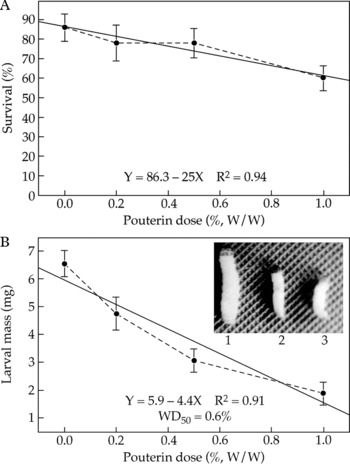
Figure 1A and B show the effect of pouterin on the mortality and mass of A. kuehniella fourth instars on day 20, respectively. The mortality and weight of larvae fed with control diet (represented by the Y-intercept value) were about 14% and 6.4 mg, respectively. Diet containing 1% pouterin caused a 20% increase in mortality, and a 71.4% reduction in the average weight of the larvae. A concentration of 0.6% pouterin caused a 50% reduction in the average weight of the larvae (ED50; Fig. 1B). Regression analysis shows that for every 0.1% increase in the concentration of pouterin, there was a 0.76% increase in mortality (R 2 = 0.94) and a 0.44 mg decrease in weight (R 2 = 0.91). The inset photograph compares the size of larvae fed a diet containing 0.1% pouterin with control larvae. No morphological deformations were observed in the treated larvae.
Effect of dietary pouterin on Anagasta kuehniella larvae: (A) survival (%) and (B) weight, using an artificial diet bioassay. Y-intercept in (A) and (B) is survival and weight of control larvae, respectively. Inset: (1) larvae fed on the control diet; (2 and 3) larvae fed on 0.1% pouterin. Each point has an n = 25. Error bars indicate standard error of the mean.

Nutritional assays
Nutritional analyses revealed that pouterin was toxic to A. kuehniella larvae. When incorporated at 0.5% into an artificial diet, it reduced ECI, ECD and AD and increased MC of the larvae. Both ECI and ECD showed significant decreases of 6.6 and 22.9%, respectively, when compared with larvae reared on control diets, and MC was increased by 23%.
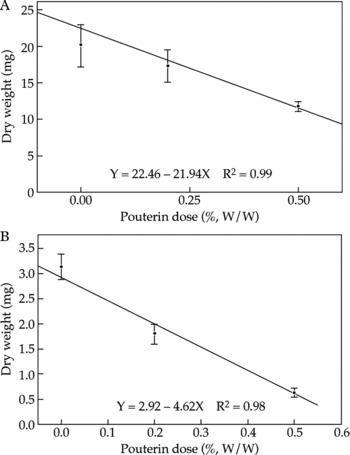
As shown in Fig. 2A, A. kuehniella larvae reared on an artificial diet consumed significantly less diet containing 0.5% of pouterin (12.5 mg/larva) than control diet (20.6 mg/larvae). Faecal production of A. kuehniella larvae reared on the artificial diet containing 0.5% pouterin was also lower by 0.55 mg/larva compared with the control group (3.1 mg/larva; Fig. 2B). These results suggest that pouterin acts on the insect's intestinal tract or interferes with digestion.
Physiological parameters measured for Anagasta kuehniella larvae. Larvae were fed for 24 days on control diets, or diets containing 0.5% pouterin. (A) diet consumption by larvae (mg; dry weight basis). (B) faecal production by larvae (mg; dry weight basis). Each point has an n = 25. Error bars indicate standard error of the mean.

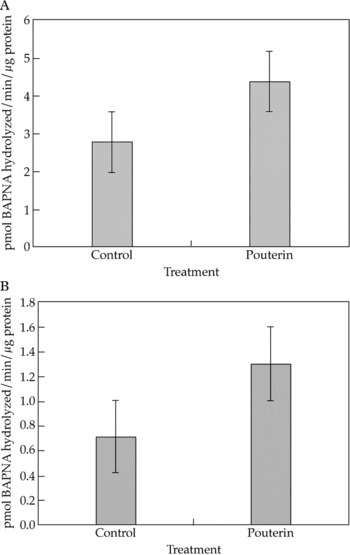
General proteinase activity in larvae reared on artificial diet containing 0.5% pouterin was observed for trypsin-like proteinase activity, using TLCK as synthetic inhibitor. Artificial diet containing 0.5% pouterin altered the tryptic activity in A. kuehniella midgut by 48% (Fig. 3A), and altered the tryptic activity of faeces by 84% compared with controls (Fig. 3B).
Trypsin-like activities of fourth instar Anagasta kuehniella fed control artificial diet and diet containing 0.5% pouterin. (A) enzymatic activities of midgut. (B) enzymatic activities of faeces. Trypsin activity was evaluated using BAPNA as substrate.

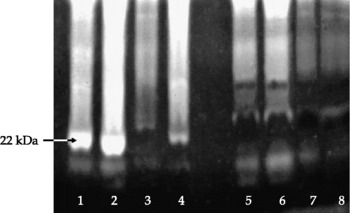
Polyacrylamide gels containing 0.1% gelatin were used to confirm the action of pouterin on tryptic activity in midguts and faeces of A. kuehniella. Proteolytic activity was represented by a clear zone against a dark background. In Fig. 4, the trypsin activity (control) of midgut and faeces was visualised in lanes 1 and 3, respectively; lanes 2 and 4 show the changes that artificial diets containing pouterin at 0.5% caused in the trypsin activity of midgut and faeces. Lanes 5, 6, 7 and 8 show activity of sample inhibited by TLCK. Under these conditions the relative activity on gelatin was approximately the same as on synthetic substrate, with no alterations in the profile of the enzymes.
SDS-PAGE (10%) containing 0.1% gelatin. (1) Midgut of larvae fed the control diet, (2) midgut of larvae fed on 0.5% pouterin, (3) faeces of larvae fed with the control diet, (4) faeces of larvae fed on 0.5% pouterin, (5, 6, 7 and 8) sample 1, 2, 3 and 4 treatment with TLCK. Proteolytic activity appears as a clear zone against a dark background.

Discussion
The insecticidal activity of plant lectins and lectin-like proteins against a large array of insect species belonging to the orders Coleoptera, Homoptera, Diptera and Lepidoptera has been well documented (Fabre et al., Reference Fabre, Causse, Mourey, Koninkx, Riviere, Puzo, Samama and Rougé1998; Carlini and Grossi-de-Sá, Reference Carlini and Grossi-de-Sá2002; Macedo et al., Reference Macedo, Freire, Silva and Coelho2007). These proteins have potential use as naturally occurring insecticide agents against pests that limit increased crop production. Their insecticidal activity is assessed through parameters such as larval weight, size, colour, survival, feeding behaviour, metabolic function, honeydew excretion levels, pupation, total developmental time, adult emergence and/or fecundity in the first and/or second generations of the insects (Vasconcelos and Oliveira, Reference Vasconcelos and Oliveira2004).
Previous studies showed that pouterin in artificial diet was toxic to larvae of the coleopteran Callosobruchus maculatus (Boleti et al., Reference Boleti, Freire, Coelho, Silva, Baldasso, Gomes, Marangoni, Novello and Macedo2007), while the results presented here show that pouterin is also toxic to a lepidopteran species.
Several other lectins detrimental to insect growth have been shown to act as anti-feedants and toxins. These include Galanthus nivalis lectin (GNA), which had antifeedant effects against the rice brown planthopper (Powel et al., Reference Powel, Gatehouse, Hilder, Van Damme, Peumans, Boonjawat, Horsham and Gatehouse1995); KpLec, which caused a dramatic reduction in larval weight of A. kuehniella (Macedo et al., Reference Macedo, Damico, Freire, Toyama, Marangoni and Novello2003) and Bauhinia monandra leaf lectin, which decreased the mass of A. kuenhiella but did not significantly decrease larval survival at concentrations of up to 1.0% (Macedo et al., Reference Macedo, Freire, Silva and Coelho2007).
The mechanisms by which lectins exert their toxic effects on insects are poorly understood, but since glycoproteins are major constituents of insect digestive tract membranes, it is plausible that the insect gut contains specific ligand-binding molecules that are targets for plant lectins (Zhu-Salzman et al., Reference Zhu-Salzman, Shade, Koiwa, Salzman, Narasimhan, Bressan, Hasegawa and Murdock1998). A peritrophic membrane lining the gut of most insects in one or more stages of their life cycle facilitates digestive processes and protects the insect gut from invasion by micro-organisms, parasites and abrasive food particles. The peritrophic membrane consists of proteins, proteoglycans and chitin (containing N-acetylglucosamine residues; Tellan et al., Reference Tellan, Wijffels and Willadsen1999).
It is likely that the decrease in consumption rate in the present study (Fig. 2A and B) was due to the toxicity of pouterin to the larvae. The reduction in AD values of fourth instars of A. kuehniella indicates that the treated larvae did not absorb nutrients from the gut with the same efficiency as untreated ones. The observed drop in ECI indicates that more food is being metabolised for energy and less is being converted to body mass, i.e. growth (Koul et al., Reference Koul, Daniewski, Multani, Gumulka and Singh2003). ECD also decreases as the proportion of digested food metabolised for energy increases (Wheeler and Isman, Reference Wheeler and Isman2001). Decreased ECI and ECD values indicate that ingested pouterin exerts chronic toxicity. We suggest that the reduction in ECD likely resulted from an increase in the proportion of assimilated energy diverted from growth to cover MCs associated with detoxification and excretion of pouterin. Mordue and Blackwell (Reference Mordue and Blackwell1993) described an increase in MC in A. kuehniella larvae similar to our study.
Lectins, in addition, may destabilise insect metabolism by interfering with gut enzymatic function, either indirectly or by binding to glycosylated digestive enzymes in the gut (Van Damme et al., Reference Van Damme, Peumans, Barre and Rougé1998). The effects of lectins, such as GNA and Canavalia ensiformis lectin (Con A) on trypsin have also been observed in Lacanobia oleracea (Fitches and Gatehouse, Reference Fitches and Gatehouse1998).
This study has shown that pouterin increases trypsin levels in A. kuehniella larval midgut and faeces (Fig. 3). Pouterin may bind and indirectly affect enzyme regulatory mechanisms, by interfering with the peritrophic matrix environment (Fitches and Gatehouse, Reference Fitches and Gatehouse1998). A change in the membrane environment and consequent disruption of enzyme recycling mechanisms may provide another explanation for the observed increases in the tryptic activity observed in treatments. Coelho et al. (Reference Coelho, Marangoni and Macedo2007) showed that Annona coriacea lectin produced a change in the gut membrane environment and a consequent disruption of digestive enzyme recycling mechanisms of A. kuehniella larvae.
Acknowledgements
This work was supported by Fundação de Apoio ao Desenvolvimento do Ensino, Ciência e Tecnologia do Estado de Mato Grosso do Sul (FUNDECT); Conselho Nacional de Desenvolvimento Científico e Tecnológico (CNPq); Coordenação de Aperfeiçoamento de Pessoal de Nível Superior (CAPES); Financiamento de Estudos e Projetos/Ministério da Ciência e Tecnologia (FINEP) and Pró-Reitoria de Pesquisa e Pós-graduação da Universidade Federal de Mato Grosso do Sul (PROPP/UFMS).