The periparturient period is a time of multiple stressors. Among those stressors are entry to a novel housing environment, introduction to the milking parlour and milking machine, changing metabolic demands, hormonal changes and altered diets. The reaction to novel environments, including the parlour, affect behavioural (Hemsworth et al. Reference Hemsworth, Barnett, Tilbrook and Hansen1989, Reference Hemsworth, Hansen and Barnett1987; Munksgaard et al. Reference Munksgaard, DePasillé, Rushen, Herskin and Kristensen2001) and physiological (Mačuhová et al. Reference Mačuhová, Tančin, Kraetzl, Meyer and Bruckmaier2002) responses. The practice of prepartum milking of dairy cows has been investigated as a means to alter hormones, shorten calving intervals and enhance milk production (Pennington & Malven, Reference Pennington and Malven1985; Malven et al. Reference Malven, Head, Collier and Buonomo1987; Greene et al. Reference Greene, Galton and Erb1988). Researchers have typically milked cows and heifers for 1–2 weeks prior to expected parturition. Milk responses have been limited and hormonal alterations were not detrimental (Greene et al. Reference Greene, Galton and Erb1988). Recent research showed that milking for 10 d (Grummer et al. Reference Grummer, Bertics and Hackbart2000) or for 3 weeks (Bowers et al. Reference Bowers, Gandy, Graves, Eicher and Willard2006) prepartum enhanced milk yield and udder health, but did not alter reproductive performance (Bowers et al. Reference Bowers, Gandy, Graves, Eicher and Willard2006). However, prepartum milking for 15 d without dietary alterations for earlier productions led to early lactation diseases (Santos et al. Reference Santos, Cerri, Kirk, Juchem and Villaseňor2004). During the periparturient period, immunity is suppressed and this suppression is more pronounced in the primiparous heifer (Kehrli et al. Reference Kehrli, Nonnecke and Roth1989). Increases in acute phase responses (Uchida et al. Reference Uchida, Katoh and Takahashi1993; Alsemgeest et al. Reference Alsemgeest, Taverne, Boosman, van der Weyden and Gruys1993) and stress hormones are known to be present at this time (Guidry et al. Reference Guidry, Paape and Pearson1976) both of which are immuno-suppressive (Tilg et al. Reference Tilg, Dinarello and Mier1997).
Following injury, trauma or infection of a tissue, a mechanism is initiated to prevent on-going tissue damage, to isolate and destroy the infective organism, and to activate the repair processes that are necessary to return to homeostasis. The cumulative homeostatic process is known as inflammation and the early reactions are known as the acute phase response (APR). The APR is initiated in tissue by macrophages or blood monocytes. Cytokines released during this initial response include interleukin (IL)-1, IL-6, and tumour necrosis factor-alpha (TNF-α) (Baumann & Gauldie, Reference Baumann and Gauldie1994). The liver is the primary target of systemic inflammatory mediators and supplies the components for defence at the site of tissue damage, confines tissue destruction, clears toxic agents, and aids tissue repair by stimulation of the acute phase proteins (APP) response. Glucocorticoids, such as cortisol, can stimulate expression of some APP directly, but their principal action is to exacerbate the IL-1 and IL-6 cytokines.
One of the primary APP in cattle is haptoglobin (Uchida et al. Reference Uchida, Katoh and Takahashi1993). Bovine haptoglobin is absent from the plasma of healthy cattle (Cole et al. Reference Cole, Roussel and Whitney1997). Plasma haptoglobin generally becomes elevated 24–48 h post-inflammatory onset and returns to normal 7–10 d after inflammatory onset. The role of α1-acid glycoprotein (AGP) is less clear, but it is a marker of inflammation in cattle (Godson et al. Reference Godson, Baca-Estrada, Van Kessel, Hughes, Morsy, Van Dondersgoed, Harland, Shuster, Daley and Babiuk1995). Both appear to be regulated by Il-1β, but AGP requires prolonged administration of IL-1β as opposed to an immediate haptoglobin response that is triggered by a single administration of IL-1β.
The effect of prepartum milking on parlour behaviours in conjunction with physiological responses is not known. In this study we wanted to reduce the stress immediately after parturition by either pre-milking the heifers for 3 weeks or exposing them to the parlour for 3 weeks prior to parturition. We expected to see decreased APR and stress hormones with pre-milking, and fewer disruptive parlour behaviours.
Materials and Methods
Two studies were conducted in successive years. The first study was in a confinement setting with free-stall housing. The second was in a modified grazing system. In the second study, days of observations were expanded both pre-and post-parturition.
Study One: confinement housing
Forty-eight Holstein heifers (24 months old) were assigned to one of three treatments prior to parturition: control (no experience in the parlour until after parturition); experienced (experience moving through the parlour with milked cows, but not milked for 3 weeks prior to parturition); and pre-milked (milked in the parlour for 3 weeks prior to parturition). Heifers were blocked for seasonal effects according to expected calving dates, six heifers (two per treatment) in each of eight blocks. Heifers were moved to group free-stall housing at 4 weeks prior to expected parturition and then to an individual maternity stall when they showed signs of parturition. At 3 weeks prior to expected parturition, treatments were initiated. Free-stall housing, the parlour and holding areas also housed multiparous cows. Entry into the parlour was with experienced cows. The milking units, equipped with automatic detachers, were attached and then re-attached only once if necessary for prepartum-milked heifers. The pre-milked and experienced heifers remained in the parlour until all in the group were milked. The mean time spent in the parlour for the Purdue herd was 19·1 min (11·5–30 min). Feeding throughout this study was ad libitum and was not altered to compensate for increased milk production in the pre-milked heifers. Heifers were milked twice daily, at approximately 07.00 and 17.00. Purdue Dairy Teaching and Research Center management and milking procedures were followed by the dairy personnel. This included sanitizing teats and massaging of the udder, fore-stripping, and wiping with individual disposable towels before attaching the milking clusters at a targeted 60 s following initiation of the procedure and following the milking with teat dips. The milking was by Purdue dairy personnel following their normal schedule, which included differing a.m. and p.m. milkers. However, milkers did not differ among treatments.
Study Two: modified grazing system
Pregnant heifers (Holstein and Jersey, n=20) were assigned to either a prepartum milked (pre-milked; n=10) or control (n=10) treatment group. Heifers (23 months old) were blocked by breed and expected calving dates. Prepartum milked and control heifers were housed in outdoor paddocks with access to free stalls when conditions were less than adequate outside (semi-confinement/modified grazing). All heifers were fed a total mixed ration (TMR) and given free choice Bermuda grass hay and water in addition to mixed-grass paddocks. The premilked heifers were taken through the parlour and milked twice daily (approx. 6.00 and 17.00) starting 3 weeks prior to calving. The control heifers were first milked within 12 h after calving by the Mississippi State University (MSU) dairy personnel. All animals received an injection of oxytocin (1 ml; Pfizer Animal Health, Kalamazoo MI, USA) after calving, which is standard procedure for the MSU dairy. Milking procedures were otherwise the same as for the confinement system. The time in the parlour was 18·4 min (9·1–24·9 min).
For both studies, all animal care followed recommendations of the Guide for the Care and Use of Agricultural Animals in Agricultural Research and Teaching (1999) and animal use was approved by the MSU Animal Care and Use Committee (no. 00-008).
Behavioural measures
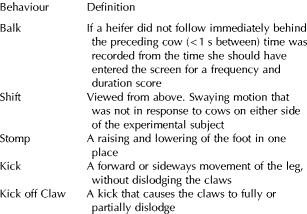
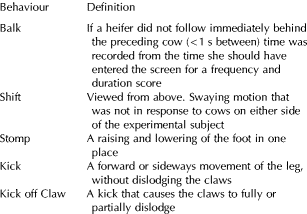
Behavioural observations were conducted at both locations that have similar parlours. Behaviour was monitored in double herringbone parlours (six units per side) early in lactation. Two milkers were present at each milking. Morning and evening milkers and weekend milkers differed, but milker training and protocols were consistent. Because our goal was to measure changes in indicators of post-calving stress, we elected to only compare treatments at the time point of interest (post-calving) in the Purdue herd, but expanded our observations to include within-cows measures throughout the trial lasting from −21 until +16 d relative to actual calving in the MSU experiment. Eight cameras (Panasonic AG-6740, Milpitas CA, USA) were mounted so that a side view of three heifers was visible enabling all four legs, the udder, and the milking cluster of each cow to be clearly seen. Two more cameras were mounted on each side over the parlour such that the top view of the same three heifers could be seen. Therefore, four cameras were utilized per side. Video-recording was continuous (24-h mode) during milking. Heifers were colour coded by painting the back and attaching leg bands so that milkers knew which heifers to milk and which not to milk until after parturition in the Purdue herd where the parlour-experienced treatment was conducted. The colour coding also aided observers in heifer identification during video-tape analysis although observers were blind as to the significance of the colour codes. The MSU herd was electronically identified or visually identified by markings when electronic identification was not available. The video-recording allowed us to determine when any of the experimental heifers were balking coming into the parlour in the Purdue herd, independent of cows preceding her. Continuous observations were made of the a.m. and p.m. milkings using The Observer® software (Noldus, Wageningen, The Netherlands) beginning when the heifer entered the parlour and stopping when the claws were removed. We recorded number of individual occurrences of stomps, kicks, shifting and kicking off the clusters in the parlour (Table 1). Shifting was not seen to be a continuous behaviour, but rather a short duration response, so it was only recorded as a frequency. After reviewing the data of the grazing study, a.m. and p.m. data were combined as frequency per milking to minimize the diurnal variation that interfered with the analysis.
Definitions of parlour behaviors
Physiological measures
Venous blood was collected by venipuncture of the coccygeal vein into 10-ml heparinized Vacutainer® tubes on days 1, 3, 5, 7, 9 and 14 after parturition in both systems and additionally on days −21, −14, −7, −5, −3, and −1 relative to parturition in the grazing system at approximately 1 h after the morning milking. The heparinized tubes were centrifuged at 700 g for 15 min and plasma removed and stored at −80°C for later determinations of cortisol, haptoglobin and AGP in the confinement system experiment. Only haptoglobin was measured in the grazing system experiment. Cortisol concentrations were determined from plasma samples using a 125I radioimmunoassay (Coat-a-count, Diagnostic Products Corp., Los Angeles CA, USA). APP, haptoglobin and AGP, were determined by radio immuno-diffusion assays (Saikin Kagaku Institute Co., Sendai, Japan).
Statistical analysis
Data were analysed as a repeated measures design using the MIXED procedure of SAS (Littell et al. Reference Littell, Milliken, Stroup and Wolfinger1996; SAS, 1999). Sources of variation were treatment and time and their interactions. Behavioural data were transformed as needed using a square root transformation to normalize the distribution and homogenize variances. The Bayesian information criterion (BIC) was used to determine the appropriate variance and covariance structure. The compound symmetry structure provided the best fit for the data. Balking and kicking off the claws were also analysed by Poisson Regression Analysis because of frequent zeros in the data.
Heifers were blocked into eight blocks of time by expected calving dates in the confinement system, because of seasonal diversity. Heifers in the grazing experiment were blocked by breed, because of using Jerseys and Holstein heifers. Seasonal block in the confinement system and breed block in the grazing system were included as random variables.
Results and Discussion
Milking parlour behaviours
Confinement system
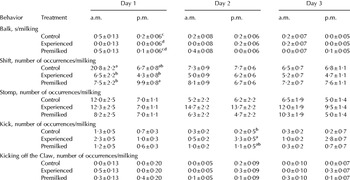
Observation of milking parlour behaviours began with balking as the heifers came into the parlour (Table 2). A trend for the pre-milked heifers to balk on day 1 at the afternoon milking was detected (P<0·10). No significant differences among treatments were detected by Mixed models analysis but Poisson Regression analysis determined experienced heifers balked least (P=0·03). Control heifers shifted more (P<0·05) than both the experienced and pre-milked heifers on day 1 at the morning milking. However, the pre-milked heifers shifted more (P<0·05) than the experienced heifers at the afternoon milking on day 1. This difference at the second milking resulted from an increase of frequency of shifting for pre-milked heifers and a decrease in shifting for experienced heifers, while the control heifers decreased by over 14 occurrences during that milking. Stomping resulted in a similar pattern in that experienced heifers stomped more overall, but levels of probability at any one milking were always >0·10. Experienced heifers tended (P=0·07) to kick more overall. However, only at the afternoon milking on day 2 was a significant treatment effect detected, when experienced heifers kicked more than the control heifers (P<0·05). Kicking off the cluster occurred infrequently and no treatment differences were detected by either analysis.
Confinement system behaviour frequencies of heifers for the a.m. and p.m. milking on days 1–3 post partumFootnote †

†a,b Means±se for the same behavior within a milking with differing superscripts differ (P<0·05) and c,d(P<0·10)
Modified grazing system
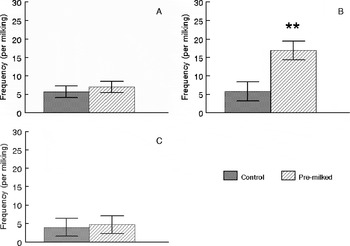
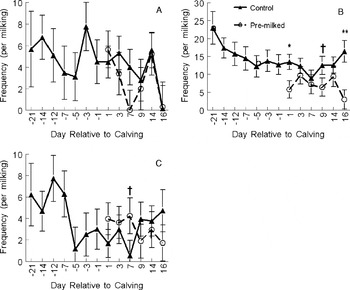
In this experiment behavioural data were compared for the first milking; 21 d prepartum for the pre-milked group and the first milking following parturition for the control group. The first-milking shifting (Fig. 1, Panel B) was greatest for the pre-milked group (P<0·01). When analysed within cow over time (Fig. 2, Panel B) from 21 d prepartum until day 16 post partum, shifting decreased gradually and reached significance (P<0·05) by 5 d prepartum compared with day −21. When treatments were compared from first milking following parturition up to and including day 16 of post-partum milking, pre-milked heifers shifted more on day 1 (P<0·05), day 16 (P<0·01) and tended to shift more on day 9 (P<0·10). Kicking (Fig. 1, Panel A) was not significant between treatments for comparison of the first milking (day −21 and day 1, for pre-milked and control heifers respectively). Within-cow analysis (Fig. 3, Panel A) of the pre-milked group detected only day −3 as significantly different from day 16 (0 kicks per milking). No differences for kicking were detected between the control and pre-milked heifers for comparisons on day 1 up to and including day 16 post partum (Fig. 2, Panel A). Similarly, stomping (Fig. 1, Panel C) was not different at first milking (day −21 and day 1 for pre-milked and control heifers, respectively) nor between treatments from day 1 up to and including day 16 post partum (Fig. 2, Panel C). However, when analysed within cow (Fig. 3, Panel C), at day −5 up to and including day 7, stomping was decreased (P<0·05) from day −12. At day 9, stomping increased compared with the day-7 frequency of 0·17 stomps per cow/milking. A trend (P<0·10) for day-14 and day-16 to be greater than day-7 stomps was detected.
Mean frequency per milking±se for kicks (A), shifts (B) and stomp (C) of prepartum-milked or control heifers in a modified grazing system at their first milking (day −21 and day 1 for prepartum and control heifers, respectively). **Denotes treatment differences, P<0·01 (n=10 heifers per treatment).

Mean frequency per milking±se for kicks (A), shifts (B) and stomp (C) of prepartum-milked or control heifers in a modified grazing system from day −21 prepartum to day +16 post partum inclusive. Treatments differ: †P<0·10, *P<0·05, **P<0·01 (n=10 heifers per treatment).

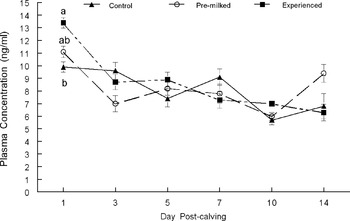
Mean plasma cortisol concentrations±se for heifers that were premilked, had parlour experience, or control treatment in the confinement system. a,bP<0·05.

Rushen and de Passille (personal communication, 2001) did not see behavioural differences between experienced and control heifers with a 1-week habituation to the parlour. In contrast, Van Reenen et al. (Reference Van Reenen, Van der Werf, Bruckmaier, Hopster, Dngel, Noordhuizen and Blokhuis2002) reported changes in frequencies of kicks plus steps between observations made on days 2, 4 and 130 of lactation. The greatest changes occurred during preparation and were least on day 4.
Physiological measures
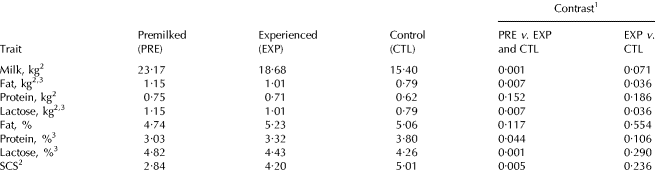
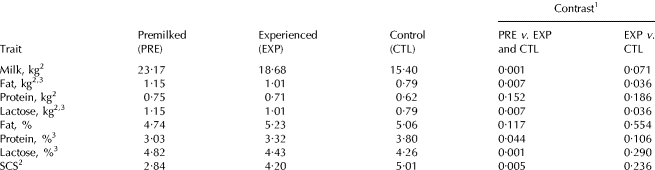
Milk production (kg) was greater for the first 2 weeks after calving for heifers in the confinement system (Table 3). In contrast, the grazing system (Bowers et al. Reference Bowers, Gandy, Graves, Eicher and Willard2006) showed distinct breed differences, with Jersey having greater milk production for the prepartum milked heifers throughout the first 2 weeks. Somatic cell scores (SCS, Table 3) were reduced by prepartum milking in the confinement system, but the grazing system did not differ between treatments for SCS (Bowers et al. Reference Bowers, Gandy, Graves, Eicher and Willard2006). However, the prepartum-milked heifers of that study had reduced incidence of udder infections. The lower SCS of the prepartum-milked heifers corresponded to the earlier return to baseline haptoglobin concentrations. Whether this was an effect of another variable such as insulin-like growth factor-1 or whether both were indicators of improved mammary health is not clear. Reproductive measures were not different for the grazing groups (Bowers et al. Reference Bowers, Gandy, Graves, Eicher and Willard2006), and pre-milking did not affect parturition date or other parturition parameters (Schutz & Eicher, Reference Schutz and Eicher2001; Bowers et al. Reference Bowers, Gandy, Graves, Eicher and Willard2006). So, the calving parameters did not interfere with additional measures by incapacitation or hospitalization of heifers nor did any of the treatments trigger earlier onset of calving.
Least squares means and probability level of specific contrasts from mixed model analyses of measures of production and somatic cell scores (SCS) in the first 2 weeks after calving for confinement system heifers milked before calving (PRE) or exposed to the parlour without milking (EXP) or control heifers (CTL)
1 P>F
2 Effect of block significant at P>F<0·05
3 Effect of linear, quadratic, and cubic regression of day on trait significant at P>F<0·01
Plasma cortisol concentrations (Fig. 4) were greater for the experienced heifers than for the control heifers at the first sampling (within 24 h of parturition). The pre-milked heifers' plasma cortisol concentrations were not different from control or experienced heifers' cortisol (P>0·05). However, by day 3 post parturition, all treatments had plasma cortisol that was at a normal concentration (approximately 8 ng/ml), and not different among treatments. Cortisol responses to novel environments have been documented for dairy cattle (Guidry et al. Reference Guidry, Paape and Pearson1976). The short cortisol response in the experienced heifers suggests that they were accustomed to the parlour without milking. We believe that the experienced heifers had an acute cortisol response with the novelty of milking in a familiar setting. The cortisol response to a novel environment in cows that were accustomed to milking was much greater when measured within minutes of the stressor and those with a higher cortisol response adapted better (Mačuhová et al. Reference Mačuhová, Tančin, Kraetzl, Meyer and Bruckmaier2002). We were interested in persistence of the response rather than the peak response, therefore the samples collected 1 h after milking were appropriate for the objectives of this study.
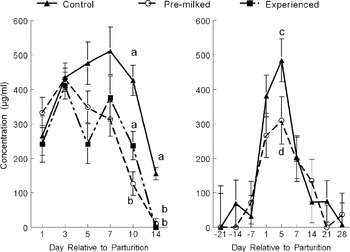
Mean plasma haptoglobin concentrations±se for heifers that were premilked, had parlour experience, or control treatment in the confinement system (Panel A) and heifers that were premilked or control treatment in the grazing system (Panel B). Means within a day with different superscripts differ: a,bP<0·05; c,dP<0·10.

Plasma haptoglobin concentrations in the confinement system (Fig. 4) peaked later for the control heifers, day 7 compared with day 3 for pre-milked and experienced heifers. This resulted in greater plasma haptoglobin concentrations at day 10 post parturition for the control compared with pre-milked heifers (P<0·05). By day 14, both the experienced and pre-milked heifers' plasma haptoglobin concentrations were lower than that of the control heifers (P<0·05). Mean plasma haptoglobin concentrations of all heifers were <200 μg/ml, which is the threshold for normal values. In the grazing system, plasma haptoglobin (Fig. 4) peaked at day 5 for both the control and the pre-milked heifers. Control heifers' haptoglobin concentrations tended to be greater than those of the pre-milked heifers (P=0·06). However, both treatments returned to the threshold for normal values (200 μg/ml) by day 7. Plasma AGP concentrations of heifers in the confinement system were highly variable so that no treatment differences were detected throughout the observation period.
Two APPs have been shown to increase dramatically following parturition. Serum amyloid A (SAA) more than doubles within 24 h after parturition, but then by 48 h it is already declining (Alsemgeest et al. Reference Alsemgeest, Taverne, Boosman, van der Weyden and Gruys1993). The response time of SAA is similar to the reported cortisol response in that study and to the cortisol response that we observed. Haptoglobin detection rates (positive sera) were increased at 0–1 d after parturition, but serum concentrations of AGP did not change (Uchida et al. Reference Uchida, Katoh and Takahashi1993). Haptoglobin's primary function is as a red blood cell scavenger, but the function of AGP is as a marker of inflammation. Another APP, SAA, which we did not measure, is responsible for removal of debris from circulation and responds similarly to haptoglobin. From these data and the data of Uchida et al. (Reference Uchida, Katoh and Takahashi1993) it is evident that when used as indicators of animal health, the APP response must be considered along with the biological function of that APP and the corresponding physiological status of the animal. The APP response itself may not be an indicator of a problem, but a prolonged response may indicate additional stress or disease.
In conclusion, these studies showed that changes in behaviours indicative of restlessness were transient for first-calf heifers. This was verified by the minimal cortisol response that was observed. However, APP responses that are known to be exacerbated by cortisol either had greater peak concentrations or a prolonged response in control heifers compared with the prepartum-milked heifers. Prepartum milking may have benefits for udder health following parturition, but the role or significance of haptoglobin concentrations returning to baseline more quickly with prepartum milking needs to be elucidated.