The Bembridge Marls Insect Bed crustacean fauna includes branchiopods (Anostraca, a fairy shrimp; and Spinicaudata, a clam shrimp), an ostracod (seed shrimp) and an isopod (relative of the woodlouse/sea slater); all except the first are scarce (Jarzembowski Reference Jarzembowski1980). The fairy shrimp is the extinct branchipodid, Branchipodites vectensis Woodward, Reference Woodward1879 and abundant, complete examples of this crustacean are often associated with articulated insect bodies, but such rich layers appear to be very local (Jarzembowski Reference Jarzembowski1976; Rogers Reference Rogers2009, Reference Rogers2013). The Insect Bed ostracod, Potamocypris brodiei Jones & Sherborn, Reference Jones and Sherborn1889, has been compared more recently with another fresh water-brackish cypridid (Cypridopsis Brady: Haskins, Reference Haskins1968) and occasional ostracod valves may be found in silty laminae within the limestone (Jarzembowski Reference Jarzembowski1980). In our opinion, Haskins's ostracod does not resemble P. brodiei so it is not revised. The extinct, sphaeromid-like Eosphaeroma margarum (Desmarest in Brongniart & Desmarest, Reference Brongniart and Desmarest1822) is a fresh water-brackish isopod also known from the continental late Palaeogene of France, and Germany (Martini Reference Martini1972; Basso & Tintori Reference Basso and Tintori1995). The spinicaudatan (‘conchostracan') Paraleptestheria mitchelli sp. nov. is described for the first time and is the main focus of the contribution as it is the only ‘Tertiary conchostracan' (clam shrimp) described from Europe so far.
1. Locality and horizon
The specimens are from the Insect Bed of the Bembridge Marls Member, which outcrops along the NW and NE coasts of the Isle of Wight. The Bembridge Marls are the basal member of the Bouldnor Formation and overlie the lacustrine Bembridge Limestone Formation (Daley Reference Daley1972, Reference Daley1999). The marls are an argillaceous sequence of muds and silts with occasional thin sands and limestones deposited in brackish to fresh water conditions (Insole et al. Reference Insole, Daley and Gale1998). The term Insect Bed applies to a thin clay bed, near the base of the formation, with micritic limestones and hard marls under- and overlain by shell beds with a brackish/quasi marine fauna (Jarzembowski Reference Jarzembowski1980; Ross & Self Reference Ross and Self2014). The micritic limestone (‘Insect Limestone') occurs either as discrete concretionary lenses or as thin but continuous beds and contains aggregations of fossils including plant detritus, arthropods, molluscs, bird feathers and lizard scales. Fossil insects (Jarzembowski Reference Jarzembowski1980; McCobb et al. Reference McCobb, Duncan, Jarzembowski, Stankiewicz, Wills and Briggs1998) and spiders (Selden Reference Selden2001, Reference Selden2002) are often found with exceptional three-dimensional preservation. The age of the Insect Bed was reviewed by Ross & Self (Reference Ross and Self2014) and is now considered to be late Eocene.
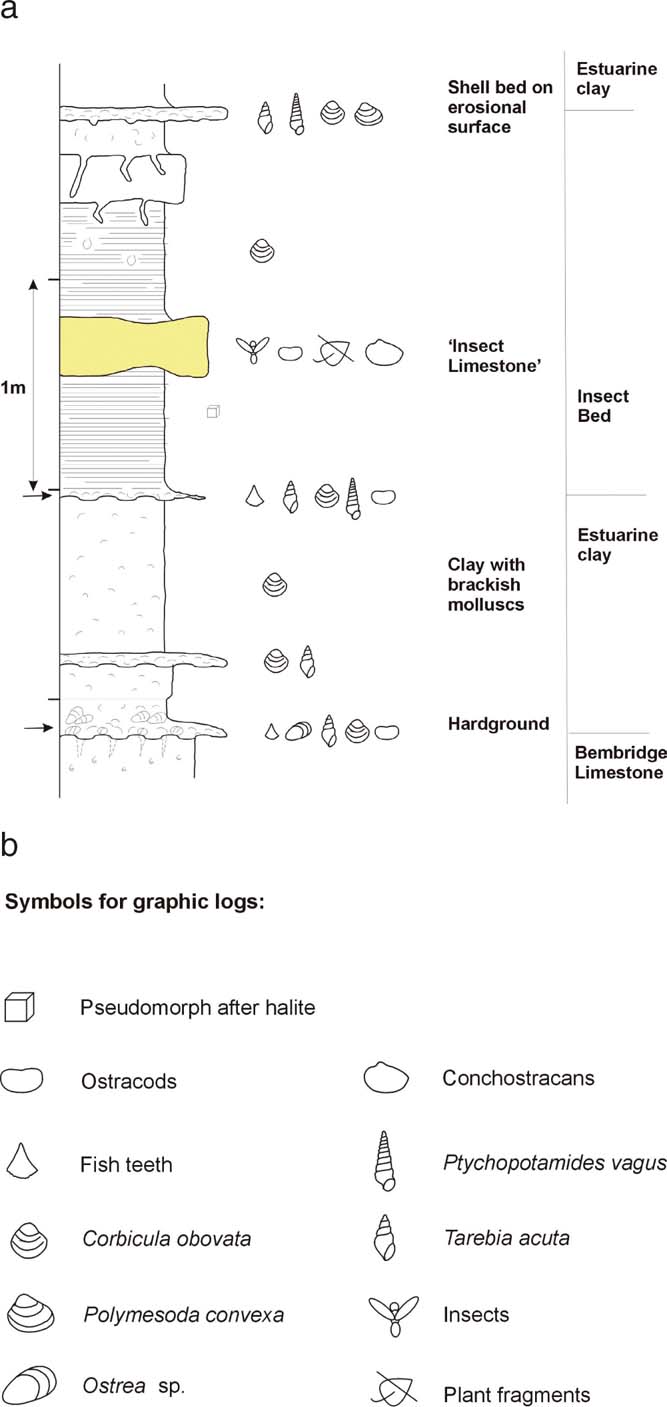
Although the Insect Bed occurs at a number of exposures, conchostracans have only been found to date at St Helens on the NE coast (see Ross & Self Reference Ross and Self2014, fig. 1). Here a section of the lower Bembridge Marls, approximately 300m long, is visible in the low-slipped cliffs between Node's Point and the ruins of St Helen's Church (Fig.1). The Insect Bed is approximately 8m above the base of the cliffs at Node's Point [national grid reference SZ 638 900] and dips southwards towards the axis of the Bembridge Syncline so that at the southern end [SZ 638 897] it lies 0.5m above the cliff base (Jarzembowski et al. Reference Jarzembowski, Siveter, Palmer and Selden2010). The Insect Bed here comprises a 0.65–0.85m thick sequence of finely laminated silts and clays with a single 0.1m band of micritic limestone. The ‘Insect Limestone' is also found as loose blocks on the foreshore. At least six orders of insects are present, including beetles (Coleoptera), true flies (Diptera), ants and wasps (Hymenoptera), bugs (Hemiptera), dragonflies (Odonata) and termites (Isoptera). The insects are predominantly terrestrial and are often accompanied by plant remains, Crustacea and gastropods.
Stratigraphical section of the lower Bembridge Marls, in the low-slipped cliffs between Node's Point and the ruins of St Helen's Church.

2. Material and methods
The electron microscope images of the uncoated spinicaudatan specimens were taken using a JEOL JSM 5310LV under low vacuum conditions. Elemental analysis was carried out using energy-dispersive X-ray microanalysis with an Oxford Instruments ISIS system possessing a thin window SiLi X-ray detector. Areal distribution of the main components was assessed by X-ray dot mapping. Field numbers are given in parenthesis after museum registration numbers for continuity. The following abbreviations are used: coll., collected by; NHMUK, Natural History Museum London.
The taxonomy adopted herein follows Chen & Shen (Reference Chen and Shen1985) and Martin & Davis (Reference Martin and Davis2001). The methodology used for the spinicaudatan description follows partially the proposal of Scholze & Schneider (Reference Scholze and Schneider2015).
3. Spinicaudata
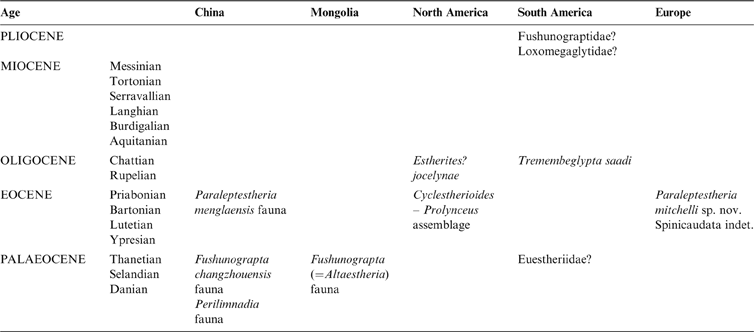
‘Conchostracans' now formally called spinicaudatans (see Shen Reference Shen2003; Gallego Reference Gallego2010; Astrop & Hegna Reference Astrop and Hegna2015) are extant bivalved crustaceans that have inhabited fresh water to brackish environments throughout the Phanerozoic from the late Palaeozoic onwards. According to Gray (Reference Gray1988), spinicaudatans (among other branchiopods) have played an important part in fresh water ecosystems through much of the Phanerozoic. The world record of Cenozoic fossil spinicaudatans is limited to only a few countries: China, with many localities ranging from the late Palaeocene to the early Eocene (Hong et al. Reference Hong, Yang, Wang, Wang, Li, Sun, Sun and Tu1974; Chen Reference Chen1975; Chen & Shen Reference Chen and Shen1979, Reference Chen and Shen1980, Reference Chen and Shen1981, Reference Chen and Shen1985; Shen & Chen Reference Shen and Chen1979; Shen & Zhang Reference Shen and Chen1979); Mongolia (late Palaeocene to early Eocene: Trusova & Badamgarav Reference Trusova, Badamgarav and Kramarenko1976); Brazil (Oligocene: Gallego & Mesquita Reference Gallego and Mesquita2000); Argentina (late Palaeocene and Miocene–Pliocene: Gallego & Mesquita Reference Gallego and Mesquita2000; Petrulevicius Reference Petrulevicius2001) and North America (Eocene: Shen et al. Reference Shen, Gallego, Buchheim and Biaggi2006; early Oligocene: Stigall et al. Reference Stigall, Plotnick and Park Boush2017) (see Table 1).
Stratigraphical distribution of the Cenozoic ‘conchostracans' of the world (modified from Shen et al. Reference Shen, Gallego, Buchheim and Biaggi2006).

In the present paper, we describe a new species, Paraleptestheria mitchelli sp. nov. assigned to the Family Loxomegaglyptidae from the Insect Bed (Bembridge Marls), the latest Eocene transition in southern England. This is the first Cenozoic fossil spinicaudatan to be formally described from England and indeed from Europe.
4. Cenozoic ‘conchostracan' distribution
In Asia, three Cenozoic ‘conchostracan' faunas can be recognised: the Perilimnadia fauna, the Fushunograpta changzhouensis fauna (Palaeocene) and the Paraleptestheria menglaensis fauna (early Eocene) (Zhang et al. Reference Zhang, Chen and Shen1976; Chen & Shen Reference Chen and Shen1981). In North America, Shen et al. (Reference Shen, Gallego, Buchheim and Biaggi2006) reported the presence of Cyclestherioides wyomingensis Shen & Gallego (in Shen et al. Reference Shen, Gallego, Buchheim and Biaggi2006), and Prolynceus laneyensis Shen & Gallego (in Shen et al. Reference Shen, Gallego, Buchheim and Biaggi2006), in the Laney Member (Green River Formation, Wyoming, USA). These represent a new Eocene fauna (the Cyclestherioides–Prolynceus assemblage) belonging to Cyclestheriida and Laevicaudata respectively; these species have a close affinity to the extant species of Cyclestheria and Lynceus.
Recently, Stigall et al. (Reference Stigall, Plotnick and Park Boush2017) described the first northamerican cenozoic spinicaudatan, Estherites ? jocelynae from Medicine Lodge Formation (early Oligocene, Beaverhead Basin) in southwestern Montana. Also it is the second-youngest fossil clam shrimp described globally, the first record of the genus Estherites outside China and finally it extends the range of the superfamily Estheriteoidea into the Paleogene.
In South America there are three ‘conchostracan'-bearing formations. Tremembeglypta saadi Gallego (in Gallego & Mesquita Reference Gallego and Mesquita2000) has been reported from the Oligocene Tremembé Formation of the Taubaté Group, São Paulo State, Brazil. Petrulevicius (Reference Petrulevicius2001) mentioned ‘conchostracans' (Euestheria?) in the Maíz Gordo Formation (late Paleocene) of Salta Province, Argentina. Neogene ‘conchostracans' in the Upper Member of the San Roque Formation from San Luis, Argentina, represent two taxa probably belonging to the Fushunograptidae and Loxomegaglyptidae (Gallego & Mesquita Reference Gallego and Mesquita2000). New geological studies of these lithostratigraphic units tentatively changed previous interpretation on the assignation to the San Roque Formation, but new studies are necessary to obtain more accurate data (Rivarola et al. Reference Rivarola, Camina, Perón Orrillo, Prámparo and Gallego2016).
In Germany, Middle Eocene juvenile ‘conchostracans' were identified in fish coprolites from Eocene Lake Messel by Richter & Baszio (Reference Richter and Baszio2001) and were listed by Wedmann (Reference Wedmann2005), but have not been formally described.
As far as we know, no definite Quaternary fossil ‘conchostracans' have yet been reported anywhere in the world.
5. Systematic description
Phylum Arthropoda von Siebold, Reference von Siebold, von Siebold and Stannius1848
Subphylum Crustacea Brünnich, Reference Brünnich1772
Class Branchiopoda Latreille, Reference Latreille and Cuvier1817
Subclass Phyllopoda Preuss, Reference Preuss1951
Order Diplostraca Gerstaecker, Reference Gerstaecker and Bronn1866
Suborder Spinicaudata Linder, Reference Linder1945
Superfamily Eosestherioidea Zhang & Chen (in Zhang et al. Reference Zhang, Chen and Shen1976)
Family Loxomegaglyptidae Novojilov, Reference Novojilov1958
Genus Paraleptestheria Chen (in Zhang et al. Reference Zhang, Chen and Shen1976)
Type species. Paraleptestheria menglaensis Chen (in Zhang et al. Reference Zhang, Chen and Shen1976), from the early Eocene, China.
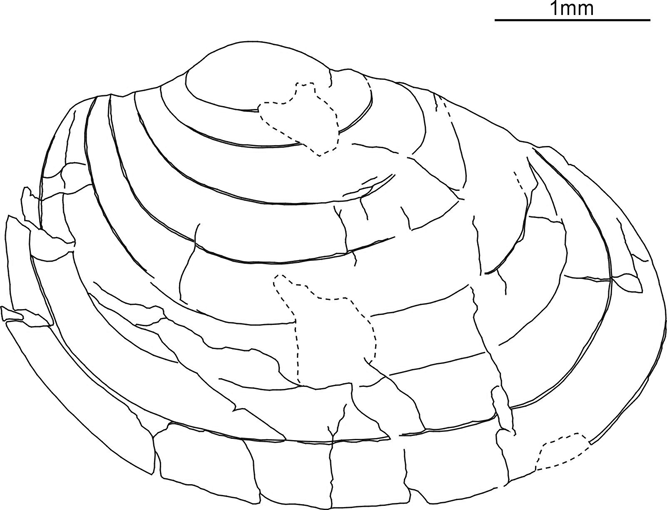
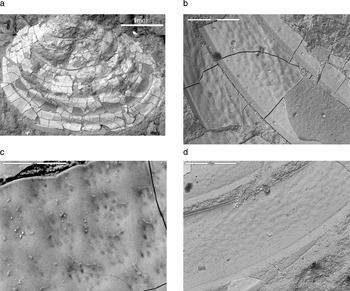
Paraleptestheria mitchelli nov. sp. Figs 2–4
Paraleptestheria mitchelli sp. nov. drawing of NHMUK IC.1269 (BLN 4427) (coll. A. Mitchell) (Scale bar=1mm).

Paraleptestheria mitchelli sp. nov., SEM photographs NHMUK IC.1269 (BLN 4427) montage+2 close-ups, IC.1271 (BLN 4401) matrix impression. (a) General ovate outline, subcentral umbo, few growth lines and irregular meshwork ornamentation pattern, SEM image (Scale bar=1mm). (b) Detail of the last two anterior growth bands with irregular meshwork ornamentation (Scale bar=200μm). (c) Detail of b with few meshes filled with small punctae (Scale bar=50μm). (d) Detail of postero-ventral growth band without whitest layer and showing a poor, well-preserved ornamentation pattern.

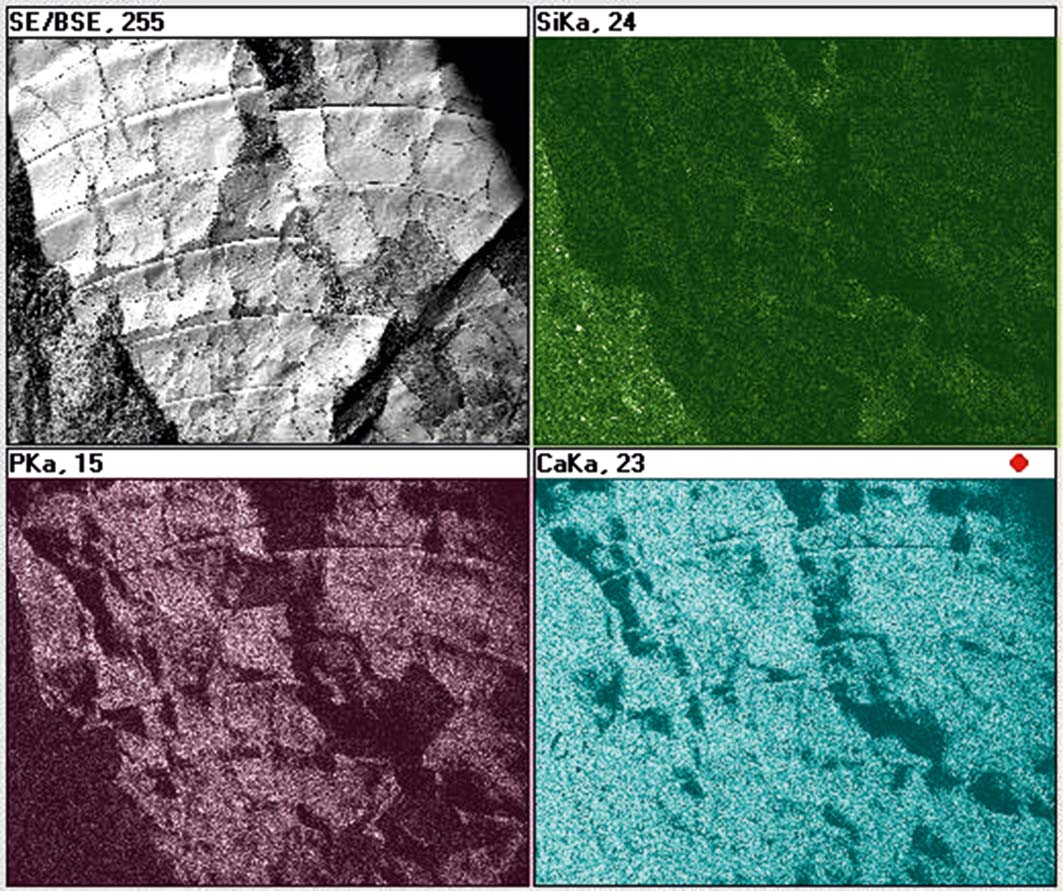
X-ray elemental analysis showing that the P. mitchelli carapaces are calcium phosphate (probably apatite) embedded in clayey limestone (IC.1270 (BLN 4470)).

‘Clam shrimp (Crustacea, Conchostraca)' Jarzembowski et al. Reference Jarzembowski, Siveter, Palmer and Selden2010, p. 242, fig. 5.28.
Type specimens. Holotype NHMUK IC.1269 (BLN 4427) Paratypes IC.1270 (BLN 4470), IC.1271 (BLN 4405), IC.1272 (BLN 4401).
Etymology. After Mr A. A. Mitchell (Gillingham) who found this species.
Diagnosis. Carapace oval, large, submedial and supramarginal umbo, maximum height in middle of valve; seven or eight wide and smooth growth lines; broad growth bands ornamented with irregular reticular meshwork; meshes filled with small punctae which in external mould appear as nodular sculpture; areolae isodiametric in middle of carapace or elongated antero-posteriorly in ventral area, 0.01–0.05mm wide.
Occurrence. ‘Insect Limestone', Insect Bed (late Eocene); St Helens, NE Isle of Wight, National Grid Reference SZ 638898
Description and measurements. Spinicaudata ‘conchostracan' with large carapace oval in outline (ratio H/L 0.74), strongly convex, up to 4.2mm long (L) and 3.1mm high (H). Submedial and supramarginal umbo with elliptical outline. Umbonal area very small. Short dorsal margin (l/L 0.58) slightly convex comprising one third of total length of carapace, slightly sloping in front and behind. Anterior margin less convex and higher than posterior margin. Ventral margin slightly convex. Maximum height in middle part of carapace. Growth lines either seven or eight in number, broad and smooth. Growth bands broad and ornamented with irregular reticular meshwork. Each mesh is 0.01–0.05mm wide and varies from isodiametrical in the mid carapace to elongated antero-posteriorly in ventral area and is filled with small punctae, which in external mould appear as a nodular sculpture.
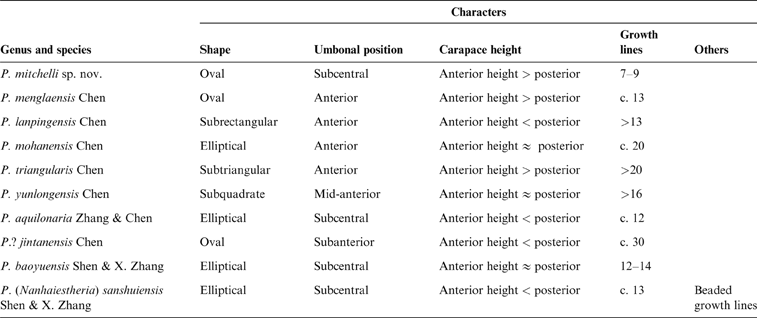
Remarks. The type species Paraleptestheria menglaensis Chen (in Zhang et al. Reference Zhang, Chen and Shen1976, pl. 37, figs 1–8) differs from the new species in its oval outline, long and straight dorsal margin, small anterior umbo, greater anterior height, posterior margin contracted and 10–16 growth bands with large, horizontal, polygonal ornamentation (polygons 0.05–0.75mm across) which are weaker posteriorly. Both species share the anterior margin being broadly rounded, a low number of stout growth lines, and broad growth bands with areolar ornamentation. There are nine species attributed to the genus Paraleptestheria (Chen Reference Chen1975; Zhang et al. Reference Zhang, Chen and Shen1976; Shen & Zhang Reference Shen and Chen1979). The key characters of these species are given in Table 2.
Key characters of the species of Paraleptestheria.

From Table 2 we can see that this new species is chiefly distinguished from the others by its subcentral umbo, which rises above the dorsal margin, and fewer growth lines; moreover, the mesh is filled with punctae.
Discussion. The only other European occurrence of a ‘conchostracan' from the Cenozoic, from Messel (Germany), is rather poorly known as there are few morphological characters given by Richter and Baszio (Reference Richter and Baszio2001, p. 351): ‘…The specimens are egg-shaped, small (body length ca. 150–200μm) and clearly segmented. In some cases, a bifurcated antenna is visible on the largely expanded and ventrally bent anterior end. At the posterior end, a bifurcated furca is sometimes visible. The whole body including the head is covered by a carapace and bears a large number of thoracic leg pairs (up to 13 visible). The last two characters prove that these are not juvenile Cladocera, but rather very small, fully developed juvenile Conchostraca.' We speculate that they perhaps belong to a spinicaudatan ‘conchostracan'. But we do not know whether the carapace is with or without growth lines. Such a very small carapace (ca.150–200μm) has never been found in either fossil or living specimens before.
The genus Paraleptestheria has so far only been found in China and P. menglaensis Chen is considered as an index member of the early Eocene Paraleptestheria fauna. Paraleptestheria was found in association with the subgenus P. (Nanhaiestheria) (Shen Reference Shen2003) in the Buxing Formation in the Sanshui basin of Guangdong, southern China (Shen & Zhang Reference Shen and Zhang1979). The subgenus is characterised by having a beaded structure along the lower margin of the growth lines (Shen & Zhang Reference Shen and Zhang1979, pl. 2 figs 1–4).
The rare carapaces from St Helens are broken or cracked; X-ray elemental analysis (Fig. 4) shows that they are calcium phosphate (probably apatite) embedded in clayey limestone.
Ostracods, probably Potamocypris brodiei, are lying near the specimens of P. mitchelli in the same pieces of limestone (Fig. 5).
Paraleptestheria mitchelli sp. nov., photograph of NHMUK IC.1269 associated with ostracods, probably Potamocypris brodiei Jones & Sherborn, Reference Jones and Sherborn1889.

6. Anostraca
Anostracans are commonly known as fairy shrimps, this group (order Anostraca) being included by Tasch (Reference Tasch and Moore1969) in the subclass Sarsostraca (a name resurrected by Martin & Davis, Reference Martin and Davis2001). These small crustaceans are characterised by an elongated body without a carapace, commonly with 11 thoracomeres with appendages modified for swimming and occasionally 17 or 19 thoracopods (in the atypical Polyartemia), eight abdominal segments generally without appendages, the body ending with a caudal furca with an unsegmented stylus, stalked eyes, short antennule and long prehensile antennae in males which are reduced in females. Of the 10 recognised families (Tasch Reference Tasch and Moore1969; Rogers Reference Rogers2013) only two are exclusively fossil (Gilsonicarididae and Palaeochirocephalidae) and considered as Incertae Sedis (Rogers Reference Rogers2013), and the families Artemiidae, Parartemiidae (suborder Artemiina) and Streptocephalidae, Tanymastigidae, Branchipodidae, Thamnocephalidae, Branchinectidae and Chirocephalidae (suborder Anostracina) are extant (Rogers Reference Rogers2013). They usually inhabit small, temporary, alkaline fresh water bodies (although Artemia salina Linnaeus, Eocene to Recent, and Branchinecta campestris Lynch are adapted to a high degree of salinity in saline lakes and lagoons), also occurring in pools after rain or those formed by the melting of ice or snow. In the Antarctic continent, they can survive under the ice cap. Other species at the opposite extreme can survive temperatures up to 41°C. Anostraca range from the Lower Devonian to Recent.
Systematically, Martin & Davis (Reference Martin and Davis2001) considered that the anostracans constitute a clearly separate lineage from the rest of the branchiopods as this is an old group with a slow evolutionary rate. They should be treated as a separate subclass (Sarsostraca) that probably in future could include the extinct order Lipostraca (including Lepidocaris rhyniensis Scourfield from the Devonian) and the Cambrian genus Rehbachiella Müller. But recently, Olesen (Reference Olesen2009) considered that Lipostraca is the sister group of Anostraca and Rehbachiella the sister taxa or all branchiopods (Sarsostraca and Phyllopoda).
Martin & Davis (Reference Martin and Davis2001) cited the mistake of including a non-crustacean and an insect nymph in this group. Thus Tasch (Reference Tasch and Moore1969, p. R183) mentioned that Rolfe (Reference Rolfe1967) called attention to the genus Rochdalia Woodward not being an anostracan and indistinguishable from a breyeriid nymph (Insecta: Palaeodictyoptera) from the Carboniferous (Wootton Reference Wootton1972). Belk & Schram (Reference Belk and Schram2001) also incorrectly considered that Rochdalia parkeri Woodward from the Upper Carboniferous has 11 thoracic segments and anostracan affinities. Tasch (Reference Tasch and Moore1969) also suggest that Rolfe (Reference Rolfe1967) mentioned that Gilsonicaris van Straelen and Branchipusites Goldenberg could be a myriapod and an arthropleurid respectively (sensu Belk & Schram, Reference Belk and Schram2001).
The fossil record of anostracans is sparse and discontinuous, and their preservation and assignment to known families is very problematic, when the sexual organs are not preserved, any systematic interpretation is doubtful. Belk & Schram (Reference Belk and Schram2001) argued that due to the delicate exoskeleton they are rare as fossils and that in the literature there are only a few ambiguous records. Schram (Reference Schram1986) considered that the Palaeozoic record of the anostracans is unconvincing; nevertheless, he gave a possible example from the Upper Silurian of Indiana. Belk & Schram (Reference Belk and Schram2001) described Branchinecta barstowensis Belk and Schram from the middle Miocene of California and a doubtful, unidentified anostracan has been described from the Cretaceous of Australia (Jell & Duncan Reference Jell and Duncan1986).
On balance, the Anostraca–Lipostraca group has a scarce record (Tasch Reference Tasch, Whittington and Rolfe1963) and the most ancient fossil is Gilsonicaris rhenana van Straelen (Upper Devonian) with 18 thoracic segments, 11 of them with appendages, and close affinities with Branchipodites vectensis, differing only in the larger number of segments. Schram (Reference Schram1986) also considered this taxon was doubtful. On the other hand, Branchipusites anthracinus Goldenberg (Upper Carboniferous) has got only eight segments with appendages that resemble the branchial lamella of the living Branchipus (Goldenberg Reference Goldenberg1873). Belk & Schram (Reference Belk and Schram2001) suggested that it could be a juvenile insect, however it was recently considered to be an arthropleurid (Paleobiology Database 2015).
Subclass Sarsostraca Tasch, Reference Tasch and Moore1969
Order Anostraca Sars, 1867
Family Branchipodidae Simon, Reference Simon1886
Diagnosis (sensu Tasch, Reference Tasch and Moore1969). Like Artemiidae in number of somites and genital organs except that the apical parts of the penes bear several spines. Basal segments of antennae in males coalesce medially in so-called clypeus. ?Upper Carboniferous, late Eocene, Recent.
Comments. As mentioned by Tasch (Reference Tasch and Moore1969), this branchiopod family is morphological similar to Artemiidae, and only differs in just two penes with several spines in the apical portion. On the other hand, the male antennae are basally coalesced until the middle portion. The genus Branchipodites Woodward is recorded from the late Eocene of England and Branchipusites Goldenberg from the Carboniferous of Germany. Two other genera are living ones, Branchipus Shäffer from Europe, Asia and Africa and Branchipodopsis Sars from Asia and Africa.
Genus Branchipodites Woodward, Reference Woodward1879
Type species. Branchipodites vectensis Woodward, Reference Woodward1879, OD, pp. 345–46, plate XIV, figs 6–9, latest Eocene Insect Bed (Bembridge Marls), Isle of Wight, England.
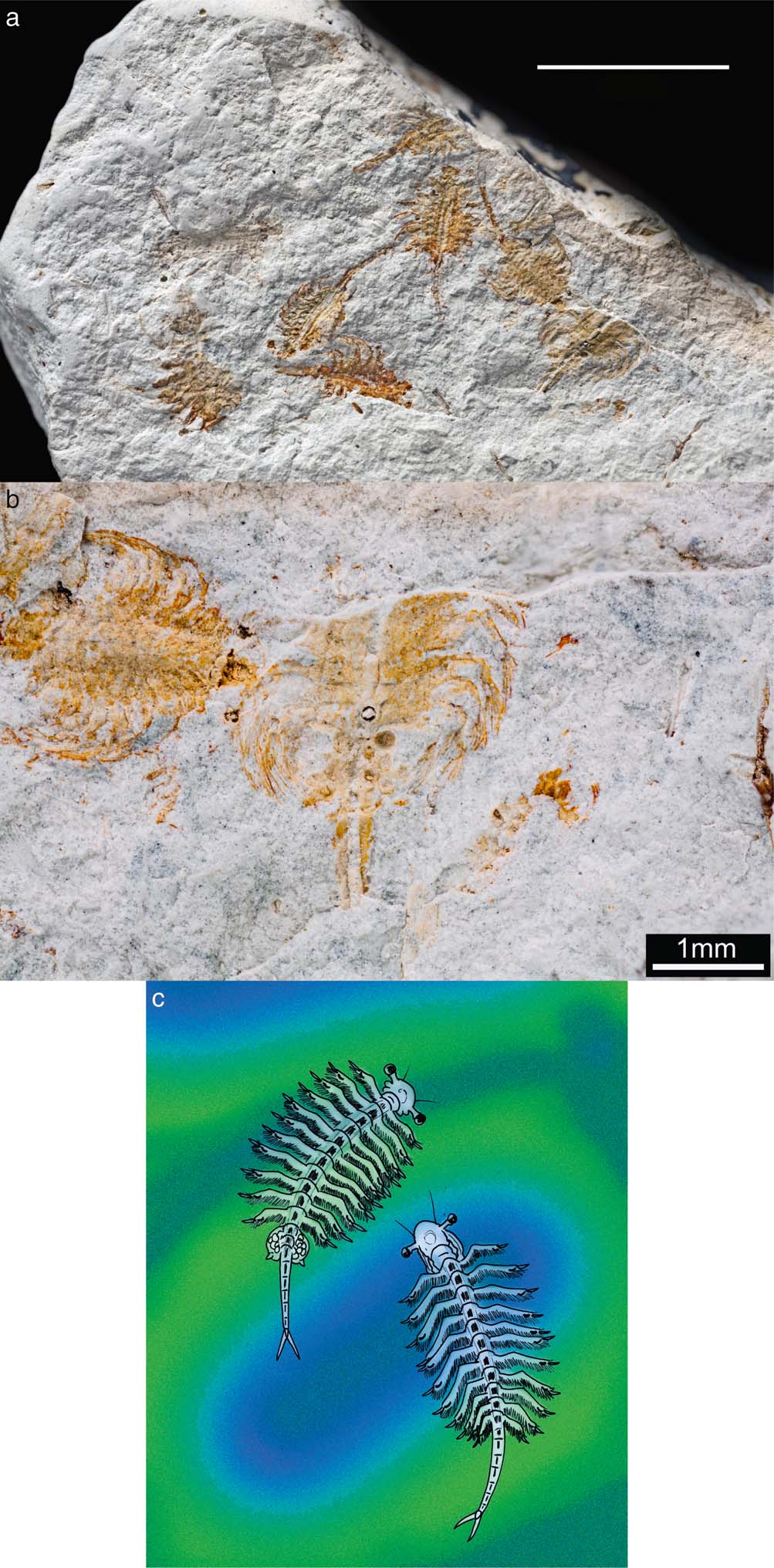
Branchipodites vectensis Woodward, Reference Woodward1879 Fig. 6a–c
(a–c) Branchipodites vectensis Woodward, Reference Woodward1879 group photo (Scale bar 5mm) and close-up showing ovisac IC.1267 (coll. A. Yule). c. Reconstruction (reproduced with permission from Avancna © 2014 deviantART).
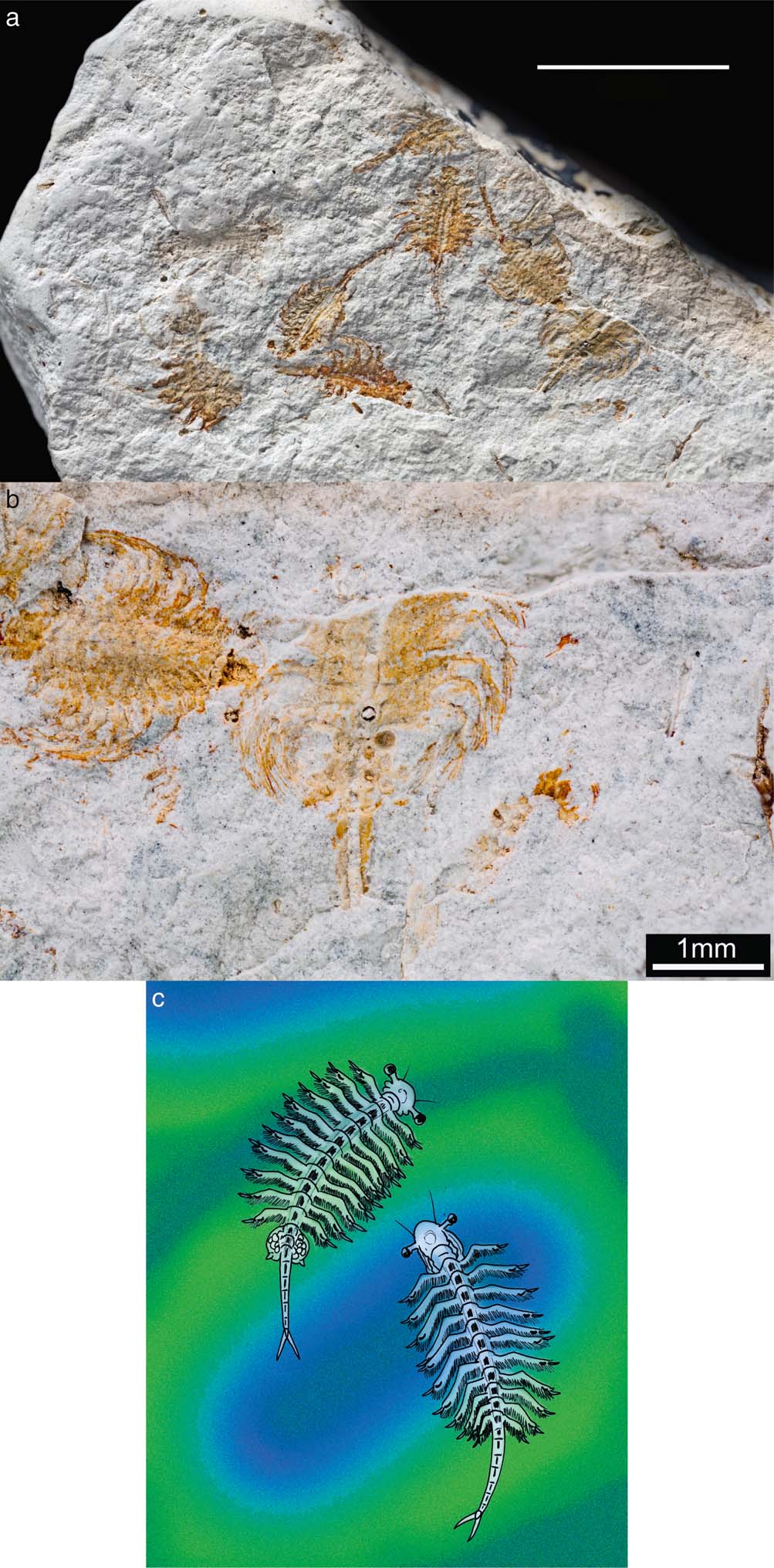
Diagnosis (sensu Tasch, Reference Tasch and Moore1969). Males with large clasping antennae, females with small antennae and egg pouches; female trunk with eight pairs of legs; abdominal somites narrow, elongated. Eyes stalked.
Occurrence. ‘Insect Limestone', Insect Bed (latest Eocene), NW Isle of Wight, England.
Remarks. Often small spherical cavities are found in pieces of ‘Insect Limestone'. These are consistent in size and shape with the eggs in the egg pouches of B. vectensis.
Peloids, thought to be anostracan faecal pellets, are the most abundant allochem in the limestone. These are locally concentrated and frequently co-occur with fossilised B. vectensis (see Ross & Self, Reference Ross and Self2014).
7. Isopoda
Aquatic isopods are woodlouse-like crustaceans with a dorsal-ventrally flattened body comprising a cephalothorax, seven free thoracic segments (each with a pair of limbs, the first for grasping, the others for walking) and a reduced abdomen covered dorsally by a single plate (with a pair of branched uropods). They are known from the Upper Carboniferous onwards (Wilson Reference Wilson2012).
Today, terrestrial isopods include the domestic woodlice and pill bugs, but there is no common name for all the diverse aquatic isopods: some more familiar marine species include the sea slater (a ligiid), speckled sea louse (a cirolanid) and sea pill bug (a sphaeromatid). The latter, like the Insect Bed isopod, is considered to be a sphaeromatoid in the suborder Sphaeromatidea, previously Flabellifera (Brandt & Poore Reference Brandt and Poore2003). Sphaeromatids are so called because the oval body is readily rolled into a ball as in pill bugs and some trilobites. The family name is Latinised as Sphaeromidae, but was altered to Sphaeromatidae (to reflect the Greek stem of Sphaeroma) by Dahl (Reference Dahl1916). We have retained the latter for nomenclatural stability.
Extant species of the typical genus Sphaeroma are good swimmers and live in estuaries and saltmarsh pools, as well as on the seashore, and can even occur in fresh water, although are only transitory in the latter.
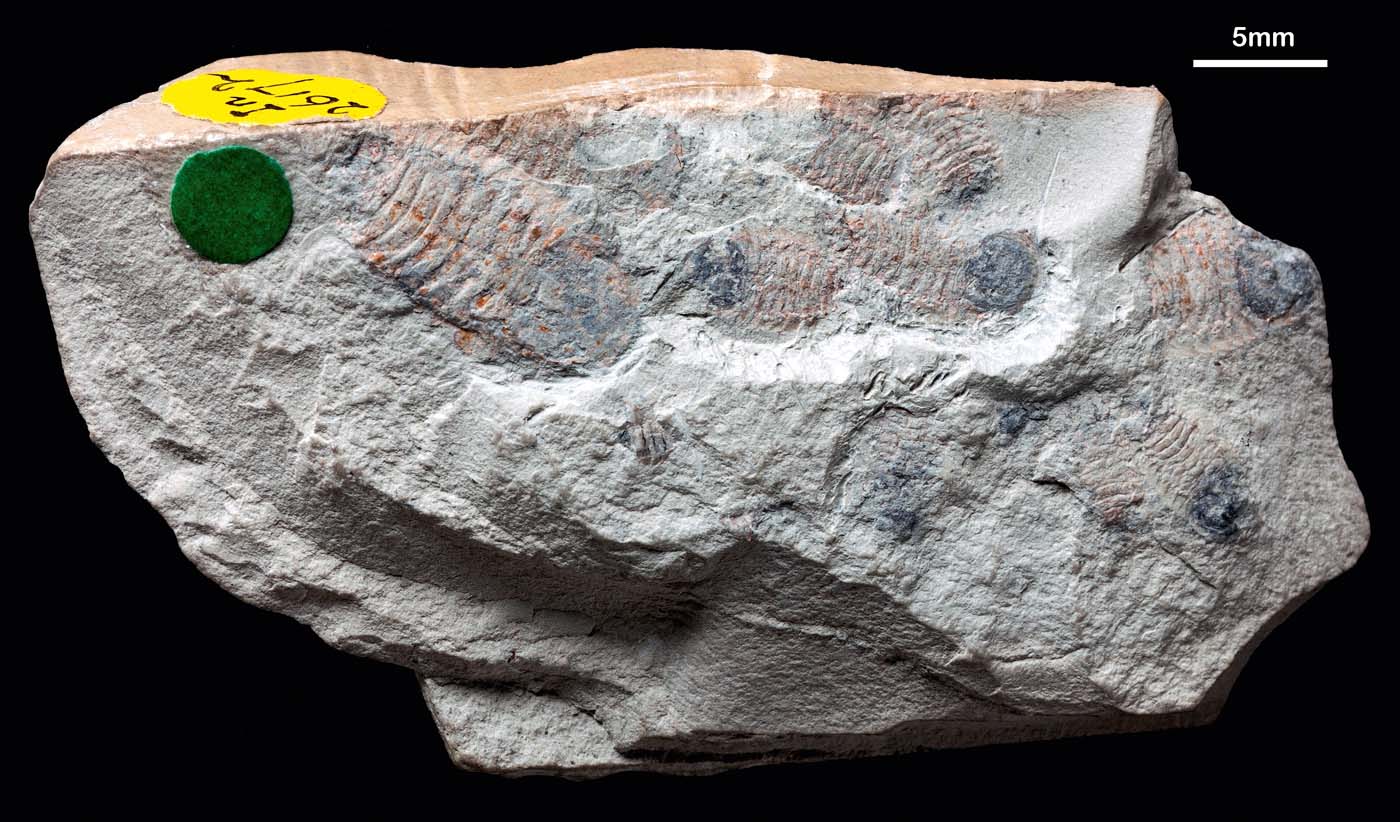
Fossil sphaeromatoids are known from the Triassic onwards. The Insect Bed isopod belongs to the fossil taxon Eosphaeroma that was considered a ‘basket genus' by some 20th-Century workers, e.g., Basso & Tintori (Reference Basso and Tintori1995). Assigning fossil species to natural genera in the absence of some fine details, e.g., in the appendages, can be a problem for the palaeontologist, but can be overcome by placing them in collective groups (Jarzembowski et al. Reference Jarzembowski, Wang, Fang and Zhang2014). In this case, we suggest that the genus Eosphaeroma is treated as a collective of possible sphaeromatid morphospecies with a broad, ovoid body; small head much narrower than and sunk into the thorax; subequal, ‘sickle'-shaped uropods; and a nearly semicircular abdominal plate (pleotelson), broadly rounded posteriorly (Fig. 7).
Eosphaeroma margarum (Desmarest, 1822) group photo in 26172b: green spot indicates specimen figured by Martini (Reference Martini1972, pl. 2, fig. 3). The dark grey patches are pleotelsons.
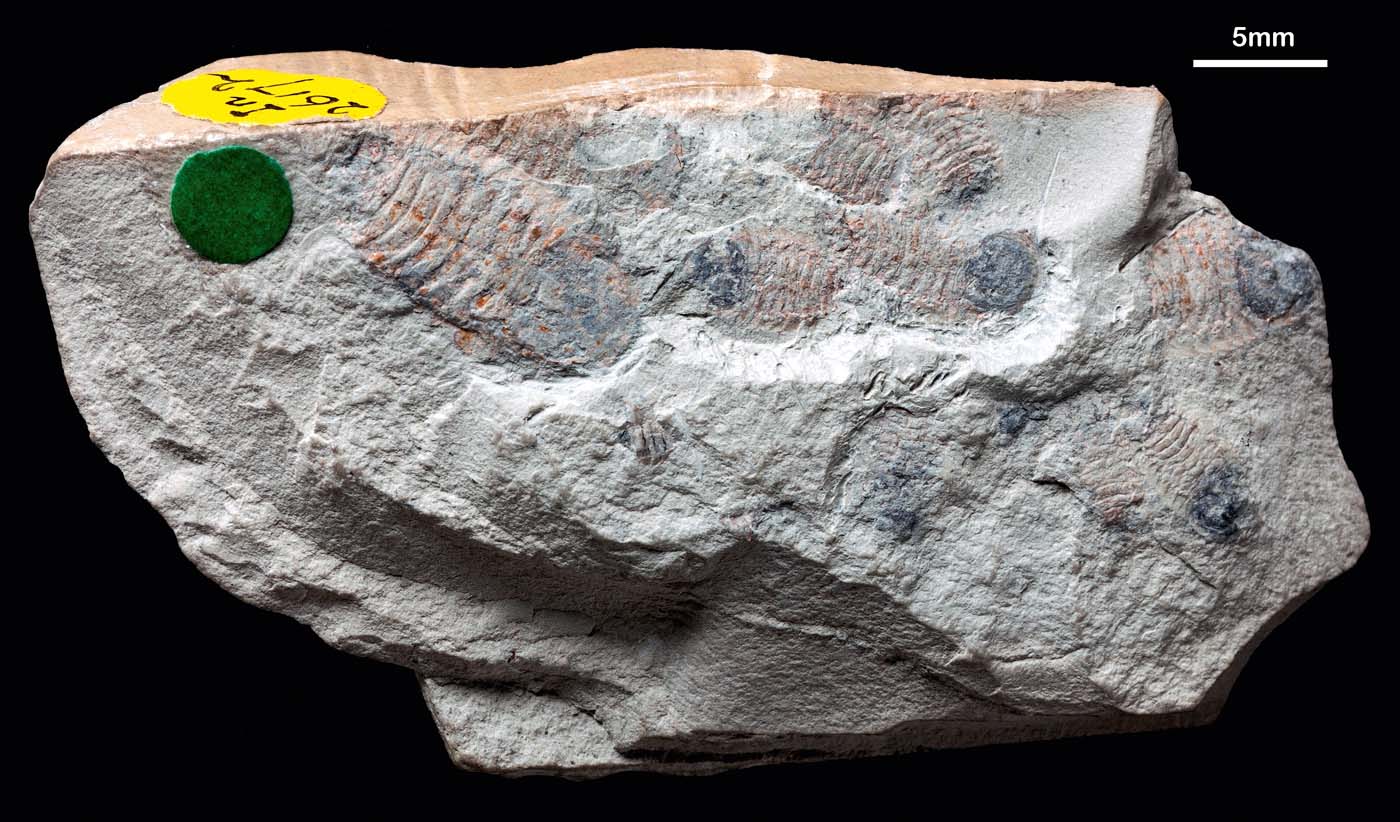
Martini (Reference Martini1972) revised the Insect Bed isopod, considering it to belong to a French fresh water–brackish species, Eosphaeroma margarum (Desmarest). Fossils are uncommon and only occur locally in the ‘Insect Limestone', individuals varying in size.
He also revised Eosphaeroma obtusum (von Meyer) considering it to occur in the higher part of the Bembridge Marls, as well as in the Lower Oligocene of France and Germany. More recently, E. obtusum has been reported from Italy (De Angeli & Quaggiotto Reference De Angeli and Quaggiotto2014).
Class Malacostraca Latreille, Reference Latreille1802
Order Isopoda Latreille, Reference Latreille and Cuvier1817
Suborder Sphaeromatidea Wägele, Reference Wägele1989
Superfamily Sphaeromatoidea Latreille, Reference Latreille1825
?Family Sphaeromatidae Latreille, Reference Latreille1825
Genus Eosphaeroma Woodward, Reference Woodward1879
Type species. Eosphaeroma fluviatile Woodward, Reference Woodward1879 by subsequent designation (Van Straelen, Reference Van Straelen and Quenstedt1931); ‘Insect Limestone', Insect Bed (latest Eocene), NW Isle of Wight, England
Eosphaeroma margarum (Desmarest in Brongniart & Desmarest, Reference Brongniart and Desmarest1822) Fig. 7
Diagnosis (after Martini, Reference Martini1972; De Angeli & Quaggiotto, Reference De Angeli and Quaggiotto2014). Small to medium sized isopod with elongate-oval body, slightly convex in cross section; comparatively small head with laterally located eyes; head enclosed posteriorly and laterally by first pereonite; pereonites expanded laterally and seven visible but only one free pleonite with continuous transverse suture; large, subcircular pleotelson, rounded posteriorly and comprising about one third of body length; pair of biramous uropods, laterally located on pleotelson, with subequal branches and relatively wide endopod and leaf-shaped exopod.
Occurrence. Late Palaeogene of France, Germany and England (Martini Reference Martini1972).
Comments. This species is the senior synonym of E. fluviatile and differs from E. obtusum (von Meyer Reference von Meyer1858) in the shape of the uropods and possession of an uninterrupted transverse suture on the free pleonite (von Meyer Reference von Meyer1858).
8. Palaeoecology
The fine grain size and planar laminations indicate that the Insect Bed at St Helens was deposited in a low-energy environment. Halite pseudomorphs are present in the laminated clays and limestone suggesting that the sequence was deposited in a hypersaline lagoon. However, the pseudomorphs are rare so that super-saturation may have only occurred sporadically.
Extant ‘conchostracans' and anostracans generally live in transient aquatic environments. ‘Conchostracans' are mainly benthic and affected at an early stage by declining oxygen levels as the pools desiccate. Weak-swimming ‘conchostracans' are unable to utilise oxygen in the sub-surface layer due to the high-energy expenditure required to swim to the air-water interface whereas anostracans are nektonic (Brendonck Reference Brendonck, Day, Stewart, De Moor and Louw1999). Extant ‘conchostracans' therefore develop and attain sexual maturity earlier than anostracans. Benthic conditions suitable for colonisation may, however, have been short lived. The low abundance of ‘conchostracans' cannot be attributed to palaeopredation as fish are very rare in the Insect Bed (see Hooker et al. Reference Hooker, Evans and Davis2019). Alternatively, the carapaces may have been washed in to the site of deposition, but not far from their natural habitat.
In China, Paraleptestheria often occurs in red beds in which gypsum or rock salt is common. This indicates that the animals could adapt to a saline or brackish water environment (Chen & Shen 1981). This is consistent with the lagoonal setting of the British occurrence (see above).
9. Conclusions
‘Conchostracans' decline generally after their Mesozoic heyday (possibly due to the rise of teleost fish) and are absent from the modern British fauna (although still surviving in continental Europe). This first British Cenozoic find is therefore significant. Extant branchipodid fairy shrimps are marginalised too in Europe, e.g., occurring in rain-filled tank tracks on Salisbury Plain in England (English Nature 1993). The Insect Bed is their only record in the British ‘Tertiary'. The occurrence of these branchiopods is ecologically significant (representing succession in the water body) as discussed above. The generic placement of the Insect Bed ostracod needs confirmation as mentioned above, despite occurring in a limestone matrix (modern ostracod investigators prefer to work with freshly sieve samples). Also, the family placing of the rare and somewhat elusive isopod needs confirmation, especially as it is stratigraphically replaced by another congener in the European Palaeogene (Martini Reference Martini1972). In view of the exceptional preservation of the ‘Insect Limestone', other crustaceans such as water fleas (Cladoceromorpha) should be looked out for.
10. Acknowledgements
We are indebted to Harry Taylor (NHM), Andrew Ross (NMS) and Avancna © 2014 deviantART for Figures 5–7 and Fred Clouter and Pete Austen (UK) for help with images. This study was supported by the National Natural Science Foundation of China (Grant no. 40572005, 40672013 to Y. S.), Chinese Academy of Sciences (Grant no. 2011T2Z04 to E. A. J.), Consejo Nacional de Investigaciones Científicas y Técnicas-CONICET-Argentina and the Secretaría General de Ciencia y Técnica, Universidad Nacional del Nordeste-Corrientes-Argentina, both to O. F. G. This is a Leverhulme Emeritus Fellowship Contribution for EAJ.