Introduction
The trend of masculinization of the population in Asia has drawn the attention of policy makers and researchers working in various fields such as population, health and gender and social planning. India (Jha et al., Reference Jha, Kumar, Vasa, Dhingra, Thiruchelvam and Moineddin2006), China, Hong Kong, Taiwan (Poston et al., Reference Poston, Gu, Liu and McDaniel1997; Zhang, Reference Zhang1998), South Korea (Park, Reference Park1983; Park & Cho, Reference Park and Cho1995) and Central Asian countries including Azerbaijan, Georgia and Armenia (Guilmoto, Reference Guilmoto2009) have experienced a high sex ratio at birth (SRB) in recent decades.
While a high SRB has been found in many Asian countries, studies indicate a decline in SRB in developed countries such as Canada (Allan et al., Reference Allan, Brant, Seidel and Jarrell1997), Denmark (Biggar et al., Reference Biggar, Wohlfahrt, Westergaard and Melbye1999) and among white women in the US (Marcus et al., Reference Marcus, Kiely, Xu, McGeehin, Jackson and Sinks1998; Mathews & Hamilton, Reference Mathews and Hamilton2005). The discrepancies in the sex composition of adult populations at the global level have the potential to generate new trends in international migration in the future, and contribute further to emerging international health issues at global, continent and country levels.
The SRB is commonly measured as the number of male births per one hundred female births, and is biologically defined as 105–106 males per 100 females (Hardy, Reference Hardy2002). A wider range of the SRB of 103–107 is also conventionally accepted as normal (Chahnazarian, Reference Chahnazarian1988). A high SRB estimate is considered as statistically significant if the 95% confidence interval (95% CI) of that estimate exceeds the upper limit of the normal range 103–107 (Wei, Reference Wei2005). Scholars have begun to envisage the long-term implications of a high SRB in the context of global demographic changes (Boer & Hudson, Reference Boer and Hudson2004).
Previous studies in a range of settings have shown a wide range of socioeconomic and demographic factors influencing SRB. A high SRB has been revealed to be associated with higher socioeconomic class (Chahnazarian, Reference Chahnazarian1988) and certain races and ethnicities (James, Reference James1987a, b) and social and biological factors (Seth, Reference Seth2010). A lower SRB is associated with maternal malnutrition (Anderson & Bergstrom, Reference Anderson and Bergstrom1998), while younger maternal age is associated with high SRB and higher birth order is associated with lower SRB (Ruder, Reference Ruder1985). A high SRB is more likely to be observed in a population with declining fertility, particularly when it reaches the replacement level of 2.1 (Biggar et al., Reference Biggar, Wohlfahrt, Westergaard and Melbye1999; Ding & Hesketh, Reference Ding and Hesketh2006).
There is also a range of biological factors influencing the SRB via the sex ratio at conception. Numerous factors have been known to influence the mobility and survival time of X- and Y-bearing sperm. The isolation of sperm in artificial insemination and in IVF–embryo transfer techniques, which are used to select higher quality embryos, are reported to have enhanced the capacity for sex pre-selection (Tarin et al., Reference Tarin, Bernabeu, Baviera, Bonada and Cano1995). The age of the ovum at fertilization is also reported as having an effect on the sex ratio at conception. Fertilization at early or later stages of the menstrual cycle is more likely to produce a male fetus. The pH chemical balance of the female genital tract also affects the sex of the fetus. A high level of gonadotrophin at conception is associated with a lower SRB in African populations (James, Reference James1996, Reference James2004a). Higher coital rates may result in a greater number of male conceptions. This factor may be responsible for the higher SRB observed during and after wars (James, Reference James2003, Reference James2004b; McMahan, Reference McMahan1951).
Health status has also been reported as influencing SRB, particularly some specific diseases: men who develop testicular cancer record a significantly lower SRB than the general population, prior to the diagnosis (Jacobsen et al., Reference Jacobsen, Bostofte, Engholm, Hansen, Skakkebæk and Møller2000). Men exposed to dioxin (2,3,7,8-tetrachlorodibenzo-p-dioxin) have a lower SRB in their offspring for many years after exposure (Mocarelli et al., Reference Mocarelli, Gerthoux, Ferrari, Patterson, Kieszak and Brambilla2000). The effect of dioxin on SRB has been explained by an alteration of the sperm transit time, which provokes the delay of fertilization of the oocyte (Jongbloet et al., Reference Jongbloet, Roeleveld and Groenewoud2002). Parents, particularly mothers, infected with Hepatitis B virus are more likely to produce sons (Lin & Luoh, Reference Lin and Luoh2006). Lower SRB has also found to be associated with smoking behaviour in previous studies. Although the smoking habits of males do not have an effect on the percentage of X- and Y-bearing sperm, male heavy smokers produce higher proportions of female embryos (Viloria et al., Reference Viloria, Rubio, Rodrigo, Calderon, Mercader and Mateu2005).
Previous studies have also identified social and cultural factors contributing to an upward bias of SRB, including parental gender discrimination behaviours and socio-cultural practices (Kumm et al., Reference Kumm, Laland and Feldman1994), data systematic errors such as under-reporting of female births in health data (Zhang & Zhao, Reference Zhang and Zhao2006), incomplete neonatal mortality data in vital registration data (Wu et al., Reference Wu, Viisainen and Hemminki2006) and limited sample size in population surveys (Zhang, Reference Zhang1998). However, female-selective abortion has been identified as the most significant and proximate cause of the high SRB phenomenon in Asia (Miller, Reference Miller2001; Arnold et al., Reference Arnold, Kishor and Roy2002; Zhu et al., Reference Zhu, Lu and Hesketh2009).
In Vietnam there is evidence of a high SRB in recent years, with the figure reported at 110 nationwide in 2006 (GSO, 2007; Guilmoto, Reference Guilmoto2008). This increase in SRB has occurred in the context of rapid socioeconomic and demographic changes in Vietnam over the last decade. Gross domestic product (GDP) doubled in the 1990s, and the poverty rate fell from 58% in 1993 to 20% in 2004 (Vietnam, 2005). However, there are significant income inequalities in Vietnam, with the monthly average per capita income in 2006 of urban areas being 2.09 times higher than that of rural areas. Furthermore, the monthly income per capita of the richest quintile was 8.37 times that of the poorest (GSO, 2006).
Within these societal changes in Vietnam, the relationship of SRB with socioeconomic and demographic factors is of much interest. The total fertility rate (TFR) declined from 2.33 in 1999 to the replacement level of 2.1 in 2005, and has remained below that level in recent years, and is predicted to decline further in coming years (GSO, 2007, 2008). It is likely that the SRB will continue to increase (GSO, 2008). The current social and political context has institutionalized the social norm of small family size while retaining the traditional family norm of son preference. These conditions have facilitated the adoption of modern sex-selection methods in the population (Pham et al., Reference Pham, Hall, Hill and Rao2008). Previous studies on SRB in Vietnam suggested that high SRBs are more likely to be observed in the Red River Delta region (Guilmoto et al., Reference Guilmoto, Xuyen and Toan2009; Pham et al., Reference Pham, Hill and Adair2009b), where son preference is stronger than elsewhere in the country (Belanger, Reference Belanger2002).
Hence, knowledge of population sub-groups experiencing high SRB is of vital importance. Despite this, little is known about the variation of SRB amongst different socioeconomic and demographic groups of women. This paper seeks to identify the levels and associations between certain maternal socioeconomic and demographic characteristics and the differentials in SRB. If the level of SRB is significantly high amongst particular sub-groups in the population, this would enable intervention programmes to be targeted and inform further research to explore reasons for any variation.
Methods
Data source
The data source used in this paper is the Population Change Survey (PCS) conducted by the General Statistics Office (GSO) in April 2006. Like the PCS of previous years, the PCS 2006 employed a stratified random sampling method, based on the sampling framework of the 1999 Census. The sampling framework uses stratification in two stages: province/city (64 provinces/cities) and urban–rural sector, with 3838 sampling clusters distributed in disproportion to the population size of each province (the smaller population size provinces were allocated relatively more clusters). The list of provinces and the distribution of sampling clusters by region and province are published elsewhere (GSO, 2007).
Households were randomly selected in each cluster. Each cluster consists of about 100 households and an approximate population of 450–500. The total sample size is about 1.6 million, representing approximately 2% of the total population for the country. Data on 461,476 women of reproductive age (15–49) were extracted from the main dataset and used for this analysis.
Statistical analysis
Two sets of analyses have been undertaken. Firstly, the SRB has been estimated for the most recent birth using variables including sex, month and year of birth and total female births. The SRB for a year was estimated using the data on births in the 12 months prior to the survey, i.e. the SRB of 2006 was estimated using the number of births from 1st April 2005 to 31st March 2006. This time scale is consistent with the definition currently used by the GSO, providing comparable estimates to the GSO's figures for the previous years. All regression analyses were restricted to only those most recent births born in the period 1st April 2000–31st March 2006 to explore the socioeconomic and demographic factors associated with the SRB after the 1999 Census. The SRB estimation method applies sample weights, which were developed according to the proportion of population sizes (GSO, 2007).
The STATA software package was used for SRB estimation and analysis. In this statistical program, the 95% CI of SRB estimates are calculated using Taylor's series linearization method to assess the reliability of an estimate. This method is commonly used for analysis of population sample surveys to account for the survey design and incorporation of weights. The SRB estimate is considered as significantly high if the 95% CI of that estimate is above the normal range of 103–107. The formula for Taylor's linearization method is:

In the formula, SE(r) is the standard error of an estimate r; zhi=yhi−rxhi and zh=yhrxh, where h denotes the layer varying from 1 to H; mh is the total of clusters selected in the layer h; yhi is the total of weighted values of the y variable in cluster i and layer h; xhi is the total of weighted cases in cluster i and layer h; and f is the general sampling proportion, which may be omitted if the value is small.
The SRB was estimated for different maternal socioeconomic and demographic groups, with variables including: rural–urban residence, geographic region, age, main job, education and birth order. The number of previous female births is included as a measure of son preference. If all previous births are female, and parents are willing to continue childbearing until they obtain a son, the last birth is more likely to be male. A demonstration of this fertility behaviour is known as the ‘stopping rule’ – a fertility decision-making mechanism expressed in a context of strong preference for son – and has been presented elsewhere (Pham et al., Reference Pham, Hill and Adair2009b).
The second analysis uses logistic regression to identify the socioeconomic and demographic factors associated with the sex of the most recent birth. The variables listed above are included in the models. Logistic regression was also conducted specifically for each socioeconomic and demographic group to assess whether the association of the number of previous female births with the sex of the most recent birth differs between these groups. If this association does differ, then it may suggest son preference is stronger in certain groups and explain any differences in SRB. The results of regression analyses of second and third births are also presented.
Results
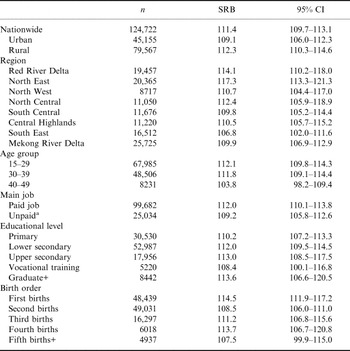
Table 1 shows the SRB estimates for most recent births by maternal socioeconomic and demographic characteristics. The data show that the SRB is significantly high at the national level (111.4; 95% CI 109.7–113.1), particularly in rural areas where it is 112.3 (95% CI 110.3–114.6). A significantly high SRB is also found in the Red River Delta and the North East regions (SRBs of 114.1 and 117.3, respectively). This ratio is also significantly high among women in age groups 15–29 and 30–39, women who have paid jobs, and those with either primary, lower secondary or upper secondary education. With regard to birth order, the SRB is significantly high at first births (114.5; 95% CI 111.9–117.2), but insignificant at higher birth orders (the SRB estimate for fifth births had a wide 95% CI due to a small sample size).
Sex ratio at birth of most recent births by maternal socioeconomic and demographic characteristics, Vietnam, 1st April 2000 to 31st March 2006, PCS 2006

a Including housework, study, unemployment and unidentified.
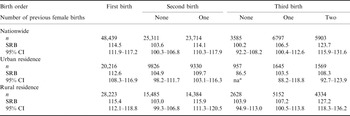
Table 2 presents the SRB estimates for most recent births by birth order, number of previous female births and urban–rural residence. The analysis was limited to women with three births or fewer because the numbers of women with four births or more are small in the sample. The results indicate that the high SRB of most recent births is positively associated with the number of previous female births. For instance, the SRB of third births ranged from 100.2 (95% CI 92.2–108.2) if none of the two previous births was female to 123.7 (95% CI 115.9–131.6) if both of the previous births were female. This trend is observed in both rural and urban areas, but the association is stronger in rural areas. The SRB is 127.2 in rural areas for third births, where the two previous births were female.
Sex ratio at birth of most recent births by birth order, number of previous female births and rural–urban sector, Vietnam, 1st April 2000 to 31st March 2006, PCS 2006

a Not available due to missing standard error because of stratum with single sampling unit.
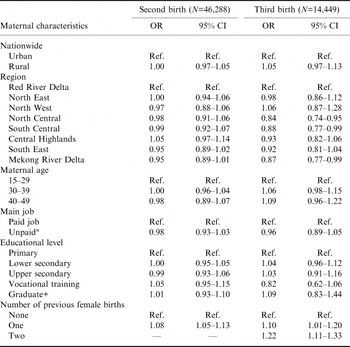
Table 3 shows the results of regression analysis of the association between the SRB of second and third births and maternal socioeconomic and demographic factors. The data show that the number of previous female births is the only independent demographic variable significantly associated with the sex outcome of the most recent birth. For instance, the likelihood of the second birth being male is 1.08 times (95% CI 1.05–1.13) higher if the first birth is female, compared with if it is male. Similarly, the likelihood of a male third birth increases 1.1-fold (95% CI 1.01–1.20) if one of the two previous births is female, and by 1.22 times (95% CI 1.11–1.33) if both of the previous births are female, compared with if none of the two previous births is female. However, the differentials of sex outcome for the second and third births are not statistically significant across different maternal socioeconomic or demographic groups (i.e. the 95% CI of the odds ratio overlaps with the value of one). For example, the likelihood of third births being male among women aged 30–39 is 1.06 times higher than that of women aged 15–29, but the 95% CI of 0.98–1.15 is not statistically significant.
Logistic regression of sex of most recent birth by birth order and maternal socioeconomic and demographic factors, second and third births, Vietnam, 1st April 2000 to 31st March 2006, PCS 2006

a Including housework, study, unemployment and unidentified.
Note: model includes all variables in the table.
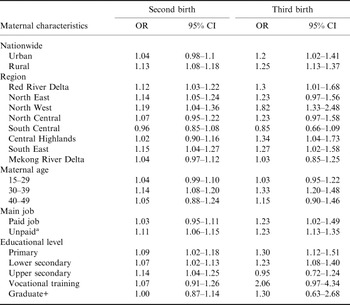
Table 4 provides further analysis of the association of sex outcome for second and third births, and previous female births, according to maternal socioeconomic and demographic groups. Regression analysis was conducted separately for each socioeconomic demographic group, to predict the likelihood of the most recent birth being male according to whether all previous birth(s) were female. The results indicate that the strength of the relationship between sex outcome of the second or third births and the sex of the previous birth (female versus male) is significantly and consistent across certain categories: rural area, Red River Delta, North East, North West and South East regions, age 30–39, unpaid employment and primary and lower secondary education. The odds ratios are not statistically significant for other socioeconomic and demographic variables.
Logistic regression of most recent birth being male (versus female) where all previous births are female (versus others) for each maternal socioeconomic demographic group, second and third births, Vietnam, 1st April 2000 to 31st March 2006, PCS 2006

a Including housework, study, unemployment and unidentified.
Note: model conducted for each category separately.
Discussion
Limitations of the Population Change Survey 2006 data
In the absence of high quality birth statistics in Vietnam, the PCS 2006 appears to be an appropriate option for in-depth analysis of the SRB (Pham et al., Reference Pham, Rao and Hill2009a). The survey records approximately 25,000 births born in the 12 months prior to the survey. With this sample, the PCS 2006 data provide a reliable estimate at the national level. However, the sample size has been a limitation for all the annual PCS data series conducted since 2001, preventing further analysis of SRB for comparisons of urban and rural sectors, or estimations at regional and provincial levels or for particular socioeconomic and demographic groups.
To overcome this limitation, the data on most recent births have been combined for the six-year period 1st April 2000 to 31st March 2006. With a large cohort of 124,772 births, the data provide more reliable SRB estimates for this period and furthermore allow the analysis of socioeconomic and demographic factors. There is some selection bias arising from the descriptor most recent birth, which can designate any birth order, depending on the age of women at the survey time. For instance in a young woman aged 15–19, the most recent birth is more likely to be the first birth, but for a woman aged above 40, it is more likely to be the final birth. Lastly, the sample of women in the age group 15–19 was quite small, especially when examining the sex outcome of the second and third births (only 2807 observations). With this in mind, the analysis was conducted for three age groups: 15–29, 30–39 and 40–49.
The high level of the SRB in Vietnam
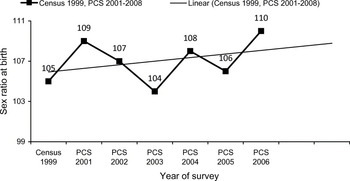
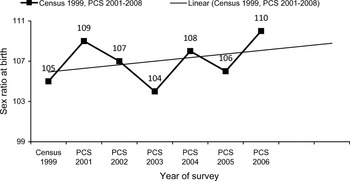
Figure 1 shows the levels of national SRB estimates based on the annual PCS over the period 1999–2006. The data suggest a fluctuation of the SRB in the period 1999–2006. Despite the variation of the ratio over time, the data show that the national SRB has increased at a rate of about 0.7% per year on average over the period 1999–2006, compared with the increase rate of about 0.65% per year in the peak periods in China (1980–2000) and Korea (1980–1990) (Guilmoto, Reference Guilmoto2008). Given that Vietnam is now at the early stage of the SRB transition, this indicates the potential for the SRB to increase in the future.
Sex ratio at birth and trend line, Census 1999 and PCS 2001–2006, Vietnam 1999–2006.
The sex ratio (SR) of children aged 0–4 (SR0–4) also indirectly reflects the SRB in previous years. The SR0–4 for the year 2006 was computed using the sex information of most recent births in the period 1st April 2002 to 31st March 2006. Given that no sex differential was reported in the mortalities of children under five in Vietnam (GSO, 2002), one would expect this ratio to be in the normal SRB range of 103–107. The estimate of SR0–4 for 2006 was 110.2 (95% CI of 107.7–112.2), which is significantly high. This is evidence reaffirming the high SRB in the years prior to 2006.
Socioeconomic and demographic factors association with the SRB
Urban–rural residence
Although the SRB was high in both urban and rural areas, it was significantly so in rural areas, but not significant in urban areas. The difference in SRB between the two sectors was not significant, because the 95% CIs of the two estimates overlapped. The SRB of the third birth where both previous children were female was a very high 127.2 in rural areas. In the logistic regression analysis, the odds ratio indicated no significant difference in likelihood of the sex of the most recent birth based on urban–rural status. Furthermore, the association of sex of previous births and sex of recent birth was also not significantly different between urban and rural residents.
Geographical region
The analysis of SRB differential by geographical regions revealed the high SRB to be statistically significant in two regions in northern Vietnam: the Red River Delta and the North East. These increases may be associated with the recent changes in the socioeconomic development of the Red River Delta (Pham et al., Reference Pham, Rao and Hill2009a), where son preference is established (Belanger, Reference Belanger2002) and the implementation of the one-to-two child family policy is more cohesive (Goodkind, Reference Goodkind1995).
Maternal age
The SRB estimation by maternal age groups showed that the ratios were significantly high among women in the age group 30–39, but the difference was not significant in other age groups. The regression analysis showed that women in the age group 30–39 are likely to have a male birth at the second, and especially the third birth, following previous female births. This likelihood is significantly high. These observations suggest that sex-selection adoption is particularly high in this age group. The finding is consistent with a previous survey on late abortion in Vietnam (MOH, 2007).
Main employment
The SRB was significantly high among women with paid employment, but remained normal among women with unpaid jobs such as housework, study or the unemployed. The differentials of SRB, as well as the association between number of previous female births and sex of most recent birth, between the two groups were not significant. However, the likelihood of a third birth being male after two female births increased significantly in both groups of women. This suggests that while economic independence is a factor influencing sex-selection practices, this factor is more likely to impact on the sex outcome of third births. This observation is discussed further in the next section.
Educational level
The SRB estimates by maternal education showed that the high SRB was significant among women who have primary, lower secondary and upper secondary education. Furthermore, the likelihood of a male birth at the second and the third births following previous female births was significant only among women with primary and lower secondary education.
A previous study on the SRB of Vietnam had suggested that women with higher socioeconomic status in urban areas were more likely to have access to sex-selection services (Belanger et al., Reference Belanger, Oanh, Jianye, Thuy and Thanh2003). However, the significant increases of SRB and the likelihood of a male birth following female births among women who have unpaid jobs, or with only primary or secondary education, suggest that access to sex selection is now no longer limited to these groups of women, but has already spread to those with lower socioeconomic status and some rural areas.
Birth order
The SRB increased by birth order from the first to the fourth birth. This observation is consistent with experiences in China (Wu et al., Reference Wu, Viisainen and Hemminki2006) and India (Arnold et al., Reference Arnold, Kishor and Roy2002). Sex selection was identified as the underlying cause of the increased SRB by birth order in those countries. However, the high SRB of first births was also revealed in the data. This observation in Vietnam is exceptional and needs further study. A lower SRB observed in the fifth birth order could be a result of the influence of higher parental and maternal age (Ruder, Reference Ruder1985).
Number of previous female births
The higher SRB of most recent births was significantly associated with the number of previous female births. The number of previous female births is the only variable that is significantly associated with the sex outcome of most recent birth when all variables are included in the regression model. This association is consistently observed across all different socioeconomic and demographic groups of women.
The likelihood of a male birth at the second and the third birth following previous female births was significantly high, not only in the Red River Delta, where the SRB was high, but also in the South East region, where the SRB was normal (106.8; 95% CI 102.0–111.6). These observations suggest that son preference is present across a range of socioeconomic and demographic groups. Furthermore, it is likely that the number of previous female births is a factor encouraging women to adopt sex selection in the following birth, in an attempt to balance the sex composition of their children. This finding supports the previous observation that women with only girls born in the previous births were more likely to use abortion services (Institute for Social and Development Studies, 2007). Also, this may be a reflection of parents' willingness to continue childbearing until they bear a son; however, it would require identification of last births for this to be ascertained.
In previous studies on SRB in large populations where deliberate sex selection is not a significant issue, the SRB declines slightly with birth order, maternal age and parity, due to the effects of biological factors. It also increases with number of prior brothers and decreases with number of prior sisters. In this study on the SRB in Vietnam, the above results have shown that the SRB increases with the number of previous female births, and that this observation is consistent across different socioeconomic and demographic groups of women. The inference can be drawn with some confidence that there has been some intentional interference with the natural processes to bias the natural balance in the SRB in the Vietnamese population.
Conclusion
This paper fills a research gap by assessing the variation of SRB amongst different socioeconomic and demographic groups in Vietnam. The PCS 2006 is a valid data source for analysis of these factors associated with SRB in Vietnam. Using these data, the paper has found that a high SRB is present amongst many socioeconomic and demographic groups in the country, and that nationally it is significantly higher than the normal level. The SRB estimates have shown that the high SRB is mostly present in rural areas, in the northern regions, and particularly in the Red River Delta. High SRBs are also more likely to be observed among women in the age group 30–39 and those who have unpaid jobs and with only primary or secondary educational levels. The SRB is even higher where the previous births were female. The logistic regression analysis of maternal socioeconomic and demographic factors has identified that the number of previous female births is the sole statistically significant factor influencing the SRB when all variables are included in the multivariable analysis model. The significance of this factor is also consistent across maternal socioeconomic and demographic groups, despite the differentials of SRB observed amongst some groups.
With the declining fertility rate likely to continue, it is reasonable to suggest that the SRB will increase further in coming years. The need to address high SRB in these population groups is vital. Further research into the reasons for high SRB in these groups is required, as are intervention policies and programmes. There is a need to raise awareness of the social consequences of a high SRB arising from sex-selective abortion, both at a family and national level. Legal prohibition of sex selection has not been effective in the face of unchanging social values, and change in this area needs to be considered in the development of public population policy. The lessons learned from India and China show that the government needs to recognize the urgency of the current situation of gender equity and communicate this actively in open public discussion, leading by example in shaping population and gender policy, and promoting gender-equitable choices around family size and composition. As government reshapes its policy, influencing family choices becomes more realistic, and has the potential to change the current level of SRB in engagement with the community, and to ensure a sustainable future for Vietnam.
Acknowledgments
The research was funded by the Australian Leadership Awards (ALA) Programme and the Australian Agency for International Development (AusAID). The cost of data collection was partially covered by the Evidence for Health Policy in Viet Nam project (VINE), funded by the Atlantic Philanthropies. The PCS 2006 was partially financed by the United Nations Population Fund in Vietnam. There was no influence from these donors on the data analysis and report writing. The authors take full responsibility for the views expressed in this paper.