1. Introduction
Granitic rocks that are now exposed at the surface, and emplaced in the upper crust during Neogene-Quaternary, bear witness to recent exhumation (e.g. Ito et al. Reference Ito, Yamada, Tamura, Arai, Horie and Hokada2013; Spencer et al. Reference Spencer, Danišík, Ito, Hoiland, Tapster, Jeon and Evans2019; Spiess et al. Reference Spiess, Langone, Caggianelli, Stuart, Zucchi, Bianco and Liotta2021). Chronological constraints on cooling histories indicate that extremely high rates of tectonic exhumation are feasible, particularly during late orogenic extension (Zák et al. Reference Žák, Verner, Finger, Faryad, Chlupáčová and Veselovský2011; Hennig et al. Reference Hennig, Hall, Forster, Kohn and Lister2017; Gardien et al. Reference Gardien, Martelat, Leloup, Mahéo, Bevillard, Allemand, Monié, Paquette, Grosjean, Faure, Chelle-Michou and Fellah2022), when crustal anatexis by decompression, detachment faults and thermo-rheological perturbation produced by the granitic intrusions are active (Daniel & Jolivet, Reference Daniel and Jolivet1995; Dallmeyer & Liotta, Reference Dallmeyer and Liotta1998; Acocella & Rossetti, Reference Acocella and Rossetti2002; Caggianelli et al. Reference Caggianelli, Ranalli, Lavecchia, Liotta, Dini, Llan-Fúnez, Marcos and Bastida2014; Jolivet et al. Reference Jolivet, Arbaret, Le Pourthiet, Cheval-Garabedian, Roche, Rabillard and Labrousse2021). This widely accepted interplay has increased numerical modelling of exhumation using geochronological data (Dobson et al. Reference Dobson, Stuart and Dempster2010; Jiao et al. Reference Jiao, Herman and Seward2017), providing rates, from less than 1 mm/year (Lanari et al. Reference Lanari, Boutoux, Faccenna, Herman, Willett and Ballato2023), up to 40 mm/year (Spencer et al. Reference Spencer, Danišík, Ito, Hoiland, Tapster, Jeon and Evans2019). This wide spectrum of exhumation rates suggests the need to set up a robust and wide database of thermochronological data to better constrain the process. We contribute to this issue by providing data from the inner Northern Apennines (i.e. Northern Tyrrhenian Basin and Tuscany, Fig. 1), where post-extensional tectonics took place since early-middle Miocene (Carmignani et al. Reference Carmignani, Decandia, Disperati, Fantozzi, Lazzarotto, Liotta and Meccheri1994; Carmignani et al. Reference Carmignani, Decandia, Disperati, Fantozzi, Lazzarotto, Liotta and Oggiano1995; Carmignani et al. Reference Carmignani, Decandia, Disperati, Fantozzi, Kligfield, Lazzarotto, Liotta, Meccheri, Vai and Martini2001; Brogi, Reference Brogi2005, Reference Brogi2008; Brogi & Liotta, Reference Brogi and Liotta2008; Barchi, Reference Barchi, Beltrando, Peccerillo, Mattei, Conticelli and Carlo2010), in association with coeval magmatism, referred to as the Tuscan Magmatic Province (TMP) (Serri et al. Reference Serri, Innocenti and Manetti1993; Poli et al. Reference Poli, Peruzza, Rebez, Renner, Slejko and Zanferrari2002).
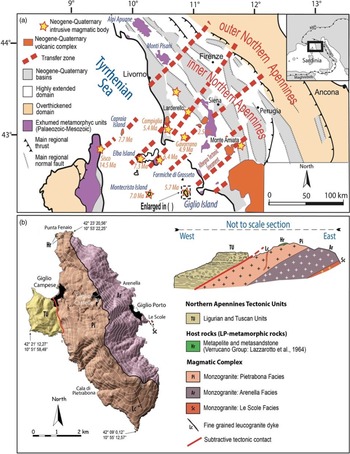
(a) Simplified geological map of the Northern Apennines and Northern Tyrrhenian Sea. The main Pliocene–Quaternary basins, transfer zones (See Brogi et al. Reference Brogi, Caggianelli, Liotta, Zucchi, Spina, Capezzuoli and Buracchi2021), Neogene–Quaternary volcanic complexes and main intrusive magmatic bodies and metamorphic units are shown. The ages of the main granites of Campiglia (40Ar/39Ar; Di Vincenzo et al. Reference Di Vincenzo, Vezzoni, Dini and Rocchi2022), Porto Azzurro in eastern Elba (zircon U-Pb; Spiess et al. Reference Spiess, Langone, Caggianelli, Stuart, Zucchi, Bianco and Liotta2021), Monte Capanne in western Elba (zircon U-Pb; Barboni et al. Reference Barboni, Annen and Schoene2015), Gavorrano (biotite K-Ar; Ferrara & Tonarini, Reference Ferrara and Tonarini1985), Montecristo (biotite K-Ar; Borsi et al., Reference Borsi, Ferrara and Tongiorgi1967) and Capraia (biotite K-Ar; Aldighieri et al. Reference Aldighieri, Gamba, Groppelli, Malara, Pasquare, Testa and Wijbrans1998) are shown. (b) Geological sketch map of the Giglio Island (modified after Westerman et al. Reference Westerman, Innocenti, Tonarini and Ferrara1993). The facies of the monzogranite, as well as the units affected by high-pressure metamorphism, are shown. The cross-section shows the geometrical relations between the facies of the monzogranite.

The TMP includes Neogene felsic plutons (Fig. 1) that were mostly emplaced at less than 8 km depth (e.g. Innocenti et al. Reference Innocenti, Serri, Ferrara, Manetti and Tonarini1992, Reference Innocenti, Agostini, Di Vincenzo, Doglioni, Manetti, Savain and Tonarini2005; Brogi et al. Reference Brogi, Caggianelli, Liotta, Zucchi, Spina, Capezzuoli and Buracchi2021; Di Vincenzo et al. Reference Di Vincenzo, Vezzoni, Dini and Rocchi2022). Several plutons are exposed while others have been encountered at a depth of 3–4 km during drilling works for geothermal and mining exploitations (e.g. Ricceri & Stea, Reference Ricceri and Stea1992; Gianelli & Laurenzi, Reference Gianelli and Laurenzi2001), as in the case of the Larderello area (e.g. Dini et al. Reference Dini, Gianelli, Puxeddu and Ruggieri2005; Gola et al. Reference Gola, Bertini, Bonini, Botteghi, Brogi, De Franco and Trumpy2017; Romagnoli et al. Reference Romagnoli, Arias, Barelli, Cei and Casini2010; Rochira et al. Reference Rochira, Caggianelli and de Lorenzo2018, Montanari et al. Reference Montanari, Ruggieri, Bonini and Balestrieri2023). Therefore, the northern Tyrrhenian Sea and southern Tuscany represent ideal crustal sectors for studying and quantifying the exhumation processes that led to the exposure of the Neogene felsic plutons (Fig. 1a). In this paper, we integrate petrological, geochronological and thermochronological analyses of the granite exposed in the Giglio Island, with the aim of constraining the exhumation history of the pluton in the framework of the extensional tectonics that formed the Northern Tyrrhenian basin (Fig. 1b). We hope the results of this research will arouse interest in the study of the processes that take place on the roof of granites and determine localized rapid exhumation.
2. Geological setting
Giglio Island (c. 21 km2) sits on the NNW trending Giglio–Formiche di Grosseto Ridge (Fig. 1a). It developed during Neogene extensional tectonic activity that was a consequence of post-collisional evolution of the Northern Apennines (Bartole, Reference Bartole1995). The island is largely formed of peraluminous granite (Westerman et al. Reference Westerman, Innocenti, Tonarini and Ferrara1993), exposed in a roughly elliptical shape having a long axis of c. 9 km. The remaining part, the Franco promontory, is comprised of piled tectonic units of the Northern Apennines belt (Lazzarotto et al. Reference Lazzarotto, Mazzanti and Mazzoncini1964) that were affected by high-pressure metamorphism (Capponi et al. Reference Capponi, Cortesogno, Gaggero and Giammarino1997; Rossetti et al. Reference Rossetti, Faccenna, Jolivet, Funiciello, Tecce and Brunet1999; Giuntoli & Viola, Reference Giuntoli and Viola2022). The Giglio pluton is a monzogranite (Westerman et al. Reference Westerman, Innocenti, Tonarini and Ferrara1993) composed of two main facies: a) the Arenella facies, a massive, K-feldspar megacryst-bearing granite that is exposed in the eastern part of the island and b) the Pietrabona facies, a foliated granite with a higher colour index that crops out mainly in the western part of the island and is juxtaposed with the metamorphic units by a tectonic contact that is interpreted as a dipping to the West normal fault (Lazzarotto et al. Reference Lazzarotto, Mazzanti and Mazzoncini1964; Rossetti et al. Reference Rossetti, Faccenna, Jolivet, Funiciello, Tecce and Brunet1999). A smaller, more differentiated mass (Le Scole granite facies) intruded the main plutonic body and is characterized by an even stronger peraluminousity. It crops out near the East coast of the island, and at Le Scole islets, about 1 km to the southeast of Giglio Porto. Magmatic and metamorphic xenoliths (Barrese et al. Reference Barrese, Della Ventura, Di Sabatino, Giampaolo and Di Lisa1987) are scattered throughout the granite, while small outcrops of the wall rock, affected by contact metamorphism, are exposed in the north of the island (Fig. 1b).
Eight samples from the main granite body, the minor Le Scole intrusion, a felsic dyke and a magmatic xenolith were dated by Rb-Sr biotite–whole-rock method by Westerman et al. (Reference Westerman, Innocenti, Tonarini and Ferrara1993). They provided Rb-Sr whole rock–biotite cooling ages ranging from 4.88 ± 0.07 to 5.07 ± 0.08 Ma, not significantly different from previous K-Ar and Rb-Sr ages (5.1 ± 0.15 Ma; Ferrara & Tonarini, Reference Ferrara and Tonarini1985). Westerman et al. (Reference Westerman, Innocenti, Tonarini and Ferrara1993) reported Sr and Nd isotopic data that indicate the hybrid nature of the magma, generated by interaction of a crustal anatectic component and a subcrustal basic magma. On the basis of the normative composition of the monzogranite, plotted in the ternary Qtz–Ab–Or diagram for minimum melt composition in water-saturated conditions, they estimated crystallization pressure of the magma of c. 400 MPa, considerably higher than that estimated for the emplacement of other granites of the TMP (Monte Capanne and Porto Azzurro from Elba Island, Campiglia and Gavorrano localities; cfr: Musumeci & Vaselli, Reference Musumeci and Vaselli2012; Caggianelli et al. Reference Caggianelli, Zucchi, Bianco, Brogi and Liotta2018; Brogi et al. Reference Brogi, Caggianelli, Liotta, Zucchi, Spina, Capezzuoli and Buracchi2021; Di Vincenzo et al. Reference Di Vincenzo, Vezzoni, Dini and Rocchi2022).
The geodynamic setting, which assisted the emplacement of the Giglio monzogranite, is characterized by a severe crustal stretching and lithospheric thinning (Carmignani et al. Reference Carmignani, Decandia, Disperati, Fantozzi, Lazzarotto, Liotta and Meccheri1994; Di Stefano et al. Reference Di Stefano, Bianchi, Ciaccio, Carrara and Kissling2011; Moeller et al. Reference Moeller, Grevemeyer, Ranero, Berndt, Klaeschen, Sallarès and de Franco2013), accompanied by top-to-the East extensional detachments and normal faults since early Miocene (Keller & Pialli, Reference Keller and Pialli1990; Bartole, Reference Bartole1995; Carmignani et al. Reference Carmignani, Decandia, Disperati, Fantozzi, Lazzarotto, Liotta and Oggiano1995; Jolivet et al. Reference Jolivet, Faccenna, Goffé, Mattei, Rossetti, Brunet and Parra1998; Rossetti et al. Reference Rossetti, Faccenna, Jolivet, Funiciello, Tecce and Brunet1999; Jolivet et al. Reference Jolivet, Sautter, Moretti, Vettor, Papadopoulou, Augier, Denèle and Arbaret2021). The final uplift and unroofing of the pluton took place during late Pliocene–early Pleistocene (Rossetti et al. Reference Rossetti, Faccenna, Jolivet, Funiciello, Tecce and Brunet1999). The abundance of metamorphic xenoliths and xenocrysts and the presence of roof pendants in granite suggest that it was emplaced at less than 400 MPa (Clarke, Reference Clarke1992; Philpotts & Ague, Reference Philpotts and Ague2022). Thus, there is uncertainty in the level of granite emplacement, and, in addition, there is no knowledge of the exhumation history. Consequently, to quantify the process that exposed the Giglio granite, we have estimated its emplacement level, by analysing metamorphic xenoliths, xenocrysts and wall rocks of the pluton, and obtained U-Pb and (U-Th)/He dates from the granite. These data have allowed us to trace the history from emplacement to exhumation of the pluton, in the regional tectonic framework of the inner Northern Apennines.
3. Analytical procedure
Preliminary observation of thin sections under the microscope was followed by BSE and EDS imaging performed at the Dipartimento di Scienze della Terra e Geoambientali of the University of Bari. Mineral compositions (Table S1) were obtained with energy dispersion systems (EDS) with X-Max Silicon drift detector from Oxford instruments coupled with a Zeiss EVO 50 XVP SEM. The operating conditions include 1 nA probe current, 100 s counting time, 8.5 mm working distance and 15 kV accelerating potential.
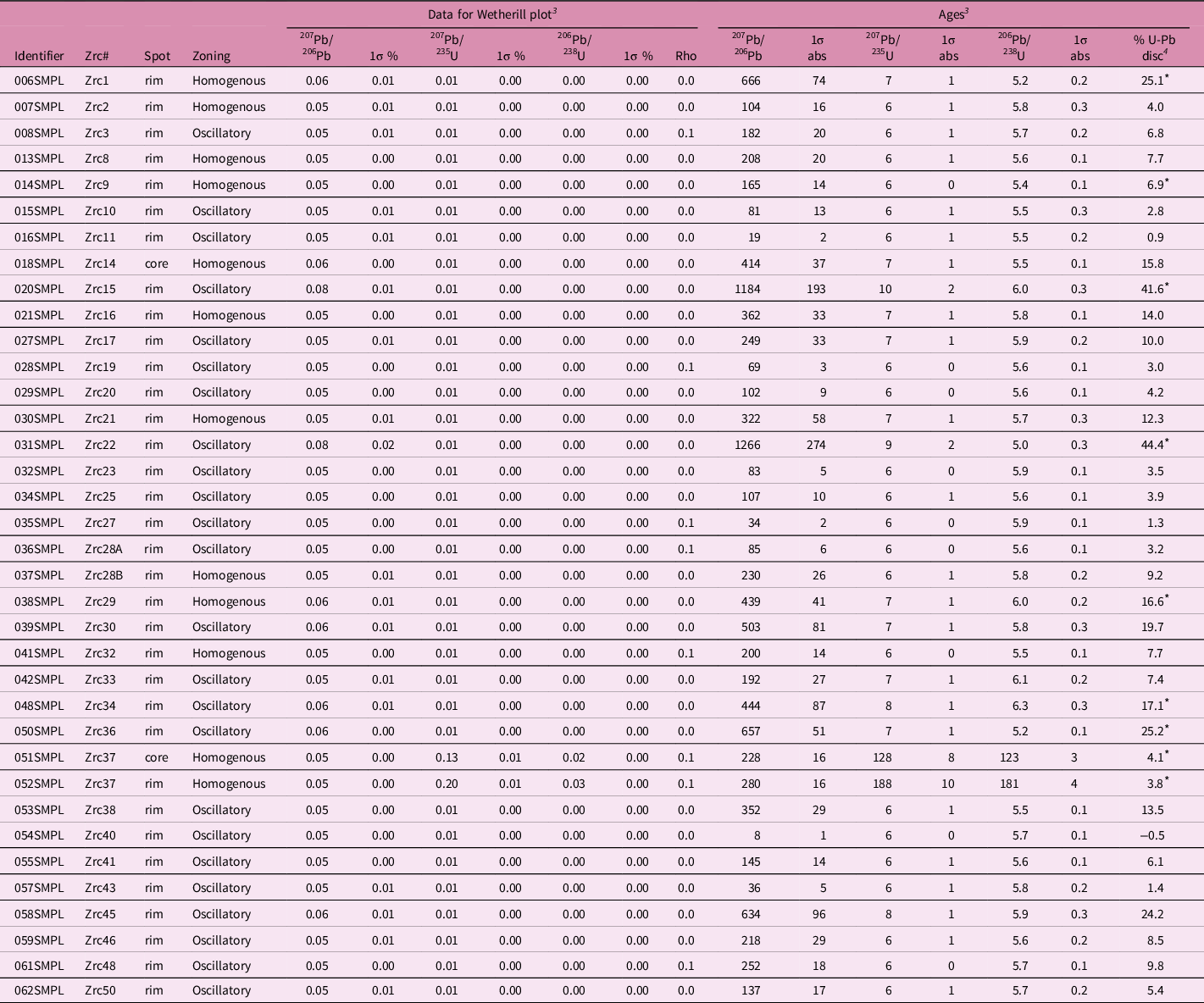
Zircon U–Pb ages were determined by LA-ICP-MS at CNR-IGG-UOS of Pavia, Italy. Zircons were separated by conventional methods (crushing, heavy liquids and handpicking) from one sample (GIG11). Prior to age determination, the internal structure of the zircon grains was investigated with backscattered electron (BSE) and cathodoluminescence (CL) images using a Philips XL30 electron microscope equipped with a Centaurus CL detector. Images were obtained using 15 kV acceleration and a working distance of 26 mm. Age determinations were made using a 193 nm ArF excimer laser microprobe (GeoLas200QMicrolas) coupled to a Triple Quadrupole (Agilent 8900). Analyses were carried out in single spot mode and with a spot size fixed at 25 μm. The laser was operated with a frequency of 5 Hz and with a fluence of 8 J/cm2. Sixty seconds of background signal and at least 30 s of ablation signal were acquired. The signals of 202Hg, 204(PbHg), 206Pb, 207Pb, 208Pb, 232Th and 238U were acquired. 235U is calculated from 238U based on the mean ratio 238U/235U of 137.818 (Hiess et al. 2012). Masses 202 and 204 were measured to monitor the presence of common Pb. Mass bias and laser-induced fractionation were corrected by analysis of the GJ-1 zircon standard (608.56 ± 0.4 Ma; Jackson et al. Reference Jackson, Pearson, Griffin and Belousova2004). The Plešovice zircon (Sláma et al. Reference Sláma, Košler, Condon, Crowley, Gerdes, Hanchar, Horstwood, Morris, Nasdala, Norberg, Schaltegger, Schoene, Tubrett and Whitehouse2008) was analysed together with unknowns for quality control. Data were reduced using the GLITTER software package (Van Achterbergh et al. Reference Van Achterbergh, Ryan, Jackson and Griffin2001). Time-resolved signals were carefully inspected to detect perturbation of the signal related to inclusions, cracks or mixed-age domains. Within the same analytical run, the error associated with the reproducibility of the external standards was propagated to each analysis of sample (see Horstwood et al. Reference Horstwood, Foster, Parrish, Noble and Nowell2003), and after this procedure, each age determination was retained as accurate within the quoted error. Ages were calculated using the function in the software package Isoplot/Ex 3.00 (Ludwig, Reference Ludwig2003). The discordance has been calculated as {[1−(206Pb/238U age/207Pb/235U age)] × 100}. Analytical errors are reported as 2σ. The IsoplotR software (Vermeesch, Reference Vermeesch2018) was used to draw diagrams of age data and to calculate the weighted average age. The 2σ error of the weighted average age has been calculated as the statistical average of the 2σ analytical error. U–Pb isotope data and calculated ages are reported in the data repository (Table 1).
LA-ICP-MS isotopic data of zircon from Giglio granite

* =not considered for the weighted average age calculation.
The (U-Th)/He dating of apatite was carried out at the Scottish Universities Environmental Research Centre (SUERC), United Kingdom. The analytical protocol follows Foeken et al. (Reference Foeken, Stuart, Dobson, Persano and Vilbert2006). Apatite crystals free from inclusions and cracks were selected using a high magnification (up to 500×) binocular polarising microscope. The grains with inclusions were easy to observe when the mineral is oriented in an extinction position. Zircon and monazite inclusions are typically very small and were located close to a few of the apatite crystal faces. All selected apatite grains were ≥80 μm radius with one or two terminations and a good crystal morphology. Two crystals with consistent diameter (to ensure equal diffusion and ejection characteristics) were put in a single Pt packet and crimped shut to prevent loss of crystals during heating. The Pt-foil packets were loaded directly into the sample planchet and mounted in the laser pan. Samples were heated for 120 seconds at approximately 600 ºC using a 5.8 W beam on a 500 µm circle spot size delivered by a fibre diode laser. This procedure is enough to degas the crystals without volatizing the U and Th. Evolved gases were purified using two liquid N2-cooled traps and 4He amount was determined using a Hidden HAL3F quadrupole mass spectrometer. Blank He amounts were determined by heating empty Pt-foil packets before each sample. All sample packets were re-heated to ensure that all 4He was extracted in the heat step. After the 4He analysis, the aliquots were retrieved from the pan. All samples were then spiked with approximately 0.05 g 230Th and 0.02 g 235U, and the volume was made up to 4 ml with 5% ultra-pure HNO3. The solutions were then equilibrated for 24 hours on a hot plate at 80 ºC before being transferred into a vial for U and Th measurement. U and Th analysis were carried out on a VG Plasma Quad PQ2 + ICP-MS. Fractionation was monitored using the U500 standard with a certified value of 235U/238U = 0.9997. A 5% HNO3 wash-out solution was used to purge the ICP-MS between sample solution analyses. Total amounts of U and Th were determined following the formula of Evans et al. (Reference Evans, Byrne, Keegan and Dotter2005), and final AHe ages were calculated using the noniterative formula of Meesters and Dunai (Reference Meesters and Dunai2005). Five aliquots of Durango apatite were analysed in each pan as an internal procedural standard. The average AHe age of these Durango apatite fragments (31.9 ± 2.3 Ma) is consistent and comparable to published age (31.0 ± 1.0 Ma; Boyce & Hodges, Reference Boyce and Hodges2005; McDowell et al. Reference McDowell, McIntosh and Farley2005).
4. Emplacement depth
The wall rocks of the Giglio granite crop out in a limited area along the northern coast close to the lighthouse of Punta Fenaio (Fig. 1b). In addition, Westerman et al. (Reference Westerman, Innocenti, Tonarini and Ferrara1993) reported the presence of rocks affected by contact metamorphism that they interpreted as roof pendants within the granite. The wall rocks consist of dark foliated metamorphic rocks derived from the Triassic pelitic and quartzitic sandstone of the Tuscan Domain (i.e. Verrucano Group, Lazzarotto et al. Reference Lazzarotto, Mazzanti and Mazzoncini1964). These metamorphic rocks are characterized by andalusite with quartz, K-feldspar, plagioclase, tourmaline, graphite, Fe-oxides and low content of micas ± cordierite. Andalusite is mostly prismatic chiastolite that may reach a centimetre in length. Zones affected by advanced pinitization reflect the former presence of cordierite. These rocks can be classified as andalusite-tourmaline paragneiss and are not suitable for constraining the pressure range at the time of granite emplacement.
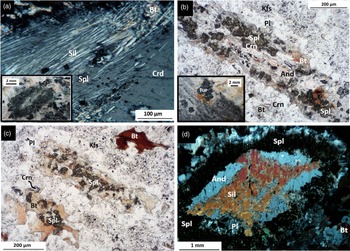
The granite of Giglio Island contains many xenoliths and xenocrysts mostly derived from the disaggregation of wall and roof rocks affected by contact metamorphism. This is particularly the case of the Arenella granite facies that contains isolated crystals of cordierite and miarolitic cavities with walls covered by quartz and tourmaline. The xenoliths are typically a few centimetres in size. They are characterized by the presence of andalusite and/or sillimanite, biotite, spinel, ilmenite, plagioclase, K-feldspar and cordierite. Ovoidal cordierite poikiloblasts with inclusions of biotite, green-brown spinel, fibrolite sheafs, ilmenite and minor blueish corundum (Fig. 2a). These characteristics are compatible with a metamorphic restitic or a magmatic peritectic genesis of cordierite (see Clarke, Reference Clarke1995). On the other hand, the presence of coarse-grained andalusite in wall rocks and roof pendants indicates that the andalusite-bearing xenoliths and xenocrysts are products of disaggregation of the wall rocks affected by contact metamorphism (Barrese et al. Reference Barrese, Della Ventura, Di Sabatino, Giampaolo and Di Lisa1987). One andalusite-bearing xenolith is migmatitic and has thin melanocratic layers alternated with leucocratic feldspar-rich layers (Fig. 2b) (Pattison & Harte, Reference Pattison and Harte1988). The melanocratic layers are largely composed of biotite and elongated spinel-bearing mineral aggregates that in some cases show the presence of colourless or pinkish andalusite in the core (Fig. 2b). Corundum and zoned tourmaline surrounded by a feldspar shell are also present. Biotite is frequently embayed and is strongly pleochroic (Fig. 2c) up to saturated red-brown tones corresponding to elevated Ti content (X Ti = 0.53, Table S1). The most remarkable feature is represented by the elongated mineral aggregates with a contour showing evidence of resorption. They host weakly pleochroic low-Ti biotite (X Ti = 0.01). In some cases, hercynitic spinel grains (X Hc = 0.82) host inclusions of corundum (Fig. 2b). The mineral aggregates are surrounded by plagioclase (X An = 0.38), which in turn is surrounded by cloudy K-feldspar grains. The overall microstructural features indicate that biotite and andalusite were involved as reactants in partial melting.
Micrographs of xenoliths and a xenocryst from the Giglio Island granite. Mineral abbreviations after Kretz (Reference Kretz1983). (a) Thin section micrograph of xenolith showing poikiloblastic cordierite hosting fibrolite sheafs (Sil) and biotite, spinel + ilmenite and corundum (crossed polarized light). The inset shows the ovoid shape of the xenolith. (b) Thin section micrograph of andalusite-bearing xenolith showing an elongated mineral aggregate made up of spinel, biotite, corundum and, in the core, pinkish andalusite (plane-polarized light). It is surrounded by plagioclase and K-feldspar. The inset shows the laminated structure of the xenolith marked by thin melanocratic levels alternated with leucocratic feldspars-rich levels. The presence of tourmaline with embayed margins can be also observed. (c) Thin section micrograph of spinel – biotite – rich mineral aggregates and an isolated biotite with evident embayed margins (plane-polarized light). Biotite in the aggregate shows pale pleochroism in comparison to the isolated embayed crystal, reflecting the contrast in the Ti content, higher in the latter. The elongated mineral aggregate in the centre of the image is surrounded by plagioclase and turbid K-feldspar. (d) Thin section micrograph of an andalusite xenocryst in basal section affected by partial replacement with sillimanite mostly along the chiastolitic cross (cross-polarized light). The xenocryst is armoured by spinel-rich corona with plagioclase, minor biotite and corundum.

Evidence of partial melting was also observed in columnar xenocrysts of andalusite up to 2.5 cm in length. They are characterized by partial sillimanite replacement (see also Cesare et al. Reference Cesare, Gómez-Pugnaire, Sánchez-Navas and Grobety2002) that, in basal section, occurred preferentially along the chiastolite cross (Fig. 2d). They are armoured by a spinel-rich (X Hc = 0.81) corona with plagioclase (X An = 0.36), minor biotite and corundum. Locally, a spinel-plagioclase symplectite is observed. Outside the spinel-rich armour, plagioclase, cordierite and then K-feldspar occur. These microstructures have been found in wall rocks close to the contact with the magma (e.g. Johnson et al. Reference Johnson, Aster and Kyle2004; Droop & Moazzen, Reference Droop and Moazzen2007; Saki, Reference Saki2010). Hence, the andalusite-bearing xenoliths and xenocrysts of the Giglio granite, after disaggregation from wall and roof rocks, underwent partial melting upon incorporation into the magma (Barrese et al. Reference Barrese, Della Ventura, Di Sabatino, Giampaolo and Di Lisa1987). Thus, they are useful for our purpose of defining the level of emplacement of the Giglio Island granite.
Several partial melting reactions in the K2O–FeO–MgO–Al2O3–SiO2–H2O (KFMASH) system relevant for quartz-absent assemblages have been reported for the wall rocks and xenoliths of an igneous complex (see Pattison & Harte, Reference Pattison and Harte1988). Among these, a biotite ± Al2SiO5 consuming reaction, compatible with our observations, is:
 $${\rm{Bt}} + {\rm{A}}{{\rm{l}}_{\rm{2}}}{\rm{Si}}{{\rm{O}}_{\rm{5}}} = {\rm{Spl}} + {\rm{Crn}} + {\rm{Kfs}} + {\rm{melt}}$$
Since plagioclase is involved, we consider equilibria in systems including Na2O and CaO as additional components. Thus, the first hercynite-forming reaction, R1, into NCKFASH system (Fig. 3), is:
 $${\rm{Ann}} + {\rm{And}} + {\rm{Pl}} = {\rm{Hc}} + {\rm{Kfs}} + {\rm{An}} + {\rm{Qtz}} + {{\rm{H}}_{\rm{2}}}{\rm{O}}$$
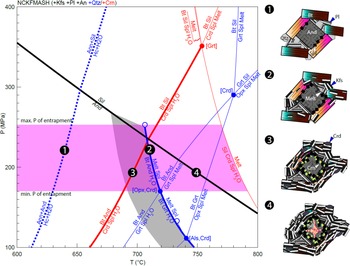
P–T grid calculated with THERMOCALC (Powell & Holland, Reference Powell and Holland1988), using the ds62 thermodynamic dataset (Holland & Powell, Reference Holland and Powell2011) and activity–composition models for metapelite-forming minerals (White et al., Reference White, Powell and Johnson2014); quartz, anorthite, corundum and H2O are assumed as pure endmembers. Reactions in blue are calculated for SiO2-saturated compositions; continuous blue lines are calculated in the NCKFMASH system while broken blue lines are calculated in the NCKFASH system. Reactions in red are calculated for SiO2-undersaturated compositions. The thick reactions in blue and red (i.e. R1, R2, R3, R4) are those recorded in the andalusite-bearing xenoliths and xenocrysts. The grey area highlights the effect of boron on the wet solidus (modified after Spicer et al. Reference Spicer, Stevens and Buick2004). The magenta-filled field highlights the P conditions of entrapment and the maximum-T conditions reached, limited by the wet solidus in corundum-saturated system. On the right side, frames 1–4 are cartoons representing the evolution of the observed microstructures related to reactions R1–R4. Mineral abbreviations after Kretz (Reference Kretz1983).

At higher temperature, for SiO2-saturated compositions in the NCKFMASH system, the wet solidus reaction curve, R2, is encountered:
 $${\rm{Bt}} + {\rm{And}} + {\rm{Qtz}} + {\rm{Pl}} + {\rm{Kfs}} + {{\rm{H}}_{\rm{2}}}{\rm{O}} = {\rm{An}} + {\rm{Spl}} + {\rm{melt}}$$
Reaction R2 degenerates in the NCKFASH system (Fig. 3) at high-P, in the sillimanite stability field, with the degenerate point representing the maximum-P for the entrapment of the xenolith. The position of the wet solidus is sensitive to the presence of boron in the fluid phase (e.g. Pichavant, Reference Pichavant1981). Embayed margins of tourmaline imply that it has been consumed with the consequent release of boron. The effect on the solidus is shown in Fig. 3 (modified from Fig. 1 in Spicer et al. Reference Spicer, Stevens and Buick2004).
In this case, as partial melting proceeds, quartz may be consumed, and the system becomes SiO2-undersaturated. When this happens, melting stops and corundum forms together with K-feldspar, anorthite, spinel and fluid. Consequently, the system becomes corundum-saturated and andalusite is continuously consumed up to reaching reaction R3:
 $${\rm{Bt}} + {\rm{And}} + {\rm{Pl}} = {\rm{Crd}} + {\rm{Spl}} + {\rm{Crn}} + {\rm{Kfs}} + {\rm{An}} + {{\rm{H}}_{\rm{2}}}{\rm{O}}$$
If the position of the wet solidus is poorly affected by boron in the P–T space and R2 occurs at the highest-T, partial melting in the andalusite field will likely take place at higher T than R3 (Fig. 3). Once quartz is consumed in R2 and the system becomes SiO2-undersaturated, biotite and andalusite would be rapidly consumed, since R3 would be largely overstepped. Irrespective of R2 being crossed at lower T or at higher T than R3, the occurrence of R3 is confirmed by the presence of cordierite together with feldspars around the andalusite xenocryst. A further temperature increase may produce the andalusite to sillimanite transition, R4. The presence of both Al2SiO5 phases observed in the xenocryst is evidence of the sluggish reaction kinetics with andalusite surviving in a metastable state in the field of sillimanite (e.g. Droop & Moazzen, Reference Droop and Moazzen2007).
Considering the P–T grid (Fig. 3) and the sequence of reactions, the andalusite-bearing xenoliths and xenocrysts were incorporated into the granitic magma at between 170 and 250 MPa, the lowest pressure defined by where the wet solidus intersects the garnet-forming reactions.
5. Timing of emplacement and exhumation
5.1. U–Pb geochronology
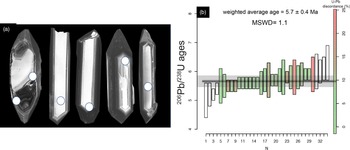
Zircon grains are generally elongated (mean aspect ratio = 3.47). These grains typically have a large homogeneous core and rims/tips with oscillatory zoning (Fig. 4a). We have undertaken forty-seven U-Pb analyses on forty-five different grains. Spot analyses were positioned at the rims with oscillatory zoning and at the cores of some grains. Eleven analyses were discarded as the isotopic signal was severely influenced by apatite inclusions. Except for one grain, which yielded two old dates (early Jurassic and early Cretaceous), all analyses (n = 35 from 34 zircon grains) provided 206Pb/238U ages in the range of 5.0–6.3 Ma (Table 1). The main data population (26 data out of 34) provides a weighted average age of 5.7 ± 0.4 Ma (Fig. 4b). This population corresponds to the central distribution of the data and has been obtained by discarding a few older (four) and younger (four) data interpreted as potential xenocrysts or grains affected by late perturbating events.
(a) BSE-CL images of zircon grains from granite representative of different CL features. Location of LA-ICP-MS spots is shown and corresponds to 25 μm diameter. (b) 206Pb/238U zircon data for GIG15 and GIG11 samples. U-Pb data are ordered and shown as vertical bars comprising two sigma errors. The coloured bars were used for calculation of weighted average age (grey horizontal bar). The colour of the bars is related to the percentage of discordance according to right vertical axis scale.

5.2. Apatite (U–Th)/He thermochronology
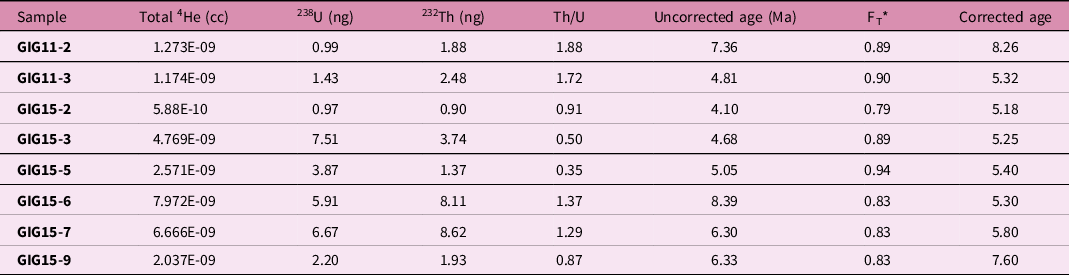
Apatite (U–Th)/He (AHe) analyses were performed on samples from the Giglio granite. Ages, corrected for recoil using Farley (Reference Farley2002), are reported in Table 2. Two aliquots yielded erroneously old ages, which could have resulted from unrecognized inclusions, 4He implantation or U-Th zonation (Farley, Reference Farley2002; Dobson et al. Reference Dobson, Stuart and Dempster2010). They are not geologically meaningful and were not used in the cooling age calculation. Aliquot AHe ages range from 5.18 to 5.80 Ma. The average age of all aliquots is 5.38 ± 0.2 Ma. This partially overlaps the emplacement age attesting to the rapid exhumation of the pluton.
(U + Th)/He data of apatite from Giglio granite

5.3. Exhumation history
To constrain the exhumation history of the Giglio Island granite, we consider the U–Pb, (U–Th)/He ages and the emplacement depth. Thus, we have two ages in the exhumation history needing to be related to distinct crustal levels. Ideally, the zircon U–Pb age of 5.7 ± 0.4 Ma represents the time when the magma was emplaced at the constrained crustal pressure of 250–170 MPa. On the other hand, the (U–Th)/He age of 5.38 ± 0.2 Ma represents the time of cooling below established closure temperature in response to exhumation (e.g. Spencer et al. Reference Spencer, Danišík, Ito, Hoiland, Tapster, Jeon and Evans2019). To estimate the closure temperature, we followed Reiners (Reference Reiners2005). On the basis of the average dimension of apatite crystals (c. 130 µm) and the cooling rate of the granite in approaching the surface (>50 °C/Myr), a closure temperature of c. 80 °C was assumed. To convert this temperature to depth, an understanding of the geothermal gradient at the time is required. Even before the ascent and emplacement of the Giglio granite, the region must have been characterized by a high thermal gradient, precursor of pluton emplacement and result of the lithospheric thinning that affected the northern Tyrrhenian domain. After the emplacement of the granitic magma, this high thermal gradient is further elevated. For example, in the Larderello area, which is underlain by a cooling granitic body, the regional surface heat flow is currently in the order of 200 mW/m2 (e.g. Batini et al. Reference Batini, Brogi, Lazzarotto, Liotta and Pandeli2003; Bellani et al. Reference Bellani, Brogi, Lazzarotto, Liotta and Ranalli2004), in zones mostly affected by conductive heat transport. On this basis, fixing thermal conductivity at 2.5 W m−1K−1, we obtain a thermal gradient of c. 80 °C/km. Consequently, during the exhumation of the Giglio granite, we speculate that the 80 °C isotherm was located at c. 1 km below the surface. Conservatively, we have fixed the depth of emplacement to the minimum value of 6.4 km, corresponding to a pressure of 170 MPa. Thus, the minimum amount of exhumation is estimated to be 5.4 km. Considering the exhumation took up to 0.9 Myr (the maximum difference of the zircon U-Pb and apatite (U-Th)/He ages allowed by the uncertainties), the minimum estimate of the average exhumation rate is 6 mm/year up to 1 km below the surface.
6. Discussion
The level of emplacement of the Giglio Island granite as reported in the literature was based on melt composition in the wet granitic system (Westerman et al. Reference Westerman, Innocenti, Tonarini and Ferrara1993). In this way, a minimum crystallization pressure of 400 MPa, corresponding to a depth of c. 15 km, was obtained. This is deeper than the estimates of all the other Neogene granites of the TMP, not exceeding 8 km (Acocella & Rossetti, Reference Acocella and Rossetti2002). Nevertheless, the occurrence of miarolitic cavities, which we recognized in the Arenella facies, supports a shallower level of emplacement of the Giglio Island granite (Candela, Reference Candela1997). This is consistent with the presence of roof pendants and of locally abundant xenoliths derived from the disaggregation of the wall and roof rocks, still indicative of shallow magma intrusion (Clarke, Reference Clarke1992; Philpotts & Ague, Reference Philpotts and Ague2022). The sequence of reactions we detailed in the present study (Fig. 3), related to the microstructures observed in the xenoliths and xenocrysts (Fig. 2), indicates a pressure range of ∼170–250 MPa, corresponding to a depth interval of ∼6.4–9.4 km (for average crustal density of 2.7 g/cm3). Considering that the xenoliths and xenocrysts may be incorporated into the magma even before reaching the final emplacement site, the pluton of the Giglio Island may not be as different as the other granites of the TMP in relation to its original depth of 6.4 km.
The new U-Pb emplacement age of the Giglio Island granite (5.7 ± 0.4 Ma) is significantly older than previous determinations (4.88 ± 0.07 to 5.1 ± 0.15 Ma; Ferrara & Tonarini, Reference Ferrara and Tonarini1985; Westerman et al. Reference Westerman, Innocenti, Tonarini and Ferrara1993). The emplacement occurred in the late Messinian, not during Pliocene (Cohen et al. Reference Cohen, Finney, Gibbard and Fan2013). This was after the Monte Capanne and Porto Azzurro granites (7.3 ± 0.2 Ma and 6.4 ± 0.4 Ma, respectively; Barboni et al. Reference Barboni, Annen and Schoene2015, Spiess et al. Reference Spiess, Langone, Caggianelli, Stuart, Zucchi, Bianco and Liotta2021), almost coevally with the Campiglia granite (5.409 ± 0.043 in Di Vincenzo et al. Reference Di Vincenzo, Vezzoni, Dini and Rocchi2022) and before the Gavorrano granite (4.9 ± 0.2 Ma; Ferrara & Tonarini, Reference Ferrara and Tonarini1985). From the regional perspective, this is in line with the migration of magmatic activity to the E–NE with time (see Fig. 1a). Granite emplacement is believed to be controlled by NE-oriented regional transfer zones, whose activity is coeval with the eastward crustal stretching since Miocene (Dini et al. Reference Dini, Westerman, Innocenti and Rocchi2008).
The Neogene-Quaternary extensional setting of inner Northern Apennines and Tyrrhenian Sea (e.g. Carmignani et al. Reference Carmignani, Decandia, Disperati, Fantozzi, Lazzarotto, Liotta and Meccheri1994; Daniel & Jolivet, Reference Daniel and Jolivet1995; Brunet et al. Reference Brunet, Monié, Jolivet and Cadet2000; Dini et al. Reference Dini, Innocenti, Rocchi, Tonarini and Westerman2002; Barchi, Reference Barchi, Beltrando, Peccerillo, Mattei, Conticelli and Carlo2010; Rossetti et al. Reference Rossetti, Glodny, Theye and Maggi2015; Jolivet et al. Reference Jolivet, Arbaret, Le Pourthiet, Cheval-Garabedian, Roche, Rabillard and Labrousse2021) was challenged by Finetti et al. (Reference Finetti, Boccaletti, Bonini, Del Ben, Geletti, Pipan and Sani2001 with references therein) who envisaged a Miocene-Pliocene continuous compressional evolution up to the Pleistocene. Modest differences in the regional stress field through time were introduced by Bonini & Sani (Reference Bonini and Sani2002) who suggested that the predominant compression was punctuated by short-lived extensional periods in the last 9 Myr. Later, Bonini et al. (Reference Bonini, Sani, Stucchi, Moratti, Benvenuti, Menanno and Tanini2014) proposed that, after the Oligocene-early Miocene collisional stage, a significant Miocene extensional phase took place, thinning the crust and lithosphere. However, in the Bonini et al.’s hypothesis, shortening was again active between 7.5 and 3.5 Ma, when magmatism took place. In this perspective, the development of thrusts would have caused the emplacement and exhumation of the Neogene granitoids of Tuscany (Musumeci et al. Reference Musumeci, Mazzarini and Barsella2008; Musumeci & Vaselli, Reference Musumeci and Vaselli2012; Musumeci et al. Reference Musumeci, Mazzarini and Cruden2015; Sani et al. Reference Sani, Bonini, Montanari, Moratti, Corti and Ventisette2016; Viola et al. Reference Viola, Torgersen, Mazzarini, Musumeci, van der Lelij, Schönenberger and Garofalo2018; Ryan et al. Reference Ryan, Papeschi, Viola, Musumeci, Mazzarini, Torgersen, Sørensen and Ganerød2021; Papeschi et al. Reference Papeschi, Vannucchi, Hirose and Okazaki2022). In addition, Sani et al. (Reference Sani, Bonini, Montanari, Moratti, Corti and Ventisette2016) and Montanari et al. (Reference Montanari, Minissale, Doveri, Gola, Trumpy, Santilano and Manzella2017) proposed a slightly different scenario where extension, alternated with local compressional events, would have been active during the Pleistocene. Considering the depth of granite emplacement, the compressional deformation would have implied doubling of the crust. However, it is noteworthy that no indication of crustal thickening or high-pressure metamorphic conditions in the granite evolution time range (Messinian-Pliocene) has been recognized, throughout the inner Northern Apennines, from Corsica to Tuscany (Brunet et al. Reference Brunet, Monié, Jolivet and Cadet2000; Molli, Reference Molli2008; Bianco et al. Reference Bianco, Brogi, Caggianelli, Giorgetti, Liotta and Meccheri2015; Rossetti et al. Reference Rossetti, Glodny, Theye and Maggi2015). More reasons why extensional tectonics better explains the Neogene geological evolution are given in Brogi et al. (2005), Brogi (Reference Brogi2008), Brogi and Liotta (Reference Brogi and Liotta2008), and Spiess et al. (Reference Spiess, Langone, Caggianelli, Stuart, Zucchi, Bianco and Liotta2021).
The new (U-Th)/He age suggests that the exhumation of the Giglio granite was essentially complete before the start of the Pliocene.
The minimum estimate of the average exhumation rate of 6 mm/year is significantly higher than the value (3.4 – 3.9 mm/year) reported by Spiess et al. (Reference Spiess, Langone, Caggianelli, Stuart, Zucchi, Bianco and Liotta2021) for the Porto Azzurro granite of eastern Elba. Even higher exhumation rates have been reported for young granitoids, although in a different geodynamic setting by Spencer et al. (Reference Spencer, Danišík, Ito, Hoiland, Tapster, Jeon and Evans2019). Depending on their assumption of geothermal gradient, they estimated exhumation rates spanning from 5 mm to 40 mm/year.
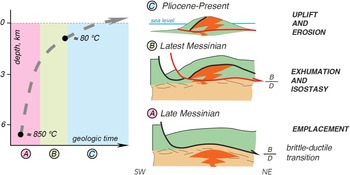
Similar to the setting of the Elba Island, the exhumation of the Giglio Island pluton was favoured by unroofing operated by low-angle extensional detachments (Keller & Pialli, Reference Keller and Pialli1990; Smith et al. Reference Smith, Holdsworth and Collettini2011; Spiess et al. Reference Spiess, Langone, Caggianelli, Stuart, Zucchi, Bianco and Liotta2021), related to the development of the Tyrrhenian Basin (Bartole, Reference Bartole1995; Jolivet et al. Reference Jolivet, Faccenna, Goffé, Mattei, Rossetti, Brunet and Parra1998; Rossetti et al. Reference Rossetti, Faccenna, Jolivet, Funiciello, Tecce and Brunet1999). At Elba, Porto Azzurro and Monte Capanne plutons were emplaced along regional transfer zones (Dini et al. Reference Dini, Westerman, Innocenti and Rocchi2008), up to 6–7 km wide, that separated crustal volumes with different amounts of extension and related vertical movements, coeval with the unroofing low-angle detachments (Smith et al. Reference Smith, Holdsworth and Collettini2011; Liotta et al. Reference Liotta, Brogi, Meccheri, Dini, Bianco and Ruggieri2015). A similar scenario has also been documented for the Gavorrano pluton (Brogi et al. Reference Brogi, Caggianelli, Liotta, Zucchi, Spina, Capezzuoli and Buracchi2021), inland of southern Tuscany, suggesting that the TMP plutons were subjected to a common mechanism, which controlled the fast uplift of extending crust and the progressive exhumation of the magmatic bodies (Spiess et al. Reference Spiess, Langone, Caggianelli, Stuart, Zucchi, Bianco and Liotta2021, Reference Spiess, Langone, Caggianelli, Stuart, Zucchi, Bianco and Liotta2022). We can speculate that also the Giglio Island pluton after its emplacement along a transfer zone, with its inland continuation in southern Tuscany (i.e. the Albegna tectonic lineament, Fig. 1a), was rapidly unroofed by low-angle normal faulting (Rossetti et al. Reference Rossetti, Faccenna, Jolivet, Funiciello, Tecce and Brunet1999). This was accompanied by vertical movements favoured by the crustal thermal softening consequent to the upward migration of the regional brittle-ductile transition after magma emplacement, simulated by thermo-rheological modelling for the Elba Island granites (Caggianelli et al. Reference Caggianelli, Ranalli, Lavecchia, Liotta, Dini, Llan-Fúnez, Marcos and Bastida2014; Liotta et al. Reference Liotta, Brogi, Meccheri, Dini, Bianco and Ruggieri2015; Spiess et al. Reference Spiess, Langone, Caggianelli, Stuart, Zucchi, Bianco and Liotta2021). A possible scenario for the exhumation of the Giglio granite is illustrated by the schematic diagram of Fig. 5.
Conceptual sketch of the Giglio Island granite evolution through time. To the left, a possible exhumation path of the granite, according to an exponential law, in line with models set up for the Monte Capanne and Porto Azzurro granites at the Elba Island (Caggianelli et al. Reference Caggianelli, Ranalli, Lavecchia, Liotta, Dini, Llan-Fúnez, Marcos and Bastida2014; Spiess et al. Reference Spiess, Langone, Caggianelli, Stuart, Zucchi, Bianco and Liotta2021). Temperatures of 850 °C and 80 °C are related, respectively, to the emplacement level of the granitic magma and to a depth of c. 1 km, when the closure temperature for AHe is reached. To the right, cartoons illustrating the role of extension and isostasy in determining the exhumation and uplift of the pluton within the transfer zone that favoured magma ascent. The brittle-ductile transition is also qualitatively indicated and is convex upward as an effect of the thermal perturbation produced by the emplacement of the granitic magma (a) in a geodynamic setting affected by crustal stretching since early-middle Miocene. Progressive deformation developed through new normal faults, cross-cutting the previously formed structures and soling out into the brittle-ductile transition, once magma cooling occurred (b). A rapid exhumation resulted in the exposure of the granite during Pliocene (c).

Finally, the studies on the sedimentary evolution of the Tyrrhenian Basin indicate syn-rift sedimentation during Miocene-early Pliocene (11–3.6 Ma) and post-rift sedimentation from late Pliocene to present (Bartole, Reference Bartole1995). Early Pliocene deposits filling up the Formiche Basin to the north of Giglio Island (Pascucci et al. Reference Pascucci, Merlini and Martini1999) onlap the substrate units hosting the granite. This accounts for a limited contribution of erosion to the final stage of exhumation, while the bulk of exhumation occurred earlier, by effects of crustal thermal softening and reduction of the crust thickness by normal fault activity.
7. Concluding remarks
We draw the following conclusions from this work:
-
a. Xenoliths and xenocrysts of the Giglio granite are derived from the disaggregation of wall and roof rocks affected by contact metamorphism and characterized by the presence of andalusite ± sillimanite together with biotite, spinel, ilmenite, plagioclase, K-feldspar and cordierite.
-
b. The reconstructed reaction sequence that affected the xenoliths and xenocrysts after their incorporation into the magma allowed to constrain pressure in the range of 170 – 250 MPa, corresponding to a minimum emplacement depth of c. 6.4 km for the Giglio Island granite. Thus, in terms of the level of emplacement, it may not be significantly different from the other granites of the TMP.
-
c. The new zircon U-Pb age of the Giglio Island granite is 5.7 ± 0.4 Ma, and its emplacement can now be attributed to the latest Messinian.
-
d. The AHe cooling age of 5.3 ± 0.2 Ma implies a rapid exhumation with an average rate of 6 mm/year at minimum.
-
e. The fast exhumation of the Giglio pluton resulted from the interplay between the exhumation induced by the extending crust, operated by low-angle normal faults and the crustal thermal softening determined by the cooling magma.
Supplementary material
The supplementary material for this article can be found at https://doi.org/10.1017/S0016756823000420.
Acknowledgements
This study was conducted in the frame of Chinedu Uduma Ibe’s PhD, supported by the University of Bari, Aldo Moro, Italy. We thank Luigia Di Nicola, Stefania Corvo and Matthia Bonazi for providing invaluable assistance in the laboratories. We acknowledge the editorial work of O. Lacombe and the constructive comments we received from an anonymous referee and R. Lanari.
Competing interests
The authors declare no known competing interests.