Power, Intimacy, and Submission in Hollywood Tap
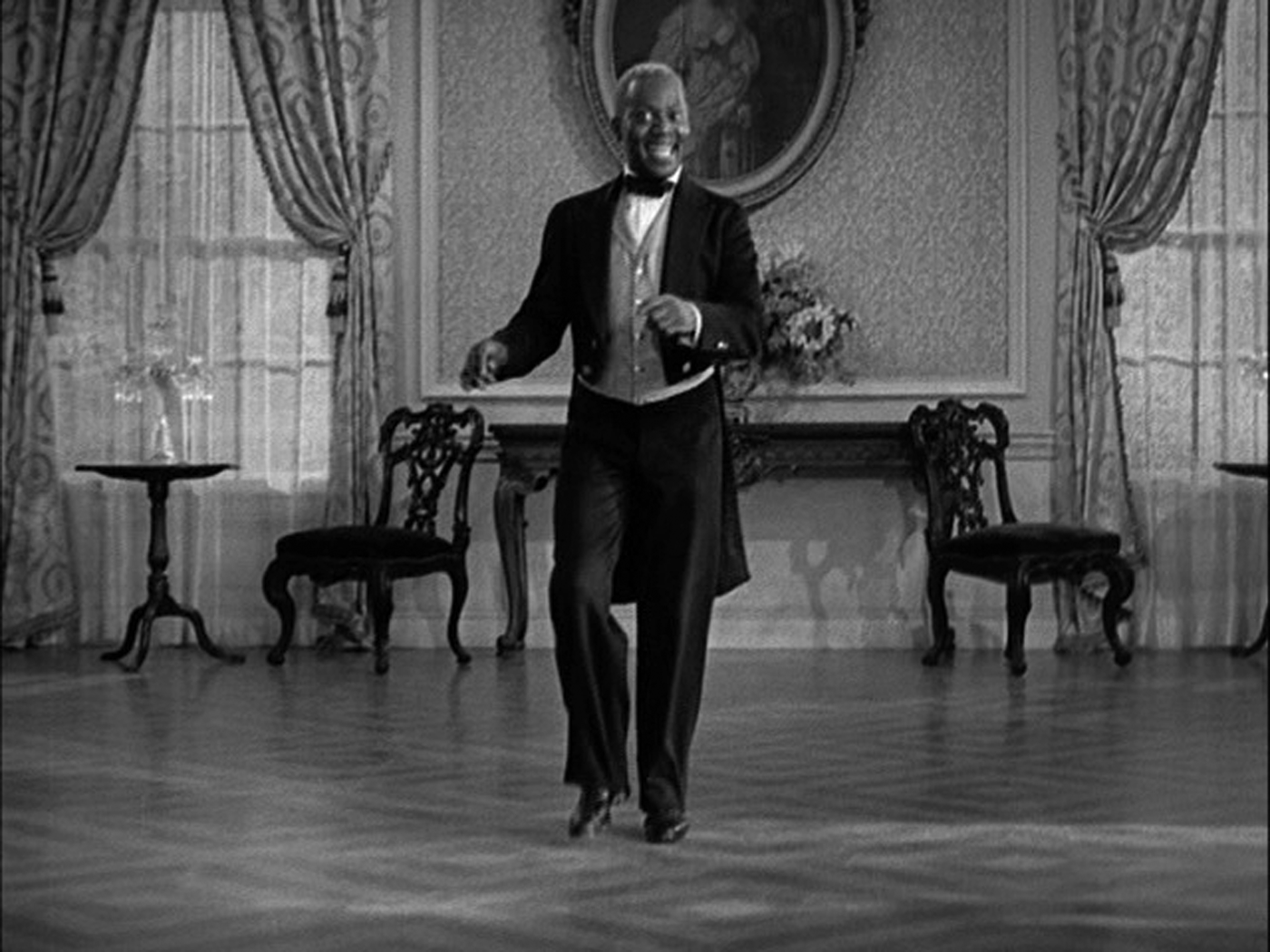
Tap dance movies flourished rapidly in the 1930s and, by 1935, Hollywood's production of feature-length tap films doubled in comparison to the preceding years (Photo 1). The industry eagerly promoted new tap stars and developed cinematic techniques to feature them, as tap dance musicals proved to be some of the biggest box office draws of the year.Footnote 1 In 1935, several feature films catapulted Bill “Bojangles” Robinson to movie stardom, and the press hailed Eleanor Powell as the “greatest female tap dancer” for her screen debut (Schultz Reference Schultz1994, 9). Two of their works, Robinson's The Littlest Rebel and Powell's Broadway Melody of 1936 (both of which opened at the end of 1935), utilize a cinematic formula that features the virtuosic footwork of the tap artists in sequences that are intercut with giant close-ups of toothy grins. The experience for contemporary spectators can be unnerving, as magnified lips, teeth, and eyes dominate the screen and interrupt the pleasure of watching expert tap. By the mid-1930s, just a few years after the advent of sound motion pictures, Hollywood had perfected the lucrative genre of tap dance musicals. The industry used close-up shots of the smile to repackage tap dance for the big screen, as cinematic techniques also constructed narratives of race and gender.
Bill Robinson. Video still from The Littlest Rebel. Directed by David Butler. Twentieth Century Fox, 1935. Beverly Hills, CA: Twentieth Century Fox Home Entertainment, 2005.

In this article about tap and teeth, I examine the interplay between virtuosic footwork and close-up shots of the smile to reveal how tap artistry intersects with Hollywood's construction of racial and gender stereotypes. At first glance, Robinson and Powell share few similarities aside from their reputations as skilled foot technicians, charming performers, and relentless perfectionists. Yet, despite obvious differences of gender, race, age, and their dissimilar career backgrounds, dance styles, movie studios, and plot lines (Broadway Melody of 1936 is a back-stage musical, and The Littlest Rebel is a Civil War plantation drama), movie-makers filmed Robinson and Powell in a similar manner in these dance sequences. Tap dance, without a doubt, is noted for smiling performers. Tap dancer Honi Coles remarked of Robinson that “Bo's face was about forty percent of his appeal” (quoted in Stearns and Stearns Reference Stearns and Stearns1979, 188), and one of MGM's first moves to prepare Powell for her film career was to fix her teeth (Thomas Reference Thomas1935). The smiling or non-smiling moment signals a complex negotiation between the dancer's agency and the demands of the director and production, and can express a multitude of meanings and emotions. I address only one type of shot utilized by filmmakers: the close-up of the smiling dancer's face in the midst of his or her tap routine.
The editing technique of intercutting close-up shots of smiling teeth with full-body shots of tap dancing creates multilayered narratives of power, intimacy, and submission. Robinson's and Powell's power as performers is established in the opening moments of their solos. In the birthday party scene of The Littlest Rebel, Robinson steps forward with confidence; in the “Broadway Rhythm” sequence of Broadway Melody of 1936, Powell boldly sprints onstage to an orchestral fanfare. Both artists elegantly command their performance spaces and focus the attention of their staged audience, telling us—the live viewers—that they are worthy of admiration.Footnote 2 Close-up shots of their faces in the opening moments of their dance solos direct spectators to see Robinson and Powell as powerful and important stars. The connection between live fan and filmed star becomes even more intimate, as he or she looks directly into the camera and appears to gaze into our eyes. In the moment our eyes meet through their direct address, all other spectators fall away, and the dancer's smile and performance seem to be for the individual viewer, alone. Yet these close-up shots also evoke themes of submission. Robinson's close-up can be read as a depiction of racial subservience, as audiences are confronted with the smiling minstrel mask and the perpetuation of the legacy of minstrelsy in Hollywood. Powell's smile in close-up emphasizes her feminine sexual availability and evokes the voyeuristic camera shots of beaming, passive chorus girls made famous by 1930s movies.
My research focuses on the ways these very similar shots and edits in Robinson's and Powell's films contribute to divergent constructions of black masculinity, white femininity, and sexuality. The two extremes of the tap dancer's body, the smile and the feet, offer an opportunity to look at these intersections of meaning within tap dance artistry and tap history. In an analysis of their solos in The Littlest Rebel and Broadway Melody of 1936, I explore how Robinson and Powell use their faces, feet, and bodies. I refer to film scholar Jane Feuer's (Reference Feuer1993) writing to discuss the relationship between the choreography of the camera and spectatorship in these films, and I consider debates over race and gender in tap that have centered around the two artists. In my analysis of tap and teeth in Bill Robinson's film footage, I examine the minstrel mask and tap's roots in minstrelsy. I draw on Anna Everett's (Reference Everett2001) study of African-American film criticism and the works of Donald Bogle (Reference Bogle1988, Reference Bogle2001), Marlon Riggs (Reference Riggs2004), and Eric Lott (Reference Lott1993) to look at Robinson's career-long subversion and negotiation of minstrel stereotypes and the complex position he held, and continues to hold, for his public. My analysis of Powell's tap and teeth employs feminist and queer film theory, particularly works by Adrienne McLean (Reference McLean and Griffin2009) and Steven Cohan (Reference Cohan2005, Reference Cohan and Cohan2010). The trope of the camera's male gaze upon a “passive” female body is brought into question by Powell's “active” film performance. In turn, Hollywood's eagerness to promote Powell as a star calls into question the oft-repeated idea that tap dance virtuosity, by definition, is masculine.
I conclude with a consideration of how constructions of race, gender, and sexuality in Hollywood musicals have influenced the filmed archive of tap. The film industry “minstrelized” the dancing black man and reinforced tropes of white, heterosexual femininity to capitalize on Robinson's and Powell's tap virtuosity. Hollywood's commercial machine determined who was selected and how they were represented, leaving audiences with a highly mediated and biased film archive that informs contemporary perceptions of tap.
Robinson, Powell, and the Choreography of the Camera
Eleanor Powell noted that Fred Astaire was indirectly responsible for her MGM contract, “since the studio wanted a female counterpart whose style was similar to the RKO star” (Schultz Reference Schultz1994, 12). Indeed, in 1935, each major studio pitted its own tap soloist or duo in competition against the others. MGM had Powell; Twentieth Century Fox had the team of Robinson and Shirley Temple, and soloist Dixie Dunbar; Warner Brothers had Ruby Keeler; United Artists had the Nicholas Brothers; and RKO had Astaire and Ginger Rogers, and the duo of Robinson and Jeni LeGon (Stearns and Stearns Reference Stearns and Stearns1979, 400–1).
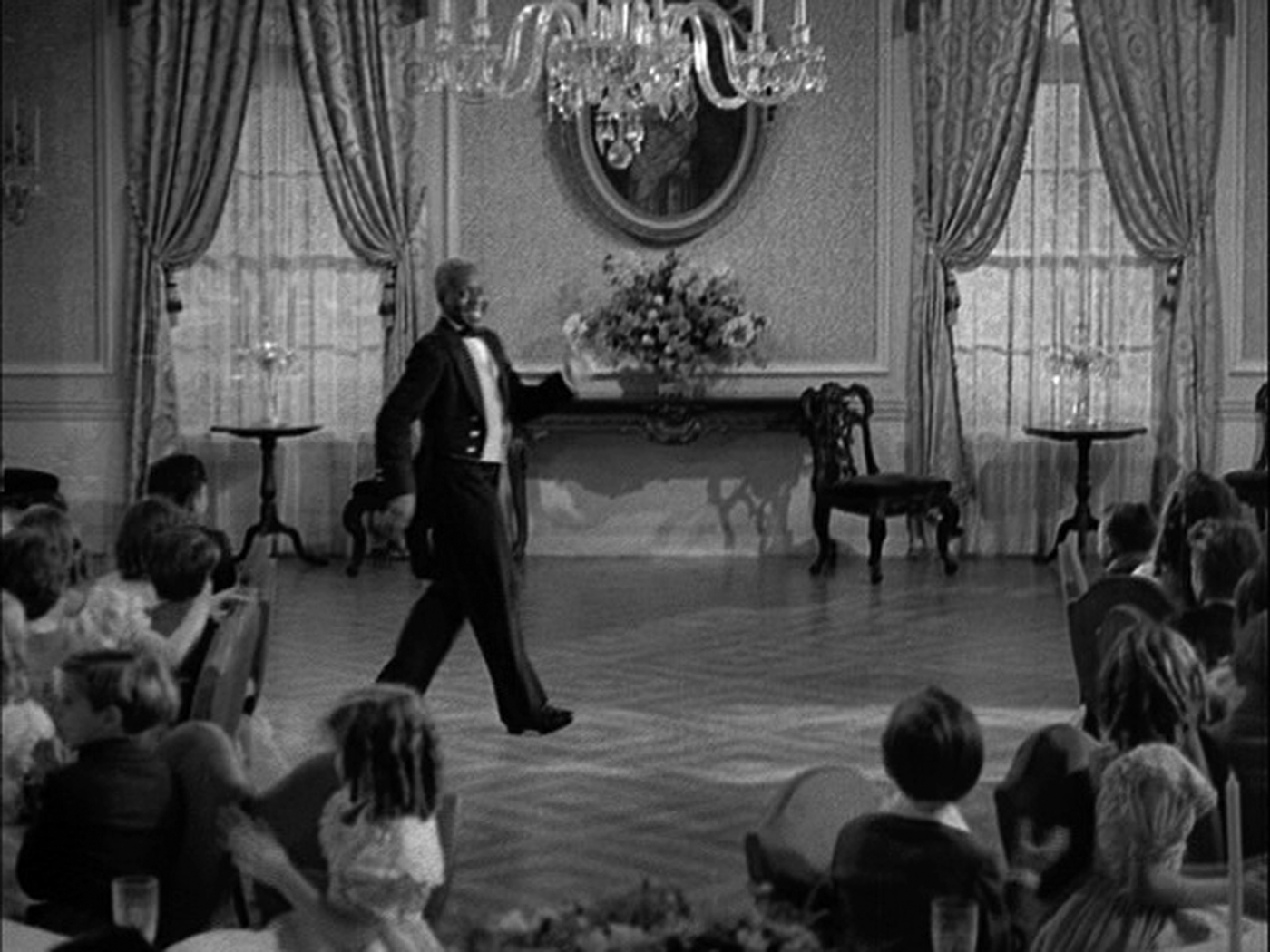
Before they arrived in Hollywood, Robinson was already a star, and Powell a rising name, on Broadway and white vaudeville. The motion picture industry pulled talented artists from theater and strove to capture on celluloid the intimacy and excitement of stage entertainment for audiences who were accustomed to seeing live tap dancing along with movies. Even until the mid-1930s, many venues across America still featured line-ups that included both vaudeville acts and films. Film scholar Jane Feuer notes that movie-makers used camera shots and editing to recreate the fiction of a “direct and spontaneous performance” (Reference Feuer1993, 2) and foster a “sense of participation in the creation of the entertainment” (30) for audiences who expected to interact with live performers through applause, laughter, and commentary. The screen distances the film audience in time and space from the recorded performer. The movie musical therefore attempted to bridge the gap by creating a community within the film and placing the spectator within that group (2–3). As Feuer suggests, “In order to get a direct response from the ‘live’ audience, Hollywood musical-makers had to place in their path another, spectral audience” (26). Both Robinson's and Powell's dances open with shots “over the backs” of the filmed audience to give the spectator the “illusion of sitting adjacent to the internal audience” (28) (Photo 2). In shot transitions to closer views, the staged audience of extras is no longer visible, and live spectators can feel a sense of immediacy as they replace the internal audience. The choreography of the camera cuts to closer shots of the dancer and recreates the intensity of live performance and an increased impression of intimacy as Robinson and Powell look us in the eye and “the performance can truly be ‘all for us’” (28). I propose that the themes of submission in these two sequences, depicted in Robinson's minstrel mask and Powell's showgirl smile, additionally reinforce the viewer's sense of intimacy, participation, and even community.
Bill Robinson strides onto the dance floor to perform for his staged and live audiences. Video still from The Littlest Rebel. Directed by David Butler. Twentieth Century Fox, 1935. Beverly Hills, CA: Twentieth Century Fox Home Entertainment, 2005.
Bill Robinson in The Littlest Rebel
The Littlest Rebel opens with an idyllic representation of a Southern plantation, and the camera angles and editing of Bill Robinson's solo give the live audience the illusion of sitting in the midst of an opulent children's birthday party (Butler Reference Butler1935). Shirley Temple plays the gracious, six-year-old hostess, Virgie, who entreats her beloved slave, Uncle Billy (Bill Robinson), to entertain her guests (the diegetic audience). As Robinson takes the floor, the wide-angle shot shows the backs of the heads of Virgie's friends, and places us, the live audience, within the group of children who eagerly clap for the entertainment to begin. The edit cuts to a closer, full-body shot as Robinson opens with eight bars of time-steps, dancing the repetitive and swinging iambic tetrameter of “and THANK you FOR the BUG-gy RIDE” (Stearns and Stearns Reference Stearns and Stearns1979, 177), accompanied by actor Willie Best playing “Turkey in the Straw” on harmonica. Best and Robinson portray two of the stock characters from minstrelsy (Bogle Reference Bogle2001, 51). Best's slumping posture and slow confusion indicate the dim-witted “Sambo,” and provide a distinct contrast to Robinson's upright body carriage and confident joie de vivre in the role of the devoted and trustworthy “Uncle Tom.” Even Robinson's exact time steps, the classic opening for turn-of-the-century buck-and-wing dances, establish that Uncle Billy is familiar, solid, reassuring, and traditional.
African-American film scholar Donald Bogle dubs the 1930s “The Age of the Negro Servant” (Reference Bogle2001, 36), when African-American actors were cast primarily as domestics or laborers. These characters invariably depicted a handful of racially stereotyped roles inherited from nineteenth-century minstrelsy. Robinson appeared in approximately sixteen full-length and short films in the 1930s (Bogle Reference Bogle1988, 457; Internet Movie Database n.d.; Sampson Reference Sampson1995, 697), in which he was either cast in the role of a servant or slave, or billed as a specialty dancer, with no or few lines. In an era that nurtured a multitude of skilled tap dancers, who appeared in almost every type of variety venue, Robinson held the unique position as the sole adult, African-American tap dancer to appear in mainstream films (for white audiences) as a featured, speaking character who was central to the plot.Footnote 3 In these roles, he always embodied one of the socially acceptable “good Negro” characters, who “keep the faith, n'er turn against their white massas, and remain hearty, submissive, stoic, generous, selfless, and oh-so-very kind. Thus they endear themselves to white audiences and emerge as heroes of sorts” (Bogle Reference Bogle2001, 4–5).
In a close-up shot at the top of the second eight-bar phrase of his dance, Robinson smiles directly into the camera, with large, round eyes, open mouth, and visible teeth and tongue. His magnified face displays his enthusiasm to tap for his audience and resembles the minstrel mask of rolling white eyes, stretched, wide lips, and exaggerated, red mouth full of gleaming teeth.Footnote 4 The moment reinforces the interdependency of the two main characters. Uncle Billy grins broadly and teasingly gestures with his fingers “shame on you,” as the camera cuts to Virgie, who gestures back to him in kind. Robinson and Temple are more than Hollywood's first “interracial couple.” In the roles of Uncle Billy and Virgie, they are two parts of an inseparable unit, linked through devotion, friendship, and duty. At times, they finish each other's sentences. Their obvious differences in race, gender, and age take a back seat to their identical vulnerability, charm, talent, and resourcefulness. Their undifferentiated, childlike innocence even equalizes their mistress–slave relationship. When Virgie's birthday is interrupted by the outbreak of the Civil War, she ponders, “What does that mean, ‘free the slaves’?” Uncle Billy's naive response, “I don't know what it means myself,” reproduces the nineteenth-century minstrel trope of slavery as a benign and civilizing institution that cared for simple and unsophisticated blacks (Riggs Reference Riggs1986).
The dominant representations of African Americans in popular culture from the 1840s until past the mid-twentieth century were drawn from minstrelsy. Marlon Riggs's documentary film Ethnic Notions (Reference Riggs1986) delineates how African Americans in performance, music, literature, advertising, and popular media were portrayed as the stereotypes of the kind and trustworthy Uncle Tom, happy-go-lucky Sambo, ludicrous Zip Coon, nurturing Mammy, and adorable pickaninnies. Their caricatured smiling faces, grotesque or amusing, reinforced the pervasive system of Jim Crow denigration on all levels of American culture. The exaggerated grins of nineteenth-century white minstrel men in blackface “functioned historically to placate white guilt about slavery” (Franz Fanon quoted in Gubar Reference Gubar2000, 81). By the 1930s, blacking up was no longer compulsory for African Americans who performed for whites, and blackface minstrel shows no longer dominated the American popular stage, as they had in the nineteenth century, but “the open blackface mouth was everywhere” (Bernard Wolfe quoted in Rogin Reference Rogin1996, 176). Within a racist society, omnipresent depictions of African Americans as simple, childlike, and subservient, wearing the smiling minstrel mask, functioned to assuage “white fear of black retaliation” (Gubar Reference Gubar2000, 82) and maintain the fiction that blacks happily submitted to white supremacy.
For African Americans, “the mask was an outward accommodation to the rampant bigotry in America and was used as strategy for survival” (Hill Reference Hill2000, 93). As African-American poet Paul Laurence Dunbar wrote in 1896, “We wear the mask that grins and lies” (quoted in Hill Reference Hill2000, 93).Footnote 5 Robinson's submissive grin, with lips that charm and disarm, “conceals and obscures deeper emotions and motivations” (Hill Reference Hill2000, 93). Though Hollywood's Jim Crow imagery dominates the screen in Robinson's close-ups, the full-body shots of his dancing reveal coded subversions of those stereotypes. As Robinson embodies the minstrel trope of the happy, dancing, black man, he also performs his agency through his self-possessed body carriage and the virtuosic performance of his own sophisticated choreography. At first glance, even Robinson's neat-fitting butler's tailcoat gives him a refined line. African-American class acts of tap utilized precision dancing, grace, and elegance as key strategies to embody and display empowered, black masculinity and subvert pervasive portrayals of raggedy and backwards darkies (Morrison Reference Morrison2010; Stearns and Stearns Reference Stearns and Stearns1979, 291–7). Yet, the hand of the production team is evident in his servant's costume that denies Robinson the dignity of wearing the exquisitely tailored suits he always sported for his Broadway and vaudeville audiences. Hollywood's reproduction of ubiquitous Jim Crow normatives in everyday objects is apparent in Robinson's similarity to illustrations of Uncle Ben on the rice box or the friendly chef offering Cream of Wheat.Footnote 6 His smiling minstrel mask in the role of the well-dressed house slave is used by the filmmakers to display the Uncle Tom's contentment which “has always been used to indicate the black man's satisfactions with the system and his place in it” (Bogle Reference Bogle2001, 8).
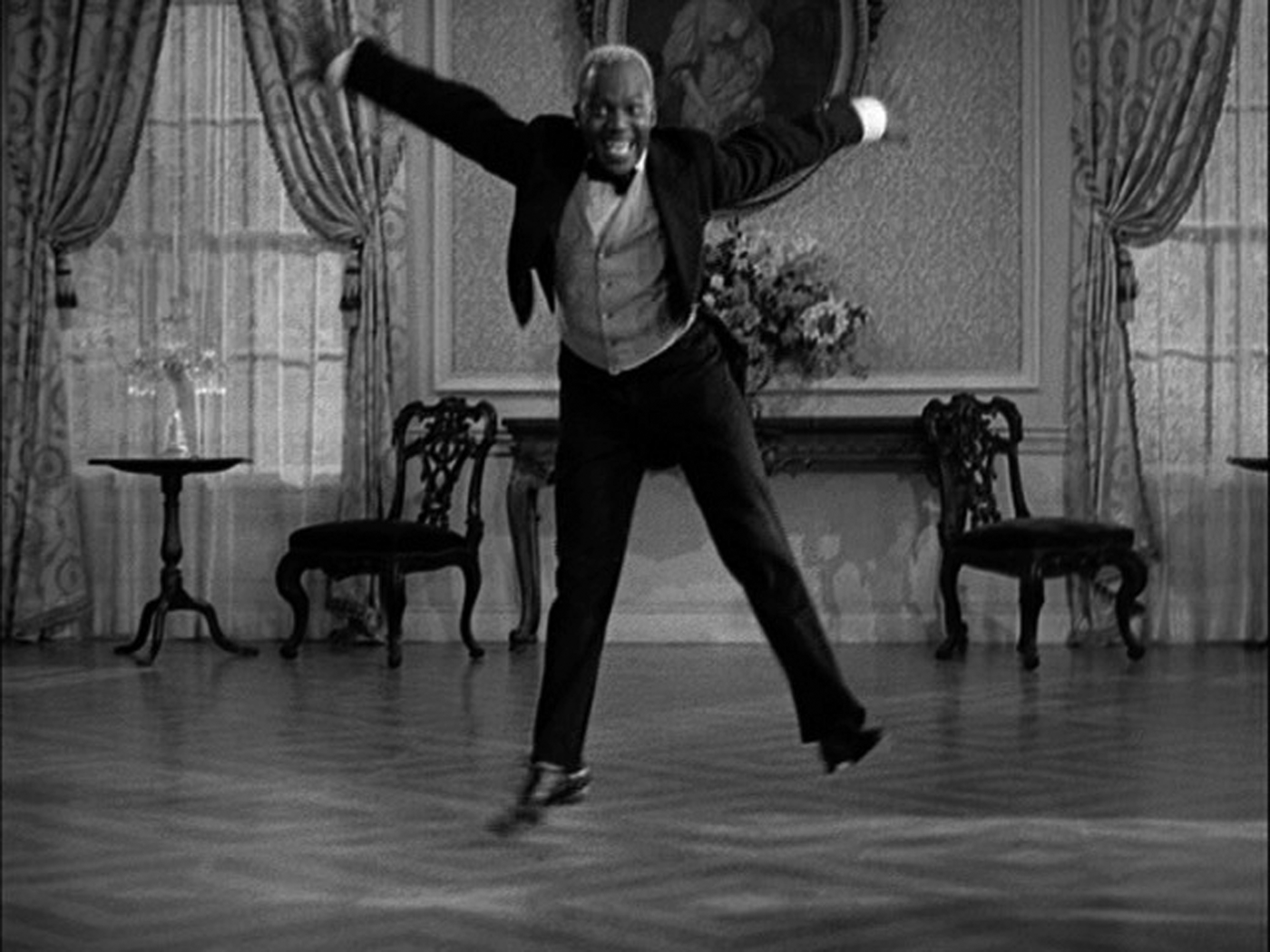
The live spectator views Robinson's dance through Miss Virgie's adoring eyes, as the choreography and camera shots guide us to admire his skills. While their duets elsewhere in the film use rhythmically sophisticated, but technically simplified, footwork that a talented six-year-old could master, Robinson pulls out all the stops in his solo. He displays a masculine athleticism in an extraordinary work full of flash steps or challenging, gravity-defying foot rhythms, which require full body movements. In the third eight-bar phrase, he launches into changing wings, leaping side to side, his arms flying wide. His feet wing out to execute three extra tap sounds, mid-air, and-a-one, and-a-two, and-a-three, times three, while his stabbing toe point punctuates precise hops at the end of every two-bar phrase (Photo 3). The camera cuts to a wider angle that again positions the viewer within the group of children. Historian Eric Lott notes that blackface minstrelsy was based on a fascination with black male sexual potency (Reference Lott1993, 57). In this scene, however, the movie studio reframes “minstrelsy's mixed erotic economy of celebration and exploitation” (6). The overt sexual potential of a black man powerfully displaying his body becomes a scene of white, ruling class children delighting in the desexualized performance of a black, childlike adult.
Bill Robinson's athletic wing steps. Video still from The Littlest Rebel. Directed by David Butler. Twentieth Century Fox, 1935. Beverly Hills, CA: Twentieth Century Fox Home Entertainment, 2005.
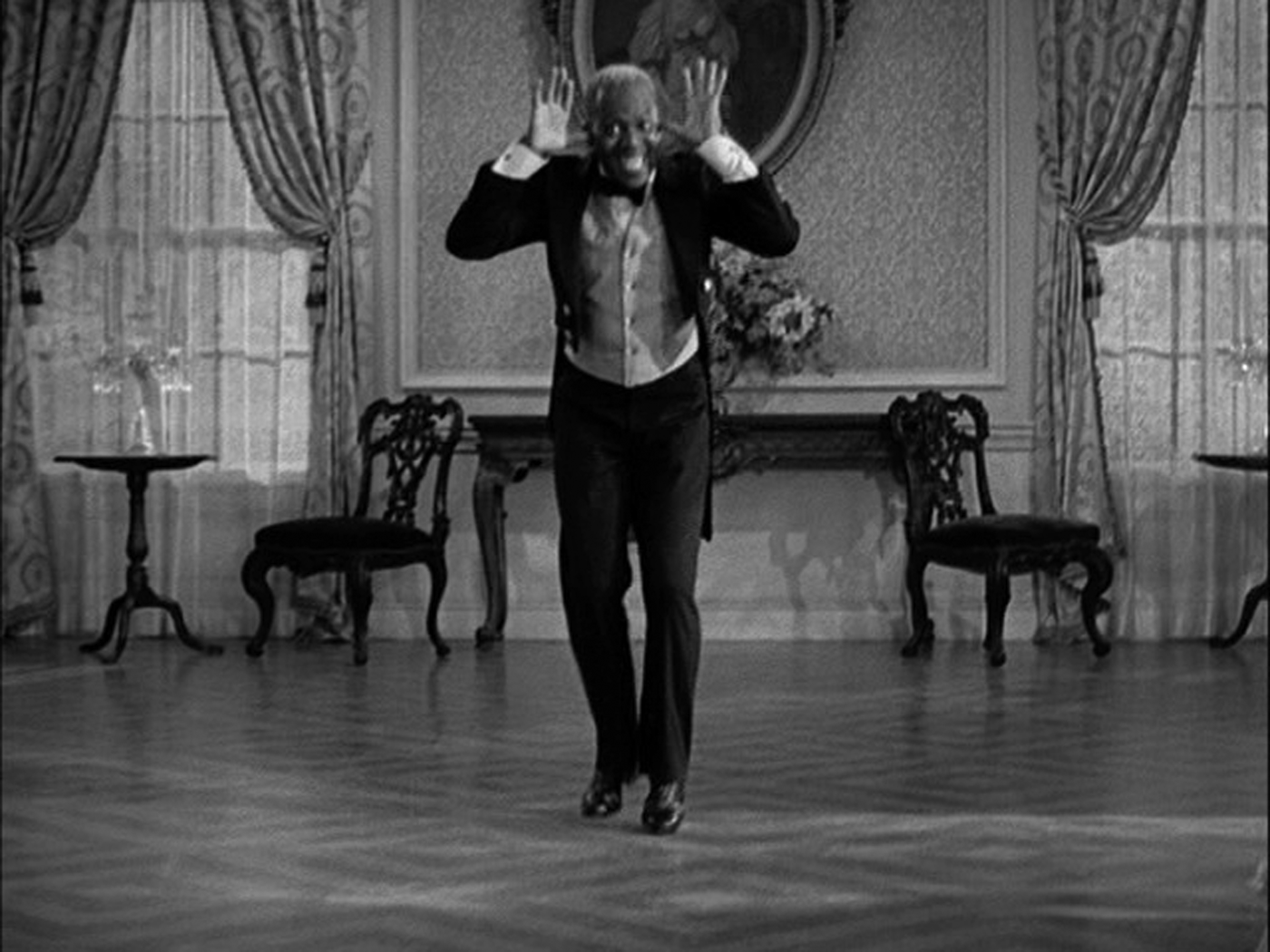
Robinson's smile masks the physical effort of hot, flash tap. He expertly puts the aesthetic of the cool (Thompson Reference Thompson and Caponi1966, 74) to work as he turns his back to his audience and calls attention to his cooler phrase of elegant, backwards-running flaps.Footnote 7 His demeanor draws the observer's eyes and ears to the sophisticated simplicity of repeated pauses and syncopated off-beats, a-four-and-a-ONE . . . DOO WAH . . . doo WAH . . . DOO WAH . . . doo WAH, a-four-and-a-ONE .... Robinson's clarity of sound attunes the listener's ear before his next energetic build at the top of the second chorus when he faces the camera again to turn the old-fashioned falling-off-the-log into an athletic rapid-fire roll of flying feet, embellished with a filigree of triplets, created with the airborne sounds of pull-backs. The full-body camera shot of Robinson's adult male dancing is again interrupted by cuts to a mocking exchange between Uncle Billy and Virgie. Robinson's and Temple's identical open mouths, visible tongues, and impish expressions evoke a presexual, infantile orality (see Rogin Reference Rogin1996, 176) (Photo 4). Off stage, Robinson was known for his temper, at times aggressively wielding a pistol to protect his material or his honor (Haskins Reference Haskins1988, 45; Stearns and Stearns Reference Stearns and Stearns1979, 185). On film, however, his teeth are gleaming and attractive, never hostile. The repeated interruptions remind the spectator that Robinson's virtuosity is interwoven with the depiction of an enslaved man's eager compliance to perform for diminutive masters and mistresses. At the end of his solo, Robinson builds to an exciting finish as a full orchestra joins the tinny harmonica. He springs into six, seven, eight double wings, the balls of his wooden-soled shoes trilling against the floor, and he beams mischievously with his heel-clicking exit, to the applause of the children. Robinson has taken his audience on a seventy-one second journey through a dynamic range of tones, jazz-era rhythms, and crystal-clear, vernacular footwork, all while reinforcing Hollywood's fantasy of a racist social order that is disrupted, but never subverted, by the impending war.
Bill Robinson's mocking exchange with Shirley Temple. Video still from The Littlest Rebel. Directed by David Butler. Twentieth Century Fox, 1935. Beverly Hills, CA: Twentieth Century Fox Home Entertainment, 2005.
Minstrelsy, Tap, and Robinson
African-American protests against the denigrating representation of blacks on the American stage date at least to Frederick Douglass's scathing condemnation of minstrelsy in the 1840s (Lott Reference Lott1993, 15). Even before Robinson appeared in his first two feature films with Temple, The Crisis (the magazine of the National Association for the Advancement of Colored People) published a critique of the relegation of black actors to “either buffoons or ubiquitous Uncle Toms” in Loren Miller's 1934 essay, “Uncle Tom in Hollywood” (Everett Reference Everett2001, 266).
Robinson negotiated throughout his career with minstrel stereotypes and Jim Crow restrictions. Blackface minstrelsy incubated tap dance, as the form evolved from the nineteenth century Africanist jigs, soft-shoe, and buck-and-wing styles of expert African-American and white minstrel dancers. Robinson, born in 1878, entered the stage as a pickaninny, or African-American child performer, and honed his skills as a blackface, dancing comedian. In the 1910s, Robinson dropped the blackface, along with many early twentieth century black artists who would “shed the costume of the shuffling darky” (Nathan Huggins quoted in Hill Reference Hill2010, 96). Robinson was one of a generation who worked to abandon demeaning stereotypes, create opportunities on stage, and perform empowered masculinity and virtuosic showmanship as strategies of subversion and uplift. Robinson refused to perform under the white vaudeville convention that restricted African Americans from appearing as a solo act (Hill Reference Hill2010, 63). In breaking the “two colored” rule, Robinson launched his solo career and fused both aspects of the typical two-man, song-and-dance team of comic buffoon and elegant dandy, popularized by the great Bert Williams and George Walker. Footage of Robinson in the 1935 film, Hooray for Love, shows him as the sophisticated, sharply dressed, masterful dancer and uproarious entertainer, exactly as his Broadway and vaudeville audiences would have seen him (Lang Reference Lang1935).
Robinson's vaudeville act offers insight into his performance of black masculinity in a setting where he had artistic agency over his presentation. Jazz musician Louis Armstrong describes seeing Robinson in the 1920s: “He waited after the Thunderous Applause had finished ... and said to the man who controlled the lights ... ‘Give me a light my color.’ And all the lights all over the house ‘went out’ ... with the whole audience just Roaring with Laughter [sic] ... Then Bojangles went into his act” (Armstrong Reference Armstrong1999, 184). On the stage and in The Littlest Rebel, Robinson steps forward to perform and fosters a sense of community in his audience by calling attention to his blackness. While the film depicts his race as a marker of social and mental inferiority, and the editing of the sequence implies that the live spectator is sitting within a community of ruling-class white children, Robinson's agency on the vaudeville stage allowed an empowered performance of race and a clever subversion of the audience's expectations. In Armstrong's anecdote, Robinson, not the camera, exerted control over what his audience could see (or could not see, when he directed the light man). Robinson's stage presence and performance reinforced his all-black audience's sense of racial pride. His gag provided the opportunity to laugh and delight with him in the knowledge that talented, dignified black men could neither be invisibilized (by lack of theater lights or by mainstream society), nor silenced. Armstrong describes Robinson's great skill as a comedian and proudly makes the distinction that Bojangles had his theater audiences rolling in the aisles without wearing the “black cork with thick white lips” (28) of minstrelsy. Needless to say, Robinson did not have the same degree of artistic agency in Hollywood where the centralized film industry “contained and sustained conventional structures of oppression” (Gubar Reference Gubar2000, 55). The studios had no use for depictions of strong, independent black men. The minstrel mask and stock minstrel characters were alive and well, as Hollywood used the new technology of sound film and editing to recombine tap with racist depictions of black submission.
During his film career, Robinson negotiated complex debates about his agency as a performer and questions of collaboration with Hollywood's endemic racism. He worked to maintain his star status and positive public image in African-American newspapers that were vocal in their critique of the film industry's depiction of black characters. Anna Everett's comprehensive work on film criticism in the black press reveals a wide spectrum of complex positions, from accommodationist commentary whose goal was to increase black participation in the Hollywood mainstream, to leftist writers who mobilized “Marxism, socialism and proletarian art aesthetics,” and at times criticized African-American stars for perpetuating damaging stereotypes (Reference Everett2001, 180). Everett notes that the Pittsburgh Courier review of The Little Colonel (1935) performed an “apologist or damage control function” (Everett Reference Everett2001, 194) for Robinson in his first plantation feature with Shirley Temple. Bernice Patton's “uncritical celebration” of Bojangles aligned with the mandate of the black press to provide promotional boosterism of the accomplishments of African Americans (Everett Reference Everett2001, 193–4).
Robinson directly attacked accusations of “Tomism” in Earl Morris's Reference Morris1937Courier interview by asserting, “I am a race man! And I do all in my power to aid my race. I strive upon every turn to tear down any barriers that have existed between our two races and to establish harmonious relationship for all.” Everett comments that the interview permitted Robinson to “negotiate a middle ground for himself that effectively deflect[ed] criticism of his Uncle Tom roles by ‘many who innocently feel,’ as Robinson explains it, ‘that I haven't my race at heart’” (Reference Everett2001, 213). The article steered away from questions of collaboration and moved toward a “favorable discussion of Robinson's checkbook consciousness” (213) and his philanthropy to blacks in need. Everett notes that “Robinson, cognizant of the immense chasm separating his Uncle Tom star persona from his self-presentation as a race man, refutes the conflation of the exigencies of his screen image with his personal racial politics” (213). In the Courier article, Bojangles is recuperated as a “‘race man’ worthy of the community's respect, admiration, and continued support at the box office” (214). But Robinson's negotiation of that “middle ground” could not lay the questions to rest and, even after his death, he continues to hold a complex position for his audience.
Robinson's films challenge viewers to develop what African-American feminist scholar bell hooks calls an “oppositional gaze” (Reference hooks and Thornham1999, 313), or the critical spectatorship to view African-American talent within an environment of racist imagery. An oppositional gaze can lead viewers to engage in a complex process of filtering, where either Robinson's tap artistry or the racist content is foregrounded. It is tempting, as a tap fan, to filter out the obvious racisms, to delete the close-ups, as it were, and simply admire tap choreography, subversions, and agencies in Robinson's films. Manthia Diawara identifies the moments of “rupture” when the spectator resists “complete identification with the film's discourse” (quoted in hooks Reference hooks and Thornham1999, 309). Robinson's movies, and the close juxtaposition of tap and teeth, demand that the viewer stays in that moment of rupture, that we keep both the grotesque horrors of Jim Crow and the delights of tap dance in our line of vision, and that we remember that tap virtuosity and “the terrible pleasures” of minstrelsy (Lott Reference Lott1993, 11) are interlocked.
Eleanor Powell in Broadway Melody of 1936
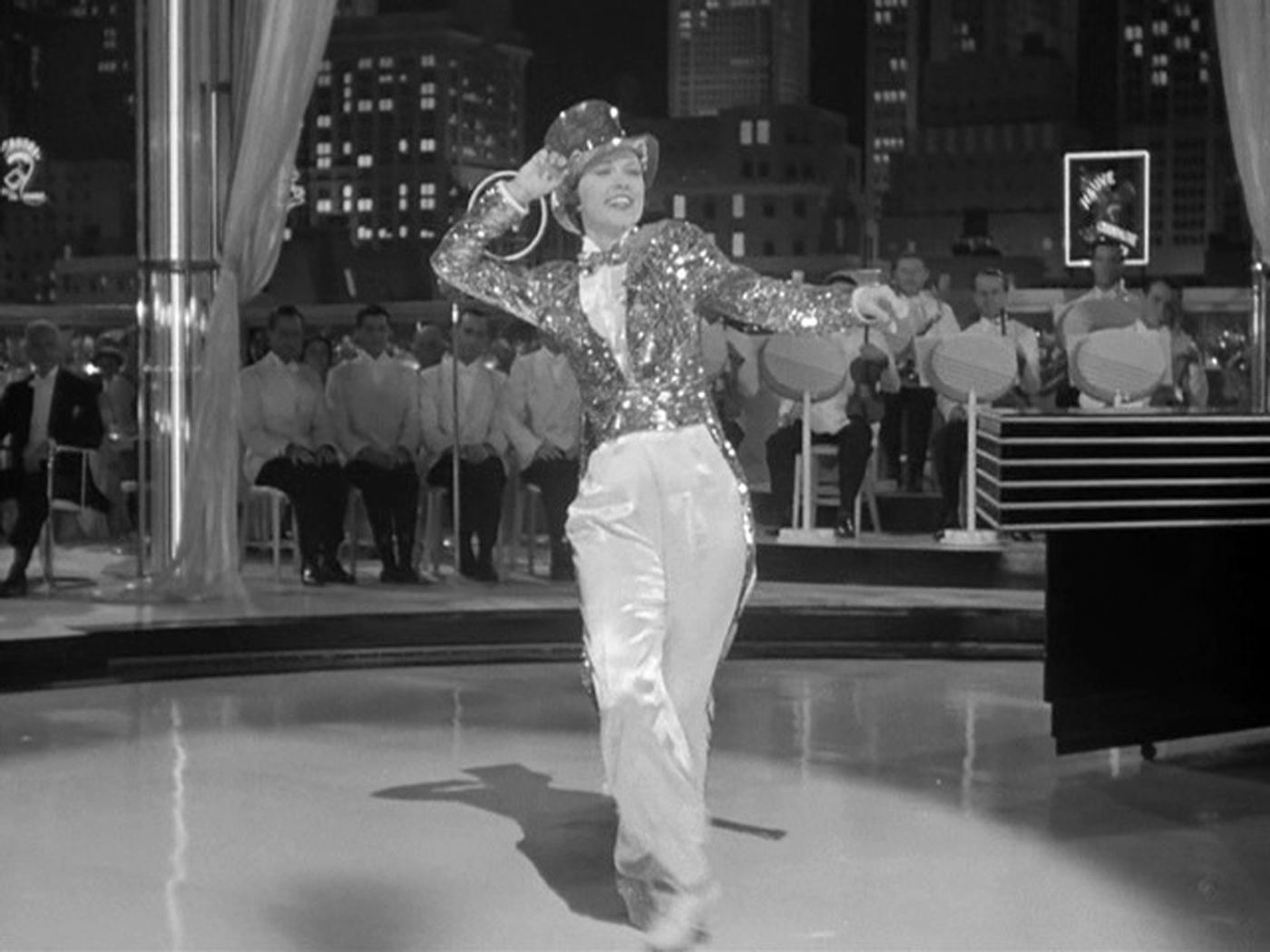
The opening shots of Eleanor Powell's “Broadway Rhythm” number in Broadway Melody of 1936 situate the live audience in an elegant nightclub (Photo 5). The spectator views Powell as if seated next to her paramour, played by Robert Taylor, and watches in a long shot as the dancer commands the space with galloping tap steps that carry her around the circumference of the floor. She pauses to acknowledge Taylor, as the camera cuts to his excited reactions (Del Ruth Reference Del Ruth1935).
Eleanor Powell in her elegant nightclub. Video still from Broadway Melody of 1936. Directed by Roy Del Ruth. Metro-Goldwyn-Mayer, 1935. Burbank, CA: Warner Home Video, 2008.
In discussing Powell's and Robinson's smiles, I do not imply that race and gender are equal as sites of meaning, power, or identity. Any site of meaning represents a complex, multifaceted construction that intersects, in “historically specific ways,” with multiple other sites of meaning (Bordo Reference Bordo1993, 222).Footnote 8 There are similarities in how Powell's and Robinson's smiles are filmed, but each sequence suggests a unique construction of masculinities, femininities, blackness, and whiteness, specific to 1935.
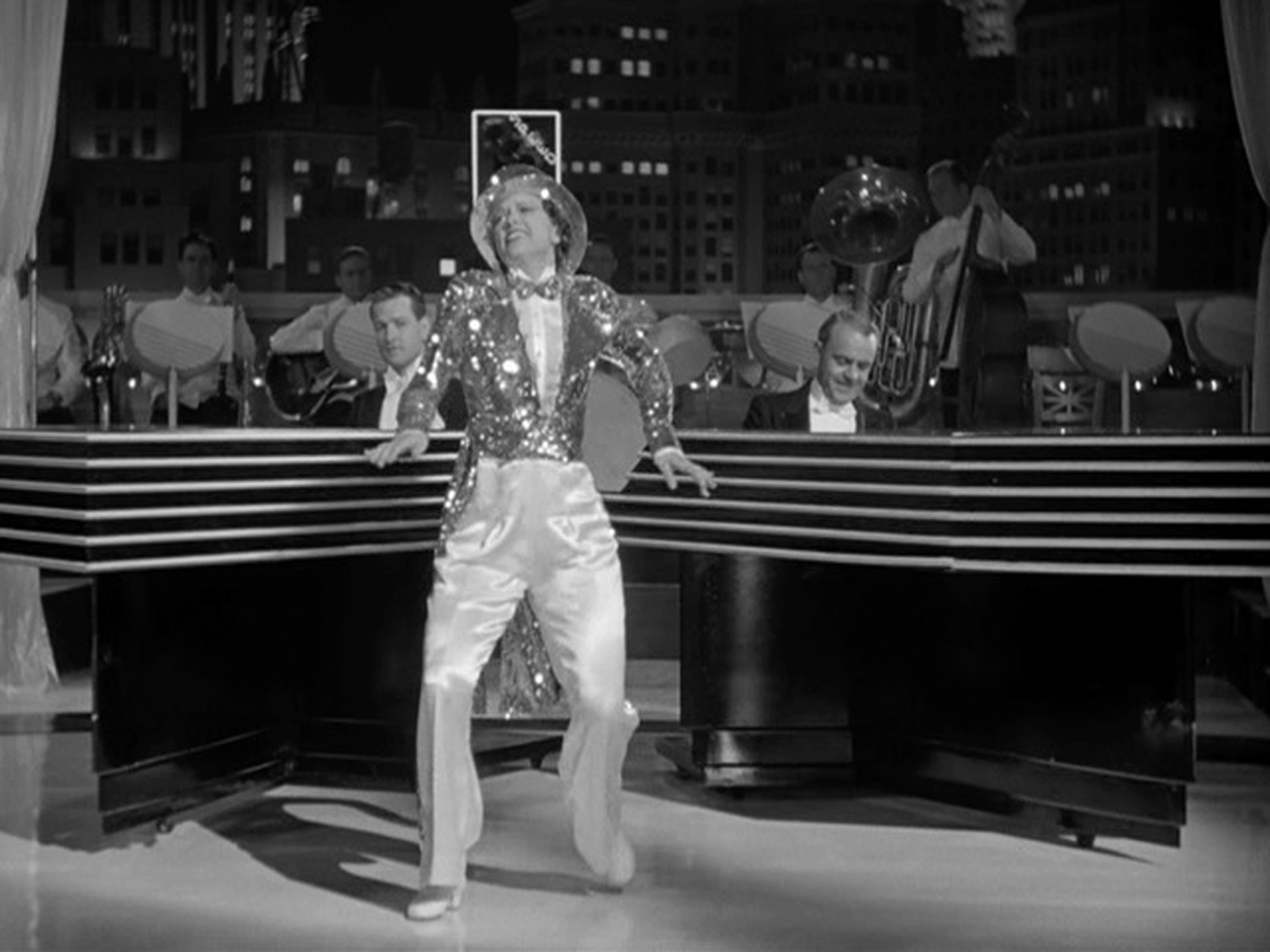
Powell choreographed all her own routines (Schultz Reference Schultz1994, 12), and the staging of this work emphasizes her range of talents. The top of her solo features her exact, close-to-the-floor tapping without the sound of the orchestra. A full-body shot shows her accompanied by not one, but two, Art Deco pianos. Powell plays the part of a third musician, tapping a rhythmic line of swinging eighth-notes that interweaves, in counterpoint, to the two musical lines the pianists play in canon (Photo 6). Powell noted that a dancer had to be a musician, “a frustrated drummer” even, who uses her feet as a percussion instrument (Schultz Reference Schultz1994, 5). As the orchestra resumes, she plays not only the floor, but her whole body as a musical instrument, and displays her acrobatic training and feminine form. Her foot rhythms segue into percussive hand slaps up her leg and torso (the movement is both sensual and utilitarian) until she reaches over her head, into a backbend to touch the floor. She completes the phrase with a tapping turn, implying sultriness with hip and shoulder gestures.
Eleanor Powell hunches her shoulders in pleasure as she dances with two Art Deco pianos. Video still from Broadway Melody of 1936. Directed by Roy Del Ruth. Metro-Goldwyn-Mayer, 1935. Burbank, CA: Warner Home Video, 2008.
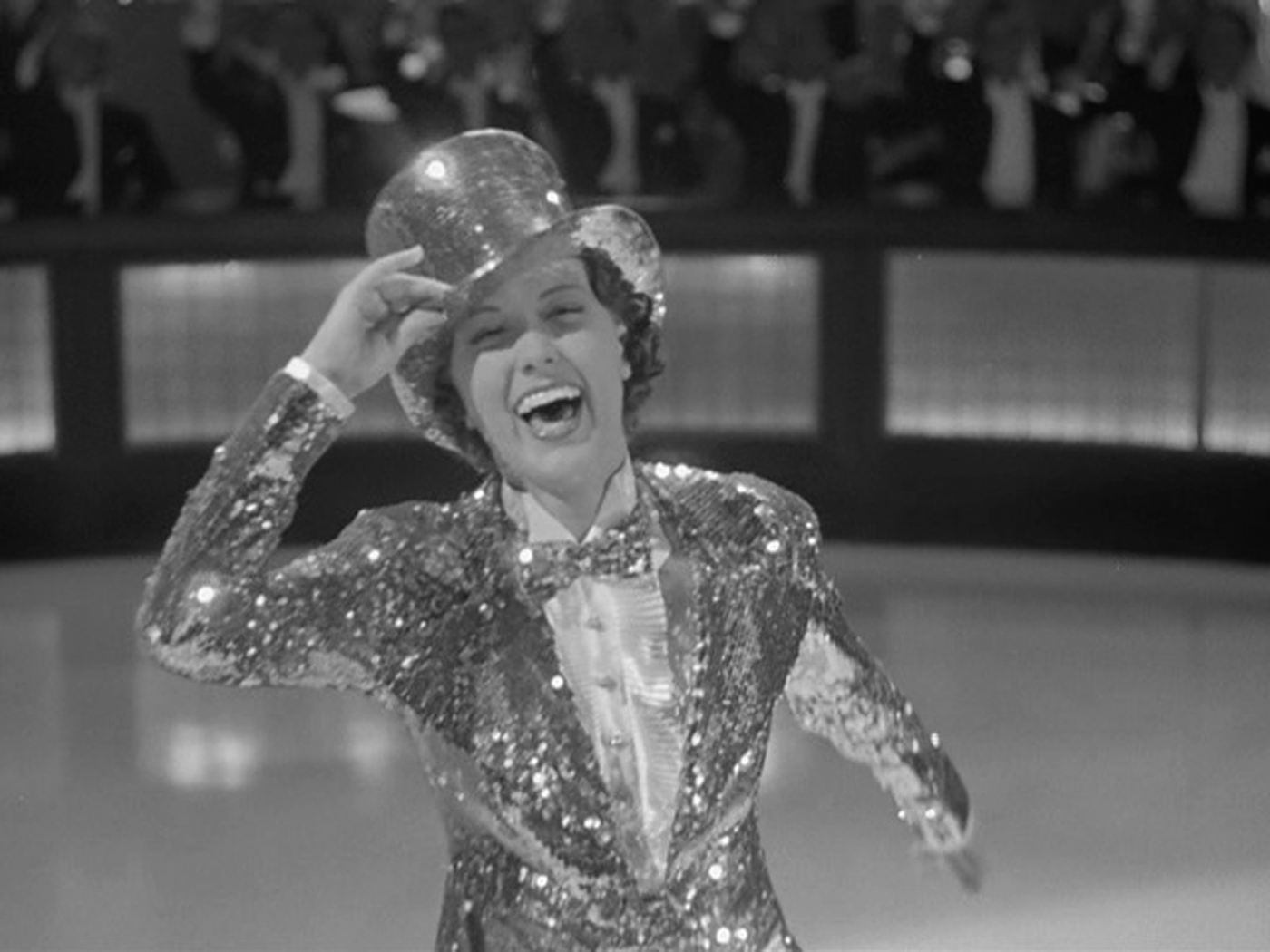
A cut to an upper-body shot frames her sinuous tapping walk toward the camera. The shot narrows in on her face as Powell comes directly at us, bedroom-eyes half closed, her smiling mouth fully open and tongue visible. Her pearly teeth engulf the majority of the screen and she leans her head to the side, as if she is about to recline in the viewer's arms and receive a kiss.Footnote 9 Theater scholar Brenda Foley, in her study of beauty pageants, comments that “the smile is specifically codified in women as an indicator of ... availability, passivity, interest, approval, and a nonthreatening or submissive attitude” (Reference Foley2005, 62). Feminist film theorist Laura Mulvey writes of the visual pleasure intended in shots of women as the “male gaze projects its fantasy onto the female figure, which is styled accordingly .... Women are simultaneously looked at and displayed, with their appearance coded for strong visual and erotic impact” (Reference Mulvey and Thornham1999, 62). The film spectator is clearly meant to view Powell as her paramour sees her: glamorous and enticing, her open mouth indicating her romantic and sexual availability.
The next shot widens as Powell taps her retreat and hunches her shoulders flirtatiously as if to express her delight in dancing for her audience. In a wide shot, she travels from one side of her stage to the other in a swinging and syncopated hybrid of ballet and tap: an airborne brisé volé, lifting one foot to meet the other, clicking heels twice on the offbeat, as the second foot scissors to the front and back again. The editing cuts again to an upper-body shot of her twinkling grin, hand on the brim of her spangled top hat. Her now invisible feet sound out sixteenth notes as she happily leans toward the camera with wide eyes that meet the viewer's gaze (Photo 7). The intimacy of Powell's close-ups intercut with full-body shots of her dancing creates a multilayered narrative. She sprints like an athlete, then plays the floor as a musician, then appears submissive, delighted to please, and sexually available both as a glamorous star and as the wholesome, down-home girl from Albany. In addition to this, within the diegesis or plot of the film, she plays the role of a confident, charming trickster who engages in an elaborate tap dancing scheme to get the attention of the man she loves. By this point in the movie the film spectator, like Taylor, would be a fool to resist her charms.
Eleanor Powell: glamorous, wholesome, and delighted to please. Video still from Broadway Melody of 1936. Directed by Roy Del Ruth. Metro-Goldwyn-Mayer, 1935. Burbank, CA: Warner Home Video, 2008.
Queer film theorist Steven Cohan (Reference Cohan2005, 138–40) suggests that Eleanor Powell's moves, her tuxedo, and even the very act of tap dancing are indications of “masculinity,” but I contend that this signals a misreading of the range of femininities present in 1930s tap performance and perpetuates an idea that Powell was an anomaly as a skilled female tap dancer.Footnote 10 Newspaper reviews, the limited archive of film footage, and recent research indicate that there were “plenty of good women” tap dancers of the 1930s (Ingram, Kodish, and Dornfeld Reference Ingram, Kodish and Dornfeld2004), who embodied a wide range of gender expression in their body movements, costumes, and their performance of sexuality.Footnote 11 One of Hollywood's first moves in bringing tap to the screen was to feature female dancers. 42nd Street (1933), starring Ruby Keeler (Feuer Reference Feuer1993, 89), was followed in quick succession by films featuring Powell, Jeni LeGon, Dixie Dunbar, and others (Stearns and Stearns Reference Stearns and Stearns1979, 399–406). Hollywood was a socially conservative industry, whose first goal was to sell movies, and often it did so by reinforcing tropes of traditional femininity. It is unlikely that the studios would have featured the talents of these women if audiences and film producers of 1935 considered tap dancing exclusively masculine. Rather, the acclaim that women tap dancers of the time received on film and on stage indicates an entertainment culture that was eager to see, and eager to make money from, highly feminine, highly virtuosic tap dancing.
Feminist film scholar, Adrienne McLean, discusses the relationship of creativity and virtuosity to gender in Eleanor Powell's Hollywood musicals by expanding on Mulvey's notions of spectacle, whereby female performers are depicted as passive and sexually available showgirls. McLean considers Powell's “aesthetics of competence, the physical practices of virtuosity and skill, on the showgirl herself” (Reference McLean and Griffin2009, 90). This interplay between voyeuristic shots of showgirls and tap skill can also be seen in Busby Berkeley's “Lullaby of Broadway” number in Golddiggers of 1935 (Reference Berkeley1935). This sequence offers an opportunity for intertextual commentary from a Hollywood musical of the era that similarly intercut images of feminine submission with shots of feminine power expressed through active rhythm tap footwork. Golddiggers, released the same year as Powell's debut, features a number with an army of male and female tap dancers. Wide-angle shots show predominantly ungendered footwork: men and women tap identical time-steps and cross-steps in close unison, using flat-footed stomps to accent the off-beats. The feet create a thunderous and rhythmically sophisticated soundscape. Closer shots emphasize gender distinctions as smiling female dancers call and respond tap rhythms with the men and lift their black chiffon skirts to display bare, hoofing legs and swishing hips beneath bare midriffs and gleaming black tops. Though the camera moves into a classic Berkeley close-up of beaming peroxide blondes, even in this most voyeuristic moment, the showgirls are not completely passive. Their smiling, bobbing heads continue to move in response to the rhythms of their still actively tapping feet (Berkeley Reference Berkeley1935). Powell does not display as much skin as the Berkeley showgirls, but similarities in the filmed formula of tap power, intimacy, and submission are apparent.
Powell's movements are coded as feminine, but her body, far from passive, acts as a site of percussive power. Gender theorist Judith Butler argues that “gender is not passively scripted on the body” (Reference Butler1988, 531).Footnote 12 Powell's performance of gender can be understood through historian Joan Wallach Scott's categories of gender analysis, particularly “culturally available symbols” and “normative concepts that typically take the form of fixed binary opposition” (Scott Reference Scott1988, 43–4). Though no human movement or choreography is inherently gendered as either masculine or feminine, within the context of this film sequence, certain culturally available symbols, such as ballet-inspired moves and qualities of delicateness and vulnerability, mark Powell's choreography as “feminine.” Powell's use of an expressive and flexible spine, shoulders, and hips, garbed in the soft, white silk and spangles of her tuxedo, reads as feminine, in its binary opposition to the chorus of rigid men in black tailcoats.
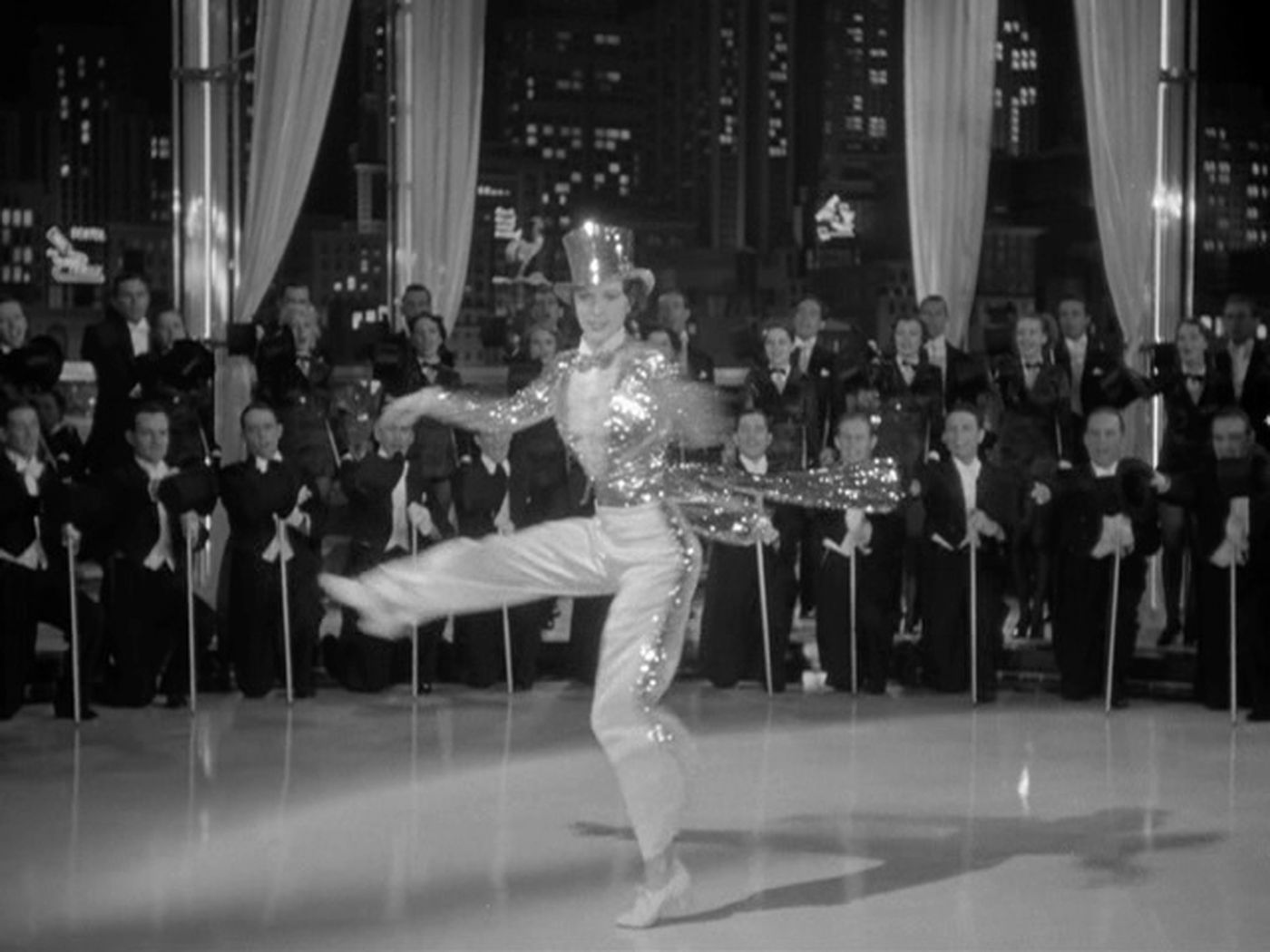
Powell's work exemplifies what tap dance scholar Ann Kilkelly (Reference Kilkelly2013) calls feminine flash: acrobatic or challenging tap choreography that displays graceful athletic skill and movements associated with femininity. Flash is designed to show off the performer's power and incite excitement and applause, as the body pushes the limits of human potential in tap and jazz dance. Like Robinson's changing wings and pull-backs, Powell's ballet/tap hybrid steps defy gravity. But they also emphasize delicateness. Her backbends invert and stretch her body beyond pedestrian limits, like the flips and splits of the Nicholas Brothers, but the position exposes her vulnerability. Powell's solo ends with a thrilling series of turns—a display of her ballet-trained prowess. She spins with one leg out to the side in pirouettes a la seconde, into a quintuple pirouette, backed by phalanx of black-tuxedoed men singing, “Dance! ... Dance!” (Photo 8). Top speed chainé turns around the perimeter of the floor bring her downstage toward the camera. She ends on a dime, as the camera zooms into her beaming face, and she looks directly into our eyes through the lens of the camera.
Eleanor Powell's turning flash ending. Video still from Broadway Melody of 1936. Directed by Roy Del Ruth. Metro-Goldwyn-Mayer, 1935. Burbank, CA: Warner Home Video, 2008.
For the contemporary spectator, the repeated shots of Powell's smiling face can seem ludicrous, as the viewer's enjoyment of her tap dancing is interrupted by close-ups of her grin. Steven Cohan discusses this reaction as a
dual register ... [that] manifests itself every time a musical uses direct address in a number: that is, when performers “cheat out,” as it is also called, by facing the camera and hence the audience directly. This convention engages audiences with a double sense of being addressed: directly ... by the performer in the manner of a live performance and simultaneously, by the performer's character expressing herself in musical terms. (Reference Cohan and Cohan2010, 4)
The close-up of Powell's direct address, smiling into the camera, asks the live spectator to take a role in her performance. The viewer is no longer impassive or anonymous, sitting in a darkened movie theater (or in the twenty-first century, in front of the small screen of an electronic device). As Powell's eyes meet ours, we become her adoring nightclub audience, even her lover, her smile beseeching us to love, desire, and approve her femininity. To my eye, at best, the smiling close-ups of Robinson and Powell interrupt my pleasure of enjoying the skill of the feet and the dancing body. At worst, the interruptions demand that I assume a power role in their submission. Feuer notes that in the shot transitions to close-ups of direct address, “Our subjectivity is placed within the narrative universe of the film” (Reference Feuer1993, 27). One scene pushes the spectator into the role of slave owner (or a child of slave holders), demanding the viewer's pleasure in Robinson's obsequiousness. The other scene asks the observer to desire Powell, to be aroused by her open sexual mouth and soft tongue. Feuer adds that for a contemporary audience unfamiliar with these filmic conventions, the effect of direct address can be discomforting; the strain on a viewer's sense of reality can provoke nervous laughter (quoted in Cohan Reference Cohan and Cohan2010, 4). Indeed, twenty-first century viewers can be left with the sense that though we came to admire, we did not consent to the intimacy implied by these power relationships.
Sexuality in Hollywood Tap
The cinematic formula of power, intimacy, and submission used in the editing of these tap sequences raises the question of Powell's and Robinson's performance, or non-performance, of sexuality. The mores of the movie industry ensured that romance, sexuality, or even friendly equality on screen was strictly prohibited between an adult man and woman of different races. Though Eleanor Powell and Bill Robinson had performed together at private parties, and Powell was the only dancer whom Robinson allowed to perform his Stair Dance in tribute to him, they could never perform together on film (Schultz Reference Schultz1994, 15). The Motion Picture Production Code, or Hays Code, instituted in the 1930s as an industry guideline on taste and decency, regulated sexuality on film.Footnote 13 Hollywood explicitly prohibited any hints of miscegenation and sanctioned only one type of heterosexuality: “chaste, same-race ... courtship leading to monogamous marriage. All other forms were officially regarded as ‘unhealthy’” (Griffin Reference Griffin2009, 9). Though instituted to regulate immorality and vice, the influence of the Code can be seen even in the chaste dance sequences of Powell and Robinson.
In the two stars' dance footage, static close-ups of smiles interrupt shots of intense, kinetic tap dance athleticism. The fragmentation of the dancers' bodies, where only their faces are seen, functions to reframe and contain their energies within Hollywood's narrow constructs of race, gender, and sexuality. Queer film theorist Sean Griffin notes, “The establishment of the Production Code stands as the most elaborate example of regulating definitions of heteronormative behavior” (Reference Griffin2009, 10). The edits in Powell's dance reinforce the narrative of heterosexual love. She offers her body to her paramour, and to the film viewer, as she displays her talented glamour and wholesome skill. The interruptions by relatively still close-up shots of smiles serve to convince the spectator to re-interpret her intense physicality as conventional, yielding femininity. Powell's submissive smile offers a counter-narrative to the independence in her dancing, affirming that she is a “real woman” too, eager for romance, sex, and marriage.
The static close-up of the minstrel mask that interrupts Robinson's musical and athletic choreography acts to convince the viewer that Robinson is not a sexually mature, empowered black man, despite the agency he displays in his sophisticated dancing. A reverse ageism appears to have been at work in Hollywood's casting of Bill Robinson as a benign, childlike servant because he was older. Robinson's stardom reflects his ever-fresh showmanship, rhythmic and technical excellence, along with unrelenting hard work, ambition, and business acumen. Yet it is striking that he achieved international acclaim well into his fifties, dancing the steps, rhythms, and musical phrases of 1900.Footnote 14 Robinson's age, his older style of tap, and the static close-ups that interrupt his adult, athletic dancing all set the stage for his on-screen friendship and teamwork with Shirley Temple. African-American writer Loren Miller asserted in 1934 that the Production Code set forth “unwritten, but iron clad rules in the movie industry” requiring films with interracial casts to depict white characters as victors, or “overlords,” and represent blacks as inferiors (quoted in Everett Reference Everett2001, 265–71). The chaste, interracial, mixed-gender relationship of a little white girl dancing with her elderly black servant was palatable to Hollywood, explicitly because Robinson simplified his steps and portrayed the childlike “good Negro.”
Robinson and Powell were two of a small cadre of tap dancers who were filmed in the 1930s. The studios selected certain skilled dancers to turn into stars, ignored many others, and displayed the wide range of choreographic, technical, and musical talents of their dancing stars through the industry's narrow definitions of race and gender. I do not imply that Robinson, Powell, and other stars lucky enough to be preserved on film are not worthy of their status, but when one considers that Hollywood was neither a level playing field, nor a meritocracy, the inadequacy of film becomes apparent. The range and talent of the thousands of male and female tap dancers, who performed live on black and white vaudeville and nightclub stages in every city in the U.S., is not available in a visual archive. Hollywood's cinematic formula of power, intimacy, and submission, created through shots of gleaming teeth intercut with virtuosic dancing feet, helped the industry package excitement, construct the illusion of immediacy, and sell tap dance musicals. In producing and marketing big-budget feature films in 1935 to mainstream (white) America, the film industry was happy to promote female tap virtuosity, as long as it was feminized, sexualized, heteronormative, and white. Hollywood was comfortable with adult, male, black tap virtuosity, as long as its star performer was elderly, servile, and childlike. The dancing of Robinson and Powell preserved on film illuminates how the prodigious talents of a few were filtered through the biases of the era.