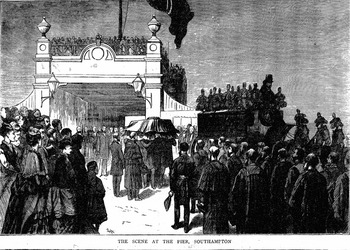
It is Tuesday, 27 January 1874, and a telegram from her Majesty's Acting Consul-General at Zanzibar reaches the Foreign Office, reporting news of the death of Dr. David Livingstone. An incredulous British public struggles to disbelieve and discredit the account. Months later and, after an agonizing delay, the Peninsular and Oriental Company's steamship Malwa arrives, bearing a broken and wizened body to port in Southampton. Waiting is a public throng, in mourning for its national hero. Later he is laid to rest in a chockablock Westminster Abbey, a public symbol of the national interest vested in Livingstone (See Figure 1).
“The Scene at the Pier, Southampton.” Illustration from Supplement to the Graphic (25 April 1874): 404. Courtesy of Gale Electronic Products. © British Library Board (Shelfmark 4211.220000 DSC).

Since then his posthumous reputation has fluctuated from the sensational heights of heroism to vilification as an agent of Empire. John M. MacKenzie describes how Livingstone “has become the subject of a major biographical industry” (“Worldly After-Life” 203) and notes how the hero has “lent himself to any number of iconic images,” oftentimes in seeming contradiction (“Iconography” 102). In the scramble for Africa, his polemic against the slave trade served “as a valuable justifier of empire in East and Central Africa” (“Iconography” 93). Later, during the formation of the Central African Federation, Livingstone's persona was again mobilised to emotionally bolster the process and “cynically to disguise the essential nature of the empire” (Holmes 349).Footnote 1 Inevitably, he became a subject of critique during decolonisation, but, perhaps due to his radical racial politics, he simultaneously became “something of an icon of a particular brand of African nationalism” (MacKenzie, “Iconography” 84). In short, Livingstone's historical reputation has shown remarkable malleability; he has acquired a plurality of identities, being moulded variously by writers emerging from differing socio-cultural locations and with contrasting purposes. Debate continues over his identity to this day as Felix Driver observes; was he “really a missionary, really an explorer or really an imperial pioneer” (“David Livingstone” 11)?
The aim of this paper is to consider the ways in which Livingstone was constructed in just one year, 1874, immediately after his body returned to British soil. At that critical moment in the judging of a life – the days immediately following demise – we can bring into sharp focus the manufacturing of the meaning of a life on the borderland between a living past and a dead present. This temporal fulcrum point presents an opportunity to scrutinise a body of unexplored literature, a wealth of obituaries and eulogies, which delivered some of the foundation stones of his posthumous reputation. By examining the differing ways in which Livingstone was produced as a hero in diverse social spaces, what I call “sites of construction,” his name and legacy are revealed as spaces of essential contestation.
Numerous explanations have been posited, of course, for the way in which Livingstone so fascinated the British imagination. Adrian S. Wisnicki usefully surveyed these accounts in a recent article in Victorian Literature and Culture. Thus Andrew Ross, he notes, suggested that the low public morale succeeding the Crimean war led the nation “to thirst for stories about heroes and heroines” (109). Livingstone, it would seem, arrived on the scene at an opportune moment. Another Livingstone biographer, Tim Jeal, has pointed to the irreducible complexity of his popularity, which owed itself to a litany of factors that ranged from the patronage of the multiple organisations which sought to make him famous, to Livingstone's own exceptional ability to combine “patriotism and Christianity” (163, 3). Wisnicki notes how other critics have seen “the actual narrative of Missionary Travels as key to the success of both text and missionary” (256). Among these, both Mary Angela Schwer and Timothy Holmes have drawn attention to Livingstone's skilful self-fashioning. The latter picked up on the textual editing by which he ensured his Travels would contain “something for everyone” (Holmes 124). Wisnicki postulates his own interpretation: Livingstone's acclaim and adulation resulted, at least in part, from the Travels’ attempt to “map the cultural and physical geography of southern Africa in a way that responded to the sacred and secular desires of the British public” (256). Livingstone charted Central Africa's religious disposition, creating a spiritual cartography that represented the areas in which he was optimistic for settlement and mission as the “imaginary centre” of the continent; he thus created an “ideal space – an interstitial, idyllic domain that cater[ed] to deeper British imperial fantasies” (264, 267).
While all such research is undoubtedly significant, this article resists the quest to explain Livingstone's popularity. Instead, it scrutinises the very nature of his heroic identity in all its complexity. It illuminates the competing representations to which Livingstone was subject, and perpetually asks which hero is being celebrated. This study owes its methodology, in part, to Nicolaas Rupke's development of what he calls “metabiographical” analysis, the task of which is “primarily to explore the fact and the extent of the ideological embeddedness of biographical portraits, not to settle the issue of authenticity” (215). In other words, the quest is not to conclusively discover the “true” identity of one's historical subject, but to explore representational differences and their underlying preoccupations. Rupke, surveying the reputation of the famed German explorer and scientist Alexander Von Humboldt, points out how his many biographers have “offered a diversity of reasons for honouring him, each highlighting what he/she considered interesting and significant.” While drawing upon the same biographical material, writers in different socio-political circumstances “moulded it differently, developing distinct narrative lines, supported at times by specific hermeneutic and research strategies” (16). The location – both spatial and cultural – of the writer, governed the ways in which Humboldt was found to have significance. He, like Livingstone, was continually appropriated, or reconstructed, so as to instantiate the most cherished values of the particular group producing him. This paper will argue that while Livingstone was certainly the hero of Victorian culture, this should not be thought about in any monolithic sense; he was rather a suite of heroes of multiple identities produced out of a plurality of Victorian cultures.
Dead Certainty: The Poetics of Death and the Popular Press
Before considering the conflicting constructions of Livingstone that will preoccupy the bulk of this paper, however, it is important to register that certain features pervaded Livingstone's posthumous textual production across social space more generally. While my purpose is to broadly illustrate early episodes in a contested legacy and to point towards complexity, it would be mistaken to imply that the different “Livingstones” produced bore no resemblance to each other. This commonality was discernible in reported tributes and public speeches as the remains of the nation's favourite explorer-missionary were laid to rest. But nowhere perhaps is this more clearly evident than in the numerous, though surprisingly neglected, eulogizing poems that burgeoned in the press in the months around Livingstone's burial. By scanning this deathly poetics, and glancing at the discourse surrounding his interment more generally, we can form the very broad image of Livingstone, the backdrop of shared agreement, against which my story of constructed multiplicity is forged.
One of the most significant images to be attached to Livingstone was that of the adventurous explorer who battled against a hostile climate, lethal life-forms, and indigenous opposition. In presenting encountered peoples as obstacles, many of the poetic eulogies relied upon conventional dehumanising tropes of barbarity and savagery. In “Muelala-Bisa Country,” printed in the Glasgow Herald, the intrepid Livingstone became one who “in the Manyuema land” had “seen the handsome dark-brown race/Who eat their captured enemies/With all the savant in their face” (J. H. S. 4). Through adjectival overload, many of the death poems created a portrait of environmental resistance in which Livingstone and landscape were cast as opponents locked in perpetual conflict. In one poem, the hero faced “forests” that were “dense o'erarched,” and a sun “wild red” and full of “fire” (P. M. F. 6), while in another he was celebrated for trekking “through wilds, vast, drear & dread” (Hoskyns-Abrahall 5). A conspicuous feature of these poetics is the way in which the environmental, faunal, and indigenous challenges merge indiscriminately in their function as hindrances. The poets luxuriate in this haphazard hybridising:
Standing in opposition to all these impediments, the heroic figure materialises full of courage, vigorous strength, and tenacious persistence, as an exemplar of civilisation, order, and culture.
Livingstone was cast therefore as a figure of mastery and authority. Even while he gave voice to a relatively progressive racial politics, his encounter with Africans was poetically performed so as to establish an unmistakable socio-racial hierarchy. Under this logic, Livingstone was represented as a commander of unquestioning, passive, and juvenile native servants. The Daily News reporting on the arrival of Livingstone's body at Southampton described one of his African companions, Jacob Wainright, as “the boy – for although he is one-and-twenty years of age, he seems but a boy,” and commended him for “respectfully and gracefully doff[ing] his cap” (“Arrival of Dr. Livingstone's Remains” 5). Wainright's childlikeness established black inferiority whilst his respectful demeanour implied deference to his betters. Again, versified commemorations articulated this binary relation and dynamic of power most effectively. A stanza in Hoskyns-Abrahall's poem produced the hierarchy by appropriating native speech: “‘Good morning, master dear!’ (such the command/The master's self has spoke) the servant cries” (5). Through their own mouths, the natives accept their auxiliary role and inferior status; through linguistic manoeuvre the master-servant dialectic is naturalised.
In traversing terra incognita, Livingstone's mastery extended to the environment. For Roden Noel, the land the hero infiltrated was a “Vast immeasurable Void,” a mythological place out with the “imperial march of History.” By contrast, Livingstone “reclined” in imposing command while his penetrating “falcon eyes explore[d] the moonèd East.” He would enter “undiscover'd worlds” and “lay [his] hand upon the Mystery” (Noel 3). The language of “mystery” conferred mastery on the one who had pierced the African veil. In Noel's poem, the metaphorics of vision for power and possession loomed large, Livingstone's piercing gaze signifying his easy and masterful dominance over the inscrutable and “undiscover'd” terrain.
The domesticating logic of this “scopic regime” also clearly underpinned the representations of Livingstone as an exacting and meticulous field scientist.Footnote 2 Indeed, a substantial focus of the literature surrounding Livingstone's interment was the scientific apparatus that was conspicuously exhibited at the chambers of the Royal Geographical Society preceding the public ceremonial. The record of the Daily News drew attention to the array of tables on which were displayed “the spoils of many a bloodless victory in the field of science” (“Funeral of Dr. Livingstone” 3). On show were Livingstone's “marvellous specimens of careful penmanship” and the instruments of natural science which always “created a great sensation amongst the natives, causing them to exclaim that a white man was coming who brought down the sun and moon, and carried them under his arm. Here were the instruments bearing full marks of active service” (“Funeral of Dr. Livingstone” 3). In the same way, Livingstone's cartographic accomplishments in filling in the blank African canvas served as a metaphor for his all-encompassing grasp of the continent. Indeed, to Punch's poet, he died so “That our maps may stand/Their blanks filled in with names and figures” (“David Livingstone” 52).Footnote 3 Indeed cartography here did not only imply environmental mastery for its semiotic message of authority, but signified the intense struggle that was required in its production; the blank spaces to be filled and labelled had to be forcefully “wrung,” at the cost of life and limb, from nature's reluctant, resistant, and “close-clenched hand” (“David Livingstone,” Punch 52). In the discourse surrounding Livingstone's interment then, he became a symbol of scientific triumph and civilising conquest.
In deathly verse, Livingstone was also construed as a great emancipator bringing liberation to the captive people of Central Africa. The sonnet, “In Memoriam,” by W. H. Dowding, declared that Livingstone's “whole career was a sublime endeavour/To make the Negro's cruel bondage lighter/And cheer his soul with better hopes and brighter” (6). In bringing clemency, Livingstone was typically staged as a force stimulating vital transformation in those he encountered. Commemorative verses in the Western Mail extolled him for having “Struck off the gyves which manacled the slave,/Bade him be free – a brother and a man!” (A. 6). In this instance, Livingstone transfigured the African from object to subject, endowing the newly unchained with the full status of humanity. His presence was a civilising one, and those he had apparently reconditioned became an important stamp of authority that validated his mission. The same poem praised his native carriers for their faithfulness in transporting his corpse to the coast, announcing that they may:
The tremendous efforts of the body-bearers were used to confer glory on Livingstone as the one who had moulded them into such impressive models of indigenous capacity. For instance, in the Times's account of the funeral service, Jacob Wainwright, the token African present, became identified explicitly as a signifier of Livingstone's success. He was “a manumitted and Christianized young African, whose presence symbolized the beneficent work of the master whom he tended so faithfully to the last” (“Funeral of Dr. Livingstone” 12, my emphasis).
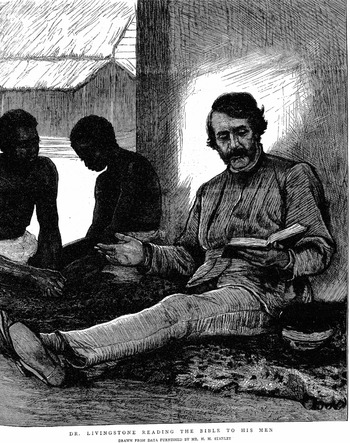
Livingstone thus emerged as an adventurer, master, and freedom-bearer at the time of his interment. But arguably his most pervasive representation was as a Christian and spiritual hero (See Figure 2). He became the “Muscular Christian” par excellence — an identity forged out of a combination of manly vigour and spiritual virtue.Footnote 4 Indeed, an entire suite of religious tropes accumulated around Livingstone, a discourse that was conspicuously thick in the descriptions of his final hours of life. While suffering in his makeshift tent, wrote the Northern Echo, he was but a short while “from his home above” where “the crown was already waiting for his brow” (“The Dead Hero” 2–3). To William Hughes in the Examiner, Livingstone embodied the Pauline model of a successful life: “With Bible in hand he fought the good fight” (106–07). Indeed, Livingstone's spiritual staging even exceeded traditional religious phraseology. To Lloyd's Weekly Newspaper, he was “One of the Apostles of the present age” and nothing less than God's mouthpiece (“On Livingstone” 5). This was heightened by prophetic references, which carried connotations of courageous isolation and lonely perseverance:
Even members of the clergy interpreted him in this Elijah-like fashion. Dean Stanley, for one, preaching at the Westminster interment, endowed Livingstone with the energy of the Hebraic lawgivers, speaking on “the Scripture narrative relating to the death of Aaron on Mount Hor in the midst of the desert of Zin,” a text “singularly applicable to the circumstances under which the great traveler passed away amidst the wilderness of Central Africa” (“Funeral of Dr. Livingstone,” Daily News 3). Similarly, the Rev. H. M. Hamilton took a text from Deuteronomy 32 for his own homily at a parallel service in Livingstone's hometown: “he found him in a desert land, and in the waste howling wilderness”; Livingstone struggled like the nation Israel, but was “shielded” and “guarded,” chosen by God (“Commemoration in Scotland” 5).
“Dr. Livingstone reading the Bible to his men: Drawn from data furnished by Mr. H. M. Stanley.” Illustration from Supplement to the Graphic (25 April 1874): 393. Courtesy of Gale Electronic Products. © British Library Board (Shelfmark 4211.220000 DSC).

The profusion of prophetic references expressed the degree to which, in the public consciousness, Livingstone was found to have exceeded the conventional demands of piety. Such allusions were important too in consolidating Livingstone's image as an epitome of self-sacrifice, “a martyr to the cause he had so ardently espoused” (“The Last Hours of Livingstone” 6). In the pages of John Bull, he was conspicuously “self yielding in these all too selfish days,” one whose “Heroic sacrifice has led the van,/And all humanity must reap the gain” (“David Livingstone” 280). The laboriously entitled “On Reading Livingstone's Last Words in the Account of His Death,” was similar in emphasis:
All these general imaginings of Livingstone reflected a nation's veneration for one who was deemed to have achieved a higher level of existence. His was a life of action and devotion, lived in the public sphere for public good, and so incomparably more noble than common experience. But while Livingstone was a nation's ideal man, it would be a mistake to take the common constructions at face value. Indeed, the celebration of a hero is one thing, but the meaning attached to such heroism is another. For all the shared agreement over a life of worth, Livingstone was no monolithic hero. Lurking beneath the surface of exterior harmony is a story of difference and dispute in which Livingstone was represented and put to use in strikingly different ways. And so, rather than focusing on surface homogeneity, it is the complex nature of competing representations emerging from different socio-cultural locations that I will now explore.
Competing Constructions
The metabiographical methodology, on which the remainder of this paper relies, is influenced by the insights of a flourishing industry in reception theory, with its emphasis on the contrasting production of meaning in differing readerships. Indeed, it could be argued that metabiographical analysis is the consequence of extending hermeneutic logic beyond the textual realm, and applying it to the ways in which events, people, and legacies are multifariously interpreted. Hans-Georg Gadamer was among the first to realise that interpretation operates through the practices of exclusion and selectivity, and that texts are encountered from inescapably specific circumstances. Because historical boundedness is inexorable, the present situation and past experience of “knowers” become “constitutively involved in any process of understanding” (Linge xiv). In reading, one's “horizon” of experience is inevitably brought to bear upon the text; our inescapable human setting, our “hermeneutical situation,” is necessarily implicated in the production of “discovered” meaning (Linge xv). But the point here is that horizons do not merely impact textual experience; rather, they govern one's interpretation of wider life and its significance more generally.
The importance of “horizons” also surfaces in Charles Taylor's magisterial volume, Sources of the Self, in which they become critical for thinking about self-identity. For Taylor, the horizon is that space of questions in which one exists and through which life takes on meaning. The “complex and many-tiered nature” of selfhood and identity take their shape in relation to the orientations and identifications provided by this framework (Taylor 29). These range from what we consider universally valid commitments to the more local and particular. In other words, from the lofty to the mundane, “what I am as a self, my identity, is essentially defined by the way things have significance for me” (Taylor 34). The relevance of Taylor for my argument is this: just as one's own self is constituted out of some horizon of significance, so too was Livingstone's identity. Even while there was some “common” image of Livingstone, the competing horizons of the “sites of construction,” with their distinct values and identifications, were brought to bear on interpreting the “meaning” of his heroism. Those with different frameworks found different significances in Livingstone's life and work and so they constructed him accordingly.
I will begin my exploration of the sites of construction in which Livingstone was differently produced by contrasting the emphases of scientific and religious arenas, two spaces which distinctly made the hero in their own image. Among scientific sites, the Lancet medical journal perhaps most clearly demonstrates the creation of Livingstone out of a specific horizon. The medical profession continually emphasised his role as physician. One letter to the editor stressed that “Livingstone, besides his holy occupation, belonged to our profession. In my own mind I have a strong impression that a considerable portion of his great works resulted from that part of the education which he imbibed in our professional schools” (Fergusson 566). Given the medical mould in which this construction is cast, it is unsurprising that Livingstone's significance became so bound up with his physician's training. Indeed, Livingstone even became an iconic emblem of the medical character; in embarking upon “the devious and dangerous career of missionary explorer,” one contributor wrote, he exemplified “the unmercenary character of the student of nature” (“Medical Annotations” 674). Here professional calling and moral virtue were seamlessly interwoven. Yet another article, pondering the reasons for the small number of doctors entering the navy, concluded that “[i]t cannot be that they are deterred by ignoble motives of personal safety and comfort, or are less imbued with a spirit of adventure than the rest of their countrymen: a long distinguished rôle of men, from Park and Livingstone” would indicate otherwise (“The Naval Medical Service” 665). So Livingstone was enshrined as a distinctly medical hero. He gave ammunition to a fantasy, becoming an embodied representative of an idealised self-image. And the medical world was by no means unaware of the esteem that Livingstone was able to bestow upon them. The Lancet traced the discussion surrounding the erection of a “Memorial Missionary Training Institution” in his memory and the creation of a “Livingstone scholarship”; together these “would at once express our regard for his memory, and show that we are not insensible to the great honour which Livingstone has conferred upon us” (J. M. B. 607).
Certain religious zones similarly claimed Livingstone as their own distinctive kind of hero. An article in the British Quarterly Review, a magazine that appealed to Congregationalists and Baptists, claimed to show “how the work that made this man so justly famous grew out of the noble nature of his soul”; “Never perhaps in all the history of human enterprise was a career of physical discovery so . . . constantly crowned by religious devotion” (“David Livingstone” 507, 494). Just as the Lancet represented his medical training as the wellsprings of his success, this religious journal declared his piety to be foundational. While Livingstone was generally recognised as a hero of the faith, as we have already seen, the British Quarterly strongly staked a claim to him by arguing that his spiritual status was the way to understand his importance: “His career, if read aright, should teach the world that religion is not a speciality of dogmas and ceremonials, but a great satisfying influence, catholic enough to embrace all forms of fruitful labours” (“David Livingstone” 514). In this understanding, the most legitimate interpretation of Livingstone's career was one that drew upon his energy to bolster Christianity and more particularly the independent brand of low worship practice.
A key difference between the scientific and religious zones was one of emphasis; the former tended toward a results-based discourse, while the latter preoccupied itself with character and devotion. In Nature, for example, the concern was always Livingstone's “grand results” and the ways in which “various departments of science [have] been enriched by his observations . . . . [H]e has shown that in Africa a fertile field remains for the minute observations of the trained naturalist, ethnologist, geologist, and meteorologist” (“Livingstone's ‘Last Journals’” 143). The scientific value of his journals, and their expression of disciplined empiricism, was constantly exhorted; “nearly every sentence is a statement of an observed fact,” and “there is so little of what is superfluous” (“Livingstone's ‘Last Jounals’ II” 183). For the British Quarterly Review, however, a results discourse was not so appealing. Of course a religious paper would have no desire to focus on the fruits of scientific and cartographic fieldwork, but neither did it choose to concentrate upon the results of Livingstone's evangelistic work. This was simply because he was notoriously unsuccessful in winning converts – those typical signifiers of missionary success. And so, instead, the emphasis was upon Livingstone as one of those “whose characters have been a more precious legacy than any of their practical achievements.” He would leave “new lines of character” which would “affect the whole being of mankind (British Quarterly, “David Livingstone” 487).” His greatness lay in his embodiment of Christian virtue, in his moral influence, rather than the more seemingly tangible outcomes of his work. In both these spheres then, the scientific and the spiritual, what Gadamer calls the “prejudices” of the interpreters mediated the way in which Livingstone was understood (Linge xv). For Gadamer, an act of understanding must bridge the gap between the alien object and the familiar world that is already understood (Linge xii). And so Livingstone became encompassed by and assimilated into the familiar horizons of his interpreters. Both sites clearly presented Livingstone as a hero in terms that they valued, as a champion in their own image. They created him out of contrasting economies of virtue for particular readerly communities who inhabited the same network of esteem.
By creating Livingstone in such self-mimetic fashion, both sites revealed their preoccupation with status and their desire to cultivate greater prestige by fostering their connection with the explorer. As William J. Goode argued in his pioneering study, human beings seem to have a fundamental need for respect, admiration, and approval (7). And furthermore, individuals as well as “[o]rganizations from clubs to nations constantly try to change their own internal prestige payments (as they try to alter external economic or prestige markets in their favour) so as to reward and support one type of activity rather than another” (Goode 54). Indeed, in the competing constructions of Livingstone, he actually entered into this process of status negotiation by functioning as a sort of symbolic capital. Those writing about him sought to claim him as one of their own and to draw upon his substantial reserves of honour in order to bolster their societal position. Both spaces, scientific and spiritual, presented him in such a way as to profit through association with a name that was an exceedingly powerful cultural commodity. Livingstone was not constructed in order to merely reflect competing horizons, but was drawn on in order to consolidate them.
It would be mistaken of course to cast the debate over Livingstone in the tired and clichéd dichotomy of science versus religion. The obituary in the Proceedings of the Royal Geographical Society transgresses and complicates such a binary model. Of course, given its audience, Livingstone's importance as a geographer and scientist received most textual space. Sir Bartle Frere, President of the Royal Geographical Society (RGS) and a former Governor of Bombay, quoted Lord Ellesmere on the quality of Livingstone's writings: “I believe I may say that there is more sound geography in the sheet of a foolscap which contains them than in many volumes of much more pretension” (506). His career was nothing less than a metamorphosis “from that of the quiet but active missionary . . . to that of the bold and vigorous explorer” (501). Frere self-consciously alluded to Livingstone's debt to the Society and reminded his readers how the RGS championed him: “Such honours as it was in our power to bestow were quickly his” (506). By so presenting Livingstone, Bartle Frere mobilised his reputation to raise the prestige and profile of the society and geographical endeavour. Yet this obituary is evidence of both the way in which the projections of the explorer can overlap and interlink, and the complex nature of the horizons which mediated his interpretation. For Frere also happily acknowledged that “the wide and extended view he had of the duties of his sacred calling, gave to his character an elevation and power far beyond what the highest mental or physical gifts could have commanded” (502). In articulating the spiritual underpinning of his vocation, Frere's obituary demonstrates that scientific and religious constructions of Livingstone were not mutually exclusive. Each site of construction was not entirely hermetically sealed from its neighbours, but was an intellectual space where a particular image of Livingstone took shape with greater or lesser intensity.
The complicated nature of the spaces of production can be seen in internal conflict within their own borders. For instance, the religious spaces themselves were by no means homogenous. While a common trend in the newspapers was to represent Livingstone as a non-denominational hero, with a “thoroughly unsectarian Christianity,” in reality he became embroiled in factional struggle (Daily News 4). The nonconformist Northern Echo, for one, used Livingstone as ammunition against the established Church, quoting at length his diatribe against the Anglican practice of “sheep stealing” by placing Bishops in areas where other missions had done the groundwork (“Sacerdotal Insolence” 2).
Such sentiments, unsurprisingly, had not exactly received a favourable hearing among some sections of the Church of England. Indeed, when Livingstone's letter was publicised it provoked a firm rebuttal from Rev. J. L. Barnett at a meeting of the Society for the Propagation of the Gospel. In his counterattack he took it upon himself to destabilise Livingstone's status as a spiritual hero. While he was “great as a discoverer; great as an adviser of the statesmen of the age,” Livingstone was no theologian or “representative of the Church of God” and so was without religious authority; he was certainly “not great as a judge of the policy and action of the Catholic Church” (“Society for the Propagation of the Gospel” 5). While Barnett's rather critical perception of Livingstone was certainly a minority viewpoint, it serves to reinforce my claim that different “Livingstones” came into being in various socio-political locations.
Barnett, however, could not escape censure from Livingstone enthusiasts. The Northern Echo firmly took an opposing stance. An article that appeared on 16 April railed against the clergyman's comments, even denouncing the established Church as guilty not only of “flagrant violation of both the letter and the spirit of the religion they profess, but of that more deadly sin, too often committed now-a-days, of identifying Christianity with the most hateful intolerance, and parading as the spirit of the Church of CHRIST the very spirit of those who crucified the Saviour.” The Northern Echo stormed at the Church Herald for its “unfavourable comments upon Dr. Livingstone's interment” and described it with loathing as “that organ of Antichrist.” Barnett was merely “an indiscreet member of a great and growing party in the Establishment, whose ideal seems to be to disgust all rational Englishmen with religion, and to drive the masses of the country into atheism” (“Sacerdotal Insolence” 2). In all this, the Echo was able to use the weight of Livingstone's life and legacy as a weapon against the established Church. The perhaps foolish criticism of a national hero provided a welcome opportunity for a nonconformist paper to lambast the theological opposition. Clearly, Livingstone had become a pawn in a larger politico-ecclesiastical struggle between the established and dissenting church communities. He had become a resource for culture wars, a territory on which theological battles could be fought out.
National Negotiation
The scientific and religious arenas explored are merely two venues among the many where the meaning of the Livingstone phenomenon was actively constructed. In their conspicuous difference, however, they are indicative of the more general principle that differing horizons critically impinged upon the way Livingstone was created. But there are also sites of a broader nature, operating at a different scale, overarching these intra-cultural struggles. Indeed, contemporary geopolitical horizons came to play a key role in shaping the nature of Livingstone's heroic persona. The differing representations to which he was subject in both Scottish and American spaces attest to something of how Livingstone was marshalled in the cause of broader national agendas.
Newspaper obituaries from north of the border quickly reveal that Livingstone was valued and enshrined as a specifically Scottish icon; his Blantyre roots, his Glaswegian education, and his Scots “character” all came to be valorised. But how should these claims to Livingstone be read? The strong declaration of his Scottish identity could surely be taken as an expression of nationalism. One letter to the Glasgow Herald forcefully asserted Livingstone's Scottishness by contesting his burial in Westminster Abbey. “One can hardly help feel that Livingstone himself would have shrunk from this trumpet-blaze of fame at his interment, and would have liked a less famous resting-place.” The author tried to reclaim Livingstone by urging that he should be interred on Scottish soil: “there is no town that has more pre-eminent claims than Glasgow to be the resting-place of the illustrious Livingstone. . . . All his early associations were with the West of Scotland and its capital. What place, then, more suited for his final repose than our ancient Cathedral?” (“Where should Livingstone be Interred?” 7). Underpinning this epistle could be an irritated nationalist force that aimed to reclaim Livingstone from the appropriation of a grasping south. Another writer, adopting a more humorous tone, noticed that the London Times “had a leader about the departed being a great ‘Englishman?’” and joked that “the coffin plate will a little disturb the Cockneys,” who “to their great disgust must call him a Scotsman” (“A Glasgow Man on his Travels” 7). Again, a note of resentment that Livingstone's Scottish identity was so often overlooked can be most clearly detected. Both these letters sought to resist English hegemony and bristled at the tendency to stage Livingstone as the embodiment of “English” character. As Peter Mandler observes, English dominance within the “mongrel” mix of the United Kingdom meant that it had become “possible unselfconsciously to talk about ‘England’ and mean ‘Britain’” (66–67).
While a strand of nationalist sentiment is arguably detectable here, what is just as conspicuous are the efforts made by Scottish partisans to use Livingstone to renegotiate British identity itself. Paul Ward warns against the historiographical tendency to interpret every “expression of non-English identity,” purely “as an implication of nationalism” (143). Instead, echoing Homi Bhabha, he insists that “Britishness has always been unstable” and is constantly “in a process of formation” (Ward 3); a nation is recursively “caught, uncertainly, in the act of ‘composing’ its powerful image” (Bhabha 3). Scottish identity has been perennially capable of co-habiting with a British one since, as Linda Colley has famously written, “identities are not like hats. Human beings can and do put on several at one time” (6). Despite deep tensions in Britishness, “across the period since 1870 the majority of people living in the United Kingdom, have adopted cultural and political identities associated with the existence of this multi-national polity” (Ward 2). In the late nineteenth century, “the complicity of many of the Scottish in imperialism was utilised as a method of enhancing a distinctive Scottish identity, but at the same time Scottish men made the Empire truly British” (Ward 150). And so the repeated, if often gentle, assertions of Livingstone's Scottishness served to remind the United Kingdom of Scotland's integral role in Britain's identity and in its international adventures. In other words, Livingstone had become part of a prestige struggle on a national scale. British rivalry was performed on the platform of his name. So whether all this is read as one episode in a wider struggle to negotiate Britishness, or as symptomatic of a simmering nationalist sentiment, a Scottish cultural landscape is clearly conspicuous as a critical horizon against which Livingstone was projected.
Within Scotland itself, moreover, Livingstone was subjected to regional claims. One letter to the Herald mourned that “Glasgow was lacking somewhat in her characteristic energy” when it allowed the honour of a memorial to Livingstone, “rightly hers,” to pass to Edinburgh (“A Statue to Livingstone” 3). A memorial in Glasgow was appropriate, another letter argued, since “Livingstone might be considered as one of our fellow-citizens, born in the neighbourhood” (“Statue in Glasgow to Dr Livingstone” 4). Just as the Lancet recognised medicine's gain in prestige by connection with Livingstone, so it was acknowledged that through a memorial Glasgow “would honour herself” (4). Thus Scotland's industrial city lamented the missed chance to draw upon Livingstone's symbolic reserves. Rival regions vied over the prestige and cultural capital associated with Livingstone's name. The hero was not, then, constructed out of merely national horizons: here, Livingstone became local.
It is worth noting too that the use of Livingstone to imagine a common British identity did not rest with the Scots alone. Lecturing at the City Hall in Glasgow, Bartle Frere emphasised that Livingstone was, as the Leeds Mercury reported, “one of the many Scotchmen who may be fitly represented to you as a hero worthy of your Ideal allegiance” (“Sir Bartle Frere on Livingstone” 6). The Times noted that Frere referred to “the important part which Scotchmen had taken in what he regarded as the great works of that nation” (“Sir Bartle Frere on Livingstone” 7). For both the Scottish and other Britons, Livingstone helped consolidate the strength of the Union. But Frere's involvement reminds us that which Livingstone was presented depended on the readerly community into which he was projected. He calculatingly emphasised Livingstone's Scottishness precisely for the purpose of playing on the national sensibilities of a Scottish crowd.
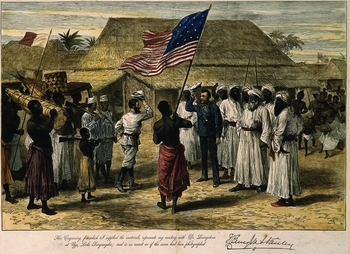
But Britishness and Scottishness were not the only geographical identities at stake in the posthumous representation of Livingstone. Clare Pettitt convincingly argues that Livingstone's connection with H. M. Stanley, the journalist from the New York Herald, had significance for transatlantic relations (See Figure 3). Their famously comic encounter, in 1871, had been “a fitting symbol of a thaw in Anglo-American relations after all the bitter feeling over the American Civil War” (Pettitt 12). Britain's tacit support for the Confederate cause, in building ships for the southern states, despite their official neutrality and opposition to slavery, had left considerable tension between the two nations. The United States had demanded reparations, known as “Alabama claims,” and in 1872 “Stanley's handshake was timely, reported as it was alongside the successful settlement of the claim that same summer” (Pettitt 90). Now Stanley was certainly interested in self-promotion, and he exploited his connection with Livingstone to such an extent that he was taken off in the Examiner, which in writing “of the distinguished reception given to Mr. Stanley in Westminster Abbey” noted “the opportunity taken at the same time of interring there an individual of the name of Livingstone” (“Acknowledgements and Notes” 602). But there were deeper agendas at work in Stanley's construal of Livingstone. He sought to convey a hero who could appeal to both Americans and the British and so, in order to cultivate transatlantic brotherhood, he drew upon the concept of the “Anglo-Saxon.” This was “a means of consolidating and legitimating a new identity for America – as a global force for good” (Pettitt 122).
H. Hall, “Henry Morton Stanley meeting David Livingstone at Ujiji, in Africa.” Coloured wood engraving. c. 1880 Courtesy of Wellcome Library London.

After his death, Livingstone continued to serve the cultivation of transatlantic partnership. Stanley closed a lengthy article on Livingstone published in the Graphic by promoting the shared role of the States and Britain as “the shepherds of the world,” who must protect “the feeble and oppressed races of Africa” (407). The Herald, the paper behind the scheme to “find Livingstone,” also drew attention again and again to the Stanley connection. James Gordon Bennett, the Herald's editor, considered it his duty to keep the British press well supplied with letters from Livingstone to Stanley that expressed the Scot's great indebtedness to the younger American. In one letter Bennett sent to the Times, Livingstone wrote to Stanley that “I felt, and still feel, that I had not expressed half the gratitude that wells up in my heart for all the kind services you have rendered to me. . . . I am perpetually reminded that I owe a great deal to you, for the men you sent” (“Dr. Livingstone” 5).
However, the American depiction of the Livingstone-Stanley encounter was more than an exercise in the forging of transatlantic comradeship. According to Pettitt, Bennett presented Stanley's success in “finding” Livingstone as an American victory over the “Royal Geographical Society of London, backed by the ready purses of the whole English nation” (100). Stanley's “scoop” became “the emotive story of the ordinary American man overcoming the massed power of the old-world elite” and displayed “the force and purposefulness” of the United States (Pettitt 106, 116). It seems that Bennett meant not so much to imply fellowship between Britain and America but rather to suggest the latter's superiority as the new leading world power. If Britain and America were members of the same family, there was to be no doubt who was the big brother. When Livingstone died, this parade of predominance persisted. In fact Bennett actually capitalised on the hype surrounding Livingstone's demise by appropriating his energy to an American hero. Stanley too sometimes seemed less concerned with transatlantic solidarity than with cultivating American triumphalism. Sometimes, however, the two aims were held in ambiguous tension. Preparing for travel in mid-November 1874, for instance, Stanley publicised his “enlistment of all the ‘faithfuls’ who have at various times accompanied Livingstone, Speke, Burton, Grant, and himself” (“African Exploration” 6). Did this manoeuvre suggest affinity between the United States and Britain, between himself and the other explorers, or did it suggest that both he and his country far surpassed the old? In life and in death, then, Livingstone found himself embroiled in the negotiation of the United States both as a British ally and as a younger, more vigorous nation. In these representations, Livingstone's relationship with Stanley went way beyond the personal; he was the foil to an American hero.
In both these spaces, Scottish and American, we see what David Linge calls “the constitutive role of the interpreter's own facticity in all understanding” (xvi). The historical positioning and political situation of the interpreters were inescapable facts that inevitably bore on the significance read in Livingstone. Indeed, understanding and interpreting always involve an act of “translation” into the terms of one's present horizon. Livingstone's representation was thus mediated through contemporary political realities. The undercurrents of the national concerns of both Scotland and the United States were clearly reflected in their respective constructions of the hero.
Spaces of Dissent: Livingstone as Antihero
In nearly every portrayal of Livingstone considered so far, he has been treated as a hero. The reason for this is not difficult to discern. The differing representations have all arisen against a backdrop of a shared sense that his life was one of worth, and association with him was something to be desired. Yet, this was not always the fate of explorers. According to Driver, more often than achieving heroic status they “were presented as controversial figures who challenged rather than defended orthodoxy” (Geography Militant 22). In contrast to those material and institutional locations in which we have so far seen Livingstone constructed, the site of dissent in which he took shape as something of an antihero was rather more metaphorical. It was a space imaginatively produced through the common association of those for whom Livingstone could be no unambiguous celebrity.
Of course, during his lifetime Livingstone was not free from censure, particularly after the disaster of the Zambesi expedition and the tragic deaths of members of both the Helmore-Price and UMCA missions (Universities’ Mission to Central Africa). It is important to realise too that even in the midst of the hero-worship offered up on his death, this strand of critique was never quite extinguished. Henry Rowley, a surviving member of the UMCA, continued to cast doubts on Livingstone's character in an article for the Cornhill. While applauding his service to humanity, his powerful faith and non-sectarian character, there were points at which Rowley was by no means sparing in his censure. Livingstone, he declared, was “scarcely fitted to be the leader” of the Zambesi expedition at all. “His arbitrary, not to say unjust, dismissal of some; his distrust of others, who were worthy of confidence; and the sense of failure, and consequent vexation of spirit, which beset not only him but all others associated with him, had practically broken up the Expedition before it was abruptly recalled” (Rowley 420). Notwithstanding the continual lionising and memorialising that came Livingstone's way, these niggling doubts about Livingstone's inferior leadership call attention to how the “myth-making process was fraught with conflict” (Driver, Geography Militant 131). The transfiguration from man into icon could never occur seamlessly without resistance.
Paul Zweig has drawn a helpful distinction between the hero and the adventurer that could be of use here. A hero is “the sort of man who risks his life to protect society's values,” while an adventurer is “a darkly sinister anti-social character”; “dangerous to his friends and to his enemies alike”; and, who “fascinates because he undermines the expected order” (Zweig 16, 34). Livingstone was surely no full-blown adventurer in Zweig's sense; he is by no means an “embodiment of all risk, all transgression” (34). Yet in Livingstone's case the dichotomy might be false for he seems to straddle aspects of both Zweig's hero and his adventurer. The dubious leadership that Rowley so condemned, alongside his refusal to be open and frank with his companions, his utter obsession with conquering the Cabora Bassa rapids, and his unpredictable and brooding character certainly problematised his celebration as a hero in certain domains. Even while becoming canonized as a saint, then, there remained a strand of thought casting Livingstone as a potentially dangerous figure.
Of course, there were certain deep anxieties that surrounded explorers more generally. Many worried that they would “go native” and abandon their European civilised standards. Certainly this dread of degeneration surrounded Livingstone whose strange accent and deeply tanned skin created something of a stir on his visits to the imperial centre. Bartle Frere, lecturing in Glasgow City Hall before the news of Livingstone's death had broken in Britain, felt the need to address those who wondered at “the degree . . . he has naturalized himself in Africa and become like one of the Africans.” While of course Frere declared him “to be still, and to have always been . . . a missionary of the Cross,” the necessity of meeting such concerns at all indicates the reservations that surrounded explorers who spent such lengthy periods away from the homeland (“Sir Bartle Frere on Livingstone,” Times 7). Some also found themselves anxious about Livingstone's attitude to the indigenous population. While his humanitarianism routinely received praise, the Scotsman, on 30 July, described his viewpoint as typical of the “negrophilists,” at the opposite pole from Richard Burton and Samuel Baker who “always assigned to the negro a rather low place in nature” (4). Again, on 21 April, the Scotsman warned against “illusions and prejudices of love, as well as those of hatred,” implying that Livingstone was so deceived when it came to the “negro”: it was the hideous slave-trade which “prompted him to clutch more passionately to his heart the down-trodden victim, and to overlook his faults” (4). Livingstone's progressive racial politics are seen here as an embarrassment needing to be explained away. For those who were particularly strong advocates of racial hierarchy, of the “anthropological” persuasion, he could not be simply praised without qualification.Footnote 5
While all these qualms might differ from the sense of foreboding that Zweig sees surrounding the mysterious and antisocial adventurer, they nonetheless express a disquiet that his was a radical free spirit that might transgress accepted societal bounds. Personal antipathy and political persuasion could situate an author on the continuum of dissent, in a site of construction where Livingstone was imagined as an antihero.
The “Body” of Evidence
So far we have seen that Livingstone, from the very moment of his demise, was subject to conflicting constructions and competing claims to his name. His persona was malleable and mouldable, able to take on various meanings for different people and groups. Something of this struggle was reflected in his spectacular funeral in Westminster Abbey (See Figure 4). Clare Pettitt, engaging in a semiotic exercise, suggests that the whole spectacle “drew attention as much to the mourners as to the mourned” and revealed at least two ways of reading Livingstone's life (135). She argues that the presence of the aristocracy and his entombment in Westminster Abbey, opposite Field Marshall Wade, signified that he was embraced by the ruling classes, while the presence of Sir Fowell Buxton, the anti-slavery campaigner, the radical MP John Bright, and other “notable radicals and critics of the empire” emitted a distinctively different message (Pettitt 135). As Driver writes, “each of the pall-bearers on that day in April 1874 were staking a claim upon his name as well as his body” (Geography Militant 68–69). Thus Livingstone was symbolically connected with radical British politics even whilst concurrently being canonised as the establishment's hero of empire. “Even as the funeral staged the triumphalist power of empire and of ‘England’, the forces of resistance and criticism were present” (Pettitt 134). Different visions of Livingstone competed while he was consigned to the grave, as groups with diverging politics simultaneously laid claim to him.
“Funeral of Dr. Livingstone in Westminster Abbey.” Etching. 1874. Courtesy of Wellcome Library London.

What is particularly interesting here is the way in which a single event, the burial of Livingstone, took on different meanings for different people. But this analysis can be pushed even further. Livingstone's mangled corpse, no less than his funeral, was itself a site of multiple and conflicting significations. His carcass actually became a symbolic space on which a wider debate over the capacity and authority of black Africans could be played out. Underlying the entire discourse of the remains, their return, and their identification was a trial of native reliability and black capability. Indeed, it is precisely because of its significance as a testing ground for African credentials and trustworthiness that the transcontinental journey of his body, from the heart of Africa to Westminster Abbey, attracted such extensive textual space and became a national obsession and public event.
When the first rumours of Livingstone's passing began to reach British ears, there were mixed reactions. Some believed and began to mourn, while others were more dubious, remembering comparable tales propagated by Livingstone's “Johanna men” in 1867 which had soon proved to be false. Since these new reports similarly originated with Africans, for many in Britain they emphatically could not be trusted.Footnote 6 Indeed many of Livingstone's oldest and most famed companions cast doubt on African truthfulness, revealing a deep-set distrust of indigenous authority. Dr. John Kirk, for one, aired his suspicion; for him the story was pure fiction. After all he was one who knew firsthand “how rumours grow in Africa” (“Central Africa and Dr. Livingstone” 5). The future editor of Livingstone's Last Journals, Horace Waller, had similar reservations. He pointed to “the habit the natives have of using an exaggerated expression which leads one to suppose a man is dead when he is only seriously disabled” (“The Fate of Dr. Livingstone” 5). David Leslie, writing to the Glasgow Herald as late as 23 February, sought to discredit native witness and to pitch the authoritative weight of his own experiences in Africa against it. It was his superior knowledge of tribal life on which he “ground [his] doubts as to the truth of the reports.” No matter how seemingly honest, native reports should always be greeted with a healthy dose of suspicion. “The Johanna men were also ‘faithful servants’,” he pointed out, “and they lied” (Leslie 4). So why trust these new and equally dubious rumours? Continually, reasons were dug up to doubt the native report. Surely, some complained, preserving a body in salt would be impossible in the African climate. And surely, others argued, the Africans’ manic fear of corpses and their lack of respect for the dead were even greater grounds for doubt. Robert Moffatt, Livingstone's father-in-law, articulated the logic underlying all of this: the hero simply could not be pronounced dead until certified by the “evidence of Europeans” (“The Reported Death of Dr. Livingstone” 3).
Indeed, the only decisive body of evidence that would eradicate doubt was Livingstone's body itself. Only by an examination of the corpse could the question finally be settled; it would take Western scrutiny to authorise a tale of African origin. When Livingstone's corpse arrived in the United Kingdom, the prestigious surgeon Sir William Fergusson was called upon to identify the body and so put all anxieties to rest. In his post-mortem Fergusson described himself as “one of those who entertained hopes that the last reports of Livingstone's death might, like others, prove false” (566). But when he examined the largely unrecognisable remains, the discovery of Livingstone's infamous “false” arm joint “set [his] mind at rest.” Livingstone's men could now be counted trustworthy, vindicated by an “oblique fracture,” “[e]xactly in the region of the attachment of the deltoid to the humerus” (Fergusson 566). As Dorinda Outram has perceptively written, “the oldest locus of authority is the human body” (290). In Livingstone's case it became a means of verifying the stories of those who, by their ethnicity, were cast aside as without credibility.
When Livingstone's native companions were finally vindicated and their constancy confirmed, their fortunes changed; they became heroic figures publicly praised. But even then the dialogue surrounding Livingstone's body did not entirely cease; the discourse instead shifted from a discussion of African reliability to African capability. In other words, while the authority and truthfulness of Livingstone's men were no longer at stake, some suggested that the body's successful transcontinental journey was in actuality owed to European assistance at the critical moment. A series of letters, printed in the pages of the Times, passionately disputed the matter of the glory due for its spectacular return. Did the credit belong to his self-sacrificing African followers, or to the Europeans of Lieutenant Lovett-Cameron's party? The debate was spurred by a letter from Clements Markham, secretary of the RGS: “The time has, I think, come when I may ask you to bring the Cameron-Livingstone Expedition more prominently than has hitherto been done before the notice of your readers” (12). He presented Cameron as Livingstone's heir; his attempt to reclaim the hero's papers at Ujiji was nothing less than an act of “obedience to the dying request of Dr. Livingstone.” But most critically, Markham contended that “it was owing to aid given by Lieutenant Cameron's party that Dr. Livingstone's body was sent down in safety to the coast” (12). While the trustworthiness of those who bore the body was no longer the issue, Markham's letter certainly sought to shift the glory and confer it upon Cameron.
Markham's missive immediately provoked a response from Livingstone's son Thomas, whose brusque letter to the Times fuelled a dispute which would eventually be terminated by the editor a month later, on 10 August, as a most “ungrateful controversy” (12). Thomas, writing on 9 July, rebutted Markham's “grievous error in supposing that but for meeting Mr. Cameron's party, the brave fellows who had carried my father's body . . . would not have reached the coast” (8). His retort was that Susi and Chuma “should have reached Zanzibar much earlier had they not been obliged to escort Dr. Dillon and Lieutenant Murphy.” Thomas defended his father's African followers from those who would belittle them: “One cannot allow anything to pass that might in the slightest degree detract from the splendid feat accomplished by my father's attendants” (8). The body's return proved, for him, the capacity and competence of Africans and he was intent on advocating their cause.
At this stage, Cameron's father “the Rev. J. H. Lovett-Cameron, vicar of Shoreham, Kent,” took up the cudgels. In reply to Thomas he asserted that his son “Lieutenant Cameron sent out succour to the explorer's servants before their reaching Unyanyembe, and furnished them with supplies for the journey to Zanzibar” (Lovett-Cameron 12). Indeed, it was due to “Lieutenant Murphy's management, when he was in charge of the caravan” that the bearers “secured the unmolested conveyance of the remains through the Ugogo country.” The likelihood that they would have completed the march without this aid was “improbable” at best, especially in light of “the misconduct of the great majority of them at Unyanyembe” (12).
But the matter was not allowed to lie. Thomas responded again to what he considered the preposterous claims made by Cameron's companion, Murphy, to have provided critical aid and protection for the indigenous carriers. His letter, on 10 August, struck at what he called “a masked battery” against his father's men. He lashed out at Murphy, calling him an “infant in exploration” compared to Chuma and Susi who were “old enough in experience to be his great grandfather” (Livingstone 12). They certainly were “able to shift for themselves after eight years’ tramping and exploring” with Livingstone, and so he doubted their need for any assistance at all. For rhetorical support, Thomas quoted his father's journal, which condemned those who dismissed Africans lightly: “Nothing but the most pitiable puerility would lead any manly heart to make their inferiority a theme for self-exaltation. However, that is often done, as if with the vague idea that we can, by magnifying their deficiencies, demonstrate our immaculate perfections” (12). In all this Thomas staged himself as an advocate of Africans, championing their cause against those who would appropriate the credit and fame due to them. He took the side of the indigenous, resisting those who would try to reveal a fundamental foundation of European assistance.
Native capability was not all that was at stake in this debate in the Times. Cameron and Murphy's advocates were undoubtedly on a campaign to promote these explorers as heroes in the Livingstonian mould, for his name served as a resource by which to cultivate the reputations of less illustrious travellers. Prestige could be significantly enhanced by a symbolic connection with the ultimate heroic trekker. Perhaps then, another logic at work in Thomas Livingstone's vigorous defence of the indigenous, and his confrontation with Cameron and Murphy, was to do with resisting these new heroic claims. He was anxious, indeed admirably so, to defend his father and to prevent the eclipse of his memory so soon after his demise. In protecting Chuma and Susi's achievement, Thomas simultaneously defended his father's reputation, for it was commonplace to attribute their astonishing perseverance to Livingstone's civilising and humanising influence. David Leslie's letter to the Glasgow Herald is a case in point:
“if [Livingstone] has died as we are told, the greatest proof to my mind of the ascendancy he gained in Africa, of the power which his very name was possessed of, would be the fact of his men having carried his remains to Zanzibar, and having been allowed to do so by the inhabitants of the villages through which they passed”. (Leslie 4)
In other words, Livingstone's men had become signifiers of his success, emblems of his supreme authority. In defending them, Thomas protected the father he had so recently lost; their success was proof of the civilising mission so precious to Livingstone.
Issues of indigenous credentials certainly wove their way through the discourse surrounding Livingstone's mortal remains, as did the matter of his own credibility. But there was another way, yet more fundamental, in which authority was bound to his body. Of course, matters of warrant and dependability have always surrounded travellers, who would return home bearing incredible tales from remote and exotic lands – stories that often seemed just too fantastic to be true. Unlike other scientific discoveries, traveller's reports from overseas could not be replicated and tested in any simple way; they simply had to be trusted. But how could one be sure that the explorer was an honest and reliable reporter, rather than a manipulative fraudster? The solution lay in character. Authentication came to rely upon moral calibre. Michael Heffernan sheds light on the resolution of such credibility quandaries when he reveals how warrant often came to reside in the bodily wounds and scars won in exploration; they came to serve as signs of reliability, signifiers of moral authority. Heffernan argues that “[a]uthority ultimately derived, if not from premature death itself, then at least from the corporeal evidence of heroic travel – the noble empowering stigmata of scarred and disfigured bodies” (219). Livingstone's mangled remains sealed his status and proved his heroism. The extraordinarily graphic examination report by Sir William Fergusson, reprinted in the popular press and hungrily consumed by the public, was an anatomical eulogy fit for a martyr:
The lower limbs were so severed from the trunk. . . . The soft tissues seem to have been removed to a great extent from the bones. . . . There had been made a large opening in front of the abdomen and through that the native operators had ingeniously contrived to remove the contents of the chest. . . . Every where was that shrivelling. . . . The features of the face could not be recognized. . . . A moustache could not be recognized, but whiskers were in abundance. (Fergusson 566)
Most attention was given to his most ancient badge of authority, the arm shattered by a lion attack, of which Lloyd's wrote, “No dust of hero in the Abbey bears a more honourable scar than this!” (“The Funeral of Dr. Livingstone” 1). His disfigured arm and crushed remains bore testimony to truth and his credentials. He had been prepared to go to the extremes in pursuit of his cause, and his body had borne the consequences.
Pettitt, analysing the hype and sensation surrounding the return of “withered remains” argued that they “were reassuringly unbodily” by the time they arrived in Southampton. The delay had allowed his corpse to be “purified of all suspicion of material corruption” and so, wizened like a saint's body, “Livingstone had been both literally and imaginatively transformed from mortal remains to immortal relic,” to what Lord Houghton called a “sacred crust” (Pettitt 126). While there is merit to this argument, it equally seems to me that there was such fascination with his body because it was a mangled corpse. The gruesome embalming procedure, with the bloody removal of guts, was a major source of captivation; it was physicality and corporality that enthralled the people as much as a sacred relic. His brokenness spoke of adventure and sacrifice, and firmly sealed his status as the ultimate explorer-hero in the eyes of the public.
Livingstone's body was the site of multiple and conflicting meanings, a site of clashing horizons. It was an arena in which debates about native warrant and indigenous potential could be dramatised. But the story of the body's return also provided the opportunity to negotiate and debate the prestige of other explorers, who would profit by association. On another level the whole body discourse was crucially bound up with the issue of Livingstone's own authority. The successful return of his remains signified his civilising influence in moulding such exceptional men, while his battered carcass spoke volumes about sacrifice.
Conclusion
This article has sought to escape the notion that Livingstone was enshrined in any homogenous way. While MacKenzie has observed the surprising heterogeneity of his longer heroic history, no one to date has explored in detail the plural nature of his identity at the height of his fame and the competing discourses surrounding his demise. From the very moment of his interment, Livingstone was subject to competing claims, and so divergent meanings have been perennially attached to him. Underneath the umbrella of his name were a plethora of heroic identities, constructed out of a plurality of Victorian cultures. Debated and created in disparate intellectual and socio-political sites, he was diversely produced by groups possessing contrasting horizons of significance. And being created in the image of the creators, Livingstone became deployed as symbolic capital, a mechanism for enhancing status and prestige. As a cultural commodity his name became involved in diverse disputes that ranged from the theological to the national and even the international. Quiet voices of dissent for whom Livingstone was a dangerous and potentially transgressive figure persisted and complicated his consecration.
Livingstone's corpse had powerful symbolic value: it too became a space for debate. An altercation over extra-European authority and reliability found its focal point in the remains. Indeed, the contemporary clash in notions about Africans was played out in the diverging stories about the body and its return to Britain. But all this also had implications for Livingstone's own credibility. The transcontinental journey seemed to signify his tremendous elevating influence, while the actual battered carcass put the final authorisation upon his discoveries and heroic status. A final couplet, from one of the many poetic venerations, seems an appropriate (or perhaps inappropriate) way to conclude:
These words now carry ironic weight; Livingstone's name simply never carried just one meaning that could remain in eternal stasis.