Introduction
Consanguineous marriage, a union between biologically related persons such as second cousins or closer relatives, has been a long-standing social habit among populations. The prevalence of consanguineous marriages depends on demographic, religious, cultural and socioeconomic factors (Bittles, Reference Bittles2001; Saadat, Reference Saadat2007, Reference Saadat2008). The inbreeding depression that results from consanguinity has a variety of known deleterious correlations with factors that affect health, fitness, morbidity and mortality within human populations (Bittles et al., Reference Bittles1993; Stoltenberg et al., Reference Stoltenberg, Magnus, Skrondal and Lie1999; Bittles, Reference Bittles2001; Saadat & Zendeh-Boodi, Reference Saadat2006). For countries such as Iran, where consanguineous marriage is common (Saadat et al., Reference Saadat, Ansari-Lari and Farhud2004), the association between consanguinity and healthy life expectancy at birth is highly important for public health programmes. Therefore, the present ecological study was done.
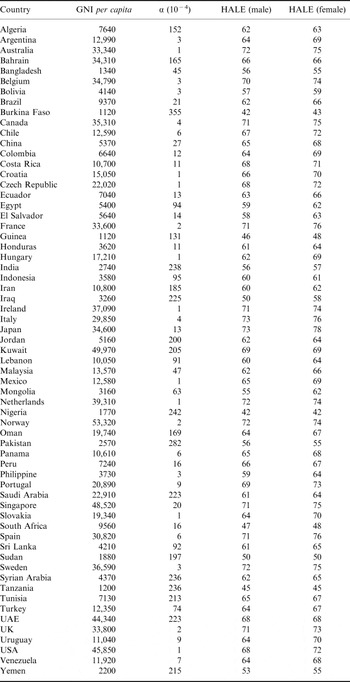
Mean of inbreeding coefficients, GNI per capita and sex-specific HALE at birth in the study countries

Methods
Healthy life expectancy at birth (HALE; years) is defined as average number of years that a person can expect to live in ‘full health’. Data about HALE for 2007 were obtained from the WHO website (http://www.who.int). The inbreeding coefficient is the probability that an individual has received both alleles of a pair from an identical ancestor. The mean inbreeding coefficient (α) values for different countries were obtained from the website http://www.consang.net. Several studies have shown that HALE correlates with income (Matthews et al., Reference Matthews, Smith, Hancock, Jagger and Spiers2005; Gonzalez et al., Reference Gonzalez, Carcaba and Ventura2010). The present study therefore used gross national income per capita (GNI; in international dollars) as a confounding factor. Data about GNI per capita for 2007 were obtained from the WHO website. Selection of countries was based on availability of the above-mentioned variables (Table 1).
Using the Kolmogorov-Smirnov test the GNI per capita and α did not show a normal distribution (for GNI per capita: Kolmogorov-Smirnov Z-test=1.579, p=0.014; for α: Kolmogorov-Smirnov Z-test=2.208, p<0.001). Logarithmic transformation was used on GNI per capita and α, because they had highly skewed distributions and the logarithmic transformations brought them closer to normal distribution (for log10GNI per capita: Kolmogorov-Smirnov Z-test=0.861, p=0.449; for log10α: Kolmogorov-Smirnov Z-test=1.133, p=0.153).
Correlations between the variables were determined using parametric Pearson's correlation coefficient analysis. Moreover, partial correlation coefficient analysis was done. Statistical analysis was performed using the Statistical Package for Social Sciences version 11.5 (SPSS Inc., Chicago, IL, USA). A probability of p<0.05 was considered statistically significant. For multiple comparisons the Bonferroni adjustment was applied. All statistical tests were two-sided.
Results and Discussion
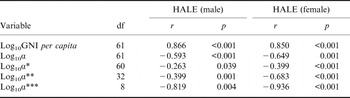
Statistical analysis showed that HALE positively correlated with log10GNI per capita (for males r=0.866, df=61, p<0.001; for females r=0.850, df=61, p<0.001). This finding confirmed previous studies (Matthews et al., Reference Matthews, Smith, Hancock, Jagger and Spiers2005; Gonzalez et al., Reference Gonzalez, Carcaba and Ventura2010). Also HALE showed negative correlation with log10α (for males r=−0.593, df=61, p<0.001; for females r=−0.649, df=61, p<0.001). It should be noted that log10α and log10GNI per capita were significantly correlated with each other (r=−0.885, df=61, p<0.001).
Partial correlation analysis was carried out in order to eliminate the possible confounding effect of GNI per capita on the association between HALE and log10α. After controlling for log10GNI per capita, significant negative correlations between log10α and HALE were observed (Table 2). As shown in Table 2, the correlation coefficients between log10α and HALE decreased after controlling for log10GNI per capita in comparison with the correlation coefficients before controlling for the log10GNI per capita. However, this change can partially be explained by the confounding effect of GNI per capita on the corrections. Table 2 also shows that correlation coefficients between HALE and log10α (before and after controlling for log10GNI per capita) were stronger for females than males. It is known that females have two X chromosomes and males have only one X chromosome. This difference may explain, at least in part, the effect of increasing the probability of homozygosity for loci located on the chromosome X in females due to parental consanguinity and/or difference(s) of environmental risk factors between males and females.
Correlation coefficients between the study variables

* After controlling for Log10GNI per capita.
** After controlling for Log10GNI per capita in countries having GNI per capita at least $10,000.
*** After controlling for Log10GNI per capita in Asian and African countries having GNI per capita at least $10,000.
Countries were stratified according to their GNI per capita: low- and high-income countries with GNI per capita less than and more than $10,000, respectively. Statistical analysis showed that in high-income countries, after controlling for log10GNI per capita, the correlation between HALE and log10α was significant (for males r=−0.399, df=32, p=0.001; for females r=−0.683, df=32, p<0.001).
Since prevalence of consanguineous marriages is strongly associated with region (Bittles, Reference Bittles2001; Saadat et al., Reference Saadat, Ansari-Lari and Farhud2004; Othman & Saadat, Reference Othman and Saadat2009), further analysis was done using data for Asian and African countries. In high-income Asian and African countries, after controlling for log10GNI per capita, the correlation between HALE at birth and log10α was significant (for males r=−0.819, df=8, p=0.004; for females r=−0.936, df=8, p<0.001).
The problem with multiple comparisons is that the experiment-wise error rate is often much larger than the error rate applied to each single analysis. This can result in the declaration of spurious effects as significant. There are many procedures for adjusting the analyses to account for these multiple analyses. One of the simplest – a Bonferroni adjustment – requires that each analysis be carried out using an α/k Type I error rate, where α=0.05 and k is the number of comparisons made (here k=4; α/k=0.012). However, this results in a very conservative estimate of the statistical significance of each evaluation. Taken together, it might be concluded that consanguinity influences HALE independent of country income.
In countries where consanguineous marriages are common, increased levels of mortality and morbidity caused by the action of recessive and multifactorial traits can be predicted (Bittles, Reference Bittles2001). In most developing countries, socioeconomic circumstances have become more favourable. This has translated into advanced diagnostic and health care facilities. In these countries the incidence of non-genetic diseases has decreased dramatically. Because of the high prevalence of consanguineous marriages in these countries, genetic disorders now account for an increasing proportion of morbidity and death. Other studies are necessary in order to conclude that a large proportion of deaths can be attributed to inbreeding in several countries due to a high prevalence of consanguinity.
As mentioned in the Methods section, the data on GNI per capita and HALE were taken from publications in 2007, whereas the data on mean inbreeding coefficient listed in www.consang.net cover a much wider period (1950–2009). Since the GNI per capita of most developing countries has improved rapidly in recent years, direct correlation of these different data sets is the main limitation of the present study. The other limitation of the study is a potential bias called the ‘ecological fallacy’. In ecologic study specific individuals are not studied, but rather groups of people are compared. Because nothing is known about exposures experienced by the groups (here homozygosity due to parental consanguineous marriages, family income, etc.), ecological studies may be more prone to biases that cannot be controlled. Also, consanguinity and GNI per capita may not be the only characteristics that can be distinguished between countries. There may be other confounding factors.
Finally, the present ecologic study raised the hypothesis that ‘parental consanguineous marriages lead to higher mortality rates in offspring in comparison with unrelated marriages’. This hypothesis must be tested with more rigorous research.
Acknowledgment
This study was supported by Shiraz University.