Introduction
Cannabis abuse is highly prevalent in patients with psychosis, with on average 11% of patients having current abuse of cannabis and 19% having abused cannabis during the past year (Green et al. Reference Green, Young and Kavanagh2005). In comparison, around 1.5% of Americans are estimated to have diagnosable cannabis abuse or dependence (Compton et al. Reference Compton, Grant, Colliver, Glantz and Stinson2004). Cannabis use in patients with psychosis is associated with reduced adherence to antipsychotic treatment (Olfson et al. Reference Olfson, Mechanic, Hansell, Boyer, Walkup and Weiden2000; Kamali et al. Reference Kamali, Kelly, Clarke, Browne, Gervin, Kinsella, Lane, Larkin and O'Callaghan2006), and increased psychotic relapses (Hides et al. Reference Hides, Dawe, Kavanagh and Young2006), psychotic symptoms (van Os et al. Reference van Os, Bak, Hanssen, Bijl, de Graaf and Verdoux2002; Grech et al. Reference Grech, van Os, Jones, Lewis and Murray2005) and number of hospitalizations (Caspari, Reference Caspari1999). Although evidence regarding the impact of cannabis on negative symptoms and cognition is unclear (Bersani et al. Reference Bersani, Orlandi, Gherardelli and Pancheri2002; Yücel et al. Reference Yücel, Bora, Lubman, Solowij, Brewer, Cotton, Conus, Takagi, Fornito, Wood, McGorry and Pantelis2012), experimental studies have shown that intravenous delta-9-tetrahydrocannabinol (THC) acutely and negatively affects these domains in patients with psychosis (D'Souza et al. Reference D'Souza, Abi-Saab, Madonick, Forselius-Bielen, Doersch, Braley, Gueorguieva, Cooper and Krystal2005; Leeson et al. Reference Leeson, Harrison, Ron, Barnes and Joyce2012). For these reasons, treating cannabis use disorders may improve prognosis for patients with psychosis.
Trials on cognitive behaviour therapy (CBT), motivational interviewing, psycho-education and treatment as usual (TAU) have generally failed to show efficacy of any intervention over others for treating cannabis use disorders (Cleary et al. Reference Cleary, Hunt, Matheson, Siegfried and Walter2008; Hjorthøj et al. Reference Hjorthøj, Fohlmann and Nordentoft2009). Most trials have been relatively short interventions (1–10 sessions) with short follow-ups, and with risk of bias and random errors due to small sample sizes, incomplete allocation concealment and analyses not being intention-to-treat. Only two trials have focused exclusively on cannabis (Edwards et al. Reference Edwards, Elkins, Hinton, Harrigan, Donovan, Athanasopoulos and McGorry2006; Bonsack et al. Reference Bonsack, Gibellini, Favrod, Montagrin, Besson, Bovet and Conus2011). Trials with lower risk of bias have generally not reported separate results for cannabis use (Hjorthøj et al. Reference Hjorthøj, Fohlmann and Nordentoft2009) and often found significant intervention effects of motivational interviewing, CBT, or their combination (Jerrell & Ridgely, Reference Jerrell and Ridgely1995; Barrowclough et al. Reference Barrowclough, Haddock, Tarrier, Lewis, Moring, O'Brien, Schofield and McGovern2001; Kavanagh et al. Reference Kavanagh, Young, White, Saunders, Wallis, Shockley, Jenner and Clair2004; Bellack et al. Reference Bellack, Bennett, Gearon, Brown and Yang2006; Kemp et al. Reference Kemp, Harris, Vurel and Sitharthan2007). It remains unknown whether the lack of efficacy in trials reporting separate outcomes for cannabis is due to poorer quality of these trials or to the interventions being more effective for other substances. It was thus important to initiate a trial targeted directly at cannabis abuse, attempting to replicate the successful findings in studies that did not report on cannabis separately. This entailed setting up an intervention with more sessions than in previous studies because shorter interventions may be insufficient for dual diagnosis patients to change their substance use. It also entailed recruiting a sufficient number of participants to achieve statistical power to detect intervention effects, and minimizing potential sources of bias that may have been present in previous trials.
We aimed to compare 6 months of CapOpus, consisting mainly of motivational interviewing and CBT aimed at cannabis-related problems, plus TAU versus TAU alone. Our primary hypothesis was that CapOpus added to TAU would be more effective in reducing the number of days with cannabis use in the previous month compared with TAU alone. Our secondary hypothesis was that CapOpus added to TAU would also improve psychopathology, cognitive functioning, quality of life and similar areas compared with TAU alone.
Method
The trial was a 6-month, parallel-group, observer-blinded superiority trial comparing CapOpus plus TAU with TAU alone, including patients from September 2007 to December 2010 in Copenhagen, Denmark.
Participants
Patients were referred from Danish Early Psychosis Intervention Services (Opus teams; Petersen et al. Reference Petersen, Jeppesen, Thorup, Abel, Ohlenschlaeger, Christensen, Krarup, Jorgensen and Nordentoft2005), Community Mental Health Centres (CMHCs; Nordentoft et al. Reference Nordentoft, Knudsen, Jessen-Petersen, Krasnik, Sælan, Treufeldt and Wetcher1996), Assertive Community Treatment (ACT) teams (Vendsborg et al. Reference Vendsborg, Nordentoft, Hvenegaard and Søgaard1999), and psychiatric wards. Inclusion criteria were: ICD-10 schizophrenia spectrum psychosis (F2); cannabis use disorder (F12); age 18–35 years (chosen so as to yield more homogeneous groups for the planned group sessions; a combination of slow influx of patients and interested participants just outside the inclusion age range led us to modify this after 5 months of inclusion and include patients aged 17–42 years); residence in the Copenhagen area; not requiring an interpreter; and the ability and willingness to give informed consent. We allowed dependence to other substances if participants themselves designated cannabis as their primary substance of abuse. The diagnosis of schizophrenia spectrum psychosis was usually established by the referring agent, and in cases of doubt was established by the Schedules for Clinical Assessment in Neuropsychiatry (SCAN) interview (Wing et al. Reference Wing, Babor, Brugha, Burke, Cooper, Giel, Jablenski, Regier and Sartorius1990). After complete description of the trial to the participants, written informed consent was obtained before randomization.
Randomization and masking
Computerized central randomization (1:1) was performed by the Copenhagen Trial Unit, stratified by intensity of cannabis use (0–14 or 15–30 days in the past month) and type of TAU (see below). The block size varied between 6, 8 and 10, and was known only to the Copenhagen Trial Unit. The outcome assessor was kept blind to allocation by asking participants not to divulge the allocation, staff names, etc. The assessor registered a guess of the intervention group at both follow-up interviews, and these were ultimately compared to the actual intervention received by participants. The value of κ between allocation and guess was 0.33 (p = 0.004) post-treatment and 0.22 (p = 0.03) at follow-up. Fourteen patients or case managers accidentally broke the blind, with a tendency towards higher risk of unblinding in the CapOpus group (19% v. 8%, p = 0.09). Blinding was maintained throughout data entry and management, analysis, manuscript preparation and drafting of conclusions; after data collection was completed, the investigators received a randomization code from the data manager of the Copenhagen Trial Unit detailing whether patients had been allocated to group 0 or group 1. Only once the manuscript and conclusions had been approved by all authors were the CapOpus investigators informed by the data manager which of the two groups was the experimental group.
Interventions
CapOpus
CapOpus was an add-on intervention to TAU, which all patients received. Full details are given in the design paper (Hjorthøj et al. Reference Hjorthøj, Fohlmann, Larsen, Madsen, Vesterager, Gluud, Arendt and Nordentoft2008) and full protocol (www.capopus.dk). The intervention was based on the EPPIC manual, and was similar to the Midas trial (Hinton et al. Reference Hinton, Elkins and Edwards2002; Barrowclough et al. Reference Barrowclough, Haddock, Wykes, Beardmore, Conrod, Craig, Davies, Dunn, Eisner, Lewis, Moring, Steel and Tarrier2010). CapOpus lasted 6 months from first contact with CapOpus consultants. One or two weekly individual sessions were offered in the first month, depending on the participants' wishes (two sessions were actively encouraged to those whom CapOpus consultants deemed to be more troubled by their cannabis use or psychosis). One weekly session was offered during the remaining 5 months. The intervention was fully manual based, starting with motivational interviewing to enhance alliance and motivation, and shifting to CBT as patients became motivated to change their cannabis use. Returning to motivational interviewing was often required. Emphasis was placed on analysing the advantages and disadvantages of continued use, and instructions in the development of personal strategies in relation to craving trigger situations. The sessions could take place in CapOpus offices, at the patient's home or treatment facility, and typically, an assertive approach was applied to get the patients to attend (e.g. home visits). Addiction consultants were trained and experienced in motivational interviewing and CBT. One consultant was a psychologist (handling 71% of participants), one a master student of psychology, and one an occupational therapist. The consultants met several times a month and shared experiences, and received both internal and external supervision. Meetings with TAU case managers and families were sought at a predefined schedule. Patients were offered complimentary food regardless of cannabis use, in an effort to increase adherence. The uptake of this was minimal and was deemed to have influenced the consultant–participant alliance in a maximum of six participants. Case load was intended to be 1:10 but was usually between 1:6 and 1:7. Weekly group sessions were planned but never implemented, as too few patients wanted to participate in them.
TAU
TAU consisted of the treatment available to patients had they not participated in the trial, provided by staff not employed by CapOpus. TAU was carried out in Opus, CMHCs or ACT teams (Nordentoft et al. Reference Nordentoft, Knudsen, Jessen-Petersen, Krasnik, Sælan, Treufeldt and Wetcher1996; Vendsborg et al. Reference Vendsborg, Nordentoft, Hvenegaard and Søgaard1999; Petersen et al. Reference Petersen, Jeppesen, Thorup, Abel, Ohlenschlaeger, Christensen, Krarup, Jorgensen and Nordentoft2005). No explicit manual exists regarding co-occurring cannabis use disorder in TAU. Instead, these facilities primarily target the psychotic disorder using both antipsychotic medication and methods such as CBT (but generally not targeted at substance use). Case load is approximately 1:10 in Opus and ACT teams and 1:20 to 1:30 in CMHCs, not all of whom participated in the trial. We did not register use of antipsychotic medication, but previous investigations have shown that approximately 60% of patients in TAU in Denmark are given antipsychotic medication (Petersen et al. Reference Petersen, Jeppesen, Thorup, Abel, Ohlenschlaeger, Christensen, Krarup, Jorgensen and Nordentoft2005). Most patients already received TAU at inclusion, and we facilitated referral for the rest. TAU did not end after the 6-month trial duration.
Measurements
Patients were interviewed three times by a trained assessor blind to treatment allocation. The first interview was pre-randomization. For the CapOpus group, the second interview was scheduled 6 months after the first contact with the CapOpus consultant. This variation in time since inclusion was replicated in the TAU group by flagging TAU participants included around the same time as the CapOpus participants as ready for interview. This second interview is referred to as ‘post-treatment’. The third interview was scheduled 4 months later and is referred to as ‘follow-up’. If the post-treatment interview was not conducted within 4 months, attempts were still made to conduct the follow-up interview. Interviews could take place at CapOpus, the participant's home or a treatment facility. As a last resort, interviews could be conducted by telephone and questionnaires sent by post. Interviews could be split in two over a week, or partial interviews could be conducted on prioritized outcomes.
Most data were collected at all three interviews. The primary outcome was the self-reported number of days with cannabis use in the past month, with recall assisted by Timeline Follow-Back (TLFB; Sobell & Sobell, Reference Sobell, Sobell, Litten and Allen1992). This also allowed for quantification of the number of ‘standard joints’ in the past month. We defined a standard joint as containing 0.5 g of cannabis resin, and multiplied this by 1.5 for more potent types of cannabis. TLFB-assisted self-report is a highly valid measure of cannabis consumption even in this patient group, perhaps even better than blood samples when going beyond 30 days (Hjorthøj et al. Reference Hjorthøj, Fohlmann, Larsen, Arendt and Nordentoft2012a, Reference Hjorthøj, Hjorthøj and Nordentoftb). Baseline information on other abuse diagnoses was collected using the SCAN. Secondary outcomes were the Positive and Negative Syndrome Scale (PANSS; Kay et al. Reference Kay, Fiszbein and Opler1987), Global Assessment of Functioning (Endicott et al. Reference Endicott, Spitzer, Fleiss and Cohen1976), the World Health Organization (WHO, 2000) Disability Assessment Schedule, EuroQol's Quality of Life Interview (EQ-5D; Brooks, Reference Brooks1996; Halling Hastrup et al. Reference Halling Hastrup, Nordentoft, Hjorthøj and Gyrd-Hansen2011), the Manchester Short Assessment of Quality of Life (MANSA; Priebe et al. Reference Priebe, Huxley, Knight and Evans1999), the Brief Assessment of Cognition in Schizophrenia (BACS) – symbol coding (Keefe et al. Reference Keefe, Goldberg, Harvey, Gold, Poe and Coughenour2004), Trail Making Tests A and B (Bowie & Harvey, Reference Bowie and Harvey2006), the Continuous Performance Test – Identical Pairs (Cornblatt, Reference Cornblatt, Lenzenweger and Erlenmeyer-Kimling1989), the Hopkins Verbal Learning Test (Brandt, Reference Brandt1991), Neuropsychological Assessment Battery mazes (Stern & White, Reference Stern and White2003), and the Danish adaptation of the National Adult Reading Test (Nelson & O'Connell, Reference Nelson and O'Connell1978). The Client Satisfaction Questionnaire (CSQ) was administered post-treatment (Larsen et al. Reference Larsen, Attkisson, Hargreaves and Nguyen1979). Outcome measures on health-care utilization will be published separately.
Sample size
With α = 0.05 (two-sided) and power = 0.9, we calculated a priori that to detect a statistically significant difference at either interview point of 5 days of cannabis use (s.d. = 5.0), we needed 2 × 22 patients. Assuming 37% attrition (Petersen et al. Reference Petersen, Jeppesen, Thorup, Abel, Ohlenschlaeger, Christensen, Krarup, Jorgensen and Nordentoft2005), 2 × 35 patients were needed. To perform subgroup analyses, we attempted to include 2 × 60 to 2 × 70 patients, but slow inclusion of patients forced us to cease inclusion after the 103rd patient was recruited. Early analyses of patients were performed for conference presentation purposes once before inclusion ended, with the explicit determination that these results would not lead to decisions regarding early stopping, as this may introduce bias and random errors.
Approval
The study was approved by the local ethics committee (H-D-2007-0028) and the Danish Data Protection Agency (2007-41-0616), and registered at ClinicalTrials.gov (NCT00484302).
Data management and statistics
Data were entered into the database twice and discrepancies corrected according to unambiguously designed case-record forms. The primary outcome was analysed using multi-level, mixed-effects repeated-measures Poisson regression, yielding both time × group interaction terms and between-group comparisons at each assessment point expressed as incidence rate ratios (IRRs; the ratio of days with cannabis use). Continuous outcome measures were analysed using linear mixed models (LMMs), with unstructured variance repeated measurements. We also performed LMM analyses for the primary outcome to obtain estimated marginal means (a measure of absolute rather than relative difference). Both of these models include baseline values in their estimation of treatment effects. Abstinence was analysed using logistic regression and satisfaction with treatment using linear regression. Analyses were intention-to-treat, analysing all patients as randomized. Missing outcome data were handled by log-likelihood-based measures in the multilevel Poisson model and the LMM, and by multiple imputations in other analyses. We conducted sensitivity analyses assuming either last observation carried forward or an increase in cannabis consumption. All tests of significance were two-sided. We specified a priori that we would perform subgroup analyses, but not on which subgroups. The subgroups we chose were deemed likely to influence the efficacy of a psychosocial intervention. Analyses were performed using Stata/SE 11.2 (Stata Corporation, USA).
Results
Participants
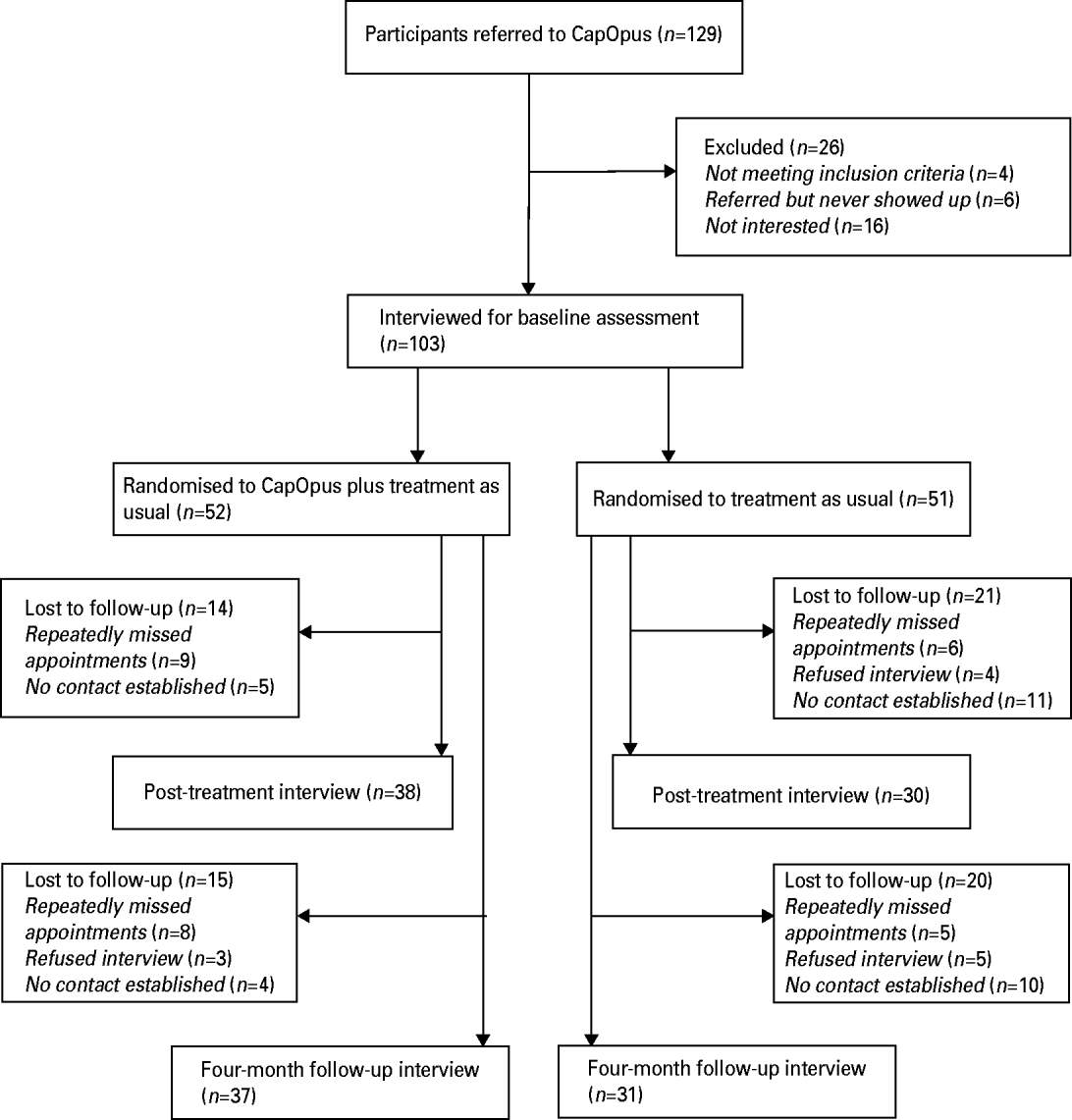
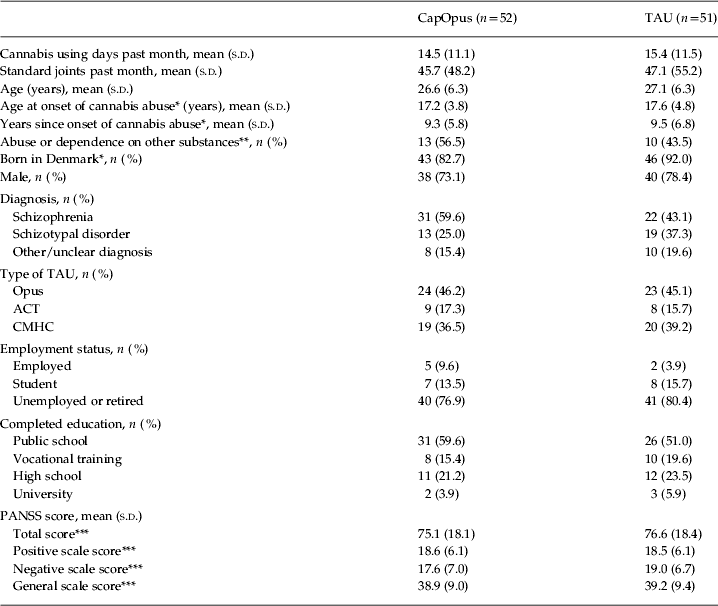
Participant flow is depicted in Fig. 1. Patients were randomized to CapOpus plus TAU (n = 52) or TAU alone (n = 51). Table 1 shows that there were no indications of skewed distribution of cannabis consumption or other baseline characteristics between intervention groups. Post-treatment interviews were carried out by telephone and letter for three patients in CapOpus and two in TAU (p = 0.66). At follow-up, three interviews in each group (p = 0.98) were carried out by telephone and letter.
Trial flow chart.

Baseline characteristics
TAU, Treatment as usual; Opus, Opus teams for early detection and treatment of young people with psychosis (not an acronym); ACT, Assertive Community Treatment; CMHC, Community Mental Health Centre; PANSS, Positive and Negative Syndrome Scale for Schizophrenia, s.d., standard deviation.
Because of missing data, some comparisons are based on
* 102,
** 61 or
*** 100 patients.
Attrition
Mean (s.d.) time between baseline and the post-treatment interview was 9.3 (1.4) months, and 14.9 (2.1) months between baseline and follow-up. Neither differed between interventions (p = 0.59 and p = 0.97). Thirty-eight patients (73.1%) in CapOpus and 30 (58.9%) in TAU completed the post-treatment interview (p = 0.13). For the follow-up interview, completion proportions were 37 (71.2%) in CapOpus and 31 (60.8%) in TAU (p = 0.27). There were no indications of skewed attrition in terms of baseline cannabis use, sociodemographic factors or any baseline scores.
Effect of intervention on cannabis consumption
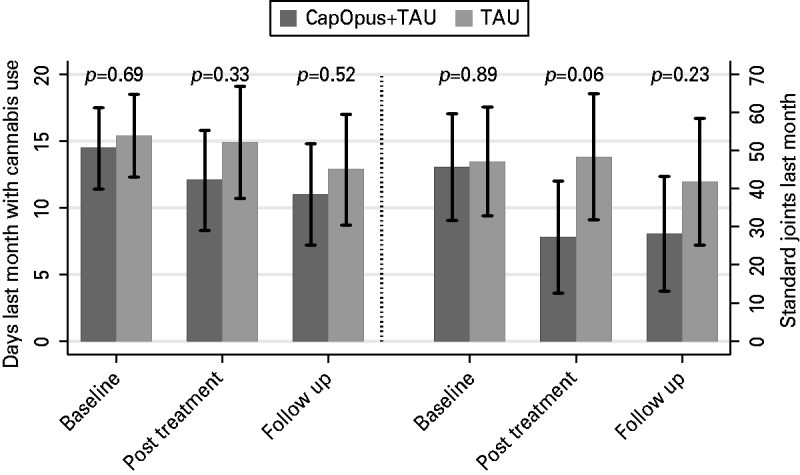
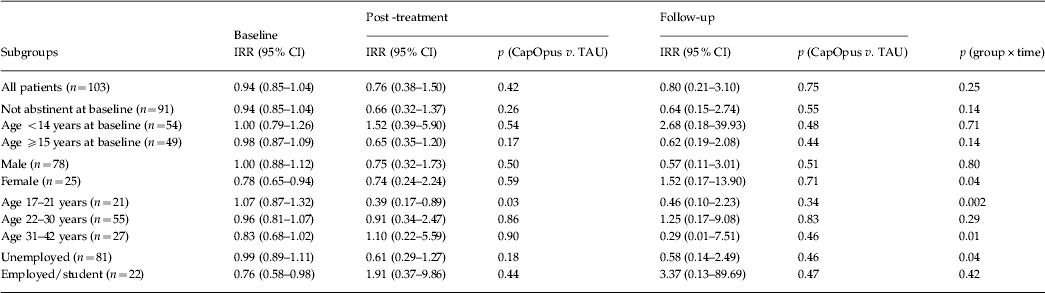
The primary outcome, the number of cannabis-using days in the past month, is presented in Table 2 as IRRs (ratio of days) for the CapOpus group compared with the TAU group, showing no significant differences post-treatment or at follow-up. The absolute consumption of cannabis is shown in Fig. 2 as estimated marginal means and confidence intervals (CIs) from the LMM. The ratio of cannabis-using days in CapOpus versus TAU was 0.76 (95% CI 0.38–1.50) (p = 0.42) post-treatment and 0.80 (95% CI 0.21–3.10) (p = 0.75) at follow-up. CapOpus participants smoked 20.9 (95% CI –1.0 to 42.9) fewer joints post-treatment per month than TAU participants (p = 0.06), whereas the difference was 13.3 (95% CI –8.5 to 35.1) (p = 0.23) at follow-up. There were no differential effects according to which addiction consultant had treated patients in the CapOpus group (p > 0.20). Multiple imputation logistic regression analyses revealed that post-treatment and follow-up odds of abstinence from cannabis did not differ significantly between CapOpus and TAU participants [odds ratio (OR) 1.31, 95% CI 0.47–3.64, p = 0.61 and OR 0.64, 95% CI 0.25–1.68, p = 0.37 respectively]. This was confirmed in observed cases and all sensitivity analyses. LMM analyses did not reveal any difference on plasma concentrations of THC between interventions (data not shown).
Main results of the CapOpus trial as estimated marginal means. TAU, Treatment as usual.
Ratio of number of days (incidence rate ratios) of days with cannabis use in the CapOpus group compared to treatment as usual (TAU)
IRR, Incidence rate ratio; CI, confidence interval.
Effect on cannabis consumption in subgroups
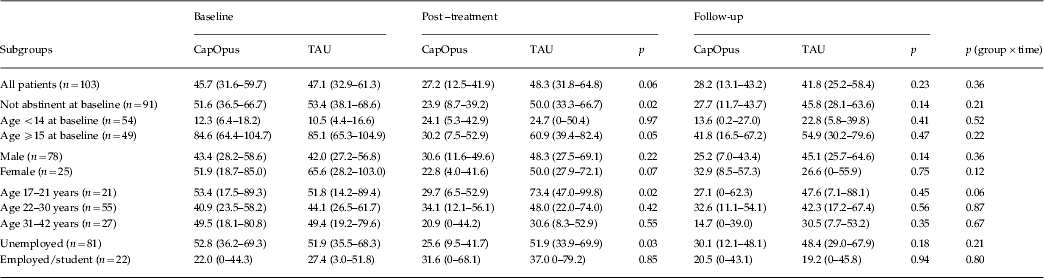
Table 2 shows IRRs for cannabis-using days in the preceding month for patients receiving CapOpus versus patients receiving TAU, stratified into subgroups. Table 3 shows, within the same subgroups, LMM-estimated marginal means within the two interventions on standard joints during the preceding month. Although the IRRs between interventions were not significant for any subgroups based on the baseline amount of cannabis used, post-treatment marginal means of monthly standard joints were significantly lower in CapOpus than in TAU for two such subgroups; among those not abstinent at baseline, participants in the CapOpus group had used 26.1 (95% CI 3.5–48.7) fewer standard joints in the preceding months than patients in the TAU group (p = 0.02). At follow-up, the difference was reduced to 18.2 (95% CI –5.7 to 42.1) (p = 0.14). In the subgroup of patients who had used cannabis at least 15 days during the month prior to the baseline assessment (a separate randomization stratum), the difference post-treatment was 30.7 (95% CI –0.6 to 62.0) (p = 0.05) in favour of CapOpus.
Number of joints in the preceding month by treatment group and over time in the trial
TAU, Treatment as usual.
Values given as estimated marginal mean (95% confidence interval).
There seemed to be a strong intervention effect in the youngest quartile of patients (age 17–21 years). These CapOpus participants reduced their number of cannabis-using days post-treatment by a third, and their number of monthly joints by half. Young TAU participants increased their cannabis use to nearly daily consumption and 40% more joints. At follow-up, these differences were no longer significant. A similar tendency was observed for patients with the earliest onset of cannabis abuse (age ⩽14 years, p = 0.05, data not shown).
Unemployed patients in CapOpus more than halved their number of post-treatment monthly joints whereas unemployed patients in TAU did not alter their consumption (p = 0.03).
Effect of intervention on other outcomes
There were no significant intervention effects on other outcomes such as PANSS scores, cognitive tests and quality of life. The difference in marginal means post-treatment in TAU compared with CapOpus on overall PANSS scores was −0.7 (95% CI −7.9 to 6.6), p = 0.86; for the positive symptoms PANSS subscale the difference was 1.3 (95% CI −1.1 to 3.7), p = 0.29; on the negative symptoms subscale the difference was −1.1 (95% CI −3.7 to 1.6), p = 0.44. On quality of life as measured by MANSA, the difference was 2.2 (95% CI −1.9 to 6.2), p = 0.29. Among cognitive tests, the one that came closest to a difference between groups was the Trail Making Test Part B (difference −11.6 s, 95% CI −25.9 to 2.7, p = 0.11), with all other p values >0.37. There seemed to be no harmful effects defined as increases in cannabis use or psychopathology. In multiple imputation linear regression analyses, the standardized β coefficient of CSQ satisfaction with treatment was 0.64 in favour of CapOpus (p < 0.001).
Adherence
CapOpus sessions usually lasted 1 h, but could be shorter or longer according to the participants' wishes. Twenty-four sessions were planned and on average 16 were achieved. Ten sessions per patient were carried out as home visits. Three patients (5.8%) attended zero sessions, and 77% had at least eight sessions of CapOpus. Adherence varied with consultant (p = 0.02); one consultant who saw 71% of patients had 9.9 fewer sessions per patient than one consultant who saw 15% of patients. The importance of this seems to be negligible as there was no indication of a time-by-staff interaction (p = 0.79). Most case managers delivering TAU to CapOpus patients participated in the planned meetings. The involvement of families was largely unsuccessful, with 73% of patients more or less completely refusing family involvement, and only 19% having at least four meetings with the family. Data on TAU were obtained from service registers for 97 individuals, revealing nearly identical TAU usage in the two groups. CapOpus participants received a mean (s.d.) of 15.3 (11.8) TAU sessions, compared with 15.6 (11.9) in TAU alone (p = 0.89).
Discussion
Adding CapOpus to TAU did not significantly reduce the number of days with cannabis use, but there was a tendency to reduce the number of monthly joints, compared with TAU alone. Certain subgroups seemed to have reduced their cannabis use when receiving CapOpus, including those not abstinent at baseline, younger participants and unemployed participants. Previous trials have not published intervention effects within subgroups. Because of multiple-comparison issues potentially leading to type I errors, our subgroup results should only be used for generating new hypotheses. Future trials should define which subgroups to explore a priori, to reduce risk of type I errors due to data-mining.
Participants receiving CapOpus were significantly more satisfied with the intervention than those receiving TAU, indicating that the intervention was acceptable to patients but that satisfaction does not necessarily imply clinical improvement.
Our main results are comparable with previous trials, including the tendencies towards reductions in amount but not frequency of substance use (Hjorthøj et al. Reference Hjorthøj, Fohlmann and Nordentoft2009; Barrowclough et al. Reference Barrowclough, Haddock, Wykes, Beardmore, Conrod, Craig, Davies, Dunn, Eisner, Lewis, Moring, Steel and Tarrier2010; Bonsack et al. Reference Bonsack, Gibellini, Favrod, Montagrin, Besson, Bovet and Conus2011). Our trial was larger, lasted longer or achieved more therapeutic sessions than most trials identified in a systematic review, which may explain why we tend to find more evidence of an effect at least on the number of monthly joints (Baker et al. Reference Baker, Bucci, Lewin, Kay-Lambkin, Constable and Carr2006; Edwards et al. Reference Edwards, Elkins, Hinton, Harrigan, Donovan, Athanasopoulos and McGorry2006; Martino et al. Reference Martino, Carroll, Nich and Rounsaville2006).
This lack of efficacy may several possible explanations. Patients may perceive cannabis as having positive effects that outweigh its negative consequences, such as self-medication for negative symptoms, anxiety, sleeplessness and social dysfunction (Schofield et al. Reference Schofield, Tennant, Nash, Degenhardt, Cornish, Hobbs and Brennan2006). Furthermore, the psychological and physical dependence could be too strong to overcome without a pharmacological agent. Patients both in TAU and CapOpus may have benefited from the research interviews, potentially diluting the efficacy of CapOpus over TAU. Although cognitive deficits in psychosis may limit the applicability of CBT and motivational interviewing (Heinrichs & Zakzanis, Reference Heinrichs and Zakzanis1998), these approaches do seem to work for general substance use disorders in this population (Hjorthøj et al. Reference Hjorthøj, Fohlmann and Nordentoft2009). Furthermore, there was a tendency towards fewer monthly joints post-treatment in the CapOpus group, possibly indicating a successful harm reduction. The significant reduction of post-treatment joints in CapOpus for those who had not already stopped using cannabis on their own at baseline indicates that inclusion of ‘self-curers’ may have diluted the efficacy of CapOpus.
Strengths and weaknesses
Our trial holds important strengths. We used centralized randomization, which reduces selection bias, improves comparability between intervention groups and ensures allocation concealment. We used a manual-based intervention implemented in a very similar manner to what would be feasible outside a randomized trial. Although neither treatment staff nor patients could be blinded, all other stages of the trial were blinded, including observer-rated assessments, data management, analysis, drafting the manuscript and drawing conclusions.
Our trial also has certain limitations. Because patients were referred, they may have been selected among those most willing to change their cannabis consumption. We did not obtain data on readiness to change, and cannot exclude this potential bias. It is thus not certain that our results can be generalized to patients at the pre-contemplation stage according to the Stages-of-Change model (Prochaska & DiClemente, Reference Prochaska and DiClemente1992). Future trials should try to explicitly include such patients, for example by approaching consecutively admitted patients.
CapOpus addiction consultants carried out fidelity self-ratings following sessions, shared experiences with each other and were involved in internal and external supervision. The fidelity measure used was not, however, truly quantifiable, and future trials should take more care in registering fidelity, as lack of fidelity to the treatment manual may be a cause of lack of effect in the psychosocial intervention trials.
Participants and addiction consultants were not blind to allocation, and we cannot exclude collateral intervention bias, although no evidence of this was apparent when comparing TAU in the two intervention groups. Furthermore, outcome assessment and all other tasks were carried out blinded, minimizing the risk of reporting bias. The outcome assessor was better at guessing the allocated intervention than would be expected by chance, but with κ values indicating that this was only modestly so. We chose to register these guesses because this was the recommendation at the time according to the original Consolidated Standards of Reporting Trials (CONSORT) statement, although it was consequently advised against in the latest update to CONSORT (Schulz et al. Reference Schulz, Altman and Moher2010a, Reference Schulz, Altman, Moher and Fergussonb). As explained in the latest revision of the CONSORT statement, outcome of such guesses could just as well be attributable to efficacy, etc.
Although we stopped inclusion earlier than 120 patients, power is above the 80% used in our sample-size calculation, which required 2 × 35 patients. The observed between-group difference was lower than the 5 days specified in the sample-size calculation, and it is doubtful whether this difference is clinically relevant and should be used to guide power in future trials. The lack of group sessions and less than optimal adherence to the CapOpus intervention may have influenced the efficacy of CapOpus negatively, but is probably how patients would behave if CapOpus was implemented. If future trials become more successful at achieving these non-individual aspects, this may improve intervention efficacy. Furthermore, because TAU case managers could have patients in both interventions, a degree of contamination may have occurred so that elements of CapOpus became available in TAU as well.
Our trial had 34% attrition, which is comparable to other trials (Petersen et al. Reference Petersen, Jeppesen, Thorup, Abel, Ohlenschlaeger, Christensen, Krarup, Jorgensen and Nordentoft2005). Attrition seemed to be non-differential. Time from inclusion to the post-treatment interview was a mean of 9.3 months, reflecting delays in participants starting the intervention, cancellations and no-shows from the post-treatment interview. We achieved similar follow-up times in the TAU group, which we believe has guarded against biases. We cannot exclude the possibility, however, that this may have introduced biases or random errors that could have both over- and underestimated intervention effects.
The contents of TAU regarding cannabis use disorders is not manual based, and some compensation may have occurred for participants randomized to TAU, that is case managers increasing their focus on the problem beyond their normal approach. We did not observe a difference in frequency of TAU sessions in the two interventions. Cannabis use was largely unchanged over time in TAU, indicating that even if a change in focus did occur, it was not successful.
Implications and future research
Psychosocial interventions seem to be insufficient for reducing the frequency of cannabis use among patients with psychosis. In the spirit of harm reduction, it may be better to add CapOpus to TAU but research should be taken a step further. Open-label and randomized trials in patients without psychosis have shown the efficacy of buspirone and perhaps dronabinol, entacapone and lithium (Weinstein & Gorelick, Reference Weinstein and Gorelick2011). Combining pharmacological and psychosocial interventions may yield a more pronounced treatment effect. Such combination trials on dual-diagnosis patients are an obvious choice for future research and could focus on some of the subgroups in which we may have found significant intervention effects. Such trials may benefit from exploring ways to include group sessions and family-based interventions.
Acknowledgements
We thank our co-workers at the Research Unit of the Mental Health Centre Copenhagen for critical comments to the manuscript. We are also very grateful to the trial participants.
This work was supported by the Lundbeck Foundation, the Municipality of Copenhagen, the Egmont Foundation, the Health Insurance Foundation, the Ministry of Social Welfare, Aase and Ejnar Danielsen's Foundation and the Wørzner Foundation. The funding bodies of the trial had no influence on the design, analysis, interpretation, drafting of the manuscript, decision to publish, or any other areas other than funding.
Declaration of Interest
None.