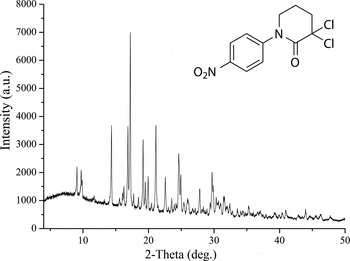
3,3-Dichloro-1-(4-nitrophenyl)-2-piperidinone is an intermediate in the synthesis of the anticoagulant, Apixaban (Zikria and Ansell, Reference Zikria and Ansell2009; Jiang and Ji, Reference Jiang and Ji2013). The sample was prepared using 1-(4-nitrophenyl)-2-piperidinone and was recrystallized in methanol and dried. The sample was then ground into powder (HPLC ≥ 98%, ρ = 1.493 g cm−3, T melt = 130–132 °C) and mounted on a flat zero background plate. X-ray powder diffraction measurement was performed at room temperature using an X'Pert PRO diffractometer (PANalytical Co., Ltd., Netherlands) with a PIXcel 1D detector and CuKα radiation (generator setting: 40 kV and 40 mA). The diffraction data were collected over the angular range from 4° to 50°2θ with a step size of 0.01313°2θ and a counting time of 70 ms step−1. The software package Material Studio 8.0 (Accelrys Co., Ltd. USA) was used to process the data in the Analytical & Testing Center (Sichuan University, Chengdu, China). The X-ray powder diffraction pattern was pre-treated by subtracting the background, smoothing, and stripping off the Kα 2 component. Automatic indexing results were obtained by DICVOL91 method (Boultif and Louër, Reference Boultif and Louër1991). The following figures of merit were achieved: F 26 = 85.6 (0.0049, 62) (Smith and Snyder, Reference Smith and Snyder1979) and M 26 = 27.5 (de Wolff, Reference de Wolff1968). The preliminary cell from indexing was refined using the Pawley method (Pawley, Reference Pawley1981). Pawley refinement results confirmed that the sample crystallizes in the triclinic space group P-1(2), with a = 11.088(4) Å, b = 11.594(5) Å, c = 12.689(3) Å, α = 118.456(1)°, β = 100.320(3)°, γ = 107.763(3)°, V = 1259.27 Å3, Z = 4, and ρ x = 1.525 g cm−3. Figure 1 shows the powder X-ray diffraction pattern of the compound.
Powder X-ray diffraction pattern of 3,3-dichloro-1-(4-nitrophenyl)-2-piperidinone.

SUPPLEMENTARY MATERIALS AND METHODS
To view supplementary material for this article, please visit http://dx.doi.org/S088571561500055X
ACKNOWLEDGEMENTS
This work was supported by the Applied Basic Research Project of Sichuan Province (Grant No. 2014JY0042), the Testing Platform Construction of Technology Achievement Transform of Sichuan Province (Grant No. 13CGPT0049), and the National Development and Reform Commission and Education of China (Grant No. 2014BW011).