
Introduction
Since the beginning of archaeology as a scientific discipline in Europe, researchers have often made sense of archaeological data by dividing cultural materials into three distinct groups (e.g. Lower, Middle, Upper; Early, Middle, Late) (Sackett Reference Sackett1982; Monnier Reference Monnier2006; Klein Reference Klein2009). Palaeolithic research in eastern Asia was initiated and led primarily by European scientists (e.g. Andersson, Licent, Teilhard de Chardin), meaning that it was considered perfectly acceptable to apply the Western-derived Palaeolithic cultural sequence to sites and materials in eastern Asia (Gao & Norton Reference Gao and Norton2002). The justification for continued use of this three-stage cultural model in eastern Asia has been the subject of debate in recent years. Before evaluating the eastern Asian Palaeolithic record, however, it is important to discuss the meaning of a ‘Middle Palaeolithic’.
Periodisation in archaeology serves to divide the long sequence of behavioural variation into analytical units. A classic example of this is Christian Thomsen's division of archaeological materials into separate Stone Age, Bronze Age and Iron Age units that supposedly represented divisions in past human behaviour (Gao & Norton Reference Gao and Norton2002). Accordingly, divisions in the Palaeolithic are based on culture-historical blocks of common technology (Sackett Reference Sackett1982; Monnier Reference Monnier2006). Of these various major divisions within the Palaeolithic, the Middle Palaeolithic, as widely used in Europe, is one such division, appearing in the archaeological record c. 300–250 kya (Roebroeks & Tuffreau Reference Roebroeks, Tuffreau, Roebroeks and Gamble1999). It is equivalent to the coeval Middle Stone Age in Africa. The Middle Palaeolithic and Middle Stone Age were replaced by the Upper Palaeolithic and Late Stone Age after 50–40 kya in their respective regions (Klein Reference Klein2009). The Middle Palaeolithic/Middle Stone Age is known for the appearance of a prepared core technology that is often referred to as the Mousterian tradition (Bordes Reference Bordes1968).
One of the primary technological differences between the earlier Acheulean (Lower Palaeolithic/Early Stone Age) and the Middle Palaeolithic/Middle Stone Age is the latter's paucity of large bifacially worked stone tools (e.g. handaxes and cleavers) (Schick & Toth Reference Schick and Toth2001; Monnier Reference Monnier2006). In addition, Middle Palaeolithic and Middle Stone Age stone artefact technology is distinguished by techniques to prepare cores and produce more regularly sized and morphologically consistent flakes. Core preparation methods culminated in the Levallois technique, which appeared commonly throughout the Western Old World (Klein Reference Klein2009). Moreover, fine-grained raw materials (e.g. flint and chert) were preferred in contrast to earlier Acheulean tools, which were usually produced with lower quality raw materials (e.g. quartz and quartzite). Middle Palaeolithic lithic technology is further represented by diverse retouched tool types, including stone-tipped spears and knives, which contrast noticeably with the primarily handheld tools of the Oldowan and Acheulean (Shea Reference Shea2006; Klein Reference Klein2009). Middle Palaeolithic stone toolkits also display a degree of inter-assemblage variability, which may imply different stages of lithic reduction, or chaîne opératoire, not often seen in the older Oldowan and Acheulean (Inizan et al. Reference Inizan, Roche and Tixier1992).
There is little debate that the Middle Palaeolithic/Middle Stone Age represents a distinct cultural subdivision of the Palaeolithic (although see Monnier Reference Monnier2006 for further discussion). As outlined here, there are concerns whether a model generated primarily from European data can be applied across time and space, particularly when evaluating events occurring during the same time periods in the Eastern Old World. Indeed, this topic has become something of a debate in recent years in eastern Asian Palaeolithic research. Over a decade ago, Gao and Norton (Reference Gao and Norton2002; see also Norton et al. Reference Norton, Gao, Feng, Camps and Chauhan2009) evaluated the Chinese ‘Middle Palaeolithic’ and found its continued use to be without support from the archaeological record. The primary observations from their studies were:
-
1. Behavioural stages cannot be defined by the presence/absence of various vertebrate faunas, particularly mid-Pleistocene Homo (term as described by Xiao et al. Reference Xiao, Bae, Shen, Delson, Jin, Webb and Qiu2014).
-
2. Behavioural stages cannot be defined strictly by geochronology, because if a site is later found to be much older or younger, then by default it would require the site and materials to be moved to an older or younger cultural stage.
-
3. Judging from four standard archaeological criteria (raw materials, core reduction, retouch and typology), a distinct ‘Middle Palaeolithic’ is not present in China.
A pair of recent papers published in this journal (Yee Reference Yee2012; Li Reference Li2014) continued the debate over the utility of a ‘Middle Palaeolithic’ in China. Yee (Reference Yee2012) argued that the criteria and data used by Gao and Norton (Reference Gao and Norton2002) were problematic and that there was enough support to continue to use the three-stage (Lower, Middle, Upper) Palaeolithic sequence in China. Li (Reference Li2014), on the other hand, suggested that many of the examples cited by Yee to support her argument were tenuous at best and that there remained little archaeological evidence in China to support a distinct Middle Palaeolithic.
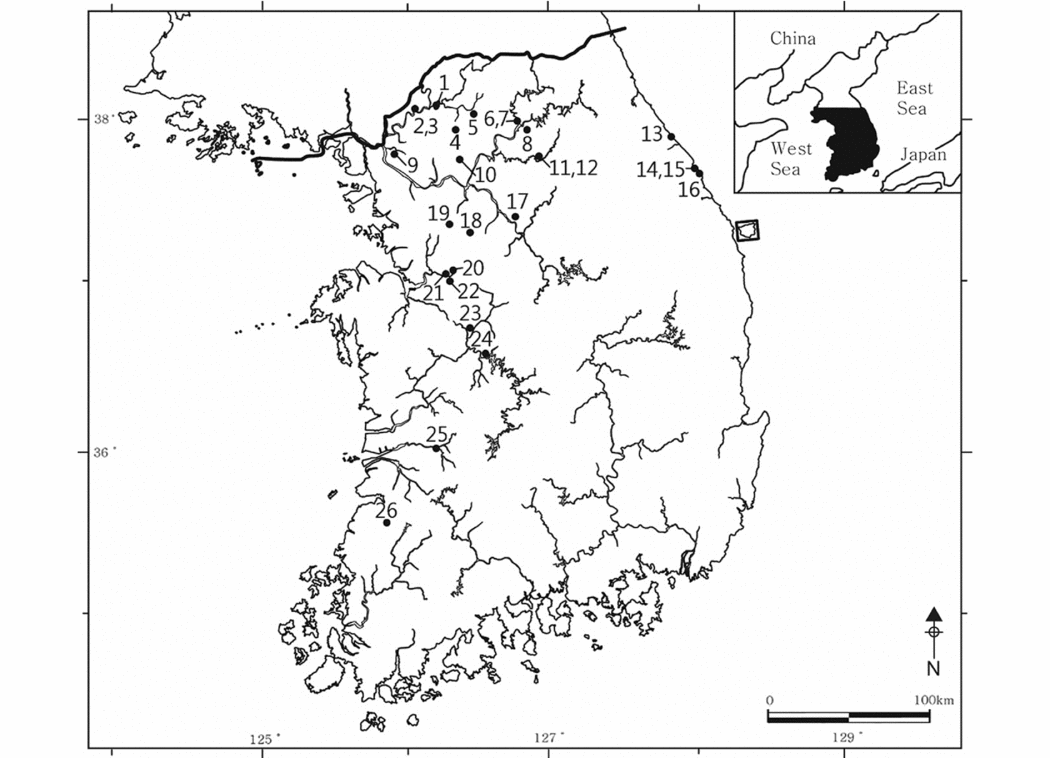
These various recent arguments are evaluated in more detail below by including Korean data in the debate (Figure 1; Table S1). Adding data from other regions of eastern Asia to test the hypothesis that a distinct Middle Palaeolithic is present is justified given that in Gao and Norton's original discussion, their observations were applicable to eastern Asia as a whole and not restricted to China alone (see also Ikawa-Smith Reference Ikawa-Smith and Ikawa-Smith1978). The Korean Palaeolithic record is a suitable case study to be included in this discussion because no major geographic barriers separate the peninsula from the Chinese mainland (Norton Reference Norton2000; Norton & Jin Reference Norton and Jin2009; Bae & Bae Reference Bae and Bae2012). Furthermore, given the increasing amount of research in Korea over the past several decades (more than 1000 Palaeolithic sites have been identified in South Korea alone) (Norton Reference Norton2000; Bae & Kim Reference Bae and Kim2010; Bae & Bae Reference Bae and Bae2012; Bae et al. Reference Bae, Bae and Kim2013), there is a greater accumulation of data available to facilitate behavioural and chronological comparisons with sites and materials across the Old World.
Approximate locations of Palaeolithic sites in southern Korean Peninsula (1: Jeongok-ri; 2: Juwol/Gawol-ri; 3: Jangnamgyo; 4: Yongjeong-ri; 5: Hwadae-ri; 6: Galdun; 7: Seosan-ri; 8: Geodu-ri; 9: Sangjiseok-ri; 10: Hopyeong-dong; 11: Hahwagye-ri; 12: Baegi; 13: Anhyeon-dong; 14: Wolso; 15: Mangsang-dong; 16: Gigok; 17: Yeonyang-ri; 18: Pyeongchang-ri; 19: Dongbackli∙joongli; 20: Gaejeong-ri; 21: Usin-ri; 22: Suheol-ri; 23: Mansu-ri; 24: Nosan-ri; 25: Bonggok; 26: Jeungsan). Sites 1–5 are located along the Imjin and Hantan Rivers.

The ‘Middle Palaeolithic’ in Korea
Palaeolithic artefacts were originally identified on the Korean peninsula during the 1930s. It was not until the 1960s, however, with the formal excavations of the first Palaeolithic sites, Gulpo-ri in North Korea and Seokjang-ri (Sokchangni) in South Korea, that modern-day Palaeolithic research began (Norton Reference Norton2000; Han Reference Han2014). Due to the paucity of international dissemination of Palaeolithic research currently being done in North Korea (Norton Reference Norton2000), the focus of this discussion is on the better-known South Korean record.
Powkey Sohn became the main figure in Palaeolithic research in Korea with his excavation of the open-air Seokjang-ri (Sokchangni) site. During the initial development, Sohn enthusiastically borrowed French Palaeolithic typological and chronological standards to describe Korean sites and materials. As such, Sohn divided the long and complex stratigraphy from Seokjang-ri into Lower, Middle and Upper Palaeolithic stages (Sohn Reference Sohn1972, Reference Sohn1973). Designating cultural layers 7, 8 and 9 as Middle Palaeolithic, Sohn adopted the French Palaeolithic typological system to describe the Seokjang-ri artefacts. This included applying the Levalloisian Index to artefacts from the Middle Palaeolithic layer 9, interpreting an increase in the number of denticulates as representative of a Mousteroid industry (Sohn Reference Sohn1970: 7). Based on his analysis of “Levalloisian blade-like flakes” and “Mousteroid scrapers of quasi-Quina type”, Sohn concluded that “judg[ing] from typological and technological as well as stratigraphical sequence, this [Seokjang-ri] industry can be attributed to a Middle Palaeolithic industry” (Sohn Reference Sohn1970: 8). While criticisms of Sohn's chronological and typological reconstructions of the Seokjang-ri site and materials do exist (Chung Reference Chung1986), the three-period system and French typology were widely applied to the Korean Palaeolithic, especially by his students (Park & Choi Reference Park and Choi2002; Han Reference Han2009).
Another good example of the uncritical acceptance of the European Palaeolithic scheme is Mou-chang Choi's (Reference Choi1983, Reference Choi1994) argument for the existence of the Mousterian tradition in Korea. Briefly, Choi argued that the Jeongok-ri (Chongokni) industry, which includes a small percentage of bifacially worked stone implements, i.e. handaxes and cleavers (Norton et al. Reference Norton, Bae, Harris and Lee2006; Norton & Bae Reference Norton and Bae2009), represents the Mousterian of Acheulean tradition, and tried to find flakes that were morphologically similar to Levallois flakes. Although Choi's proposal has been largely discounted (Lee Reference Lee2000; Seong Reference Seong2002; Bae & Bae Reference Bae and Bae2012), the indiscriminate use of the term ‘Middle Palaeolithic’ continues to pervade Korean Palaeolithic research (e.g. Lee Reference Lee2000; Park Reference Park and Choi2002; Han Reference Han2009). Korean researchers usually assign stone toolkits to the Middle Palaeolithic based on geological age or the argued presence of distinctive morphological/technological characteristics. Each of these points is addressed here in turn.
The Middle Palaeolithic of Korea based on geological age
As in China (Gao & Norton Reference Gao and Norton2002; Norton et al. Reference Norton, Gao, Feng, Camps and Chauhan2009), Korean researchers often assign assemblages considered older than the Late or Upper Palaeolithic to a distinct Middle Palaeolithic. While the Middle Palaeolithic concept is widely used in Korea, the exact time range is not usually specified. Some favour the range to be between 80–75 kya to 40 kya (Yi Reference Yi1989), while others suggest it ranges between 100–120 kya and 40 kya (Park Reference Park1992, Reference Park2002). Yi (Reference Yi1989: 237) himself set the Lower–Middle Palaeolithic boundary at 75 kya based on palaeoclimatic reconstructions rather than changes in hominin behaviour. In their re-analysis of the Seokjang-ri collections, Park and Choi (Reference Park and Choi2002) proposed that the Korean Middle Palaeolithic should be set between 100–120 kya and 30 kya, but provide no archaeological evidence to support such a time bracket. We are unaware of any Korean researchers who suggest that the beginning of the Middle Palaeolithic in Korea was coeval (c. 300 kya) with the same behavioural transition in the Western Old World.
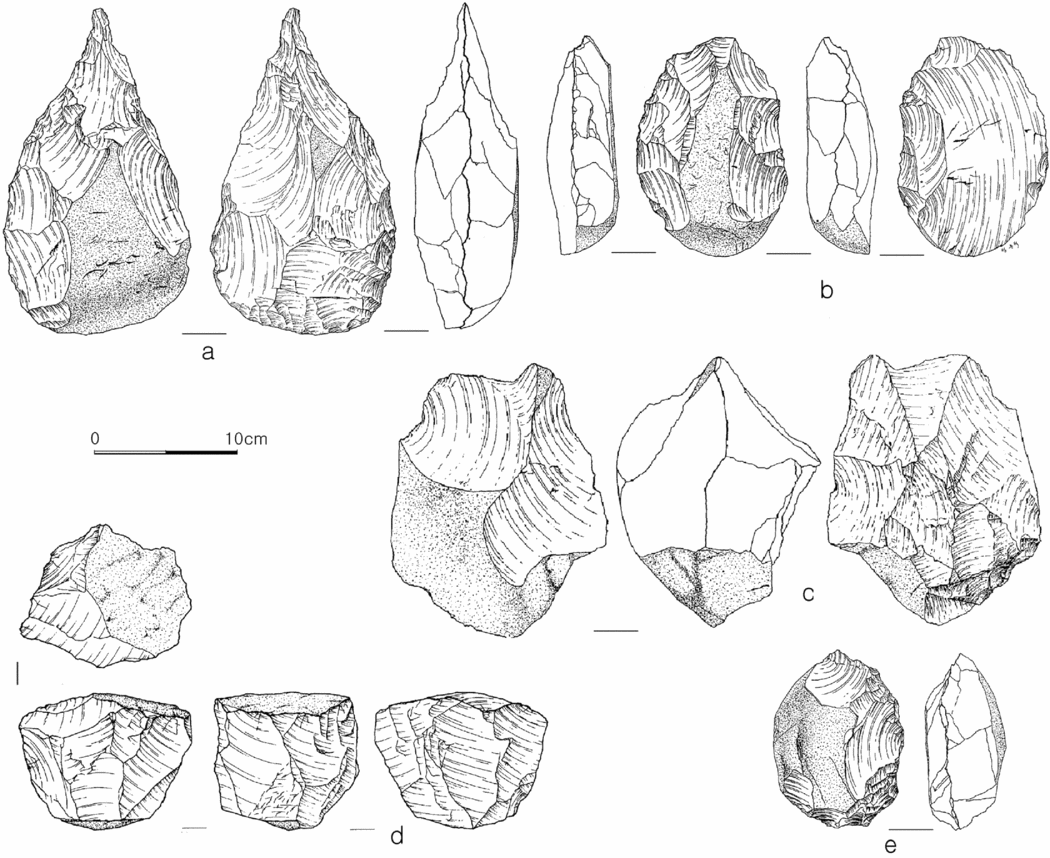
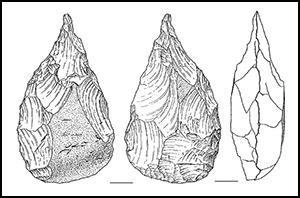
Although no lithic assemblages in Korea are securely dated to the time span of the Western Old World Lower Palaeolithic (>300 kya), several candidates do exist, including the lowest horizons at Jeongok-ri, Gawol/Juwol-ri, Jangsan-ri, Geumgul and Mansu-ri (Figure 1). The artefact collections derived from the lowest horizons of these sites are consistently comprised of choppers, handaxes, large flakes and cores that are difficult to distinguish morphologically from artefacts found in the middle horizons at Jeongok-ri and other Imjin-Hantan River basin sites (Figure 2).
Examples of large quartzite artefacts collected from Juwol/Gawol-ri, except for (d), which is from Jangsan-ri, including a handaxe (a); a large scraper (b); cores (c & d); and a chopper (e). While we do not know the exact age when these materials were made, it probably falls within the range of the typical Middle Palaeolithic in western Eurasia.

Being one of the best studied sites in Korea, reconsideration of the Jeongok-ri stone tool industry and its compositional and morphological change through time may be of importance in discussions of the Korean Middle Palaeolithic issue. Given the questions relating to the age of the deposits, however, it is often difficult to rely on chronology to distinguish a Lower from a Middle Palaeolithic. For instance, assessing whether the artefacts overlie the Jeongok basalt (0.5 Mya) or the Chatan basalt (0.15 Mya) will help determine how old the cultural deposits are (Bae et al. Reference Bae, Bae and Kim2012). Using the Jeongok basalt as the base, some researchers (e.g. Norton et al. Reference Norton, Bae, Harris and Lee2006; Norton & Bae Reference Norton and Bae2009; Bae et al. Reference Bae, Bae and Kim2012) have suggested that the lowest artefact horizons may date to c. 350 kya. Using the Chatan basalt as the base, however, and with mainly OSL-derived absolute dates, other researchers have suggested that all of the deposits should be restricted to the Late Pleistocene (Yi Reference Yi1989, Reference Yi2009; Yoo Reference Yoo2009).
Irrespective of how old the Jeongok-ri deposits are, it is generally accepted that the lithics from the lower deposits are older than those from the middle or upper sequence, and that the most recent cultural horizons may date to 30–20 kya, as attested by the identification of Aira-Tn (AT) tephra from southern Kyushu, Japan, and dated to c. 30 kya in the deposits (Norton et al. Reference Norton, Bae, Harris and Lee2006). Artefacts found in the lower horizons are often assigned to the Lower Palaeolithic, while artefacts found in the middle horizons are assigned to the Middle Palaeolithic. Unfortunately, it is premature to reach such a conclusion at Jeongok-ri because little change occurs in the assemblage composition or artefact morphology. This also applies to most, or all, of the sites found in the Imjin-Hantan River basins (Figure 1).
The Middle Palaeolithic of Korea: based on artefact morphology
One of the most characteristic features of the Palaeolithic industries in Korea and broader eastern Asia is the long persistence of similar stone tool types produced using the same techniques, and lithic assemblages that relied on locally available, low-quality raw materials such as quartzite and vein quartz (Ikawa-Smith Reference Ikawa-Smith and Ikawa-Smith1978; Gao & Norton Reference Gao and Norton2002; Seong Reference Seong2002, Reference Seong2004; Wang et al. Reference Wang, Bae, Huang, Huang, Tian, Mo, Huang, Huang, Xie and Li2014). Suggestions have been made, however, that typologically, a distinctive Middle Palaeolithic could be identified among the Korean lithic toolkits. For instance, Park (Reference Park2002) assigned assemblages from Seokjang-ri, Juknae-ri, Yongho-dong and Naechon-ri to the Middle Palaeolithic because, in his view, they feature more standardised flakes, prepared cores and a greater diversity of flake tool types such as increased numbers of awls and points. Other researchers have suggested that handaxes appeared initially during the Lower Palaeolithic and became widespread during the Middle Palaeolithic in deposits at Jeongok-ri, Gawol/Juwol-ri and Hahwagye-ri (Lee Reference Lee2000).
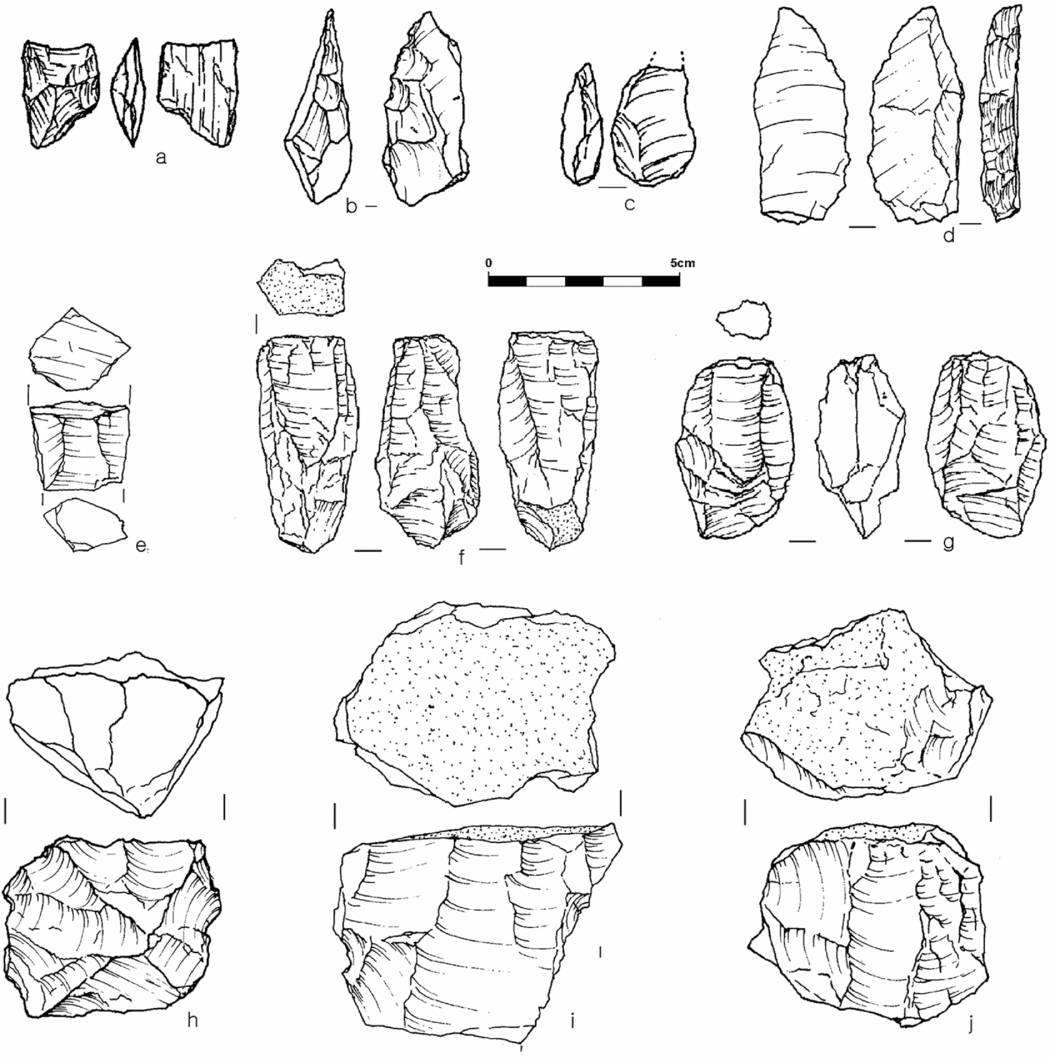
There are a number of sites in Korea where a Middle Palaeolithic is supposedly present. These include lithic assemblages from stratified sites with at least three cultural horizons and at least one interpreted as Middle Palaeolithic, as indicated by absolute dates (Table S1). The lithic assemblages from these sites provide a cloudy picture of how the lithic technology and industries in Korea evolved during the Palaeolithic. For instance, little change can be seen between the lower and middle horizons at Jeongok-ri, where choppers, handaxes and large flakes produced on locally available quartzite cobbles were recovered. It is not until the upper cultural horizon that large heavy-duty tools are replaced by smaller artefacts knapped on finer-grained vein quartz (Figures 3 & 4).
Examples of small vein-quartz artefacts from Korea, including a trapezoid (a); backed knives (b–d); and cores (e–j). While there are no definitive absolute dates for the artefact collection, the discovery of AT tephra and associated stratigraphic evidence suggest that they were about 30 000–25 000 years old. (a & c: Pyeongchang-ri; b & h: Juwol/Gawol-ri; d, e, f, i, j: Jeongok-ri).

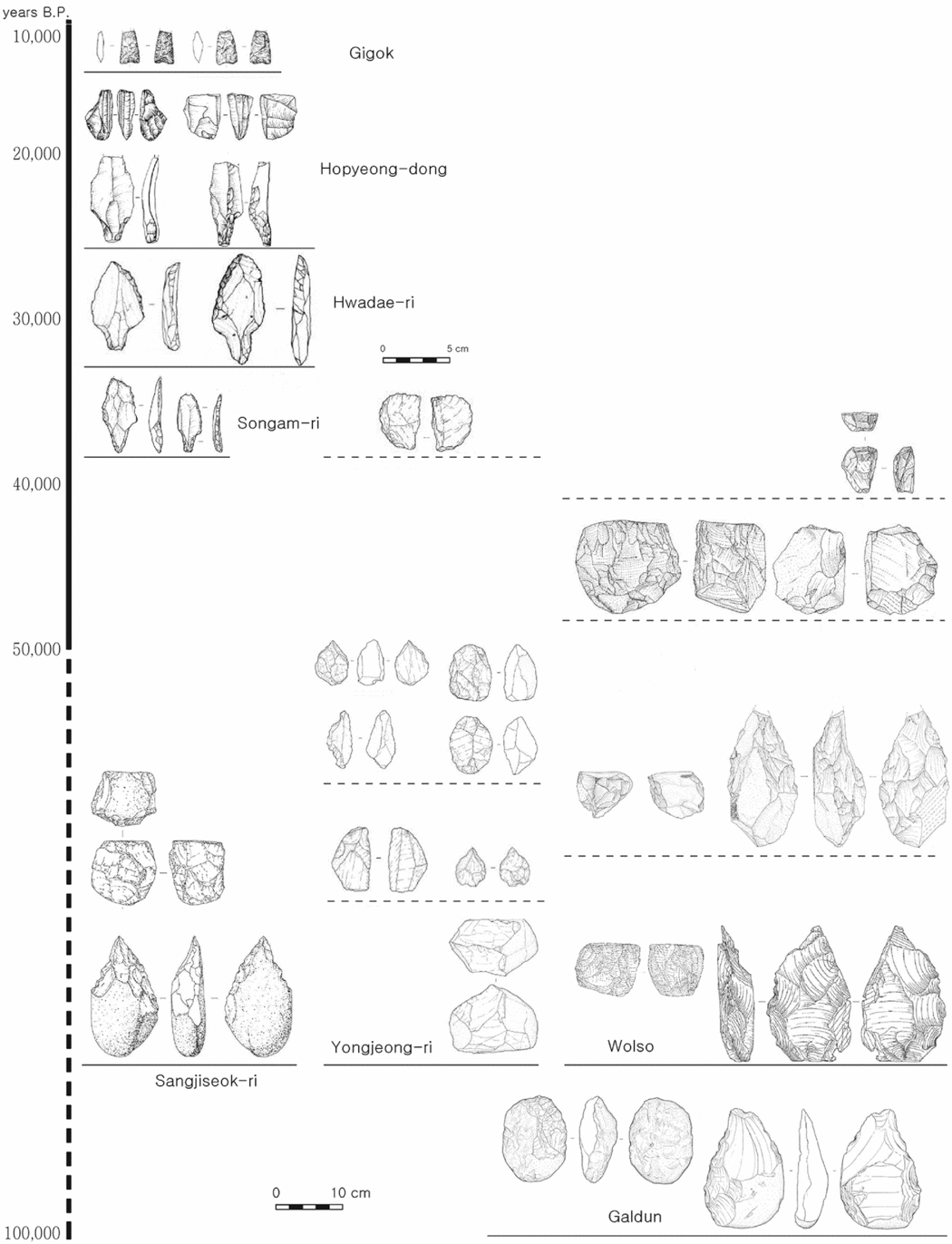
Change of artefact types during the Upper Pleistocene in Korea using stratified sites and absolute dates (Table S1). Top left: typical Late Palaeolithic types made of fine-grained raw materials, including arrowheads, microblade cores and tanged points. Earlier larger artefacts include quartzite types such as handaxes, choppers and scrapers. The horizontal dotted lines distinguish the multiple horizons identified at Yongjeong-ri and Wolso. Note the difference of scales between assemblages older and younger than 40 kya.

The lithic assemblages from Hahwagye-ri, Gigok, Dongbaek-ri, Yongjeong-ri, Wolso and Hwadae-ri are good examples of Korean sites that display evidence of a major behavioural transition occurring during the Palaeolithic (see Table S1). For example, four stratigraphic levels were identified at Hahwagye-ri, with the three lowest horizons represented by large choppers and polyhedrals made of quartzite and vein quartz. The dates for these horizons range between 80 kya and 40 kya (see Table S1): the proposed time period of the Korean Middle Palaeolithic (Park & Choi Reference Park and Choi2002; Choi et al. Reference Choi, Ahn and Ryu2004). Although little difference is evident in the lower three horizons, blades and microblades appear in the uppermost stratigraphic level with associated dates placing the horizon during the terminal Pleistocene. A similar pattern is present for the lithic assemblages from Gigok, Wolso, Dongbaek-ri and Hwadae-ri, but the transition appears a little earlier at around 30 kya. Indeed, at Hwadae-ri, a significant behavioural change occurs marked by the appearance of a new tool type (tanged points) that is produced on fine-grained siliceous shale and dated to older than 30 kya (Bae & Bae Reference Bae and Bae2012; Bae et al. Reference Bae, Bae and Kim2013; Seong Reference Seong2015).
Recently excavated assemblages from the stratified sites of Yongjeong-ri, Galdun, Sangjiseok-ri and Mangsang-dong suggest that quartzite and vein-quartz artefacts dominated lithic technology during the supposed Middle Palaeolithic range c. 100–40 kya. Over 90 per cent of lithic artefacts were made of quartzite and vein quartz, which were locally available at most sites and used for the duration of this time frame (see Table S1). Artefact assemblages are composed of large flakes, choppers, polyhedrals and, occasionally, handaxes, along with small flakes. Cores are mostly blocky and flat without any sign of preparation.
Although basic quantifiable data are available from excavation reports, questions often arise as to how confident typological assignments can be. Nevertheless, only minor variations in stone tool production during the Middle and Late Pleistocene are suggested. Mansu-ri is one such example of this, where five artefact-bearing layers were recognised along the 7–10m-deep profile (see Table S1). Using primarily OSL dates, the stratigraphic layers are bracketed between 110 kya and 24 kya. No absolute dates were reported from the lowest artefact horizon except for a singular 26Al-10Be date of 750–350 kya, but this date is considered to be anomalous (Kim Reference Kim2011).
The Mansu-ri lithics show a slight decrease in the overall size of cores and flakes over time (see Table S1); the younger flakes appear to display a higher number of dorsal scars and the core tools become smaller as their age decreases (Kim Reference Kim2011). Other changes include fewer heavy-duty tools in the younger deposits, and the presence of biconical and pseudo-prismatic cores and small elongated, detached flakes. Retouch appears throughout, but in higher frequencies in the younger deposits, which may in part be related to raw material availability (Seong Reference Seong2004). Expedient knapping strategies using locally available vein quartz and quartzite still dominated the lithic toolkits from the older and younger deposits at Mansu-ri.
Discussion
The Middle Palaeolithic in Korea
Transitions in lithic technological organisation should represent a significant departure from existing techniques, such as core preparation, retouch and raw material use (Nelson Reference Nelson1991), as Gao and Norton (Reference Gao and Norton2002) suggested in their critical review of the Chinese Middle Palaeolithic. These criteria are still valid for considering the relevance of dividing the Palaeolithic into periods according to transitions in lithic technology. For instance, in Korea, low-quality, locally available raw materials such as quartzite and vein quartz were widely used, showing no evidence of change during the supposed Lower–Middle Palaeolithic transition, whether the date of this transition is set at 300 kya as it appears in the Western Old World, or 100 kya as it is in Korea. A marked behavioural transition does not appear in the Korean archaeological record until around 40–35 kya (Seong Reference Seong2009, Reference Seong2015; Bae & Bae Reference Bae and Bae2012). This transition is clearly visible when tanged points and blades produced on non-local, higher quality silicified shale and hornfels appear in different areas of the peninsula at sites such as Songnam-ri and Hwadae-ri (Figure 4).
The prepared core technology that defines the Middle Palaeolithic is absent from the eastern Asian archaeological record until very recently (post 40 kya). In Korea, it is generally acknowledged that Levallois technology is not present at all (Lee Reference Lee2000; Yi Reference Yi2000, Reference Yi2009; Seong Reference Seong2002; Kim Reference Kim2012). Korean lithic assemblages from between 300 and 40 kya are characterised by polyhedrals, choppers, handaxes and small flakes, while in the post-40 kya upper cultural layers of some sites (e.g. Jeongok-ri, Gawol-ri, Dongbaek-ri) stone tools become more diverse and smaller (Bae & Bae Reference Bae and Bae2012; Seong Reference Seong2015; Figure 4).
Other researchers have also questioned the existence of a distinct Middle Palaeolithic feature in Korea. A recent study observed that no lithic assemblage currently exists in Korea that matches the original definition of the Western Old World Middle Palaeolithic (Kim Reference Kim2012: 10–11). While Kim acknowledges the change towards an increased frequency of small flakes in assemblages, this represents a developing trend rather than a distinguishing marker that can define a clear Middle Palaeolithic. We observed much the same pattern: generally, core and flake tools became smaller and more refined towards the Late Palaeolithic when a diversification of different lithic types appears (e.g. tanged points, blades and eventually microblades after 30 kya). In other words, little evidence appears to exist for a distinct ‘Middle Palaeolithic’ in Korea based on the current archaeological record.
The Middle Palaeolithic in broader eastern Asia revisited
As described originally by Gao and Norton (Reference Gao and Norton2002), many Chinese Palaeolithic researchers traditionally use geochronology (with most dates bracketed between 130 kya and 30 kya) and the presence of mid-Pleistocene Homo fossils to determine whether to assign a lithic assemblage to the Middle Palaeolithic (see also Norton et al. Reference Norton, Gao, Feng, Camps and Chauhan2009). The primary conclusion that Gao and Norton (Reference Gao and Norton2002) drew from their study is that if researchers study behavioural variation through the stone tool record, then their analyses must depend on what the lithics tell us rather than relying on indirect evidence such as geochronology or the presence or absence of certain types of hominin taxa. When evaluating Chinese Middle Palaeolithic stone tool assemblages using four standard criteria (raw materials, core reduction, retouch and typology), Gao and Norton (Reference Gao and Norton2002) found insufficient grounds to justify a clear Middle Palaeolithic. This led them to conclude that dividing the Chinese (and, as we infer from their article, the broader eastern Asian record) into an Early and Late Palaeolithic was viable given the current state of the archaeological evidence. The Gao and Norton (Reference Gao and Norton2002) study has recently been criticised directly and indirectly by arguments that a clear Middle Palaeolithic is present in China.
In a recent critique, Yee (Reference Yee2012) argued that the degree of variation in the four standard archaeological criteria used by Gao and Norton (Reference Gao and Norton2002) were sufficient to justify that these stone tools assemblages (Zhoukoudian locality 15, Xujiayao) could represent a distinct cultural period (i.e. a Middle Palaeolithic). In another study, Hou et al. (Reference Hou, Yang, Dong, Zhang and Liu2013) argue that there is clear evidence for a Middle Palaeolithic that can be distinguished from an Upper Palaeolithic at the four sites of Xiaogushan, Shiyu, Salawusu and Yanjiagang. Indeed, they concluded that “If there is a missing [Middle Palaeolithic] period (Gao Reference Gao1999), the stone artifacts and associated other remains from the four sites mentioned above have not revealed it. After reviewing the Palaeolithic materials in China, it is difficult to make a different conclusion to that presented here” (Hou et al. Reference Hou, Yang, Dong, Zhang and Liu2013: 189–90). We interpret this statement to mean that Hou et al. (Reference Hou, Yang, Dong, Zhang and Liu2013) found clear evidence of a Middle Palaeolithic in the four sites they studied (contra Gao Reference Gao1999 and by extension Gao & Norton Reference Gao and Norton2002). Furthermore, in their review of the Chinese Palaeolithic, Bar-Yosef and Wang concluded that
Although these [Chinese ‘Middle Palaeolithic’ artefacts] lack the use of Levallois methods, their predominance of cores and flakes, of which a certain percentage is shaped into side scrapers, is similar to that of the non-Levallois industry known as Quina Mousterian in France (Bar-Yosef & Wang Reference Bar-Yosef and Wang2012: 327).
They thus came to the conclusion that a Middle Palaeolithic is clearly present in Pleistocene China. Finally, in an analysis of the Middle Pleistocene bifaces from the Fengshudao site in Bose basin, Guangxi, Zhang and colleagues reached the conclusion that “The main specific characters are the slight convexity of predominant removal preparation, and the recurrent unidirectional method during the procedure of knapping. Clearly these features prefigure the Levallois method” (Zhang et al. Reference Zhang, Huang and Wang2010: 442), suggesting that the Levallois should be found in the region.
Using the Korean data combined with the Chinese data, it is our view that there is little support for suggestions that there was a distinct Middle Palaeolithic in eastern Asia. For instance, one of the core arguments used by Yee (Reference Yee2012) is the supposed appearance during the Middle Palaeolithic of discoid cores. A recent critique of Yee's argument notes that discoid cores actually appear in Early and Late Palaeolithic assemblages as well, and are “not a reliable marker of the Middle Palaeolithic” in China (Li Reference Li2014: 1305). Even when discoid cores are present at purported Middle Palaeolithic sites in China (e.g. Gezidong, Jiangjiawan and Banjingzi), they generally do not represent a high proportion of the overall stone tool assemblage, and may not even be considered true discoid cores as defined by Western typologies (Li Reference Li2014).
The argument by Hou et al. (Reference Hou, Yang, Dong, Zhang and Liu2013) appears to be based on the idea that chronology and variation in the associated vertebrate palaeontology are sufficient grounds to recognise a distinct Middle Palaeolithic in China. Indirect data such as chronology and associated fauna are not viable indicators of a distinct behavioural or technological transition having occurred during the Palaeolithic in eastern Asia. Although there may be some truth to the observation that some Chinese scrapers are reminiscent of the French Quina Mousterian (Bar-Yosef & Wang Reference Bar-Yosef and Wang2012), we await a detailed morphometric comparative analysis to test this hypothesis. Regardless, if Quina-like side scrapers are in fact uncommon in eastern Asia, their presence may contribute little towards the development of a deeper understanding of hominin behavioural evolution during the late Middle Pleistocene and early Late Pleistocene. More recent studies (e.g. Wang et al. Reference Wang, Bae, Huang, Huang, Tian, Mo, Huang, Huang, Xie and Li2014) suggest little evidence to support the prediction that a Levallois will be found at Bose, Guangxi, in deposits “just as ancient than [sic] Fengshudao, or even more” (Zhang et al. Reference Zhang, Huang and Wang2010: 442). Thus, the jury is still out regarding these arguments for a distinct Middle Palaeolithic in China.
Conclusion
Palaeolithic research in eastern Asia was largely initiated in the early twentieth century by European scholars, making the borrowing of terms and schemes inevitable. Given, however, that more than half a century has now passed (almost a full century in China), the uncritical acceptance of the Western Old World Palaeolithic scheme hinders research in Korea and broader eastern Asia (Ikawa-Smith Reference Ikawa-Smith and Ikawa-Smith1978; Gao & Norton Reference Gao and Norton2002; Seong Reference Seong2002; Norton et al. Reference Norton, Gao, Feng, Camps and Chauhan2009). Indeed, the Middle Palaeolithic in Japan also appears to be defined simply by sites dated to older than 30 kya (Sato Reference Sato1992; Matsufuji Reference Matsufuji2001; Shimada Reference Shimada2010), despite the fact that the Levallois, or any other unique technique or artefact typology that might be used to distinguish a Middle Palaeolithic, has yet to be identified on the Japanese archipelago (Sato et al. Reference Sato, Nishiaki, Suzuki, Dibble and Bar-Yosef1995). The grounds for referring to a lithic assemblage as Middle Palaeolithic therefore remain uncertain at best throughout much of eastern Asia.
Most, if not all, researchers working in the eastern Asian Palaeolithic would agree that variation exists in lithic toolkits across time. Indeed, even Yee (Reference Yee2012: 624) notes that in the Chinese Palaeolithic “industries do show gradual transition” in terms of the increasing complexity of core preparation and reduction. The question of whether gradual change is strong enough to justify a distinct Middle Palaeolithic remains, but the current state of the evidence suggests that it is not (Gao & Norton Reference Gao and Norton2002; Li Reference Li2014).
Two other interesting points may be raised here. First, if the eastern Asian three-stage behavioural model follows the European/African standard, then should we expect to find the initial stage of a distinct eastern Asian Middle Palaeolithic to be similar to the Western Old World (c. 300 kya)? All proponents of a Middle Palaeolithic in Korea suggest its origins can be dated to the beginning of the Late Pleistocene or even more recently between 100 and 75 kya. Even supporters of a Middle Palaeolithic in China suggest that the cultural stage spans 140–30 kya (Yee Reference Yee2012). Second, the presence or absence of Levallois technology during the Middle and first half of the Late Pleistocene in eastern Asia may not actually be a priority for debate. Almost everyone working in eastern Asia would agree that the stone tool technologies are largely different from the European record, and we should perhaps not necessarily seek to find a European marker (Levallois or Quina-like flakes in late Middle or early Late Pleistocene deposits) to prove or disprove the hypothesis. It would be more constructive to evaluate the eastern Asian record critically to determine whether there are any grounds for the division of the Palaeolithic record into one, two or three or more stages. This would continue a trend begun by Gao and Norton (Reference Gao and Norton2002) and Norton et al. (Reference Norton, Gao, Feng, Camps and Chauhan2009).
The continued use of the Middle Palaeolithic in Korea and broader eastern Asia is inappropriate, and has been a major obstacle in understanding the diversity of lithic assemblages across time and space. As Yee herself recognises, “research in China should avoid aligning with the Western conceptual framework” (Yee Reference Yee2012: 625). Without more detailed evaluations, the continued unconditional application of the Western Old World three-stage cultural sequence to the eastern Asian Palaeolithic needs to at least be placed temporarily on hold. If eastern Asian prehistory is re-evaluated in this light, then Middle and Lower Palaeolithic sites and materials should be grouped together and renamed the Early Palaeolithic, and the Upper Palaeolithic should be renamed the Late Palaeolithic. In other words, based on the current state of evidence from Korea and China, the eastern Asian Palaeolithic should be divided into two stages: Early and Late. Additional investigations will hopefully enable us to test the validity of this proposition.
Acknowledgements
This work was supported by a National Research Foundation of Korea Grant (NRF-2013S1A5B6043901). We thank Min-Kyeong Kim for help with the tables and figures. We are also grateful to Robin Dennell for comments on an earlier draft of this manuscript. We alone are responsible for any errors that may be present here.
Supplementary material
To view supplementary material for this article, please visit http://dx.doi.org/10.15184/aqy.2016.141