Healthcare-associated infections, especially those caused by multidrug-resistant (MDR) bacteria, are associated with increased morbidity, mortality, and healthcare costs and prolonged length of hospitalization.Reference Pumart, Phodha, Thamlikitkul, Riewpaiboon, Prakongsai and Limwattananon 1 The skin is a major reservoir for pathogens. Patients colonized with MDR bacteria, such as methicillin-resistant Staphylococcus aureus (MRSA), vancomycin-resistant enterococci (VRE), extended-spectrum beta-lactamase (ESBL)-producing gram-negative bacteria, MDR Acinetobacter baumannii, and MDR Pseudomonas aeruginosa, are at increased risk of subsequent infection.Reference Chavers, Moser and Benjamin 2 – Reference Kassakian, Mermel, Jefferson, Parenteau and Machan 6 Chlorhexidine gluconate, which has broad-spectrum activity against both gram-positive and gram-negative bacteria,Reference Mangram, Horan, Pearson, Silver and Jarvis 7 has been used to bathe hospitalized patients to reduce the bacterial density on the skin, especially in intensive care units (ICUs). Chlorhexidine gluconate is a positively charged molecule that binds to the negatively charged sites on the cell wall of bacteria to destabilize the cell wall and interfere with osmosis regulation, resulting in bacterial cell death.Reference Puig Silla, Montiel Company and Almerich Silla 8 Moreover, chlorhexidine gluconate can be applied directly as a solution (at a 2% concentration) or as an ingredient in soaps and gels (at a 4% concentration). Several experimental studies have reported the impact of skin cleansing with chlorhexidine gluconate at both concentrations on reducing the incidence of central line–associated bloodstream infections (CLABSI) and colonization. The results of cleansing the patient’s skin with chlorhexidine gluconate revealed 23% to 50% reduction in skin colonization, particularly from VRE and MRSA. The rate of CLABSI was decreased to 0.69-4.1 cases per 1,000 catheter-days.Reference Bleasdale, Trick, Gonzalez, Lyles, Hayden and Weinstein 9 – Reference Vernon, Hayden, Trick, Hayes, Blom and Weinstein 14 However, the benefit of chlorhexidine gluconate for preventing gram-negative colonization and infections has not been well documented.Reference Derde, Dautzenberg and Bonten 15 Currently in hospitals, 2% chlorhexidine gluconate–impregnated washcloths for cleansing the patient’s body surface are widely available. Siriraj Hospital (Bangkok, Thailand) produced 2% chlorhexidine gluconate–impregnated washcloths in the pharmacy department to be used for hospitalized patients at risk of VRE during a VRE outbreak in 2012. Chlorhexidine gluconate–impregnated washcloths have also been used since at the hospital for cleansing patients with any documented MDR organisms. A previous prospective study at Siriraj Hospital observed that newly hospitalized patients had rates of colonization of 45.1% for ESBL-producing bacteria, 18.4% for MDR A. baumannii, 14.1% for MDR P. aeruginosa, and 9.4% for MRSA.Reference Choorat, Rattanaumpawan and Thamlikitkul 16 These data indicated that colonization with MDR gram-negative bacteria in hospitalized patients at Siriraj Hospital was more common than with MDR gram-positive bacteria.
The objective of this study was to determine the effectiveness of cleansing the patient’s body surface with chlorhexidine gluconate–impregnated washcloths for the prevention of MDR bacterial colonization, especially gram-negative bacteria, and hospital-acquired infections in adult patients in the ICU at Siriraj Hospital.
METHODS
The study protocol was approved by the Siriraj Institutional Review Board and written informed consent was obtained from all study patients or their legal representatives.
Study Design and Participants
A randomized, open-label trial was conducted with hospitalized patients in 4 medical ICUs from December 2013 to January 2015. Adult patients aged 18 years or older who were expected to stay in the ICU longer than 48 hours and who had swab samples collected from the target sites within 48 hours were included. The patients who were allergic to chlorhexidine, had extensive skin lesions, or were unable to receive routine bathing were excluded. The eligible patients were randomly assigned to the control group or the chlorhexidine group by block randomization (1:1) for each ICU. A random sequence was generated by a computer using a block size of 4 and was concealed in sequentially numbered, sealed, opaque envelopes.
Study Procedure
The patients in the control group received routine bathing with non-antimicrobial soap and water twice daily and were allowed to use skin-care products such as moisturizer. The patients in the chlorhexidine group received 2% chlorhexidine–impregnated washcloths to wipe their body surfaces once daily in the morning and were not allowed to use other skin-care products. All baths were performed by nurses. In brief, 6 chlorhexidine-impregnated cloths were used in sequential order to wipe the body surfaces from neck to toe to avoid exposure of chlorhexidine to the mucous membranes of the eyes, ears and mouth. If the patient received any procedure that might remove chlorhexidine from the body surfaces, such as a tepid sponge, the same procedures for wiping the body with chlorhexidine-impregnated cloths were repeated. The chlorhexidine-impregnated washcloths were made by the pharmacy department of Siriraj Hospital. Our chlorhexidine-impregnated washcloths were analyzed for chlorhexidine gluconate concentration by high-performance liquid chromatography method. We performed in vitro microbiologic activity tests of locally produced chlorhexidine-impregnated washcloths every few weeks up to 6 months and we found that they still contained similar in vitro microbiologic activity up to 6 months.Reference Block 17 – 19 Hand hygiene adherence of healthcare personnel in all ICUs was greater than 70% throughout the study period. There were no other interventions introduced during the study. The adherence to the intervention was more than 95% during the study period. The swab samples were collected from nares, axilla, antecubital, groin, and perianal areas from each enrolled patient within 48 hours of admission to the ICU and on days 3, 5, 7, and 14, or until the patient left the ICU. The swabs were sent to the infectious diseases laboratory for determination of target MDR bacteria—that is, MRSA, VRE, ESBL-producing Klebsiella pneumoniae, ESBL-producing Escherichia coli, MDR A. baumannii, and MDR P. aeruginosa. Preliminary isolation of ESBL-producing gram-negative bacteria was performed using ceftriaxone (4 µg/mL)–supplemented MacConkey agar. Confirmation of ESBL-producing gram-negative isolates was obtained by the double disk diffusion method. Preliminary isolation of MRSA was performed using mannitol salt agar. Preliminary isolation of VRE was performed using vancomycin (6 µg/mL)–supplemented enterococcal agar. Antibiotic susceptibility of the isolated MDR bacteria was determined by a disc diffusion assay. MDR A. baumannii and MDR P. aeruginosa were defined as the isolates that were resistant to at least 3 of 5 classes of systemic antibiotics—that is, cephalosporins, beta-lactam/beta-lactamase inhibitors, carbapenems, aminoglycosides, and fluoroquinolones.
Outcome Assessment
The study outcomes were a favorable event; target MDR bacteria colonization-free time; hospital-acquired infections—that is, ventilator-associated pneumonia (VAP), CLABSI, and catheter-associated urinary tract infection (CAUTI); length of ICU stay and length of hospital stay; and adverse skin reactions. A favorable event was defined as (1) the swab samples collected from all the aforementioned sites were persistently negative for target MDR throughout ICU admission, or (2) the initial swab samples showed the presence of any target MDR bacteria but the samples collected thereafter were negative for target MDR bacteria. The target MDR bacteria colonization-free time was defined as the time for which a favorable event was maintained. Hospital-acquired infections were determined by trained infection control personnel in accordance with criteria defined by the Centers for Disease Control and Prevention National Healthcare Safety Network. The length of ICU stay and hospital stay were recorded. Each patient was monitored for skin reactions to the study intervention by the ward nurses. Skin reactions were graded as (1) faint erythematous macule or dry skin, (2) erythematous papule, (3) skin blisters, or (4) skin ulceration. Isolation and identification of the target MDR bacteria was performed by the personnel in the infectious disease laboratory who were unaware of the patient groupings.
Sample Size Estimation and Statistical Analyses
A previous prospective study at Siriraj Hospital found that 58% of newly hospitalized patients were colonized with MDR bacteria within 48 hours of admission. To detect a 25% reduction in target MDR bacterial colonization in the ICU patients who received chlorhexidine wipes over 14 days, 236 patients per group were needed with a power of 80% and a 2-sided type I error of 5%. All analyses were based on a modified intention-to-treat analysis. The χ2 test or Fisher exact test was used to compare the proportions of categorical variables between the groups. The unpaired t test or Mann-Whitney test, as appropriate, was used to compare continuous variables. Survival analysis was used to compare favorable events between the 2 groups. P<.05 was considered significant. The PASW statistical software, version 18.0 (IBM), was used for data analyses.
RESULTS
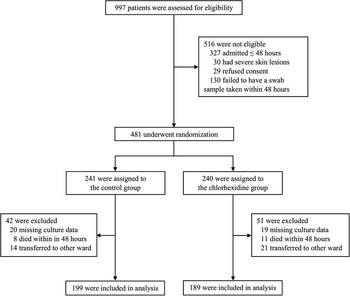
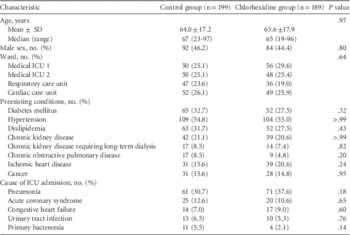
In total, 997 patients who were admitted to 4 ICUs were screened for eligibility to the study as shown in Figure 1. Of these, 516 patients were not eligible; 327 of them had stayed in the ICU less than 48 hours. The remaining 481 patients were randomized and followed up throughout their ICU admissions. Nineteen patients died suddenly, 35 patients were transferred to general medical wards after admission, and microbiologic data were not available for 39 patients. Therefore, 388 patients were suitable for outcome analysis. The baseline characteristics of the patients in both groups are shown in Table 1. The MDR bacterial colonization at enrollment, preexisting conditions, and causes of ICU admission were similar in both groups.
Flow chart of the patients in study of effectiveness of chlorhexidine wipes.

Baseline Characteristics of the Patients in Study of Effectiveness of Chlorhexidine Wipes

NOTE. ICU, intensive care unit.
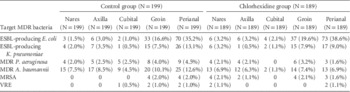
The prevalence of target MDR bacteria colonization at each site of the patients at enrollment is shown in Table 2. ESBL-producing E. coli, ESBL-producing K. pneumoniae, MDR P. aeruginosa, and MDR A. baumannii were mainly isolated from perianal swabs from 35.2% to 38.6% of the patients in both groups. MRSA colonization was detected in 2.1% of the nasal swabs taken from the patients in the chlorhexidine group. VRE was isolated in only approximately 1% of the samples collected from the groin and perianal areas. The prevalence of target MDR bacterial colonization at each site of the patients at enrollment did not differ between the 2 groups.
Prevalence of Target MDR Bacterial Colonization at Enrollment

NOTE. A. baumannii, Acinetobacter baumannii; E. coli, Escherichia coli; ESBL, extended-spectrum beta-lactamase; K. pneumoniae, Klebsiella pneumoniae; MDR, multidrug-resistant; MRSA, methicillin-resistant Staphylococcus aureus; P. aeruginosa, Pseudomonas aeruginosa; VRE, vancomycin-resistant enterococci.
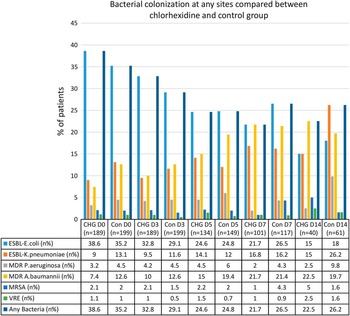
The prevalence of target MDR bacteria colonization by site and time after enrollment were determined. MDR A. baumannii and ESBL-producing K. pneumoniae colonizing the nares, axilla, and cubital areas increased after ICU admission. Groin and perianal areas were initially colonized with ESBL-producing E. coli but the colonizing organisms after ICU admission were predominantly MDR A. baumannii. The overall prevalence of ESBL-producing E. coli colonization tended to decrease over time whereas the prevalence of MDR A. baumannii colonization tended to increase over time during ICU admission as shown in Figure 2. The overall prevalence of carbapenem-resistant Enterobacteriaceae at any site or time after enrollment did not differ significantly between the control and chlorhexidine groups (4.0% and 4.8%, respectively).
The numbers of patients for which target multidrug-resistant (MDR) bacterial colonization was detected at any site in the chlorhexidine and control groups. A. baumannii, Acinetobacter baumannii; CHG, chlorhexidine gluconate; Con, control; D0, day 0; D3, day 3; D5, day 5; D7, day 7; D14, day 14; E. coli, Escherichia coli; ESBL, extended-spectrum beta-lactamase; K. pneumoniae, Klebsiella pneumoniae; MRSA, methicillin-resistant Staphylococcus aureus; P. aeruginosa, Pseudomonas aeruginosa; VRE, vancomycin-resistant enterococci.

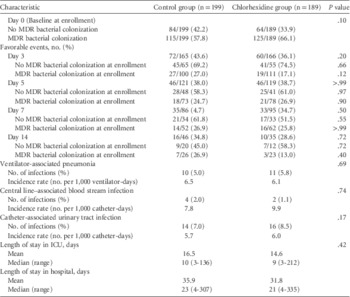
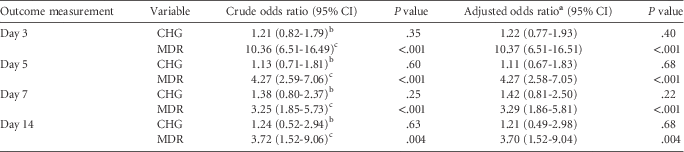
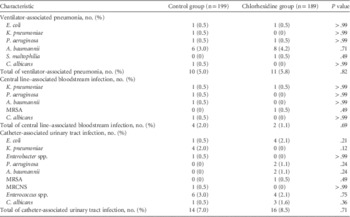
The number of favorable events observed on day 14 in the control group (34.8%) did not differ significantly from the chlorhexidine group (28.6%), and the incidence rates of VAP, CLABSI, and CAUTI were similar in both groups as shown in Table 3. The subgroup analyses between no-MDR and MDR bacterial colonization at enrollment resulted in higher favorable events in the no-MDR bacterial colonization group, as shown in Table 3. MDR bacterial colonization at enrollment was the risk factor of unfavorable outcome in Table 4. The CLABSI rate was the highest among hospital-acquired infections at 7.7 and 9.9 per 1,000 catheter-days in the control and chlorhexidine groups, respectively. The median lengths of stay in the ICUs and in the hospital did not differ significantly between the control and chlorhexidine groups, 10 vs 9 days and 23 vs 21 days, respectively, as shown in Table 3. The etiologic agents of hospital-acquired infections are shown in Table 5. Most of the infections were caused by gram-negative bacteria—that is, 64% in the control group and 69% in the chlorhexidine group.
Outcomes in Study of Effectiveness of Chlorhexidine Wipes

NOTE. ICU, intensive care unit; MDR, multidrug-resistant.
Factors Associated With Outcomes in Study of Effectiveness of Chlorhexidine Wipes

NOTE. CHG, chlorhexidine gluconate; MDR, multidrug-resistant.
a Adjusted for CHG and MDR.
b Compared with soap groups.
c Compared with no MDR at enrollment.
Etiologic Agents of Hospital-Acquired Infections in Study of Effectiveness of Chlorhexidine Wipes

NOTE. A. baumannii, Acinetobacter baumannii; C. albicans, Candida albicans; E. coli, Escherichia coli; K. pneumoniae, Klebsiella pneumoniae; MRCNS, methicillin-resistant coagulase-negative staphylococci; MRSA, methicillin-resistant Staphylococcus aureus; S. maltophilia, Stenotrophomonas maltophilia; P. aeruginosa, Pseudomonas aeruginosa.
The overall incidence of adverse skin reactions in the patients who received chlorhexidine-gluconate wipes was 2.5%. All skin reactions were mild (grade 1 and 2) and all of the patients who had skin reactions received routine bathing with non-antimicrobial soap instead.
DISCUSSION
This randomized controlled trial showed that once-daily cleansing of ICU patients with no-rinse 2% chlorhexidine–impregnated washcloths did not prevent or delay MDR gram-negative bacteria colonization compared with routine twice-daily cleansing with non-antimicrobial soap. Our findings differed from the results of 4 previous observational and experimental studies that revealed the benefit of 2% chlorhexidine–impregnated washcloths in reducing MDR bacteria colonization, particularly for VRE and MRSA.Reference Vernon, Hayden, Trick, Hayes, Blom and Weinstein 14 , Reference Bass, Karki and Rhodes 20 – Reference Ridenour, Lampen, Federspiel, Kritchevsky, Wong and Climo 23 The discrepancy could be due to differences in ICU structure, facilities, and the types of colonizing bacteria. The major colonizing organisms in ICU patients in the present study were gram-negative bacteria including ESBL-producing E. coli, ESBL-producing K. pneumoniae, MDR P. aeruginosa, and MDR A. baumannii, whereas the major colonizing organisms in the previous studies were MRSA and VRE, with no data reported on gram-negative bacteria. However, several previous studies on using chlorhexidine bathing in ICU patients did not observe any reduction in the colonization of patients with Acinetobacter spp. and Enterobacteriaceae.Reference Evans, Dellit, Chan, Nathens, Maier and Cuschieri 22 , Reference Cassir, Papazian, Fournier, Raoult and La Scola 24 Previous studies on the in vitro activity of chlorhexidine against various bacteria found that the minimum inhibitory concentration of chlorhexidine for P. aeruginosa (5–60 µg/mL) was higher than that for S. aureus (0.5–1 µg/mL) and chlorhexidine-resistant A. baumannii and E. coli owing to a drug efflux pump.Reference McDonnell and Russell 25 , Reference Hassan, Jackson and Penesyan 26 In subgroup analyses, MDR bacterial colonization at enrollment had significantly fewer favorable events compared with no-MDR bacterial colonization at enrollment, and the MDR bacterial colonization was the major risk factor of unfavorable outcomes. The reason might be that MDR gram-negative bacteria isolated from the ICU patients in this study were resistant to chlorhexidine. However, this postulation was not certain because the susceptibility to chlorhexidine of these MDR gram-negative bacterial isolates was not determined. Other possible reasons for the failure of 2% chlorhexidine–impregnated washcloths in reducing MDR bacteria colonization in the present study may be (1) the concentration of chlorhexidine was too low, (2) once-daily cleansing of ICU patients with no-rinse 2% chlorhexidine–impregnated washcloths was insufficient, (3) additional infection control practices were inadequate, or (4) most of the MDR gram-negative bacteria colonization was found in the swab samples collected from the perianal area, which should be related to gastrointestinal colonization with MDR bacteria that was not affected by chlorhexidine bathing. Several studies have demonstrated that once-daily bathing and 4-times-daily oral care with 2% chlorhexidine aqueous solution, environmental cleaning, contact precautions, cohorting of patients, and antibiotic stewardship collectively could limit colonization and infection with extremely drug-resistant A. baumannii and carbapenemase-producing K. pneumoniae in medical ICUs and in long-term acute care hospitals.Reference Apisarnthanarak, Pinitchai, Warachan, Warren, Khawcharoenporn and Hayden 27 , Reference Munoz-Price, Hayden and Lolans 28 Therefore, no-rinse 2% chlorhexidine–impregnated washcloths alone may be inadequate to control MDR gram-negative bacteria colonization in ICU patients.
The present study also revealed that the incidence rate of hospital-acquired infections, especially VAP and CAUTI, did not differ significantly between the 2 groups. This observation was similar to previous studies.Reference Bleasdale, Trick, Gonzalez, Lyles, Hayden and Weinstein 9 , Reference Popovich, Hota, Hayes, Weinstein and Hayden 13 , Reference Evans, Dellit, Chan, Nathens, Maier and Cuschieri 22 , Reference Apisarnthanarak, Pinitchai, Warachan, Warren, Khawcharoenporn and Hayden 27 , Reference Popovich, Hota, Hayes, Weinstein and Hayden 29 , Reference Noto, Domenico and Byrne 30 However, Martinez-Resendez et alReference Martinez-Resendez, Garza-Gonzalez and Mendoza-Olazaran 31 reported the benefit of daily use of 2% chlorhexidine–impregnated wipes and hair washing with no-rinse 0.12% chlorhexidine foam shampoo for the prevention of VAP and CAUTI but provided no data on the etiologic agents of such infections. Recently, there was a meta-analysis that found daily bathing with chlorhexidine would decrease the incidence risk of VAP. The authors of the meta-analysis hypothesized that daily chlorhexidine bathing plays a great role in decreasing the colonization pressure, which is a momentous risk factor for hospital-acquired infections and in reducing the risk of subsequent infection from manipulation of devices associated with the patient.Reference Chen, Cao and Li 32 The effect of chlorhexidine on the incidence rate of CLABSI varied. Five studies demonstrated that chlorhexidine bathing reduced the incidence of CLABSI mainly caused by gram-positive bacteriaReference Bleasdale, Trick, Gonzalez, Lyles, Hayden and Weinstein 9 , Reference Climo, Yokoe and Warren 11 – Reference Popovich, Hota, Hayes, Weinstein and Hayden 13 , Reference Evans, Dellit, Chan, Nathens, Maier and Cuschieri 22 whereas the present study did not show such a benefit. A recent randomized controlled trial also revealed that hospital-acquired infections including CLABSI, VAP, CAUTI, and Clostridium difficile infection did not significantly differ between the chlorhexidine group and the control group; however, there was no microbiologic data for hospital-acquired infections.Reference Noto, Domenico and Byrne 30 The incidence of adverse skin reactions in this study was low and skin reactions that did occur were mild, similar to a previous study.Reference Climo, Yokoe and Warren 11
There were several limitations to the current study. Many patients stayed in the ICU less than 48 hours and many patients were discharged from the ICU before 14 days. Therefore, the number of the subjects with outcomes on day 14 was limited. Moreover, we did not determine whether the MDR gram-negative organisms were resistant to chlorhexidine. The strengths of the current study, however, were the large number of enrolled patients, the modified intention-to-treat analysis, and the inclusion of a control non-antimicrobial soap group. In addition, the prevalence of ESBL-producing E. coli colonization at the time of admission was high in this population because many patients were transferred from general wards and from other hospitals after hospitalizations for a while. Generalizability of study results to populations with lower prevalence may be limited. Furthermore, this study was likely underpowered to detect a difference in rates of hospital-acquired infections. Although the present randomized controlled trial does not show any benefit of once-daily cleansing of ICU patients with no-rinse 2% chlorhexidine–impregnated washcloths in preventing or delaying MDR bacterial colonization compared with routine twice-daily cleansing with non-antimicrobial soap, the time spent using the washcloths was much less than with the soap. Besides, the cost of washcloths was low. Most of the healthcare personnel who used no-rinse 2% chlorhexidine–impregnated washcloths and the patients who received this treatment were satisfied with this cleansing method. Therefore, no-rinse 2% chlorhexidine–impregnated washcloths can be considered an alternative method of cleansing the body surface of ICU patients.
ACKNOWLEDGMENTS
We thank the nurses at the medical ICUs, for performing body cleaning procedures on the patients and colleting the swab samples; and Sasima Tongsai, PhD, for statistical analysis of the data.
Financial support. The Health Systems Research and Development Project, Faculty of Medicine, Siriraj Hospital; the Health Systems Research Institute (Thailand); the Thai Health Promotion Foundation; and the International Development Research Centre (Canada).
Potential conflicts of interest. All authors report no conflicts of interest relevant to this article.