Introduction
Globally, fruit flies (Diptera: Tephritidae) are significant pests of agricultural crops in Asia since the beginning of the last century. Species in the genus Bactrocera have been reported to potentially infest more than 173 kinds of fruits and vegetables (Gupta & Verma, Reference Gupta and Verma1978; White & Elson-Harris, Reference White and Elson-Harris1992; Allwood et al., Reference Allwood, Chinajariyawong, Kritsaneepaiboon, Drew, Hamacek, Hancock, Hengsawad, Jipanin, Jirasurat and Krong1999; Drew & Raghu, Reference Drew and Raghu2002; Dhillon et al., Reference Dhillon, Singh, Naresh and Sharma2005; Ekesi et al., Reference Ekesi, De Meyer, Mohamed, Virgilio and Borgemeister2016), where internal feeding by larvae causes premature abscission of fruit (Shinwari et al., Reference Shinwari, Khan, Khan, Ahmad, Shah, Mashwani and Khan2015).
Within the Bactrocera genus, Bactrocera correcta (Bezzi), Bactrocera dorsalis (Hendel), Bactrocera cucurbitae (Coquillet) and Bactrocera tau (Walker) have been considered economically important and widely distributed pests of agricultural crops including fruits, vegetables and nuts all over the world (Drew, Reference Drew2004; Clarke et al., Reference Clarke, Armstrong, Carmichael, Milne, Raghu, Roderick and Yeates2005). The B. correcta (the guava fruit fly) has been listed as a quarantine pest in most Asian countries (Tan et al., Reference Tan, Tokushima, Ono and Nishida2011; Jiang et al., Reference Jiang, Li, Deng, Wu, Liu and Buahom2013), and studies have reported that it could cause significant damage to commercial fruit crops in Thailand and Vietnam (Drew & Raghu, Reference Drew and Raghu2002; Liu et al., Reference Liu, Jin and Ye2013). The B. dorsalis is known to utilize more than 250 host plants, and as a result of this wide host plant range, its infestation tends not to be recorded above the economic injury level of 7.5% at the time of harvest in high-value crops such as carambola (star fruit) (Jiang et al., Reference Jiang, Gui, Xu, Pei, Smagghe and Wang2017). In contrast, high levels of infestation by other Bactrocera species have been reported: for example, 41–89% infestation rates by B. cucurbitae in bitter gourd (Lall & Sinha, Reference Lall and Sinha1959; Kushwaha et al., Reference Kushwaha, Pareek and Noor1973). In Asia, approximately 15–40% losses in fruit are caused by B. tau infestation (Hasyim et al., Reference Hasyim, Muryati and De Kogel2016). And the losses level varies from 30 to 100% (Gupta & Verma, Reference Gupta and Verma1978; Dhillon et al., Reference Dhillon, Singh, Naresh and Sharma2005), which depends on the infested vegetable species and seasons.
Integrated pest management (IPM) techniques are very important for the management of Bactrocera species in farms and orchards (Kogan & Bajwa, Reference Kogan and Bajwa1999). In IPM programs, it is necessary to understand the basic and detailed information of pests, such as survival, development and reproduction rates, and this information can be derived through life table modeling (Yang et al., Reference Yang, Carey and Dowell1994; Vargas et al., Reference Vargas, Walsh, Kanehisa, Stark and Nishida2000). However, traditional life table models only provide information for female age-specific populations (Leslie, Reference Leslie1945; Birch, Reference Birch1948; Lewis, Reference Lewis1977), whereas models for both males and females are needed to understand ecology, population dynamics, and survival (Huang & Chi, Reference Huang and Chi2012, Reference Huang and Chi2013).
In order to compile species life tables, insects usual are reared on artificial diets under laboratory conditions, since it is difficult to use the natural hosts during the whole year (Chang et al., Reference Chang, Caceres and Jang2004). An artificial diet is defined as ‘an unfamiliar food which has been formulated, synthesized, processed, and/or concocted by humans, on which an insect in captivity can develop through all or part of its life cycle’ (Singh, Reference Singh1977). While different artificial diets have been successfully prepared for the rearing of economically important pests, most of these species were lepidopterans (Castañé & Zapata, Reference Castañé and Zapata2005). The preparation of a larval diet for the mass rearing of Bactrocera fruit flies has long been considered an important area of research and there have been some developments: Bactrocera survival, growth and developmental rates were improved using dry plant materials, sugars and yeasts in an artificial diet (Vargas & Carey, Reference Vargas and Carey1989; Rajaganapathi & Kathiresan, Reference Rajaganapathi and Kathiresan2002; Liu et al., Reference Liu, Chen and Zeng2015; Rabab et al., Reference Rabab, Al-Eryan, El-Minshawy and Gadelhak2016), whereas banana was found to be an important fruit for the preparation of semi-artificial diet (Rabab et al., Reference Rabab, Al-Eryan, El-Minshawy and Gadelhak2016). Although a banana-based, semi-artificial diet for rearing larval B. dorsalis to study the olfactory behavior in male adults (Liu et al., Reference Liu, Chen and Zeng2015), no studies have been done on the fitness of male and female fruit flies of Bactrocera complex species on the semi-artificial diet.
In order to improve widely the methods for mass rearing of Bactrocera flies to gain an better understanding of their life history, the objective of this study was to assess male and female fitness of four species of economically important Bactrocera flies including B. correcta, B. dorsalis, B. cucurbitae, and B. tau, on a banana-based, semi-artificial diet, under laboratory conditions to create two-sex life tables.
Materials and methods
Insects
Cultures of B. correcta, B. dorsalis, B. cucurbitae, and B. tau were established in 2016 at the College of Agriculture, South China Agricultural University, Guangzhou, China. Prior to the experiment, the flies were reared for least two generations to allow for acclimatization to the semi-artificial diet and laboratory conditions. Adult flies were reared in cages (30 × 30 × 30 cm3) by providing water-soaked cotton wool in a box (12 × 6.8 × 7 cm3) and powdered yeast and sugar (2:1) in petri-dish (6 × 1.5 cm2). Fruit fly rearing and experimental study were carried out in a controlled room set at 25 ± 2°C, 60 ± 5% relative humidity, and a photoperiod of L:D 14:10 h. The temperature was controlled by the air-conditioner (Gree Electric Appliances, Inc. of Zhuhai, Zhuhai, China) and the humidity was maintained by humidifier.
Diet preparation
The semi-artificial diet was prepared according to the method of Liu et al. (Reference Liu, Chen and Zeng2015) and comprised 150 g corn flour, 30 g yeast, 30 g sucrose and 30 g fiber as well as 150 g banana that were measured on an electronic weighing balance (AB204-N, Mettler Toledo, Boston, USA) and then mixed together in an electronic blender (OPY-908, Zhongshan Opaye Industry Co., Ltd., Zhongshan, China). To this dry mixture, 0.6 g sodium benzoate, as an anti-microbial, and 1.2 ml hydrochloric acid and 300 ml water were added and mixed to make a semi solid diet (Liu et al., Reference Liu, Chen and Zeng2015).
Life table parameters
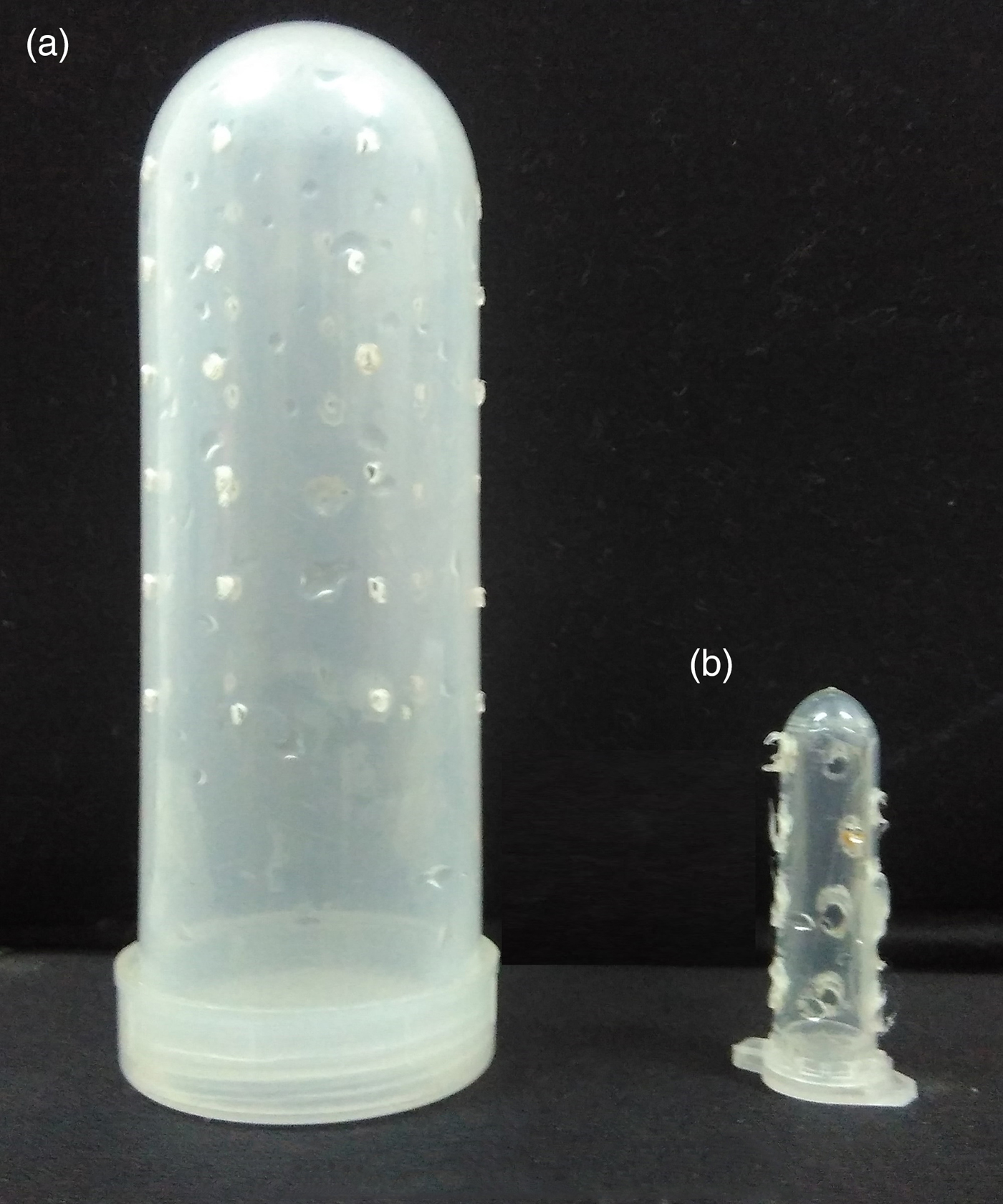
To determine life table parameters for male and female flies, eggs which had been laid within 24 h were selected. Eggs were collected from banana and pumpkin that had been placed in plastic bottles (11 × 4 cm2) perforated with 1 mm diameter holes (fig. 1a) that had, in turn, been placed in the above mentioned rearing cages. The bottle's surface was considered as an oviposition substrate. Eggs were collected by soft hair brush and shifted into jar (12 × 6 × 6 cm3) that contained semi-artificial diet. The jars were covered with muslin cloth. Five eggs of each species were placed into a jar. This experiment was replicated ten times. The developmental condition of each species, from egg to adult formation, was recorded daily. Puparia were removed to a separate plastic box (23.5 × 15.8 cm2) containing a 3-cm layer of sand, before adult emergence. After emergence, adults were sexed; one pair of flies (one female and one male) per species was introduced into a plastic jar (18 × 16 × 16 cm3) as a replication. Ten replications per species were conducted for this experiment. A small plastic bottle (4 × 1 cm2; perforated with 1 mm diameter holes, and contained banana and pumpkin) was kept in each plastic jar for fecundity recording (fig. 1b).
Plastic bottles (a) perforated and filled with banana and pumpkin into which eggs were laid; and (b) to record fecundity of adult female fruit flies.

Biological/Fitness parameters were recorded daily, comprising duration (days) of adult developmental stages; adult pre-oviposition period (APOP) or adult pre-reproduction period (APRP) of adult females; total pre-oviposition period (TPOP) or total pre-reproduction period (TPRP) of female counted from birth; oviposition duration (days); and, fecundity. Body weights of immature and mature stages of each fly were measured on an electronic weighing balance (Chi & Su, Reference Chi and Su2006; Singh et al., Reference Singh, Kumar and Ramamurthy2010), while body lengths and widths of immature and mature stages were measured using a Keyence VHX-5000 digital microscope, according to the method by Pozuelo et al. (Reference Pozuelo, Chang and Yang2015).
Statistical analysis
The biological/fitness parameters included development duration of both immature and mature stage, APOP, TPOP, oviposition and fecundity were calculated in the computer program TWO-SEX-MS Chart (Chi & Team, Reference Chi2017) in VISUAL BASIC (version 6, service pack 6) for the Windows system (http://140.120.197.173/Ecology and http://nhsbig.inhs.uiuc.edu/wes/chi.html). The population life table parameters (intrinsic rate of increase (r), finite rate of increase (λ), gross reproductive rate (GRR), net reproductive rate (R 0), doubling time (DT) and the mean generation time (T) were estimated according to the method described by Chi & Su (Reference Chi and Su2006).
In this study, the intrinsic rate of increase is estimated using the iterative bisection method from the Euler-Lotka formula with age indexed from 0 (Goodman, Reference Goodman1982), as shown in Equation 1.
 $$\sum\limits_{n = 0}^\infty {\left( {\matrix{ n \cr k \cr}} \right)} \;{\rm e}^{ - r(x + )}lxMx = 1$$
The mean generation time is defined as the length of time that a population needs to increase to R 0-fold of its size (i.e. erT = R 0 or λT = R 0) (Chi & Su, Reference Chi and Su2006). The life table parameters of each species were repeated three times to confirm the data. The differences between means were compared using least significant difference (LSD) with the statistics program SAS (SAS Institute, 2009) with PROCGLM and bootstrap tests (P > 0.05).
Results
Fly development
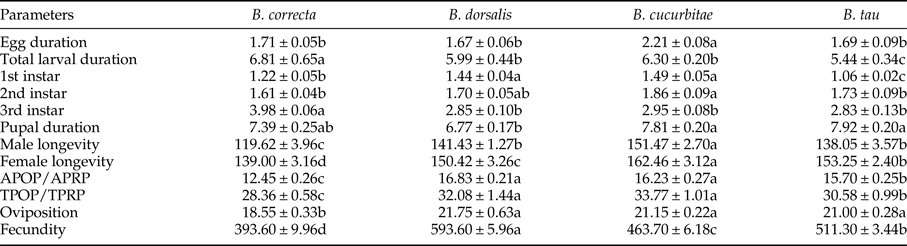
Significant differences in development times, from egg to pupation, among B. correcta, B. dorsalis, B. cucurbitae, and B. tau were recorded and analyzed (table 1). The incubation period (time between laying and hatching) for B. cucurbitae was significantly longer than for B. dorsalis, B. correcta, and B. tau (F 3,76 = 2.9, P < 0.05). The total larval period of B. correcta was significantly longer than for B. dorsalis, B. cucurbitae, and B. tau (F 3,76 = 20.1, P < 0.05). Comparison of adult male and female longevity showed females lived longer than males (table 1). The life spans of B. cucurbitae males and females were significantly greater than those of the other species (males: F 3,76 = 8.28, P < 0.001; females: F 3,76 = 47.0, P < 0.001; table 1).
Fitness parameters of B. correcta, B. dorsalis, B. cucurbitae and B. tau.

APOP, adult pre-oviposition period; APRP, adult pre-reproduction period; TPOP, total pre-oviposition period of female counted from emergence, TPRP, total pre-reproduction period of female counted from emergence.
With the exception of fecundity (eggs female−1), units are days.
Means rows followed by the same letter are not significantly different (P > 0.05) using bootstrap test.
There was no significant difference in the APOP of female adults for B. dorsalis and B. cucurbitae. However, the durations of APRP for these species were significantly longer than those for B. correcta and B. tau (F 3,36 = 39.3, P < 0.001). TPOP was remarkably longer in female B. dorsalis than in the other three species (F 3,36 = 12.3, P < 0.001; table 1).
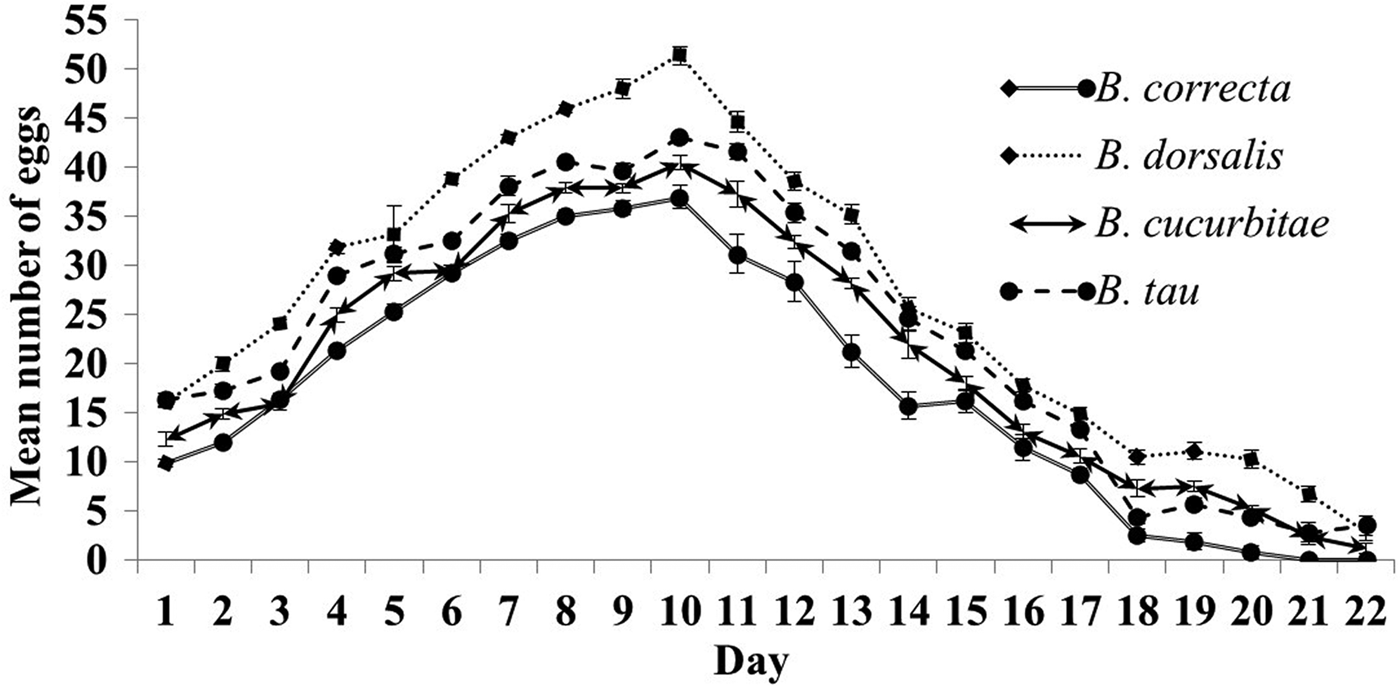
Mean daily egg production rate curves for B. correcta, B. dorsalis, B. cucurbitae, and B. tau were shown in fig. 2. Mean egg production rate curve of female B. dorsalis was the highest one among the four tested species (fig. 2). Fecundity in B. dorsalis was significantly higher than those in the other three species (F 3,36 = 139, P < 0.001; table 1).
Daily reproduction dynamics of adult females of B. correcta, B. dorsalis, B. cucurbitae, and B. tau on artificial diet.

Population life table parameters
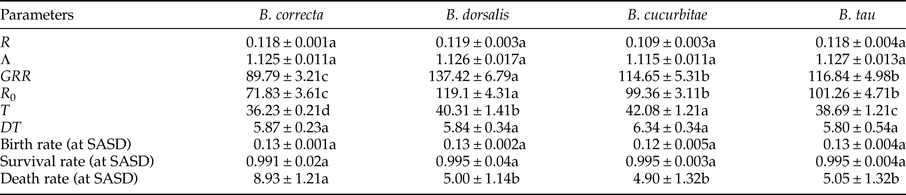
There was no significant difference in the intrinsic rate of increase and finite rate of increase per day among the four species of Bactrocera. The GRR and R 0 for B. dorsalis (137.4 and 119.1 offspring individual−1, respectively) were higher than B. correcta, B. cucurbitae and B. tau (table 2). Mean generation time for B. cucurbitae was longer than those for B. correcta, B. dorsalis and B. tau; however, there was no difference in the DT among four species (table 2).
Life table parameters of B. correcta, B. dorsalis, B. cucurbitae and B. tau.

r, intrinsic rate of increase (day−1); λ, finite rate of increase (day−1); GRR, gross reproductive rate (offspring individual−1); R 0, net reproductive rate (offspring individual−1); T, mean generation time (days); and, DT, Doubling time.
Means in rows followed by the same letter are not significantly different (P > 0.05) using bootstrap test.
Body weight
There were significant differences in body weight of immature and mature stages among four species, where B. dorsalis gained the greatest body weight. The body weights of larval B. dorsalis were greater than those of other three species (the first instar larvae: F 3,36 = 433, P < 0.001; the second instar larvae: F 3,36 = 526, P < 0.001; and the third instar larvae: F 3,36 = 534, P < 0.001, respectively). Similarly, the pupal body weight of B. dorsalis was significantly greater than those of the other three species (F 3,36 = 245, P < 0.001). Adult male (F 3,36 = 510, P < 0.001) and female (F 3,36 = 532, P < 0.001) flies of B. dorsalis gained the highest body weight among the tested four species (table 3).
The body weight of development stages B. correcta, B. dorsalis, B. cucurbitae and B. tau.

Means in rows followed by the same letter are not significantly different (P > 0.05) using LSD test.
Body size
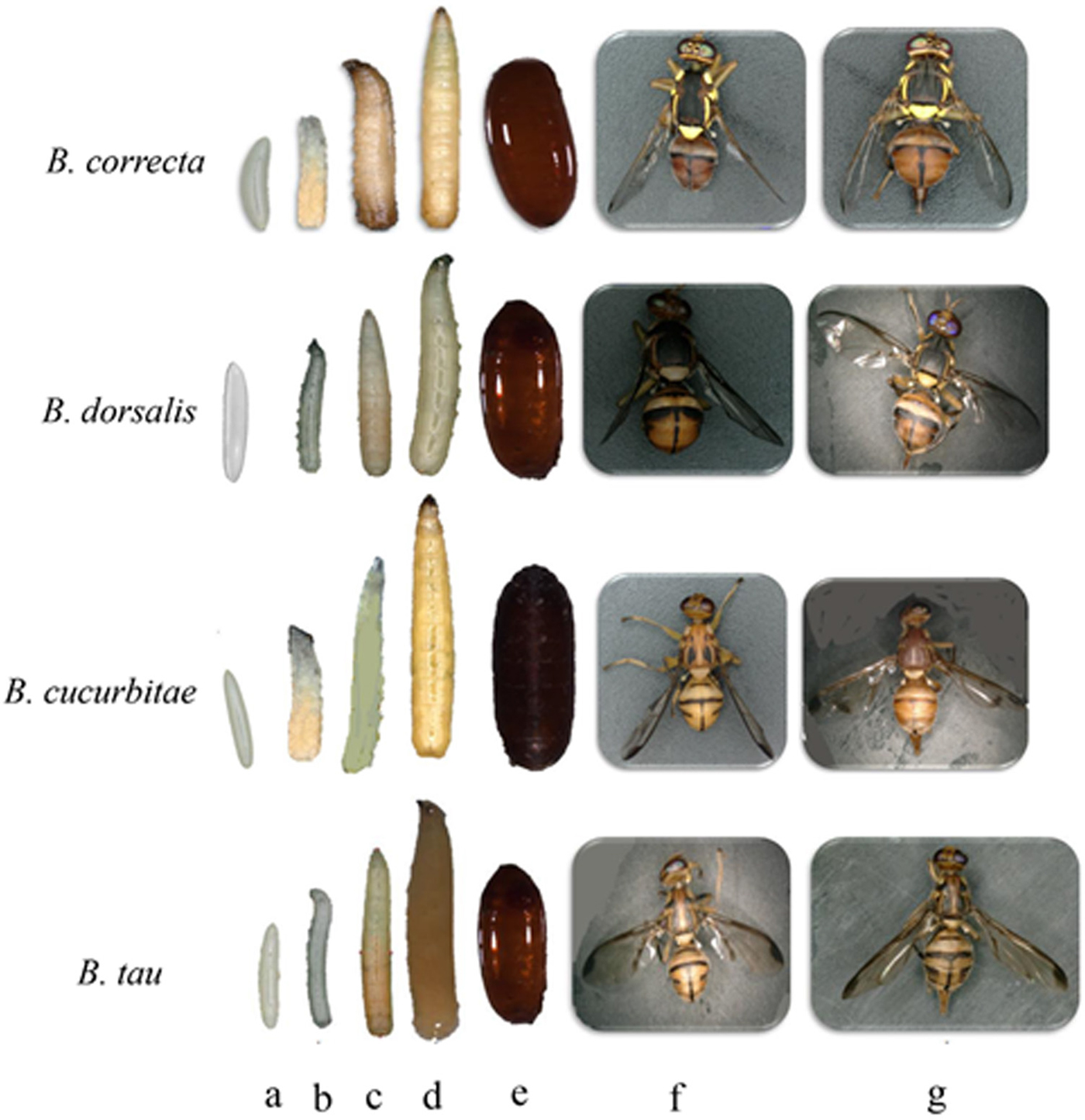
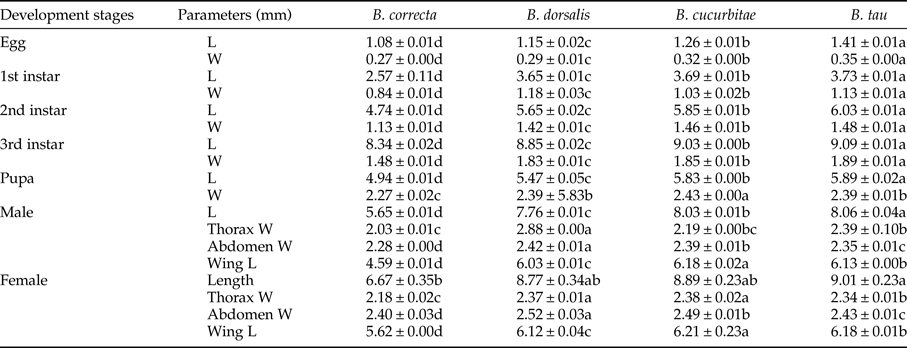
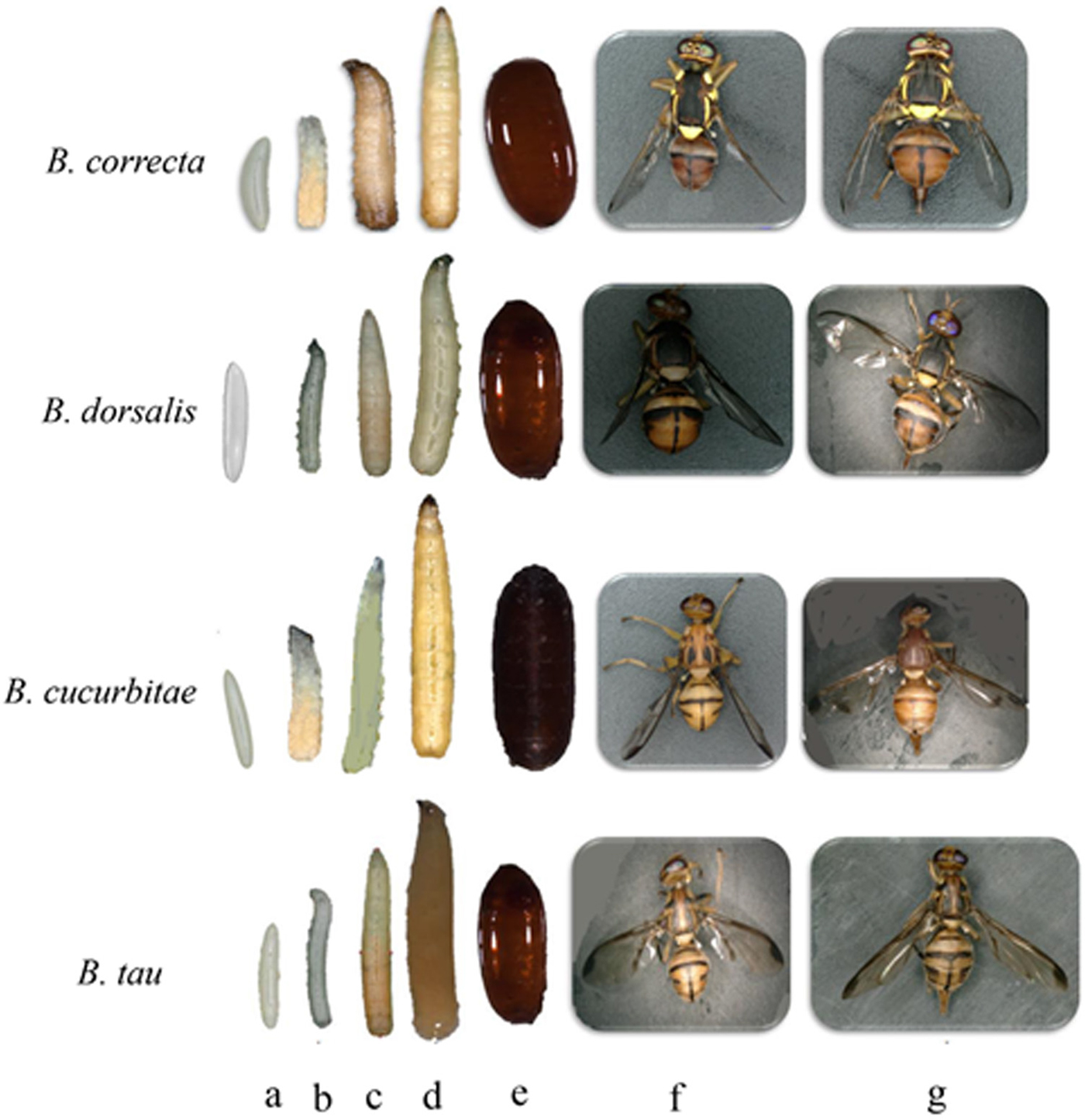
The immature and mature stages of B. correcta, B. dorsalis, B. cucurbitae and B. tau were shown in fig. 3. Mean body length and width of immature and mature stages of B. dorsalis, B. correcta, B. cucurbitae and B. tau were significantly different from each other (table 4), the mean egg length (F 3,36 = 1.01, P < 0.001) and width (F 3,36 = 1.01, P < 0.001) of B. tau were greater than those of other Bactrocera flies. A similar trend was observed for other immature stages (first, second, third instar and pupa) of B. tau (table 4). Mean body lengths of male (F 3,36 = 309, P < 0.001) and female (F 3,36 = 416, P < 0.001) adult B. tau were significantly longer than those of other three species. Mean wing length of female B. cucurbitae was significantly longer than those of other three species (F 3,36 = 23.74, P < 0.001). Mean thorax (F 3,36 = 247, P < 0.001) and abdomen (F 3,36 = 248, P < 0.001) widths of male adult of B. dorsalis were significantly longer than those of other three species. Similarly, the same trend was recorded for the thorax (F 3,36 = 292, P < 0.001) and abdomen (F 3,36 = 49.8, P < 0.001) width of female adults of B. dorsalis (table 4).
Different stages of Bactrocera species fed on the semi-artificial diet. (a) egg; (b) first instar; (c) second instar; (d) third instar; (e) pupa; (f) male adult; and, (g) female adult.
Mean body length and width of B. correcta, B. dorsalis, B. cucurbitae and B. tau.

L, length; W, width.
Means in rows followed by the same letter are not significantly different (P > 0.05) using LSD test.
Discussion
Several studies have described the biology of Bactrocera species on different natural host plants and artificial diet (Ekesi et al., Reference Ekesi, Nderitu and Chang2007; Vayssières et al., Reference Vayssières, Carel, Coubes and Duyck2008; Waseem et al., Reference Waseem, Naganagoud, Sagar and Kareem2012; Mir et al., Reference Mir, Dar, Mir and Ahmad2014), with a few studies having focused on the two-sex life table traits of B. cucurbitae on cucumber as a natural host plant (Huang & Chi, Reference Huang and Chi2012; Reference Huang and Chi2013). Our study, first time described the two-sex life table parameters of four species in the genus Bactrocera e.g., B. correcta, B. dorsalis, B. cucurbitae and B. tau fed on semi-artificial diet.
The development of immature insect pests is known to fluctuate with various abiotic and biotic factors, including light, temperature and humidity, and food resource, predation and competition, respectively (Shen et al., Reference Shen, Hu, Wu, An, Zhang, Liu and Zhang2014; Chen et al., Reference Chen, Li, Wang, Ma, Huang and Huang2017). When controlling for other factors, optimum food resource for development of insect pests is typified by shortest life cycles and highest levels of fecundity (Awmack & Leather, Reference Awmack and Leather2002). In our study, we found that B. dorsalis responded better to the semi-artificial diet than other three species, since it had the shortest life cycle and highest fecundity (table 1).
Semi-artificial diets including inert bulking agents, such as tissue papers and cotton wool soaked with fluid have been used successfully for small scale rearing of Ceratitis capitata (Wiedemann) and Rhagoletis cerasi L. (Katsoyannos et al., Reference Katsoyannos, Boller and Remund1977; Rajaganapathi & Kathiresan, Reference Rajaganapathi and Kathiresan2002). The biology of B. olae has been successfully studied on two types of artificial diets (cotton toweling and liquid diet) (Mittler & Tsitsipis, Reference Mittler and Tsitsipis1973), while B. cucurbitae and B. tryoni have been reared on a liquid diet, with wheat-based bulking agent and oil, but there were high costs associated with diet management (disposal and tray cleaning), storage, space, labor, and sanitation (Changmu & Hongmu, Reference Changmu and Hongmu2006; Dominiak et al., Reference Dominiak, Sundaralingam, Jiang, Jessup and Barchia2010). Our study successfully described the fitness of four Bactrocera species reared on a semi-artificial diet that was prepared with low associated costs.
Pupal development period and weight are important key factors for the survival of insect pests, especially in fruit flies, where the high pupal body weight is positively related to high fecundity. We found the highest pupal body weight and fecundity in B. dorsalis fed on the semi-artificial diet. The development time of the immature stages appears to vary with food resource, because the pupal period of B. cucurbitae was completed in 8–9 days on a cucumber diet (Waseem et al., Reference Waseem, Naganagoud, Sagar and Kareem2012), while in our study completion took 6–7 days.
The pre-oviposition period of B. cucurbitae has been reported as 10–15 days by Mir et al. (Reference Mir, Dar, Mir and Ahmad2014). In our study, pre-oviposition of B. cucurbitae was 16.23 days. Huang & Chi (Reference Huang and Chi2012) reported that the total pre-adult development time of B. cucurbitae was 15.1 days at 25°C on the natural host (cucumber) and Vayssières et al. (Reference Vayssières, Carel, Coubes and Duyck2008) reported 17.2 and 13.2 days, at 25 and 30°C respectively. In our study, we found total pre-adult development times for this species reared at 25°C was 16.23 days. In comparison with natural host plant as diets, this quicker development time might be due to the artificial food and rearing conditions. In IPM, application of management tactics for Bactrocera species would be more useful at pupal and pre-oviposition period rather than other stages.
Fecundity rates are known to vary among species; according to Vargas et al. (Reference Vargas, Walsh, Kanehisa, Jang and Armstrong1997), fecundity of B. dorsalis was greater than that of B. cucurbitae when reared on natural host plant material. In this study, we also found that fecundity of B. dorsalis was greater than that of B. cucurbitae. Furthermore, temperature-related differences in fecundity have been found in fruit flies. For example, Changmu & Hongmu (Reference Changmu and Hongmu2006) found the mean fecundity of B .cucurbitae reared on a cucumber diet at 30°C was 896 eggs female−1, while Mir et al. (Reference Mir, Dar, Mir and Ahmad2014) found the fecundity range was 58–92 eggs at 23.97 ± 0.66°C and our study showed a rate of 463.7 eggs female−1 at a temperature of 25°C. Differences in longevity between males and females, which we found in our study, have also been reported elsewhere, where females tend to live longer than males (Mir et al., Reference Mir, Dar, Mir and Ahmad2014).
Concerning biology and bionomics of B. tau, the detailed parameters of larval instars were not described (Singh et al., Reference Singh, Kumar and Ramamurthy2010). In our study, the body length and width of these flies were higher than those reported by Singh et al. (Reference Singh, Kumar and Ramamurthy2010). It may reflect a difference in rearing medium and food source. The intrinsic rate of increase (r) is an important population parameter in insect development and survival, because it explains the age, sex ratio, survivorship, and fecundity of insect population (Varley & Gradwell, Reference Varley and Gradwell1970). If r is greater than 0, then it might be the most appropriate population index to describe the adaptation of an insect to a food resource (Razmjou & Golizadeh, Reference Razmjou and Golizadeh2010; Chen et al., Reference Chen, Li, Wang, Ma, Huang and Huang2017). Indeed, we found that the r values for the four Bactrocera species were greater than zero, indicating suitability of the semi-artificial diet. The net reproductive rate is an indicator of rate of population increase, where the highest rate of population increase is dependent on the fecundity, development and survival of insect pests (Sayyed et al., Reference Sayyed, Saeed and Crickmore2008; Huang & Chi, Reference Huang and Chi2012). According to life tables, traits of R 0 less than 1 and r greater than 0 result in a mean population increase (Southwood & Henderson, Reference Southwood and Henderson2000; Chen et al., Reference Chen, Li, Wang, Ma, Huang and Huang2017). Our data support this theory, because they indicated that the semi-artificial diet was more suitable for the B. dorsalis due to higher fecundity and shorter development time than those of other three Bactrocera species.
In our study, we only compared the fitness of four Bactrocera flies by using two-sex life table on semi-artificial diet, which would be more useful for mass rearing of these flies. This study will be more helpful for future works, whether there are significant differences in fitness parameters of fruit flies on this semi-artificial diet and natural host. We suggest that our study will be helpful in the mass rearing, study of molecular biology, and sterile insect techniques for Bactrocera species, especially for B. dorsalis, B. correcta, B. cucurbitae and B. tau. In addition, based on the results of life table study, we could better understand when (and why) the populations of Bactrocera species suffer high mortality. In this way, a plan for the IPM of Bactrocera species would be timely conducted.
Acknowledgements
This research was supported by the National Science and Technology Pillar Program of China (2015BAD08B02). The authors are thankful to Prof. Dr Hsin Chi and Muhammad Nadir Naqqash from the Department of Plant Production and Technologies, Faculty of Agricultural Sciences and Technologies, Ömer Halisdemir Üniversity, for two-sex life table analysis.