Introduction
Wheat aphids are serious pests in wheat-growing areas and have caused major losses to wheat production in China (Wang et al., Reference Wang, Yuan, Chen, Lei and Wu2006). They mainly damage crops by feeding on plant juice and spreading the yellow dwarf virus, which causes wheat yellow dwarf disease, like Schizaphis graminum (Rondani) (George and Gair, Reference George and Gair2010). The aphids and combined diseases can cause premature plant decline, seed weight reduction, reduced yield and grain quality, and even the death of whole plants (Zhou et al., Reference Zhou, Chen, Liu, Frédéric, Eric, Claude, Sun and Cheng2013). It is critical to manage wheat aphids, particularly in Northern China. There are 32 species of aphids that endanger wheat crops worldwide, mainly Sitobion miscanthi (Takahashi), Sitobion avenae (Fabricius), Rhopalosiphum padi (Linnae), S. graminum and Acyrthosiphon dirhodum (Walker) (Wang et al., Reference Wang, Cui, Jie, Francis, Yong and Tooker2011; Hu et al., Reference Hu, Liu, Thieme, Zhang, Liu and Zhao2015; Duan et al., Reference Duan, Peng, Qiao and Chen2016).
The Chinese wheat aphid (CWA), S. miscanthi (Hemiptera: Aphididae) was incorrectly called Sitobion avenae Fabricius in China (Jiang et al., Reference Jiang, Zhang, Qin, Yin, Zhang, Li, Zhang, Fan and Chen2019), which is one of the main wheat pests worldwide and causes economic losses through direct feeding and virus transmission (Li et al., Reference Li, Xu, Shi, Shen and He2016; Zhang et al., Reference Zhang, Su, Xie, Zhen, Hu, Jiang, Huang, Liu, Gao, Chen and Gao2020).
The control of wheat aphids mainly relies on synthetic insecticides, i.g. organophosphates, carbamates, and pyrethroids. So far, neonicotinoid insecticides like imidacloprid and thiamethoxam have been widely applied in the prevention of aphids and other stinging or sucking pests, not only because of their high efficacy, but also low toxicity to humans and effective duration (Devine et al., Reference Devine, Harling, Scarr and Devonshire1996; Lu and Gao, Reference Lu and Gao2009; Cui et al., Reference Cui, Sun, Yang, Yan and Yuan2012; Kim et al., Reference Kim, Kwon, Ki, Kim and Lee2015). However, with the frequent and long-term application of neonicotinoids, neonicotinoid-resistant pests have appeared (Liu et al., Reference Liu, Han, Wang, Zhang, Zhang and Liu2003), such as wheat aphids (Cui et al., Reference Cui, Sun, Yang, Yan and Yuan2012; Tang et al., Reference Tang, Ma, Hou and Gao2017; Wang et al., Reference Wang, Zhang, Huang, Yang, Su and Chen2018; Zhang et al., Reference Zhang, Su, Xie, Zhen, Hu, Jiang, Huang, Liu, Gao, Chen and Gao2020). The most common causes of insecticide resistance include enhanced metabolic detoxification and reduced sensitivity of target sites. R81T resistance mutation has been previously found in aphids (Myzus persicae and Aphis gossypii) to be associated with neonicotinoid resistance phenotype (Hirata et al., Reference Hirata, Kiyota, Matsuura, Toda, Yamamoto and Iwasa2015, Reference Hirata, Jouraku, Kuwazaki, Kanazawa and Iwasa2017; Wang et al., Reference Wang, Watson, Loso and Sparks2016; Mezei et al., Reference Mezei, Bielza, Siebert, Torne, Gomez, Valverde-Garcia, Belando, Moreno, Grávalos, Cifuentes and Sparks2020; Sial et al., Reference Sial, Zhao, Zhang, Zhang, Mao and Jiang2020). The increased detoxification mediated by the overexpression of P450s is a common mechanism of insecticide resistance (Li et al., Reference Li, Schuler and Berenbaum2007; Puinean et al., Reference Puinean, Foster, Oliphant, Denholm, Field, Millar, Williamson and Bass2010; Schuler, Reference Schuler2011, Reference Schuler2012; Mohammed et al., Reference Mohammed, Wilding, Collier and Deeni2014; Liu et al., Reference Liu, Li, Gong, Liu and Li2015; Zhang et al., Reference Zhang, Su, Xie, Zhen, Hu, Jiang, Huang, Liu, Gao, Chen and Gao2020). It has been reported that resistance to neonicotinoids is mediated in part by CYP6CM1 in Bemisia tabaci (Jones et al., Reference Jones, Daniels, Andrews, Slater, Lind, Gorman and Denholm2011). For example, overexpression of CYP6CM1 is associated with imidacloprid resistance in B. tabaci (Karunker et al., Reference Karunker, Benting, Lueke, Ponge, Nauen, Roditakis and Morin2008). Another common characteristic of P450 is inducibility (Brandt et al., Reference Brandt, Scharf, Pedra, Holmes, Dean, Kreitman and Pittendrigh2002); the expression level of P450 in pests can be significantly induced by insecticides (Zhang et al., Reference Zhang, Kong, Cui and Zeng2016a, Reference Zhang, Kong, Wang, Gao, Zeng and Shi2016b, Reference Zhang, Ma, Liu, Lu, Chen, Zhang and Gao2019).
The expression of P450 genes can be regulated by both transcriptional and posttranscriptional regulation. At the posttranscriptional level, microRNAs (miRNAs) with a length of approximately 22 nucleotides can affect the posttranscriptional regulation of P450 genes by binding to coding sequences, 3′ UTRs, or 5′ UTRs (Tamasi et al., Reference Tamasi, Monostory, Prough and Falus2011; Pritchard et al., Reference Pritchard, Cheng and Tewari2012; Asgari, Reference Asgari2013). It has been reported that posttranscriptional regulation of P450 genes occurs when some miRNAs bind to their 3′UTRs or coding sequences (Hong et al., Reference Hong, Guo, Wang, Hu, Fang, Lv, Yu, Zou, Lei, Ma, Ma, Zhou, Sun, Zhang, Shen and Zhu2014; Peng et al., Reference Peng, Pan, Gao, Xi, Zhang, Ma, Wu, Zhang and Shang2016; Ma et al., Reference Ma, Li, Liu, Liang, Chen and Gao2017, Reference Ma, Li, Tang, Liang, Liu, Zhang and Gao2019a, Reference Ma, Tang, Zhang, Liang, Wang and Gao2019b). For instance, the expression of CYP325BG3 was regulated by miR-71 (Hong et al., Reference Hong, Guo, Wang, Hu, Fang, Lv, Yu, Zou, Lei, Ma, Ma, Zhou, Sun, Zhang, Shen and Zhu2014), and the expression of CYP6AG11 was regulated by miR-278-3p in Culex pipiens (Lei et al., Reference Lei, Lv, Wang, Guo, Zou, Hu, Fang, Tian, Liu, Liu, Ma, Ma, Zhou, Zhang, Sun, Shen and Zhu2015).
Although P450s are critical in the metabolism of insects to insecticides, the molecular mechanism of P450 in S. miscanthi in response to insecticides is still obscure. In the current study, we found that CYP4CJ6 could be involved in insecticide resistance. To better understand the molecular mechanism of the inducible expression of CYP4CJ6, posttranscriptional regulation of CYP4CJ6 was explored. It is essential to clarify the molecular genetic mechanism of P450s in the resistance of CWA to insecticides.
Experimental procedures
Insects and cell culture
CWA, the susceptible strain (SA-S) originated from approximately 1000 wingless aphids of parthenogenic lineages from the infested plant leaves of the wheat field in Xihua (Coordinates, N23.16 E113.23) of Henan Province of China in May 2003 and retained in a greenhouse for more than 10 years with no exposure to any insecticides. The culture condition was mentioned previously (Lu and Gao, Reference Lu and Gao2009). The aphid-dipping method was used to screen for resistance in each generation (Chen et al., Reference Chen, Xia, Wang, Qiao and Wang2013). The susceptibility of the strain to imidacloprid (SA-S) was determined, which had an LC50 value of 0.62 μg ml−1. The imidacloprid-resistant strain (SA-R) was obtained from the SA-S strain by continual selection with gradually increased concentrations of imidacloprid based on the LC50 values from the bioassay of their parent generations for 25 generations in the laboratory. Approximately 5000 apterous aphids in each generation were selected by the leaf-dipping method, and mortality was maintained at 40–80%. Finally, an SA-R strain of CWA (LC50 = 20.76 μg ml−1 after 24 h) was obtained by continuous selection of imidacloprid with 33.48-fold resistance compared with the SA-S strain. Both of the strains were fed on wheat seedlings at 23 °C, 60–70% relative humidity, and a photoperiod of 16:8 h (light:dark) under standard conditions (Lu and Gao, Reference Lu and Gao2009). The human embryonic kidney cell line 293T was cultured in DMEM (Servicebio, Wuhan, China) supplemented with 10% fetal bovine serum (Servicebio, Wuhan, China), 1% penicillin, and 1% streptomycin. 293T cells were cultured at 37 °C with 5% CO2.
Bioassays of a leaf with aphid-dipping
Insecticide toxicity to CWA was determined by using the aphid-dipping method with a slight modification (Chen et al., Reference Chen, Xia, Wang, Qiao and Wang2013). Insecticides were dissolved in acetone, and then diluted to serial concentrations with 0.05% (v/v) Triton X-100 in water. Wheat leaves were cut into 20 mm long pieces. The leaves with aphids were dipped into 0.05% (v/v) Triton X-100 water with insecticides for 10 s, or dipped into 0.05% (v/v) Triton X-100 water without insecticides as a control. The leaves with treated aphids were put into a glass tube (6 cm in length, 2 cm diameter) with the open end covered with cotton to prevent insect escape. Each concentration had three biological repeats, each with 20 healthy apterous aphids. Mortality was recorded after insecticide exposure at 24 h.
Rapid amplification of cDNA ends (RACE)
The 3′ and 5′ RACE first-strand cDNAs were synthesized, and the PCR system was constructed according to the instructions of the Smart™ Race cDNA Amplification Kit (Clontech). Based on the sequence fragment of CYP4C1-like, 4 gene-specific primers (GSPs) were designed to amplify the full-length cDNAs. The designed primers are presented in table 1. The thermal cycling was performed using touchdown PCR as follows: 5 cycles at 94 °C for 30 s and 72 °C for 3 min; 5 cycles at 94 °C for 30 s, 70 °C for 30 s, and 72 °C for 3 min; and 27 cycles at 94 °C for 30 s, 68 °C for 30 s, and 72 °C for 3 min. The products of the 3′ and 5′ RACE were cloned into the pGEM-T Easy Vector and sequenced.
List of primers used for qPCR and dsRNA synthesis

Note: F: forward primer, R: reverse primer; the sequence of the T7 promotor is represented by small letters; the restriction sites are represented by red letters.
Quantitative real-time PCR and data analysis
MagZol™ Reagent (TRIzol Reagent) (Magen, Guangzhou, China) was used to extract total RNA from 10 live aphids, and cDNA was synthesized with Honor™ II 1st Strand cDNA Synthesis SuperMix for qPCR with gDNA digester (Novogene, Tianjin, China). qPCR was performed on the ABI7500 platform (Applied Biosystems) with Unique Aptamer™ qPCR SYBR® Green Master Mix (Novogene, Tianjin, China). Each qPCR was performed with three biological replicates and two technical replicates. The 2−ΔΔCt method of relative quantification was used to process the above data (Pfaffl, Reference Pfaffl2001). Actin (Xu et al., Reference Xu, Wu and Han2014) and 18S rRNA (Broackes-Carter et al., Reference Broackes-Carter, Nathalie, Deborah, Stephen, John and Ann2002) were used as housekeeping genes for CWA. The primers used are presented in table 1.
Insecticides and dsRNA feeding assays
We used glass tubes with openings at both ends for feeding assays. One end was sealed with double-layer parafilm, and the solution containing either 100 μl of 0.5 mol l−1 sterile sucrose (artificial diet) with 10 μg ml−1 imidacloprid (95.3%) or thiamethoxam (5 μg ml−1, 97.0%) was sandwiched between the two parafilm layers. These concentrations were used based on our preliminary experiments of mortality between about 20 and 40%. A brush was used to gently place fifty healthy apterous aphids of the imidacloprid-resistant strain into the glass tube, and then the other end of the glass tube was closed with gauze. The aphids were fed an artificial diet containing insecticides for 24 h. The control was the same treatment without the insecticides. The experiments were performed in three independent biological replicates, and at least 40 live aphids were collected for RNA extraction.
Primers containing the T7 polymerase promoter sequence were used to amplify the sequences of the target genes and the green fluorescent protein (GFP) gene (table 1). PCR products were used as templates to amplify dsRNA using the MEGA script RNAi kit (Ambion, USA).
To process the dsRNA feeding experiments, the rearing method and the artificial diet used were mentioned previously (Gong et al., Reference Gong, Yu, Shang, Shi and Gao2014; Zhang et al., Reference Zhang, Ma, Liu, Lu, Chen, Zhang and Gao2019) with minor modifications. dsCYP4CJ6 was added to 0.5 mol l−1 sterile sucrose solution (the artificial diet) at a final concentration of 50 ng μl−1. dsGFP was also mixed into 0.5 mol l−1 sterile sucrose solution (the artificial diet) at a final concentration of 50 ng μl−1 as the control. The experiments were performed in three independent biological replicates. To investigate the silencing efficiency of CYP4CJ6, aphids were collected at 24, 48, and 72 h postfeeding for qPCR.
The susceptibility of aphids to insecticides was investigated after silencing CYP4CJ6. For the dsRNA feeding assays, fifty healthy apterous aphids of the imidacloprid-resistant strain fed dsCYP4CJ6 with the artificial diet for 24 h were transferred to the artificial diet containing imidacloprid (10 μg ml−1) or thiamethoxam (5 μg ml−1). dsGFP was added to the artificial diet as the control. Aphid mortality was recorded after insecticide treatments for 24 h. The experiments were performed in three independent biological replicates.
miRNA target studies of CYP4CJ6
A 150-bp fragment of the 3′ UTR of CYP4CJ6 containing a predicted target site of miR-316 was inserted into the pmirGLO vector (Promega, Madison, USA) downstream of the luciferase gene with Xba I and Xho I restriction sites, generating the pmirGLO-CYP4CJ6-UTR target construct. The mutated miR-316 target DNA sequence was synthesized by GenePharm Co., Ltd. (Shanghai, China) and inserted into the pmirGLO vector to generate the pmir GLO-CYP4CJ6-Mut target construct.
293T cells (a human renal epithelial cell line transfected with the adenovirus E1A gene) presented by the Institute of Microbiology Chinese Academy of Sciences were cultured in a 96-well plate and transfected with target plasmids and an miRNA agomir (a dsRNA formed with the miRNA and its complimentary sequence) of each miRNA or agomir-NC using the Calcium Phosphate Cell Transfection Kit (Beyotime, Nanjing, China) according to the manufacturer's instructions. Each well contained 0.5 mg of the plasmid with a final concentration of miRNA agomir of 150 nmol l−1. Luciferase assays (performed in the same manner as the promoter assays) were conducted at 24 h posttransfection. The normalized firefly luciferase activity (firefly luciferase activity/Renilla luciferase activity) was compared to that of the control pmirGLO vector. The mean of the relative luciferase expression ratio (firefly luciferase/Renilla luciferase) of the control was set to 1.0. For each transfection, the luciferase activity was averaged from three replicates.
miRNA feeding and subsequent impact on the expression of CYP4CJ6
An antagomir (inhibitor) and an agomir (mimics) of miR-316 synthesized by GenePharma (Shanghai, China) were used to feed aphids of imidacloprid-resistant strains. The antagomir and agomir of miR-316 were added to the artificial diet at a final concentration of 2.5 mmol l−1. For the control, an artificial diet containing a negative control (NC antagomir or NC agomir) was adopted in the experiments. The rearing method and artificial diet were the same as described above. Fifty healthy apterous aphids of the imidacloprid-resistant strain were fed the artificial diet for 24 h. The experiments required three independent repetitions. Then, the aphids were collected to extract their RNA. The expression of CYP4CJ6 was investigated by qPCR.
Statistical analyses
The data were analyzed by an unpaired t-test using the GraphPad InStat 3.0 software (GraphPad Software, San Diego, CA, USA).
Results
Cloning, sequence analysis and induction expression of CYP4CJ6 by imidacloprid and thiamethoxam
Transcriptome analysis and differential gene expression (DGE) profiling of CWA (imidacloprid-exposed library and unexposed library) were performed under imidacloprid exposure, the transcriptome clean reads and computationally assembled sequences were submitted to the NCBI/SRA database, under accession number: SRX374716. And the results showed that the expression of CYP4C1-like genes (renamed CYP4CJ6) could be induced by imidacloprid, which could be related to the resistance of CWA to imidacloprid. In addition, all reads from the 2 sRNA libraries (imidacloprid-exposed library and unexposed library) were submitted to the NCBI SRA database (Accessions No: SRP309979 or PRJNA708304). The significantly downregulated expression of miR-316 under imidacloprid exposure indicated that miR-316 could be involved in imidacloprid resistance.
The hypothetical miRNA target sequences within the UTRs of transcripts from S. miscanthi including the targets of the 77 differentially expressed miRNAs between controls and imidacloprid treatments were predicted (Zhang et al., Reference Zhang, Hu, Lu, Hu, Li, Su, Dong, Zhen, Liu, Kong, Shi and Chen2021), which was conducted by the Miranda, RNAhybrid, and Target Scan programs (Enright et al., Reference Enright, John, Gaul, Tuschl, Sander and Marks2003; Rehmsmeier et al., Reference Rehmsmeier, Steffen, Hochsmann and Giegerich2004; Betel et al., Reference Betel, Wilson, Gabow, Marks and Sander2008). The results indicated that miR-316 could post-transcriptionally regulate expression of CYP4CJ6, and negative regulation of miR-316 and CYP4CJ6 was also observed under imidacloprid exposure.
To further explore the function of this P450 gene, the full-length sequence was obtained by the 3′/5′-RACE technique and named CYP4CJ6. It consists of a 327-bp 5′ UTR, a 1533-bp open reading frame (ORF) coding for 511 amino acid residues and a 283-bp 3′ UTR. The nucleotide sequence of CYP4CJ6 in CWA has been submitted to NCBI, and the accession number is MT975435.
To further understand the effects of insecticides on the expression of miR-316 and CYP4CJ6, aphids from the SA-R strain were exposed to both imidacloprid (10 μg ml−1) and thiamethoxam (5 μg ml−1) for 24 h. The qRT-PCR results showed that the expression of miR-316 was significantly decreased after insecticide exposure (fig. 1A), whereas the expression of CYP4CJ6 was significantly increased (fig. 1B). These data suggested that the expression levels of CYP4CJ6 and miR-316 were negatively correlated under exposure to both imidacloprid and thiamethoxam for 24 h.
Relative expression of miR-316 and CYP4CJ6 in CWA fed imidacloprid and thiamethoxam. (A) Relative expression of miR-316 in CWA fed 10 μg ml−1 imidacloprid and 5 μg ml−1 thiamethoxam for 24 h. (B) Relative expression of CYP4CJ6 in CWA when fed 10 μg ml−1 imidacloprid and 5 μg ml−1 thiamethoxam for 24 h. The bars represented by different letters (a, b) indicate significant differences between the treatments and the controls (P < 0.05).

Increased susceptibility to insecticides after silencing CYP4CJ6 in the aphids
To examine the efficiency of CYP4CJ6 knockdown, qRT-PCR analysis revealed the time-dependent suppression of RNAi (dsCYP4CJ6), as shown in fig. 2a. The expression of CYP4CJ6 was significantly reduced in dsCYP4CJ6-fed aphids by 52.5, 45.3, and 51.5% compared with controls (dsGFP-fed aphids) at 24, 48, and 72 h after feeding dsRNA. The efficiency of CYP4CJ6 knockdown was relatively stable from 24 to 72 h. The actual mortality was significantly higher in dsCYP4CJ6-fed aphids (59.7 and 62.8%, respectively) than in controls (dsGFP-fed aphids) (23.5 and 30.6%, respectively) after RNAi for 24 h, and then aphids were exposed to imidacloprid (10 μg ml−1) or thiamethoxam (5 μg ml−1) for 24 h, as shown in fig. 2b.
Relative expression of CYP4CJ6 and the mortality rate of CWA fed 10 μg ml−1 imidacloprid and 5 μg ml−1 thiamethoxam in vivo. (a) Relative expression of CYP4CJ6. (b) Mortality rate (%) of CWA fed 10 μg ml−1 imidacloprid and 5 μg ml−1 thiamethoxam. The results are shown as the means ± SE for three independent biological replicates. The significant differences between the treatment and control are represented by asterisks (*). (Student's t-test, P < 0.05).

Modulation of miRNA impacts on the susceptibility of S. miscanthi to imidacloprid
The expression of miR-316 was significantly lower in S. miscanthi adults fed an artificial diet containing the corresponding miR-316 antagomir than in adults fed a DEPC water control or the NC control, and the depression efficiency of miR-316 reached 39.1% (fig. 3A). Under imidacloprid exposure, the mortality decreased by 21.73% in the aphids fed the miR-316 antagomir compared with those in the controls (fig. 3B).
Effects of miR-316 modulation on imidacloprid susceptibility. (A) Orally mediated inhibition of miR-316. (B) The effects of modulating the levels of miR-316 using a feeding antagomir on imidacloprid tolerance in S. miscanthi. Mean mortality ± SE. Error bars indicate 95% confidence intervals. Different letters on the bars of the histogram indicate significant differences based on ANOVA followed by Tukey's HSD multiple comparison test (P < 0.05).

Expression levels of miR-316 and CYP4CJ6 in the two strains of CWA
To further identify the participation of miR-316 and CYP4CJ6 in imidacloprid resistance, the expression of CYP4CJ6 in the SA-R and SA-S strains was investigated by qPCR. The data showed that the expression level of miR-316 was significantly decreased in the SA-R strain compared to the SA-S strain (with a percentage of 69.8%), while the expression level of CYP4CJ6 was significantly increased in the SA-R strain compared to the SA-S strain (with a percentage of 323.0%) (fig. 4). Thus, the expression of CYP4CJ6 and miR-316 was significantly negatively correlated.
Relative expression of miR-316 and CYP4CJ6 in vivo in CWA. The results are shown as means ± SE for three independent biological replicates. (A) miR-316 expression; (B) CYP4CJ6 expression. The bars represented by different letters indicate significant differences between treatment and control (Student's t-test, P < 0.05).

miR-316 regulates the expression of CYP4CJ6
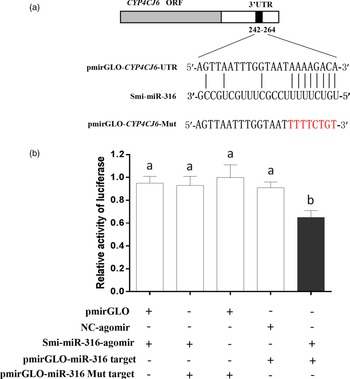
With 3 software programs, miRanda (Betel et al., Reference Betel, Wilson, Gabow, Marks and Sander2008) and RNAhybrid (Rehmsmeier et al., Reference Rehmsmeier, Steffen, Hochsmann and Giegerich2004), and TargetScan (Enright et al., Reference Enright, John, Gaul, Tuschl, Sander and Marks2003) a binding site of miR-316 was predicted in the 3′ UTR of CYP4CJ6 (fig. 5A). To determine whether miR-316 could regulate the expression of CYP4CJ6, the 3′ UTRs of CYP4CJ6 carrying the binding site of miR-316 were cloned into a pmirGLO vector to obtain the pmirGLO-miR-316-Target. Under cotransfection of the pmirGLO-miR-316-target with miR-316 agomir, the luciferase activities were significantly lower than those of the negative agomir control. However, cotransfection of the target mutated plasmid (pmirGLO-CYP4CJ6-Mut) with the miR-316 agomir did not significantly reduce the relative luciferase activity (fig. 5B).
Regulation of CYP4CJ6 by miR-316 by dual luciferase reporter assay. (A) The binding sites of miR-316 predicted by software in the 3′ UTRs of CYP4CJ6. (B) Luciferase reporter assays performed by cotransfection of the miR-316 agomir with a luciferase reporter gene linked to the 3′ UTR of CYP4CJ6. The mathematical symbols ‘+’ and ‘−’ are used to indicate that a component was added or not added. The bars represented by different letters indicate significant differences based on ANOVA followed by Tukey's HSD multiple comparison test (P < 0.05).

To validate whether the expression of CYP4CJ6 is regulated by miR-316 in vivo, S. miscanthi were fed an artificial diet containing agomir or antagomir of miR-316 for 24 h. Subsequently, the expression levels of CYP4CJ6 were examined via qRT-PCR. Compared to that in the control group, the expression of CYP4CJ6 in the group fed miR-316 agomir decreased by 42.7% (fig. 6A), while the expression of CYP4CJ6 increased by 48.2% in the group fed miR-316 antagomir (fig. 6B).
Relative expression of CYP4CJ6 regulated by miR-316 in vitro. The results are presented as the mean ± SD of three biological independent replicates. (A) The effects of the miR-316 agomir on CYP4CJ6 expression; (B) The effects of the miR-316 antagomir on CYP4CJ6 expression. The bars represented by different letters (a, b) indicate significant differences between the treatments and the controls (Student's t-test, P < 0.05).

Discussion
Imidacloprid and thiamethoxam are neonicotinoid insecticides that can act on insect nicotinic acetylcholine receptors (nAChRs) and have many advantages, such as high efficiency, long duration, broad spectrum, low toxicity to mammals and high control efficacy in planthoppers and aphids (Buckingham et al., Reference Buckingham, Lapied, Corronc and Sattelle1997; Roat et al., Reference Roat, Santos-Pinto, Miotelo, de Souza, Palma and Malaspina2020). In addition, it has been also reported that lethal toxicity of imidacloprid and thiamethoxam was observed in Anagrus nilaparvatae, Trichogramma cacoeciae, Gonatocerus ashmeadi (Hymenoptera: Mymanidae), Apis mellifera (Hymenoptera: Apidae) and so on (Schuld and Schmuck, Reference Schuld and Schmuck2000; Byrne and Toscano, Reference Byrne and Toscano2007; Wang et al., Reference Wang, Yang, Su, Shen, Gao and Zhu2008; Yang et al., Reference Yang, Chang, Wu and Chen2012; Tavares et al., Reference Tavares, Roat, Carvalho, Silva-Zacarin and Malaspina2015). However, the resistance of insects to neonicotinoids is becoming increasingly serious due to the frequency and scope of the application of neonicotinoid insecticides (Liu et al., Reference Liu, Han, Wang, Zhang, Zhang and Liu2003; Chen et al., Reference Chen, Ebert, Pelz-Stelinski and Stelinski2020).
The substantially increased expression of P450 genes plays a partial role in insecticide resistance (Li et al., Reference Li, Schuler and Berenbaum2007; Puinean et al., Reference Puinean, Foster, Oliphant, Denholm, Field, Millar, Williamson and Bass2010; Schuler, Reference Schuler2011, Reference Schuler2012; Liu et al., Reference Liu, Li, Gong, Liu and Li2015; Zhang et al., Reference Zhang, Su, Xie, Zhen, Hu, Jiang, Huang, Liu, Gao, Chen and Gao2020). In Diaphorina citri (Homoptera: Psyllidae), increased expression of CYP303A1, CYP4C62, and CYP6BD5 participated in the detoxification of imidacloprid (Tian et al., Reference Tian, Li, Wang, Liu and Zeng2019). Insecticide resistance can result from the interactions between insecticides and inducible regulatory mechanisms (Goff et al., Reference Goff, Hilliou, Siegfried, Boundy, Wajnberg, Sofer, Audant, ffrench-Constant and Feyereisen2006; Zhang et al., Reference Zhang, Kong, Cui and Zeng2016a, Reference Zhang, Kong, Wang, Gao, Zeng and Shi2016b). Furthermore, another common characteristic of P450s is inducibility, which has been proven in insects (Harrison et al., Reference Harrison, Zangerl, Schuler and Berenbaum2001; Hu et al., Reference Hu, Lin, Chen, Li, Yin and Feng2014; Zhang et al., Reference Zhang, Ma, Liu, Lu, Chen, Zhang and Gao2019). In the present study, we also found that expression of CYP4CJ6 can be significantly enhanced by imidacloprid or thiamethoxam treatments compared to the controls, suggesting that CYP4CJ6 could be involved in the response of S. miscanthi to these two insecticides.
The overexpression of the P450 gene is the key factor in insecticide resistance in insects (Li et al., Reference Li, Schuler and Berenbaum2007; Puinean et al., Reference Puinean, Foster, Oliphant, Denholm, Field, Millar, Williamson and Bass2010; Liu et al., Reference Liu, Li, Gong, Liu and Li2015). To further confirm that CYP4CJ6 acts on imidacloprid resistance, the expression of CYP4CJ6 was investigated in imidacloprid-resistant and imidacloprid-susceptible strains (apterous aphids). Our qPCR data indicated that CYP4CJ6 was significantly overexpressed in the imidacloprid-resistant strain, and the expression of CYP4CJ6 could be induced significantly by both imidacloprid and thiamethoxam. Similarly, the overexpression of 11 P450 genes was found in a laboratory-selected imidacloprid-resistant strain of CWA and was induced significantly by imidacloprid (Zhang et al., Reference Zhang, Su, Xie, Zhen, Hu, Jiang, Huang, Liu, Gao, Chen and Gao2020). Further RNAi experiments by feeding assays indicated that silencing the expression of CYP4CJ6 could significantly increase the susceptibility to imidacloprid and thiamethoxam in the resistant aphids of CWA; the RNAi method in aphids has also been studied in other reports (Peng et al., Reference Peng, Pan, Gao, Xi, Zhang, Ma, Wu, Zhang and Shang2016; Ma et al., Reference Ma, Li, Tang, Liang, Liu, Zhang and Gao2019a, Reference Ma, Tang, Zhang, Liang, Wang and Gao2019b; Zhang et al., Reference Zhang, Su, Xie, Zhen, Hu, Jiang, Huang, Liu, Gao, Chen and Gao2020, Reference Zhang, Hu, Lu, Hu, Li, Su, Dong, Zhen, Liu, Kong, Shi and Chen2021). So, CYP4CJ6 in CWA could be significantly induced by imidacloprid and thiamethoxam, and the overexpression of CYP4CJ6 in the imidacloprid-resistant strain played a crucial role in the resistance of imidacloprid and thiamethoxam in our current study. The regulation of P450 genes involves transcriptional and posttranscriptional regulation mechanisms, such as regulation by insecticide DNA methylation and posttranscriptional suppression by miRNAs (Tamasi et al., Reference Tamasi, Monostory, Prough and Falus2011). However, previous studies have tended to explore the transcriptional mechanism of P450 genes, while few have simultaneously clarified their findings at the posttranscriptional level.
To further explore the molecular genetic mechanism of CYP4CJ6, upregulated expression of CYP4CJ6 by miR-316 was investigated at the posttranscriptional level. miRNAs, as small noncoding RNAs, can act on the expression of target genes at the posttranscriptional level (Pritchard et al., Reference Pritchard, Cheng and Tewari2012; Asgari, Reference Asgari2013). It has been reported that miRNAs are involved in the regulation of P450 gene expression. The expression of CYP1A1 in humans was observed to be suppressed by miR-892a (Choi et al., Reference Choi, An, Lee, Kim, Choi, Kim, Jang, An and Bae2012). In Aphis gossypii, CYP4CJ1 could be regulated by miR-4133-3p (Ma et al., Reference Ma, Li, Tang, Liang, Liu, Zhang and Gao2019a, Reference Ma, Tang, Zhang, Liang, Wang and Gao2019b). Moreover, in C. pipiens, miRNAs could participate in insecticide resistance by regulating the gene expression of P450 (Hong et al., Reference Hong, Guo, Wang, Hu, Fang, Lv, Yu, Zou, Lei, Ma, Ma, Zhou, Sun, Zhang, Shen and Zhu2014; Lei et al., Reference Lei, Lv, Wang, Guo, Zou, Hu, Fang, Tian, Liu, Liu, Ma, Ma, Zhou, Zhang, Sun, Shen and Zhu2015).
Similarly, in our previous study on the differential expression of miRNAs under imidacloprid exposure for 24 h of Sitobion miscanthi, we found that 77 miRNAs were significantly differentially expressed under imidacloprid exposure based on high-throughput sequencing of short RNA libraries, suggesting that differentially expressed miRNAs (including miR-316) may participate in the resistance mechanism of S. miscanthi to insecticides (Zhang et al., Reference Zhang, Hu, Lu, Hu, Li, Su, Dong, Zhen, Liu, Kong, Shi and Chen2021). At the same time, the expression of CYP4CJ6 could be regulated by miR-316 acting on the 3′ UTRs by feeding miR-316 antagomir/agomir in vitro and dual luciferase reporter assay methods. These observations indicated that miR-316 could play a role in the resistance of CWA by regulating the expression of CYP4CJ6 to insecticides. A similar report showed that one cytochrome P450 and two glutathione S-transferase genes could be recognized by mse-miR-316 in Manduca sexta (Zhang et al., Reference Zhang, Zheng, Cao, Ren, Yu and Jiang2015). There were other reports that regulation of the Wnt pathway by miR-316 is involved in caste differentiation within social insect groups (Shi et al., Reference Shi, Zheng, Pan, Wang and Zeng2015). Furthermore, miR-316 was also identified from winged and wingless morphs of S. avenae, and dietary uptake of miR-316 agomirs and antagomirs led to significantly higher mortality.
In conclusion, CYP4CJ6 overexpression was related to imidacloprid resistance, as confirmed by RNAi feeding experiments. Enhancement of CYP4CJ6 expression was observed when the aphids were exposed to different insecticides, suggesting the hypothesis that it could be involved in the metabolism of the insecticides. Furthermore, CYP4CJ6 was verified to be regulated posttranscriptionally by miR-316.
Financial support
This work is supported by the Key Science and Technology Program of Henan (Agriculture) (212102110441), the Key Scientific Projects of Institutions of Henan (21A210008), the Project of Plant Protection Key Discipline of Henan Province (1070202190011005), and the Graduate Education Innovation Training Base Project of Henan Province in 2021 (107020221005).
Author contributions
X. C. and B. Z. conceived and designed the experiments. L. L., and G. H. performed the experiments. L. L., W. D, Y. L., and B. Z. analyzed the data and wrote the manuscript. X. S., and G. H. participated in the data analysis. All authors reviewed the manuscript.
Conflict of interest
The authors declare that they have no competing interests.